This week 700 asylum seekers drowned when their boat capsized somewhere in the Mediterranean sea; reports suggest that a large number of these poor souls were locked in the hold of the ship and had no chance of escape. A year ago the people on this ship might have been found rescued earlier by the European Union’s large, integrated emergency response program Mare Nostrum, but unfortunately it was defunded and replaced with a much weaker local Italian response under the explicit rhetoric of “deterrent,” pioneered so effectively by Australia. Countries with significant anti-immigrant political parties and communities, most notably the UK and Germany, refused to fund the continuation of a coordinated Mediterranean-wide rescue program on the basis that rescuing asylum seekers at sea encourages people smugglers to simply send more, and the best way to save lives is to refuse to help, so that the people smugglers’ business collapses when their customers realize the risks.
The events of the last week – 400 drowned last week, 700 this week, and it’s only Monday – show how effective that tactic has been. So does the record so far this year, with 30 times the deaths recorded in the equivalent period last year under Mare Nostrum. Record numbers are crossing the Mediterranean, fleeing persecution in Libya and chaos in Syria and Iraq. These people appear not to have got the Home Office memo, and apparently think that any risk is better than staying where they are. The ideology of “pull factors,” based on the assumption that these asylum seekers aren’t really that desperate and are just looking for the best country to settle rather than a place of safety, has been shown to be completely wrong.
Last year, before the end of Mare Nostrum, I wrote that Europe has been presenting evidence against the Australian ideology of reducing “pull” factors. Since I wrote that blog post Mare Nostrum has ended and the flow of refugees has exploded. Either there is no relationship between the border control policies in place at sea, or the defenders of this ideology – if they are being honest – will have to accept that the evidence shows that the only “pull” factor at work here is going in the opposite direction of their claims, and that rescuing asylum seekers at sea is a more effective deterrent than letting them drown. Of course they won’t accept such a conclusion, and will continue to argue that we “encourage” these desperate people by saving them, when all the evidence now shows that their plight is so desperate that they don’t care about our search and rescue plans, they just want to get out. But our political masters don’t care about these people, and indeed why should they when popular columnists refer to them as vermin and cockroaches? So instead mealy-mouthed politicians in Europe try to maintain their ideology of deterrence through callousness, and maintain that they will end the flow of refugees by targeting the people smugglers – rhetoric they have used for years to no effect, probably because they aren’t even bothering to do that. And how can they affect migration policy in North Africa? Libya is a chaotic mess that the last Italians fled from months ago, leaving the people of Libya and especially its most vulnerable stateless displaced to their bloody fate. How do you target people smuggling when you don’t even have an embassy? Europe is powerless to affect events on the ground in Syria, and refugee flows through that part of the world are now so huge that it would be impossible to identify the people smugglers, let alone stop them.
Japan is another example of the emptiness of “pull factor” rhetoric. Even though Japan has only approved a handful of asylum applications in the last decade, numbers of people claiming asylum have increased ten-fold over that time. How can it be that a country which offers zero chance of resettlement is seeing unprecedented application numbers, if asylum policy at the destination is a major determinant of asylum seekers’ choices?
Abandoning people to drown is cheap and politically easy in modern Europe, but it will not deter these people, because they are desperate. It’s time for Europe to recognize that its neighbourhood has gone to hell, and Europe won’t be able to keep ignoring this problem forever, or pretending that it can stand by and let people drown out of simple callousness. If Europe is not willing to invest the time, money and lives in stabilizing Syria and Libya, then it needs to recognize that it has at least a moral responsibility to save the lives of the desperate and stateless when they put to sea. Maybe then Australian politicians will also rethink their cruel and vicious policies towards the stateless. This problem is not going to end anytime soon, but if we keep lurching towards the moral event horizon, our humanity will …
The journey to the swarm was uneventful, though after a day at sea they entered squalls of acidic rain that hurt their eyes and tasted foul. On the second day they reached a point close enough to the swarm to see it and understand its magnitude – it stretched across the whole sea before them like a fog bank, fading into hazy obscurity to left and right and giving off a vile stench. Dilver had been right, they could not penetrate the haze above the swarm, and deeper into the swarm this haze stretched high into the sky. A vile, warm breeze rolled off the thing whenever the wind changed, as if it were exhaling charnel breath, and from their vantage point they could see a pilot whale decaying in the hazy edges of the swarm.
They dove, heading down to the submarine’s safe depth of 40m and making fast progress to the swarm. As they passed under it their sonar screen lit up, and looking at it they felt as if they had begun sailing under a cloud of some kind. The submarine slowed down to more closely measure the swarm, and the tension mounted. In the front of the sub Ryan had begun donning his scuba gear, but everyone could not help but notice his nervousness and unusual reluctance to prepare for a dive. Everyone thought the same thing: they were floating under a cloud of death, with no clue about what to do when they got to its centre, and their whole fate resting on an 18 year old boy and his sea lion, who would be swimming up to scout at the edge of that noxious web of death.
After perhaps an hour of careful movement Leviathan noticed something new on his sonar screen: a huge object lying beneath the water, so big that its edges extended beyond the submarine’s weak sonar range, and hanging perhaps 60m or more below the surface. The submarine could go beneath it, but this was obviously what they were looking for. It was time for Ryan to dive…
Under the miasma
Ryan entered the chamber at the bow of the submarine where Arashi waited, and when he was sure that he was ready the chamber flooded, Arashi taking his dive breath on command. The lights went out, the front doors of the submarine opened, and Arashi dragged Ryan out into a cathedral of neon. With the sun hidden behind clouds and sinking and the sea covered in a thick carpet of jellyfish, the ocean at 40m depth was almost black, and Ryan and Arashi found themselves hanging in a twilit limnal zone, looking down at rapidly fading grey light, and up at the carpet of jellyfish. Jellyfish, of course, are phosphorescent, and the ocean surface was crowded with countless blinking lights, a neon constellation stretching as far as Ryan could see in every direction. For a moment Ryan forgot his work and hung in the twilit depths, gazing up at this pelagic universe in fascination. Blues, reds, greens, all flickered above him, so rich and varied that he felt as if he was looking up at a new sky.
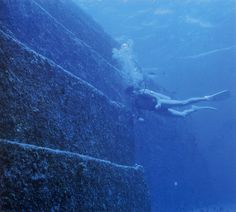
A deadly sky, of course. Ryan remembered his task and set off to explore the sonar shadow. As he approached the shape he turned on his torch, and found himself staring at a mysterious object from another world. A huge stepped structure hung in the water in front of him, stretching from the surface to perhaps 30 metres below where Arashi and Ryan floated, staring in awe. It was some kind of huge stepped structure, incomprehensible in design to innocent Ryan but obviously a relic of the pre-flood era. It stretched beyond his torchlight in both directions laterally, and from the way the waves slapped against it at the surface he guess it rose above the surface of the water. It sloped away from him as it rose, and he and Arashi could glide along its barnacle-encrusted surface upward towards the neon-flickering swarm, noticing how it was carved in step shapes, each layer of the steps slightly recessed from the one before. It seemed to Ryan that a century ago when the world flooded, a nation of toiling slaves must have built some kind of pyramid and set it afloat on the high seas. How could that be?
At the steps of the temple
After a few minutes drifting across the subsea structure, Ryan decided he needed to check what was happening above the water. How big was this thing? Where did it go? He had noticed that near the face of the structure the swarm was so deep that only the biggest jellyfish, and the dying jellyfish, gathered. The jellyfish here were the size of small boats, with thick rope-like tentacles that would probably be powerful enough to entangle him if they touched him, but these jellyfish were far enough apart that he thought he and Arashi could find a way through. Ignoring the tension in his belly he drove Arashi up towards the surface, picking a spot where two huge jellyfish lay dead and rotting to make space for himself. As he approached, Ryan noticed an amazing thing: all the jellyfish were pulsing with movement, but all their movements were in the same direction. The jellyfish themselves were not laid out in any regular order, but their movements were all in one direction: towards the Hulks.
He managed to pass between jellyfish relatively easy but as he pushed for the surface he began to feel strange: tingly and vague. He noticed that Arashi became listless and then began to twitch, losing forward momentum. Something was affecting them in the zone where the jellyfish swam, but he couldn’t guess what. It was too late to go back now and he needed a view, so he drove his mount forward, and although Arashi was barely responsive he managed to break the surface after a few more moments’ struggle. They floated there for the moment Ryan needed, Arashi chan hanging limp in the water and Ryan fighting a strange feeling of nausea and confusion. Above the water the miasma stretched out into misty obscurity, but immediately in front of Ryan the strange pyramid rose up into the distant fog, silent and most importantly free of human interlopers. Ryan pushed Arashi down and they dived, Arashi now swimming on the dimmest of reflexes, his body twitching and jerking as if poisoned. They passed back through the zone of dead jellyfish and almost immediately Arashi recovered, looking back at Ryan and releasing a thin stream of panicked bubbles. With time running out and Arashi agitated and confused, Ryan directed them back to the submarine. They reached it in time, the doors to the chamber closed without incident, and after what seemed like an eternity Ryan and Arashi chan were back into air and light. Ryan staggered through the doors of the exit chamber and began stripping off his wetsuit, shaking and clamorous with reaction. Behind him Crimson tossed fish to a listless and uncaring sea lion, returned temporarily to its feral self. For good measure, he closed the doors to the exit chamber, because no one wants one ton of panicked beast rampaging through their one room submersible, and they sat down to hear Ryan’s story.
Voltaire’s Temple
Ryan of course knows nothing of the ancient world; he is barely a man, and he has never been educated in anything except diving and how to communicate with dumb beasts. He has never learned about the ancient world, so he doesn’t know about the strange stepped temple he saw. But Dean has studied the ancient world, and identifies it immediately from the description as a Ziggurat. As the world flooded, communities desperately tried to build floating structures that were cheap and reliable. Some people gathered together fallen trees and old boats and bound them together; others used purpose-built structures such as the Arc; but as time began to press, innovative design became impossible. Instead, people needed to find ways to build floating structures rapidly, cheaply and en masse from existing systems. One of the most popular methods was to adapt plastic modular dock systems to build huge structures that were guaranteed to be buoyant. These plastic dock systems were designed to float and to lock together; it was just natural that they should be converted into huge immobile structures that would float when the ocean reached them. By loading the bottom-most layers of these plastic blocks with concrete or water, or building them around steel super-structures, huge floating structures could be mass produced, laid out on land and prepared. When the flood reached them they would rise gently with the water, and people could float safely on the ocean. Most of these structures were build with an outer pyramid structure surrounding an inner bowl, in which people lived and food was grown. The bottom-most blocks were built to be heavier than water, and buoyancy carefully balanced so that a large portion of the structure would be underwater. A 100m-high structure might have 40m above water, with the inner area close to sea level but protected from the ocean by 40m of plastic wall. The whole structure would float, and being made of 1000s of blocks built in many layers it was highly unlikely to ever sink. The huge underwater structure provided strong substrate on which to build an ocean environment, and the whole thing was so large as to be proof against even the strongest of storms. Unfortunately these structures had one major problem: they were too large and too cumbersome to move, and eventually they would encounter a current that was heading either north or south, and drift into polar regions where all their occupants would die.
This Ziggurat had clearly not drifted into polar regions, but had instead found itself caught in a swarm, and in a current heading into the gyre. But how had it come out of that current? Leviathan provided the answer to this question[1]. Ryan’s strange feelings, and Arashi’s strange behavior, when they were surfacing must have been caused by some kind of electrical field in the water. This field must be the reason for the strange, coordinated behavior of the jellyfish. By sending an electric field through the water someone must be controlling the direction of movement of all the jellyfish in the miasma, and the field of jellyfish was so large that the ziggurat moved with it. Someone inside the ziggurat was driving it, and to do so they must be in control of a very powerful source of energy. Everyone immediately settled on the same single possible explanation: nuclear power. Captain Dilver had told them to find out what was driving the swarm and destroy it or bring it back if it was useful: here they had a relic from the start of the flood, an almost indestructible floating monument that would make an invaluable addition to the Gyre; and inside it a functioning nuclear power plant. All they had to do was take it.
Galvanized by this decision, they set course for the ziggurat. The submarine would not be impeded by jellyfish in surfacing at the edge of the temple, since only the largest of the swarm floated here and the submarine’s vents would not be clogged when they were venting water, only drawing it in. They could surface, but they might not be able to submerge again. As they rose Leviathan turned off all the submarine’s electronic systems and its batteries, setting the vents to full open and surging to the surface in a barely-controlled rush. They swept up the sloping sides of the ziggurat and splashed to the surface just a short distance from the ziggurat, drifting to a rough stop against its plastic sides. After a moment’s debate they gave the Ocean Whisperer a cell phone and told her to stay put, strapped on filter masks, and emerged from the conning tower hatch.
The ziggurat was as deserted on this side as Ryan had described. The air was still and calm, thick with the haze of the miasma, and the only sound was the gentle wash of waves against its sides. The plastic face of the ziggurat was devoid of life, and stretched above them into the mist, silent and dead. In the short distance they could see there was no evidence that anyone had ever used this monolith, but they knew someone must be here. They jumped from the submarine to the ziggurat’s steps, carefully avoiding the foul water, and gathered themselves at the base of the steps. A decision was quickly taken, and Dean stole carefully up the steps towards the top of the ziggurat, to see if he could find any sign of life. Moving stealthily from step to step, he ascended perhaps 100 metres before he reached the ziggurat’s crown. Here the air was clearer and he could see perhaps 500 metres in either direction, which gave him a full view of the whole top of the ziggurat. The ziggurat was roughly rectangular, perhaps 1km long and half a kilometre wide, with a bowl cut into its centre that was perhaps 400m long and 200m wide. From the rampart where Dean lay carefully watching the steps cut steeply down into this bowl, which lay perhaps 40m below the ramparts – about 60m above the water surface. The ramparts stretched around this bowl in a perfect rectangle 10m wide. At the furthest, narrower ends of the rectangle the ramparts were surmounted by a single watchtower, rising perhaps another 30m above the ramparts. On the far side of the bowl from Dean a huge crane rose into the sky, built into the superstructure of the ziggurat itself. This rusting monolith must have been used to load the original ziggurat with its current contents: on the floor of the bowl several sections of aircraft fuselage had been placed, and were obviously being used as accomodation. Opposite them, at one end of the bowl near one of the watchtowers, was a small cooling stack and the obvious structure of some kind of modular nuclear power plant, steam rising gently from its tower and into the soupy air. The rest of the bowl was covered in soil, on which grew scraggly grass and a few stunted, weak-looking lemon trees. A large section had been set aside for farming, and here amidst ragged cabbages, tomato vines and strawberry bushes Dean could see a single person working, weeding and tilling. The only other signs of life were distant figures in each of the watchtowers; otherwise the whole thing was silent and empty. But judging from the aircraft fuselage and the scale of the farm, there could not be many people here – perhaps 20 or 30.
Dean slunk back down to the group, and together they moved up to his position on the rampart, stopping just below the rim. They could take this place, if they moved quietly and quickly. They made a rough plan, and prepared to take their greatest conquest …
[This report has been split into parts for brevity. The final part will describe the somewhat chaotic and confused battle for control of the ziggurat].
—
fn1: this situation gave a great example of the benefit of skill checks. Leviathan is a ship’s captain and engineer, the kind of person who should understand such things. Crimson’s player is an engineer, the kind of player who knows about such things. When I described Arashi’s condition Crimson’s player immediately realized an electric field was being used to control the jellyfish. But Crimson would never understand such a thing, and Leviathan – the PC that actually should know this stuff – was being played by someone with no engineering knowledge. So I required a simple engineering skillcheck by Leviathan to intuit what Crimson’s player had guessed. Understanding this information was not crucial to the adventure, but not getting it would lead to problems with the submarine when it surfaced. It’s unfair to penalize a group because the player who understands the history of electrical impulses is playing an idiot.
—
Photo credit! The photo of the Steller sea lion was taken by Emerald diving company at Neah bay.
This is the second adventure in the Flood series. It is half a year since the near-catastrophe with the old man on the raft community, and our heroes have been split up, working in different parts of the Hulks on security jobs. They were surprised then to receive a text message from Captain Dilver in the middle of the night:
[received 2:04 AM. Sender: Captain Dilver. Marked: Emergency] Go to the Flats immediately and bring in the woman called the Ocean Whisperer for questioning over distribution of fake medicines. Gather with your team at the Octopus Seller on the Flats’ leeward side, a short distance from the Whisperer. Be discreet and bring her without trouble. If anyone sees you tell them the reason but keep everyone calm. Bring her to me at Pier 17 and DO NOT keep me waiting. D.
They responded immediately of course, and were soon gathered together under the dim sodium light at the corner of the Octopus Seller’s shop. There were five, but they were not familiar with each other from previous adventures[1]:
Ryan the rider, whose sea lion mount saved the party repeatedly when they were on the rafts in their last adventure
Crimson the old soldier, whose tenacious unwillingness to die stood between the party and complete extermination in their last adventure
Dean, a middle-aged archer and scout with a penchant for heavy weapons
Leviathan, the new captain of the submarine that the characters captured in the last adventure
Thorne, an unhinged young martial artist with an invisible “friend” of very dubious morality
After brief introductions and confirmations, they headed to the Ocean Whisperer’s address. Here they found a flat, open raft, perhaps once a river barge, with the skeletal structure of what might be a simple pavilion over one end, and a small home made out of the cabin of an old boat at the other. Above the door of the cabin was a painted logo of an octopus, and three cats sat patiently outside the door. The sea this night was calm but active, with perhaps 2m waves out on the open sea; here within the border of the Hulks there was perhaps 10-20m of plastic, tires, old chains and wood beneath the water, and the sea was rendered sluggish by this debris, so that the barge only rocked a little with the swell; occasional splashes of water rolled over the edge of the barge, but it was the kind of still, grimly dark night that often rolls over the Hulks at the end of spring. This evening the sky was obscured in a thick veil of cloud, and the Hulks lay in complete darkness outside the occasional glow of solar-powered lamps, four of which illuminated the decks of the Ocean Whisperer’s barge, and their approach. The cats meowed, but scattered when Leviathan shattered the stillness with a loud hammering on the door and a yell of “Open up bitch, it’s the wind guardians!” Discreet, indeed … After a moment and a few more bangs the door opened, revealing an old woman, perhaps in her 60s, wearing a semi-transparent night gown and looking blearily out at them, long grey and brown hair tied back in an austere ponytail. “Yes?” she asked in trepidation when she saw their wind guard armour and uniforms. They soon had her out of the house, and dragged her off to Pier 17 without further trouble.
Pier 17 is located in one of the Hulks’ two inner docks, docks set within a broader sweep of the structure of the Hulks and intended to be partially protected from storms. Pier 17 is one of the least secluded, facing open water in the middle of the dock area. On this night the open sea was hidden in darkness, but the pier itself was lit with brilliant white light from two large portable spotlights, that shone onto a focused point in the middle of the pier. Behind this stood Captain Dilver, wearing a strange and old-fashioned uniform that looked about 20 years old and had only the single wave insignia of a corporal on its shoulder and chest. To one side on the far side of one lamp stood two ranks of five storm guards, also in completely outdated and strange uniforms; between them lay a coil of plastic cable, with plastic cuffs attached every metre or so. As the PCs approached this scene, Thorne and Dean both realized what it meant, though they understood for very different reasons: Dilver was recreating the scene from 20 years ago when he threw rebel children overboard, and laughed as their shackled parents tried to save them, and drowned. This was the atrocity that made Dilver famous, and gained him his power in the wave guards. The Ocean Whisperer obviously knew this scene very well, for as soon as she saw it she shrieked and tried to run away. Leviathan and Thorne grabbed her though, and dragged her forward to stand in the lights. With barely a nod of recognition to them, Dilver stepped forward and addressed her.
Dilver: A pleasure to see you again Agnes, do you remember me?
Agnes: Yes …
Dilver [gesturing behind him]: I think you remember what all this means. How could either of us forget? Just a little reminder of what I am willing to do for the safety of our little world.
Agnes: …
Dilver: Now, Agnes, I have a simple question for you, a very easy one for you to answer. Try to be honest with me this time, yes? Tell me: can you really speak with the giant beasts of the deep? Do they really whisper to you in your dreams, or is it all a fraud?
Agnes [after a brief pause to think]: It’s all a lie, Dilver. They don’t speak to me, it’s just a story I tell to make ends meet.
Dilver [stepping back to give a slow golf clap]: Well, Agnes, I’m happy to hear that. Now I’m going to make you a very simple offer, that I know you won’t want to refuse. You go back to your cabin and sleep off this little interruption, then in the morning you convene a special meeting of your silly little church, and you tell them that it was all a fraud. You tell them that there is no way anyone can speak to the beasts of the deep, that they’re just dumb animals and we are just tiny, frail people clinging to life on the surface of a great dark ocean. You tell them your church is over, because there is nothing anyone can do to control the beasts of the deep and anyone who tells them otherwise is a liar. Then you go into your cabin and wait. In the afternoon some wind guards will be around to arrest you for dealing fake medicines, and you’ll never need to worry about seeing the disappointment on your congregations’ faces. [Pauses] If you don’t do this, I’ll murder you and lock you in your cabin with your cats, and I’ll make sure you aren’t discovered until your cats have eaten a good part of your corpse. Then I’ll drown them. Is that clear?
Agnes [eyes only widening a little bit]: Okay Dilver, okay. Please just don’t hurt anyone.
Dilver [snapping fingers at two of the guards, who drag Agnes away]: I will hurt everyone I need to, Agnes. Don’t ever forget that.
With that Agnes faded into the darkness, her pale face frozen in disgust as she was dragged away. Moments later Dilver gestured to the group peremptorily, leading them around a pile of crates to pier 18, where the slim and deadly shape of his favourite gunship the Gunfather loomed over them in the first shadows of dawn. They boarded and walked silently down gantries and corridors to the captain’s cabin, a bare room with a single bench a set of screens, and a narrow bed. Dilver himself poured them seaweed tea, and handing it around to them said
“I don’t believe any of that stuff. But you hear stories about what’s out their in the ocean, and it’s my job to rule out every possible threat, no matter how unlikely. Because we have an unlikely problem, gentlemen, and it is a once-in-a-lifetime threat that calls for all our efforts.” He stabbed his finger at a point on one of the screens and the darkened room lit up with the pale blue of an ocean map, a jagged red slash carved into it to show the path of some interloper approaching the Hulks.
“A miasma is coming, gentlemen. We have to stop it. But it is not drifting with the current. A fishing boat found it a few days ago and tracked it, sending us warning of its movements, but then the boat disappeared. We sent a drone, but that too disappeared. The problem is that the miasma is not moving with the currents. It has departed the stream of the current and is moving purposefully for us. It will be here in a week. We need to find out what is making it move, and destroy it. That is your job. You are to take the submarine, head to the miasma, and find out what is driving it. Then you are to destroy that thing, or bring it back if it is useful. The submarine has been configured to hold the rider’s beast – what’s its name, Ryan? – so you will be able to investigate with your own eyes under the miasma. This miasma is huge, so big that we cannot see into its centre, and I dare not risk something as valuable as a seaplane until I know more, so I am sending you instead. Questions?”
Leviathan said tentatively, “We should take the Ocean Whisperer with us sir. If she knows nothing it’s no trouble, but if she does know something we can use her. Like you say, it’s best to cover all bases.”
Dilver agreed to this. He also told them more about the mission: two days to get to the miasma in the submarine, the first to be accompanied by a battery ship to keep the sub charged. They would be given a special GPS beacon which, when activated, would act as a homing beacon for missiles and artillery, so that they could call down a huge storm of artillery on themselves. Ryan was to be given a set of scuba gear and a special watertight diving suit that would protect him for a short time from jellyfish stings. Arashi, Ryan’s sea lion, was already largely immune to stings due to his thick watertight fur, and could likely survive for a short time in even a thick cloud of the things. Because the submarine had no windows or external cameras and lacked manoeuvrability, Ryan and Arashi would be key to finding out what was driving the swarm.
They took their leave and headed to the submarine, which was waiting at pier 16, rocking gently in the swell. Arashi lay lazily on its bow, and let out a happy “whoof!” when he saw Ryan – the exact same “whoof!” that Crimson remembered with a shudder from the dark waters where Arashi slew the pirates who owned this very submarine. Agnes was brought to them, cuffed, and they set off for the swarm.
[Note: I have split this report into parts due to length. You can get a lot done in a few hours with Cyberpunk rules! The next part, Voltaire’s Temple, will be uploaded in a few days]
—
fn1: This time I had my full complement of normal players bar one, so three new PCs had to be made: Dean, Leviathan and Thorne.
I ran into more problems trying to run OpenBUGS on a Bayesian spatial regression model today. The problems are laid out pretty simply in the picture above: I ran into an illegal memory write. I know this is not the fault of my model, as it runs smoothly for 50, 500 or 1000 iterations. This illegal memory write happens somewhere between 6000 and 6100 iterations.
This model is a simple version of a larger model I’m building. It has data on about 1800 small areas collected over four time points, with age and sex covariates, with a Poisson distribution for the outcome and an adjacency matrix for the 1800 areas. The data are laid out with the time points and age- and sex-values as separate records, so for one municipality I have 4*6*2=24 observations. I can’t use other packages for this because they assume one observation per municipality (i.e a very simple relationship between data structure and adjacency matrix). So I’m using OpenBUGS or WinBUGS. The ultimate goal is to extend to 30 time points and 18 age categories, with a more complex time and age structure, but I want to get this simple model running first because I’m running into major computational issues.
Today I identified that these computational issues can’t be solved. The reason for the illegal memory write is that OpenBUGS has a 1.6Gb RAM limit. People say this but it’s hard to confirm; however, in digging through critiques of BUGS I discovered it is written in Component Pascal and compiled in BlackBox, and a bit more digging reveals BlackBox has a 1.6Gb RAM limit.
This is frankly ridiculous. It’s understandable that there would be a RAM limit in a 32-bit system, but OpenBUGS has been around for about 9 years now and no one has upgraded it to handle either multi-core computers or 64 bit architecture. Given that OpenBUGS is designed to handle complex, processor-demanding simulation-heavy Bayesian models, the decision to write it in such a restrictive framework is ridiculous. I’m a strong critic of open source systems but if it had been written for R it would at least be able to use the 64-bit architecture, even though R has been late to the multi-core party. I bought a PC with 128 Gb of RAM specifically for this big project, and I might as well have bought a laptop with the minimum RAM. For the model I ultimately aim to build I expect I will need about 100,000 iterations to get stability, which means that OpenBUGS will never get there. The only way to run this model without a workaround is to either 1) write the full adjacency matrix by hand and implement it directly [something I am considering] or 2) recompile the source code (which I think might not be available) in a different Pascal compiler. I have no idea how to even start with that.
I have considered two workarounds, however, though I don’t know whether either of them might work.
Save and rerun: the reason that OpenBUGS hits its RAM limit is that it saves all iterations in RAM, but I think this is possibly bad design. So one option could be to run the model to 5000 iterations, then save the results, shut down OpenBUGS, reopen OpenBUGS, load the model file, and then use the update functions to run another 5000 iterations on what has already been run. I think this can be done (running additional updates on a past model) but I’m not sure. If this works I just need to run one set of runs a night for about 3 weeks, and I’ll get my model.
Rerun with sequential initial values: If method 1 doesn’t work, another option that I am very sure will work is to run the model for 5000 iterations, extract all estimated values from the model, then start a new model of 5000 runs with the past estimated values as the initial values for the next model. I’m pretty sure it will start off where it left off, assuming I correctly specify them all, although there might be small jumps in the trace, but ultimately it’ll get where it needs to go. But restarting the model is going to take a lot of time unless I can find a way to loop through and extract values automatically (I think I can’t). So probably a month to run the model.
Ridiculous! And even if I had a supercomputer I couldn’t speed it up …
Today Stata 14 was released, and it finally has built in functionality for a wide range of Bayesian statistical tasks. I’m hoping that they’ll introduce conditional autoregression and the BYM model in version 15. Really, if you have a grant that can afford a single Stata license, it’s really worth getting. You just can’t rely on open source statistical packages. Only use them when you must!
Today I’m trying to do some simple prediction in R. I have a simple linear model with a single missing data point, and I need to get the predicted values and standard errors for 14 data points including this one missing point. Because I find R’s data handling in linear prediction really hard to use, I decided to use a brutal, simple loop approach to get the job done. And in doing so I have uncovered a really weird piece of behavior.
My linear model predicts a proportion as a function of year, with year valued from 0 to 13 and 2 missing. My outputs are a matrix with the year and the predicted value (con.pred) and a matrix with the year and standard error (con.se). My input is the data (dataValues) and the resulting model (con.lm). So my model runs like this:
con.lm<-lm(y~year,data=dataValues)
for (j in 1:14){
year<-j-1
temp.pred<-predict(con.lm,newdata=year,se.fit=TRUE)
con.pred[j,2]<-temp.pred$fit
con.se[j,2]<-temp.pred$se
}
Now the weird thing here is that this breaks down and delivers the following error:
Error in eval(predvars, data, env) : not that many frames on the stack
However, it didn’t stop working immediately. The first 5 elements of the output con.pred have values – the process failed at j=6. Even weirder, when I ran it two hours ago it failed at j=10. However, it works fine if I make this tiny change:
for (j in 1:14){
year<-j-1
temp.pred<-predict(con.lm,newdata=data.frame(year),se.fit=TRUE)
con.pred[j,2]<-temp.pred$fit
con.se[j,2]<-temp.pred$se
}
How can it be that the prediction process works for the value year=5, but doesn’t work when year=6? But it works for all values if I redefine the scalar year to be a data frame? Does this mean that R treats scalars with a value below 6 as data frames, but not above 6?
Also, if I type the following commands directly into the command line I get different predicted values:
However, the latter command doesn’t produce any warnings and does not do the default prediction (which would return 69 fitted values; it returns one value, that appears to correspond with a value of year of about 9. Furthermore, while the first of these two commands works, this command does not, and brings up the same not enough frames error:
So I have confirmed in the command line that the commands I have given in script break at some value of year>1.
I don’t know what’s going on here, but it’s completely counter-intuitive. The only error returned is also completely meaningless. R really needs to improve its linear prediction and data handling, because there is something deeply wrong with the way it handles input data.
This week I stumbled upon another one of many articles in the Guardian complaining about fat-shaming, which is apparently something society does unsuccessfully to try and force everyone to be skinny. In an interesting parallel, this week Rabbett Run has an article digging through the role of Big Tobacco in funding libertarians to talk up smoker-shaming. This “assault on smokers” is a common complaint of the Clarksons and Telegraph-letter-writers of the world: sure, smoking is bad for your health but the anti-tobacco movement has “gone too far” and now it shames and ostracizes smokers and treats them like second-class citizens (in the words of Rabbett Run’s libertarian scholar, they are parallel to the treatment of Jews in Germany!)
An interesting similarity of language exists between the anti-fat shamers and the anti- anti smokers. There is a lot of public debate about how to handle obesity, and a lot of it is denialism of varying forms:
Straight-up denialism, such as this book from one of the Lawyers, Guns and Money bloggers, which claims obesity is not harmful for health, the scientific research is wrong and there is nothing to fear. This crosses the political spectrum, but is usually also associated with suspicions about the diet and weight-loss industry and/or an ideology of personal health choices
Politically-motivated rejectionism, often feminist, which associates obesity concerns with body-normative biases and society’s obsession with controlling women’s appearance. An example of this is Fat is a Feminist Issue by Susie Orbach, which associates campaigns against overweight with historical attempts to control women’s appearance. These campaigners may deny the role of obesity in poor health (such as the Healthy at Every Size movement) or they may accept the increased risks and fall back on a logic of personal choice, but in either case these rejectionists are politically-motivated: their first concern is the ideological impact of scientific research on and public health campaigns against overweight, and this motivates their stance
Adaptationists, who think that it is too late to reverse trends to obesity, and/or that they are built into our society now, and so we are better off learning to adapt to these trends than try to undo them. In the medical field this manifests in a belief that we should find pharmaceutical solutions to the health challenges of obesity, rather than behavioral campaigns. This stream of thought is also common amongst anti-fat shamers and the Healthy at Every Size movement
First world shamers, who believe it is shameful of rich westerners to worry about eating too much when so many people in the world are starving. These deniers want us to accept that fatness is a sign of a stable and functioning society and something the world should (implicitly, usually) aspire to – similar to how some AGW denialists think that burning fossil fuels is an inevitable and necessary part of economic growth and something we should encourage the world to do, rather than trying to find alternative development paths. These first world shamers also usually ignore the fact that overweight and obesity is a heavily class-biased phenomenon in rich countries, and increasingly a problem of the poor only
Free choicers, who think that we should all be able to take any health risks we want if they don’t affect others, and who see obesity purely as a personal decision (i.e. fat people eat too much). Some of the adaptationists also take this view of fat as an entirely personal decision, and sadly so do a lot of public health policy-makers who want to fix the problem. Seeing obesity as a consequence of personal behavior inevitably means that public efforts to reduce prevalence of overweight will be seen as intrusive and restrictive of civil liberties, and enables these free-choicers to reframe the debate in terms of personal choices and freedom rather than the structural and social changes that are actually needed to reduce overweight. This argument is more potent when deployed in the obesity debate because it is much easier to claim that obesity doesn’t harm others
Skinny-shamers, the kind of hippy punchers of the anti-fat shaming movement, who see thinness as disgusting or at least present themselves in opposition to it. This fat and proud movement is distinctly political, though not necessarily associated with any party, and it is embedded in a broader cultural movement in the anglosphere towards rejecting any form of attention to appearance at all. This movement sometimes has an influence on the fashion world, especially in its attempts to redefine very thin and small models as wrong – it sometimes engages in its own form of shaming, attacking the skinny and small as wrong or ill
Anorexia bait-and-switchers, perhaps a subset of the fat-proud and feminist denialists, who associate campaigns against overweight with anorexia, and suggest that body-normative ideas drive young women to anorexia. In fact anorexia is a serious mental health problem not caused by social pressure or women’s magazines, and this link is spurious but it has a strong hold in popular culture, and is a powerful rhetorical device. Note that it also often relies on its own form of body-shaming, treating anorexic bodies as disgusting and accepting that they are deeply unhealthy, and often the spectrum of this body-shaming extends to women who are not unhealthy, just thin
Many of these types of obesity denialism seem to be similar in ideological composition to anti-vaccination or anti-AGW thinking. In AGW denial circles it’s common to read conspiracy theories about how the whole scare has been made up to transfer money and power to a clique; how it is cheaper and more effective to adapt than prevent; how attempts to mitigate AGW will lead to (and/or be driven by) restrictions on personal freedom. AGW denialists also often see AGW mitigation in terms of direct attacks on their personal choices rather than structural and cultural changes, for example in which they will lose individual direct choice over light bulbs and car makes, rather than seeing it in terms of industrial and community-level decisions such as changes in power generation or land use practices that no one individual can control. Arguments based on intervention in personal decision-making rather than group practices are much more amenable to conspiracy theories and assignment of nasty political motivations, and the obesity denial movement does have a fair share of such thinking.
In reality the battle against overweight and obesity cannot be won with individual changes: overweight and obesity arises only partially from personal choices, and a lot of it is driven by structural and social factors that individuals cannot change. You can’t make a decision to walk to work if your work is far away and there is no public transport; you can’t make a decision to eat healthily if there are no decent sources of fresh fruit and vegetables near your house, or if almost all the food you buy is poorly labelled and full of sugar. It’s also much much harder to stay thin if your job involves sitting for 8 hours a day, and personal decisions to do something personal to offset a structural factor are much harder to make than personal decisions that go along with that structural factor. Furthermore, cultural practices are insidious and hard to change: ideas about wasting food that come from a poorer time, types of food and eating practices are not easy to change by the time one is an adult steeped in a certain food culture. But because public health policy-makers cannot change broad structural factors outside of their discipline, like public transport and town planning, they have to focus on the things they can touch: personal behavior. This is easily construed as preaching or trying to restrict freedoms.
Of course fat shaming does happen in our societies but it’s not driven by health concerns: it’s another manifestation of a long-lasting and deeply-entrenched sexism in our society. It’s also a reflection of the fact that traditionally aesthetic values were of great importance, and people who deviated from certain aesthetic norms have been shamed for that. Compared to the way people with tattoos or men with long hair used to be treated, for example, fat shaming is nothing: no one obese ever got refused entry to Disneyland for being fat, for example. Public health campaigns do not, generally, utilize fat shaming as part of their repertoire, and the association of fat shaming with public health concerns about obesity is another example of denialism at work – and a very effective way to dampen the debate about what to do about this growing problem.
And make no mistake, it is a big problem. The continuing growth of overweight and obesity is going to have huge costs for health systems, and people who are proud to be fat now are not going to be so pleased with their personal health decisions when the musculoskeletal and cardiovascular problems start to bite in later life (when reversing the process is hardest). With the decline of smoking in the developed world, obesity is becoming the next big risk factor that will bring a wave of disease with it. Worse still, in many low- and middle-income countries overweight and obesity rates are also skyrocketing, but these countries have fragile health systems with weak financing that are not ready to manage a huge growth of chronic illness. This is a global problem, and denying it will delay the necessary steps to resolve it, leaving many countries facing an unexpected cost and health problems they aren’t prepared to deal with. Sound familiar?
I don’t think that obesity denialism is a product of Big Tobacco or Big Sugar, as was the anti-anti smoking lobby or AGW denialism. It also lacks a dimension of harm that the anti-vaccination movement carries with it (since fat kids can’t accidentally infect and kill other fat kids the way unvaccinated children can). But it has similarities with both, in terms of its scientific ignorance, the rhetorical tactics it deploys, and its blithe ignorance – or even celebration – of the problems it causes. The linked Guardian article is suggesting a need to add fat-shaming to the list of discriminatory activities that should be outlawed in Britain, which makes me think of the inclusion of “political” objections to vaccination in vaccination laws. Perhaps it’s time to start treating obesity denialism a little more seriously, before it gets a serious grip on our legislative and public health processes, making it harder for our societies to move out of a path that is ultimately not going to be good for us …
[Warning: Australian politics] I read in the newspapers yesterday that Clive Palmer, mining magnate and funder of the Palmer United Party, is going to sue two former party members for campaign financing he provided to help them get elected. Given how mercurial and weird Palmer is, the news is probably already out of date and he has changed his mind already, and I certainly hope so, because this is a legal case that absolutely should not happen. He is going to try and get back $9 million he spent on getting the two members, Glenn Lazarus and Jackie Lambie, elected on the basis that since he paid for them to get into parliament in his party, they should have stayed in his party.
I know nothing about the law but I am going to make a prediction for this court case on the basis of my understanding of Australian culture and the history of the courts in Australia: this case is guaranteed to fail. Almost no court or jury will find in his favour given the obvious chilling implications for democracy, and the defendants will be able to appeal any loss right up to the High Court. There is absolutely zero chance, in my opinion, that the High Court will find in Palmer’s favour. Even the most conservative imaginable possible array of High Court judges will throw it out in a heartbeat – or rather, in the length of time it takes them to write a dismissive and compelling judgment that will make Clive Palmer very very embarrassed.
At least it would embarrass him if he had any shame, but in case the infamous twerking video didn’t convince you this court case should be the final proof that Palmer has no shame. That he would even conceive of such a case shows how out of touch he is with Australian civic values, how little respect he has for the political process, and how he really views his party – not as a vehicle for political change but as a personal possession (to be clear, I never doubted this – but smarter tycoons might at least try to pretend it weren’t true!) Imagine if the Liberals or Labor could sue a party member every time they jumped ship or split to recover election costs – the effect on party discipline would be very impressive, but the effect on political debate would be terrible. But worse still, imagine if donors could demand repayment of their money if a member jumped ship? And if a donor can demand repayment of election expenses when a member leaves the party, can they not also demand repayment if their legislative goals are not achieved? Currently big corporate and organizational donors give money to a political party on the assumption that it will represent their interests, but not on the assumption that they can get specific legislative goals (though they often do, of course, get these). But if Palmer were to win this case they could conceivably write more specific contracts for their donations, backed up by the implied threat of civil action if they don’t get what they want. I think legal argument is the one place where slippery slope arguments make sense, since a decision sets a precedent for subsequent decisions; in this case, Palmer’s legal efforts could open the door to at least the kind of implied threats that could seriously damage political independence. And some of those donors are big givers – the unions give the ALP millions, and some corporate donations to the Liberals are in the hundreds of thousands. Everyone knows that these donors will withdraw their money in future if the party doesn’t represent them; but the possibility that they could sue for past money would surely terrify the two major parties and make them much, much more careful about toeing the donors’ line.
Plus of course donors wouldn’t have to sue over a specific lost legislative goal – they just wait for a process event (such as a member leaving or being found guilty of a crime of some kind) and sue out of spite. The mere threat to sue in such a case could convince a party to change a policy. It would be disastrous.
These considerations are why I think the High Court would take the case and then decide in favour of the defendants. Whatever one might think of the individual politics of High Court members, none of them are stupid and they are very careful and considerate custodians of the constitution. They just won’t let this happen!
I wonder if it is time Australia considered a law preventing the kind of direct ownership of parties that Palmer has used here. The party is clearly a vehicle for his own personal interests, and given that he is a mining magnate with some big business problems the conflict of interest is obvious. Fortunately for the Australian public he is too stupid to get anything right, but if some Lex Luthor type figure were to come along with the same plan it could be very dangerous. I’m not sure how it could be done in a fair and balanced way, but perhaps consideration needs to be given to a law that prevents individuals from directly setting up a party with their own money. If Palmer wants to influence the political process he should do it the same way every other corporate body does – by networking with politicians, donating money to their party without conditions, and making their case for change through long, careful deliberation through existing social organizations. Buying your own party is crass, and destructive to the political process. I hope the Australian legislature can find a way to stop it in future.
—
Footnote for non-Australians: Clive Palmer is a mining magnate and “billionaire” who essentially set up his own political party at the last federal election, poured his own money[1] into it and managed to get 6 senators elected. The party is called the “Palmer United Party” but the “United” part is pretty much a footnote of history now since all members bar one have left. Unfortunately these 6 senators basically controlled the balance of power in the senate, which has descended into chaos since the party became disunited[2]. Palmer is sunk in legal problems with business partners and also may be suffering some business challenges (now is not a good time to be an iron ore exporter in Australia) and many people think this party was his attempt to protect his business interests from some bad decisions, and/or to try and force changes through that would benefit his company. For example he refused to pass laws repealing the carbon “tax” until the government agreed to refund money paid since its inception, which would have been a multi-million dollar windfall for his business. It’s hard to see what his real motives were because he is so chaotic and weird, but certainly his party has not been a good thing for Australian legislative processes.
fn1: Well, a Chinese mining company claims it was their money, but that’s currently being negotiated in the courts
fn2: Kind of. It was chaotic before the disunity because Palmer doesn’t know what he wants and changes his mind by the day.
[Warning: Australian politics] Last weekend there was a State election in Australia, with popular Liberal (for overseas readers: “conservative”) premier Mike Baird up against apparently well-liked Labour (for overseas readers: “liberal”) opposition leader Luke Foley. In the context of a deeply detested federal Liberal government, and a recent crushing defeat for the Liberals in Queensland, this election was being carefully watched for warning signs of the imminent demise of the federal Liberal leader, Tony Abbott. Unfortunately for people who like to draw simple conclusions, and by extension the federal labour party, the swing against the federal Liberal party was small (about 2%) but the swing to the Labour party huge (about 9%). It wasn’t enough for Labour to win government but enough to restore them as a political force (they had previously been wiped out in the state due to rampant corruption and general nastiness[1]).
But for those of us who care about the environment and the future of modern, peaceful, developed human society there was an interesting side story, initially ignored by the media. The Greens, Australia’s environmental party, increased their seats in the lower house by 3-4, depending on the result of late counting, and also their vote share. They increased their vote share in the seat they previously held and stole at least two new seats – at least one from the Nationals, a slowly dying party of rural socialism. But in addition to this, they became the second biggest vote winner in a range of seats – most of which are staunchly conservative voters.
What’s going on here?
There is a lot of debate about this coming out in the national media, and most of it is evidence of high panic. The Telegraph (not to be confused with the British high tory newspaper of the same name – the Aussie New South Wales version is toilet paper) has two articles complaining that inner city Greens voters are too rich to care about environmental issues, and rural Greens voters are a bunch of lazy drug users. The latter story gives a detailed run-down of the economics of the electorate that has voted for a Green candidate, suggesting that the Green has been voted in because the electorate is full of unemployed drug users, but doesn’t really pay any attention to the fact that the electorate has been under the control of the Nationals since 1988. Surely if an electorate has been under the control of one party for nearly 30 years, the unemployment and drug use problems of that electorate are the fault of the 30 year party, not the newly-elected one? Perhaps the election of a new candidate is a sign that the locals don’t want this to continue? Perhaps they want change?
Meanwhile there is new evidence that the Greens have replaced Labour as the party of protest in a range of wealthy suburban seats in the north of Sydney. So now we have a situation where National Party seats are being stolen by Greens in rural Australia, and wealthy Liberal voters are switching to the Greens in preference to Labour. This has led the Australian newspaper (owned by American espionage expert Rupert Murdoch) to refer to the Greens as a “cancer on democracy” (as, obviously, any party that wins at the ballot box must be) and is surely leading to a new round of panic in the offices of Labour and the Liberal party.
What’s going on here?
On the surface it looks like Australians are starting to wake up to the environmental problems Australia faces. The new seats appear to have been won on the back of protests against coal seam gas, which is a sign of classic anti-AGW activism with the power to change seats. However, the increase in votes in wealthy areas might possibly be attributable to NIMBYism (“not in my backyard” politics), and this is certainly the line defenders of wealthy privilege are taking – but it could also be because people in those seats are starting to realize that the Liberals as they are currently composed are a threat to humanity.
Traditionally Australian media outlets have avoided talking about Green successes and trumped apparent Green set-backs, and argued that Greens in power would fail. But the federal Green politician is going well electorally, and now the Greens have significantly increased their state representation. This is a sign that people in Australia are starting to realize that the environment is their key concern, and also that the existing “mainstream” political parties do not serve to improve the wealth of the regions. Of course the Liberals could easily combat this by fielding a candidate for prime minister who recognizes the pre-eminence of global warming and understands the genuinely liberal value of local areas controlling local environmental decisions. I don’t necessarily agree with this idea, but it is naturally liberal and it is not happening because the current Liberal party at both federal and state level is essentially a legislative vehicle for developers. If the Liberals want to fix their electoral challenges and become a genuinely liberal party they need to do two simple things: ditch Tony Abbott, and find a way to destroy the influence of developers on state political parties.
Do that, and the Liberals will hold power for a generation.
—
fn1: And would have been wiped out much sooner, except that the religious right wing of the federal party carefully organized a hit job on the moderately liberal state leader and replaced him with a far right christian; during this vicious hit job the party leader attempted to commit suicide, and the current federal Liberal leader joked about his suicide attempt the same day.
Indiana, USA[1] has just passed a law that discriminates against ordinary arseholes, and especially confirmed atheist arseholes. This law would make discrimination okay so long as the discriminator [hereafter referred to as “the arsehole”] is religious, and clearly sets up three categories of people with different sets of rights: nice people who want everyone to get along, religious arseholes and non-religious arseholes. Into the latter category we can add arseholes who are religious but whose arseholery is clearly not religiously-based, which is a distinction I’m sure the current Supreme Court can have a lot of hours of fun with.
As a confirmed, unrelenting but unfortunately atheist arsehole, I will be boycotting Indiana from now on. I was planning to visit later this year, rent a massive gas guzzling car with sealskin hubcaps and drive around throwing money to passing orphans while snorting cocaine off the naked bodies of zero-size barely legal models, but I refuse to throw away my arsehole currency in a state that classifies me as a second-class citizen. I will instead visit a state that allows all arseholes to be equally arseholey[2].
I mean, what is the point of this law except to redefine arseholes into two categories? It can’t possibly be the case that the LGBT couple who are refused service will be all peachy about it just because the refuser is wearing a funny hat, or believes in some funny beardy dude; I accept that intent is important in framing law (see e.g. manslaughter vs. murder) but usually it is limited to classifying degrees of severity, not allowing some people to break the law with impunity. Sure, if the law defined degrees of discrimination it might make sense (and a whole new season of Law and Order would be born) but to just define away criminality for certain classes of arsehole? Isn’t that … discriminatory?
This Vox article tells me that 20 states in the USA have these laws in place, and suggests to me that arsehole freedom is the next great civil rights movement in America (we could call ourselves the moonies). It also makes me wonder if there are any adults left in America, because it suggests that most of these laws have been passed to protect “religious minorities” and gives an example of Amish trying to protect themselves from a law that requires them to hang a glowing light on their buggies. They had to go to court to get protection against that law? Couldn’t everyone just discuss the law and come up with a compromise? Apparently not in America. And did the Amish really think they were so special that they were willing to go to special legal lengths to ensure that they didn’t have the same road safety responsibilities as everyone else? And why should they?
The same applies to vaccination exemption laws. If you believe in some beardy dude who says that women are second-rate citizens, gay people should be shot (I’m looking at you, Californian arseholes!) and pi is 3.0, you get to endanger other peoples’ kids by refusing a medically safe and proven technology. But if your intention is simply to endanger other peoples’ kids because you’re a misanthropic arsehole who is too smart to believe the blather of a 2000 year old book that was written before people understood how to be nice to each other then too bad! You gotta be nice or face a fine.
Why this extreme double standard against arseholes?
America needs a movement of arseholes, willing to throw off their shackles and rise up against discrimination, before it becomes impossible to be intelligent and mean in any state of the union! Rise up, arseholes of America, and reclaim your right to be mean to people you don’t like for no other reason, without having to dishonestly cloak it in superstitious blather! Truly, liberation of pure arseholes is the movement 21st Century America needs, and truly 21st Century America is ready for it!
—
fn1: What is it with Americans thinking they don’t need to specify which country their states are in?
Next weekend I will be running another short adventure in my Flood campaign world, and the adventure trigger will be the arrival near the Hulks of one of the drowned earth’s most potent environmental threats: the Miasma.
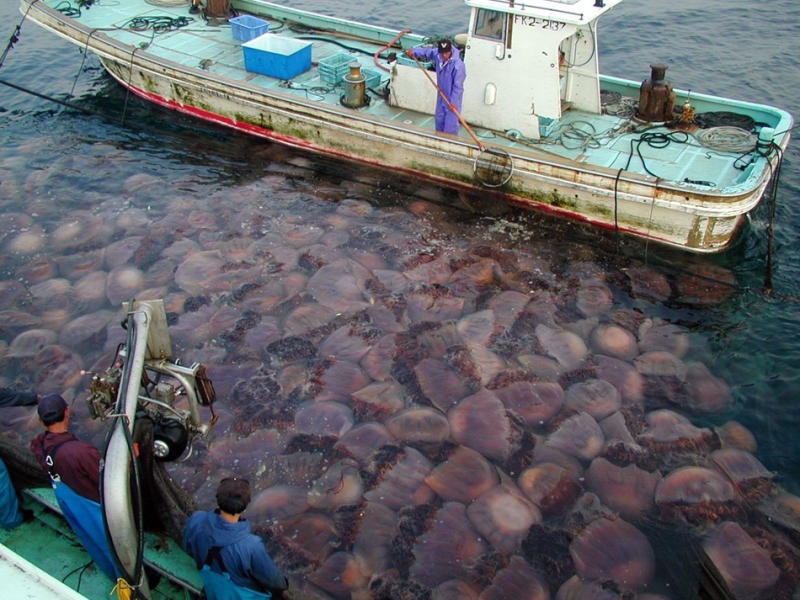
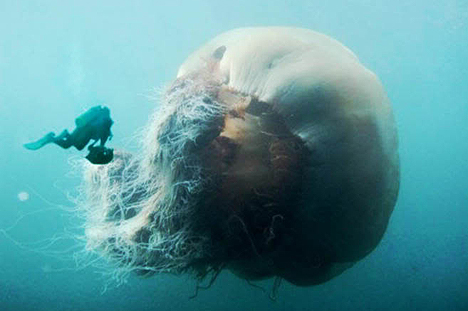
The Miasma is a special type of jellyfish swarm that can only exist in the depopulated aquatic deserts of the world ocean. With almost all land sunk thousands of metres below the surface of the ocean there are very few areas where fish can spawn and thrive, and huge expanses of the earth’s surface are too far from these spawning areas for larger fish to be able to survive in them. These areas, too far from fish populations to support any biodiversity larger than plankton, have become a strange and top-heavy ecosystem. Aside from occasional large predators migrating through, these empty wilds have become the domain of the grazers: whales, basking sharks and jellyfish that thrive on the plankton in surface waters. But the most efficient and terrifying of these open ocean grazers are the jellyfish, which sometimes by happenstance gather together into huge swarms, sometimes tens of kilometres across, that dominate the open ocean wherever they drift, and leave a terrible path of destruction behind them, like enormous army ants of the open seas.
The survivors of human civilization live in terror of these jellyfish swarms, which they call miasma. These swarms, though composed primarily of plankton-eating drifters, are also usually heavily infested with giant, slow-moving grazers and a large number of deadly predatory jellyfish. They consume everything in the ocean around them, and are an existential threat to the fishing grounds that most human communities zealously nurture. They also transform the atmosphere and sea around the swarm, turning the ocean into a kind of limpid swamp that offends the sensibilities of drifting raft communities, and is deeply toxic.
Most raft communities float on oceans more than 1000 m deep, and are as vulnerable to the currents as a jellyfish swarm. To maintain a reliable ocean food supply, the rafters carefully and systematically build up local ecosystems, which in turn feed a network of wild distant ecosystems. In areas like the Gyre, where a relatively large number of human communities live in close proximity, this produces a wider network of ecosystems that spread beyond the immediate vicinity of the rafts and support wildlife somewhat akin to the offshore ecosystems of the old world. But these systems are fragile, and require careful stewarding by the rafters. Every human community that floats on the waves has some system of undersea support for local fish life, that may be as simple as a series of sub-surface floating breeding beds made of old tires, or a complex architecture of reed beds and corals under the hulls and keels of the rafts. In the Gyre, where human communities are structurally large and complex, there are a host of shallow underwater structures that are thriving with sea life that once would have only existed at the shoreline: lobsters in nooks and crannies of the rafts, oysters growing on the old submarine superstructure that gives the larger rafts stability, and small fish breeding amongst every chain link, tyre underside, and submerged rope knot in the entire archipelago of floating human life. There is even a small community of sea lions on the Hulks. Every underwater structure is covered in sea weeds, and kelp grows downward and outward from the edges of the rafts. Further out, larger fish prey on the smaller fish, moving nomadically between communities and eating the larger fish that live further out from the human settlements. The residents of the Hulks put a lot of time into the care of these undersea communities, enforcing strict waste disposal rules and carefully tending weedbeds and corals to ensure that the ecosystem is balanced and thriving.
A miasma can end 100 years of this careful management and stewarding in a few days of insensate gorging. When the miasma overwhelms a human community it will consume everything that floats free in the water. All plankton and feeder fish will be sucked up by the filter feeders, and the larger fish will be found and killed by the predatory jellies. Sea mammals in the open water when the miasma hits will be entangled and drowned, or slowly paralyzed by the accumulation of stingers. The water the miasma carries with it is devoid of oxygen and highly acidic, and if the miasma is moving too slowly on the currents the effect of this tide of pollution will be to destroy all corals and weeds in the raft and its vicinity. Lobsters, crabs, prawns and octopuses that might be untouched by predatory jellies will suffocate in the miasma, and once the swarm has passed all that remains will be dead and rotting sea life. Sometimes the miasma does not pass, and the weight of its central parts will drag the raft community with it, leading to starvation and death for all those onboard. If the rafters do not realize the danger, escape may be impossible: small sailing ships do not have the power to escape the weight of jellyfish in the water, and most smaller powered vessels will have their rudders and rotors entangled, stalling them in the water. Once trapped in the sea of deadly stingers, there is no way to swim out. There are many stories of miasmas that are haunted with the ghosts of lost rafts and ships, and many people claim that they are more dangerous for a small raft community than the ocean’s storms.
There is no herding these slow beasts
The miasma carries its own meteorological phenomena, that in large part are the reason for its name. On the edge of the swarm freely moving predatory jellyfish hunt anything that moves, but in the body of the swarm are primarily filter-feeding drifters, some of them larger than a small boat. Near the centre of this gelid mass the sea becomes so thick with packed-together jellyfish that it is almost solid, and devoid of any other life. When the jellyfish here become too densely packed or when the swarm becomes too large, they die and rot, creating a fetid and stinking swamp of rot. The largest swarms becalm the sea around them, changing its texture so that waves are dampened and currents stop; there in the middle of this becalmed and dense swamp-like realm, the sun beats down and the sea heats up, giving off a stinking and rotten cloud of steam and heat haze that obscures the surface of the water. Most swarms above a certain size carry with them a thick, swamp-like haze that is impenetrable on all but the stormiest of days. Rumour has it that the largest swarms break up under their own meteorological effects: the heat from the centre creates storm cells that scatter the swarm and cast it about into smaller swarmlets. Usually one can smell the swarm before one sees it, because tendrils of this rot drift ahead on the currents. If one is lucky the swarm will be large enough and dense enough that the rafts can be moved out of the currents, or some kind of defenses prepared. But for the larger swarms, or for rafts adrift on a strong current, there is no defense: only prayer.
The miasma leaves problems long after its passing. In addition to destroying all marine life attached to the rafts, it will leave polyps on every surface, and every part of the underside of the rafts needs to be scoured clean to ensure that the raft does not, a year later, become the centre of its own swarm. Jellyfish will also destroy nets and befoul important undersea structures, their weight breaking precious ropes and chains, blocking inlets for power and water desalinators, and poisoning the water as they die and rot. Delicate floating solar panels will be damaged or lost, and the acidic water may do irreparable damage to the oldest and most fragile parts of a long-lived raft community. Small boats may be carried away under the pressure of the swarm, or their propellors and other underwater components entangled and ruined. The raft will also find itself floating in an open sea devoid of life, and any community that is used to catching fish in the immediate vicinity of its decks will need to find a way to venture further afield for food until the ecosystem rights itself – if ever it does. Most likely, though, the local ecosystem will be destroyed, and the rafters will need to make a call on other human communities they know to obtain new stocks of coral, shellfish and weed to regrow their precious ecosystem. Usually such help comes with a high price, that many communities cannot pay: they will then break up, and individual rafts will be forced to brave the open ocean as they seek new fishing grounds or functioning communities to join.
The larger communities are the most vulnerable, because they cannot move. These communities have found ways to ride out the miasma, or even to divert it, but their efforts almost always come with a great cost, in equipment and often lives. Where once jellyfish were annoying pests at the beach, they have now become the greatest terror of the open ocean, and for a community like the Hulks the onset of a major miasma is a threat that most of its residents will only ever see once in their lifetimes – if they survive it …




 Compromise and Conceit