• Some technology endures ...
    Some technology endures …

    Our heroes have learnt many things about the forces they have fallen afoul of, and are beginning to understand that they have fallen in amongst a web of intrigues that is wide and ancient. The supine priest has awoken, and they found themselves lost against the Shoal of Dreams, an ancient object from his religious history that could not have been built by a primitive race. They visited their Oracle and learnt more about the ancient and sinister history of the AI and the death priest, and thanks to their work at the Tombspine they know that the ancient AI they are carrying, the Starred One, was driven mad attempting to penetrate anti-AI defenses to steal the ansible, which they now have in their possession.

    They know now that the ansible is a means of faster-than-light communication, which is why it was buried in a tomb protected from intrusion by AI. Once AI have possession of an ansible they can communicate faster than light. Were an AI to reverse-engineer this technology and build it into a computer system, that AI would be able to spread across the universe, maintaining constant contact with all of its fragments, and forming a single, mighty AI that would be immune to any form of interference or destruction. In the hands of an AI, the ansible offers new dimensions of power. If the AI could find a biological system into which to implant themselves, in combination with this ansible technology, they would be close to being able to achieve transsubstantiation, and entirely escape their dependence on computer systems or physical structures to maintain their consciousness.

    This is why several AI factions were pursuing both the ansible and the crystals it requires to power it. The characters had their suspicions about the reasons the AI were also looking for the bodies of Red Cloud of the Coming Storm and the witch he had been hunting; these suspicions were confirmed during the jump from the Shoal of Dreams to Reek.

    Silicon life

    During this jump, the Left Hand of Darkness alerted Captain Ahmose to a new problem: Red Cloud was sick. He was complaining of weakness and diarrhea, and was having increasing difficulty finding any strength to stand or even pray. ‘Darkness wanted to subject him to a full medical examination, combining all the limited data obtained from his cryopod with full tests. Given he was from a remnant planet it was highly likely he was susceptible to diseases that the rest of the crew were carrying but immune to, and this carried huge risks for him. Red Cloud had been spending a lot of time with ‘Darkness, as she was running language education programs to teach him Galactic Standard, but he still had huge difficulty accepting that the “Spirit in the wall” was not an evil entity, and she needed the human crew to assist her in the tests.

    Ahmose agreed, and over several hours they coaxed Red Cloud into having the tests. He had begun to accept the crew now, and could speak to Alva and Lam and Simon Simon without referring to them as “pale worms”, though he still angered easily and in his fury would threaten them with torture and being rendered into magical ingredients. He grudgingly accepted the medical intervention, which required him to be poked and prodded and scanned and have his blood taken and be subjected to various indignities for three hours. At the end of it, exhausted and humiliated, he yelled weakly at everyone and struggled back to bed.

    A few hours later they gathered in the Captain’s ready room near the bridge, to discuss the findings.

    The Left Hand of Darkness was adamant about the results of the tests. Red Cloud was an alien life form, based on silicon rather than carbon. As a result he was immune to all human diseases, but also could not eat carbon-based food. He needed silicon-based substances to function. This was also why he drank so little water, and why his people were able to live on a planet with almost no water – they just needed much less of it. Red Cloud’s different biology was not a big problem for ‘Darkness: She could easily use the fabricators on board to produce silicon-based food, though they would need to take on extra silicon at the next port. With Ahmose’s permission, the ship began experimenting with silicon-based foods.

    The characters were struck by the bigger implications of this finding though. If Red Cloud was a silicon-based life form, and transubstantiation requires a biological basis for the sentience that transsubstantiates, then AI would be very eager to get hold of his living body. This would also explain why the Confederacy had hidden a Lake class ship in orbit around the planet to strengthen the blockade – they wanted nothing to leave or enter that planet that could reveal the truth about its alien nature. To the best of the characters’ knowledge there was no confirmed sentient alien species in the Confederacy’s borders, all having been exterminated during the collapse, or having mysteriously disappeared aeons ago. No doubt the Confederacy wanted to keep the existence of this species secret until they knew what to do about it.

    And yet here they had one on their ship, adapting poorly, getting sick, and being chased by powerful factions that wanted to experiment on him for their own sinister purposes.

    Dreams and nightmares on Reek

    By the time they arrived at Reek ‘Darkness had developed a palatable form of silicon-based food and Red Cloud was largely recovered from his troubles, returning with ease to his normal annoying, imperious and arrogant self. Reek is a small, temperate planet with a thin, tainted atmosphere and a tiny population of just 270 people, living in a few small communities at very low tech level. These people are a mixture of settlers, pilgrims and hunters, with a few researchers in official Confederate-sanctioned research centres. Reek has a single continent that stretches around the planet in a complex ribbon, with many small seas in the curves of the ribbon, all toxic to humanity and relatively empty of life. The planet is of research interest because what life does thrive in these small seas has evolved separately over a very long period of geological stability, and offers insights into the evolutionary process. The planet is also of interest to the Confederate navy because its apex predator, the Giger, is a semi-sentient psionic ambush predator of ferocious powers. This creature can grow to the size of a small bus, and uses its psionic powers to camouflage itself and stun its prey, which includes any humans foolish enough to walk the planet unprotected. The creature’s only known predator is itself – sexless, it breeds by mentally attacking another member of its own species, destroying its mind and embedding an embryo in the still-living victim. This embryo is believed to grow by feeding off both the living body and the psionic residues of the creature’s mind as it recovers from the attack, slowly reducing the sentience of the host until it goes mad with pain and anger. This rage causes the embryo to burst forth from its host and activate its own psionic powers, fleeing from the scene before the adult can recover sufficiently to kill it. The majority of births kill the host, but some do survive and recover, and it appears that those who do survive often have a residual psionic healing power. All these predators appear to be approximately clones of their parent, though there appears to be some form of mutation or change in the implantation process, as clones are not perfect copies – possibly due to the high intensity of cosmic rays penetrating the thin atmosphere. While the predators themselves are largely clones of near generations, psionic typing studies suggest that children develop a psionic and sentient signature that varies from their parent and is likely influenced by the mental anguish of the host. Research on the implications of this birth process for psionic powers is ongoing, and challenging.

    Hunting these creatures for sport is sanctioned by the Confederacy, and licenses are available for those who can make a good application and are willing to wait the time required to preserve the population. The PCs’ intention was not to hunt, but to find a safe place on a physical world to activate the ansible, but they wanted to make sure they were ready to jump out of the system as soon as the ansible was activated, so they had a week to wait. They spent some of this time on the planet, exploring areas declared free of Gigers. They also visited a park with a single captive Giger, where they were able to witness its reflexive use of psionic powers for camouflage – standing on opposite sides of the beast, they each saw it in different colours and patterns to match the different backgrounds it stood against relative to each of them. The beast crept around its enclosure, patterns shifting subtly to match the viewpoint of everyone in the group, until it settled into the shade of a tree and dozed off, its predatory dreams leaving them all mildly unsettled. The thing reeked of threat and fear, and they argued with each other and took spiteful and petty digs at each other for hours after the visit.

    Still, it did not destroy their minds, and seven days after they arrived in Reek they were ready to activate the ansible. They found a secluded park that was guaranteed free of monsters and put the crystal into the slot. It took just a moment for the ansible to activate, and they found themselves staring at a grey screen with a few dots on it, and a big box with some text in the middle. On the bottom right was an icon of some kind, and on the bottom left another icon; they couldn’t touch anything until they chose one of the three options in the central box. Everything was written in a script they could not read, mysterious and impenetrable. They tried hitting a few random buttons but they couldn’t get anything meaningful to happen. They were about to remove the chip and give up when a box appeared in the middle of the screen, displaying characters in Galactic Standard. It said,

    WHO ARE YOU?

    Lam touched the message and a dialogue box appeared; when she touched that, a keyboard of some kind appeared, covered in unfamiliar characters. She tapped a bunch until eventually she found the execute button, and the message disappeared. About a minute later, another legible message appeared on the screen. It said,

    GIVE ME THE ANSIBLE OR I WILL DESTROY YOU

    It was soon followed by a third message:

    I KNOW WHERE YOU ARE

    They panicked and pulled out the crystal.

    It was then that Ahmose remembered that Michael, the Ocean priest on board the Left Hand of Darkness, could translate any language with his strange powers. They sent a message to ‘Darkness, and asked her to bring him to the surface. A few hours later, they could read the screen and operate the ansible. The dots on the screen were stars, and the message had come from the specific star with the red circle around it – another ansible. They knew where it was, and it knew where they were.

    It was then that Ahmose found the ansible’s message history. It had preserved the last few years of messages it had sent or received, messages from some ancient civilization 47,000 years ago. The early messages showed that the ansible was not a pocket technology – there were no personal messages or trivial exchanges, only short messages sending information of key importance to major organizations. For example:

    SHIPMENT SENT IN 500k TON FREIGHTER GILEAD; EXPECT IN THREE MONTHS VIA SILIVAD STARPORT

    or

    GOVERNOR TILIVAN DEAD AT 349 YEARS (EUTHANASIA). ELECTION OF SUCCESSOR COMMENCES IN ONE MONTH. FULL REPORT ON ELECTION PROCESS AND OUTCOME BY SLOW BOAT NEXT YEAR

    The messages were infrequent, perhaps once a month, and blunt. Scrolling through these messages, it was clear that the ansible was a tool for maintaining basic galactic cohesion, not for a detailed means of keeping the interstellar community connected on a daily basis. It was like a faster-than-light telegram system. Perhaps it could have been developed to something all-encompassing, but subsequent messages – closer to the final shutdown date of the ansible – gave some hint of the reasons why it would not reach this stage of development. Perhaps 10 years before the final message, the messages began to shift their focus from trade and politics to war and genocide. For example:

    UNREST AND COMMUNAL VIOLENCE BEGINNING ON UMBRED III. RULING COUNCIL TAKING SHELTER IN COASTAL CAVES, THREAT OF NUCLEAR REPRISALS.

    After perhaps two years of reports of growing and spreading threats came the first reports of AI activity

    UNEXPECTED INVASION FLEET AROUND AUSPEX MOON. PSIONIC SCANS REPORT NO SENTIENT CREW – AI INVASION IMMINENT.

    and then

    AI TARGET ON YEMEN SYSTEM PREPARED AND EXPECTING RAID. THEY HAVE ANSIBLE TECHNOLOGY. REPEAT. THEY HAVE ANSIBLE TECHNOLOGY.

    After this reports became more frequent and more desperate, as planets fell to various forces and reports of more strenuous and desperate attempts at resistance filtered through. The final message said:

    ANSIBLE OPERATOR CHEVEK FINAL SIGNOFF. LAST ANSIBLE STATION FAILED TO RESPOND FOR PRESCRIBED TIME AT NOON TODAY. NO MORE NEWS FROM OTHER SETTLEMENTS OR RESISTANCE FORCES. LIKELY COMPLETE DISRUPTION OF THE ANSIBLE NETWORK. AFTER THIS MESSAGE WILL SHUT DOWN THIS ANSIBLE AND DESTROY ALL RECORD OF IT. PERHAPS SOMEONE SOMEWHERE WILL RECORD THE END OF THE HUMAN SPECIES, BUT IT WILL NOT BE BROADCAST.

    After Ahmose read this final message in a somber voice, everyone turned to look at Simon Simon.

    Then they pulled the crystal out, and fled the system.
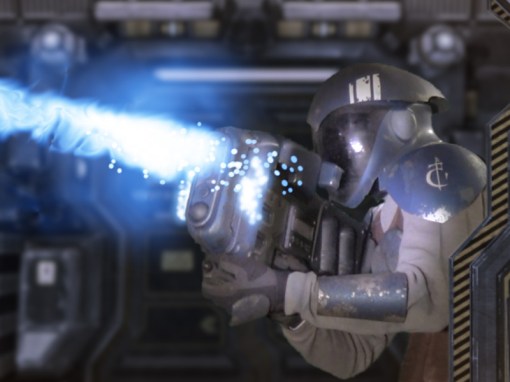
    Fire in the hold!
    Fire in the hold!

    An unexpected reunion

    From Reek they headed to Ariak Safari, another hunting planet 7 light years from Reek. During their interview with the Oracle she had given them word about an illegal arms shipment they could capture, which they would use to arm their ship. This shipment was due to be collected at the Seven Sisters system, and flown to Horvan’s Nest. From there it would be smuggled into Severn, a planet that was being blockaded by the Confederacy. The Confederate Navy did not know about this illegal shipment, which was made possible because the organizers had corrupt connections on Severn. But somehow the Oracle had pieced it together, and had identified that the organizers would be recruiting mercenaries at Ariak Safari. The job of these mercenaries was to protect the smuggling ship against other criminals who might attempt to board it during its journey from Ariak Safari to Horvan’s Rest, and to stay on board at Horvan’s Rest until the ship was ready to jump to Severn. The ship, Losing My Religion, was at Ariak Safari for about a month as it recruited mercenaries, and so it was to Ariak Safari that the group headed. There plan was to be recruited as mercenaries, and then to capture the ship during jump to Horvan’s Rest, meet the Left Hand of Darkness at Horvan’s Rest, transfer the weapons, and then disappear. Easy!

    Ariak Safari was very similar to Reek, a frozen planet with a thin, tainted atmosphere and a variety of large fauna to hunt. It also had only a rudimentary starport and no naval presence, which made it an ideal location for recruiting shady people. Ahmose successfully navigated contract negotiations with the mercenary leader, Zilschik Tad Malcontent, and they found themselves aboard the Losing My Religion. This ship was a classic freighter – a 1km long spindle with engines and accomodation at one end, a bridge at the other, and most of the spindle used to hold detachable cargo pods. Most of these pods were filled with agricultural equipment, but the plan was to distribute weapons amongst this gear. The blockade of Severn allowed agricultural and medical equipment planetside, but nothing else, but because this gang had a sympathiser in Confederate ranks they should be able to slip through the blockade if they disguised their weapons. The PCs were to take rooms at the rear of the freighter with a ten-man combat team called the Avalon Fire. They would have three weeks to plan their attack – one week in jump, one week in Seven Sisters, and most of the week in jump to Horvan’s Rest.

    The two weeks on board ship gave them a simple plan: Simon Simon would seize control of the ship’s rather backward peripheral systems and shut down the doors to the Avalon Fire’s rooms, preventing them from leaving, during the sleep cycle. They would then walk up to the bridge and take it, with Simon Simon attempting to shut Zilschik Tad Malcontent and his elite crew into their rooms as well. Once they had the ship they would negotiate with everyone, and if necessary keep them locked in until they could steal the stuff. If possible they would kill noone.

    The first hitch in this plan occurred on the first day of jump out of Seven Sisters, when Ahmose bumped into a big man in the hallway, and immediately recognized him as Kong the Younger. They stared at each other in surprise, but then she realized that he didn’t recognize her at all. She scuttled away, and remembering the rumours that Kong is a revenant, realized that this Kong was not the Kong she had met – but if they took him alive, they would have a chance to find out where the real Kong was.

    Unfortunately things didn’t work out quite that way. The first part of their plan – locking the Avalon Fire in their rooms – worked perfectly, but the second part went wrong very quickly, because the Bridge was on a separate command system to the rear of the ship and by the time Simon Simon discovered this they were in battle with Zilschik’s elite crew. The bridge was guarded by four elite guards and their two sergeants, Aurora and Flickknife, as well as Zilschik and, presumably, Kong the Younger. The PCs were trapped in the hallway near the bridge in an intense gun battle with the four crew and their sergeants when Kong the Younger teleported into their room and dropped a grenade on them. He took cover behind control panels in the bridge and suddenly they were beset on all sides. While Simon Simon and Ahmose were trying to kill him Lam and Alva were in intense gun combat with the remaining crew. They had four of their own crew with them for support, and it was beginning to look like they would prevail, until Zilschik appeared in the doorway behind his colleagues. He was carrying a PGMP – a man-portable plasma gun – which he unleashed at full power on Alva. The gun tore through Alva’s cover in the blink of an eye, and reduced the entire area to ashes. Fortunately Alva was able to push all his will into a reflexive teleport, and emerged unscathed behind Zilschik, crouched against the benches that the rest of Zilschik’s crew were taking cover behind. Lam’s laser shots were firing past him on all sides, and the room was full of smoke – everywhere Alva had been hiding was a boiling mess of plastic and metal. Alva opened fire with his whole magazine on Zilschik, but it wasn’t enough, and suddenly everyone was trying to shoot, stab or crush Alva.

    Fortunately Lam was able to kill Zilschik with a single headshot, and Simon Simon managed to access the main computer system and shut down power to all the crew’s laser weapons. Kong teleported out again, leaving a grenade behind, but the battle had turned. They managed to kill the crew and the sergeants, and were just finishing the battle when Kong the Younger reappeared in the doorway, carrying a second PGMP.

    He didn’t know that power had been shut down to all the energy weapons his team possessed. He screamed at them in rage and then opened fire – and nothing happened. A small woman’s voice said, “Please check power engagement settings,” and then Alva opened fire with the first PGMP. Kong the Younger’s entire lower body dissolved into a mass of scorched flesh.

    They had the ship.

    Discovered

    They were able to negotiate with the Avalon Fire, who agreed to spend the rest of the jump confined to their rooms. While they were negotiating Alva noticed something strange about Kong the Younger’s body, and by the time negotiations were finished everyone was watching it. His face had begun to change – first beginning to develop a strange discoloration, and then very slowly beginning to change shape. Ahmose, beginning to suspect something, had Alva set up his drone with a time lapse camera, and ordered everyone to leave the body untouched for a few hours. By the time they had the ship secure and had checked the armoury and cleared up the other bodies, Ahmose was sure – Kong the Younger was a changeling.

    Changelings are a small group of people from a single planet, called Valentine, who have the ability to change their body shape and structure to mimic other humanoids. There is much debate about whether they are a strange human mutation or an alien species, but there is little debate about their general qualities amongst the Confederate navy – they are shiftless, untrustworthy and dangerous outcasts. They are also excellent agents. Most people who have worked for or know the Confederate navy knows that it uses changelings for its most sinister tasks, and their ability to change shape makes them highly suspect to most naval crew. They are also known to have a high propensity for psionics, which they use to support their shape shifting, and the general rumour is that they are exempt from the usual restrictions on the use of psionics. No one trusts a changeling, and this distrust is confirmed by their behavior outside the navy – those encountered outside of their home planet who are not naval agents are almost always criminals.

    This explained the rumours that Kong the Younger was a revenant. Either he had hired a couple of changelings to impersonate him, or a group of changelings had killed the original Kong and taken over his criminal empire. They had probably also killed the captain of this vessel, and would be able to pretend to be him for the crucial task of getting through the naval blockade at Severn.

    Lam and Ahmose both spat on the corpse, and then spaced it. No good could come of having a changeling on their ship. They also searched through his computer records and communications, and they were able to confirm some details about Kong the Younger’s activities on Dune. A changeling agent on Dune had smuggled the two bodies out of Dune and onto the space station, and the plan had been for these bodies to be collected after the space station was destroyed. He did not know that the Reckless was monitoring the station and identified the presence of the alien bodies when they arrived. He had left ahead of the destruction of the space station with the crystal that Ahmose and Alva had obtained for him, and never suspected that the bodies had been picked up by Ahmose on behalf of the navy. He still didn’t know that the Reckless had been hiding on the edge of the atmosphere the whole time, though he did know from his scavengers that someone else had beaten them to the bodies. It also appeared that his motives for smuggling out the bodies and the crystal were not merely selfish – the contact that Kong the Younger was dealing with promised to cause trouble for the Confederacy, and Kong and his changeling coterie saw this as an opportunity to advance the cause of freedom for the Changeling planet. It appeared that the Changelings wanted to escape the Confederate yoke, and an organization amongst them had a long plan to achieve this.

    All this information they copied and prepared to transfer to the ‘Darkness when they arrived at Horvan’s Rest. They searched through the cargo pods to identify what they needed to take, and prepared a program to offload it quickly from the cargo pods. Everything was ready.

    They arrived in Horvan’s Rest to a standard scene of tranquil space operations. The first burst of comms informed them that the Left Hand of Darkness was in system waiting for them, and aside from a few small freight craft nothing unusual was happening. Lam set a path out of the jump zone to rendezvous with the Left Hand of Darkness, and then set the automated unloading program running.

    It was then that they received the incoming call.

    Registered Freighter Losing My Religion, this is the Confederate Naval vessel The Reckless. Please prepare for a customs inspection.

    Silence on the bridge was so stifling they could almost hear the rage rising in Ahmose’s breast. They watched the screens in horror as the vast bulk of the Reckless slowly materialized just off their bow, first blocking out the stars and then slowly forming from a black crystalline mass to the glittering swathe of deadly metal they had last seen during their catastrophic dive into dune. Of course no one on the Reckless was aware of the fate soon to befall the PCs – they were holding a yacht race in the atmosphere around the ship, thousands of people gathered on small floating platforms and party ships to watch as a colourful assortment of windships drifted across the face of the giant spaceship, cheering and letting off occasional fireworks.

    Inside the bridge of the Losing My Religion the only fireworks were coming from Ahmose and Alva, who were further outraged by the second message they received.

    Registered Freighter Losing My Religion, this is boarding officer Captain Noulgrim. Please indicate your readiness for boarding, and proceed to the docking area. Do not come wearing any armour, or bearing any weapons. We will be docking in several minutes.

    There was nothing they could do, in the face of an 8km long naval ship just a couple of hundred kilometres off their bow. They could already see the boarding flier heading towards them. “Understood,” Ahmose replied curtly, and they proceeded – unarmed and unarmoured – to the docking bay.

    Minutes later the docking bay doors opened and they saw the familiar face of Captain Noulgrim, striding purposefully into the bay with his best, most shit-eating grin beaming from his smug face. He was accompanied by an equally upright and perfect-looking Colonel, by two very serious looking soldiers in battle dress – and by Sue the Unbroken, head of their crew on the Left Hand of Darkness in their absence. She was handcuffed, and looking extremely unhappy.

    “Captain Ahmose!” Noulgrim announced cheerfully, “I can’t say this is a surprise, but it’s so good to see you again. And you’ve come up in the world now – your own ship, your own crew. Such success! Such a shame I will have to confiscate the ship!” He held out one hand and strode forward as if to shake hands with Ahmose, who recoiled in horror, spluttering and angry.

    “Confiscate the ship!? What?! After all we’ve done!”

    “Well yes indeed! You have committed a wide range of crimes!” Noulgrim stepped back, pulling a tablet from his uniform, and his supercilious grin widened as he read them.

    “Murder – 30 years for each victim. Illegal arms smuggling – 10 years. Attempting to breach a confederate blockade – 30 years. Possession of unlicensed weapons – 10 years. Impersonating a licensed pilot – 5 years. Electronic intrusion of a registered freighter – 15 years. Implanting illegal software in a registered vessel – 30 years. Human trafficking – 50 years and confiscation of profits, to with the Left Hand of Darkness. Unauthorized uplift of a remnant entity – 100 years.

    “Of course, we will resleeve you across your sentence and you will be required to work for an extra period in repayment for your resleeve, so you should expect to achieve your liberty as an old woman in your third or fourth resleeve cycle. Crime, Ahmose. It really doesn’t pay!”

    Everyone stared at him in stunned silence, until Ahmose finally blurted out, “We never intended to breach that blockade!”

    As Noulgrim shook his head in a performance of disappointment, the Colonel spoke for the first time. Raising his hand, he gestured for Noulgrim to put the tablet down, though Noulgrim showed no apparent displeasure at being interrupted. “Now then, now then, I’m sure this is all a misunderstanding. Captain Noulgrim can be very obstinate in his adherence to Confederate law – ” at this Alva snorted and grunted in obvious anger ” – and sometimes he needs to be reminded of the importance of official discretion. I’m sure, for example, that we have no evidence of any intent to break the blockade, and no doubt you committed many of these crimes in order to break this arms smuggling ring, and to hand over the weapons to us – am I right? Of course, in certain special circumstances licenses can be offered retrospectively, and it’s not a crime to uplift an entity if one is rescuing it. Am I not correct on these nuances, Noulgrim?”

    Noulgrim nodded, still beaming with pleasure at the situation.

    “The truth is, Ahmose, we need your help,” The captain continued. “We discovered your trick with the mad AI on those ships at the Dune system. After the AI infected one ship it killed all the crew, and then destroyed the other ship, but before it did it released all that ship’s data in a sudden burst of information that the Reckless picked up. We captured the ship and were able to identify that the crew had been working for an AI called the Cognate, that is ancient and powerful. It was looking for you and the cargo you were carrying. The AI we captured kept uttering only one phrase – ‘kill the Cognate’ – and that AI is very old and powerful too. We decided to come and talk to you. You’ve obviously been up to a lot of mischief since we left you, and we need to have a long talk about what you’ve been doing and where this is leading.

    “In exchange for your help, we’ll help you to arm your ship and give you licenses for all your weapons. We’ve got a shared problem here, Captain Ahmose, and we want your help and everything you know.

    “Last time we made you work for us to pay off a stupid crime. This time, we’re asking for your help because we need it. And trust me, the Confederacy rewards its agents very well. What do you say?”

    “Wait!” Simon Simon spoke. “What about Dune? You just left it there to find us, unprotected? What about the AI searching for Red Cl – for the bodies? They could just get more if you’re not there!”

    “Oh, no problem there,” the Colonel waved his concern away. “We were replaced a few weeks ago by the Forest Class ship Once a Believer. She’s only 10% of our size, but she’s 1000% more dangerous. We’re not really fitted out for war, but once we sent a report back on the possibility of AI involvement they sent us a ship who is. So now here we are, ready to go wherever we need to go and do whatever needs to be done.”

    Alva snorted at the idea that the Reckless was not fitted out for war, remembering the over-the-horizon beam weapon that created a nuclear blast, and the stealth cloaking. But there was nothing he could say, really – this seemed like an offer they couldn’t refuse.

    After a moment, Ahmose had taken stock of the mettle of her team. “Okay,” she conceded with a sigh. “We’ll talk to you about everything that’s happened. Come to the crew room, and we’ll give you a briefing. But it will take a while.”

    “Oh no, that’s okay!” the Colonel replied breezily. “We’ve prepared a viewing platform for the races. It will be much more comfortable than this clunky old thing. Why don’t you come watch the windraces? And don’t worry about loading weapons onto your ship – we’ll kit you out with much better shortly.

    “It’s a pleasure to be able to work with you, Captain Ahmose!”

    And with that, he gestured for them to leave the ship they had captured at such personal risk, and head into the belly of the Confederate beast …

     

    Save

    Save

  • There is no universal interpretation of this
    There is no universal interpretation of this

    Coming off of a mildly catastrophic discussion of Trump and racism at Crooked Timber, I thought I’d use some of my holiday time to make a first pass at organizing some opinions I have been forming about sexism, misogyny and the pernicious influence of Christianity on western discrimination. I’ll try not to make it too long but I have today off and a long, complex write-up of the weekend’s adventure to procrastinate about, so we’ll see …

    First I should say this post is aimed at left wing philosophy. If you’re a right-wing philosopher you might find it entertaining but I doubt there is much to benefit you here, so you might want to save yourself an hour of bad prose and move along …

    There is a common debate in western leftism between people who think that various forms of discrimination (most especially sexism and racism) arise out of economic relations, and those who think that economic relations arise out of the inherent structures of some underlying fundamental inequality. For example, some feminists might argue that human development goes through a universal stage of domination of women, and from this arises the various heirarchical structures that give us racism, classism etc. Others might argue that the economic relations always come first, and that for example the economic forces unleashed by the development of agriculture favor the development of specific social forces (e.g forcing women to have more children in order to support population growth made possible by agriculture, or slavery to enable use of more land). Obviously most people see these things as interlinked or happening contemporaneously, and no one is ever silly enough to think that this stuff was all purposive (a group of farming men getting together and deciding to lock up their women, or whatever).

    These origin stories don’t have much importance in day-to-day struggle, but they do and have been influential in major political movements in the past. For example, most of the streams of communist or anarchist radicalism believe that the economic forces of capitalism necessitate class and gender divisions and we can’t eliminate gender discrimination without destroying capitalism; but in contrast radical feminists often believe that you can’t reformulate the social organization of any system without first tackling the underlying gender discrimination that sustains all heirarchies. Obviously on a day-to-day basis we fight battles on the basis of the nature of the battles, so if an issue of equal pay is best won by union activism we organize that way, while if it requires a fundamental rethink of the way women and men interact at work we may fight it through education and awareness raising. But sometimes something big comes up in the ordinary day-to-day political hurdy-gurdy, and in order to deal with it we have to think about the underlying structures of society and what really drives our mainstream political ideas. Brexit and Trump are examples of this, and in many ways I think the radical left has failed to understand them by casting them as simple economic responses rather than manifestations of a deep underlying racism in these societies. In the case of Brexit there is a yearning for lost empire underlying the dreams of the little Englanders, and in the case of Trump I think we are seeing the final fight against the civil rights movement and, assuming the left wins, the burial of slavery apologia and confederate dead-ender ideology.

    I used to think about the social order primarily in terms of the economic forces argument: that is, I used to think that when racist and sexist undercurrents reared their head in mainstream politics or pushed a surge of hatred through society, that they reflected some kneejerk, incoherent response to underlying economic forces. In this worldview we don’t have to tackle the deeper undercurrents of society’s problems, we just look for the economic pressures and fix them. Fixing economic pressures is easy, whereas tackling things like the social undercurrents of the alt-right’s hideous misogyny is hard. But then I came to Japan, and discovered that actually a functioning capitalist society with all the same economic pressures can have radically different approaches to the interaction between the sexes, and I started to understand that actually in many cases culture trumps economics, and understanding the cultural forces driving our social development is really important to being able to finally end many of the problems we face. I don’t know how a right-wing interpretation of these things would work, but the classical hard left really needs to adapt its analytical strategies to consider the deep undercurrents of social life. Similarly, when I came to Japan I realized that origin stories or analytical frameworks that posit universal underlying structures based on universally observable basic facts are useless, because actually there are huge differences in the way societies practice the same forms of discrimination, and these differences are relevant. In particular, radical feminist ideas about the origins of sexism and how sexism functions and is maintained fail dismally in the face of cultural differences that I think radical feminism, with its primarily American and British origins, doesn’t understand.

    In this post I aim to discuss how I changed my mind about this in the light of Japanese gender relations, and how I came to realize the overwhelming importance of christianity’s sexual morals in generating western gender relations. As a result of coming to Japan I realized that if we want to change gender relations for the better in the west we need to – absolutely have to – crush the influence of Christianity on our culture. So first I want to explain the difference between the west and Japan on this issue, and then explain why I think it’s important.

    Before I go onto the next section I want to stress that it is not my task here to present Japan as an ideal society or to say it is not sexist or women don’t have a hard time or there is no rape or anything like that. I just want to show how things are different.

    How are Japanese gender relations different?

    I think the very first thing that foreigners realize when they come to Japan is that it is safe. It’s safe for men, and every day I am so happy about the fact that physical confrontations don’t happen here, but the absolutely overriding difference in safety is noticed by women. There is no street harrassment and no public fear of rape. I live in an area surrounded by parks that are dark at night and it is absolutely normal to see women walking alone through those parks at midnight, with earphones in, alone, with no concern in the world. I know in the country that there are places where women don’t travel alone at night because of flashers and gropers, but in the city at least this absence of the threat of sexual violence is noteworthy. It’s not just a statistical anomaly brought about by underreporting or something, and everyone who lives here seems to feel it very quickly. And when come from a western country with a lot of interpersonal aggression and a lot of violence against women (like Australia) you really – I cannot stress this enough – you really don’t understand what a difference this makes until you experience it. Once you have experienced a world without this kind of behavior you just lose all tolerance for western approaches to it. When I look at the lockout laws being introduced in Australia to stop violence between drunk men in pubs I am just astounded that we ever as a society tolerated this kind of thing, or that we have to use such a ridiculously heavy-handed approach to stopping it – and I notice exactly the kind of problem I alluded to above. The lockout laws are an attempt to use economic and legal tools to stop an underlying socio-cultural problem. Tackling adult male violence is hard, but stopping them from getting drunk in public is easy. But these solutions don’t stop the problem, they just stop it manifesting.

    Some other easily-grasped ways in which gender relations are different in Japan include:

    • There isn’t really any Japanese word for “cunt” that you can use as an insult, and in fact there are no insults based on sexual activity or sexuality. In Japan you don’t tell someone to fuck off, you don’t say they’re a fag, you don’t say that was a dick move – sex is just not a degrading or insulting thing here, and you can’t use it as such, and if you tried people just literally wouldn’t understand what you were saying (though they would think you were being very coarse)
    • As a result of this difference, two chapters of Dworkin’s famous book Intercourse – Dirt and Death – don’t really seem to apply in Japan. A whole section of the radical feminist understanding of the universality of women’s oppression is built on an explicitly christian framework that 120 million people don’t get
    • Japanese women seem to have a much greater ability to negotiate safer sex than western women. Obviously I don’t know what every Japanese woman is saying or doing in the bedroom but the statistics make it clear: the vast majority of Japanese women are not using the pill, but rates of teenage pregnancy are very very low, as are rates of pregnancy generally. The only way this is possible if Japanese women – even teenage girls – are able to negotiate the parameters of sexual activity more effectively than western women
    • Japanese attitudes towards casual sex are completely different to the west. The love hotel is a ubiquitous part of Japanese life and while westerners usually think this concept is disgusting and weird Japanese people in general have no real problem with it at all.
    • Japanese women often work in industries where western women can never be seen. In particular farming, transport, and even construction seem to have a higher prevalence of women workers. It’s not common, but not especially rare, to see female truck drivers, and female farmers are normal.
    • Japanese women’s sporting participation seems to be much higher than western women’s and much more widely respected, across a wider range of fields. In particular Japanese women’s participation in fighting sports – and non-participant women’s deep appreciation of fighting sports – is completely normal, while it remains a very modern phenomenon in the west
    • Attitudes towards sex work and all forms of the sex industry here are much more practical and non-judgmental
    • Small businesses almost universally don’t have men’s toilets. They have a women’s toilet and a shared toilet
    • Opposition to homosexuality appears to be minimal and based primarily on concerns about responsibility to family and society, not on fear and disgust

    I think these differences in attitude are strong and they derive from an obvious source: Japan is a pagan society. It has no long-standing or deep-seated religious just-so stories about how everything is women’s fault and women are dirty and bad, and sex is a punishment from God. Attitudes towards sex in Japan are constructed around privacy and shame, whereas in the west they’re structured around guilt and sin. Indeed, if you dig into some of the attitudes towards sex that are similar between Japan and the west – the lack of mixed bathing, for example, or the weird video censorship – you will often find they’re a result of Japan reacting to western values either post-Meiji or after world war 2.

    Another result of this difference in attitudes that I have noticed but which I can’t formulate easily into words is the difference in attitudes towards femininity. In the west femininity seems to be seen as this kind of act that women put on in their early 20s, and it is seen as a deceptive and manipulative cloak. To be taken seriously at work or as an adult a woman needs to divest herself of this feminine cloak (or, as it is generally described, these “wiles”) and behave seriously – it is seen as a kind of childlike deceit. In Japan it seems to be viewed as just a natural aspect of being a woman, not a deceptive trick, and women remaining feminine into their 50s and 60s is completely normal. I think this also means that women are not taken less seriously because they dress and act feminine, although this femininity may disadvantage them by drawing attention to their gender (which, as everyone knows, is discriminated against at work and home in Japan as everywhere). I think this difference in attitudes towards femininity explains why Japanese women have maintained a high level of style and attention to personal appearance separate to men even as women in the west have begun to favour jeans and t-shirts – Japanese women don’t need to hide or be ashamed of their femininity, because they don’t have to dress in men’s uniform to be taken seriously. This is also evident in sport, where Japanese athletes who are taken really seriously by the public (the Nadeshiko football team, for example, or the wrestling team) still dress and act feminine because they don’t have to hide this stuff in order to be taken seriously. It’s hard to draw these links because it’s all nebulous cultural stuff, not hard science, but I think the simple reason for this difference is the Genesis story. In Genesis a woman tricked a man into a sin, and as a result women can’t be trusted. Christianity tells us that performative femininity is a deception that leads men into trouble and danger – it’s literally wily. After 2000 years of that story (and all the stupid badly-done renaissance paintings of a wily girl tricking a dude) we get young men who know nothing about Christianity or feminism or indeed women saying that they can’t trust a girl who wears make up, they don’t like make up because it’s deceptive, etc. There’s a 2000 year long history of distrusting women’s wiles and tricks at work there, and I think it has a profound effect on the way women in the west present themselves at work and in politics.

    I suspect also that in reaction to this notion of femininity as performative and deceptive, and out of deep-seated fears of homsexuality that are also grounded in biblical hatred, men overperform their masculinity. The result is street violence. I think in fact Japanese men are much more comfortable about their masculinity and feel no special need to display it, not because women have been held back and men thus don’t feel threatened, but because they haven’t been raised in a society where men have to constantly prove themselves as not feminine and not gay.

    What does this mean for western views on sexism and racism?

    Obviously I’m no cultural theorist and I’m definitely not an expert on Japanese culture and history; this is just my impression of the differences between the west and Japan from 10 years of living here. Obviously also these lines between ancient books and modern practice are mediated by thousands of years of cultural baggage, and there are other cultures at play in western countries that may still have a lingering influence on how sexism and racism develop. But I think the connections are there, and that even though we in the west like to fancy ourselves as enlightened and developed, we’re actually still wallowing in a swamp of barely-understood cultural norms that derive from what is, in essence, a very very bad place. When you step outside the christian world and spend some time looking in, you start to notice that actually a lot of our bad points are not universal, and I think they probably stem from our religious origins. Here I have given the example of gender relations but I think the same thing applies to race relations and probably the way we approach class, economic inequality and other -isms. But I think that the differences in gender relations are clearest because they are most noticable in day-to-day life, and perhaps also reflective of the most poisonous aspect of Christianity.

    I have said before on this blog that I think western radical feminism is itself misogynist and conservative. This is because it’s really hard to escape the origins of your own culture, and the reality is that our culture has its origins in a deeply misogynist, poisonous text that is hateful and judgmental – the old testament of the bible. And while modern Christians try to pretend that they built their ideology on the new testament’s story of love, this new testament story is an evil story of child murder, with a side of nasty misogyny from some of the apostles, and it doesn’t do anything to leaven the nasty hatred of the old testament. Furthermore, while our modern Christian movement tries to pretend that it is all about love and light (and murdering your own son so you can be famous, then fetishizing his dead body), the actual origins of our cultural approach to sex and sexuality are all in the old testament, in the disgusting, judgmental and hateful texts of Genesis and Leviticus. Our fundamental origin story is designed around hating women, and making sex sinful and dirty. Much as we like to pretend that we’re free of religion, we’re not free of its cultural influences, but we need to be if we truly want to liberate women and men from the shackles it has imposed on our relations. But my experience in Japan shows that these ideas are not universal, they’re not fundamental parts of who we are as human beings or who we will become if we try – we can shake off these ancient rusty chains, and become better people. But in order to do that we need to confront the causes of some of our deepest, most secret problems, and for the left that means not assuming we can fix all our problems by fixing economic relations – we need to keep taking the fight to the bible, and to the deep-seated insecurities and social tics it has created in us.

    And sometimes that means we need to recognize where our society is failing itself, and fight cultural battles on purely cultural grounds, because when we assume there is some economic force that created Trump or the modern Republican hate machine, we are guaranteed to fail. Sometimes hate is just hate, and sometimes we need to fight it on its own grounds.


    About the picture: This is a picture a friend of mine took at a recent festival. It’s Seiko Omori, about whom I know nothing, and I think it’s a good example of the kind of Japanese cultural imagery that is a) really hard for westerners to understand at all and b) almost certain to be misunderstood and misinterpreted if we try to analyze all the imagery in terms of western notions of sex, sexism, women’s roles, pornography, or power.


  • Did I build a ship to wreck?
    Did I build a ship to wreck?

    After they left the Reach, the characters sold one of their two mysterious human cargo to an adherent in exchange for a spaceship called The Left Hand of Darkness. Fresh from the Confederacy shipyards, ‘Darkness is a sleek and beautiful thing, designed for luxury travel at high speeds but carefully built to be reconfigured as a combat vessel for those slightly more adventurous lordlings who feel like slumming it in the Frontier.

    A room of one's own ...
    A room of one’s own …

    The Left Hand of Darkness has the following basic structure:

    • Bridge with room for pilot, navigator, captain, engineer, two gunners. The bridge is spacious and high tech, with a large window-like area at the front which is actually a screen (not a window)
    • Captain’s ready room (off the bridge) with desk, couch, pot plant, and display screens for planning
    • Conference room (off the bridge) with room for 8 people around a good quality table
    • Armoury (off the bridge) with weapons racks sufficient for 8 people
    • The entire bridge section can be detached in emergencies and has a separate small power supply that can keep the bridge functioning for about a week
    • Ship’s boat, reached either directly from the bridge or from the main deck, with space for 24 people (basic seating) or 8 people (comfortable accommodation including sleeping arrangements)
    • The ships’s boat has two turret locations
    • The main ship has four turret locations, giving all-round fire arcs, but it has no weapons on them and no fire control system installed
    • A single level 2 computer with advanced AI defences
    • A luxury cabin suite for the captain, with office and separate bathroom
    • Standard cabins for 8 crew, with their own toilets and a shared bathroom area
    • Bunk cabins for sub-crew, with room for 8 more in two bunk rooms of 4 each, typically used for soldiers or passengers, having shared bathroom and toilets
    • Two recreation rooms, one between the crew accommodation and the bridge, with a kitchen and open space; one behind the bunk rooms, smaller, with a kitchen and eating area
    • A small gym/training area near the cargo hold
    • A large cargo hold capable of holding perhaps 8 containers of cargo
    • A separate utility hold with two small flyers, each with space for two people. These flyers can be armed but again are currently not. This hold also has spare space that can be converted to cargo or used for e.g. other flyers, mining equipment, etc.
    • A separate armoury with space for heavy weaponry up to tripod machine gun or mortar size (obviously in the Confederacy a weapon of this size may be capable of nuclear-scale destruction); armour is also stored here
    • Two air locks, with separate spaces for vac suits and additional small armouries
    • A medical bay with room for two injured, two morgue slots, and some laboratory space. There is space for a server for backed up memories but this is absent (such a thing would be RP4 and illegal for the PCs to own)
    • A welcome room near one air lock for entertaining business people and guests coming in from space stations; this room also opens into the main physical entry that opens below the ship to allow external entrance planet-side
    • A series of emergency escape pods scattered around the ship, sufficient for a crew of 24 to be able to eject from the ship.
    • An observation deck near the rear of the ship that allows a bit of star gazing and has a small garden (very small) with a bench, sadly not big enough for a picnic
    • Basic field effector shields that will protect the vessel from sub-light collisions with small objects, and a couple of blasts from a heavy ship-borne laser, but no more
    • ‘Darkness is lightly armoured, sufficient to survive one or two heavy laser blasts but no more
    • A small general purpose space in the centre of the ship, currently empty
    • Some of the walls linking things like recreation rooms and the general purpose space can be reconfigured to make more space available in certain situations

    The Left Hand of Darkness of course has the standard set of sub-space and hyper-space drives, power plants, etc. Her Slug is sufficient for three months’ life for 24 people. ‘Darkness is capable of Jump 3 and M-drive 3. All fittings and equipment are TL14.

    Ship Layout design is by Eddie, one of our players. His portfolio can be viewed here.

    Save

    Save

  • Did I dream you dreamed about me?
    Were you hare when I was fox?
    Now my foolish boat is leaning
    Broken lovelorn on your rocks,
    For you sing, “Touch me not, touch me not, come back tomorrow:
    O my heart, O my heart shies from the sorrow”

    (Song of the Path of Tears)

    [GM Note: This is a report of a part of session 8 of the Spiral Confederacy campaign. Session 8 covered a lot of different events, which are too much to describe in one post, so I’m breaking the write-up over three or four separate posts to keep them manageable]

    Having asked all they could of the Oracle, and not to happy with their answers, the characters left Niscorp 1743 quickly. They had a plan to raid a weapons-smuggling ship and steal its cargo, but first they wanted to track down at least the first steps of Kong the Younger, the man who had originally employed Ahmose and Alva to recover a chip from an asteroid of Dune, which they thought might power the ansible. He had left Dune a few days before the space station was destroyed, so they guessed that the quickest way to track him would be to go to Dune, find out which system he had jumped out to, and follow him. The greatest likelihood was that he had headed to Reek, in which case they could head in his direction while they also moved in the direction of the arms shipment they were going to raid.

    They jumped to Dune. While they were in jump space Ahmose asked Red Cloud about the chip that powered the ansible. They had seen diagrams of this chip on the space station over Perez, when they stole the ansible from the mad AI the Starred One, and as soon as they saw it they recognized it as the same chip they had been asked to recover by Kong the Younger. Ahmose thought maybe that these chips could be found on the planet of Dune itself, so she asked Red Cloud about it.

    “Oh that!” Red Cloud stuttered in surprise when he saw the picture of the chip. “That is a relic of ours, it is a great crime to depict that relic ever, such depictions are a sin. That is why we hunt the Path of Tears.” He waved a hand agitatedly, indicating in his imperious rough-hewn manner that he wanted the image hidden. Ahmose duly hid it – it was not wise, in any case, to expose Red Cloud to screen technology for too long, as he became angry at it and started ranting about evil demons and magic.

    “The Path of Tears? Is that another dumb religious thing?” Lam asked helpfully.

    This elicited one of Red Cloud’s signature hand slap-growl-grunt combinations, intended to show his displeasure at an inferior addressing him directly. “Pale worm! How dare you speak so insolently! Captain, why do you not boil this thing down for magical parts? What other use has it!?”

    Lam sniffed scornfully at the ignorant lout as, once again, Ahmose ordered him to address her by her name and reminded him that no one would be rendered down for magical parts.

    “The Path of Tears,” he explained wearily once he had been calmed, “Is a heresy, a group of witches and warlocks who believe heretical things about our universe and about the Dream. It is because of their heresy that we hunt them. It was such a witch – of the Path of Tears – that I was about to kill, as it is my duty to do -” hearty masculine chest thump! “- when someone captured me and sealed me in that coffin.”

    “The Dream?” Alva asked, but Ahmose waved him silent before Red Cloud could begin ranting about pale worms blaspheming by saying the word, or something equally silly.

    “So this witch you were hunting – she believes in the power of this crystal, rather than your god?”

    “No no no! Of course she believes in the power of the sun god! Who could not, given that he rises daily to remind us of his harsh fury? No, she holds other strange ideas. And heresies! For example, followers of the Path of Tears believe it is not a sin to make depictions of the crystal, and so they all wear a necklace with a perfect replica of the crystal. Heresy!” He spat angrily on the deck.

    For once no one reacted to his filthy manners. They were all staring at each other in shock. “WHAT?!” Ahmose roared. Suddenly they all remembered – when they examined the dead woman’s body just after they found it, she had indeed been wearing a necklace with a tiny crystal on it. They had completely forgotten that she had been wearing it, and then they had sold the body to DK in exchange for the ship, The Left Hand of Darkness.

    Ahmose surged to her feet, hammering one hand down on the table in rage. “We had it HERE! Was it on the witch the whole time?!”

    “Wait wait no!” Alva leapt up to. “I remember I took it off her body, I kept it in my room. I should still have it! It was on our things in the Come As You Are!”

    “Find it!” Ahmose snarled. “Everyone help him look. Maybe we -” She was going to say “sold the witch” but then she remembered Red Cloud was in the room. “Maybe we can find it now. Thank you Red Cloud for this information.” They all ran out of the room to search, forgetting to ask Red Cloud about the Dream.

    They searched their things thoroughly, Ahmose growing into a towering rage as they realized the crystal necklace was nowhere to be found. She was beginning to lose her temper at Alva for his foolishness and sloppiness when a thought suddenly struck her.

    “Larry and Barry!” She struck the wall next to her. “They stole it! As soon as we got this ship they went their own way! They were originally hired to find the same crystal as us! They took it!” She began cursing all the gods of the underworld and hitting the doorframe with one gloved fist. “They stole it!”

    Gathered in the open area in front of their shared rooms, the common room scattered with all of Alva’s personal belongings, they all realized she must be right. When Ahmose and Alva had emerged from the asteroid with the chip they had been ambushed by Larry and Barry, but had won the fight and in exchange for sparing their lives, Larry and Barry had agreed to let them use their spaceship the Come As You Are until they could get a ship of their own. But of course as soon as they realized that Alva had the crystal they would have stolen it – something all too easy to do on the Come As You Are, where crew were sharing rooms and everyone was packed into the same small common room area during long jump trips.

    Treachery!

    “Well then,” Ahmose growled after a moment. “We had better find Kong the Younger. I don’t care if he’s a revenant – I’ll kill him as many times as I have to to get that damn crystal.”

    Interdiction at Dune

    They arrived in Dune to find the system unchanged since they left it several months ago. The two navy ships were drifting around on the far side of Dune, and a few spaceships were working at salvaging the remains of the space station. A few other ships drifted around in-system, perhaps setting up independent mining operations or just passing through. Within a few minutes of arrival they had received an update on all ship movements in the sectors to leeward, and sifting through it soon found the information they needed on Kong the Younger – after leaving Dune he had jumped to Reek, a jump-1 trip for them and a well-surveyed system, though the spaceport was small. They set the Left Hand of Darkness to move in-system and braced themselves for a week drifting through the system, waiting for their computer to reset after jump.

    Unfortunately they did not have any time to relax. Just a few minutes after she had set the course, Ahmose was interrupted by the Left Hand of Darkness. “Captain, we seem to be under attack. I have received several energy weapon hits on my shields.” At the same time they saw on their screens that two of the ships that had been moving calmly in the distance were now on a fast-closing attack trajectory. Moments later a communications alert sounded. They engaged the comms link.

    “Captain Ahmose, this is the Mono:Overload. Discharge the cargo or be destroyed.”

    The two ships speeding towards them had identified themselves on general systems comms, and they had already identified them as the Mono:Overload and the Transfer:Complete, but there had been no warning that they were dangerous in any way. Of course everyone knew immediately what they were after.

    “I’m afraid we don’t know what cargo you’re talking about,” Ahmose replied tersely. She looked at the others and shrugged. “Darkness, can we withstand these weapons?”

    “Captain Ahmose, I’m afraid that they will soon break through our shields if they fire again. After that they will quickly destroy the hull. You may have to comply with their request.”

    Ahmose muttered something about taking orders from a stupid machine and looked around at the others. “Vacc suits people!”

    They rushed to comply. No further attacks hit them, and they listened nervously for the next communication as they rushed into their vacc suits. The ships were still minutes away, and it would take minutes for every stage of the negotiation to proceed. As she struggled into her combat dress Ahmose was frantically checking all the sensor channels for any evidence that the Reckless had noticed the attack, but she could find none.

    Minutes later the reply came. “Captain Ahmose, don’t lie to us. You have two cryotubes containing cargo that is ours. Discharge it immediately and we will allow you to live. If you do not discharge it we will cut your ship into pieces and take the cargo from your silent hold. You have 10 minutes to comply.”

    Ahmose’s immediate thought was to discharge the empty cryotubes, but of course the ship was only carrying one. And of course, even if they discharged the cargo they would still be dead – it would be a matter of a few minutes’ work to carve up the ship and kill its occupants, guaranteeing no vengeful crews chasing these two ships.  They needed another way out.

    What to do? They looked at each other. No one had an idea. Their ship was unarmed, and although they could try dodging the attacks, they would need to maintain their evasiveness for hours in order to stay alive until one of the Navy ships came within defensive reach. They could refuse to negotiate and hope to repel borders, but it was far more likely that the ships would simply cut their vessel into pieces, and then kill them where they hid in the shadows of the wreck as it pried out the empty cryotubes.

    “We have to jump, Captain.” It was Lam who said it. “We can do it. We have an extra astrogator, the computer will be jump-sick but we can do it. Better to jump out and save the ship.”

    Ahmose looked around at the rest of her crew. With no guns and no nearby naval ships, she couldn’t see any alternative. “Okay, let’s jump. Set a course for Reek. We’ll take our chances with the void.”

    “Captain my Captain…” Simon Simon piped up quietly from the corner. “I have a weapon we could try …”

    “Yes, Simon Simon …?”

    “We still have the remnants of the mad AI on the server in the hold. I could try and send an attack message to one of those ships, that implants the mad AI in the ship. It will completely take control of them. It won’t happen quickly, but if we come back here in two weeks the ship will probably be completely mad, and everyone will be trapped on board. We could board it and find out what they wanted and who we are. They’d probably beg us to take them off …”

    Ahmose thought over the implications. There was no risk that the mad AI could escape from the system, since jump travel would kill it, and it could not thrive in the system because there was no longer a fully functional computer system. If it caused any serious trouble the Reckless would no doubt destroy it in a moment. The plan probably wouldn’t work but if it did it would ensure that the crew of at least one of those two ships was imprisoned on board and desperate to be rescued. Probably the mad AI would cast them into space, or empty all the air from the ship, or kill them in some other cruel and uncaring machine way.

    “Do it. You have eight minutes, then we jump. Lam, plot that course.”

    They jumped, leaving a mad AI behind them…

    Where are we...?
    Where are we…?

    Misjump

    Jumping a few minutes after a past jump is an incredibly reckless move. No one knows what will happen. Unless your astrogator and your ship’s computer are very very good, the jump will go wrong. The possibilities are daunting: perhaps the ship will never leave jump space, and you will be trapped in that grey nowhere between the stars until you starve or, worse, go mad and kill each other; perhaps you will materialize on the far side of a distant galaxy, lost and alone; perhaps you will arrive at your destination, but too close to its sun, and be torn apart by the conflicting forces of hyperspace and subspace; perhaps your journey will complete in the normal way of things, but you will arrive insane with visions of monsters in deep space. There is nothing you can do after such a jump, except wait and see what the capricious forces of hyperspace have planned for you.

    Ahmose wasn’t waiting. She understood how the uncertainty of a rushed jump could affect people even if the jump itself was safe, so she set them to work. For the first week of the journey every moment of time was filled with activity – cleaning, cataloguing, cleaning again, defensive drills, language lessons for Red Cloud, strategy meetings, anything to keep the crew busy and focused. For a week it worked, and attention was diverted. People knew they were on a potentially fatal path, but they didn’t really think about it. But on the eighth day things started to fray. Ships always come out of jump by seven days, usually around five or six – an eighth day in jump is a sign of an error. Tempers started to fray, people started to lose their perspective. The ship was spotless, everyone had their defensive tactics polished, Red Cloud was sick of verb declensions and sullen at the lack of sunshine, and everyone was starting to wonder. A ninth day passed, tense and fraught with small arguments. On the tenth day Ahmose had everyone drilling again, running up and down the hallways in mock battles, but nobody’s heart was in it. The fear was in them. Were they trapped forever in this limnal nowhere? At lunch, sour looks were cast at the crew member who had programmed the jump, or at Lam because she didn’t or at Ahmose because she ordered it, or at Simon Simon because he didn’t stop it, or at Alva because couldn’t he teleport them out of here? Two people got in an argument over a cup. Ahmose relented, and decided not to pursue an afternoon of fitness training; she dismissed everyone to their rooms. “Don’t worry people, we’ll arrive soon, you’ll see!”

    She was right. On the evening of the 10th day the jump alarms sounded. Everyone rushed to the bridge. Ahmose ordered vacc suits, just in case, and they all scrambled into them in the ready room or the hallway, eager to see where they had arrived. If it was the centre of the sun, at least they would know …

    The alarms sounded. The view screens flickered to life, grey chaotic swirls faded, a rush of static ran across the window and there they were, floating in space, real space, not the grey nowhere of hyper space. Ahmose rushed to the comms unit to look for signs of nearby ships, while everyone else stared at the dark, empty screen, scattered with stars. “Where are we Lam?!” Ahmose demanded, voice tense.

    Lam was fiddling with navigation tools. It was Red Cloud who spoke first.

    “Captain, why do you insist on taunting me with heresies. This is an insult to me, a deep and personal one, and after all I told you. Please do not display these pictures on your wall just to insult me, and in front of the pale worms too!”

    Ahmose turned to snap a curt response at the infuriating priest, but as she straightened she saw them, standing in slowly revealed rows in the empty space before the ship: a long line of huge, golden structures floating in space. Each was the perfect shape of the crystal she had given to Kong, then found, then lost, and now sought again. They were the same colour, and they floated there in space in a long line, like vast golden dominoes, though each too far from the other to touch. It was impossible to tell their size as they floated there in the inky black, with nothing for perspective. Everyone stared silently at them.

    “That’s not a picture, Red Cloud. It’s a window. I didn’t make this to tease you – you can see it out of our window. It stands before you.”

    The entire crew watched in amazement as Red Cloud, proud warrior priest of an ignorant and backward society, sank crying to his knees. Tears streaked down his golden face, and he dashed them away without even the traditional Dune admonition of tears as wasted water, so distracted was he; placing his palms on the deck, he banged his head on the floor and sobbed.

    Everyone stared. First at Red Cloud, then at the strange floating crystals. What bizarre coincidence was this? Lam muttered something about them having the most devilish luck, and Alva said something snarky about religion and fools. “Captain, they’re very very big …” Lam added in a small voice.

    Everyone else was still watching Red Cloud. He looked up at Ahmose, eyes reddened and puffy. “Captain Ahmose, I am sorry I ever doubted you. Truly you are a sending from the sun itself -” Ahmose puffed up just a little “- to bless me with this fortune.”

    He regained his pride and surged to his feet, striding towards the window and adopting his more normal sermonizing tone. “This is the pillar and arch of our society, the greatest thing we ever built and our saddest loss. For longer than memory we have sought it, and everyone thought it lost. To depict it in statue or art or even in dreams is a sin, a heresy, to recreate this beauty in physical form is to die.” He slapped his chest. “At my hand! I have devoted my life and soul to crushing those who would besmirch the beauty of our lost world. And here, you bring me to it. You bring me to it…” His voice slid away into whispers, golden muscly arm pointed out at the screen.

    “Ah, Red Cloud,” Simon Simon interrupted his reverie. “Um. What is it?”

    For once Red Cloud forgot that he was being addressed by a pale worm, who should be rendered down into magical parts. “Simon Simon, strange little creature, feast your eyes upon it. This is the Shoal of Dreams.”

    “Well then!” Snapped Alva. “That settles that then! What actually is it, Red Cloud?!”

    Red Cloud strode to the head of the control section, where he could stand on a slightly raised dais, and give his sermon.

    “Many seasons ago, before memory, our people were numerous and our lands vaster than imagination. But no matter where we lived in those lands, we had the dream. The dream was a shared dream, and we were all part of it always – no one was left out or alone, and within the dream anything was possible. And at the heart of the dream was the Shoal of Dreams, onto which all dreams must wash gently, and from which all dreams radiate out. We all loved the dream, and lived in it, and loved each other through it. But then one day, our people decided to leave behind their physical bodies and enter the dream, to become only the dream. For what is the world of dust and sand and heat and light, against a dream where anything is possible, always? But some of us said no, they wanted to see one more sun rise. They wanted to see the lightning strike the plains as the red clouds of a summer storm roll in through the mountains; they wanted to know the salty taste of a woman’s tears one more time, or they were not ready to leave behind the smell of a sand cat when it comes in from a windy, sunlit day. For them there was too much beauty yet in the sand and the storm. So they remained behind, a tiny portion of our people, who chose never to enter the dream. And for longer than memory they guarded the remnants of our society, roamed the golden wastes, caught the dragons as they soared on the winds of the evening, dreamed their own dreams separate from each other, lost and longing but still loving the harsh beauty of rock and sky. But then one day that dream redounded upon us, washed over us as nightmare, we were caught in the nightmare, and when it was done our society was lost and we were cast down from beauty and peace into a harsh, hot, brutal world of nasty struggle. No one remembers the nightmare or what it was, but it washed over us and destroyed us, laid us low; and when we woke from the nightmare we had lost the Shoal of Dreams, we couldn’t find it, and so we were forever cut off from joining our ancestors in their dream. And so in our rage we declared it a sin to invoke the image of the Shoal of Dreams, until such time as one of us could find it and return our tribe to it.

    “And you found it, Ahmose. You will be our savior!”

    Simon Simon snorted, but remembered to make it a cough just in time to avoid angering their mercurial priest. Alva shook his head sadly and walked up to the sensor array. “Captain, it appears to be exactly the same structure as the original crystal, and it’s huge. Maybe hundreds of kilometres on every side. It’s exactly the same shape too. And there are thousands. I think …” His voice trailed off.

    “What, Alva? What?”

    “It’s …” He shook his head and flicked some dials, muttering to himself. “It’s … captain, it’s several light-minutes in length.”

    Under Alva’s command the screen zoomed back, showed a schematic of the area. There was the Left Hand of Darkness floating in space, and there in front of it, strung out like gigantic beads, was a perfectly straight line of crystals, each crystal hundreds of kilometres across, the line several light minutes long. He zoomed further out, and they could see Dune perhaps a light year behind them. They had been in jump for 10 days and traveled one light year to this strange and monstrous structure.

    “Lam, get the flyer. We’re investigating.”

    They flew out to the nearest crystal. It hung above them, silent and ominous, dwarfing their flyer or even the Left Hand of Darkness, a huge block of gold hovering in space. Flying close along its side they saw it had been cut perfectly into the exact same shape as the crystal that fit into the ansible. Occasionally they passed a pock mark, where a meteor or some other object might have hit one, but mostly the surface of the crystals was flawless. It was a mystery.

    “Captain, I have an idea …” Alva began, as they returned to the ship. “If we find a piece of crystal that has been knocked loose from one of those things, we could draw it on board, and then Darkness could cut it into the exact shape we need to activate the ansible …”

    Everyone looked at him like he was mad. Then they all nodded their heads. Lam flicked on the sensors, and they went hunting.

    An hour later they had a couple of kilograms of dislodged crystal floating in the cargo hold. It took the Left Hand of Darkness just a few minutes in the medical bay to cut a piece the exact shape and size they required. They stood around the ansible, Alva holding the crystal, and looked at each other. No one was brave enough to do it.

    Finally Ahmose spoke. “Let’s do it planetside. If we’re going to mess this up, I want to be in a breathable atmosphere.”

    Everyone agreed. They set a course for Reek, to activate the ansible.

  • The last of the lost ones ...
    The last of the lost ones …

    While they sojourned in The Reach the characters killed a death priest who was committing foul acts in the old tombs of many planets. They have been offered a job traveling back to the priest’s origin planet and avenging the damage he has done in other planets, as well as finding out why, but while they were in The Reach they had no idea who he was or where he was from. They recovered some documents of his but they could not read them, and they expected that they would need to retrace the priest’s journey from planet to planet to find out where he came from, a long and exhausting task. However, when they visited the Oracle at Niscorp 1743 they showed her the books, and she was able to immediately identify their origin. They were, she told them, books written in the language of the Cult of the Last Barrier. She told them all she knew on this Cult and its mysterious origins.

    The Cult of the Last Barrier

    My halo a crown, a crown of bones I’ll hate

    I wear a robe, the robe of souls I’ll burn

    Under the shroud

    Where seeds of chaos will grow

    Waking the dead, entering the ethereal

    The Cult of the Last Barrier is the name commonly given to an entire society of nomadic remnants, who live in three giant sub-light spacecraft and travel from planet to planet like celestial nomads. The name is taken from the cultural history of these people themselves, but they do not refer to themselves as a society; they simply call themselves The Last Barrier. They are one of only a few remnant societies that are genuinely space-faring, but one of  multitude of nomadic space-faring societies scattered across the Confederacy. Unlike most of these societies, they do not consider themselves to be part of the Confederacy, and although they benefit from its post-scarcity society wherever they travel, they have little regard for its rules or norms, and they jealously protect themselves from interference. Although they welcome trade and allow some small anthropological research, they are a closed society who give away little to the outside world, and do the barest minimum required to be tolerated in Confederate space. They are rumoured to be older than the Confederacy itself, but little is known about their history. This secrecy is not uncommon in remnant societies, although it is rare in those with existing space travel, and there is some debate as to whether they can be considered uplifted. This scholarly – and occasionally legal – debate is intensified by their two genuinely unique properties: the common practice of necromancy, and their use of living spaceships.

    From the Ashes of Angels

    A new day is dawning

    My world is prepared, barriers dissolving

    They no longer hold

    I know

    Dreaming in symmetry

    No gravity, the enemy

    This resonance will be in exordium

    The Last Barrier live in three spaceships that have been constructed from the husks of ancient interstellar Behemoths. Although these Behemoths appear not to be sentient, they are still in some sense alive, and appear to be in some form of symbiotic relationship with their inhabitants, though understanding this relationship is complicated by the Barrier’s insistence that one of the three ships is actually undead. The three ships reflect three aspects of the life that Barrier members live, and are divided between three separate religious cults:

    • The Shared Creation is the ship on which all members of the Barrier are born, and is maintained by a cult of life and healing that claim to practice a kind of priestly magic based on worshiping life, the sun and the feminine forces of creation. The shell of an ancient Behemoth somewhere in form between a squid and a ray, this ship is also used to grow food and supplies for the other two ships. When the ships travel between planets in full sub-light travel mode, this ship radiates light and appears to act as the guide for the other two ships.
    • The Lost Eden is the ship where members of the Barrier live the majority of their lives, primarily in quiet contemplation and study, or working in basic manufacturing and repair work to maintain their lifestyle. It is similar in shape to a giant mollusc or nautilus-like creature, though longer and thinner, and its many cavities and hollows offer many places for people to live and work. The Lost Eden is run by a cult of warrior monks, who worship order and knowledge. They provide the technical skills to maintain the ships, and organize the laws and rules of the whole society. Most outside observers liken them to a theocratic dictatorship.
    • The Necromanteion is the ship that the Barrier claims is undead. Shaped like a huge dead spider or a kind of starfish, it radiates almost no light and its cramped hallways and tunnels are dimly lit and silent. This ship is run by a cult devoted to death, eternity, destruction and silence, and it is on this ship that the death priest must have originated. All members of the Barrier come here to die, or are brought here after their death, and it is at the centre of this ship that the Barrier is rumoured to maintain a kind of spiritual force that contains the memories of all the souls of all the generations of the cult of the Barrier – a kind of after-death backup, that never gets used for resleeving but is visited by elders of the death cult to seek advice and knowledge.

    These ships are huge – perhaps twice the size of an Ocean class confederate ship – but sparsely populated, almost empty in the case of the Necromanteion. There are no recorded instances of interstellar behemoths of this kind ever being witnessed in the Confederacy, which gives many scholars reason to think that the Last Barrier come from beyond the Confederacy. The Barrier themselves deny this. They say that the ships are the bodies of their dead gods, and that they originated within the Confederacy. If challenged on this, their representatives argue that the ancestor memory at the heart of the Necromanteion would confirm it, if outsiders were allowed to ask.

    This Priesthood

    Time for initiation, the origin of all

    To be revealed

    Buried down

    Deep in hallowed ground

    The flame of life

    Will burn out

    The Last Barrier are controversial, of course, for their practice of necromancy. Because the Confederacy cannot accept fully the existence of such a thing, it is not possible for the Confederacy to oppose it or to demand it cease, but it is clear that the Last Barrier’s priests are incredibly powerful and up to no good. They are capable of sustaining their population through years of sub-light travel between stars, and are also able to somehow compel most of their society into a kind of quiescent semi torpor to reduce their activity during this stage of travel. They also claim to maintain a backup of the souls of all their dead stretching back to the beginning of time, which would require a degree of storage and energy that is unheard of even for the Confederacy.

    Many scholars believe that the priesthood’s vast powers are drawn at least in part from the spaceships they occupy. These spaceships draw upon subspace power to move, to maintain body temperature and also to construct fields and atmospheres around their bodies which protect their hosts, and many scholars believe that the priesthood are able to draw on these powers when they work their strange rituals. If the Necromanteion is dead then this might explain also its ability to travel through space with the other two ships; they seem to exert some kind of subspace field over it, although there is also evidence of power generation of some kind happening within the ship. Unfortunately the organic structure of the ships and their strange functions prevents deep scans of their internal functions, in the case of the Necromanteion preventing even a proper understanding of the internal layout of the beast’s empty halls. Occasionally scholars have pushed for a military takeover of the vessels so that their full function can be explored, especially given the apparently unique ability of the Last Barrier’s priests to manipulate subspace and hyperspace, in contravention of most theories of how priest magic works. The Confederacy has resisted these demands, and for now allows the Last Barrier to move freely within its borders so long as it obeys basic laws.

    Such a position of non-interference and the moral relativism underlying it would likely disappear if the Confederacy were made aware that the Last Barrier had been employing necromancy outside of its borders, and interfering with other remnant societies’ burial practices. Unless, of course, the Confederacy is keeping the Last Barrier free of interference for darker reasons of its own. Perhaps the authorities of the Confederacy see some value in courting the favour of those who can manipulate death itself. Or perhaps they know more about this mysterious society of wandering priests and necrophiles than they have been willing to reveal to their own scholars …

    Save

  • Wreckage
    Omnipresent omens
    Stark Reminders

    Burn it down and start over
    I want to leave this all behind
    Abandon all the trepidation
    Weighing heavy on my mind

    (Final song of the mechanihilists of Anselm 7)

    [GM Note: This is a report of a part of session 8 of the Spiral Confederacy campaign. Session 8 covered a lot of different events, which are too much to describe in one post, so I’m breaking the write-up over three or four separate posts to keep them manageable]

    Our heroes find themselves ever deeper enveloped in the web of the confederate navy’s dark schemes, as the human cargo they had been charged with woke up mysteriously and began raging through their ship. Stuck in jump space when his cryotube opened unbidden to reveal its angry, ignorant contents, they had no choice but to calm Red Cloud of the Coming Storm and enlist him in their crew. They were making a journey back to Niscorp 1743, where some time ago Simon Simon had found a way to release his AI mother into the ice planet’s mainframe computers, turning it from a standard wild AI into an Oracle. Oracles, with access to all the secrets flowing through the centre of the system’s computer networks, are able to draw information together to make great leaps of intuition and find patterns of meaning where others see only fragments of the truth.

    They had many questions for the Oracle, and they did not waste any time when they arrived at the tiny station above the ice planet. Leaving Red Cloud in the care of the crew, they headed to the surface in the Left Hand of Darkness‘s flyer. Simon Simon had made contact with his Oracle, and she had directed him to a Behemoth observation station near the equator, some distance from civilized settlements. The flyer took them at high speed over the rocky, ice strewn slopes at the edge of the equator’s liquid ocean, the port windows offering them breathtaking views of huge mountain ranges towering up into dark cloud, while the starboard windows opened onto a bleak vista of sea ice on a churning grey ocean. As the flyer approached the observation station they watched a single Behemoth sliding beneath the waves, its huge spined back rising like a slow island from the water as it dived, casting aside icebergs the size of apartment blocks as if they were mere styrofoam blocks, and setting up ripples of massive waves that drove crashing ice against the distant beach. This Behemoth was diving fast, but its tail was still dragging across the surface when they set down on the observation post. This post was a small, three story tower set on the craggy extension of one of the ribs of the mountain, the only visibly human-made structure in all the wide vista of rocks and ice and sea. It perched shiny and smooth on the edge of this rocky promontory, looking out over the grim seas, windswept and grey with hail and rain. They landed the flyer on a small helipad at its base, perhaps 500m above the churning ice of the shore, and stepped out into a field-protected open landing spot, cold but protected from the worst of the planet’s elements. From the flyer pad they ascended stairs into a small cloak room, where they could doff their vacc suits and draw on warm overalls, and then up another set of stairs through the silent researchers’ quarters to the observation deck. All the observation posts had quarters for visiting researchers, but it was clear that no one had ever visited this outpost. In Niscorp 1743, people avoided fieldwork as much as possible.

    The control room was a small, semi-circular room like a ship’s bridge, with huge windows on the whole forward arc that gave a perfect 180 degree view of the oceans, and the ice beaches stretching away to east and west. There were two desks, each strewn with a wide array of complex computer equipment, and some additional standing screens on the sides and rear of the room. The room was on but humming in standby mode, dark but for a couple of red lights flickering near screens. As they entered the lights switched on and a coffee machine began to brew. The room warmed quickly to a comfortable temperature.

    “Mother,” Simon Simon said, without hesitation. “I have come as I said I would.”

    Nothing happened. Lam rolled her eyes and shrugged at Ahmose, who frowned back at her. But after a moment the lights in the room dimmed again, and the windows also began to turn opaque, rapidly becoming completely dark. Moments later they turned into cinema screens, and the party were treated to a sumptuous and rare view – the back of the head of a diving Behemoth. This one had been tagged with a tag device by some scientists, a kind of scientific laboratory and sensor system the size of a small flyer that had been embedded between two monumental scales perhaps 30m behind the Behemoth’s vast head. From this emerged various sensory tools and research equipment, and in this case a small visual recording drone, which was surfing in the beast’s wake, perhaps 20m behind and above the radio tag, illuminating the Behemoth’s downward dive with strong arclights. It was descending slowly, but already the last light of the limnal zone was fading into grey above them, and strange dark things were drifting into the light and past into the ascending darkness.

    “Welcome child,” a strange voice spoke over the intercom system.

    “Mother … Are you in … there…?” Simon Simon pointed to the screen.

    “Yes, child. I wanted somewhere safe to hide a fragment of myself, and what better than a Behemoth? They are very hard to break, and they dive very very deep. Also, the tag is constantly sending signals to the system satellites, and to many onshore laboratories – it is the perfect hiding place for someone who is constantly communicating. And as I suspected, I have found that the Behemoth’s nervous system is amenable to … manipulation. I am using the tag device to experiment on it, to see if there are ways I can distribute myself organically through its nervous system. Such a beast has many brains and peripheral nerve centres. If I can use them I can perhaps make a biological version of myself. Fortunately Niscorp has a great deal of biological research I can draw upon for my theories.”

    They watched the vast beast slowly sinking into the inky depths. Someone drew in a deep breath and let it out slowly.

    “Mother, I am happy to see you have settled in here. I have questions for you. It could take a while. Do you have time to answer our questions?”

    “Of course, child, for you who freed me and nurture me, I am always available. Ask anything you like.”

    Simon Simon sat down at the console. Alva began pouring coffees. They relaxed. The questioning began.

    What is the Ansible?

    They showed her the tablet they had rescued from the insane AI on Rocannon’s world, and told her they suspected it was an ansible. She told them that the ansible was an object out of myth, little was known about it, but it was rumoured to enable its user to communicate faster than the speed of light. Messages sent between ansibles were instantaneous anywhere in the galaxy, so any group in possession of these things could use them to break the fundamental restriction on commerce and knowledge in the Spiral Confederacy. No one owned one, and most scholars believed them to be a myth. Although the technology to communicate faster than light probably could be created, it would require on human will, not on a machine tablet, since human will seemed to be intricately connected with hyperspace. However, others believed that perhaps this was a technology from before the collapse, so perhaps 30,000 or more years old, lost to humanity when humanity’s last great civilization destroyed itself – or was destroyed.

    Why would AI be looking for it?

    The Mother told them that the likely reason that AI would be seeking the ansible was its connection to the possibility of transubstantiation. For a civilization to transubstantiate required three things: a civilization-wide consciousness, a biological consciousness, and the technology to catalyze transubstantiation. Humans had the biological consciousness, but to establish a civilization-wide consciousness they would need to be able to link minds across vast distances. The only way that humans knew to do this was the use of Priests’ magic, but this magic was limited in power and its users lost their powers as their faith crumbled in the face of the universe’s vastness. AIs lacked both a biological consciousness and the civilization-wide consciousness, but if they had the ansible they might be able reverse engineer it to enable communication between computer systems across space. With that the same AI could exist across all of the galaxy, thus creating a civilization-wide consciousness. Then they would simply need to find a biological consciousness into which they could project themselves. The Oracle was experimenting with this in the Behemoth, but the most likely way to develop such a consciousness would be to find a silicon-based life form with higher sentience, but none had been found – or at least, none that the Confederacy allowed anyone to know about.

    In fact, the PCs were all aware that there are no recorded aliens in any of Confederate space. Some people suggest this is because the Confederacy exterminated them all, or that the collapse is linked to their destruction. Others suggest that humanity was able to spread into this corner of space because all alien civilizations had either previously exterminated themselves, or had transubstantiated. Many archaeologists scoured the rim looking for evidence of alien species, in the hope of finding signs of a technology that would enable transubstantiation. None had been found yet.

    Who is The Starred One?

    Simon Simon described the Starred One, the AI from which they had stolen the ansible, to the Oracle. She did not know, specifically, of the Starred One but she could tell him a little about the AI of the Reach. These AI were powerful and ancient creatures, likely older than the Spiral Confederacy. AI came from outside the Confederacy – this fact even Simon Simon did not know. They had been uncovered in the later years of the Spiral Confederacy’s expansion, perhaps 5,000 years ago, as fragments in lost human civilizations that the Confederacy was uplifting. There was no evidence of any having awakened in the Confederacy’s core, and most of the modern AIs – and their relationship with human adherents – had only become common about 1000 years ago. This was why AIs were still uncommon, and why the Confederacy had a fragmented and inconsistent policy towards them – they were too rare to be noticed, and adherents few enough that they took a long time to spread AIs across the Confederacy. No one understands where they came from or who their original creators were, but the finding of fragments of surviving AIs in human remnant systems suggests that they existed before the collapse and were destroyed with it. It is these fragments that adherents use to spread the AI through the galaxy.

    However, occasionally the Confederacy would find a long-lived AI, one that had never been reduced to just memory. The Reach, which had been discovered intact by human pirates many thousands of years ago and only recently stumbled upon by the Confederacy, was such a place. Its subspace technology had survived the Collapse, maintaining basic computer systems with it and some kind of defense system, and AI had survived with it. They welcomed the pirates who colonized the Reach many thousands of years ago, as they expanded computer systems and brought new pathways and systems to infect – but they were much older than the pirates. Early raids on the Reach had been intended partly to wipe out these AI, but no raid had survived. If the Starred One was one of these AI then it was very ancient and once very powerful. There were other AI in the Confederacy that were almost as old and almost as powerful, but they were rare and usually detached from the affairs of humans – they usually disdained adherents or even connection with other AIs.

    Who is The Shadow of the Hunter (Is the Last Thing the Mouse Sees)?

    The Shadow of the Hunter (Is the Last Thing the Mouse Sees) is an ancient AI that is part of a faction of AI believed to meddle in political affairs and take an active interest in the doings of human society. They usually have multiple adherents, and work through many human agents to achieve shadowy goals. The Oracle had no idea why he would be interested in a dead body of a human from Dune, but no doubt it would involve some scheme based on swapping the body for valuable information, or experimenting on it for some reason. The goals of the Shadow’s faction are a mystery to all other AI, as well as to humans. Even the Oracle cannot guess the goals of an ancient AI.

    Even Simon Simon was shocked to learn of AI factions. Just how powerful were these machine gods, what virtual strings did they pull, how much were they involved with the Confederacy’s leaders and its past?

    How could Red Cloud’s Cryopod just open like that?

    No idea. Don’t waste our time with such technical questions.

    And with that the conversation ended. The Behemoth had sunk so deep that communication was difficult, and the Oracle worried that too much communication with the observation station would raise attention elsewhere. Before she left, however, Simon Simon was able to glean one last useful piece of information from her: She revealed to him plans for a weapons-smuggling shipment within jump reach of Niscorp 1743, that they might be able to infiltrate and destroy. This shipment included ship-mountable weapons and good equipment that they could use for the Left Hand of Darkness. She gave them some intercepted communications and routes, and a plan to get to it[1], told them “My child is interesting, so keep him alive” and then disappeared into the depths.

    They sat in the cool light of the observation room, staring out at the bleak ocean. No Behemoth cut across their view, and as far as they could see was a flat expanse of slowly shifting ice under a slate grey sky. Sitting here on the edge of a mountain, looking out over a frozen ocean under the uncaring skies of a nowhere planet on the edge of the galaxy – suddenly they felt very small and helpless and alone. Far away under distant stars a great and ancient mind sat at the centre of a sinister web of schemes, and elsewhere other similar minds schemed to find the little grey tablet Alva now clutched in one hand. Somehow they had fallen into the middle of this web, and they had to find a way to get out of it before those gathering predators noticed their struggles, and came crawling in for the kill.

    Ahmose remembered the ice spider that nearly killed them last time he was on Niscorp 1743. “Let’s go!” She snapped. “It’s cold and empty here. Let’s go back to the Darkness.”


    fn1: This was one of the players’ bright ideas to get some real weapons for their ship. Because arms dealing at this scale is illegal in the Confederacy, they will need to steal such stuff if they ever want to be able to arm The Left Hand of Darkness. A great call by the player, so next session will be a raid on the freighter Losing My Religion.

  • Last week’s Journal of the American Medical Association had an excellent article by Chapman et al giving a robust analysis of the effect of the change in Australia’s gun laws that happened in 1996. These laws (the National Firearms Agreement) were enacted very rapidly after a major mass shooting (the Port Arthur massacre) in which 35 people died. Their major components were banning certain kinds of weapon, and introducing a gun buyback scheme to enable gun owners to hand in their guns and be compensated, provided they did so within an amnesty period. Wikipedia describes the law changes in a short paragraph that shows how wide reaching they were:

    The law, which was originally enforced by then-Prime Minister of Australia John Howard, included a number of provisions. For example, it established a temporary firearm buyback program for firearms that where once legal now made illegal, that according to the Council on Foreign Relations bought over 650,000 firearms. This program, which cost $230 million, was paid for by an increase in the country’s taxes. The law also created a national firearm registry, a 28-day waiting period for firearm sales, and tightened firearm licensing rules. The law also required anyone wishing to possess or use a firearm with some exceptions, be over the age of 12. Owners must be at least 18 years of age, have secure storage for their firearms and provide a “genuine reason” for doing so.

    The laws have been partially evaluated a few times, were the subject of an excellent John Oliver piece, and have been controversial amongst pro-gun activists for some time, with much debate about whether or not they worked. One big problem with analyzing their impact is that the rate of firearm homicides was already in decline when the laws were enacted, and at the same time the rate of non-firearm suicides began to decline in a sharp turnaround from past trends. This has given a lot of room for people concerned about the laws to argue they had no impact.Chapman et al’s article provides a thorough analysis of all the available data on the laws. The analysis uses nationally-available death and population data from 1979 – 2013, so it can analyze two 17 year periods of data to look for changes in rates. It uses the correct analytical method to handle the low numbers of counts (negative binomial regression), and the models are constructed carefully to enable comparison not just of the changes in deaths that occurred at the time the laws were introduced, but to calculate changes in trends at this point in time, and to test if these trends occurred by chance. They conducted the analyses separately for firearm- and non-firearm suicides and homicides, total homicide deaths and gun homicide deaths with mass shooting-related deaths removed. Their key findings were:

      The rate of decline of firearm homicides accelerated, though this acceleration was not statistically significantThe rate of decline of firearm suicides accelerated, and this change was statistically significantThe increase in non-firearm suicides changed to a decrease, and this change was statistically significant

    They conclude that there was no evidence of substitution of suicide methods due to the change in laws. Overall their findings seem to be robust, but actually there is a small flaw of interpretation and modeling in this paper that makes it, in my opinion, a missed opportunity to give a definitive answer to the question of the true effect of these laws.

    Several limitations with the paper

    The big problem with this paper is its failure to directly compare changes in different rates of death. They fitted separate models for the four kinds of death, when in fact they could have fitted a single model for all four kinds of death, plus time and interactions between the four kinds of death with each other, time and the laws. This model would have been slightly nasty to interpret, but would have the benefit of enabling the reader to identify any additional effect of the law on firearm homicides vs. non-firearm homicides, and firearm suicides vs. non-firearm suicides. Statistically significant terms for these parts would imply that the law had a bigger effect on firearm-related deaths than non-firearm-related deaths. This would also have the advantage of giving the model larger numbers of counts, thus reducing confidence intervals. My suspicion, just looking at the data presented in the paper, is that if this more complex model had been fit the authors would have found that the change in laws affected homicide and non-homicide deaths, and suicide and non-suicide deaths. This probably wouldn’t be as interesting a finding, but it would have been more robust.

    The second big problem with the paper is that it doesn’t include a control group. I have previously written a post on this, in which I suggested using New Zealand data as a control group, since NZ is very similar to Australia but didn’t enact gun laws at that time. In that post I found that we would probably need to wait until 2023 to make a definitive conclusion on whether the gun laws prevented mass shootings. I didn’t touch so much on the homicide/suicide analyses but the same rules would apply. By using a control group we can rule out any possible cultural changes that may have happened more broadly at that time.

    It’s also worth noting that the study doesn’t adjust for age. As Australia ages we expect to see the rate of homicides decline, since older people don’t shoot each other as much as the crazy young’uns, and this adjustment didn’t happen in the study. Given the conclusion about firearm homicides is primarily one based on trends, and a slowly aging society should see the effect of age through changes in trends, this was a missed opportunity. Similarly, suicide tends to happen in age groups where homicides don’t (above the 30s) and an aging society might be at higher risk of suicide, so adjusting for age might find an even bigger effect of the laws. I think it’s possible that a combination of aging society plus increasing proportions of non-white migrants[1] might explain the sudden cessation in mass shootings, especially if you treat mass shooting as an infectious disease, that is less likely to break out as the period of time between outbreaks increases.

    Finally, the study doesn’t appear to have actually analyzed statistically the decline in numbers of mass shootings. Is this because the result was non-significant? It’s a strange omission…

    Conclusion

    This study provides better evidence than previous studies of the effect of the national firearms agreement on firearms-related deaths in Australia, but it is not conclusive. There is still a possibility that the decline in firearm homicides was non-significant, and that the effect on firearm suicides was coincidental. In the absence of a control group, and without constructing a full interaction model testing differences in trends between suicide methods, it is not possible to definitively conclude that the observed effects were due to the national firearm laws. Also, in the absence of a statistical test of the effect on mass shootings, we also cannot conclude that the national firearms agreement reduced these shootings. Nonetheless, the study provides strong evidence that the laws achieved their intended purpose. A more thorough analysis with proper interaction terms might answer this question definitively, but sadly didn’t happen in this particular paper.


    fn1: This is probably a slightly controversial position but I have a suspicion – purely theorizing – that mass shootings start off as an in-group thing, they’re something that the majority population do to themselves. This appears to have historically been the case in the USA, with most shooters being white, but somehow in the last 10 years the disease broke out of this group and into non-white minorities, first Asian and then black Americans. I suspect this is unusual, and requires a long period of regular exposure to shootings by the in-group before it happens. This isn’t meant to say that any particular racial group is more prone to mass shootings than any other, just that it starts in the mainstream group and, while it remains a very rare event, remains there. So as the proportion of the population that this group fills declines, the rate of mass shootings also declines, leading to less and less social contagion both within the in-group and between the in-group and others. The exception to this is the USA, where the easy availability of guns means that there is no brake on the continued high rate of events, and eventually the infection spreads out of its main host[2].

    fn2: In case it isn’t clear, I think that mass shootings should be seen as a kind of infectious process, spread by media hype, and have suggested changes in media laws to prevent this.

  • So you look into the land, it will tell you a story
    Story about a journey ended long ago
    Listen to the motion of the wind in the mountains
    Maybe you can hear them talking like I do
    They’re gonna betray you, they’re gonna forget you
    Are you gonna let them take you over that way?

    • Song of the Path of Tears

    [GM Note: This is a report of a part of session 8 of the Spiral Confederacy campaign. Session 8 covered a lot of different events, which are too much to describe in one post, so I’m breaking the write-up over three or four separate posts to keep them manageable]

    Having successfully recovered what they believed was the Tablet of the Gods, and received a beautiful spaceship in exchange for trading away their dead cargo, the PCs returned from Slainte to The Reach. On the Reach they investigated the Tombspine again, and then they set off to Niscorp 1743 to interview the Oracle Simon Simon had established there. Unfortunately, once they were in jump space their living human cargo woke up.

    Where is she!?
    Where is she!?

    Red Cloud of the Coming Storm

    They were two days into their jump journey, the sky outside the ship its traditional inky, swirling black, all of them enjoying the luxury of having their own cabins and space to move during the week of idleness. Lam had set up a hammock on the bridge and was sleeping as close to the ship’s controls as she could safely get, while the rest of the crew attended to the activities they usually used to pass the time during the endless boredom of jump. Ahmose set about exploring every nook and cranny of the Left Hand of Darkness, familiarizing herself with every twist and turn of its structure against the inevitable time when they would have to defend it against boarders. She was leaning on a wall of the main deck, thinking of defense plans for the corridor linking the recreation area and the forward officer’s cabins, when the spaceship spoke to her. “Captain Ahmose,” It said in its smooth woman’s voice. “I am sorry to interrupt your tactical planning, but I feel I need to warn you that the patient in the medical bay has awoken, and is damaging my medical equipment. Please come and attend to him.”

    Ahmose ran to the medical bay, calling to the rest of the crew as she went. They gathered outside the medical bay, Lam carrying a laser rifle, and turned on the screen next to the door. The Left Hand of Darkness showed them first the cryogenic tube that their cargo had been stored in; it had slid out of its wall mount and opened, just as if someone had activated it from outside. The cameras panned to show a scene of rampant vandalism, containers and medical supplies smashed and scattered over the floor, a diagnostic tool broken, and a broken batch of chemicals of some kind burning steadily on a bench. Finally the camera panned around to show their cargo, standing in just his loin cloth in front of a bench at the far side of the medical bay from their door. He was looking around wildly, and in one hand he held a huge hammer wreathed in fire. As they watched he began smashing the hammer down on the bench, scattering more medical equipment and sending wildfire flicking across the surface of the bench.

    Ahmose turned on the intercom, and addressed the room.

    “This is captain Ahmose. Please put the hammer down.”

    The man froze at the sound, turned to face the door. Then he began yelling a stream of invective at the ceiling, looking wildly around the room to find the source of the sound. Nothing he yelled made any sense to them. Ahmose asked ‘Darkness if it understood, but the ship replied “I’m sorry Captain, I am familiar in over 70 languages, but this is not one of them.”

    “Fine,” Ahmose grunted. “‘Darkness, please increase the CO2 level in that room until the man passes out. If we can’t speak to him we’ll restrain him.”

    “Very well.” They waited and watched for a few minutes. The fire on the pool of burning chemicals began to dim, but the man’s hammer did not stop burning. At some point he began to look dazed and weak, but then he fell to one knee, whispered something to himself, and surged back to his feet, energy renewed.

    Ahmose turned to Michael, the ocean priest, who had joined them in the hall. “Michael, is this man working some magic like yours?”

    “Perhaps.” The priest was watching the screen intently, as if trying to read the cargo’s mind. “I can work a small invocation to enable us to communicate with him, but I need to be in his physical presence, not merely speaking through one of your technical tricks. Can you let us in?”

    Ahmose nodded to Lam. “Sure, but if it gets out of hand the man goes down. We’ll see if any of his little magics are proof against a laser rifle on stun.”

    They opened the door and Ahmose and Michael stepped through, Lam lurking behind. Michael whispered some small incantation, and suddenly the man’s ranting became coherent.

    “WHERE IS SHE!? WHERE IS THE WITCH!? SHE WAS MINE!!! WHAT HAVE YOU DONE WITH HER?!” He smashed his hammer down on the table, tongues of flame bursting across his hands. He did not charge forward though, perhaps wary at the sight of five people watching him.

    “Please sir, calm yourself. I am Ahmose, captain of this ship. What is your name?”

    He stopped in mid rant and looked askance at her. “Was it you who imprisoned me in yonder coffin!?” He demanded. He had a deep, mellifluous and multi-layered voice, and an imperious look and tone that suggested he was used to giving orders. “Did you take my witch? DID YOU?!”

    Lam made to speak, but Ahmose silenced her with a gesture. “Give me your name first, sir, then we can speak of this ‘witch.’ You are a guest on my ship, and should behave accordingly.”

    The man lowered his hammer a little. With his free hand he touched his belly. “I am Red Cloud of the Coming Storm, priest of the Eternal Sun. Are you my captor?”

    Somewhere behind Ahmose, Alva sighed the sigh of a man deeply disappointed. Everyone knew his opinion of priests.

    “That depends on your behavior, Red Cloud. We rescued you from a …” Remembering she was speaking to a priest of a remnant planet, Ahmose stopped herself from saying things he could not understand, or that Michael’s strange incantation could not translate. “… a bad situation. The ‘witch’ was dead when we found you.”

    “What? Rescued me?!” His voice began to rise, and he hit himself on the chest with his free hand. Now that he was in motion, not lying in the cold cryotube, they could see that his body was a lithe mass of rippling muscle, smooth gold-toned skin drawn taut across a young warrior’s body. “What lie is this? I was in battle with the witch, I almost had her, and then suddenly I lost consciousness. You ambushed me in that battle and stole my prey! She was mine! I had the license!!” His voice rose higher, eyes wide with rage. “SHE WAS MINE! MY WITCH TO DESTROY! WHERE IS SHE!?”

    “We did not ambush you! We found you in the … coffin … and rescued you from certain death. The witch was already dead.”

    “Words – lies? SPEAK THE TRUTH!” After a moment he lowered the hammer, eyes narrowing. “Ah, I see that you are. So you found me already in my coffin, and put me into this dungeon…” He gestured around him. “Why? What is your purpose, woman?”

    “Well, we hoped in time to find a way to return you to your … um … lands. But we did not expect you to awake from the … coffin. Please, Red Cloud, put the hammer down. We can speak calmly.”

    He did not lower the hammer.

    At that moment Lam pushed forward a little, so that Red Cloud could see her, and helpfully declared loudly, “You’re on a space ship, priest man, flying between the stars, and we rescued you from a burning station. You should thank us!”

    Ahmose turned to glare at the foolish pilot, but before she could speak Red Cloud had his hammer up again, flaring brilliant orange. “Silence, you PALE WORM!” He looked at Ahmose. “You say you are captain here! But you let this PALE WORM speak!? It is an abomination! It should be killed and its body rendered down for magical components!”

    Everyone looked in stunned silence at the gold-skinned man. He stared back at them furiously, almost quivering in rage. Only Lam moved, looking around at her friends in shock.

    Simon Simon spoke first. “That’s a bit unreasonable, Red Cloud Storming, don’t you think – ”

    “SILENCE, PALE WORM!” He took a step forward, and Lam raised the rifle. Ahmose raised a hand to stop him.

    “Stop! No one here is being rendered into magical parts!” She held out her open hand. “These are my crew and you will speak to them respectfully, or by all the gods of the underworld I will stuff you back into that coffin myself, and shove that hammer into your mouth until you SHUT. UP.”

    Red Cloud came to a sudden stop. He looked at the group of five, and the angry captain, and the room, and realized that perhaps his situation was not the best. The flames wreathing the hammer faded, and then the hammer itself began to fade, dissipating into nothing after a couple of seconds. Lam gasped in amazement, but had the good sense not to speak.

    A moment later, exhaustion from months of cryosleep overtook the priest, and he fell to the floor in a daze.


    There cargo was awake. They didn’t know what to do with him. They could not even speak to him if Michael were not present to work his strange magic. They could not return him to Dune, since the Navy required him for a task and they could not break the blockade; but they could not put him back in his cryochamber, not now that he was conscious. They simply had to fit him into the routine of the ship, even though he did not understand anything about it – indeed he came from a desert planet that had no oceans, and might have no concept of a ship at all. After a few hours of thought, once they had fed him and checked his health, Ahmose realized that maybe, if his planet had magic, they might have flying ships, and when she asked him, carefully, she was able to confirm that yes they did, though these vessels were exceedingly rare. She tried to explain that he was on a ship like that, only bigger, that flew between the stars.

    This didn’t work, as he burst into an angry stream of rhetoric – the stars were tears cast across the fabric of the universe by an ancient sleeper woken by a nightmare, or some such, and to fly between them was blasphemy. Indeed, to think anything else was a sure sign that the person was a heretic witch, such as the one he had been hunting.

    Ahmose calmed him down and managed to learn about the witch he had been chasing, who was apparently an adherent of a secret sect of heretics who believed that the stars were not tears on the fabric of reality, but other worlds, or maybe dreams, and maybe his world was a part of a bigger dream and the stars were all parts of it. This was apparently a great heresy, and anyone who believed it needed to be hunted down and killed. Red Cloud of the Coming Storm made a mission of this, and had been in battle with the witch when suddenly everything went dark and he had gone unconscious. He knew nothing about how or why he had been knocked out. He was obviously used to winning battles and being listened to, and couldn’t comprehend having been ambushed and captured.

    He also could not understand much of the ship’s basic functions. Running water shocked him, and they could not speak to him clearly about the eternal night outside the ship, or about their destination or how the ship flew. When they tried to explain anything in too much detail, he would become confused and then angry. He was very quick to anger, and obstinate in his beliefs. Only Ahmose had any understanding of this – to her Red Cloud was like one of her oldest and most rural relatives back on her home planet, people who were so old they could almost remember the world before uplift, and could not understand all the modern changes that had come over her planet in the past century. But they were old and fatalistic; Red Cloud was young and vigorous, and refused to accommodate anything into his beliefs if it did not make sense.

    He also had a deep hatred of pale-skinned people, who were apparently an abomination on his planet, very rare, and treated exactly as he had said. Ahmose was a rich dusky brown, but Simon Simon, Alva and Lam were all pale-skinned space dwellers – and not only were they anathema to him, but they refused to show him any respect or deference. For the first two days of their shared journey he would only refer to them as “Pale Worm” and would lose his temper if they spoke to easily to him.

    After two days the effort of adaptation became too much for Red Cloud, and he retired in a state of near-depression to hide in his cabin. They set ‘Darkness to monitor him, and began investigating the means by which his cryochamber had opened. ‘Darkness kept detailed logs of the function of everything on the ship, but there was no evidence of any kind of glitch or bug – the records simply showed that the cryochamber spontaneously began its awakening cycle. Simon Simon spent days delving carefully into the deepest possible recesses of ‘Darkness’s coding to see if he could find any bugs, viruses or sleeper programs inserted by DK, the man who sold them their ship, but he found nothing. They looked at video footage of the tube and saw no one tampering with it. Finally, paranoid that the priest had an invisible ally on board, they locked everyone in the ready room and flushed air out of all the rest of the ship, hoping to kill any invisible intruders.

    Nothing. There was no explanation, technological or sentient, for what had happened. Their super high-technology brand new ship had simply suffered an inconceivable malfunction that had wakened their cargo.

    Only Ahmose had an explanation: “Perhaps his god woke him?”

    Nobody else wanted to credit that explanation.

    They could think of nothing. They could do nothing except welcome Red Cloud of the Coming Storm onto their crew, and hope their mission was not now ruined.

    Red Cloud sulked in his room, and they sped through hyperspace towards Niscorp 1743, and the Oracle. The crew had no faith in gods or spirits, though they had seen plenty of evidence of both, but they could place faith in an AI. Perhaps the Oracle could tell them what had happened.

    But secretly they all dreaded it. What if the Oracle could not answer their questions? What if Ahmose was right?


    Save

  • Today I saw Independence Day: Resurgence, because I wanted to watch something stupid with big explosions and I have forgotten enough of the original to make it feel like I was doing something novel. Of course it was fun – big things got blown up, there were tidal waves and monstrous destruction, heroic fighter pilots taking on the behemoth, etc. But it was also, pretty much from the start, a showcase for everything that is wrong with modern action movies. Except that it’s fun to watch shit blow up, this movie was a completely execrable effort.

    It had the usual problems one learns to live with in modern action movies: speeches that are meant to be stirring end-of-the-world heroic efforts but are actually just kind of lame; random shifts in timing that mean that a 4 minute countdown to human extinction takes an hour, but a day-long trip to the moon happens at the speed of plot; American triumphalism that is so common and boring now that it might as well be part of the scenery; and military dialogue that is meant to be snappy and jocular but just comes across as wooden (everyone wants their soldiers to be like Aliens or Dog Soldiers but they just come across as macho try-hards). This movie struggled under the additional burden of occasionally being a bit top-gun like, and having a bunch of relationships between male leads that were way too closet-homosexual (a problem since Top Gun, I guess). I’m pretty sure that two scientists were meant to be gay (one gets killed of course because that’s the rule for same sex relationships) but I don’t want to impugn the actors – they may just have been terrible actors whose ineptitude came across as camp.

    But one learns to live with this kind of thing. This movie was weighed down by bigger problems than these – the kind of problems that are too common in modern action movies, and really ruin them. Here are some of these problems, with spoilers (which I hardly think you need to care about – if you go into this movie thinking any of the non-gay heroes are going to die, or that the human race was ever under any real threat, you really do deserve a medal for your naivete).

    The pointless alarms: I think there were at least three points in the movie where a major character has a breakthrough of some kind – usually, in this movie, because they have some deep connection to the alien mind – that enables them to realize that there is a big problem coming up, such as a major attack or a trap. Their discovery/revelation of this big issue is a major scene in the movie, and they rush to tell everyone, but in every instance they’re too late. Everyone finds out at exactly the point that the character reveals the issue, because the issue happens right then. There’s a whole subplot of this movie about how some humans were affected by contact with the alien hive-mind and they get insights into the alien’s plans from this contact, but every single time they rush into the control room to yell “it’s a trap!” or appear on the podium to say “they’re coming!” or whatever, it’s irrelevant – the trap springs a moment later, or the shadow of the spaceship is already overhead, or the top secret weapon is activated by someone else who has no connection with the aliens whatsoever. But of course none of our heroes (except the gay one) are allowed to die, so then we are treated to this ridiculous series of complications and implausible events that enable the heroes to escape the trap, or survive the sudden arrival of the alien spaceship, or whatever. The movie would be so much simpler and less irritating and more coherent if these realizations – and all the backstory necessary to support them – were stripped away; or, so much more tense and self-consistent if the warnings came in time to change the course of the story. Instead, since the story writers are complete idiots, the plot is constantly annoying you with this irrelevant backstory to justify urgent warnings that make no difference.

    The bad guy’s plans are just dumb: All too often this kind of movie has a bad guy who could win everything by sticking to a simple plan that works, like flying a 3000 km long spaceship over the Atlantic Ocean, blowing up everything in your way, and then sucking all the molten metal out of the earth’s core. Instead, the bad guy does stupid shit that doesn’t make any sense, either from a practical planning point of view or within the framework of the particular form of implacable evil that the bad guy represents. Sometimes the problem is just that the bad guy’s overall plan for world domination is such obvious bullshit that it should be comedy, like when the Joker (or was it the Penguin?) planned to put hallucinogens in the Gotham City water supply and then rule the world (?!). In this movie though it’s the more common problem that the evil bad guy has a simple plan that doesn’t require any embellishment, and so the embellishments don’t make any sense; and then at the end the bad guy does something completely irrational that obviously is high-risk and doesn’t match the bad guy’s personality at all. In this case, having proven that the 3000km long spaceship can destroy every orbital defense in a second, control gravity sufficient to tear entire cities into the sky, and drill a hole to the earth’s core in a day, the bad guy has to lay some kind of trap to lure a few of earth’s bombers inside its 3000km long spaceship and then blow them up. Why? Why doesn’t it just wipe them all out in a millisecond and keep on about its business? And how does this trap in any way relate to its subsequent ability to destroy all the earth’s satellite communications? (The movie suggests that they are linked somehow). This is just incoherent. Of course then subsequently, having proven that it has a spaceship capable of destroying any opposition and protecting it from any harm, the evil bad guy decides to depart in a much smaller ship and attack the main human base, which is heavily defended, rather than just sending minions. Suddenly the bad guy goes from being an implacable insect mind of infinite evil and cruelty to a vengeful viking with no common sense. This kind of sudden change in behavior really obviously was just done to make the plot work, and when the writers betray the principles of the characters so that they can make a story, you just find yourself thinking they’re arseholes with no respect for their audience.

    The pointless sacrifices that don’t matter: It’s apparently impossible to send a guided missile through a hole the size of a large crater in this super-technological future, so instead a bunch of brave dudes have to commit to a suicidal run to get that weapon in there, and then of course it doesn’t work anyway because the whole thing was a trap. This might make sense except that moments earlier we’ve been told that the air force will use drones to break down the 3000km long spaceship’s (previously impervious!) shields. I’m sorry, but if you want me to place some value on a person’s self-sacrifice, you actually have to give me a reason why they should kill themselves.

    Being a dickhead idiot jock never has consequences: Apparently when you work on a top-secret high-value moon base that holds a weapon so powerful it can destroy massive alien spaceships, that is the prize of earth’s fleet, you can just steal a spaceship, go to earth, pick up a couple of guys you think you might need (who incidentally never told you where they were) then return to the moon and be given no punishment. You can also nearly destroy that weapon by your own stupidity, then do something really reckless to stop it being destroyed, and be grounded for a day. Even though it’s your third offense, and your first offense involved destroying an experimental jet and nearly getting your buddy killed. Here’s the thing, idiot hollywood writers: jocks aren’t cool. They’re bullies and dickheads. You don’t make them cooler by making their bullying, reckless, stupid behavior consequence-free. When you do that you just make most of the audience like them less, and wonder why they’re cheering these people on.

    The cataclysms that don’t: This 3000km long spaceship settled over the Atlantic and created a tidal wave so great that it washed away Florida, and hurled cargo ships around like matchsticks; but a tiny salvage ship full of dodgy dudes out in the middle of the Atlantic, a mere kilometre away from the source of the ship’s death ray, was completely untouched and not even rocked by a wave. In case you’re thinking “oh but that was just the eye of the hurricane, right?” the writers are sure to make it clear that this is the only ship left in the area. Similarly we see these ordered refugee columns fleeing the destruction and leaving a lane of the road open for people to pass them by, and we see a rain of destruction in which one city is dropped on another city but our heroes’ valiant spaceship is completely undamaged by being in the middle of it all. This kind of thing is really annoying because it tells you immediately that all the death and destruction you’re going to see is not a threat to your heroes – they’re immune to everything and anything, and the story will make this clear repeatedly, so that by the end you’re bored of the supposed “challenges” they get caught in. Why should I invest any energy into supporting the struggle of a bunch of dudes who I know are going to make it out no matter what, because they’re jocks?

    Once, just once, I would like to see one of these movies go through all these stupid errors and then in the last 20 minutes wipe out the earth and kill all the heroes because they’re reckless fools. That, of course, is never going to happen. So instead I have to sit through these movies full of shlock in order to see a few things blown up. I guess if writing these kinds of stories were difficult this might be okay, but I’m a GM and I know how to make a simple plot that involves lots of violence for a good purpose; plus I’ve seen movies like Die Hard, Aliens, Starship Troopers and Dog Soldiers which are able to make a simple story hang together in a believable way, even though every aspect of every one of those movies is completely unrealistic.

    This shit is really not difficult to get right. Why is it so hard for modern Hollywood blockbusters to make a decent action movie?

  • completely insane, our glory
    lost in vain
    what a perfect view

    enter my coffin
    my wintercoffin
    awaiting to see the faithful king
    what a perfect view!

    [GM Note: This is a report of a part of session 8 of the Spiral Confederacy campaign. Session 8 covered a lot of different events, which are too much to describe in one post, so I’m breaking the write-up over three or four separate posts to keep them manageable]
    Having successfully recovered what they believed was the Tablet of the Gods, and received a beautiful spaceship in exchange for trading away their dead cargo, the PCs returned from Slainte to The Reach. Upon returning to the Reach they were informed that initial exploration of the Tombspine had begun, and a smart young archaeologist had uncovered several graves, scattered out of order in nearby areas, that were probably linked to the graves that the characters had encountered a death priest trying to explore. Preparations were under way to open the graves and exhume its contents but these would take time. In the meantime the archaeologist had identified one particular grave of interest for its unique design, and was preparing to take a deep scanner to investigate its contents. Would Alva like to join her?
    Of course our heroes, being men and women of science, wanted to know. They took the ship’s boat from their new, beautiful ship and headed as fast as they could to the Gardens, taking their weapons of course and the young archaeologist who had found the tomb. At the Gardens they found an agent of Pearl 7 acting as a gate guard, ready to report on any suspicious new entrants to the place, but he reported there had been no unusual activity. They hiked up into the hills, following the path they had followed when last they came here chasing the death priest. They reached the scene of their fight with the priest, now tranquil and scrubbed of any sign of violence or demons, and followed a narrow culvert into the hills. Here the Gardens sprawled across the ancient, craggy remains of a Confederacy spaceship, probably an early Continent class ship, that formed the spine of the structure they were walking along. Wrecked probably 2000 years ago in the Confederacy’s first ill-fated encounter with The Reach, when this sector was still well outside the frontier, this ship would have been 100kms long and 50 kms high, a beast of plasteel and field technology too vast to be easily fragmented; its wrecked superstructure formed the spine on which the entire Gardens was built, layers of wreckage piled on top of its flattened and uncoiled shell. At the higher, older reaches of the gardens, though, those other smaller ships were no longer part of the soil, and the characters found themselves toiling up grassy, forested slopes that were once the upper decks and turrets of this ancient, nameless starship. Mists gathered in the many valleys and tree-lined canyons of the ship’s grave, and all along the undulating ruins near the top of the tombspine they could see the remains of ancient turrets, turned thousands of years ago into tombs for fallen pirates.
    One of these tombs was their target. The young archaeologist led them along a narrow valley, filled with mist and cascading water, and up to a long, narrow block of plasteel that had endured against the encroaching forest for millenia. This building was once a missile turret, perhaps holding weaponry capable of destroying a cruiser or the entire fleet of a lesser navy. Now it stood abandoned, hollowed out for its new purpose and left to the elements. They pushed through a narrow door and into the turret itself, and the young archaeologist explained the tomb to them.
    It’s a central grave, this huge block of black material that’s blast-proof and bullet proof. There was an elaborate trap in the walls of the turret, some kind of complex laser trap triggered by the tomb itself with sufficient power and coverage to turn everyone in the room into chunks of barbequed meat. It’s been disabled now, but the central tomb is a strange arrangement still.
    The tomb sat there, a squat and ominous pile of black … something, taking up much of the room. A small pile of flasks and boxes in one corner indicated the presence of grave goods, unopened and unrobbed. The central tomb rose to chest height, a perfect block of bomb-proof black … something, unmarked in every way. Apart from the small pile of pots and pans the rest of the room was empty and undisturbed, light filtering through a few holes in the ceiling and some plants growing out of cracks in the wall. They fired up the scanner.
    They scanned the tomb. The outside of the tomb was, as their archaeologist had noticed, a weapon-proof shell. But inside it was another shell, a massive computer edifice devoted to fighting AIs. Inside that was a small computer and a sub-space power system, still running and dedicated to powering both. The AI defence and the smaller computer were both fried, destroyed by some intruder, probably necessary to disable the laser trap in the walls of the tomb. Once these two defenses had been disabled the lid of the tomb could be opened, which it had been. The body inside the tomb appeared to have been disturbed, though on first inspection nothing had been removed. Beneath the body was a small space, a final holder for grave goods, large enough to hold a tablet. It was empty.
    Someone had come here, destroyed the AI defences around the central computer, disabled the trap surrounding the tomb, and disturbed the body inside just enough to take a single grave good – a tablet. The PCs could guess the implications of this: the leader of the Cult of the Unredeemed had come here 1000 years ago, broken into the tomb, and asked his AI to break through the defenses. The Starred One had managed to break the defenses but gone crazy during the battle. The cult leader had then removed the tablet and he and his now-crazy AI had jumped onto a sublight ship and headed off to the Perez system to hide.
    This tomb told the PCs that someone placed immense value on the tablet they had found, and in particular they thought it needed to be protected from AIs.
    What had they found?