• The beauty of Autumn
    The beauty of Autumn

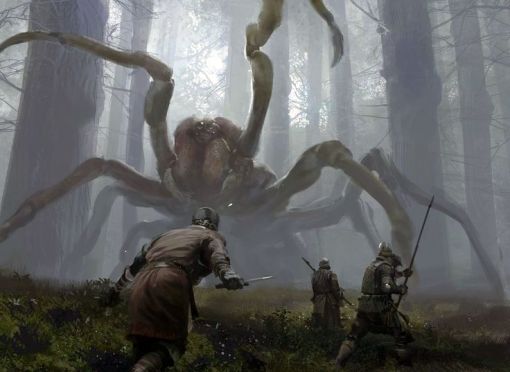
    When late summer comes to middle earth, conversations in the taverns and marketplaces of Anduin naturally turn to the most hideous forms of arachnoid death. As the oppressive heat of summer fades from Mirkwood’s dim reaches, to be replaced by the moldering stillness of autumn, and the first red tips can be seen on the leaves atop its dense canopy, the great spiders reach the end of their spawning season. In the long hot days of July and August, their chitterlings still small, these hideous beasts could satisfy themselves with the blood of small woodland creatures that they caught in light webs scattered in wide orbits around their central nests. But by the end of summer their squirming horde of new grotesques are large, and hungry. They have already eaten the smallest of their brood, and as their many eyes turn a hungry regard on the remainder of the nest their parents set forth to snare larger prey. In Anduin around the Mirkwood the cooler harvest months of September and October are also called the gorging season, for that is what the spiders do. All of Mirkwood trembles with the fear of these merciless predators stalking in the lower shadows of the dense woodlands, and the folk of Anduin discuss the ways they can die. Is it better to be taken at the end of autumn, by which time the spiders are sated, to be stocked in their larder for weeks of slow bleeding, perhaps with a little hope of rescue, or to be run down and sucked dry in a brutal orgy of bloodlust in the undergrowth?

    Opinions differ on this urgent question. These grizzled old woodmen and girlish scouts have all heard the stories – though of course none have met the man at their centre – of the survivor, who lived by licking rainwater from the webbing that held him, perhaps snapped on an occasional bug, crying out occasionally for help (better to do this after the chitterlings have fed on a nearby deer or boar, so as not to draw their attention) and praying to whatever gods can hear desperate whispers through the impenetrable canopy of this godforsaken forest; until after some weeks a miraculous rescue is mounted, and a band of Orc hunters or late-autumn woodcutters frees him from the web. This man had hope, or so they have heard. But all of them have seen with their own eyes the frenzied hunting packs, heard the desperate cry of their comrade and rushed to his aid only to find him writhing on the forest floor beneath a squirming, raging, chitinous mass of venom and death, his fate sealed. It is best then to run, your own survival guaranteed by his sacrifice, but your sleep forever after to be disturbed by the haunting sound of his weakening, desperate cries, the final gurgle, and then the clicking and slurping of feasting monsters.

    This conversation will repeat itself in the taverns of the wood folk all across the wide banks of the Anduin. Perhaps someone will brush away a tear; someone else will turn their gaze to the rose blush of sunset over the distant trees, dark memories stirring. Then all will come to agreement – best not to go into the great wood at all during the gorging months, and avoid either fate.

    So it was that the Fellowship decided to avoid the deeper paths of Mirkwood altogether on their journey to the lonely mountain. They met at the eastern end of the Mirkwood road and traveled north on the plains, cutting east of Mirkwood in the lightly wooded hills and valleys of the dale lands. Our story starts as they reach the long lake at its eastern end, where the ruins of Old Lake Town stand silent and watchful in the autumn mists. The Fellowship has four members:

    • Annunon, a wood elf, veteran of the battle of five armies
    • Durin, his friend, a dwarf who is also a veteran of the battle
    • Aregisel, a woodman scout the two hired to guide them through Mirkwood
    • Roderick, a barding squire whose father fought with the dwarf in the battle, and sent him to learn wisdom with the veterans

    Their aim was Dale, where in the first snows of winter the five armies would enjoy a reunion to relive their valiant victory and bicker over who was bravest. Annunon and Durin were returning to the scene of their first (and only) glory, where their bond of friendship was forged atop a blood-slick pile of orc corpses, and to hasten their journey they had engaged the services of Aregisel; Roderick was a burden thrust upon them by old friends.

    Having recommended a path that would draw them clear of the spiders commonest haunts, Aregisel had led them north to the lake. Here they camped on a promontory, enjoying the late autumn evening, while Aregisel scoured the lake shore for treasure. At this point the burnt and shattered remnants of docks and warehouses lay crumbling in the water, interspersed with the bleached bones of the dragon, and it was Aregisel’s hope that some treasure might remain – perhaps a merchants stash dislodged and drawn to shore in the summer storms, or a gem broken off the dragons scales and gleaming in the shallows, somehow missed by looters in the chaotic days after the destruction of Lake Town. He found nothing though, except a memorial coin minted to commemorate the occasion of the mayor of lake town’s fifth election victory – a prize of a kind, but none left alive to appreciate it. Satisfied this part of the lake had been scoured clean, and unnerved by the mists hanging over bones of city and dragon alike, Aregisel returned to camp before dusk.

    The next day they headed west towards one of the lakes crossing points, a remote and little-used raft crossing that Aregisel expected to be quiet and cheap. They traveled without structure, expecting no trouble and setting no guards, enjoying the cool air of the valleys and the joyful bird song of late summer. But even this close to Dale there are wild things and wild men, and some hours’ journey after the midday break they heard yelling and telltale cries of altercation from just the other side of the slope they traversed.

    The Fellowship are men of action, if not of wisdom, and both Durin and Roderick ran for the hilltop at the first sound of conflict. Annunon and Aregisel, none the wiser but much less courageous, melded into the brush at the side of the road and moved more cautiously forward. On the other side of the crest they saw before them a classic tableaux of rural banditry: Three roughly-dressed men carrying swords were harrassing an aging merchant. He had backed against a tree, leading a pony laden with supplies, and was holding off one of the men with a rough piece of wood grabbed from the trail side. A small boy clung to one arm, and as the Fellowship watched one of the men pushed the merchant back at the tree, yelling threats of death and worse.

    Never known for their wisdom, Durin and Roderick rushed to intercede, marching down the hillside and yelling threats. One of the men stepped forward, sword drawn, while two others maintained a wary guard on the merchant. Roderic, resplendent in mail hauberk and a tower shield passed down from his father, tried to impress the rough-cut bandit with his poise and authority, but the bandit merely laughed off posturing by a man so fresh from childhood that he had yet to muster a proper beard. Durin, dwarven veteran, sported a resplendent beard and a menacing manner, but before he could assert himself the man threatened him dourly, “This ain’t no biz o’ yers, git gone now ‘afore I cut ye a new mine.”

    Now Roderic recognized the trio, notorious bandits from Dale who had a reputation for elusiveness and viciousness. He tried threatening back, but the man was having none of it; he simply spat in the youth’s direction and grunted “Git gone, yer little twerp, or I’ll ‘ave your balls and your mammy’s too.”

    Of course the man had not counted on the two hidden in the shadows of the verge. They both let fly with their bows, but both missed. Shocked, the other two men moved forward, and battle was joined. Durin and Roderic both tried striking the leader and missed, but Aregisel’s second arrow struck true, piercing the lead bandit’s chest and passing straight through him in a burst of broken fletching, then hitting a pot on the merchant’s pony with a resounding clang. The bandit fell, killed instantly by the blow, and a moment later Annunon’s arrow pierced the second bandit’s hand, pinning him to a tree. The third took one look and turned tail, bolting for the cover of the trees. Aregisel tried to shoot him in the foot but missed, and before anyone could make chase the fleet-footed bandit had disappeared into the shadows.

    “No matter,” Aregisel called to the others, nocking another arrow and surveying the surroundings carefully. “Soon it will be dusk, and ’tis the gorging season.”

    Battle done, they descended to talk to the merchant and hear his sorry tale. He was grateful for the rescue, and revealed to them that this sorry band of reprobates had been his employees, paid to escort him to the hall of the elf king, and had turned on him once they reached the isolation of the long lake. He had been given the choice of handing over all his money and goods or losing the boy, his only son. He was on a mission to collect trade goods from the elves and transport them to the woodfolk, and these treacherous knaives had been offered 2 treasure each to take him there; he had already paid 1 upfront, and if he did not complete this trade mission by winter he would be ruined. Would the Fellowship assist him?

    Seeing a chance to make a name for themselves and a little money, as well as to help a good man in need, the Fellowship agreed, after some negotiation. Aregisel searched the body of the dead man and found nothing – not even his broken arrow could be salvaged from that carnage – while Roderic convinced the merchant to offer them 8 treasure regardless of how many survived the trip. They left the body where it lay, released the man pinned to the tree on his bond, and set out down the path to find a good campsite before sunset.

    Somewhere in the forest, a man ran for his life – and the great spiders stirred as the lazy evening of autumn bled into night…
  • They all look the same to me
    They all look the same to me

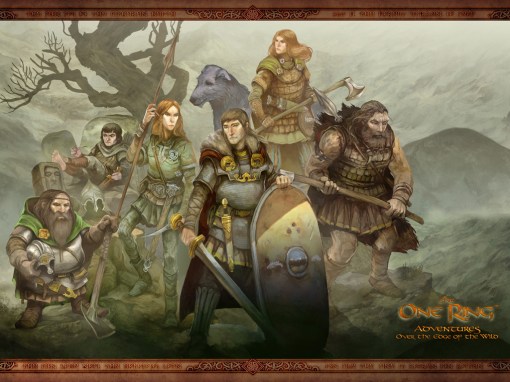
    I have begun a new campaign with a new group, playing The One Ring. This is Cubicle 7’s Middle Earth role playing game, which seems to have been broadly well-received and is certainly a thoughtful and beautiful work. We’re playing on Wednesday nights for about 3 hours, and so far we’ve only managed to complete character creation, so I can’t say anything about game play, but I can give a brief description of character creation.

    Basically in this game you make three choices: your culture (i.e. race); your “calling” which is some kind of aspect of your character determining things like what skills will advance fastest and (from memory) your vulnerability to the shadow; and your background, which is effectively your character class and further refines some aspects of your character. After this you get 10 points to spend on skills (advancing at 1 point per rank, cumulative), weapon skills (2 points per rank, cumulative) or a few other things. Characters have a bunch of traits that determine aspects of how their personality will affect play (e.g. brave, foolhardy etc) and also some special properties that are determined at one of these three stages. Character creation is relatively quick and involves no dice rolling: in fact nothing about it is random at all.

    This character creation system has made some interesting decisions that clearly break with standard RPG character creation practice. In particular:

    • All your starting skill and weapon choices are determined by your race. Your skills are fixed and immutable – every elf or woodman starts with the same set of skills – and you have a choice of just two weapon sets, with no variation. You can use those 10 points to modify these but these 10 points are a tiny portion of the total skill allocation. You start with at least one skill at rank 3, for example, which would require almost all the 10 points to acquire. Effectively your starting abilities are entirely determined by your race
    • Your starting attributes are determined by a combination of race and background. Most backgrounds appear to be similar across the races (I didn’t get a chance to look in detail but e.g. Woodmen and Dwarves both get “Slayer” as a choice) but the attributes will be distributed differently for two races with the same background. For example I have 2/4/7 in the three attributes, while a dwarf might get 4/5/4, for example. You get to add “favour to these” but this favour amounts to just 6 points spread over the three attributes, and is only used under specific conditions, so it’s not the main determinant of your attributes
    • The majority of your starting personality traits are determined by your race. There is a list of perhaps 12, and you can choose two from a sub list of 6 that are specified for your race

    Because of the combination of calling and background it is possible for two characters of the same race to differ slightly from each other in outlook, wealth and attributes, but they will essentially have exactly the same skills and almost the same attributes at the start of play. It’s not like D&D where you slightly modify the base random distribution of attributes, and skills are entirely class-based; it’s not like warhammer where attributes have a slightly different base and level of randomness and there are some additional talents. Everything is determined by your race.

    What a remarkable coincidence! How amazing that a game that attempts to faithfully recreate the world of Lord of the Rings should choose a character creation system in which your race determines everything that we normally accept as mutable about a character. I have said before that Tolkien’s work is heavy with racial determinism and the race-as-destiny theories of the era in which he wrote, and I have received considerable pushback for it. I have previously adduced as evidence of this Tolkien’s attractiveness to fascists. I’ve also said that his work has undue influence on other fantasy writers and casts a shadow of racialism across the whole hobby. Well, what a surprise then to discover that a game attempting to recreate the world puts this aspect of it at the centre. And in case one were inclined to suspect that this is just a coincidence, here is the creator of the game on this issue:

    The main reason behind the majority of the design choices in The One Ring is faithfulness to the sources. In Middle-earth, culture is the main defining element in an individual, and by limiting the choices in that regard help us attain a genuine ‘in-world’ perspective

    Notice what that blog post adds: culture determines one’s virtues and rewards. And in this comment, “culture” is simply code for race. In attempting to recreate the world faithfully, anyone who delves into it immediately notices that they need to privilege race over all other aspects of background as a determinant of not just physical attributes but also psychological and moral attributes.

    I have skimmed a few reviews of this game and the completely non-random aspect of character creation doesn’t seem to come out as a big issue for anyone. I have a suspicion that if someone tried such a tactic in any other setting their game would be viewed the worse for it, but in this case the game gets a pass. These reviews have generally also talked about how this game really is an immersive Tolkien experience, to the extent that they can’t imagine the system being used for anything else. I can’t give my opinion on that yet, since we haven’t started playing, but it certainly looks like there are many aspects beyond the character creation that imbue the game with a strong Tolkienesque flavour – the special rules for travel and fellowship and the Hope/Shadow mechanic, for example. I’m not sure if I’m going to like the system, but it looks intriguing and possibly very very good (the reviews suggest that people who play it really like it). I’ll review that when I have had a chance to test it.

    I guess it’s not obvious from my critical review of Tolkien’s work but I am a real sucker for his world – I love it and have gamed in it extensively using MERP. I think The One Ring could be a vast improvement on MERP and offer exactly the right flavour of gaming that I have been looking for in Tolkien’s rich, detailed and beautiful world. But I go into that world with a clear understanding of what it is – a scientific racist, authoritarian conservative fantasy of a dead past that we can all hope will never come back to life. This game is another example of just how powerful the racial underpinnings of the world are, and how hard it is to genuinely appreciate the world without accepting that aspect of its creation. And I present this game as further evidence of my claim that whether anyone wants to admit it or not, no one can conceive of Tolkien’s world without accepting the deterministic and moralistic nature of his racial heirarchy.

    While we enjoy this world and all its descendants, we should also remember that fantasy needs to be about so much more than this, and that while its creative, lyrical and mythical influences on fantasy have been huge and beneficial, the overarching influence of its scientific racism and conservatism have not done this genre – or our gaming world – any favours.

  • jerome

    On the weekend in addition to a fine session of Vampire: The Masquerade I managed to get my philistine arse down to the Tokyo National Art Center for an exhibition of paintings from the Gallerie dell’Accademia, Venice. I went with a Japanese friend, and while my friend was oohing and aahing at all the cool artwork, I was remembering my trip to Venice and imagining Drew smashing her culture chip and killing the Pope.

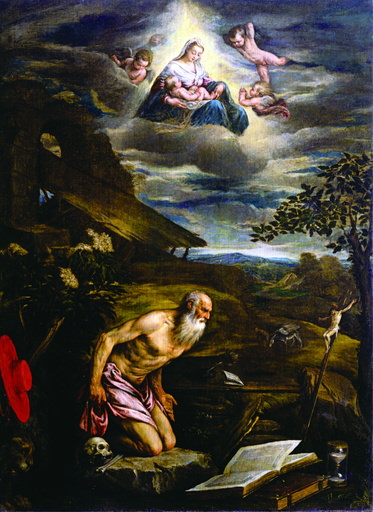
    And so then I stumbled on this picture, which I think summarizes everything Drew was getting at when she got angry with the skeezy old men leering at the virgin Mary. I think this picture, which is called St. Jerome in Penitence and the Virgin and Child Appearing in Glory, contains a kind of potted summary of everything that is wrong with Christianity’s strange and tortured attitude towards sex. It features an old semi-naked man (Jerome) punishing himself for thinking lascivious thoughts, while staring at a small statue of a young man who was tortured to death by his father because everyone keeps thinking about sex, and all of this being stared at approvingly by the spirit of Mary, whose sole reason for being able to judge anyone for thinking sexy thoughts is that god made her pregnant against her will but she stayed pure. In this one picture we have sin, guilt, death, and purity, all deeply entangled with sexuality and heavily leavened with judgment. It’s hard to see on the internet version, but we also in the bottom left hand corner have a kind of terrified looking lion, nature subjugated – another core Christian ideal. It really is the Renaissance version of one of those tweets that people subsequently delete that tells you everything you need to know about their inner life, and wish you didn’t.

    In addition to this picture of a skeezy old man punishing himself for being skeezy, the exhibition had a whole bunch of pictures of Mary being told that she was going to have a baby against her will. Impregnating someone against their will is now considered to be a pretty shifty form of abuse (even if it isn’t rape; it’s easy to find stories of abusive partners fiddling with contraception to try and get their partners pregnant), but it’s a central theme of Renaissance art (or at least it was in this exhibition). Mary looks pretty unhappy in most of the pictures where she’s being told this, but it’s hard to say that she really is – my friend said she looked like she was about to say “why me?” but in reality almost every person in almost every picture looked unhappy. I guess the Renaissance wasn’t a happy time, which is why all the models had Resting Bitch Face. But she certainly looked shocked, and the narrative accompanying some of the pictures made clear that she is supposed to be shocked.

    As you would be.

    But anyway as a consequence of giving birth to this damned child who grew up to be killed by his own father, she gets to hang out in heaven with another baby (the same baby? Seems to be the implication of the title of the picture – is heaven a kind of Groundhog day where she is constantly pregnant but never gets laid?) and cast judgment on all the men who are secretly dreaming about doing God’s work inside her. And this is the only payoff any of these pictures offer – the chance to judge others. Sure, there’s one picture of heaven, but it makes heaven look like the bottom 10% of that Iron Maiden Number of the Beast poster, where everyone is screaming and dying or fucking, only in the Renaissance version there’s no fucking. Renaissance paradise looked a lot more like hell than I think they intended, but that’s apparently the reward for a life of Resting Bitch Face and self-flagellation. Which I guess is why Bassano produced this monstrous visual rendition of his tortured inner soul.

    Just to be clear for all the doubters and whingers, I’m not saying the picture is bad or shouldn’t be held in esteem or whatever. I didn’t like it, but I’m no critic and I don’t think I can separate my appreciation of the art from the nastiness of the content, so I couldn’t really appreciate it, but if people say it was influential and important then I’m happy to believe them. My point is merely that it says so much in one dense little package about the origins of so many of our modern problems with sex and sexuality. In that respect it is a thing of (horrid) beauty.

    Two other random thoughts I had while wandering the gallery:

    • I wonder if these artists, all male, had actually seen many babies or any naked women? I don’t mean this facetiously, I really wonder. If raising babies was women’s work perhaps they didn’t see many, which might explain why the babies are all a) the wrong size and b) horribly ugly and c) painted like miniature adults. Perhaps they didn’t see much of their children? In the same vein I noticed that their men were much better drawn than their women and I wondered if perhaps they had never seen an adult woman who wasn’t their wife? I then started wondering – a lot of the women in the pictures look more like teenage girls, in particular their breasts are kind of half-formed and not mature. It made me think – could it be that the only people they could find as life models for female subjects were the children of poor families, and the reason that their women are so badly drawn and strange looking is that they were extrapolating from the budding female bodies of local 12- or 13-year old milkmaids?
    • The same day I went to see this I had read an article about terrifying new findings of highly antibiotic resistant bacteria in chickens and pork, accompanied by more warnings about the dire threat of antimicrobial resistance (AMR). Of course the Renaissance was a time before both antibiotics and the contraceptive pill, not to mention advanced cancer treatments, and it’s likely that most of the older people in the pictures are suffering from various ailments that we just can’t imagine being an issue for the kind of rich people depicted in the scenes – tooth decay, chronic pain, chronic headaches due to poor eyesight, that sort of thing. Maybe Mary looked unhappy in all those paintings because she had a chronic UTI? If so, anyone who doubts the threat of AMR for our future quality of life should check out a hall of Renaissance paintings and ask themselves – do I want to go back to that??

    This exhibition really impressed upon me that I don’t like this kind of art. Of course I find it interesting and I engage with the exhibition, even if in this case my random speculations may seem a bit facetious. But ultimately it doesn’t seem like good art to me, and the messages it contains are quite horrible. As a document of our past it’s fine, of course we should respect it and view it etc., but when I look at art like this I always leave overwhelmed by all the horrible ideas behind it, and I really think that to properly present this art to a modern audience some kind of sensitivity to or discussion of these issues would make for a better viewing experience. In this case the majority of the audience were Japanese, so it’s probably just a curiosity to them, but for westerners looking at this art it is really rich in themes that we may not be able to express clearly in words but which I think hit us anyway, and a bit more engagement with how those themes affect modern audiences might help them to react a little less viscerally to some of the denser, nastier stuff. I can’t say I’ve ever seen an exhibition of this skeezy ancient art that has made any attempt to engage with these more controversial aspects, and I expect I never will. But I think it would be nice. And I think until we do begin to engage with these underlying archaic values consistently and clearly, we’ll never really see them swept away.

    Which is what I want to see. I want to see this creepy undercurrent of death and guilt and dirt washed out of our sexual substrate, so that we can get on with the business of being sexual unencumbered by our necromantic origins.


  • Still not cool
    Still not cool

    Recently there have been three very different media controversies over sportspeople and politics in the USA, and I think all three are really good examples of how many countries treat their sports people in a really terrible way. In particular, I think these cases show the huge pressure modern sportspeople are under, and a lack of perspective on sport. The three cases in question, which all show very different aspects of this common problem, are Ryan Lochte, Colin Kaepernick, and Dwayne Wade. Each of these cases shows a slightly different aspect of the unrealistic and unfair attitude that modern sportspeople have to deal with, though of course being American they’re leavened with a whole bunch of extra race politics.

    The first case, Ryan Lochte, on the surface seems a classic case of white “privilege” and a star treating ordinary people terribly. It appears that Lochte and friends, drunk after a big night out to celebrate being every American’s hero, trashed a public toilet and pissed on it, then the next day made up a story about being harrassed by local police. This led to uproar and cries of white “privilege” and terrible American attitudes towards foreign countries. Lochte is a kind of poster boy for this kind of thing because he’s obviously a kind of clueless jock, and although everyone wanted to suck up to the clueless jock in school, we all want to tear him down once his jockish ways lead him to ruin as an adult. Except in this case, everyone criticizing him seems to be overlooking the fact that he was forced at gunpoint to hand over money to pay for the damage he did by some kind of security guard or policeman (it seems likely it was a policeman). In Australia and the UK, and I suspect the USA too, if a policeman or security guard forces you to hand over money at gun point for any reason, any at all, that is either robbery or serious corruption. In Australia that act would have the security guard/policeman in jail, and possibly the petrol station owner facing charges of receiving stolen goods. Although much of the press is up in arms about Lochte being treated leniently, it appears to me that he and his friends were either treated in a deeply corrupt way, or treated exactly as the locals would be (perhaps with a foreigner surcharge). I don’ t know which, but I’m very sure that the way the police/security guard treated them was dangerous and reckless well beyond the level commensurate with the crime, and even if they’re used to guns, being threatened like that is a terrifying response to pissing on a wall and smashing a toilet. The coverage of Lochte’s misbehavior and subsequent “lie” stinks to me of a media class enjoying payback against the kind of person they think is an overpayed, unqualified idiot. Which he might be, but this is the same media class that lauds the olympics and feeds on just so stories of valour and struggle by people like Lochte for a ridiculously hyperbolic three weeks of jingoism. It’s a little rich to build up these people as pure heroes of American goodness, and then to knock them down as over-privileged idiots when they act like the jocks they are. The sudden surprise that a swimming star who has never done anything else is a bit out of touch and clueless is a little rich coming from a media that has done all it can to make men like this think they are gods – especially when the heart of the story is an actually quite terrifying story of police corruption.

    Colin Kaepernick’s case then shows what happens if a sports star tries to show that they are not a clueless over-privileged idiot, and actually engage with the political issues of the moment. Kaepernick exercised his right to free speech by not standing up for the US National Anthem, apparently because he thinks the US hasn’t resolved its race relations issues yet, and he can’t stand proud of his nation while it is treating black people worse than white people. It seems to me, looking in from the outside at a nation that claims to have enshrined free speech in its constitution, that Kaepernick has every right to do this, and that he isn’t disrespecting his country by saying he wants it to improve before he honours it publicly. There’s a rich vein of important political debate to be mined here in a respectful exchange between opposing views about why a black sportsman would feel he had to take such an extreme position to make a point, but it doesn’t appear that much of the media took him seriously at all. He was derided for disrespecting the troops, told to stick to sport, and sneered at for being a rich man completely out of touch with his peers – again, sneered at for being over privileged. So here we have the media that got into uproar over Lochte not behaving like a responsible adult and for not respecting his role as an ambassador of the USA getting in uproar over an athlete who cares about using his public role as an ambassador to change things; and the same media that benefits from the huge money sportspeople make, sneering at this rich sportsperson for being out of touch. In Kaepernick’s case as a black athlete this latter charge is particularly smelly, since we know that it’s much harder for black people to be successful in the USA and sport is one of the few ways that mainstream racist culture has allowed black people to be successful; but now that this man is successful his very success is used as a weapon to discount his attempts to represent the political issues he believes in. Kaepernick seems to have behaved fairly well in response to this, meeting an ex-veteran footballer for a long chat and then moderating his stance to a one-knee protest that he claims simultaneously respects the troops but maintains the protest. He also has given a million dollars to community groups, which seems to suggest that the only way he can be taken seriously is if he gives up money for a cause. When was the last time a journalist was expected to give money to a cause before criticizing a politician or engaging on a particular issue? How many of the sports journalists outraged about Kaepernick’s behavior have given even a cent of their easily-earned money for a cause?

    Finally we have the case of Dwayne Wade, who was thrown into the public spotlight after his cousin was shot in some kind of tragic drive by, and Cheeto Jesus used Wade’s family tragedy to further sink his electoral prospects in a singularly tasteless tweet. Wade didn’t ask to be thrown into the spotlight – he’s just a sportsman who wants to do sport! – but he made the mistake of mentioning gun control, which is disaster for any American in public life. He then had to give interviews about this issue, which is just terrible – his cousin has been murdered and he has to give interviews about how he feels about some stupid carnival barker using his personal tragedy for political traction. I think anyone reading this would feel a kind of deep dread at the thought of having to go on national TV to talk about their feelings in a case like this – and Wade has to do this in the context of Kaepernick’s ritual humiliation and the scorn shown to uneducated and ignorant jocks like Lochte. Wade seems to have managed to handle this by some deftly understated scorn, but many is the sports person who in this situation would melt down and suddenly become the bad guy of the case.

    I think it’s safe to say that in all these instances, these guys didn’t ask to be spokespeople for their country, for their racial group or for a gun control cause. They didn’t expect to be in these situations, and they probably assume – wrongly, it appears – that if they are they will be afforded the same basic human decency and respect that everyone else is. Instead they are subjected to a kind of trial by fire, in which the rules are constantly changing and their lack of education or eloquence or political sophistication becomes a tool to be used against them. They aren’t politicians or journalists or scientists, they’re sports people who have devoted their whole lives to a career that does not reward learning to speak well, articulate ideas or give nuanced responses to complex and difficult problems – and they also happen to be rich and, yes, privileged, often by random luck. But through this random luck and the subsequent privilege of wealth and exposure, they suddenly find themselves unwitting ambassadors, or prisoners of their own conscientious actions, or just randomly cast into a situation they probably can’t handle, with a jealous and mercurial public and media waiting to pounce on any error, and punish them for not living up to standards that they have been set up to fail by a sports complex intent on victory and achievement and entertainment over all else.

    These guys aren’t the only recent cases, of course. There are some – like Hope Solo – that appear completely terrible from the outside, and others like the completely horrible treatment of Gabby Douglas for not being exactly like everyone else. I think it’s obvious that some – like the treatment of Kaepernick and Douglas – has an additional racial bias that they can’t control or in Douglas’s case even predict, but even for the “privileged” white boys or crowd heroes there is still this rapid and unreasonable fall from grace after they make a single slip. I think this is a deeply unreasonable and irrational way to treat sports stars. If you don’t like them being rich, don’t pay them so much; if you don’t like them behaving like princes and princesses, don’t treat them like that; and if you don’t want them taking unpopular political stances, don’t treat them like role models. If you’re going to sack a football player (or a cheerleader!) for some minor transgression against your role model code, don’t be shocked when they decide to act like a role model and take a strong political stance that is unpopular with your viewers – you told them to be a role model, so deal with it. If you’re going to take them out of school at 15 and sequester them in a jock- and testosterone-filled bubble, then pay them fantastic amounts and market them as heroes and sex symbols, don’t be surprised when they act like dickheads. And don’t forget that they’re human, and maybe won’t behave well when they wake up with a hangover after a night of being threatened with a gun by a corrupt policeman.  And if you do decide to treat these people with this kind of ridiculous and unpredictable double standard, don’t be surprised when some of the smarter ones troll you like this.

    It’s very clear that a lot of sports stars are overpaid and treated like heroes when they’re just ordinary men and women who are very good at one thing that probably shouldn’t really matter. But this isn’t a situation of their making – it’s a world they fell into because they were lucky enough to be good at that thing, and usually in getting into that world they had to close off a whole range of other, probably safer options, and they also had to leave the ordinary world behind. I’m a big sports fan, but I’m in favour of salary caps and a more rational approach to sport that doesn’t elevate these people to some lofty pedestal and reward them with orders of magnitude more money than they need. But if that’s the world that we have created, I don’t think we should then drag these people down because they are rich, or they decide to use the fame they have been gifted for some cause, or because they’re clueless after living their whole lives in this bubble. It’s the sports world that needs to be torn down, not the people who live in it.

  • The Prince is dead ... long live the Queen!
    The Prince is dead … long live the Queen!

    [This is a guest post by one of my group’s players, Eddie, about his Vampire characters]

    Lady Ashira (Elder)

    A protecting mother, a lover of beauty, self involved survivor.

    “ The most beautiful people are those who have known defeat, known suffering, known struggle, known loss, and have found their way out of the depths. These people have an appreciation, a sensitivity, and an understanding of life that fills them with compassion, gentleness, and a deep loving concern. Beautiful people do not just happen.”

    Lady Ashira has taken control of New York, after an extensive war with the Sabbath has ruined both groups and resulted in Final Death for most of the low generation vampires. Her rule is one of subtlety and charm, where those who make open threats or threaten ugliness have a tendency to mysteriously find divine retribution. As she would say, she truly, full-heartedly strives for everyone to feel safe and happy, and would gladly crush anyone who doesn’t.

    Embraced by the Brujah, the clan’s fury shows in her only if she, or the kindred and kine under “her protection” are harmed. She has been known to rage when her advances are refused or some beautiful art or innocent person is harmed in front of her. The Queen is extremely possessive, and it is not uncommon for people to regret asking for her protection, for while when given she will honestly do everything in her power to protect her proteges, the lines between protection and enslavement tend to blur for the Elder vampire. Some kindred have woken after years, only to find they’ve been under the Lady’s spell because they asked to be safe…

    Where the lady comes from is an unknown, but most agree it is probably from somewhere in north Africa. When asked, she always names a different country that touches the mediterranean sea; and follows it with a stream of phrases in the native tongue of the place she mentioned. Most people know not to push her too much on the matter; for some reason the Queen gets extremely … upset … when probed for information on her past.

    Those very few who know her well know that there is a streak of hidden survivalism to her, there are ugly rumours of her breaking under pressure or war, havens that burned to the ground and scores of surviving neonates with their memories shuffled. Those who know or suspect of these events, know also to keep their mouths shut, it is better that the gears turn smooth and the Lady remain kind and homely, for when they don’t, death and destruction seem to follow.

    The Good

    Kind, Understanding, Peace keeper

    The Bad

    Overprotective, Obsessive, Irrational

    Description

    Medium height, light skin, long red curly hair, dark eyes, slender figure.

    Camarilla

    “Order and peace are safe havens. The Masquerade keeps us all from Final Death, and provides our weakest with protection. Nevertheless, beware of the Tyrant who would use it as an excuse for power.”

    Anarchs

    “I can’t help but love their passion, it is a thing of beauty; but the real anarch movement is long dead. What is left is rebels without cause. The Anarchs, whether they remember or not, achieved their goal long ago, and we all paid the price for that. I hold them accountable for the Sabbath.”

    Sabbath

    “Ugh, ugly, ugly, UGLY!!!!”

    Independents

    “As long as they keep to themselves, let them have their weird rites and beliefs, especially if they bring me gifts from time to time…”

    Here's an offer you can't refuse ...
    Here’s an offer you can’t refuse …

    Johnny Falco (Ancilla)

    Mobster out of time, Territorial Demon, Anti-hero Daredevil

    “There are no atheists in a foxhole? Hah! What strunz came up with this shit? Spend a day in a trench, it’ll take you no time to realize, there is no God.”

    Everyone who is someone in New York knows Johnny Falco, the man can’t help but to be in your face. Dressed like it’s still the ’30’s, the loud mouth maniac has an unhealthy predilection for “making sure everyone knows their fucking place”. If he weren’t Katherine’s boy (and the Queen’s toy by relation), someone would’ve tried to openly whack him long ago. Not that they haven’t tried on the down-low, but “fuckin’ with Johny Falco, it’s signin’ up for a one item instant bucket list”.

    Johnny was impossible to deal with until the town got its senses together and gave him the perfect job, The Scourge. Now, instead of getting yelled at, icing random unannounced neonates is his fuckin’ job! What a sweet deal, though sometimes mistakes get made … but meh, watcha gonna do ‘bout it?

    Apart from being the bosses boy, in case you needed more reasons to stay way the fuck away from Falco, I’ll give you two: One, the man is a world war survivor, I’m talking Great War here. He was a trench fighter, and if the stories are real, he was part of a band of lunatics who would raid enemy trenches at knife point, going direct body to body in the dark. If you doubt it, ask him to show you the razor he used to scalp people with. Me, I’m easy with believing, man says he gutted soldiers in the middle of the night, hell I need no proof.

    Two, the man knows no fear. I’m not saying he is a hardass tough motherfucker, which he is, but I’m talking about borderline suicidal daredevil shit. I’ve seen him jump off roofs and into oncoming traffic, “just cuz it’ll be fun to watch ’em lose their shit the moment before the party started.” You wanna see crazy shit go down? Tell ‘im “I dare you to…” and add whatever the fuck crazy shit comes to your mind, then RUN, ‘cuz a massive fuckton of shit is on an expressway to meet the fan.

    All in all, you keep the man friendly, and a safe distance away, never step on his territory, and never ever talk shit about the Lady if youse anywhere close to him, and aaaaall will be easy peasy.

    The Good

    Loyal, Fearless, Friendly

    The Bad

    Short-fused, Territorial, Dark Secrets

    Description

    Short black hair, black eyes, tan skin, slim and medium height, decent looking, easy smile, Italian, always dresses in mob fashion

    Camarilla

    “The Cappo de tutti Capi says we play by the rules now, so we play by the rules now.”

    Anarchs

    “Oh man, how I love these crazy fucks, they never back down from a fight and are always trying to break the rules, man I enjoy catching them off-guard.”

    Sabbath

    “The sorry SOBs in the trench facing ours, I don’t know and couldn’t care less why we’re raiding then, but by god I love it when the Boss tells me to go open them a new one.”

    Independent

    “Bookies and deal breakers the lot of them, excellent for when playin’ by the rules ain’t gonna cut it. Just remember they ain’t family, and never will be family.”

    In the land of the mortal the One-eyed is king
    In the land of the mortal the One-eyed is king

    Michael “One Eye” O’Neal (Ghoul)

    Dreadnaught, Dock Worker, Falco’s Toysoldier

    “CHOO CHOO MOTHERFUCKER!!!”


    Ever heard of the gentle giant? the massive slab of cuddles? One eye Mike is exactly half of those statements. A titanic irishman with a simple love of smashing into unsuspecting crowds. The simple straightforwardness of his lifestyle is an inspiration for the masses. Boss says jump, he smashes through walls and enemies (jumping is hard when you weigh almost as much as a bear).

    And that’s that…

    Oh yeah, Falco took his left eye after Mike tried to go for one of the Boss’s harpies, bad for the image to have the commoners mixing with royalty he said, Mike can “have it back when he starts playing nice.”

    Before that, being the hulk of a man he is, Michael was on the fast track to becoming next in the Brujah line of nutjobs, but now, without an eye and in the bads with the Lady, there is little hope he makes it so far. He will try though, the recent events are his opportunity to shine and see if he can get his eye back.

    The Good

    Hulk’s body

    The Bad

    Hulk’s brain

    Description

    Hulk (colour variation)

    Camarilla

    “Eh…”

    Sabbath

    “Grr…”

    Independent

    “…”

  • How it was
    How it was

    Edgar Evans is an eighth generation kindred character in the new Vampire The Masquerade short campaign my group has started. The campaign is intended to involve not just the vampire characters, but also their elders (6th generation legends) and also one ghoul in the service of the ancilla. Edgar Evans is a rich man with a business empire, and he also has a small domain, and it is in this domain that his ghoul, Tia Nero, can be found. This post is the description of his domain and an introduction to Tia Nero, but in order to understand this domain, it is necessary to understand the politics of supernaturals in the second decade of the new millenium, as the humans they had long ignored, scorned or fed upon begin to build a world that is closing in on the supernaturals, and crushing them.

    A brief history of supernatural failure

    For aeons the main supernaturals ignored human development. Sure, the vampires fed on them and the Fae remained intertwined with them, but these relationships were not symbiotic or cooperative – humans lived in fear of the unknown, crouched in the dark and looked to superstition to rescue them from their night terrors. Over all the millennia of this unpleasant coexistence the supernaturals achieved nothing, made no mark on the world except, perhaps, to score fear in the human soul.

    But then human science overcame human superstition, and those fear-scars became just a cultural memory. It wasn’t just that there were too many humans for the supernaturals to scare directly – it wasn’t just the thronging mass of these stinking, short-lived, frail and useless cattle. Science overcame fear, and then slowly science overwhelmed the natural world. For millenia humans and supernaturals had lived side by side, and nothing really changed – and then in one century humans changed the whole world. The supernaturals looked on in horror as humans harnessed the power of the sun to destroy cities, and tried to come to terms with the ability of humans to vanish darkness and fear with cold logic and simple technology. They dismissed all that – sure humans could build big things, but they were still just frail and weak cattle. What’s to fear?

    But then the anthropocene began, and the supernaturals felt fear of their cattle for the first time. Every summer the werewolves would find new settlements, would get into fights over lost land, would find their wild reaches slowly stripped back and reduced, and though they might fight an individual farmer successfully, soon enough the hordes would arrive and they would need to fall back to a new redoubt. The mages discovered that it was harder to do their dingier works. It wasn’t just the new laws about child exploitation, or the sudden desire of humans to catalogue every one of their pathetic number, so they could never be lost. It wasn’t even the new laws on ownership and cruelty that made it so much harder to conduct animal sacrifices, or the sudden loss of empty urban space that mages would use for their less savoury experiments. The mages really noticed when they found they could no longer obtain the magical reagents they needed, because the mere existence of millions of Chinese using traditional Chinese medicine drained their reagents dry. There were so many of these pestilential creatures, consuming, consuming, always taking and taking and needing more … The vampires noticed that the dark and secret places of the old cities had disappeared, been replaced with warehouse apartments and subways and underground parking zones and all the paraphernalia of a civilization that increasingly was ignoring them – until it started making bad movies and games about them. In the space of a century they went from an object of fear to a kitsch joke, laughed at by the new science.

    Nobody asked the mummies what they thought. Who would dare?

    But the supernaturals that noticed it most were the Fae. Intimately connected to the patterns and cycles of nature, their supernatural home’s fate intertwined with the physical world, they noticed very quickly as the planet started to warm. As the summers lengthened and the ice began to retreat, the balance of power of the courts of Winter and Summer changed, and Summer began to rise. They watched the behavior of humans and they realized – disgusted at the potency of human science – that humans identified the changes a scant 50 years after they did. And worse still, humans identified the cause – humans were the cause. The Fae began to panic.

    Most vampires did not care about the Fae, although a few had their connections; even after the Fae’s warnings began to spread, most vampires cared little for the threat of global warming. They were creatures of the night, and CO2 was not going to change the earth’s orbit. Some reacted against it with the same kind of visceral wariness that many humans show towards nuclear power, simply because of its association with nuclear weapons: Vampires have always feared the sun, and anything which enhances its effects fills many of them with a kind of unwary, superstitious dread. Others saw in global warming an opportunity – after floods and storms people go missing, and the chaos engendered by these catastrophes opens up an easy hunting ground for their kind, free of the increasing risk of reprisals that had made the Masquerade so important in modern life. For them, global warming was a chance to enjoy chaos.

    But some thinkers amongst the Fae and the Vampire recognized the real philosophical threat. In a scant 100 years humans had gone from cowering, sniveling prey to a vast hive mind that could change the climate of the entire planet. They had become a horde, swarming over the planet in such numbers and building their greedy edifices in such abundance that they had not only destroyed the earth’s natural beauty, they had changed the weather, and now they were harnessing the sun and the power of the sun. The balance had been disturbed, and it was clear that its restoration would require extreme measures. A movement arose in kindred society, a movement popular among the Brujah and some of the darker sects and alliances – a demand for a cull, a real cull, before this horde overwhelmed all the dark spaces of the earth with their lust for things and their increasingly loving relationship with the sun. What if they found a cure for vampirism, some asked? What if they discovered the kindred’s society, and decided to purge it, or discovered a vaccine against the creation of new vampires? Many laughed at such fears, but the chuckling died down when the thinkers observed that humanity had eliminated smallpox in a mere 30 years, that there were societies where almost no child died, that in modern society it was impossible for a child to go missing without thousands of people descending on the scene of the calamity. They always found their murderers, and the time it took them to find a solution to a problem was growing shorter and shorter. From the discovery of smallpox to its vaccine took thousands of years. From the discovery of HIV to its treatment took 20. How long would it take them to purge the world of vampires if they found them? And as they swarmed over the earth, defiling it and investigating it and laying bare its dwindling cache of secrets, how could they not find the kindred?

    It wasn’t exactly a panic, but a kind of paralysis set in amongst the supernaturals. They watched as the dark places, the wild places, the sacred places were first torn away from them, then paved over or turned into tourist spots, young couples taking selfies by the dozen in places that a hundred years ago they would have been terrified to walk within a day’s march of. What could they do about this? In their slow and sinister way the vampires schemed, and assumed that they would always be able to hide amongst the flesh folk, always be able to make some new scheme.

    For the Fae, though, the philosophical debate quickly became a real battle for power, as it always does amongst the Fae. After the Court of Winter’s amateurish attempt to start a nuclear war in Cuba a fragile political truce was born – no more direct interference in human affairs, by any of the Courts, and everyone expected them all to honour it. But nobody counted on the Changeling, whose numbers grew as the human population swelled. Changeling were like sleeper cells for their courts, a kind of Super PAC of faerie power, who could act on behalf of their Courts without breaching the fragile agreement the Courts had made after the Winter Court’s foolish attempt to produce a nuclear winter. They manoeuvred their changelings like pieces on a chess board, infiltrating human business and politics to try and get their way. By the early 1990s everyone in the supernatural world knew the score: Winter and Spring were with the Democrats, and Summer and Autumn with the Republicans, because all of Fae meddling had shaken out along one deadly axis – global warming. By the early 1990s nothing else mattered, because every Court knew that Summer and Autumn would be forever ascendant if humanity failed to tackle the causes. All of the Fae realms had realized their fate was now tied to that of humanity, and they bent all their will to changing it.

    Naturally they sowed the ranks of business and politics with changelings. One such changeling emerged in the 1980s in business, and began to grow in power and influence. He was aging but still robust, an orange-faced caricature of a rapacious businessman, making his money in dodgy real estate and casino deals, tied to the mob and bribing politicans wherever he needed to, playing fast and loose with every standard of business and human decency – a classic progeny of the Summer Court. This man was a crass, larger-than-life bully boy, a carnival barker with tiny hands and huge insecurities, the kind of narcissist who makes it big in Fae life, and by the end of the 1980s he had begun to reap the rewards of that narcissism in mortal life, with ghost-written books and tasteless TV shows. And in the early 1990s he began to make hints about turning his popularity to political advantage – he began to talk about moving into politics.

    This was too much for one Vampire, Johnny Falco[1]. Johnny Falco had an irrational hatred of the Fae and their machinations[2], and the thought of a Summer Court Changeling taking control of American politics filled him with disgust – especially this repulsive, orange-faced ignoramus with his trashy tastes and his terrible architecture and his shallow opinions on everything. This was exactly the kind of person who really irritated Johnny Falco, and who made his grandsire despair of the cattle. So one day in 1996 while at one of his casinos in Atlantic City this businessman was murdered, horribly, with a trenching shovel and a gold-plated scale model of one of his own towers. No one saw the person who did it, no one understood how the perpetrator could have gotten into the businessman’s inner sanctum, or how he had managed to remove his face and leave it on a Ronald McDonald statue a stone’s throw away from the tower, in full view of a whole cluster of cctv cameras, but there it was the next day, leering bloodily at a small group of terrified Japanese tourists.

    The mystery was never solved, and the businessman’s empire fell into ruin – and nowhere more so than his Atlantic City casino properties.

    The Domain

    Johnny Falco didn’t just kill the businessman – he also killed his property. The Atlantic City casino properties were bleeding money, but after the murder the authorities discovered an elaborate system of shell companies that covered up for … nothing. They couldn’t find where the money came from or who was responsible for the properties, as if the dead businessman had been a mere figurehead. The casinos sat empty as investigations continued, but even years later no trace of the original investors could be found, or their money. Occasionally a city authority or some rival business would set up a scheme to buy the properties but always at the last moment someone would get cold feet, or the key figure in the investment program would disappear or die, or suddenly their business would be bankrupted overnight by some strange market play. The business world gave up on them and they fell into disrepair, crumbling in the centre of Atlantic City’s glitzy gambling zone. But buildings like that don’t just decay – they poison. Their rot spread out from them like a cancer, infecting the businesses around them and slowly paralyzing the entire zone. Investors saw easier pickings in native reservations and the effervescent Vegas economy, and slowly they pulled their money out. By the turn of the century the collapse of the casinos had spread outward to infect a large part of the Atlantic City seafront, which became a low-rent junkyard of pawn shops, bounty hunters, gunshops and cheap liquor stores. A section of the city 10 blocks long became a wilderness of malfunctioning neon and broken lives, a self-governing conclave of the poor and the destitute.

    It was here, in 1996, remarkably coincidentally with the death of the businessman, that Edgar Evans decided to set up a surf shop – right across the road from that Ronald McDonald statue. His Polaris foundation bought up an old gaming parlour and turned it into a massive surf emporium, drawing expressions of disgust and disappointment from investors across the eastern seaboard. People had had high hopes for Evans, a reformed extreme sportsman with robust business sense, but this deal made no sense at all. Sure, the entire Jersey coastline was a haven for surfers and they all had to pass through Atlantic City at some point but did he seriously think they would slum it at his surf emporium amongst the broken glass and broken dreams of this banged-out strip?

    They underestimated Evans. He didn’t just sell surfboards, but rented combi vans, set up a vegan organic restaurant called 20,000 Cows, established a live venue and a cheap hostel over the surf shop. Life returned to this tiny part of the seafront, and somehow surfers from all around the world came to enjoy his hospitality. The Atlantic City surf festival was founded, and his business thrived. He expanded to the warehouse next door, turning it into a branch office of the Polaris Foundation and using it to store equipment for the Foundation’s Atlantic Coast Research Project. Once a year the Sea Shepherd ship, Polaris Quest, docked nearby and held an open day.

    And above it all loomed the businessman’s abandoned, crumbling tower, his name still emblazoned across its penthouse level in tarnished gold, bragging about the long-dead icon’s fame. The building was occupied now, by squatters and homeless and crack gangs, but they seemed to have a kind of respect for the area, because they never caused any trouble for Evans or his business. Dark rumours spread about his means of enforcing his will on these local homeless, but no evidence ever came to light. He opened a boxing gym for local street kids, ploughed money into a drugs program, funded local rejuvenation projects – he was in every way a perfect local citizen. But still people wondered – how did he have such a hold over these locals.

    How had he made this his domain?

    The Ghoul

    Of course the press came sniffing around, looking for answers, for clues to Evans’s business vitality. They always ended up meeting the same person: Tia Nero. Tia Nero was the corn-haired, blue-eyed, mesh-and-leather skater girl who managed the surf emporium. Short, slight and cheerful, always dressed in a mixture of black punk and skater style, she was the antithesis of the good business person, but she had a way – she had a certain charisma, a certain personality, that made people listen to her and trust her. She was sassy, she had a reputation on the skate scene for extreme bravery, and she was a sharp manager. She would talk to the press, show them around, introduce them to colourful characters, show them photos of her skating days, take them to enjoy the phenomenal food and atmosphere of 20,000 Cows[4], and by the time they left they were writing glowing reviews of this new social project.

    In reality Tia Nero is a revenant, the illegitimate child of one of Polaris’s ghouls, sent to serve Edgar Evans in the new world. She is everything her public persona suggests, but she is also a steely agent of the night, ruthlessly enforcing a set of strict rules on the residents of the neighbouring tower and ensuring that they are always available for Evans to feed upon or call upon. She also administers this most public branch of his business empire, helping him to retain his connection to a community of surfers who still view him entirely positively, and supporting the activist credibility he needs to maintain connections with the environmental movements that he is manipulating for his own and Polaris’s ends. Evans is mostly in New York city now, and when he needs an agent he knows he can trust to operate on his behalf in the daytime, with initiative and sense, he calls on Tia. He knows she will do what he wants, and over long years of working together he has never met anyone he trusts more. There is only one aspect of their relationship that creates any friction between them.

    She can surf in the sunlight.


    fn1: Actually another player’s PC

    fn2: He got the worst end of their behavior in our World of Darkness campaign and the player hates hates hates them

    fn3: Tia Nero is a loose anti-person to Tia Blanco, a vegan surfer I have on my instagram feed

    fn4: 20 years ago I had a phenomenal afternoon experience in a vegan restaurant called 20,000 cows in Byron Bay, now dead (though its Lismore branch lives on). Nothing special happened, just a wonderful atmosphere, great food and a feeling of wholeness and comfort that I have never forgotten. Here it is resurrected in Atlantic City, in the shadow of a … certain business person’s … untimely bankruptcy

    Save

  • Edgar Evans 1

    Guard and defend when forces hinder and collide
    Solemn intentions both blessed and divine
    You still pulled victory from shattered hope
    Count your doubts with broken smiles
    Covered your hurt in your pride


    The Terra Nova expedition set forth to reach the South Pole in 1910, ostensibly for scientific purposes. Through tragedy and hardship its entire complement was lost, and with its leader the real reason for the expedition – robbery.

    But in fact one member of the expedition did survive, after a fashion. This is the tale of Edgar Evans, his progenesis, the lies told about him and his mission, and his modern day purpose.

    The Terra Nova expedition was led by Scott of the Antarctic, and the tale of its ultimate dismal end is usually told as one of ruthless competition between Scott and his long-term rival in exploration, Amundsen. In fact their rivalry was much more deadly and serious than a mere rush to be first to the pole. For Scott and Amundsen were both secret occultists and tomb robbers, and they and an elite group of their comrades knew that the poles were rich with treasures hidden by strange occult beasts. Their rush to the poles covered a small period of history when occultism was at its peak, before the ascendance of science and the mysterious deaths of many of the explorers leading the movement to loot these secret lairs.

    These treasure troves in the poles were the secret safe houses of ancient vampires, elders who sought a place on earth free of humans, with long periods of darkness and, in the north, a close supply of kine in the native inuit populations. As human pressure in the north intensified they moved their bases south, believing that humans could never find a way to cross such vast and inhospitable oceans and ice plateaus.

    They were wrong, of course, as vampires are so often wrong about human persistence and ingenuity, and in 1910 both Amundsen and Scott began the race to plunder the southern tombs. Amundsen found the tomb first but his party was rebuffed by ghouls, bad weather and violent magicks, and rather than risk his whole team he gave up and retreated.

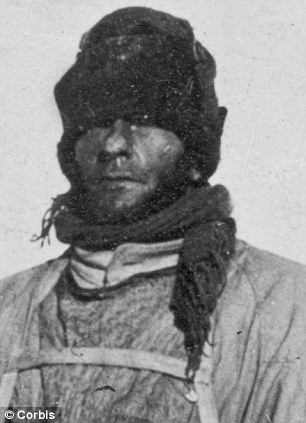
    Scott suffered his own setbacks in the foul weather of the southern ice, but eventually he and four specially selected members began the final push across the icy wastes towards their goal. It is not clear whether all members of this team knew its true purpose or whether they believed in the pure scientific goal of the mission, but they must have learnt the truth at some point, because they were able to penetrate the tomb while its guardians were distracted by the battle against Amundsen, and made off with a sizeable cache of highly valuable treasures and occult artifacts. Unfortunately they hit bad weather, and were pursued in the few hours of night by a single vampire from the tombs. Somewhere in the journey the vampire caught up with them, but with the summer light fast approaching and needing to retreat to a safe lair, it had no time to close the distance. However, before retreating for the day it stumbled upon a single member of the team who had been left behind while Scott and his fellows set up camp. This was Edgar Evans, injured in an icefall and unable to continue under his own strength. His team had left him in a shallow dugout, promising to return and collect him once they had made camp at a safe distance, and the sun was up. Evans was delirious from his head injury and frostbite, but when the vampire found him he understood well enough the offer it made – eternal life in exchange for the destruction of his party. Showing a degree of treachery well beyond that often claimed for him in subsequent years, Evans took the deal, and so he became a vampire, sired by a monstrous creature called the Bear, and ancilla of a mysterious and remote beauty known only as Polaris.

    After the sun came up, and before his change was fully upon him, Evans was collected by his team mates and dragged back to the camp, where they intended to rest in the bright sun and wait out the stormy weather. Their plan was sound – in the Antarctic summer they had many hours to travel, while their pursuers had only a scant few hours to make chase. Finding Evans still alive though delerious in the snowdrift they assumed they had shaken off their pursuers, and decided to spend a single night resting before continuing the following day with Evans on a sled. But that night Evans died, and woke again, and consumed his teammates in an orgy of destruction. He then made his way south, dragging the recovered valuables with him, hiding in the snow during the long hours of daylight.

    With Scott’s death the great age of exploration ended and the southern hideouts were safe – for a while. But after the second world war scientific expeditions began to proliferate on the shores of both polar landmasses. At first Polaris believed they would stop there but she soon realized that the human lust for land and knowledge – and energy to achieve its goals – was boundless, and she would need to find new ways to protect her wilderness redoubt. She sent Edgar Evans north, first to New Zealand and then on to the centres of power. His progress was slow and seemingly purposeless, and much of his history is lost. Sometime in the late 1960s he arrived on the Atlantic coast of the USA and became involved in the budding surf movement, making a name for himself as “the midnight surfer,” capable of amazing feats of surfing prowess but only swimming at night. After the surf scene became too large he disappeared again for a while, before he reappeared in a different guise in the extreme sports scene of the 1990s, now also at the head of a successful surfing products company. Once the extreme sports world began to be too heavily filmed he dropped out, setting up an extreme sports, snow and surf media company that soon dominated much of the sports market. A minor celebrity in this world, he also set up a foundation – the Polaris Foundation – that funded environmental activism and research connected to the poles. Through this foundation he began to influence the activities of polar researchers and political movements. He poured funds into the Sea Shepherds, into Greenpeace campaigns against arctic drilling and exploitation, and into global warming activism. He made secret, tentative contacts with the faerie court of winter, and reached out to the werewolves of the great steppes to find ways to seal off the many entryways into the arctic wilderness. Wherever the sun was extinguished for months at a time, the Polaris Foundation could be found advocating for national parks, wilderness sanctuaries, and the gradual exclusion of humanity.

    Evans sat at the heart of this web of foundations, activist groups and movements, pulling strings from his headquarters outside of New York. Rich and vaguely famous, handsome and widely respected for his achievements in surfing and extreme sports, a minor celebrity amongst scientists and activists alike, Evans slowly worked to force the withdrawal of human influence from the frozen wastes of the earth’s poles – and for whatever darker purpose his grandsire, Polaris, secretly schemed.

    Polaris

    Polaris is so old that she has forgotten her name, and much of the lore of the realm of humans. She was no raider – a simple Inuit girl living in Greenland when the Vikings came, she was turned by a visiting Danish vampire in the 14th century. Driven out of her own community after the change, she lived wild and reckless in the mountains north of the norse settlement. She would hide in the bright summers, and stalk the Danish towns in winter when the sun was largely hidden, consuming the Danish kine with gleeful abandon. In the 15th century, as Danish wealth grew in Europe and her predations became more open, many of the community began to leave, fearing to stay another winter; eventually in a single winter of brutal extravagance she slew the remainder of the community, wiping it out. That summer she took the first ship back to the mainland, and moved her predations to the bigger cities of the wider world.

    For the next few hundred years Polaris learnt the ways of the Camarila, learnt to control her hunger, and fed and studied across the cities of Europe. Eventually tiring of the Masquerade, after 400 years of petty vampire politics and growing jaded with the taste of human blood, she returned to the lands of her youth. Unfortunately they had changed beyond recognition, the beautiful fjords of her youth now transformed into whaling stations red with blood and rich with the stench of burning blubber. She realized that humans were beginning to encroach on every part of the earth, and yearned for somewhere pure and pristine to retire to, to escape from both vampire politics and human stench. Taking her wild childe the Bear with her, and a coterie of ghouls, she headed slowly south, winding her way over 10 years to the vast open plains of the Antarctic.

    Here, surely, humans can never come, she thought. But half a century later there they were, sledding across the ice towards her lair, intent on robbery and murder. It was then that she sent her childe forth, with instructions – turn one of this new breed of adventurous human, for I have forgotten how they think and why they even bother. I see they are fragile and weak as individuals, but as a mass they seem to be capable of anything. While we can no longer claim to know how these kine think, we need one of our number to bear this knowledge, to hold the memory of humanity in his heart so that he can act properly against its interests, to keep us safe. Turn one of them, have him kill his fellows, and bring him to me. A new era has dawned, an era in which the silent and dark places of the earth will soon become bright with human light and rowdy with their empty chatter and barked commands. We cannot fight such a tide, so we need to learn the dynamics of its flow, that we can divert it away from those places where we hide and seek solitude.

    And so the Bear went forth, and so Edgar Evans survived the cold, and entered into the kindred in an orgy of bloodshed and betrayal in a tiny hut on the edge of the world’s last great wilderness.

    And so too did Polaris’s schemes bend under the pressure of the human flood; and her gaze turned north, and her cold, inhuman mind turned its thoughts towards new schemes, to use human’s own curiosity and volatility against them, and to protect her and her kind.

    No one knows the truth of her schemes, only that she is ancient and cold and deadly, and that Edgar is her weapon against humanity – a lonely, gangrel weapon as cold and harsh as the adiabatic winds, and as implacable as the ice.

  • Recently I wrote a post criticizing an article at the National Bureau of Economic Research that found a legal ivory sale in 2008 led to an increase in elephant poaching. This paper used a measure of illegal poaching called commonly the PIKE, which is measured through counting carcasses discovered in searches of designated areas. This PIKE measures the proportion of deaths that are due to illegal poaching. I argued that the paper was wrong because the PIKE has a lot of zero or potentially missing values, and is bounded between 0 to 1 but the authors used ordinary least squares (OLS) regression to model this bounded number, which creates huge problems. As a result, I wasn’t convinced by their findings.

    Since then I have read a few reports related to the problem. I downloaded the data and decided to have a look at an alternative, simple way of estimating the PIKE in which the estimate of the PIKE emerges naturally from a standard Poisson regression model of mortality. This analysis better handles the large number of zeros in the data, and also the non-linear nature of death counts. I estimated a very simple model, but I think a stronger model can be developed using all the standard properties of a well-designed Poisson regression model, rather than trying to massage a model misspecification with the wrong distributional assumptions to try and get the correct answer. This is an outline of my methods and results from the most basic model.

    Methods

    I obtained the data of legal and illegal elephant carcasses from the Monitoring Illegal Killing of Elephants (MIKE) website. This data indicates the region, country code, site number, and number of natural deaths and illegally killed elephants at each site in each year from 2002 – 2015. I used the full data set, although for comparing with the NBER paper I also used the 2003-2013 data only. I didn’t exclude any very large death numbers as the NBER authors did.

    The data set contains a column for total deaths and a column for illegal deaths. I transformed the data into a data set with two records for each site-year, so that one row was illegal killings and one was total deaths. I then defined a covariate, we will call it X, that was 0 for illegal killings and 1 for total killings. We can then define a Poisson model as follows, where Y is the count of deaths in each row of the data set (each observation):

    Y~Poisson(lambda)                               (1)

    ln(lambda)=alpha+beta*X                   (2)

    Here I have dropped various subscripts because I’m really bad at writing maths in wordpress, but there should be an i for each observation, obviously.

    This simple model can appear confounding to people who’ve been raised on only OLS regression. It has two lines and no residuals, and it also introduces the quantity lambda and the natural logarithm, which in this case we call a link function. The twiddle in the first line indicates that Y is Poisson distributed. If you check the Poisson distribution entry in Wikipedia you will see that the parameter lambda gives the average of the distribution. In this case it measures the average number of deaths in the i-th row. When we solve the model, we use a method called maximum likelihood estimation to obtain the relationship between that average number of deaths and the parameters in the second line – but taking the natural log of that average first. The Poisson distribution is able to handle values of Y (observed deaths) that are 0, even though this average parameter lambda is not 0 – and the average parameter cannot be 0 for a Poisson distribution, which means the linear equation in the second line is always defined. If you look at the example probability distributions for the Poisson distribution at Wikipedia, you will note that for small values of lambda values of 0 and 1 are very common. The Poisson distribution is designed to handle data that gives large numbers of zeros, and carefully recalibrates the estimates of lambda to suit those zeros.

    It’s not how Obama would do it, but it’s the correct method.

    The value X has only two values in the basic model shown above: 0 for illegal deaths, and 1 for total deaths. When X=0 equation (2) becomes

    ln(lambda)=alpha              (3)

    and when X=1 it becomes

    ln(lambda)=alpha+beta    (4)

    But when X=0 the deaths are illegal; let’s denote these by lambda_ill. When X=1 we are looking at total deaths, which we denote lambda_tot. Then for X=1 we have

    ln(lambda_tot)=alpha+beta

    ln(lambda_tot)-alpha=beta

    ln(lambda_tot)-ln(lambda_ill)=beta     (5)

    because from equation (3) we have alpha=ln(lambda_ill). Note that the average PIKE can be defined as

    PIKE=lambda_ill/lambda_tot

    Then, rearranging equation (5) slightly we have

    ln(lambda_tot/lambda_ill)=beta

    -ln(lambda_ill/lambda_tot)=beta

    ln(PIKE)=-beta

    So once we have used maximum likelihood estimation to solve for the value of beta, we can obtain

    PIKE=exp(-beta)

    as our estimate of the average PIKE, with confidence intervals.

    Note that this estimate of PIKE wasn’t obtained directly by modeling it as data – it emerged organically through estimation of the average mortality counts. This method of estimating average mortality rates is absolutely 100% statistically robust, and so too is our estimate of PIKE, as it is simply an interpretation of a mathematical expression derived from a statistically robust estimation method.

    We can expand this model to enable various additional estimations. We can add a time term to equation (2), but most importantly we can add a term for the ivory sale and its interaction with poaching type, which enables us to get an estimate of the effect of the sale on the average number of illegal deaths and an estimate of the effect of the sale on the average value of the PIKE. This is the model I fitted, including a time term. To estimate the basic values of the PIKE in each year I fitted a model with dummy variables for each year, the illegal/legal killing term (X) and no other terms. All models were fitted in Stata/MP 14.

    Results

    Figure 1 shows the average PIKE estimated from the mortality data with a simple model using dummy variables for each year and illegal/total killing term only.

    Figure 1: Estimated Annual PIKE values
    Figure 1: Estimated Annual PIKE values

    The average PIKE before the sale was 0.43 with 95% Confidence Interval (CI) 0.40 to 0.44. Average PIKE after increased by 26%, to 0.54 (95% CI: 0.52 to 056). This isn’t a very large increase, and it should be noted that the general theory is that poaching is unsustainable when the PIKE value exceeds 0.5. The nature of this small increase can be seen in Figure 2, which plots average total and illegal carcasses over time.

    Figure 2: Trend in illegal killings and total deaths
    Figure 2: Trend in illegal killings and total deaths

    Although numbers of illegal carcasses increased over time, so did the number of legal carcasses. After adjusting for the time trend, illegal killings appear to have increased by a factor of 2.05 (95% CI 1.95 – 2.16) after the sale, and total kills by 1.58 (95% CI 1.53 – 1.64). Note that there appears to have been a big temporary spike in 2011-2012, but my results don’t change much if the data is analyzed from only 2003-2013.

    Conclusion

    Using a properly-specified model to estimate the PIKE as a side-effect of a basic model of average carcass counts, I found only a 25% increase in the PIKE despite very large increases in the number of illegal carcasses observed. This increase doesn’t appear to be just the effect of time, since after adjusting for time the post-2008 step is still significant, but there are a couple of possible explanations for it, including the drought effect mentioned by the authors of the NBER paper; some kind of relationship between illegal killing and overall mortality (for example because the oldest elephants are killed and this affects survival of the whole tribe); or an increase in monitoring activity. The baseline CITES report identified a relationship between the number of person-hours devoted to searching and the number of carcasses found, and the PIKE is significantly higher in areas with easy monitoring access. It’s also possible that it is related to elephant density.

    I didn’t use exactly the same data as the NBER team for this model, so it may not be directly comparable – I built this model as an example of how to properly estimate the PIKE, not to get precise estimates of the PIKE. This model still has many flaws, and a better model would use the same structure but with the following adjustments:

    • Random effects for site
    • A random effect for country
    • Incorporation of elephant populations, so that we are comparing rates rather than average carcasses. Population numbers are available in the baseline CITES report but I’m not sure if they’re still available
    • Adjustment for age. Apparently baby elephant carcasses are hard to find but poachers only kill adults. Analyzing within age groups or adjusting for age might help to identify where the highest kill rates are and their possible effect on population models
    • Adjustment for search effort and some other site-specific data (accessibility and size, perhaps)
    • Addition of rhino data to enable a difference-in-difference analysis comparing with a population that wasn’t subject to the sale

    These adjustments to the model would allow adjustment for the degree of searching and intervention involved in each country, which probably affect the ability to identify carcasses. It would also enable adjustment for possible contemporaneous changes in for example search effort. I don’t know how much of this data is available, but someone should use this model to estimate PIKE and changes in mortality rates using whatever is available.

    Without the correct models, estimates of the PIKE and the associated implications are impossible. OLS models may be good enough for Obama, but they aren’t going to help any elephants. Through a properly constructed and adjusted Poisson regression model, we can get statistically robust estimates of the PIKE and trends in the PIKE, and we can better understand the real effect of interventions to control poaching.

  • It's just how I roll...
    It’s just how I roll…

    My gaming group has begun a short Vampire:The Masquerade mini campaign, which I haven’t yet joined, but I happen to think that the World of Darkness system is quite terrible. At the same time we’ve all been yearning for some classic fantasy, and the manifold shortcomings of Traveler’s system have become obvious, even though I think it could be quite good with some tweaks and have suggested it as an alternative structure for Warhammer 2. This has led to some debate about which dice systems and basic mechanics are best – not which systems, because systems load a whole bunch of other non-dicey stuff on top of what they do, but just which basic mechanics. Most of my group are very fond of the World of Darkness (WoD) basic mechanic, but in my opinion it is terribly flawed to start with, and handled very badly by the designers. During this debate some alternatives such as the Warhammer 2 system or d20 system were discussed and generally dismissed as terrible. At the same time I downloaded a cute Steampunk game called Mechanika which uses FUDGE dice, the core mechanic of the Fate system. Some of my group have previously shown an interest in the Fate system, and one of them recommended Mindjammer as a basis for the Spiral Confederacy campaign, so I thought they might be interested in that system as an alternative for use in a classic fantasy setting. However, when I googled FUDGE dice I was taken to the Wikipedia page, which includes the probability distribution for the dice. This distribution has its most likely value at 0 and ranges from -4 to 4, which means that if you add 6 to all the numbers, the FUDGE dice are almost exactly the same probability distribution as 2d5 (check yourself if you don’t believe me!)

    This debate made me realize that there are essentially only three key canonical dice structures that almost all RPGs follow, and aside from some extra weird systems, they basically only follow these three possible structures. I will describe each of these here and outline why I think most systems can be reduced to them.

    Uniform distributions

    These are the classics of d20/Pathfinder, Cyberpunk and Rolemaster. The primary difference between the mechanics of individual systems is how they assign difficulty – by a simple flat mechanic like d20, with a variety of arbitrary subsystems like Cyberpunk, or with some godawful sprawling complex of tables like Rolemaster. With these systems the main determinant of how much fun they are is the relative magnitude of the range of random values to the modifiers, and all the other things attached to the system. So for example d20 has a very wide random range that allows for a lot of nuance of ability differences between characters, and lots of nuance in defensive and attacking differences too; while Cyberpunk has only half as much random range, and the modifiers are generally much larger, so that success or failure become baked into your character design rather than having much to do with the dice. These systems are old classics and for good reason: they’re easy to understand and very simple to use.

    Some of these systems, like Talislanta and Cyberpunk, allow the defender of a skill check to set the difficulty randomly. For example in Cyberpunk melee combat the difficulty to hit someone is d10 plus their escape/dodge. This means that the difficulty target can be random in some cases, but on average it still means that the difficulty will be 5+escape/dodge (in this case) on average. If you did this in d20, for example, the difficulty of hitting someone on average would be 10+AC, even if they rolled a d20 +AC every time. This process of rolling for difficulty like this is not a waste of time, however – it actually causes the random distribution of the sample to become approximately equivalent to rolling the sum of the two dice being used. To see this, consider the example of a Pathfinder attack in its most basic form, where we allow the defender to roll d20 to set the difficulty of the attack. Then denote the attacker’s dice roll result by A, and the defenders by D. We have A+attack bonus vs. D+AC, where the attacker wins if A+attack>=D+AC. This is equivalent to A-D+attack-AC>=0. But the distribution of the difference of two uniform distributions is a triangular distribution across their range, centred at the middle of all the possible values of the difference (see this pdf for the case of a uniform distribution on the interval [0,1]). In the case of A-D described here, the peak would be at 0 with values from -19 to 19, and it would look very much like a normal distribution. So in fact, if you allow both attacker and defender to roll their attack and the target difficulty, your system will converge in those cases to the second kind of canonical dice system, the additive dice pool.

    Additive dice pools

    The classic additive dice pool system is Traveler, which uses 2d6 +skill+attribute vs. a target difficulty of 8. The alternative Cyberpunk system uses 3d6, so is effectively the same. I think there are a few other systems like Numenera that also use summed dice, and I ran a whole campaign using 2d10 instead of 1d20 for dice mechanics on a d20 system base, so that campaign would have been in this class too. As discussed above, the FUDGE dice effectively produce the same distribution as 2d5. These distributions all have the property of being approximately symmetric, with the peak probability in the middle of the distribution (typically at the median) and very low probabilities in the tales. From the Central Limit Theorem, the more dice in the pool the more normally distributed it looks, but even with 2d6 or 3d6 you are looking very close to normal. This makes it very easy for the GM to understand probabilities, though not as easy as the uniform distribution because specific values vary, and you know that half the probability lies to the right of a fixed number, and half to the left. In the case of 2d6 there are only 11 unique values so it is easy to memorize a few key numbers: 8+ has a 42% probability, 12 and 2 have 3%, and so on, so working with these dice is easy. This was the basis of my recommendation of 2d6 for Warhammer 2. The only thing that makes these pools less useful than uniform distributions is that you need to add up the dice, which takes a moment longer.

    Additive dice pools are also internally consistent if you choose to use opposed dice tests where your opponent rolls the dice pool plus skill/attribute to set difficulty. By the same logic as for uniform distributions, this is equivalent to generating a difference of the two dice pools. If we approximate the dice pools as normally distributed, then we can say that the resulting distribution is the difference of two normal distributions (approximately) – and this is also normally distributed. So in this case the result of the roll becomes effectively another additive dice pool, centred at 0 but wider and more normally distributed than the original.

    There is another type of challenged skill check which both uniform and additive dice pools can use. In this case both people roll, and the attack only works if it succeeds against some target number and the defender fails against some target number. I think this sometimes happens in Traveler (though I don’t remember specific cases). If you use this mechanism, you no longer produce an additive dice pool mechanism. Instead, you have produced a special case of the third class of dice structure: counting dice pools.

    Counting dice pools

    Astute readers will have noticed that I haven’t included Warhammer 2 in the Uniform distribution category of systems, even though it uses percentile dice against a target threshold, and percentile dice are uniform. This is because rolling a percentile dice against a threshold probability is effectively equivalent to rolling a d10 and trying to get a number smaller than the threshold divided by 10 and rounded up. In that case, Warhammer 2 is effectively a game where everyone has a dice pool of one, and their die has a hundred sides, and the difficulty changes according to the attribute used. i.e., it’s effectively a variant of WoD with a single die in the pool. This is also the case if you use the success-conditional challenged skill check for either uniform or additive dice distributions – you’re really just constructing a really complex opposed dice pool. The Warhammer 2 system does this – you need to succeed against your attribute, and then your opponent has to fail their defensive check, in order for your action to work. In this case this is basically equivalent to a 1D vs. 1D WoD dice pool. This is particularly true at first level where most people’s attributes are between 25 and 35, so effectively what you’re doing is, to close approximation, rolling a d10 and trying to get over an 8. It’s WoD! Where everyone has one point in every attribute and no skills for most of the campaign, but once they’ve leveled up a few times maybe they can reduce the target to 7. WoD allows modification of difficulty targets for dice, so basically in essence Warhammer 2 is a game of WoD where every PC is completely useless at everything.

    Who wants to play that?

    Other dice pool systems are mostly variants on WoD, which is maybe not the original (I think Shadowrun might have been a bit before WoD but can’t be bothered googling). They all effectively use a variant of either dice pool vs. a fixed required number of successes, or dice pool vs. dice pool. I have shown here before that dice pool vs. dice pool opposed checks massively penalize the person who initiates the action vs. the person who defends against it, and I have also described how it is extremely difficult to design a consistent rule for defining target numbers and constructing dice pools based on attributes and skills. The only way appears to be to use (attribute + skill) to set dice pools and then divide (attribute + skill) by some number to set targets, but I have shown that this produces horrendous results in practice. I think the only solution that doesn’t produce these horrendous results is to have a table that relates the attribute+skill to a specific difficulty, and to have very large dice pools.  But… very large dice pools effectively converge to a normal distribution (based on the normal approximation for the binomial distribution), so in effect if you use very large dice pools you’re producing an asymmetric version of an additive dice pool. So Exalted, for example, with its very large dice pools, really is just producing an asymmetric and needlessly complex version of an additive dice pool.

    Dice pools will retain their flavour primarily if they are at around 3-12 dice, which is perhaps normal for Shadowrun but probably mostly below the numbers you might expect in WoD. Dice pools of this size are fun to fool around with – they feel hefty but aren’t insanely hard to calculate, and they produce some successes most times. The big disadvantage of dice pools though is that their probability distribution is fiddly and changes with every dice pool, and as a result judging and setting difficulties is extremely hard. WoD provides many examples of this. For example, I recently read a Vampiric mesmerize type power that uses a dice pool equal to some attribute plus some skill, which one might expect to be around 9 in a good campaign for a relatively tough vampire with attribute of 5 and skill of 4. Its difficulty is the target’s willpower, and the magnitude of the effect is determined by the number of successes. So against a person with willpower 3 you will need 4 successes to achieve anything – but getting 4 successes from a dice pool of 9 is difficult. So someone with quite an epic attribute and skill combination will fail to produce an effect against someone with just a slightly above average willpower on most occasions, and will almost never achieve a strong outcome. This means that the dice pool and the difficulty have been poorly fixed. But how would you fix the difficulty in this case? It’s not clear that there is a functioning method for doing so.

    Conclusion

    I have missed talking about a few systems, such as Warhammer 3 with its insane mixture of dice, Seventh Sea with its complex rules for balancing breadth and width of dice pools (I don’t remember details now) or Double Cross with its insane maximum value and exploding dice system. These don’t fit the standard categories, which makes them fun but also impossible to get used to for most gamers. But for most non-insane systems, they will either be directly or mathematically equivalent to one of the three canonical structures described above. For play I really like to construct and roll large dice pools, but I think I have made it clear by now in this and other posts that dice pool mechanisms are fundamentally broken. I think the only viable, operative and relatively easy system to use is an additive dice pool with two fairly simple dice – so 2d6, 2d8 or 2d10. They’re boring, but they consistently work. The challenge then is to produce a game that properly adjudicates difficulties, has interesting character creation and makes all the other aspects of the game work well. Traveler almost gets the dice mechanic working (almost!) but as my players have repeatedly told me, the rest of the system is boring due to lack of abilities and special crunch. Perhaps the only game that does all these things right, then, is Iron Kingdoms.

    And the three games that do everything wrong are Shadowrun, WoD, and Warhammer 2. The classics, my friends, are irreparably broken!

  • Nothing can go wrong with this expedition
    Nothing can go wrong with this expedition

    The Guardian has a series on lost cities, and today’s entry is a description of the lost city of Thonis-Heracleion, an Egyptian trading outpost at the mouth of the river Nile that sank under the sea in the year 200BC. It suffered a grisly though probably slow end, sinking into the sea in a liquefaction event as the weight of its temples finally became too much for the waterlogged sands on which it was built, which makes it a perfect analogy for the Egyptian empire at the end of its days, as the Greek and Roman empires began to eclipse it. Near its end Thonis-Heracleion was also eclipsed economically by Alexandria to the west, but in its heyday it appears to have been a bustling trade metropolis standing at the intersection of many great cultures. The Guardian’s description of the archaeological dig suggests a city that achieved almost-Talislantic levels of multi-culturalism:

    The interplay between Pharaonic and Greek societies in Thonis-Heracleion is a constant feature of the city’s remnants: Hellenic helmets were nestled in the seabed alongside their Egyptian counterparts, as were Cypriot statuettes and incense burners, Athenian perfume bottles, and ancient anchors from Greek ships

    and its description of the kinds of people who mingled in the ports and alleys of the city also suggests the kind of city that we love from Sword and Sorcery novels:

    if you were a European merchant in the fifth century BC – an importer of grain, perfume or papyrus perhaps, or an exporter of silver, copper, wine or oil – then Thonis-Heracleion loomed large on your horizon. The same was true if you were a Carian mercenary, an educated Greek, a professional sailor, or a member of the Pharaonic court

    This is a city that mingled Pharaonic nobility with vulgar traders from across the known world, soldiers and adventurers from Europe, Africa and Asia, and scholars from every major city in the mediterranean. Throw in some magic and you have a city brimming with intrigue and adventure, and bustling with gods from a thousand known religions. And the city itself has all the qualities of the kind of city you want to adventure in – Athens crossed with New Crobuzon and London before the Romans took it. It is a city of alleyways and bridges, canals and temples, where river boats from the Nile dock on one side to transfer their wares to Phoenician and Greek triremes on the other. It is easy to imagine its marketplaces and restaurants bustling with the people of a thousand nations: inscrutable dark-skinned warriors who drifted down the Nile from Ethiopia or Sudan, voluble traders from Greece, taciturn phoenician slavers surrounded by Turkish mercenaries, Bedouin camel merchants gathering for the trek across the great deserts to Timbuktu, and Roman explorers looking to map out new territories for the Republic. Over all this would loom the temples of a hundred clashing religions, calling their followers to prayer and supplication and, of course, plotting a thousand plots.

    Thonis on sea

    Adventures in the lost world of Thonis

    The world of Thonis-Heracleion is a mixture of ancient societies competing for trade and power in the cauldron of the Mediterranean. The Greek and Roman Republics, Phoenicians, Egyptians and Persians were all in various stages of conflict or rebellion when Thonis-Heracleion was at its height, but they would also have been mingling with kingdoms from the African interior – the Nok from Nigeria, the Ethiopian successor states, the Kushites of what is now Sudan, and the many fragmentary and transient kingdoms of central Africa. In amongst these would have been permanent minorities, such as Jews fleeing from the Babylonians, and exotic people from as far afield as Carthaginian Morocco and Roman Gaul. With these people would come trade from every corner of Africa and Europe and near Asia, and also every political and religious intrigue they could muster. With the spies and agents of the scheming powers of Europe and Asia would also come their wizards, their priests and their assassins. The city would be ideal for either a sandbox campaign, based in Thonis but venturing down the Nile to Kush and Ethiopia, or along the coast to Palestine and Morocco; or it could be the centre of a story campaign focused around the conflicting ambitions of the imperial powers of the time, and also the increasingly desperate attempts of the last Pharaonic dynasties to remain independent and powerful in the face of growing Roman and Persian power. What kind of adventures could we expect to see in such a world?

    • Tomb robbing: For the death cults of Egypt, tombs contain hidden magical treasures – and very real dangers. The last dynasties of the Pharaohs are still supported by their death cults, and in their desperation to regain their old powers they begin to loot the tombs of their own ancestors, sending in foolhardy adventurers to find the powerful relics buried therein. Of course they hire foreigners for the job – they know about the curse that befalls anyone who defiles those tombs, so why not send in one of the new Roman or Greek interlopers to take all the risk? Of course, they don’t tell their mercenaries, and when they find out they are doomed desperate measures are implemented …
    • Blood for the old gods: People are going missing in the marketplaces of the city, and questions are being asked about who is responsible. In fact it is a Pharaonic death cult, preparing a dark ritual to bring back one of their ancient gods and purge the city of the enemies of Egypt. But who are those enemies, and is the death cult’s goal one of simple racial purity, or do they have more sinister political designs in mind?
    • The old man’s fleece: Down in one of the poorer quarters by the river docks is an old Greek wanderer, long bereft of his mind, who sits in the blazing sun by the river and mutters to himself of golden sheep and women with snake hair whose gaze turns men to stone. The locals, poor fishermen and porters all, laugh at him but they treat him kindly – give him sweet pastries in the morning, and move him into the shade at midday, and because he is a gentle old man full of stories they leave their children with him when they go to the well. But then one day the prodigal son of a local porter returns to cries of joy – he was long thought lost in a storm on the Phoenician merchant ship he rowed for a paltry day’s wage. At the party he tells of how he was the sole survivor of his ship, whose crew were entranced by the songs of long-haired beauties in the water, who devoured them as they dived into the azure sea seeking love. He shows them the wax he stuffed in his ears to protect himself “because he heard the old man’s story down by the river when he was little.” Suddenly they realize that old man has been amongst them for too long, and could his stories be true? But the old man is gone, taken by two stern-looking Canari mercenaries. Why is everyone suddenly looking for him? The folk of that poor quarter club together their money and hire a likely looking band of adventurers – they want their old man back, because he was gentle with the children – and they want the treasure his stories speak of. From this builds a campaign with intrigue and a chase for riches – and a retracing of the steps of the Odyssey, as the characters attempt to recover all the wealth and power that the old man spoke of in those days down by the river.
    • The golem in the old quarter: Since the Babylonians went mad Jews have been flocking to the city, which is the first stop on the way to safety in Egypt but for many also the last – why go further into unknown lands when Thonis-Heracleion holds the promise of a melting pot to rival the Persian capital? Just stay here and toil amongst the unnamed and uncaring hordes, because no one will ever do to a stranger here what was done in Babylon. But one old scholar nurses a grudge, and in the long, sultry evenings of the summer he stands on the roof of his house looking over at the Babylonian trader’s house, and thinks of devious ways of bringing about the end of that hated foe. Eventually he finds it, in the forbidden texts of his father’s. One night the golem breaks lose, kills the old man, and begins its rampage. Can the characters stop it before the authorities come with their sinister army of the dead, and lay waste to the whole quarter?
    • The African expedition: A Roman scholar has heard rumours of riches beyond measure in the interior, a graveyard of elephants where there is so much ivory that one could build a castle from it. But between Thonis and that ancient grave lies a thousand kms of trouble and mad kings, and anyway he’s not sure exactly where it is. Will the characters go with him, and share in his wealth? Or are they soft, lazy fruit eaters like the rest of this town …?

    A city beset by foes and surrounded by opportunities, ruled over by a crumbling dynasty propped up by death magic, and subverted from below by the teeming poor and the scheming new religions of the European empires. To its south lies the rich green and gold tapestry of Nile country, to its north the dazzling azure of the mediterranean. In the day it is blasted by the heat of the Egyptian sun, that gives way to long, warm evenings of song and wine and intrigue, nights of hashish dreams and ghosts. Thonis-Heracleion – explore it all before it sinks below the shifting sands of the Nile delta, and drowns the gods of four civilizations in the startling blue waters that held brought all its promise.