• Nail them to the wall

    In September 2017 Philip Morris International (PMI) – one of the world’s largest cigarette companies – introduced a new foundation to the world: The Foundation for a Smoke Free World. This foundation will receive $80 million per year from PMI for the next 12 years and devote this money to researching “smoking cessation, smoking harm reduction and alternative livelihoods for tobacco farmers”, with the aim to draw in more money from non-tobacco donors over that time. It is seeking advice on how to spend its research money, and it claims to be completely independent of the tobacco industry – it receives money from PMI to the tune of almost a billion dollars, but it claims to have a completely independent research agenda.

    The website for the Foundation includes a bunch of compelling statistics on its front page: There is one death every six seconds from smoking, 7.2 million deaths annually, second-hand smoke kills 890,000 people annually, and smoking kills half of all its long-term users. It’s fascinating that a company that as late as the late 1990s was claiming there is no evidence its product kills has now set up a foundation with such powerful admission of the toxic nature of its product. It’s also wrong: the most recent research suggests that 2/3 of users will die from smoking. It’s revealing that even when PMI is being honest it understates the true level of destruction it has wrought on the human race.

    That should serve as an object lesson in what this Foundation is really about. It’s not an exercise in genuine tobacco control, but a strategy to launder PMI’s reputation, and to escape the tobacco control deadlock. If PMI took these statistics seriously it could solve the problem it appears to have identified very simply, by ceasing the production of cigarettes and winding up its business. I’m sure everyone on earth would applaud a bunch of very rich tobacco company directors who awarded themselves a fat bonus and simply shut down their business, leaving their shareholders screwed. But that’s not what PMI wants to do. They want to launder their reputation and squirm out from under the pressure civil society is placing on them. They want to start a new business looking all shiny and responsible, and the Foundation is their tool.

    PMI have another business model in mind. PMI are the mastermind behind iQos, the heat-not-burn product that they are trialling with huge success in Japan. This cigarette alternative still provides its user with a nicotine hit but it does it through heating a tobacco substance, rather than burning it, avoiding much of the carcinogenic products of cigarettes. PMI have been touting this as the future alternative to cigarettes, and are claiming huge market share gains in Japan based on the product. Heat not burn technologies offer clear harm reduction opportunities for tobacco use: although we don’t know what their toxicity is, it’s almost certainly much lower than tobacco, and every smoker who switches to iQos is likely significantly reducing their long term cancer risk. What PMI needs is for the world to adopt a harm reduction strategy for smoking, so that they can switch from cigarettes to iQos. But the tobacco control community is still divided on whether harm reduction is a better approach than prohibition and demand reduction, which between them have been very successful in reducing smoking.

    So isn’t it convenient that there is a new Foundation with a billion dollars to spend on a research platform of “smoking cessation, harm reduction and alternative livelihoods.” It’s as if this Foundation’s work perfectly aligns with PMI’s business strategy. And is it even big money? Recently PMI lost a court case against plain packaging in Australia – because although their foundation admits that smoking kills, they weren’t willing to let the Australian government sell packages that say as much – and have to pay at least $50 million in costs. PMI’s sponsorship deal with Ferrari will cost them $160 million. They spent $24 million fighting plain packaging laws in Urugay (population: 4 million). $80 million is not a lot of money for them, and they will likely spend as much every year lobbying governments to postpone harsh measures, fighting the Framework Convention on Tobacco Control, and advertising their lethal product. This Foundation is not a genuine vehicle for research, it’s an advertising strategy.

    It’s a particularly sleazy advertising strategy when you consider the company’s history and what the Foundation claims to do. This company fought any recognition that its products kill, but this Foundation admits that the products kill, while PMI itself continues to fight any responsibility for the damage it has done. This company worked as hard as it could for 50 years to get as many people as possible addicted to this fatal product, but this Foundation headlines its website with “a billion people are addicted and want to stop”. This Foundation will research smoking cessation while the company that funds it fights every attempt to prevent smoking initiation in every way it can. The company no doubt knows that cessation is extremely difficult, and that ten dollars spent on cessation are worth one dollar spent on initiation. It’s precious PR in a time when tobacco companies are really struggling to find anything good to say about themselves.

    And as proof of the PR gains, witness the Lancet‘s craven editorial on the Foundation, which argues that public health researchers and tobacco control activists should engage with it rather than ostracizing it, in the hope of finding some common ground on this murderous product. The WHO is not so pathetic. In a press release soon after the PMI was established they point out that it directly contravenes Article 5.3 of the Framework Convention on Tobacco Control, which forbids signatories from allowing tobacco companies to have any involvement in setting public health policy. They state openly that they won’t engage with the organization, and request that others also do not. The WHO has been in the forefront of the battle against tobacco and the tobacco industry for many years, and they aren’t fooled by these kinds of shenanigans. This is an oily trick by Big Tobacco to launder their reputation and try to ingratiate themselves with a world that is sick of their tricks and lies. We shouldn’t stand for it.

    I think it’s unlikely that researchers will take this Foundation’s money. Most reputable public health journals have a strict rule that they will not publish research funded by tobacco companies or organizations associated with them, and it is painfully obvious that this greasy foundation is a tobacco company front. This means that most researchers won’t be able to publish any research they do with money from this foundation, and I suspect this means they won’t waste their time applying for the money. It seems likely to me that they will struggle to disburse their research funds in a way that, for example, the Bill and Melinda Gates Foundation do not. I certainly won’t be trying to get any of this group’s money.

    The news of this Foundation’s establishment is not entirely bad, though. It’s existence is a big sign that the tobacco control movement is winning. PMI know that their market is collapsing and their days are numbered. Sure they can try and target emerging markets in countries like China but they know the tobacco control movement will take hold in those markets too, and they’re finding it increasingly difficult to make headway. Smoking rates are plummeting in the highest profit markets, and they’re forced to slimmer pickings in developing countries where tobacco control is growing in power rapidly. At the same time their market share is being stolen in developed countries by e-cigarettes, a market they have no control over, and as developing nations become wealthier and tobacco control strengthens e-cigarettes grow in popularity there too. They can see their days are numbered. Furthermore, the foundation is a sign that the tobacco companies’ previous united front on strategy is falling apart. After the UK high court rejected a tobacco company challenge to plain packaging laws, PMI alone decided not to join an appeal, and now PMI has established this foundation. This is a sign that the tobacco companies are starting to lose their previous powerful allegiance on strategy against the tobacco control movement. PMI admits they’ve lost, has developed iQos, and is looking to find an alternative path to the future while the other tobacco companies fight to defend their product.

    But should PMI be allowed to take their path? From a public health perspective it’s a short term gain if PMI switch to being a provider of harm reducing products. But there are a bunch of Chinese technology companies offering e-cigarettes as an alternative to smoking. If we allow PMI to join that harm reduction market they will be able to escape the long term consequences of their business decisions. And should they be allowed to? I think they shouldn’t. I think the tobacco companies should be nailed to the wall for what they did. For nearly 70 years these scumbags have denied their products caused any health problems, have spent huge amounts of money on fighting any efforts to control their behavior, and have targeted children and the most vulnerable. They have spent huge amounts of money establishing a network of organizations, intellectuals and front groups that defend their work but – worse still – pollute the entire discourse of scientific and evidence based policy. The growth of global warming denialism, DDT denialism, and anti-environmentalism is connected to Big Tobacco’s efforts to undermine scientific evidence for decent public health policy in the 1980s and 1990s. These companies have done everything they can to pollute public discourse over decades, in defense of a product that we have known is poison since the 1950s. They have had a completely pernicious effect on public debate and all the while their customers have been dying. These companies should not be allowed to escape the responsibility for what they did. Sure, PMI could develop and market a heat-not-burn product or some kind of e-cigarette: but should we let them, when some perfectly innocent Chinese company could steal their market share? No, we should not. Their murderous antics over 70 years should be an albatross around their neck, dragging these companies down into ruin. They should be shackled to their product, never able to escape from it, and their senior staff should never be allowed to escape responsibility for their role in promoting and marketing this death. The Foundation for a Smoke Free World is PMI’s attempt to escape the shackles of a murderous poison that it flogged off to young and poor people remorselessly for 70 years. They should not be allowed to get away with it – they should be nailed to the wall for what they did. Noone should cooperate with this corrupt and sleazy new initiative. PMI should die as if they had been afflicted with the cancer that is their stock in trade, and they should not be allowed to worm out from under the pressure they now face. Let them suffer for the damage they did to human bodies and civil society, and do not cooperate with this sick and cynical Foundation.

  • And she will come from India with a love in her eyes
    That say oh how my dark star will rise
    In rented gear two thousand years we waited for a man
    But with a whispered plea she’d die for us all tonight.
    And she will come from India with a gun at her side,
    Or she will come from Argentina
    With her cemetery eyes that say
    Oh, how my dark star will rise,

    And she will rise.

    Final confessional: Gunfire in the distance, occasional strange sounds, a young woman talking to the video in English that the mutants can barely understand because it is so ancient and rich with the accents of a different world. She is dark skinned, wearing a shroud of tattered cloth covering her hair, her teeth and skin perfect in a way that the mutants viewing the video cannot imagine – she is beautiful in the way all the ancients seem to have been. She is talking about being driven out of her home south of the river, of running out of London and then being corralled back in again – the viewers gasp, was this ravaged city they live in once called London? –  telling the phone that the world is ending, her refugee camp is under attack, they have broken through. As she talks, urgently, low and fast, her voice a stream of lyrical, barely comprehensible English from the Time That Was, they watch in appalled fascination. This is the whole world they never knew, failing before them, and this wonderful mysterious dark-skinned beauty their only tether to it.

    She goes on. No one knows what’s going on or how it started, the monsters are everywhere. She knows she cannot last much longer, the city is infested with them and they are so strong, they hunt at night and in the day and the great ones are invincible. She will run, but maybe one day someone will survive, and will want to know what happened. She’s going to leave her phone here with the charger so maybe some survivor in the future can find it and see what happened. She looks urgently over her shoulder one more time, then at the camera with a look of such yearning and loss that it reaches through the phone, across time and into their hearts in the Ark. Then it snaps to darkness.

    Fearful flight: Video taken running over rooftops, with fire exploding in the background and screaming down below. Shaking camera as someone runs, a woman’s voice screaming close to the camera. It’s the same woman’s rich and mellifluous voice, but now it’s panicked and yelling in between gasps and heavy breathing. The video might have started with the intent to document what was happening but she has already forgotten that mission as she yells to her friends and screams and pants. Her friends are yelling back and to each other, an indefinite number of other voices further away as they all run across the sloping, red-ochre tiles of the old city. At one point the camera stops and everything lurches as the woman looks down into a gap between houses, where things move and hiss. She steps back and jumps, just covering the distance with a clattering of tiles, then jerks the camera around to show a small group of other running and leaping over the gap. She turns the camera back but jerks it as from behind there is a sudden, blood-curdling yell and someone screaming “They got Johnny!” She gasps but has no time for tears, suddenly jerking the camera left and down behind a stone outcropping on the roof. The rooftops and streets around darken suddenly as a huge shadow sweeps over, roaring, and fire explodes in the street across the road. The shadow slides past with a kind of sinuous, threatening elegance, and from further away they hear other men yelling, screams and weapons fire. She starts up and runs again and suddenly the gunfire is closer. From almost on top of her they hear the heavy chatter of machine gun fire, rough male voices yelling “Down, come down!” then the camera cuts out as they clatter into a dark stairwell.

    Mushroom cloud: A shaky video starts with a howling wind and rattling, then steadies, it’s resting on some kind of railing on a high tower. Far away the sky is erupting into a mushroom of smoke rising high into the azure blue of a perfect clear day. Stretching from the horizon to halfway towards the camera is the grey mass of a city, and there are millions of fires sprouting from various places in the middle of the city, smoke haze blanketing the lower parts of the sky below the mushroom cloud. A woman is talking, describing how they had to nuke the city to stop them. It’s the last stand, they’re doing it up and down the country, she says, and then shifts the camera right after a brief flash, to show a more distant cloud beginning to sprout on the horizon. As it rises, after a still moment, there is a distant roar, and then the back of the cloud lights up with a flash from over the horizon. “That’s Southampton, maybe more beyond. We didn’t have a choice.” Then the sound of crying as the wind washes gently by, and the two mushroom clouds rise slowly higher.

    Urban horror: The same woman’s desperate sobbing in darkness, then the camera shifts and we are looking from behind a rubbish bin at a long street full of trapped cars. It’s twilight and many of the street lights are broken but the car lights are on and it’s possible to see silhouettes and movement in the light of the cars. People are running from the cars, moving between them, and grey men are leaping across the roofs, jumping onto people and dragging them down and ripping and tearing. Somewhere out of sight there is a deep roar and a much larger figure – familiar now to the mutants – leaps onto a car, screaming in rage. Its scream paralyzes people, who turn and collapse in horror and allow the grey men to catch them. The woman sobs and the camera shakes, then behind her we hear someone saying urgently, “Kara, we have to go! Come, come! Run!” Then the camera jerks and they run into darkness.

  • Oh when there’s no future
    How can there be sin
    We’re the flowers
    In the dustbin
    We’re the poison
    In your human machine
    We’re the future
    Your future

    God save the queen
    We mean it man
    There’s no future

    No future
    No future
    No future for you


    The Ark’s heroes have returned from pacifying the Doom Cult that they found to the northwest. Now their attention was fully focused on the last remaining aboveground threat, the Dark Castle that lay just to the west of the Ark, menacing and grim broken towers looming over their near horizon. But first they wanted to find Shellah, and investigate the strange black tablet she had shown them before. It must be charged by now …

    She found them, however, before they could look, in an urgent haste. They were waiting in their sky temple perhaps an hour before service started, chatting and relaxing, when she appeared from down below in an unusual hurry, not even wearing her outer layer of ragged stinking clothes and in such an urgent rush that her usual caution and reticence was all but forgotten. She produced the black tablet without suspicion or fanfare and swiped a strange, arcane pattern across its face. The thing came to life, a vibrant brilliant screen festooned with bright icons across a background of pure grass and sky. She showed them one particular icon, a white triangle on a grey background, and pressed it. The screen changed, revealing a mosaic of squares with different pictures on them. She pressed the top left one, and they all jumped back in shock as the sound of one of the other bosses, Pieces, jumped out at them. Moments later they realized they were watching a recorded image, and relaxed.

    The video had been secretly filmed by Shellah at a waste site near the Ark, maybe 200m away, that the Ark’s members use to discard rubbish and search for old remnants of the ancients. It was taken at sunset, with a pink sky and pink light reflecting off the dome of the ark. There were two bosses – Pieces and Jared – standing alone in a small hollow of the waste dump, the shadows of a few guards visible in the far edge of the video, just visible on the far side of the hollow. They were talking about a plot, and Shellah must have been filming the whole thing from a hiding place within earshot, her camera undetected amongst the junk.

    PIECES: It’s gone on long enough yo. The hawks and the church are too much.

    JARED: Agreed. Any more of this and she’ll own all the whole rotten bleachers. I’ve got trouble enough with my supplicants, I don’t need her rabble-rousing with her stupid revolution.

    PIECES: No helping it now, the stupid bitch is in heat now, and we just gotta deal with the noise. Her gang ain’t the only problem though – she’s got fucking friends.

    JARED: We could deal with that. Snag ‘em on a mission, take ‘em down and make everyone think it’s the Zone. We could –

    PIECES: Don’t be stupid! If it fucks up, or even one of them escapes, we’re in deep shit. No, mate, we gotta act smart, not brutal. Get the punters to take her down for her own ambition, leave us smelling like roses after she’s gone. Gotta get her smart, mate.

    JARED: Smart ain’t your strong point Pieces. Remember when you –

    PIECES: Shut the fuck up about that, it’s ancient fucking history. Now listen, I’ve got a plan. We can fix this real smooth if we can set her up. You wanna hear?

    JARED: Sure, what’s your bright idea, Pieces? Right now I’m thinking a knife in the dark, but if you got something better …

    PIECES: Everyone knows she’s sniffing around the Elder, got in sweet with a Chronicler, right? But right now they all think she’s so sweet she can’t do nothing wrong, but if we turn that on her, she’ll look like the conniving bitch she is, and a crim to boot. We just gotta plant a little something on her to make it obvious.

    JARED: How you gonna do that, Pieces? She’s fucking stitched up tight!

    PIECES: Not so tight. Her fixer Monja owes me a big line, some shit I sorted out a while ago, been feeding me juice from inside her gang for a while now. Nobody knows. Not even you, you little shit.

    JARED: How the fuck, Pieces?! That’s some smooth operating. Looks like I’m gonna have to shake down my gang and flush out your fixes, you little fucker.

    PIECES: You won’t find them, pigshit. Now listen. We got an inside in the Vault, right? With Shenagler, the silly old idealist. He tells me he can smuggle out a few pieces of prime goods, small but valuable. A jar of antibiotics, some painkillers and a tattoo kit, he’ll hand them over to Monja right here tomorrow night. Then Monja takes them back and slips them into Bloody Jack’s room while she’s at church. A few hours later Shenagler leads a mob of Chroniclers over to Bloody Jack’s and demands to search the stuff, makes a right fuss about stolen shit. Then bang! Finds them after a bit of faffing around pretending to search, Bloody Jack’s as good as dead. It’ll get the stupid Chronicler she’s hanging with too. The rest of them probably will get away, but if any of them move to help her we can cut them down legitimate. You and me, we have a word with L’il Kim and see if we can’t all three push to break up her gang and have her friends exiled. Problem solved.

    JARED: Sounds great to me Pieces. But what do you want me to do?

    PIECES: Everyone knows about Bloody Jack and me, but they think you’re mostly out of it. I want you to step in and make my case. I’m gonna be doing one of my boys, nowhere to be seen, innocent as the driven snow. You gotta provide the muscle to make sure it works out – have your gang get there in time to make sure the search ain’t interrupted, have your men rile up the crowd when the time comes, get the mob up and at ‘em. It needs to look like it’s the real deal, not a set up by the guy everyone knows is Bloody Jack’s enemy. You do it, and we split her gang and her stuff. But I get the stalker, Lonnie, that’s the deal. I wanna find out if it’s a man or a woman. Not that it matters, once I’m done with it it’ll wish it had never been born. Had my eye on Lonnie for a while, that’s my personal treat from this little mission.

    JARED: Alright then, so tomorrow night, sometime after church? Get my gang ready for some rabble-rousing and a bit of security for the Chroniclers. Hang Bloody Jack and her pet Chronicler out to dry, hand Lonnie over to you, exile the rest. Split the stuff.

    PIECES: That’s right. Remember the man who’ll be making the case is Shenagler. Don’t fuck it up, okay?

    JARED: I won’t, Pieces. But hey, how many Chroniclers have you got in your pocket, anyway?

    PIECES: More than enough, man. More than enough. I’ll get to the Elder eventually, don’t you worry.

    JARED: That’s heresy, you fucker.

    They slapped hands, and scramble out of the hollow in two different directions. The video ended, to the sound of gentle sighs from the assembled group.

    They all looked at each other. This video was taken yesterday, and Shellah had only just brought it to them, so time would be tight. They had to get something organized by the end of the church service or they would all be exiled … or worse. And Lonnie … They needed to act.

    Breaking the Bosses

    Their plan was simple. They would grab Monja when she slipped into Bloody Jack’s room, and offer her the choice of death or turning double agent. Then Monja and Shellah would take the stolen artifacts and hide them in Pieces’ room, somewhere where it looked obviously like he had been keeping them to himself. When the crowds came to Bloody Jack’s room she would open it for inspection, and then some of Bloody Jack’s contacts and gang in the crowd would begin demanding that Pieces room be searched. While everyone prepared their trap, Preacher gave a resounding speech in the church of the sky god about how they were all a community now, and they must have rules and that anyone who went against the common good was betraying all of them, working the gathered mutants in the church into a fever pitch of righteous anger about theft and breaking the rules. As the speech came to an end Pieces seized the moment to declare that he had evidence right now that one of the mutants had stolen from the Ark, and they must show the righteousness of Preacher’s ideas by holding this person responsible.

    While Preacher preached the party moved into action. They ambushed Monja as she was in the act of placing the goods, and caught her hiding behind a curtain. She agreed to help rather than face the inevitable bloody end that her betrayal warranted, and accompanied Shellah to Pieces’ headquarters to bury the stolen goods in a suitably incriminating place. By the time the agitated crowd arrived at Bloody Jack’s quarters, led by Pieces, Jared and Shenagler, everything was ready. Bloody Jack blustered and played her part, but welcomed them in to search the quarters, where they found nothing. As the search came to its conclusion Shellah and Chang Chang began to yell in the background, and Chang Chang revealed the video recording. The entire over-agitated crowd then went to Pieces’ quarters, where they found the stolen goods exactly where Monja had placed them. Monja claimed to have had a change of heart and returned them to their original place in Pieces possession, and the trap was sprung.

    Pieces and Jared tried to fight, but they had been caught red-handed. By the time full night was upon the Ark they were hanging from ropes outside the upper halls of the Ark, and their gangs had been broken up, the leaders exiled and the rest returned to lives of toil and insignificance. The Ark had gone from four gangs to two, and L’il Kim’s gang was now on the outer, weakened by her tacit submission to Pieces’ heretical plans. Bloody Jack and the group were in the ascendant, and their thoughts turned now to the last remaining task – reckoning with the Elder and the neglect of the Dawn Vault.

    But before they did that there was one final threat to the Ark they needed to extinguish – the Dark Castle. They began their preparations.

    Visions of the Apocalypse

    Before they headed to the Castle, though, there was something else they needed to do – Shellah’s tablet. They realized that if she had been able to film Pieces’ and Jared’s conspiracy then whoever had owned that tablet in ancient times must have been able to film the world before … the old world. They wanted to look through all the other videos they had seen on that screen, and see what they could learn. Had this tablet’s owner filmed the apocalypse itself? Could they see what had really happened when the ancients’ world fell? They sought out Shellah on the higher steps of the bleachers, and sat with her to watch the videos on the tablet.

    They were right. The previous owner of the tablet had filmed the apocalypse. They watched in horror as the world fell under a wave of fiery monsters, and its people were consumed by an army of Grey Men – and their gigantic cousins.

    The things that ended the world were swarming in the tunnels beneath them.
    The Dark Castle

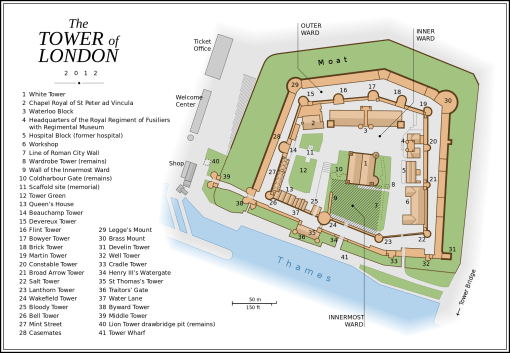
    They decided to tackle first the last of the aboveground threats, and the next day, flush with their victory over the bosses, they gathered their forces and headed west to the Dark Castle. The Dark Castle was a brooding hulk of shattered stone surrounded by solid high walls and a moat of foetid, rot-filled water, that could be accessed by a small gate on the riverside, or a bridge crossing the rotten moat from the west. They did not like the look of the river at this point at all – it was dark and stinking, it’s torpid surface occasionally disturbed by the splashings of large, unseen beasts. At the western edge the bridge was largely intact, though only wide enough for them to cross two abreast. The thick dark waters of the moat reached almost up to the bridge, and a fine oily mist hung over the still mire, giving off a dreadful smell. They were halfway across the bridge when a huge eel-like creature surged out of the water and grabbed Bloody Jack. It was followed by a second one that hit Chang Chang. These things had huge muscly tubular bodies, mouths that hinged open in four directions, and four beady, malicious eyes. Once they hit their targets they writhed and splashed and tried to drag them into the water, but fortunately both Chang Chang and Bloody Jack were able to stand their ground as Grimshaw and Bloody Jack’s gang members hacked into them. The beasts let go and slithered back into the water, only to attack again a moment later. This time, though, the group was ready, and managed to hack the eel creatures to death. They twitched and spasmed on the bridge, flooding it with a vile slick of greasy black blood, before they slid off and floated away into the mist. As the mutants stood on the bridge panting and checking their numbers, something grabbed the corpse of one of the eels from below and it sank under the bilious surface of the moat, which began to churn with the movements of a swarm of scavengers. Disgusted, the mutants ran across the bridge to the far side and the shelter of the entrance gate.

    Already damaged after just one battle, they retreated into the shadows of the gateway and sat down to rest, eating grub and drinking clear water and recovering. The gate formed a tunnel stretching through the wall to a narrow pathway between the outer wall and a thinner, smaller inner wall that was broken and crumbling in many places. Once they had rested they went through this inner wall and into the inner courtyard, which was ringed with buildings. In the middle of the courtyard was the main tower, a crumbling wreck of white and brown masonry thronging with trash crows, huge evil-eyed raven creatures perched all atop the wall and looking silently down at them as they entered. The ruined main tower was surrounded by thick grass, but the northern side of the courtyard was paved, and on that paving lay a horror show of scattered bones and corpse parts. Mostly they were animal bones, but in amongst them lay many human bodies. At the foot of the tower on its southern side an intact car lay untouched in the long grass of the courtyard.

    First they ducked into a ruined building immediately to the left of the gate through which they had entered, uncovering a functional blowtorch that could be used as a weapon and a jar of antidepressants. Then they moved to the western side of the courtyard, where a skeleton clothed in tattered red cloth lay in wild grass. From that body they recovered a polearm that Grimshaw declared would make a fine weapon. Then their attention turned to the car. They approached it, but as their gearhead attempted to move into the long grass it began to swirl and curl around his legs, trying to drag him in as the blades began to sweat acid. They grabbed him and dragged him out just in time, but realized that the car was surrounded by acid grass, a deadly hazard of the Zone. Fortunately Grimshaw had brought his scythe, the Law, which was perfect for cutting grass. Sweeping the wicked weapon ahead of him, he cut a safe path to the car, and once there their gearhead was able to drive it out safely.

    All the while the Trash Crows stared silently down at them.

    They decided to drive the car around to the north of the tower, with most of the group inside it, Bloody Jack on top, and two of the group walking behind. However as soon as they approached the butcher’s arena to the north of the tower the Trash Crows leapt into the air and began to dive bomb the group, targeting Bloody Jack and the people behind the car. They turned the car around and fled to the house at the gate of the compound. As they drove they attacked the crows, but nothing worked – there were so many, swarming thick and fast around them that they could not do any damage with sword or hammer. Only fire could work! Fortunately Chang Chang had the blowtorch! He turned it on and set the gas canister to fully open, flooding the swarm with fire as Preacher chanted and sang and encouraged the gang. The fire of Preacher’s words inspired Chang Chang to reckless abandon with the blowtorch, and soon he had turned the entire swarm to cinders. Safe!

    They explored the rest of the outer rooms in the tower, and the bones on the north of the tower, finding various treasures of the Ancients: a broadsword, a semi automatic pistol, a compound bow, a shotgun, and a suit that offered almost perfect protection against the rot. They also found an ID card of some kind. Then they opened the door to the northernmost building, which they guessed must hold the treasure they sought.

    As soon as they opened the door they were attacked by a gang of wild dogs, who had made their lair inside the shattered remnants of the western half of the building. The dogs attacked fast but were no match for the group, who cut them down quickly, leaving one wounded one to run away yelping in fear through a gap in the far wall of the building. Here they found the building was split into two halves; they had entered the western, crumbling half but the eastern half was intact and the door to it locked, protected by a small box with a single blinking red light on it. They touched the ID card to the box and the door slid open, dim lights flickering on in a long corridor. This corridor ran between two walls of glass, behind which lay the treasures they sought: Many gaudy gold and silver sceptres, crowns and tiaras embedded with a furious assortment of tacky gems. And there in the middle, on a mouldering cushion, lay the huge chunk of diamond known as the Koh-i-Noor. They smashed the glass, grabbed the Koh-i-Noor and as many of the gems and over-shiny settings as they could, and fled the Dark Tower.

    They had the gem they had sought. Now it was time to have two conversations with two very different old men. They would return the Koh-i-Noor to the old man north of the Ark, in exchange for whatever secrets he knew; and they would finally demand an audience with the Elder.

    Since they had broken the bosses and the Dark Castle their view of the landscape had changed. As they trudged home across the gentle grass slopes north of the Dark Castle they looked across the ruins to the distant Ark, and they all agreed: This is ours, it is no country for old men. Let us take it from them!
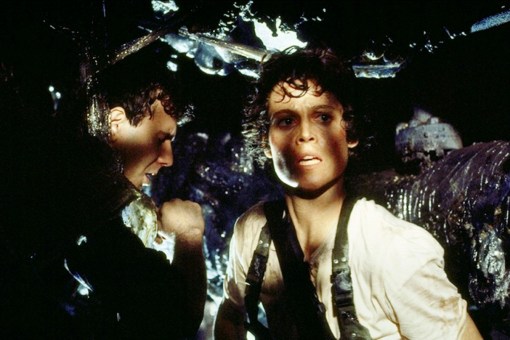
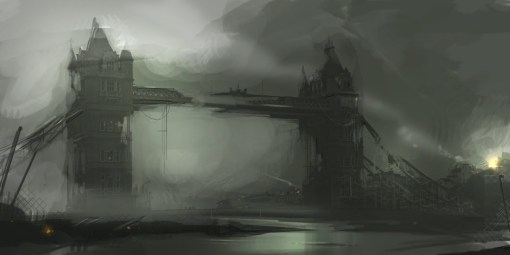
  • Another year has passed, and a chance to review the games I played and the great things I did in them, as well as to preview what I hope to play (and GM) in the year to come. This year was a relatively quiet one in gaming, actually, possibly because business travel for me interrupted a lot of gaming opportunities and possibly also because, by the standards of the two previous years, gaming has been a little bit low key in 2017. Besides a few minor side sessions, 2017 has been about playing in one major Shadowrun campaign, and running the new Mutant system. But playing, particularly, didn’t reach the heights of the previous two years. Here’s a brief review.

    Undriel: The Gaelic high fantasy that floundered

    I started the year playing a series of adventures in a world called Undriel, a classic fantasy setting with a Gaelic twist, which was run using a home-brew system our GM developed based on World of Darkness. I was officially very resistant to playing in World of Darkness rules, which I have had bad experiences with and really don’t like, and flat-out barred using the standard magic rules of e.g. Vampire: The Masquerade, which I think is a terrible system. The magic system we came up with was quite flexible, however, and I liked my character quite a lot: Xenobia the unwilling necromancer, a young noblewoman who was accidentally infected with necromantic powers by a dark ritual gone wrong. I enjoyed playing her as a creepy girl aiming to do good, but the system didn’t work as I expected (WoD, natch!) and for some reason this campaign floundered after about session 5 or 6, only 2 of which I joined for reasons of travel. I think in truth that all the players carefully avoided further participation in this because we all just did not like the system, and the Gaelic twist on the fantasy world meant we had to know too much detailed mythological background to figure out what was going on. So this campaign died in the arse somewhere around April, quite stillborn but sadly not especially mourned.

    Shadowrun: Continuing the New Horizon campaign with magic

    After Undriel failed a different GM stepped up, to run a short and low-demand Shadowrun campaign. This was a continuation of our excellent and wonderful New Horizon campaign, a classic cyberpunk setting run in Cyberpunk (which is an awful system). The New Horizon campaign was amazing, and featured probably my all time favourite PC, The Druid (aka Drew), a rifle-toting teenage girl with psychopathic tendencies, and we were all eager to run a continuation. The New Horizon campaign ended with our characters waking a dragon and bringing on the Awakening that heralds the opening of the sixth world, and the shift from Cyberpunk to Shadowrun. So our new, 2017 campaign was set 50 years or so later, in the ruins of New Horizon, in a world of magic and assault rifles and metahumans. This Shadowrun campaign has been a lot of fun, with nine sessions completed in the second half of 2017 and a lot of tense and fun adventures featuring a fairly tight-knit and well-functioning group. My character, Jayden, is a bit boring compared to Drew but he is a highly effective melee combatant and I have really enjoyed playing a character who is competent and completely comfortable in his world, without any of the psychological baggage that made Drew and Xenobia a little bit thorny for the other PCs to be around. Shadowrun New Horizon hasn’t had as many memorable moments as the original New Horizon Campaign, even though it’s run by the same GM, but this is partly by design: After a couple of high-tension high-stakes campaigns, he consulted with us and we all agreed we wanted something more low key and traditional, just a bunch of guys and girls running in the shadows and getting by as best they can. It’s been a good chance for us to explore Shadowrun pretty much as it’s written, in a Hong Kong-type setting with our GM’s flair for exceptional settings and tense scenarios but without the demands of an over-arching story. We’ve all been enjoying it and we expect it to continue into 2018.

    Mutant Year Zero: A startling new system and a fun world

    For the second half of the year I have been GMing a short campaign using the Mutant: Year Zero system by The Free League. As I stated in my review of the game, I have been really stunned to find this system which is light, highly playable and extremely flexible, and has made GMing fresh again for me. It’s a simple system that really finely balances risk and reward, and seems to have been really popular with my players. On balance over the past couple of years I think the game I ran that my players enjoyed the most was Flood, a post-apocalyptic waterworld setting run in Cyberpunk where the low-tech setting made the terrible system almost bearable, and I really really wish I had known about Mutant when I ran that campaign, because I think this system would have made it even better. Instead I’m running a campaign set in post-apocalyptic London, with the PCs doing nothing more really than exploring the area around their Ark and slowly uncovering things about the ancient world and the history of the Ark. I expect this to only run for one or two more sessions, but the players all seem to have been really enjoying it and they all really love the simplicity and elegance of the system. I can’t say that the Mutant campaign has been a masterpiece of GMing on my part but it has flowed smoothly and the system has inspired me enough that I (and I think my players too) really feel like I’m there, crouched around the trashcan fire after the fall of the world, when I break out those dice.

    GMing in 2018: Coriolis and a real high fantasy campaign

    Our other regular GM is moving away from Japan in mid-2018 and I am hoping to be able to take over the core GM role for our group for the foreseeable future, which I am hoping will give me the opportunity to run a long, detailed campaign of the type I haven’t run for years. After Mutant finishes I intend to stick with a similar system by the same company, Coriolis, and run a short campaign in that setting until I take receipt of the Forbidden Lands RPG, which is currently in production stage. That is Free League’s attempt to merge the system used in Mutant: Year Zero with a high fantasy setting, and everything I have seen in the reports on the kickstarter suggests it is going to be an awesome high fantasy system that – for the first time in years – makes me want to GM high fantasy.  I am hoping to take that and make it our group’s primary campaign setting for at least the next year and hopefully longer, running the kind of sprawling, 1st level-to-lordship fantasy campaign that historically has only really been possible in crappy systems like D&D. My whole group have been wanting to run a high fantasy campaign but we just can’t get into any of the current systems, and Forbidden Lands offers the real possibility of a setting and a system that finally work. So having played Coriolis to adapt to a richer version of the Mutant: Year Zero system, we will switch over to a full fantasy setting and get to grips with the kind of fantasy role-playing we’ve all been yearning for for years.

    That’s my 2018 Big Plan!

    Playing in 2018: Muskets and Magic

    I have joined a second group which is running a GURPS-based muskets and magic setting. I haven’t started playing with them yet but I’m hoping it will prove to be an excellent addition to my gaming in the new year. I haven’t played GURPS before, it looks complex and fiddly but viable, but the setting will be very similar to the Compromise and Conceit setting I was GMing when I first started this blog. I’m hoping that will provide not just a refreshing setting and a chance to play in a world I only ever GMd in the past, but also a chance to meet new players, new GMing styles, and new ideas. Hopefully this will mean that 2018 brings with it a whole bunch of fresh new game worlds and experiences.

    Real life in 2018: Less business, more exercise

    I have been making adjustments to my work life in 2017, including scoring some big successes, and I am hoping that in 2018 I will do less business travel, spend more time in my home, and have more time for both gaming and blogging. This blog has taken some hits in 2017, with posting dropping down to fortnightly or even monthly at times, and I have been less enthusiastic about it at times than I would like. Next year will be 10 years since I started the blog, which has held together over that whole time, and I’m hoping that in 2018 I will be able to pick up the posting a bit and get back to where it was at a few years ago. I have also discovered a much better kickboxing gym in 2017, where I am slowly recovering my love of kickboxing, and I’m hoping that in 2018 I will be exercising more and regaining the fitness that drained away slowly over the past few years. So overall in 2018 I’m hoping for less exotic destinations in the real world, and more exotic destinations in my imaginary life – which is way more interesting, anyway, than traveling for work.

    I hope you, my reader(s), who have patiently stuck by this blog over these past few years, will get to see more gaming reports and more interesting worlds in 2018, posted more regularly, and hopefully follow my players as they grow from first level adventurers to mighty heroes, in a fantasy world worth adventuring in. And I hope you too get to enjoy a rich and varied imaginary world in 2018, with large dice pools and mighty deeds. Bring it on!

  • Not what you remember

    There’s a moment in Netflix’s The Mist that I think summarizes the rot at the core of modern American TV and cinema. The main characters are Eve and Kevin Copeland, a preposterously young couple with a teenage child, who seem like a nice enough couple though they are struggling with the conflict between Eve and her daughter. At one point near the beginning of the series Kevin’s brother visits them, and we discover something about Eve. It turns out Eve used to be a slut – the town bike, as it were – and Kevin’s rough older brother was a member of the group that she used to hang with. Nothing is made clear, but it is implied pretty strongly that she has slept with Kevin’s older brother. After the brother leaves Eve is unsettled, and so when Eve and Kevin are having sex she demands that he fucks her as roughly as he can. This is funny because the sex they’re having before then is super gentle, and his “hard” fucking is pretty average, but we’re meant to believe that he’s being super rough. Anyway when it’s done there is an air of dissatisfaction, and he asks her “what was that about”, and she does that stupid thing that girls in American movies do where she’s obviously upset about something but pretends everything’s okay.

    The upshot of this scene is very clear: that women who sleep around a lot are bad people with problems; that these problems never really go away; that women who like being fucked hard must be sluts with problems; and that to want to be fucked hard is bad.

    The executive producer of The Mist was Harvey Weinstein. It doesn’t come as a surprise to me that a TV show produced by a serial rapist and sexual harasser would have a scene that carefully boils down every misogynist idea about women who enjoy sexual freedom into a mess of accusations, but some people seem to be surprised that the kind of movie world that could produce this scene would be occupied by people like Harvey Weinstein. At the time that his predations became public knowledge and the #metoo movement started there was a general upsurge of shock at both the banality of predatory behavior in Hollywood, and the extent to which that predatory behavior was enabled and supported by so many people. For people on the right this manifested as a kind of jaded relief, a sense of “oh look these liberal Hollywood types don’t believe in any of this equality stuff, it’s just a pose they adopt to appear cool to each other.” For the rest of us, and especially for mainstream media critics, there was an atmosphere of surprise at how “liberal” Hollywood was actually a nasty network of sexual predators and bullies, its supposedly famous values of liberal tolerance and equality betrayed by its own members.

    I wasn’t surprised by any of this, because I’ve never seen Hollywood as “Liberal”, and I’ve always thought a lot of its politics was pretty dire, most especially its sexual politics.

    We see the same thing in the reactions to fan disappointment over the Last Jedi. I have read many articles now in Vox, the Guardian and the Washington Post about how this reaction is partly due to fanboys being disappointed in the “diversity” on display in the movie (i.e. there are two female leaders and a couple of non-white characters), and the idea that this focus on diversity distracted from the production values of the movie (or something – I can’t quite figure out how these points are supposed to link together). This has been a controversy since The Force Awakens and Rogue One, both of which featured strong female leads, and we also saw it with the Ghostbusters remake and the latest Mad Max. I think these debates, rather than being a sign of how “liberal” Hollywood is, are really a sign of how incredibly conservative it is and has been. Consider movies and tv shows like Ghost in the Shell, Gunnm, Neon Genesis Evangelion, Appleseed, Bubblegum Crisis, and pretty much any early work from Studio Ghibli. These are all movies from the 1980s and 1990s in Japan, and female leads were a routine part of that world. Nobody questioned whether Major Kusanagi, Alita, Nausicaa or Deunan had a right to be where they were, and nobody thought diversity killed those movies – female leads in Japanese sci fi and fantasy are a pretty standard part of the picture (and this isn’t limited to anime – consider Library Wars, the recent excellent live action Gintama, or Attack on Titan as examples of live action movies with important female characters in main parts). But in America in 2017 the decision to cast a single woman in a lead role, or to have a team of women doing a job, is controversial and a sign of political correctness gone mad. If Hollywood is being castigated for finally doing something Japan was doing in the 1980s, I think we can say it’s not very forward thinking.

    Hollywood’s diversity problem is not the only example of its persistent inability to be anything except thoroughly reactionary. Here are some others.

    • The lesbian always dies: It’s pretty reliable that if there is a lesbian character in a major movie or drama, she’s either a fucked up person or she dies, or both. Usually she’s in a couple and the other one survives to suffer the grief, but one has to die. This fate also often befalls the fat chick, or the gay dude (it will probably not come as a surprise that the “gay” dude in the Mist is a psychopath, or that I guessed this in the first episode simply because of his implied sexuality)
    • Black dudes are always a stereotype: The dragon in Mulan, the black dude who briefly surfaced in Angel, almost every character Eddie Murphy has ever played … they’re almost always a stereotype, either a gangster or a magical negro. Despite the fact that a sizable proportion of American people are black, and they have been clamouring for better representation forever, it is impossible for an American movie maker to portray one in a sensitive way, except perhaps in a character piece about slavery or oppression
    • Sluts are always bad: If you are a woman who has lots of sex for fun, you are either psychopathic or severely emotionally damaged. Eventually you’ll grow out of it but you’ll never forget it
    • The goth secretly wants to be normal: See for example the horrible betrayal at the end of The Breakfast Club, which is a model for how alternative sub-cultures are treated in Hollywood
    • All women come by being fucked: And it would be completely impossible to show a woman getting licked. True love means that two people can come together and instantly have perfect sex just by fucking, and no man wants to lick a woman, and no woman cares to be; though women love to suck dick, usually on their knees. This is particularly infuriating because there’s a whole branch of American feminist criticism of porn that says it’s an unrealistic depiction of sex, but at least in porn the women actually get licked and the men actually enjoy doing it! It’s also really frustrating in Sex and the City, which is supposed to be about how the main female characters are completely empowered, but every sex scene I saw in the one episode I watched was them selflessly sucking cock
    • America’s latest geopolitical concern is your enemy: Something really jarring in Blade Runner 2049 was the casual insertion of Russian into everyday scenes. There was no Russian in the original, and no hint that Russia was relevant. Why? Because now Russia is a big geopolitical issue for America. It’s not only pathetically insecure, and it doesn’t just make every movie dated, but it also shows really obviously that Hollywood serves primarily to manufacture propaganda for the US as a whole, not to tell interesting independent stories. You can see this in so many action movies, that the enemy du jour is simply whoever happens to be in the American political consciousness at the time. Pathetic.
    • They cannot cover Global Warming: In Blade Runner 2049 it was snowing in Los Angeles. How can it be snowing in California in 2049? We know that is not going to happen! In almost every movie set in the near future in America, global warming is not depicted – it doesn’t form the theme of the movie but it doesn’t figure in the backdrop either. Florida is unchanging despite global warming, and if the weather enters into it it will be weird but it won’t be warmer. This wasn’t always the case – Soylent Green is set in a warmer world – but it is now. Hollywood will not touch the political realities of the future or of America now, only the fantasies Americans have about themselves. America produces a bunch of disaster movies every year, and none of them ever cover anything caused by global warming. Of course global warming is politically controversial in America (and only in America) – so Hollywood simply won’t touch it.
    • Guns are wonderful: Every American movie with even a hint of action has a gun fetish. There is a very simple truism of previews at movies in Japan: If it’s a live action Japanese movie, someone in the preview cries; if it’s a live action American movie that isn’t a rom-com or a human drama, everyone pulls a gun. This wasn’t always the case – watch old episodes of Knight Rider (haha) or CHIPS (hahaha) and you won’t see anyone – even the cops! – wield a gun. But now guns are fetishized. Top tip for people considering whether this is good or bad: guns are not cool, and you can enjoy action without them. See e.g. anything made in the UK, and Jackie Chan.
    • Violence against women is casual, brutal, and full frontal: There are so many crime movies on American TV, and in so many of them women get treated horribly. There is even a very long-running show about a team of cops that only deal with sex crimes (featuring Ice T as a cop, haha show us your principles Ice T!). And in recent movies especially killing women in horrible ways that are shown fully for our viewing pleasure is a real thing. If you look back at the original Blade Runner, for example, the sex scene between Deckard and Rachel is very very rapey, and it really didn’t have to be. This kind of thing is a feature of Hollywood movies
    • The criminal is often a woman: In a lot of the crime shows the murderer often turns out to be a woman, which is likely way above the actual probability that a murderer would be a woman (they’re almost always men). I think this happens because the directors want a twist, and the obvious twist in a crime show is that the killer wasn’t the dude you thought he was. But it’s interesting that when violence against women is too excessive the film makers will argue they’re being honest; but when they could be honest about how almost all murderers and sex criminals are men, they suddenly plead fantasy. It’s as if every single aspect of the film making process is set up to make women look bad!
    • Workplace sexual harassment: This is especially common (though not limited to) TV shows, where women in the workplace routinely get subjected to comments about their gender and their sexuality, jokes about dating co-workers, and suggestive comments about what they should be doing. The really disturbing thing about this is that the jokes are not presented as transgressive, or risque – they’re just facts of the workplace. Is this what it’s like to work as a woman in America? Or is Hollywood just trying to remind women they shouldn’t really be there?
    • Everyone’s home is perfect: Even people on minimum wage have perfect houses. While you, you peon, live in shit. Do you feel like a loser now?
    • Whitewashing: Do I even need to say anything on this topic?

    This isn’t even the whole of it. But when you put all of these things together what you are really seeing when you watch material from Hollywood is often an intense barrage of reactionary ideas, combined with a wilful resistance to some of the core challenges facing modern society, and a stubborn refusal to look at the ways that the world has changed. For example, Hollywood in general absolutely will not allow any ideas from pornography into its sex scenes. Sex scenes in major movies in Hollywood have not changed since Sarah Connor and Kyle Rees came together in sudden intense love in Terminator (though that scene was way more consensual than some others I guess). Thirty years later and still it is simply impossible for Hollywood to update its love scenes. We all know that everyone’s watching porn, but nobody in Hollywood will admit to the fact that sex is about more than dicks in cunts. This is just one example of the many ways in which this image factory is still stuck in the 1850s.

    We in the rest of the world put up with this, and of course we watch our own cinema which has its own problems and its own reactionary issues, its own humour and its own misogyny, so it’s not like anyone is perfect. But the difference is that nobody in Australia wastes time claiming Australia’s movie scene is relentlessly liberal, then feigns shock when it turns out that the dudes making all these rapey creepy shows were actually sexual harassers. It’s a uniquely American problem that everyone thinks Hollywood is liberal, when it’s really really not.

    So don’t be surprised when the people who make this destructive shit turn out to be destructive shits; and don’t buy into all this hype about representation and diversity. Hollywood is not your liberal friend, and because Hollywood is not liberal and not feminist and not interested in equality at all, it has attracted power hungry shits like the Weinsteins. That doesn’t mean we have to credit this industry with being a force for good, even as we pay to watch what it produces. It produces images of America for America, and I really hope America is not as conservative and reactionary as the images it produces, but one thing you can be certain of is that those images are not intended to support any radical ideals – quite the opposite.

    Hollywood is not your liberal friend.

  • Two days ago I wrote a scathing review of Star Wars: The Last Jedi, and since then I have been digging around for others’ views on the matter. The Guardian has an article giving some fans’ reviews, and the below the line comments are suitably critical of this awful movie. Meanwhile Vox has a pathetic, self-serving article by a film critic attempting to explain why so many people have such different views to the critics. This article includes such great insights as “critics don’t really care about plot” which is dismissed as a “nitty gritty detail” of a movie – they’re more interested in themes and emotional struggles, apparently, which suggests they’d be more at home at a My Chemical Romance gig than a decent movie. How did they get the job?

    In amongst the complaints on the Guardian‘s article, and at the centre of the Vox piece, is a particularly vicious little dismissive claim: That a lot of the negative reaction to the movie arises from long term fans[1], who cannot handle what Rian Johnson did with their cherished childhood movie, and are unrepresentative of the broader movie-going public. In the more vernacular form of some of the BTL comments on the Guardian article, fanboys are pissed off because Rian Johnson didn’t make the movie exactly the way they wanted. This, apparently, explains the difference between the critics’ view of the movie and the people giving a review on the Rotten Tomatoes website.

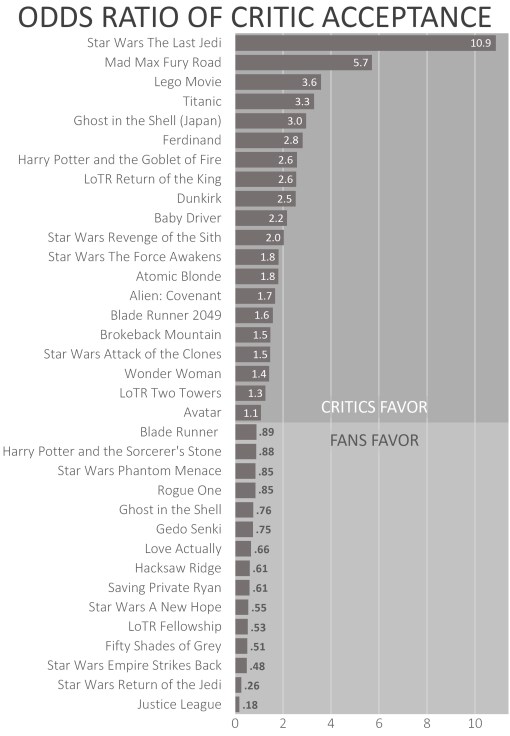
    I thought this sounded fishy, so I decided to collect a little bit of data from the Rotten Tomatoes website and have a look at just how far fanboys typically deviate from critics. I figured that if fanboys’ disappointment with not getting a movie exactly as they wanted it was the driver of negative reactions to this movie, we should see it in other Star Wars movies. We should also see it in other movies with a strong fanboy following, and maybe we wouldn’t see it in movies that don’t have strong preconceptions. I collected data on critics’ and fans’ aggregated review statistics for 35 movies from the Rotten Tomatoes website. For each movie I calculated a score, which I call the Odds Ratio of Critical Acceptance (ORCA). This is calculated as follows:

    1. Calculate an odds for the critics’ aggregate score, O1, which is (score)/(1-score)

    2. Calculate an odds for the viewers’ aggregate score, O2, which is (score)/(1-score)

    3. Calculate their ratio, ORCA=O1/O2

    I use this score because it accounts for the inherent limits on the value of a critical score. The Last Jedi got a critics’ score of 0.93, which is very close to the upper limit of 1. If the viewers’ score was, for example, 0.83, it is 0.1 lower than the critics’ score. But this 0.1 is a much larger gap than, say, the difference between a critics’ score of 0.55 and a viewers’ score of 0.45. Similarly, if critics give a movie a value of 0.1 and viewers a value of 0.2, this means viewers thought it was twice as good – whereas values of 0.45 and 0.55 are much less different. We use this kind of odds ratio in epidemiology a lot because it allows us to properly account for small differences when one score is close to 1, as (inexplicably) it is for this horrible movie. Note that ORCA scores above 1 indicate that the critics gave the movie a higher score than the viewers, and scores below 1 indicate that the viewers liked the movie more than the critics.

    I collected scores for all the Star Wars movies, all three Lord of the Rings movies, both Ghost in the Shell movies (the Japanese and the western remake), both Blade Runners, Alien:Covenant, two Harry Potter movies, Fifty Shades of Grey, and Gedo Senki (the (filthy) Studio Ghibli version of A Wizard of Earthsea), as examples of movies with a fanboy following. As readers of my blog are no doubt very aware, the Lord of the Rings fanboys are absolutely filthy, and if anyone is going to sink a movie over trivial shit they will. Ghost in the Shell is a remake of a movie with a very strong otaku following of the worst kind, and also suffers from a huge controversy over whitewashing, and Gedo Senki is based on one of the world’s most popular books, by a woman who has an intense generation-spanning cadre of fans who are obssessed with her work. Harry Potter fans are also notoriously committed. I also gathered a bunch of movies that I like or that I thought would be representative of the kinds of movies that did not have a following before they were released: Mad Max Fury Road, Brokeback Mountain, that new movie about a transgender bull[3], Ferdinand, things like that. I figured that some of these movies would not get a big divergence in ORCA if the fanboy theory is true.

    Figure 1: ORCA Scores for a range of movies, none apparently as shit as The Last Jedi.

    Results of my calculations are shown in Figure 1 (sorry about the fiddly size). The Last Jedi is on the far left, and is obviously a massive outlier, with an ORCA score of 10.9. This score arises because it has a critics’ score of 93%, but a score from fans of 55%[4]. Next is Mad Max: Fury Road, which was not as successful with fans as with critics but still got a rating of 0.85 from fans. It can be noted that several Star Wars movies lie to the right of the pale blue dividing line, indicating that fans liked them more than did critics – this includes Rogue One and The Phantom Menace, showing that this phenomenon was not limited to the first generation movies. Note that Fellowship of the Ring, the LoTR movie most likely to disappoint fanboys under the theory that fanboys want the director to make the movie in their heads, had an ORCA value of 0.53, indicating fans had twice the odds of liking it than did critics. Gedo Senki also did better with fans than critics despite being a terrible movie that completely pisses all over Ursula Le Guin’s original book.

    There’s no evidence at all from this data that fanboys respond badly to movies based on not getting the movie in their head, and there’s no evidence that Star Wars fanboys are particularly difficult to please. The ORCA score for The Last Jedi is at least 12 parsecs removed from the ORCA score for the next worse movie in the series, which (despite that movie also being a pile of shit) is not that high – it’s lower than Dunkirk, in fact, which was an awesome movie with no pre-existing fanbase[5]. Based on this data it should be pretty clear that either the “toxic fandom” of Star Wars has been hiding for the past 10 years as repeated bad movies were made – or this movie is uniquely bad, and the critics were uniquely stupid to give it a good score.

    I’m going with the latter conclusion, and I want the movie critics to seriously re-evaluate how they approached this movie. Star Wars clearly gets a special pass from critics because it’s so special, and Star Wars directors can lay any stinking turd on the screen and get a pass from critics for some incomprehensible reason. Up your game, idiots.

    A few minor side points about critical reviews of The Last Jedi

    I’ve been generally shocked by the way in which this movie is being hailed as a critical masterpiece. I really can’t see how this can be. Even if it’s not as bad as I think, I can’t understand how it can get similar scores to movies like Dunkirk, Mad Max: Fury Road, or Titanic. Those movies are infinitely better crafted than this pile of junk, with tight and carefully designed plots that clearly hold together under extensive criticism. There is nothing extraneous at all in Titanic or Dunkirk, not one moment that you could say isn’t directly relevant to the unfolding story, and the acting in all three of these movies is exemplary. Worse still, the Guardian is now claiming that Star Wars is the most triumphantly feminist movie yet. This is utter bullshit on its face: The main male character, Po Dameron, repeatedly undermines female leaders, and their attempts to discipline him are ignored, ultimately leading to the death of probably 200 people in a completely avoidable catastrophe, and he suffers no consequences for his dishonesty and treachery. Furthermore, he takes over the main role from Finn, the black character, and Rei is sidelined into a supplicant to an aging white man. As a moral story for entitled white men who can’t bear to be told what to do by women it’s exemplary. But this is even more horrific when you consider that Mad Max: Fury Road is a savage eco-feminist masterpiece, and undoubtedly the most triumphantly feminist movie ever made. This is another example of the weird special pass that Star Wars movies get: they make piss poor tokenistic gestures towards diversity and the critics are claiming they’re the most woke movie ever made.

    There’s a strange irony in this. Star Wars fanboys are being blamed for obstinately marking this movie down on the basis of silly stereotypes about nerds, when in fact it’s the critics themselves who are acting like Star Wars sycophants, giving one of the worst movies of the millenium sterling marks for trying. Unless of course the conspiracy theories are true, and they’re all paid by Disney.

    I won’t be so cynical. They’re just stupid and wrong, and in future I recommend not listening to reviewers before going to see any movie. Trust the viewers, they have much better judgment!

    UPDATE: I have swapped my shoddy figure with a figure supplied by reader frankelavsky, who apparently actually knows how to do visual stuff, so it’s now much easier to see how terribly wrong the reviewers were.


    fn1: Which, inexplicably, the Vox article seems to view as Baby Boomers, which is weird since most people want to now pretend Star Wars is a kid’s movie (it’s not[2]). Many of the fans saw it as kids, it’s true, but that’s because we were Gen X, not baby boomers. More importantly, Star Wars fandom crosses three generations, and includes a lot of Generation Y. It’s just dumb to even hint that the themes in the movie pissed off the fans because baby boomers don’t like the idea of handing on the baton to a new, more diverse generation. Star Wars fans aren’t baby boomers, and why would baby boomers have a problem with this anyway?

    fn2: How fucking stupid is modern pop cultural analysis of pop culture, and how far has it fallen, that people could say this?

    fn3: This is a joke. See here for more details.

    fn4: It was 56% yesterday. This movie is sinking by the day.

    fn5: Barring UKIP, I guess

  • Star Wars: The Last Jedi opens with Po Dameron pushing a ridiculous and unbelievable plan that gets a lot of people killed, and ends with him walking away a hero. He should have been killed in the middle of this movie as a consquence of a whole chain of reckless and stupid decisions but somehow comes out shining; I can’t say the same for my commitment to the Star Wars genre, after a similar sequence of staggeringly stupid decisions on my part. After sitting through five terrible movies even when I should have known better, I have given up on this whole thing. This fan is burnt out from all the bullshit, and this bullshit is nowhere better seen than in the latest putrid installment, a festering two and a half hours of stupidity, poor decisions, treachery to the original canon, and flagrantly bad movie making. Everything it could do wrong it did. It has a terrible plot; it can’t decide if it is a comedy, a human drama, a romance, a fantasy, a cowboy movie or a space opera, and it can’t do any part of its smorgasbord of genres at all well. It has awful characters: Po Dameron is an entitled little shit who needs to die; Rei has been drained of all her spark and vibrancy; Kylo Ren may have improved over his execrable performance in the previous movie but he is still a bullshit character whose motivations make no sense and who just cannot command any gravitas at all; and far from being the wise-cracking cynic I was promised Luke Skywalker is just a whingey old sad-sack hiding on an island, the central emotional hook for all his actions obviously transparent bullshit. Princess Leia, of course, has been hijacked and ruined in this movie. The technology is ridiculous, and the Star Wars universe has been transformed from one with cool but anachronistic tech to a series of penis-waving boys’ toys, everyone intended to outdo the previous one – perhaps in order to keep the viewer from noticing that this whole thing is a stack of steaming horseshit – in such a flagrantly obvious way that it’s kind of pathetic; and then anyway as soon as they introduce the new super powerful tech the writers do something dumb with the script that completely undermines everything that was great about the new tech. That’s bad screen writing. And did I mention the script? It’s appalling. As is the acting, the special effects, and the choreography. Also the jokes – which even if they were good serve simply to undermine whatever else is happening at the time – are genuinely lame. And what in this wide universe is going on with the PETA sub-plot? How did anyone think that was going to fit in? Or the stupid children in the stables – one of whom looks so much like Oliver Twist that I was sure he was going to burst into song. Is that meant to be inspirational, or is it a teaser to the possibility that Episode 9 is going to be an actual musical? Perhaps we’ll have to suffer through three hours of Les Miserables in space?

    This movie is just a pile of junk, and a pitifully obvious attempt to milk the last loyal fans of this bloated franchise. The whole thing is kept going by fans who are too devoted to stop, and treacherous cinema critics who give the Star Wars series an easy pass because it is a fan favourite. The Guardian gave this waste of 2.5 hours of my life five stars. I’m sorry, I can understand having differences of opinion on the quality of a movie but this movie was not anywhere near five – I could forgive giving this obvious one star bloated carcass a three because you’re not a seasoned sci-fi aficionado, but five!? Anyone who gets their movie criticism so wrong should be sacked. Now you might say “All these critics say it’s great and just you faustusnotes say it’s bad, surely they can’t all be wrong”? And I reply: Yes, yes they all are. You can believe me, and not waste your money on this insult to our childhood memories, or you can burn a couple of hours of your life and come out angry at the director, and angry at yourself for not listening to me. Here’s my tip: Wait for it to come out on TV, and spend the money on having someone hammer your kneecaps with a mallet. It’ll be more rewarding.

    — SPOILER WARNING —

    [From here below are specific detailed criticisms, which include spoilers, so if you haven’t seen the movie yet and are still dumb enough to ignore my advice, please don’t read further. I suggest you book mark this though so you can come back afterwards and curse yourself for ignoring my advice]

    The central problem of this movie is that it’s poorly written, but there are some specific and serious problems that either really let this movie down, or serve to create further trouble for the entire Star Wars effort. These bigger problems are also the reason I’m not going to waste further time on the central movies of this whole dead horse series, because the willingness of multiple Directors to piss all over the original movies’ entire purpose shows clearly the contempt with which they view fans of these movies. It’s not just a question of not wanting to waste my money on movies that are going to be predictably bad – it’s also about not giving these people a reward for ruining something that was once great. And now these movies are becoming such a drag on the whole universe that I’m starting to question my love for the originals. When it reaches the point where these movies are – in typical JJ Abrams style! – reaching back in time to ruin your childhood memories, it’s time to cut and run. So here are some specific examples of the deep contempt with which Rian Johnson treated his viewers.

    Po Dameron is a traitor who needs to die: In the very first scene of the movie Po Dameron – the shining white boy hope of this movie, apparently – goes on a reckless mission that is just patently obviously stupid, and refuses to follow orders and retreat. His mission ultimately succeeds so in the middle of the movie, certain of his own rightness, he launches an actual mutiny on a rebel ship, and sends Fin and Rose (a new character) on a mission that ultimately leads to the betrayal of the Rebellion’s plans and the death of most of its members. When his mutiny fails and he is recaptured he attracts absolutely zero consequences, when in fact he should have been spaced, and at the very end emerges with his reputation and rank unharmed by his treachery that directly led to the death of most of the entire fucking rebellion. This is an obvious flaw in the story, since the Rebellion is meant to be a military operation but here they are rewarding open traitors, but it’s also a sign of how desperately cynical these people are and how stupid the reviewers who watched this movie are. At a time when there is a mediocre – and probably treasonous – white man in the White House, at the time of the #metoo movement, we get a movie from the heart of the world of sexually harassing lazy white men, in which a lazy, stupid and reckless white man gets lots of people killed, and he gets no penalty at all for his actions, and gets hailed as a hero. As if this weren’t shocking enough, reviewers you might respect actually say that his character has really developed, and see him as a character worth engaging with rather than a flim-flam jock who should be spaced. Lots of reviews of this movie have mentioned that the entire Finn/Rose side mission is a distraction from the main point of the movie but as far as I can tell none have noticed that Po Dameron needs to be spaced. This is fucking shocking. This mission and Po’s actions had me absolutely seething. What do the script writers and the director take us for when they dump this crap on us? Have they no respect for their audience at all?

    The movie doesn’t know what it is: The first third of this movie is basically a comedy, with a few asides to a supposedly serious drama involving Rei and Luke Skywalker, or Rei and Kylo Ren, which also include jokes that are supposed to be funny (I guess) but are just lame clangers. These jokes seriously let down what little gravity any other part of the plot is trying to develop, and really do give much of the movie a feeling of being a kind of Christmas Special, not a serious movie. Yes the original Star Wars movies had light asides, but a lot of it was actually genuinely funny ascerbic banter between Solo and Leia, that was in context and most importantly actually funny, not lame one liners or silly slapstick comedy involving really stupid looking aliens, or really weak attempts at humour that fall flat like Rei’s absolutely appalling “can’t you at least wear a cowl or something” to Kylo Ren when he’s half naked. The movie keeps flicking from these serious attempts at character drama to these lame asides, and it really ruins any attempt to set up a serious arc of character development. Star Wars is not a comedy, but it’s fast become laughable.

    The core characters are weak: Rei had a lot of zest in the previous movie and was one of its few saving graces, but she has become an insipid weakling in this, a supplicant to the big men in her life. Her relationship with Kylo Ren – which by the way is utter bullshit, see my complaint below about the newfound powers of the force – and the way it is easily used to fool her into her own destruction is a complete betrayal of everything she stood for in the first movie, a backstabbing of every woman who had thought this series might move forward on the back of a strong female character. Her attempts to win over Luke Skywalker come across as weak, and just let her down as a character. Meanwhile the other two men in her life – Skywalker and Ren – are just terrible. First we get this speech where Snoke[1] basically acknowledges that the Kylo Ren of the Force Awakens was a pissy emo shithead, which has to be unheard of in modern cinema, the director using a character’s speech to admit that his critics were right and in the previous movie his character was a pissant. Then we get this weird emotional rollercoaster where Ren goes up and down between being evil and being good, where we’re meant to believe – I suppose – that he’s having some kind of crisis of confidence, then at the end the way it’s written we’re not sure if he was going through a crisis of confidence or if he was just being really super manipulative. And through all this he remains an emo shit, whiney and doing dumb and adolescent things like punching walls. He doesn’t project strength, just an overwhelming sense of insecurity. Then we have Skywalker, who one review describes as a cynical wise cracker, but who is actually just a whiney sad sack, hiding out on an island and running away from everything he is responsible for because he fucked up with Kylo Ren. The central idea here – expressed by Luke himself, not inferred by me – is that he believes he failed because he didn’t stop Ren from becoming evil. But this is obviously bullshit – Ren became evil by himself and his own choice, not because Skywalker wasn’t wise enough. Nobody believes for a moment that anything else happens, so why do the script writers and director try to convince us that this tired and pathetic guilt trip is either a) viable or b) noble? Someone needs to slap Luke in the face and tell him to grow the fuck up. Also, this movie is called the Last Jedi, and at the end Luke says “I’m not the last jedi.” Is this also a first in cinematic fuck ups, where one of the central characters admit that the movie has the wrong name? I don’t know, maybe they should have called it The Next Jedi. Or better still, the Whiney Old Sad Sack Jedi who Should Just Fucking Die Already. Which he does, voluntarily – I count three suicides or attempted suicides in this movie – why not just turn up and do it in person you coward, instead of projecting your image across the universe and doing it quietly at home? Talk about Millenials being lazy and cowardly … which brings me to …

    This movie further wrecked the force: In the original movies the force is a quite constrained power that enables its practitioners to – with considerable effort – levitate objects near them, operate light sabers, achieve fairly impressive feats of physical acrobatics, sense each others’ presence within a reasonable distance (possibly planetary) and sense mass murder on an interstellar basis. In the three prequels we discover the force is a virus, but in the new movies we were promised that that dumb idea would be pissed down the memory hole. In exchange we discover that any unqualified dufus can operate a light saber, but now we also discover that the force enables its practitioners to do incredible feats of great power, such as make them almost super human. It enables Princess Leia to survive a direct hit from a photon torpedo, followed by being spaced, and to fly back into her spaceship. It enables Kylo Ren and Rei to communicate visually over interstellar distances – a feat, we should remember, that Darth Vader explicitly could never do, having to rely instead on holograms – and it enables Luke Skywalker to project his image with life size and lifelike perfection across the galaxy, and to manipulate it with such accuracy that another Jedi is tricked into thinking he is killing Actual Luke. This is the worst kind of grade inflation here, since we now know that basically you can do anything with the force. Why waste time on soldiers? Just send in a single illusory force dude from the other side of the universe! When will this inflation end? Will Kylo Ren be tearing planets apart with his mind by the end of episode 12[2]?

    The power inflation of technology was ridiculous: First we see a Dreadnought, which is like a star destroyer on steroids, and we’re meant to believe it’s super scary, only within about 30 minutes this is outdone by Snoke’s personal star destroyer, which is like four times bigger again. Also, no actor in history should ever have to utter the phrase “Battering Ram Cannon.” You mean a really big gun? Why not just say it? What a joke!

    The super powerful tech is betrayed by the writers: When the Dreadnought appears it certainly looks scary, and we’re led to believe it’s the most powerful star destroyer in the First Order fleet, but then Po Dameron goes on a solo run across the surface of this super star destroyer and blows up every single cannon, clearing a pathway for the Rebel bombers to then come in and destroy it easily. It goes down to a tiny rebel fleet with way greater ease than it took to even damage a smaller star destroyer in Return of the Jedi. To be clear, there’s no reason for this: The Rebels could have had a bigger fleet, or been chased by normal star destroyers, or had some other plan that wasn’t so obviously intended to make the Dreadnought seem like a pissy under-powered ship. Why introduce a super-powered ship and then have it undone by a plot involving a single x-wing, making it weaker than any previous ship in any previous movie? Answer: Because you’re a bad writer. But this isn’t the only example of this. When the First Order bring out their “Battering Ram Cannon” to break down the walls of the rebel base, all the rebels are super scared that if it gets put to use it will break down the doors and then they will have to fight the First Order troops. So what do they do to stop it from breaking down the walls and making them vulnerable to the superior first order forces? They go outside the doors to attack the first order forces! Furthermore, this super powerful cannon is so powerful that … Finn, flying in a rust bucket tiny vehicle with literal actual holes in it, can enter the beam of the cannon and take several seconds inside it and still not die – then moments later while still inside the beam, get hit by another rust bucket flyer and have his own flyer get torn apart by the impact. So the “Battering Ram Cannon” is … weaker than a shitty second rate flyer? And does less damage than a microwave oven? This is awful writing. But it’s far from the worst crime these writers committed …

    The movie betrays core plot elements of the original movies: Picture the scene at rebel HQ in A New Hope as the death star is approaching the rebel base. A general makes a desperate plan and tells his colleagues about it: “We will send a small force of small ships that need to enter this tiny trench that is heavily defended, fly its whole length, and drop a photon torpedo into a hole no larger than a bantha. It’s the only weak point.” Someone at the back raises their hand, “Uh, sir?” He gestures for them to speak. “Well, um, we could just send a single cruiser into the system behind the death star, then have it jump into hyperspace through the death star at close range. It’ll tear the death star apart and kill everyone on board instantly.” General ponders. “Sure! Let’s do that!” Then looks at Leia and asks “Why did you waste your time getting the secret plans to the death star’s only weakness if we can just tear it apart by sending a cruiser into hyperspace through it?” Leia shrugs, and uses her enormous force powers to tear the general’s head off.

    Doesn’t make sense? Well it should now, because both of those things happened in this movie. Apparently a single small cruiser can tear apart the biggest star destroyer the galaxy has ever seen by simply pointing at it and entering hyperspace. And apparently Princess Leia has incredibly force powers that enable her to survive a direct hit with a photon torpedo followed by being spaced, and fly through space back inside the ship she was just ejected from. Did you know that Princess Leia had such active force powers? Why didn’t she use them to escape the star destroyer back in A New Hope? Or to help Han Solo escape Boba Fett? Why, in fact, did any of the plots of the first three movies happen at all, when Princess Leia had Jedi powers and a single cruiser piloted by a single person can destroy a death star? The answer, my friends, is that none of these things used to be true but now they are, and if you aren’t able to employ the Doublethink required to align these two entirely different perspectives on the core characters of the canon, then you probably shouldn’t waste your money on any more movies in this series.

    The weird animal rights sub plot: There is an absolutely appallingly bad seen in which Chewie roasts a space puffin over an open fire, and is about to eat the space puffin when these other space puffins turn up and make him feel guilty so he stops. Then there is another weird part of the whole Finn/Rose being traitorous sub plot where they go to a planet renowned for its horse racing and we get a little aside about how cruel the racing is, and the animals all get freed (after, weirdly, being raced which is not bad if Finn and Rose do it). Where did this weird animal rights sub plot come from? Did PETA sponsor this movie? Why is it in this movie? With 2.5 hours of this shit, do we really have spare time for a couple of asides about animal rights? Also, while we’re at it, the moralizing about arms dealers being the worse people in the universe, only to find out that they also deal to the rebellion, was just incomprehensible and weird. First of all, I doubt that the First Order – an organization so large it spans galaxies and is able to build a death star the size of a planet – buys its small arms from small independent dealers. I suspect the First Order have a full procurement system in place, and all major tech is – like the Death Star – made in house. So wtf is going on with this whole aside about the arms dealers? And also, if you want to make them seem like bad people, don’t immediately reveal that they also deal arms to the good guys. Doesn’t that just kind of mean that the whole thing is a wash? Or should the good guys not have guns? Because I didn’t notice them being very pacifist when they flew that cruiser at hyperspeed into that star destroyer and killed the hundreds of thousands of people on board. This kind of sub plot is just weird.

    The special effects and choreography were awful: I mentioned that Chewie tried to eat a roasted space puffin. The roasted space puffin he was about to eat was so obviously plastic that it was distracting. Princess Leia’s flight back into the space ship after she survived being spaced (and hit with a photon torpedo) was such a lame piece of Mary Poppins-esque christmas card glittering over the top wank that I couldn’t believe I was watching it. And the fight in the throne room between Kylo Ren and Rei against the Imperial Guards was just terribly hamfisted. There was one point where one of the actors clearly stepped carefully under a pole arm and placed himself in the position of being throttled. Pathetic.

    A brief note for the reviewers: Most reviewers gave this movie four or five stars. Why? This is a serious dereliction of your duty to the public. This movie was a stain on cinema, and you gave it top marks, said it was the best yet. Why did you do that? Aren’t you serious about your job as a reviewer? I am deeply disappointed in these people. How can I judge whether to bother seeing a movie if the reviewers are going to straight up lie to me about how good it is? At least I now know one form of quality control for movie reviewers – I can check how many stars they gave The Last Jedi, and judge all their other reviews accordingly.

    Other minor details: How come nobody knew the planet was there? How do you hide a fucking planet? Why did the lasers fired at the rebel cruiser arc through space – were they not light? If they were not light, where was the gravitational force so powerful that it could visibly blend them? When did fucking fuel become an issue in any scene of Star Wars ever? This was the central issue driving the tension of the entire movie and it’s never been raised in any of these movies ever before! Why did nobody listen when Princess Leia demoted Po Dameron, and he remained “commander” for the rest of the movie even after he led a fucking mutiny!? Why didn’t Admiral Holdo tell anyone about the invisible fucking planet and her actually quite smart plan of hiding out there? When Luke Skywalker projected himself onto the invisible fucking planet to act as a distraction for the rebels to get away, did he know that there was no other exit? If he did know, why did he go? And if he did know, why didn’t he move the rockfall before he went to confront Kylo Ren? How come even though in every scene where Sith and Jedi meet, the Sith can sense the Jedi, on this one occasion when Luke wasn’t actually there Kylo Ren couldn’t sense that and if he couldn’t sense him why didn’t he think that was weird? How actually stupid, on a scale of 0 (incredibly fucking dumb) to 10 (of star-collapsing levels of fucking stupidity) is Kylo Ren and can someone please, please kill him? How the actual fuck did the scene with Princess Leia becoming a Jedi get through any kind of quality control process? What were the producers thinking putting in an actual literal comedy conversation with that stupid little douchebag having an armed union dispute? Did they think that a straight segue from a desperately tense survival situation to a straight comedy conversation would somehow improve the movie in any fucking way at all?

    And finally, and most importantly, how stupid do these people think we are to keep watching this unmitigated shit? And how stupid are we, to keep watching this shit when we obviously should know better? Well, I’ve been fooled five times in a row by my own commitment to this universe, and by my foolish belief that reviewers would write an honest review about a major movie, so that’s it from me – I’m checking out of star wars. I will watch spin-offs if they seem like they might have a chance of being good, simply because the universe is a fun universe to watch, but I’m not burning any more of my money or my rapidly dwindling life span on the main series. It can go and die in a ditch.

    Other reviews you might be interested in

    My review of Avengers: Infinity War, describing how it bullies its audience

    My review of Mad Max: Fury Road, as an exemplar of eco-feminist violence

    My review of Dunkirk, as a story set in the in-between

    UPDATE: I have now analyzed Rotten Tomatoes data to show that the movie critics were uniquely out of sync with public opinion on this issue, and that I am right and the movie critics are wrong: This movie is unmitigated shit, and everyone agrees with me.


    fn1: Which, btw, should be the name of a bad guy in a Harry Potter movie, not Star Wars

    fn2: I read a part of an interview with the director, Rian Johnson, which mentioned that he has been given a whole extra trilogy of his own. Fuck no.

  • I am up to session 6 of a short campaign using Mutant:Year Zero, a post-apocalyptic RPG from the Free League, a Swedish mob whose games I had never heard of before I stumbled on Mutant. This game is apparently 30 years old – I’m playing the 30 year anniversary edition – and I guess it must have been available only in Swedish for most of its history, because I’d never heard of it or the Free League before. Which is a shame, because Mutant:Year Zero is a brilliant RPG, and the Free League’s work is a really refreshing and much welcome addition to the role-playing world.

    Mutant: Year Zero is set in a post-apocalyptic earth, with the players taking the role of mutants, a mysterious group of humans with strange mutations that give them a kind of limited impact super power. The mutants are clustered together in an Ark, a safe haven in a world of decay and destruction, and from the Ark the mutants venture out into the ruined outer world (called the Zone), looking for artifacts left behind by the Ancients, the people who ruled the world before the apocalypse. There are no humans in this world, just mutants and threats. The world is a really decayed and ruined place, so even finding something like an old bicycle or a pistol is a huge achievement, and when the mutants start the game they will have nothing better than a hammer or slingshot made out of old scrap, probably no armour and only their wits to help them survive. From there they build up their own supplies and develop their Ark, while (perhaps) simultaneously learning the secrets of the apocalypse.

    Character creation

    Character creation is a simple process of spending points to buy ranks in four attributes and 13 skills. You choose a character class from a choice of eight, each of which has a unique skill that only they can use. Character classes are well suited for the environment, including archetypes like Dog Handler (who has an actual dog that can do stuff), slave (who is super tough) and stalker (who finds secrets in the Zone). You also get to choose talents, some of which are unique to your class, and you roll up a single mutation to start with. Mutations are fairly exotic things, ranging from being able to explode with spores that do damage or hide your escape to being able to read minds. Mutations are triggered with mutation points (MPs), with more MPs being spent to get bigger effects. All PCs start with one MP, but it’s dangerously easy to get more. Finally, there are no hit points in this game – you take damage directly on your attributes, which means there are four damage types, and there are mutations and conditions which can do damage to all of them. Attributes range from 1 to 6, skills will be generally no more than 3 at start.

    The system

    Mutant uses a unique and savage dice pool system which incorporates a huge element of risk into skill checks, along with a vicious death spiral mechanic. You roll a dice pool composed of two types of dice, attribute and skill dice. All dice are d6s, so you need to make your dice pool with two colours of dice – in the set that comes with the game you use yellow for attributes and green for skills. Any 6 is a success, and if you roll a 1 on your attribute dice that can become damage. Once you roll the dice you can make the decision to either take the result you rolled, or push the roll. Pushing means that you can reroll any dice that show no 1s or 6s. This means you can get a success even if you failed on the first roll. However, once you push the roll any 1s do damage on the attribute associated with your skill. When you push the roll you also get MPs equal to the number of 1s you rolled, so there is a benefit to taking the damage. This means though that every skill check can potentially kill you (if it is tested using strength), knock you out from fatigue (for agility) or render you useless with confusion or doubt. It also means that you become worse and worse at everything the more you make skill checks. Worse still, the GM is advised that failure should always come with a cost, so if someone rolls a dice pool and gets no successes the temptation to push it is really high – and there is great pleasure for GMs in punishing PCs who fail. The dice pool mechanic is further enhanced by adding gear dice, black dice representing the benefit of using equipment. These can get you more successes but any 1s rolled on these dice will damage your gear if you push the roll, so pushing your roll when using your favourite artifact will eventually break it unless you can get a gearhead to repair it (also a roll with a push/fail risk!)

    Damage taken to attributes can be recovered with four hours of rest and consumption of a specific resource, or connection with friends (some relationships are established inside the party to help with this), but early on in the campaign the resources required are quite expensive and rare, which makes resting a costly business. The whole thing is finely balanced – at least early on – to ensure that the players are constantly on the edge of their seats, and always eagerly scrounging more stuff, but most of all always considering the risk of their next action. The game is heavily loaded with risk and decay, which makes it a really good mechanic for a living-on-the-edge post-apocalyptic setting.

    Combat

    Combat works pretty much on the lines of the skill system. You need at least one success to hit someone, though your opponent can defend and if they get more successes than you they can damage you. Damage is usually just 1 or 2 points per weapon, straight onto your strength attribute, with armour as a (pretty ineffectual) soak. Extra successes on your attack can be used to do extra damage or other effects like disarming your opponent, knocking them down, gaining initiative, etc. However to get extra successes will likely require that you push your attack roll – which means you damage your own strength, so one pushed roll and one hit and you can be out of combat. If your strength drops to 0 you take a critical hit, which can be fatal but most likely means you have penalties until you heal. But this combination of pushing rolls and taking damage against an attribute that can have a maximum value of 6 means that combat is absolutely lethal. Most fights only last 1 or 2 rounds and end with the entire party badly damaged, either from injuries or from pushing their rolls. I think someone has been reduced to 0 and taken a critical hit in every session so far, and there have been several fights where the PCs have been super close to TPK – in one fight a PC unleashed a huge wave of mutation powers to kill an opponent out of desperation, but their mutant powers backfired and killed them too. It’s that kind of game.

    The speed and lethality of combat means you can get through a lot of fights in a session, and you can get a lot done. Where other systems might have a dungeon crawl that takes sessions to complete, in Mutant you can do an entire lair in half a session. Combat is fast and deadly and a lot of fun.

    The Ark

    Another excellent aspect of the game is the development of the Ark. During character creation the players also develop their Ark, describing its structure and main inhabitants and assigning it basic levels in four attributes (Warfare, Technology, Culture and Food) which determine how well the PCs can do things like defend the Ark, understand artifacts they find, obtain food, and read and write. As the PCs adventure they find artifacts, which they can choose to use or to hand over to the Ark to be stored in the Dawn Vault. If handed over, these artifacts add to the Ark’s attributes, slowly improving it. The players can also select projects to improve the Ark – things like a defensive wall or a farm or universal suffrage – which further improve the Ark. As the campaign unfolds the PCs and the Ark develop together, until the Ark goes from a desperate hard-scrabble hideout carved from the corruption to being a real home for the PCs. This mechanic is very simply set up but very effective, and the way the Ark and the PCs interact with each other to support each other’s development and achievements is really great. Seeing your players debating whether to set up a tribunal or a secret police force (or cannibalism!) is really fun.

    The campaign arc

    The book comes with a campaign idea and some adventures related to it, which you can choose to follow if you like. This involves uncovering the secrets of the apocalypse and the truth about the Ark and the mutants who live in it. It helps to explain a strange point made at the beginning of the book, which is that the mutants who live in the Ark don’t remember how they got there and can’t have children, and look up to a mutant called the Elder who used to offer them guidance in their new world. This means that the Ark is a kind of stand-alone setting, much younger than the apocalypse, so it’s as if the PCs just sprang into being (it’s as if a group of god-like beings just created them from nothing!) The campaign arc answers these questions, and can also tie into an amusing-looking spin-off called Genlab Alpha. However I didn’t really like the campaign arc, so I have dumped it and decided to keep the apocalypse kind of mysterious and go my own way. I’m not sure why I didn’t like it – it seems like it would be perfectly playable and very satisfying (and challenging!) to complete, and it doesn’t necessarily interfere with the other tasks like exploring the Zone and building up the Ark, which are where the real fun lies. I guess I just don’t like being told what to do, or maybe I had my own vision of the apocalypse that I wasn’t willing to compromise on. However, if you don’t use the campaign arc you’ll probably find yourself running – as I have – into trouble explaining who the PCs are and why they’re there.

    Good points

    This is an excellent game. My players have all exclaimed multiple times at how much they love the simple, high-risk system, and how exciting the whole thing is. The Ark development is enormously appealing, the character classes really are evocative of a post-apocalyptic game, and the constant resource-scrabbling and the nature of the threats you meet really help you immerse yourself in a post-apocalyptic worldview while you’re playing. The simple, speedy nature of the rules means we almost never argue over rules – there’s the odd aside along the lines of “isn’t it weird that they decided this” but nothing more, really – and the entire system can be memorized, pretty much, because it’s all so simple. It’s a very big difference from the other system we’re playing at the moment, Shadowrun, where we often get bogged down in complex debates about stupidly complicated rules. There also aren’t many ambiguities, so you can play through almost without checking the book, unless you need to remember something numeric (this usually only happens in the Ark development phase). Somehow this game has managed to incorporate some fairly robust resource management, stronghold development, character development and high pace adventuring within a very simple, very easily learnt package. I really cannot sing its praises enough!

    Some bad points

    Besides the limiting nature of the mutant definition and the campaign arc, the main flaw with this game is the simplicity of the rules themselves, which sometimes lend it a bubblegum, comic, not-so-serious feeling that is both slightly out of whack with the context, and also an inducement not to take the game too seriously. We’re having fun with this at the moment but it limits the appeal of the system for other worlds, and I think it could also undermine it over a very long campaign. The game isn’t ultimately suited to a long campaign unless you really exploit some of its less-explored details (like relationships between PCs), because the simplicity of the rules means that there is not much sense of character development, and nothing gets bigger or more complex as you go on – your mutant powers don’t grow, and really all that happens is you get a new skill point or a largely not that great new talent. In a more rich and detailed system there would be new powers or better hit points or something, but you don’t get that here. So I think it might become a bit sterile over a long campaign. However, we’re 6 sessions in and still loving it.

    Other Free League products

    I’m kind of amazed that this game came out 30 years ago, since it feels much more like an early-noughties indie game than a game developed when the industry was new and still at its height. I’m also very impressed by the quality of the work – the artwork and writing are top notch, it’s well laid out and organized, the order of presenting information – the way of thinking – very logical and clear, and everything very nicely packaged. I subsequently bought another game by the same company, Coriolis, which is like a more mature version of the system set in space, and it is really a stunningly beautiful book with what looks like a very rich and playable system. I’ve also jumped into a kickstarter for a fantasy version of the system, called Forbidden Lands, which looks even more beautiful. I have wanted to play high fantasy for a long time but I simply can’t find a system I like, and I think it’s possible that a mature and richer version of Mutant: Year Zero could do the job. With the benefit of being well written, beautifully packaged, and well structured by an experienced and excellent game development company – how did I miss them for so long?

  • Is this gonna be a stand up fight, or another bug hunt?


    Months passed after our heroes captured their ship, and nothing happened. Lean times in New Horizon, first as they hunkered down to avoid attention after their last job, then as they waited out the repairs and reconfiguration of the HS Fortuna. Jayden and Genji moved into the ship and time stretched out, spent cleaning and training, money draining away – HS Fortuna was a great catch, but she cost money, a lot of money, and they were also maintaining a second base, which they called Firefly, a  hidden complex in a waste dump that they had designated as their safe house. Time passed, and money flew.

    So it was that they took the first job they could get when they were ready to work again. Anansie set them up of course, a noodle meal at a stall set out in one of the bigger street markets of Sai Kung. They found the stall soon enough, an oasis of quiet and empty seats in a thronged night market, and sat down at an empty bench with a sleazy-looking man in a cheap suit. On the fringes of their noodle stall cold-eyed men stood watch, quietly steering potential customers away from the shop while they ate. Signs of a man working at the edge of the law, with more money than class. The kind of guy the characters needed to do business with.

    His name was Yap Wei Man, one of those sleazy property magnates that thrive in Sai Kung like cockroaches behind a noodle stall. He flipped contracts, took over crumbling blocks and “relocated” their residents quickly to enable rapid renovations, dealt cheap rentals between slum lords the way a street dealer cuts low-grade cocaine to college kids, backed up by the same quality of muscle, muscle he could bring to bear with a grim, jaded patience on laggards, people who thought they had rights, families who couldn’t afford to see their whole pay packet squandered on greasy six-mat rooms but had to anyway. The kind of man they all hated.

    The kind of man they had to do business with, because business was not good. Not for them, and not for Yap Wei Man, who had made an investment he wasn’t turning around. Pearl View Complex, a big ugly nightmare of interconnected tower blocks long since backslid into slums, coffin apartments and illegal extensions, the kind of tower block where tenants disappeared in a typhoon, where shady businesses took over the basement and the car park had long since been converted into a night market, or a drug market, or worse. These were the kinds of properties that Yap san flipped, but not Pearl View, because people were disappearing – well, he should clarify, more people than usual were disappearing – and tenants were starting to get queasy, moving out, missing the rent, and if yields dropped much more Yap san wouldn’t be able to flip it on, and then he’d be saddled with a loss, and worse still with the tedious task of daily managing rent collection and the desperate poor. No thank you, chummer, he did not need that. And so he needed a group of people who could do dirty jobs quietly, subtle people not afraid of deploying a bit of muscle, but able to keep it quiet. Anansie had recommended them – urgent jobs done subtly, he was told – and so here he was, their humble supplicant. He wanted them to go in, find out what was causing the disappearances, and stop it – all quietly enough that no one who might be looking in the direction of the property with a commercial eye would even notice. He offered them 3000 nuyen each, nothing if the job was not done quietly.

    A room of one’s own …

    They agreed, and set off to explore the complex. It was two separate blocks, the north eastern a more upmarket tower of actual apartments, mostly legally occupied, while the south western block was a nightmare of subdivided rooms, surreptitious hostels, businesses, and redivided spaces. The two were linked by a complex network of walkways, mostly ad hoc swing bridges of dubious design. The roof of the north eastern tower had turned into a kind of residents-only night market, the bottom two levels of the south eastern block had long since fallen into disrepair, abandoned by tenants and converted to darker, more subterranean uses.

    They split up to explore the building and search for clues, and they soon found two. One part of the south western block had been taken over by a gang, the Ascendant Rats, who had slowly begun blocking off the hallways and entries to their part of the block. They had been dealing medical goods and medical care to the poorer members of the block, and seemed to have a good reputation, but about two weeks ago they had aggressively sealed up a lot of entrances to their part of the block, and stopped communicating with the rest of the block. Meanwhile down in the basement there was some new religious group that had moved in a few months ago, the Clarity of Unity. They had been painting art works around the building, and with a bit of careful mapping and thought Adam was able to confirm that yes, the art works were images of arcane power, that had been placed in the positions necessary to establish the Clarity of Unity’s home base as a magical lodge. Someone was working powerful magic in the basement.

    First they visited the section held by the Ascendant Rats. They found it empty, and disturbingly so. The rooms were smeared with dried blood, holes in the walls, one room that had obviously been the scene of a vicious battle had a hole in the floor that fell through many levels below, into darkness. As they explored the dark, silent rooms they found strange new walls that had been erected, of smooth extruded concrete that held a faint astral presence. They also felt themselves watched, heard strange clicking sounds, like the voices of aliens – or spirits. In particular a malevolent, six-eyed shadow that they saw watching them from the end of a hallway, clicking menacingly. They retreated to the thriving life of the rooftop market and put in a call to Mr. Yap – he had a vermin problem, and they were willing to fix it, but it would cost him. He agreed – bring him proof, and he would give a hefty bonus. Details were not discussed, but an understanding was reached. They decided to examine the Clarity of Unity, though they were already sure what they would find.

    First they visited them at the time of the evening meal, having heard that they ran a soup kitchen. They were welcomed into an old parking space at the ground level, that had been converted into a kind of open air church and food area. Benches were set out, and a big serving area where anyone who asked for it got a big hearty bowl of congee and some slabs of cheap chicken. The PCs did not eat any, and found themselves speaking to stony, closed faces as soon as they started asking questions about the Clarity of Unity’s purpose. Before the meal started an old, weary-looking man emerged, and the crowd began to whisper his name – “Rahman, Rahman.” He gave a short, strangely perfunctory speech about finding clarity in unity before retiring and leaving everyone to eat.

    The PCs were not satisfied. They left, and worked their way through the basement to the area behind the Clarity of Unity kitchens. Soon enough they found it – a tunnel that did not match the structure of the building, leading down into fetid warm air. Down they went, heading deep beneath the original structure of the building into a warren of tunnels, all made of the same extruded, concrete-like substance they had seen above in the lair of the Ascendant Rats. They had found the vermin nest.

    As they descended deeper into the nest they began to hear the sound of clicking and hissing, always a little way ahead, always fleeing. They were being led into a trap and they knew it – but that’s what they were being paid to do. They advanced slowly and steadily, Jayden in the lead, following the clicks. Somewhere far above, Jayden’s guardian spirit soared in the sky, heedless of barriers of stone or mud, lending him that strange and supernatural sense of danger that enabled him to walk into any trap already prepared. No one would surprise them while Jayden led the way. Behind walked Adam Lee, moving slowly, half his sense in the astral plane, watching for signs of the spirits they were sure would ambush them.

    Eventually they found the centre of the nest, a huge cone-shaped cavern far beneath the apartment, shrouded in darkness and stifling with hot, stinking, moist air. Their commlink lights did not reach far enough to light the whole place, but they showed enough: a mound of earth and junk in the centre of the cavern; beyond it a hulking, shadowy structure rising into space; and around them strange pulsing blue sacks stuck to the wall. In the darkness Adam Lee stumbled into one and shrunk back in disgust; Jayden, unfazed by mere horror, stuck a knife in the thing and tore it open, revealing a living cat encapsulated in its pulsing blue goo. The slime fell out, the cat keening and dying as it slid off Jayden’s razor sharp knife. Adam stepped back in disgust and as he did his gaze chanced up, commlink lights reaching out to strike a similar glow from larger egg shapes – and up there, at the edge of vision, the silhouette of humans inside the eggs.

    Adam screamed, John opened fire on the distant shape, and they all charged forward. In the half light they saw a horrid, pulsing thorax, a quiescent monster rising above it into the shadows. It was guarded by four strange humanoid creatures, men whose bodies had been hideously reshaped so that they had mandibles protruding from scaled faces, arms grotesquely distorted to protrude behind their backs, ending in wicked insectoid claws. One through a barrier of thin concretoid excretion around the queen and the rest attacked. Behind the queen Rahman stood, arms raised in ecstasy, droning some ancient wicked ritual to the insect gods.

    The battle was brutal. From the walls enormous termites emerged, firing noxious spray or attacking with huge mandibles, trying to defend their queen. The queen herself began to stir, slowly waking from some long slumber and beginning to shake herself free of her egg sac, massive angel-like wings twitching. They realized that the cone-shaped cavern opened to a wide, sweeping tunnel that must reach up to the surface, and that the queen was going to escape into the city if they did not stop her. They fought desperately, trying to reach Rahman before he could complete the ritual of awakening, but the termites and transformed humans blocked them, and more kept emerging. John fell to the blows of the termites and Genji fought against a fog of confusion from the termites’ poisonous breath, the queen shook more, Rahman laughed in sick glee between the beats of his ritual … but at the last Jayden was able to push through the final guardian and hit Rahman with his full might, slicing and dicing in a whirl of super-fast knife blades, cutting both of Rahman’s arms and slicing through his spine, bringing his evil chant to a halt moments before its crescendo. He fell without even screaming, too badly hurt to do anything except gasp and bleed, and the queen collapsed back into senescence. Around them termite soldiers and mutated humans reverted to uncontrolled madness, the spirits inside them free. The characters, realizing their job was done but only madness would follow, fled, dragging John with them.

    Minutes later, panting and exhausted, they emerged into the dim light of the Pearl View courtyard. They dumped John in the shadows of the tower and sagged against the wall, panting and cursing. The distant sound of shrieks and clicks faded as the termite spirits returned to their home plane, or killed each other, and somehow they knew that the queen would die. They had done it. The strange curse of Pearl View Complex was lifted, and just as its seedy owner had demanded, no one would know. Somewhere down below the encapsulated Ascendant Rats would wake up in their suddenly disenchanted sacks of insect pus, to be slaughtered and eaten by their enraged captors, but our heroes had no intention of going back in to rescue them. Jayden looked over at Adam Lee, pale and exhausted, leaning on the wall fighting off the sickness of too many spells, and saw him shake his head gently; looked at Genji, leaning panting over his sword, wiping ichor off his face, and heard him grunt a gentle “fuck it.” They had no spirit to fight. They retreated, and put in the call.

    Below them a gang was eviscerated, a queen died, spirits slunk away to their own realm. Ahead of them money, and sleep.

    All was right with their world.


  • Come sail your ships around me
    And burn your bridges down
    We make a little history, baby
    Every time you come around

    Your face has fallen sad now
    For you know the time is nigh
    When I must remove your wings
    And you, you must try to fly

    Sly moves in the shadows, done quick and on a budget – that’s what our heroes specialize in. A month after their trainwreck, rested and recovered, they were approached by Anansie with another job from the same contact, Ibrahil “the terror” Tejero, who needed a job done on a day’s noticed. As usual it came with the promise of no violence and a good payday, bonuses for stealth and discretion, and as usual they did not believe for a moment that they could make the conditions. Satisfied with the minimum fee, they met the Terror at his most recent place of business, a rooftop garden over a soy-cheese business near the docks district. The Terror told them he needed them to infiltrate a ship leaving the next night from those same docks. He needed to know what its cargo was, and where it was going, and he wanted to find out with as little attention as possible being drawn to his inquiries. He had contacts in the dock-worker’s union, so he could arrange for them to get onto the ship inside a crate, and from there he simply wanted them to explore the ship, find its real cargo manifesto, and if possible plant a bug to film the cargo. There was a bonus for planting the bug, and an extra bonus for doing everything undetected, and no pay at all if they failed to get the real manifesto. The ship’s official destination was a research facility in the South China Sea, but the Terror did not believe that for a moment – no cargo ship heading for such a place would load stealthily in the middle of the night and head out before dawn. He expected it to change course midway, and he expected its cargo was extremely dubious. The PCs’ job was to find out what, why and where.

    They asked questions, of course, and they made one point very clear: If they discovered the ship was carrying human traffic, or some other dubious cargo, they would take unilateral action and still get paid. The Terror assured them he had heard about their … how did he put it … unrealistic standards? … and had no problem with them taking unilateral action if necessary, though he would debate the details with them later. Satisfied their reputation preceded them, they agreed to the job.

    The next night found them on the Sai Kung docks, nestled in the muggy darkness behind a pile of crates, watching the Piet Maijing. Behind them a dockworker waited impatiently for them to load into a crate, that would soon be lifted onto the Piet Maijing. The ship was a typical rust bucket mid-size cargo hauler in the South China Sea, the kind of ship that was ubiquitous around New Horizon. They could see the armed guards on the deck, obviously overpowered for a simple hauling mission, and the suspicious way they eyed the dock workers. The whole thing was definitely suspicious, and those guards did not endear themselves to the group with their behavior. The PCs crawled into their crate, and waited to be lifted into the hold.

    Once on board they had to wait for the ship to cast off and head to open sea, which would take hours, so they decided to get some rest. Realizing that with rest he could cast almost any spell, Adam Lee wrought a mighty invocation that rendered the entire party invisible, then settled into a meditative pose while he waited for the ship to cast off[1]. The rest of them settled into a reverie, and they waited. The crate was lifted on board, swaying and clattering, and then after a few hours the ship broke away from the port and into the open sea. They rose, stretched their legs, and then settled to wait while Adam Lee ventured into the astral plane and searched the ship.

    Perhaps he should have done it before they set off, because it became clear very quickly that the special cargo was astrally active, so it was either living creatures or magic creatures or magic items. Whatever this ship was doing was a disaster for someone. Still, they had to confirm the contents and Astral travel was not the best way to do it; they had to get to the bridge, so they set off. Under the veil of Adam’s spell getting to the bridge was easy – there was a brief moment of tension where someone heard something, but being invisible they just stopped and waited for the moment to pass. At the bridge they had to kill one man, but Jayden did it easily, and nobody saw it, so they stuffed the body into a chair, held it upright so the guards outside could see it, and waited patiently in the shadows, invisible and silent, until their technomage could dig out the manifest from a secured server buried at the back of the bridge. Once they had the details they slipped out of the bridge, dumped the body on the roof, and headed down to the hold to place the bug. By now the ship was steaming into open waters, New Horizon far behind and the sea sparkling in the starlight, distant ship’s lights twinkling on the horizon all around.

    They did not pause to enjoy the sea air, instead moving at top speed through bulkheads and holds to the area where Adam Lee had seen the astrally active cargo. Here they found a strange problem: They met a wall of crates that seemed innocuous but was definitely designed to block off the area where the astrally active cargo could be found. They had to either go back and go around, or find a way through the crates. They chose the latter, breaking the locks on a crate and moving through. But now they decided to get crafty, and Adam Lee again went into the astral plane, pushing through the crate’s far wall to see what was on the other side. Here he found the cargo hold suddenly opened up, with the wall of crates stacked up right to the ceiling to make a blocking wall, but only a couple of crates on the floor of the cargo hold on the other side. These crates contained the astrally active cargo, and it seemed the solution was obvious: they would need to go into a crate at the top of the blocking wall, pass through, and place the camera they needed to place. The camera would then have a view of the whole cargo hold, and their job would be done: they could call in the rigger the Terror had organized for them, jump overboard and make a very large payday.

    John was selected to do this, while Adam Lee maintained an astral overwatch. He climbed up through the crates and into the topmost crate nearest to the group, walked quickly through, opened the other crate door and placed the camera in a suitable position on the ceiling of the cargo hold. He was just about to retreat when he heard a voice from below.

    “Oi chummer, give a lost boy a hand?”

    It came from one of the crates. Everyone’s heart sank: Human cargo, or at least sentient, which meant they were going to have to go nuclear on the ship. The five of them against the entire complement of Aztlan mercs. Why did nothing ever go smoothly for them?

    “Yes?” John hesitantly opened negotiations.

    They soon discovered the truth of the situation. The ship was carrying a cargo of ghouls, mostly sentient but some savage, for research, but this particular ghoul was a plant, placed in the cargo to report in to his handlers and organize a raid on the ship. He had had his commlink taken from him but they could see it lying discarded in the cargo hold some distance from the crate. All they had to do was return his phone to him and let him and his fellows out. He would place a call to his handlers, a ship would come to get them, and they would rise up against their captors. The PCs did not even need to be involved – they could set things in motion then retreat to the ship’s helideck to wait for their rigger to come in and get them.

    They thought briefly about the huge payoff they would lose by losing stealth, and by losing the camera in the hold; but they also thought they could negotiate for the possession of the ship. An easy deal. They brought the ghoul his phone, and unlocked his crate. Then, still invisible, they headed up to the helideck and waited for the battle to start.

    It started with a thick mist that rolled in from all sides, enveloping the ship in a suddenly cloying, chilling white fog. Then the ship came in, first the roar of its engines and then a shadow looming out of the mist, then a hail on a hugely overpowered loud speaker:

    “This is Captain Berberoka of the KRI Krugerrand, and you are MINE! You are slavers in violation of all standards of humanity and you will DIE. Put over and submit to a quiet death, or feel my WRATH.”

    The ship broke from the mist as the Piet Maijing‘s guards rushed to defensive positions, a slim black dagger breaking through the white fog. The guards were too late, the Krugerrand slamming up against the bigger cargo ship with a horrendous grinding sound and a horde of angry meta-humans leaping onto the deck. Elves, trolls, dwarves, orks, ghouls, even faerie leapt across the railing and into battle, blasting magic and bullets with furious abandon as they stormed the deck. Aztlan guards, outnumbered and surprised, fell back on the deck to a brutal slaughter, the entire battle lasting just a few minutes before it was reduced to coups de grace, begging and all the bloody consequences of defending slavery. The PCs stood on the helideck, shooting and stabbing anyone who tried to escape and waiting for the Kruggerrand’s captain to find them. Eventually he came stomping up the stairs to the helideck, a grizzled old man with a brilliant shock of white hair, one cyberleg, an entire half of his face composed of sagging skin covered in old, poorly-done neon tattoos, lugging a huge shotgun and grimacing at the need to talk to strangers[2]. Then he started yelling at the PCs about their contribution to freedom, and they negotiated possession of the ship in exchange for their deeds. Hands were clasped, manly threats of pirately loyalty exchanged, and the Krugerrand departed with a new cargo of freed ghouls.

    Our new ship, before recommissioning

    They called the rigger in and turned the ship around, heading back to New Horizon. Of course they could not dock their stolen ship in Sai Kung, but the Terror was surprisingly happy at their sheepish report of their intervention. He got all the information he needed, and if everyone is dead then by definition the mission was done quietly. Fortunately he Knew a Guy who could launder their ship, though it would cost them – they would have to downgrade. And so it was that the PCs found themselves in possession of a 60m converted icebreaker[4], docked two weeks later in the Sai Kung docks, their new base of operations waiting to be converted to a fighting ship, capable of journeying over the open ocean and big enough to hold an A/V lifter and a couple of drones, as well as a nice collection of heavy weapons. They had made it!

    Two weeks later they stood on the bow of their new ship, looking out over the flickering lights and neon splendour of a clear New Horizon night, and wondering – how are we going to pay for all this?

    More jobs, done faster and dirtier. The shadows are a harsh mistress.


    fn1: The way Shadowrun magic works, powerful spells cause strain, which is stun damage, but stun damage is recovered with short periods of complete rest. Invisibility on five people is a high force spell, meaning it causes a lot of stun, but once the spell is cast maintaining it is not difficult, and spell casters can recover stun damage while maintaining spells, so it was a wash: we all got invisibility, and our mage got to recover all the stun damage he took casting the spell. This is maybe the third or fourth time in seven sessions that our mage has absolutely aced it using a utility spell, which in Shadowrun are much less restricted than combat spells. His combat spells are second rate, but his use of healing, levitation and invisibility has absolutely killed it when we really needed it. His use of levitation in session 5 to lift a super powerful shaman out of cover where we could blow his brains out was a picture perfect use of a utility spell, and in this session his use of invisibility made an extremely challenging task easy, and is at the core of the huge rewards we won from this session. This session was all about Adam Lee, all the time.

    fn2: This is Coyote, one of the main characters from our Cyberpunk campaign, living out the end of his days as leader of a meta-human rebellion operating from the free state of Maluku. I can’t wait to meet Drew![3]

    fn3: Although I’ll be kind of disappointed if I do. This adventure is set years after the events Drew was part of, and she was furiously serious about dying in combat, so if she made it to actual old age she probably failed at life.

    fn4: Although the cargo ship was maybe 200m long, we were only able to get a much smaller ship after laundering it. Through negotiation with our GM we bargained it to about 60m, and then we started googling shipping sites and looking for suitable vessels. At some point someone suggested the Greenpeace ship Rainbow Warrior as a template, which triggered me to search the Sea Shepherd fleet. It’s perfect as a model for the kind of ships that an RPG group would use. They’re small, mobile ships designed to be able to survive on the open ocean (even the southern ocean) but versatile for littoral operations and able to dock anywhere; they’re designed for ship-to-ship raiding, to hold a small crew with a limited cargo, and one even has space for a small helicopter. They’re also robust, ex-ice breakers and the like, and have enough spare space that you could fit weapons if you liked (obviously the Sea Shepherds don’t). If you are aiming for a ship that isn’t straight up military, and don’t want to model it on a coast guard vessel, then the Sea Shepherd fleet is your perfect design. Also our GM told us that after the Awakening the Sea Shepherds went from protesting whaling to trying to protect swimmers from magically endowed and vengeful whales before they went out of business, so their ships are on the market and ready for us!