Further details and background support for the Compromise and Conceit campaign I am currently running are located at the website of the role-playing group where I run it, the Dragons on the Hill (in London). There are session reports, some resources, and a thread for the players. Much of the information going up there will also be posted here, but I may not always cross-post.
Compromise and Conceit
Infernal adventuring…
-

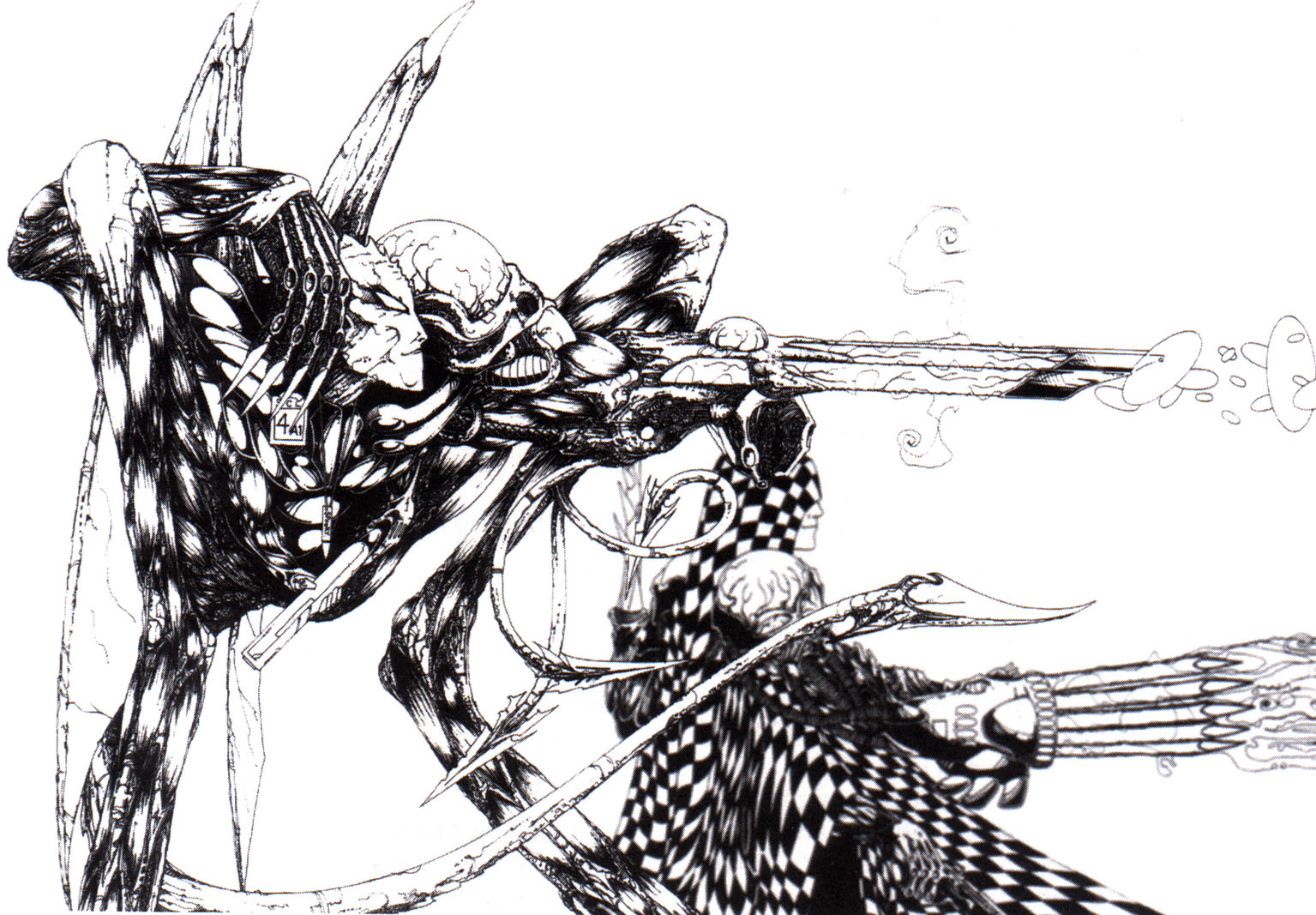
An autonomous cannon, and a French Harlequin Mercenary The most grotesque gun available in Europe, the Autonomous Sentinel Cannon (or Infernal Sentinel) is actually a semi-intelligent construct, consisting (in crude terms) of a gun built into a thinking, perceptory demon construct on stilt-like legs. The gun cannot move much under its own volition, but is capable of swivelling and stepping in place to aim at targets. In the picture here the Gun is seen in the foreground, with a mercenary wielding an Infernal Cannon to the rear. The gun can see, and has limited target selection abilities (though it is easily confused). It can be stunned by Confustor Field Rods. The most alarming aspect of the Infernal Sentinel, however, is its fuel source – regardless of who builds them, Infernal Sentinels are always powered by human blood, usually a quart per 50 shots. Their handlers are also called corpse grinders for their habit of draining the blood of their victims to fuel their gun.
-
In which our heroes meet, and learn of the perfidy of the French…
Our five doughty heroes met in Albany, New York State, on 31st October 1753, to attend jointly a summons to the Estate of the Lieutenant Governor, James deLancey. The American colonies were in somewhat of a state of tension, as the French had laid claim to the lands around the Ohio river and had begun skirmishes with the natives who lived there, perhaps preparatory to moving into the colony of Pennsylvania, should they so wish it. It is at times like this that people of dubious heritage and brave demeanour gain the chance to make their fortunes, and for this our heroes attended upon the Lt. Governor himself.
Approaching the Governor’s house, the heroes found themselves witness to a most unusual sight. An Indian brave – the first of that noble but savage race which they had chanced upon – burst from the front door of that splendid white house, stormed across the lawn and turned to vent furious words in French at the guards on the verandah. He shook his fist, within which he held the famous “Covenant Chain” by which the fates of the Iroquois and the British are intertwined. In truth it is not much to look upon, being merely a typical native belt of woven cloth and beads, with a part of a British general’s gold braid woven through it. But the natives put great stock in these symbols, and so he flourished it in the direction of the mansion, yelling his wrath, before turning to leave. As he did so, the characters were horrified to see a group of 8 Indian braves emerge from the shadows at the edge of the lawn, stepping into the waning evening light as if they had been resting there all along, though but a moment before they had been as invisible as the wind through the trees behind them. The 9 braves turned and marched into the cover of the forest, watched in their departure by the Lt. Governor himself, and 2 of his guards.
The Lt. Governor revealed that this brave’s anger was the cause of his need for the characters’ assistance. The French had begun attacking the far western reaches of the Iroquois nation and, the Iroquois being these last 100 years allied to the British, their messengers had naturally come to the British for aid. Unfortunately the British army is hard pressed in Europe fighting the war against the French, and can ill afford to antagonise them into opening another front here in America; so the Iroquois were declined the aid they believed rightfully theirs, and were sore over the affront. The Lt. Governor fears trouble between natives and British settlers which might provoke a war with the Iroquois that he can ill afford to fight. Most of the British soldiers are in forts in Pennsylvania and around Philadelphia, fearing a major French strike from that direction, and he can ill afford to spare soldiers for punitive missions against the natives. For this reason he wishes to send instructions to the Forts of the Northwest frontier, giving strict instructions on how to handle the natives:
- do not treat them rudely, or under any circumstances allow oneself to be drawn into conflict with them. Even a small conflict could spark a regional war which would distract the British from their main task of containing the French
- allow no one to trade with them for alcohol, drugs, potions, magic items or infernal weapons. The Indians have a strong objection to alcohol, and were the French to discover that the British were arming natives (even a single scrawny brave) they would have the excuse they need to demand concessions or wage war.
It is not, the Lt. Governor assures our Heroes, that Britain is weak; rather, that she aims to defeat the French in Europe, the central theatre of the war, and press them out of America as a concession, with little risk to men or materiel.
Also, the French King has asked the Lt. Governor to provide an escort for a French botanist who has come to America to study the fauna and flora of the Great Lakes. The governments being officially still under truce in America, the Lt. Governor must ensure this botanist’s survival, but does not wish to spare soldiers to the task. The characters are to deliver him to the town of Schuyler, which is a day’s journey from Fort Stanwix. Their path should take them from Albany to Cherry Valley, thence to Fort Stanwix, to Schuyler to deliver the French scholar; then to Fort Oswego on the Eastern edge of Lake Ontario and finally to Fort Niagara at the far end.
So the following morning, so early the mists were still gathering and the sun barely up, the characters met one Albert duPlessis, an annoying and foppish waif of a Frenchie, and set off along the Albany Road towards Cherry Valley. Riding upon Battle Thumbs, they passed for 2 days along a road nestled amongst the New York hills, their red- and gold-leafed forests stretching thick down to the valley floor where they rode.
Sadly, on the second day these forests disgorged horrors of the foulest kind. A strange witch, lately from the Caribbean, had set an ambush by the roadside. Amongst drifting smoke from the ritual fire she had started, enslaved zombie Indian braves came staggering from the forest, reaching and clawing for the characters. They fought back viciously, Lord Merton and his batman Russell forming a vicious killing team while the Dervish consumed undead foes in holy fire, and the Priest laid about him with gleeful abandon. Anna Labrousse caught sight of the Witch shrouded in smoke and paralysed her, before riding forward to kill her. Unfortunately Anna is a most incapable combatant, and failed to lay a good blow. The witch regained her powers of movement and lashed out with bolts of purest shadow, before being laid low by Anna’s comrades. Their first battle together had been completed with some success, and they were able to loot the Witch’s cave, confirming as they did that she was merely a lone, crazy hag in the wilderness, no part of any greater scheme.
They continued their journey, soon being greeted by Indian braves amazed at the power of the white strangers to lay low such a wicked adversary, and offering a gift – the coup-belt of one of her victims, which grants its wearer resistance to damage.
Before they reached Cherry Valley they had the first incident which made them think perhaps Mr. duPlessis was not what he claimed to be. As they were crossing a small stream, he slipped and fell in, and a book fell from his coat into the water. Father David recovered the book for Mr. duPlessis, but upon opening it discovered it was written entirely in latin, and contained a mesmeric spell of great power. Why would this be in the possession of a botanist? When confronted, Mr. duPlessis claimed the book an heir loom of his father’s, and demanded no more be said of it…
They continued to Cherry Valley, and on without incident to Fort Stanwix. Daily Mr. duPlessis drank more and more brandy, becoming inebriated by midday and ofttimes near unconscious by evening. Suspecting his plans, our heroes subtly ruined his mesmeric spellbook while he lay in a drunken stupor, and thus ruined his most duplicitous scheme. Now it merely remained to find out exactly what that scheme might be, and with whom it was to be enacted.
At Schuyler, having passed uneventfully through Fort Stanwix, the characters were horrified to discover that Mr. duPlessis had come to meet a squad of 6 English soldiers! Clearly some belligerent faction in the British army intended to use this French fop to mesmerise a band of Indians, and unleash them upon the French, starting a war the British would be forced to join! Despicable French treachery! In order to be sure, Lord Merton followed Mr. duPlessis that night to a secret meeting with the English sergeant, and there discovered that the sergeant was, in fact, a Frenchman in disguise! Who could imagine such deviltry afoot in civilised lands?!
The game was up. Once duPlessis had returned to his room, they confronted him with their knowledge of his activities, and he revealed the whole plan:
The following night, 5 of the soldiers would take their wagon to a nearby Indian village, where they would get the indians very drunk and prepare the ground for the mesmeric ritual. Once the natives were drunk, duPlessis would begin his ritual, mesmerising them all and ordering them to attack the town of Schuyler. At the same time the soldiers would prepare a signal fire on a nearby hill, and a fleet of 30 French ships – currently cloaked and laying just offshore in the nearby lake – would land and pour forth French troops. Once the natives had laid waste to Schuyler the British would sally forth from Stanwix to attack, and be ambushed by a vastly superior force of Frenchies. Stanwix would be taken without damage, and the Iroquois, thinking themselves attacked by the British, would join the French in war. Simultaneously, some of the cloaked ships would drop troops near Fort Oswego, and a major attack would commence on Fort Niagara. War, across and down the entire English colony! And if French plans succeeded, major gains would be made immediately. Mr. duPlessis was none too happy about this, revealing he had been forced to play this role by a wicked harridan in Albany… a French spy, no less.
The characters then decided on a simple course of action: slay the soldiers, explain the situation to the nearby Indians, and lay a vicious trap for the French waiting in the bay…
Once the trap has been laid, all that remains is to answer a few questions:
- who was the spy in Albany?
- How did the soldiers know that this Indian tribe would be willing to drink their alcohol?
- What was the mysterious infernal weapon in the wagon the soldiers possessed, and did it signify a special use?
- Is there a similar plan afoot at Fort Oswego?
- Did the Lt. Governor suspect all this, and send them into the wilderness gambling on their discovering an attack?
-
This week at the Pub where I role-play I will start a series of sessions testing my ideas for changing the AD&D rule system. Starting depends on whether there will be players – everyone else seems to be intent on drifting off to some Call of Cthulhu madness – but I currently have at least 2 players guaranteed, and hope for 4.
The first adventure will not use the full details of my reconfiguring scheme. Magic will use some spells I pulled out of my arse, or spells based on conversions of existing spells in the Players Handbook. Everything else will run on the skill and combat system I have (partially) laid out here.
There will be 0-3 adventures, depending on interest. They will be set in the world of Compromise and Conceit, just before the outbreak of the French and Indian War in America in 1753. The characters will be entrusted with the responsibility of delivering instructions regarding the treatment of Iroquois natives to a chain of forts from Albany to lake Ontario. Things will, of course, go wrong. The characters available at the start are:
- Anna Labrousse, an enchantress from the Regency school of magic, from a somewhat down-at-heel background (daughter of an industrialist), but able to enter the Regency school through cunning application of her enchanting talents. Being somewhat disapproved of in her School, she has had to resort to adventuring to better her lot in life
- Lord Merton of Epsom-St. Hilliers, a shiftless and irresponsible junior Earl, who possibly has syphilis or TB, discharged dishonourably from the Trajectors (a division of military engineers and wizards), and wandering the world looking for trouble in the company of his batman and Infernal Engineer. Lord Merton is armed with “the Earl of Epsom’s blurters”, a pair of rather well-enhanced pistols, and has a few other semi-magical tricks on the side. He is not of redoubtable constitution, however…
- Russell Ganymede, Lord Merton’s batman and the Infernal Engineer of his old division of Trajectors, also discharged dishonourably alongside Merton. Infernal Engineers summon Infernal essence to enhance the power of cannon and small arms, and usually also use heavy-weaponry. Ganymede has some powers of demon-conjuring and infernal enhancement, and is also a melee combatant
- Father David Cantrus, a Jesuit priest and sometime friend of Labrousse, who has been struck with wanderlust and a certain disregard for his old order. Or so he says…
- Umit Dilmen, a Whirling Dervish, a type of Turkish mystic, who has come to America to try his hand at the Great Game and been introduced to the group through the General who commands the fort at Albany.
In AD&D terms, the PCs are respectively a Wizard, Rogue, Fighter, Priest and Druid/Wizard. In this adventure, however, all have some magic skills and the Rogue particularly has a more limited set of Rogueish skills (he is probably more of an assassin). The first adventure is going to revolve heavily around combat, stealth and then some quick thinking, so the Enchantress may be a bit out of place.But first people have to turn up… -
For the past few weeks I have been playing AD&D 4th edition at the pub, first with an excellent group of players who were actually nice, and then with the same group of players but a different DM. The first few sessions I played a first level rogue, followed by a first level warlock. The last session I played a 7th level Orc rogue. My first impressions are:
4th edition AD&D is really, really boring.
Everything which makes fantasy role-playing interesting has been stripped away, leaving a bunch of tired computer game characters. It’s like playing Dungeon Siege. One player introduced 4e to me as “turning AD&D into a MMO”, and that is undoubtedly the long and short of it. But MMOs have pretty pictures. Fantasy role-playing relies on imagination for its spark, and imagination is killed by having every character the same. In the 4e rules, every character just has a different way of rolling damage. It’s designed for rolling through battles, and it doesn’t even do that efficiently – last night’s session was an orc raid on a human village and it took an awfully long time. There is no sense to it of a game system designed for the diversity and breadth of experience which fantasy role-playing demands, just for lots of fighting.
On top of that, it’s even more rules heavy than before. In AD&D 2nd edition, you could still say things like “I duck past the wagon and strike the Human in the face with my axe.” Now this simple interaction goes something like this:
Orc: Does the Human have partial cover? I have Killer Eye, so I can ignore it if he does.
DM: No, you have a full line of sight.
Orc: okay, so I can use my at-will melee power. I’ll use my minor to give a verbal command to my minion, then make a move action into an adjacent square, and for my attack I’ll use [insert meaningless action here]. Does that provoke an attack of opportunity?
DM: Yeah, this guy here can do an attack of opportunity.
Orc: Okay, well that’s no good. For my minor I’ll shift to the other side of the wagon, then I’ll make a move action and strike as my standard.
DM: That’ll give you combat advantage. Will you mark him if you hit?
None of this makes any sense to me. It also doesn’t read or sound like adventuring. To me it sounds like… programming, or something. And all the quibbling over shifts, slides, pushes, moves and minors takes a lot of game time. I mean really, who invents a “rule” which says that, if someone hits you in the face with a great axe, diverting your attention to attack someone else is a bad idea which will probably make your life harder? I thought this was what DM’s were there to do…
Mages in the new rules also seem to be awesomely bad. We had a newbie 2 weeks ago, a woman called Julie who had drifted in off the street to give role-playing a go for the first time in her life. That’s brave! She was playing a wizard that never hit anything, and when it did it got 1d6+2 damage. That was pretty much it for her powers, though she could maybe reel off a sleep once, and do a burst on the odd occasion. Meanwhile my rogue was doing 1d6+2d8+7 damage every round, never missing, and laying the bad guys out like they were wet towels. Hardly encouraging. This week, we were super-scared of the possibility of mages so my rogue scouted ahead, identified the two mages and gave a signal to the other orcs. They charged in to overpower the mages, with our minions doing 1d12+3 damage and hitting half the time. What did our super-scary mage opponents have? 1d6+2 that hit 1/3 of the time.
woooooo, scary.
So now we have a new version of AD&D where everyone has roughly the same number of powers and abilities, but for some reason wizard powers are eternally useless, and rogue powers are super-super-nasty. At least in v3.5 wizards are interesting but weak. Now they’re boring but weak. And don’t even get me started on healing surges, warlocks or the fact that one of my fellow players managed to put a flesh golem to sleep.
So far I don’t think I like it. And I don’t think it’s going to win the battle against World of Warcraft.
-
Linnaeus takes on the task of defining what a skill DC should be, as part of a revision of the AD&D 4th edition skill system. I actually think the underlying skill system in AD&D is a good idea, it just needs some rejigging to work smoothly, and the system can be changed so that every task can be handled consistently with skills. I think it can be further adjusted so that the degree of success above a skill DC defines the result – e.g. spells cast as a skill check, and every point of success indicates the duration and/or power of the effect. But at the core of the system is a relationship between numerical DCs and a sense of how difficult an action “should” be. This isn’t well defined in the original D&D 3.5 rules.
It’s not something I have ever paid much attention to, but obviously attaching numbers to the difficulty of actions is an essential task, and helps define the flavour of a campaign – heroic campaigns would have different DCs to grotty, realist campaigns. As much as possible I think DCs should be set by opposed skill checks, since this takes the task away from the DM and makes it less arbitrary. But ultimately this is the heart of the DM’s technical responsibilities, and doing it well is an important part of the job. It’s good to see someone taking it on!
-
The Pugnacious Priest has an amusing post comparing rugby (the game, in MeatWorld) with WoW in terms of Tanks, DpS characters and guild behaviour. Perhaps at last the nerds of the world have found an activity to rival team sports. I wonder how long it will be before:
- There is a worldwide league for guilds to compete in and/or
- WoW Old Boys’ Clubs become essential membership if you want to get a really plum job in The City
? -
Having written yesterday’s post about magic and its faults, I am today not so convinced that the problem I described is a big deal; and in any case, it can be resolved to some extent by inventing magic items which improve wizard’s save DCs. Nonetheless, I think the magic system is anachronistic in AD&D, representing the accumulation of years of ideas from different versions of the game, and it can be both streamlined and redeveloped so that it a) fits the skill resolution framework and therefore b) is amenable to the introduction of a spell-free magic system.
Here I aim to present some alternative methods of spell resolution, based on skill systems similar to the combat system. I will for now avoid discussion of the problem of how many spells a character gets, or the cost of using them. Let us first consider some methods of resolving the fundamental problem of magic – the spell attack – through a couple of skill resolution methods based on different fundamental magical cosmologies:
- More powerful magic is harder to cast and harder to resist: We imagine that more powerful magic requires greater effort by the caster to use, and more skill to handle, but unleashes greater power that is more difficult to resist. Set the DC of casting the spell to be the same as that of resisting it, calculated as for example 15+(spell level). The player rolls the spell-casting roll using spellcraft, and if successful the spell is cast at the stated DC. If unsuccessful the spell fails and/or costs more to use. If successful, the magnitude of difference between the failure and the DC determines the size of the effect.
- More powerful magic is harder to cast and easier to resist: This framework is closest to the existing philosophy of the d20 skill system. Consider, for example, a move silently challenged skill check. The difficulty of the check is determined by the listen skill roll of the person being stalked, but the rogue’s skill roll is modified by situational modifiers related to the environment and the difficulty of the particular stalking task. Creeping up behind someone to backstab them with a dagger is harder than creeping within 30′ to ambush them using a bow, and should be modified differently. With magic, we assume the greater energies being manipulated in more powerful spells mean that the caster is less able to focus them accurately, making them easier to resist. Consistent with this philosophy, the save DC of the spell is fixed by the caster’s spellcraft check, with a penalty equal to the level of the spell. The magnitude of the effect is determined by the degree of the target’s failure. Then the target makes a save against this DC. Under this model the hardest spells to resist will always be the ones with least effect, which the mage has most familiarity with.
- Difficulty of resistance is entirely spell dependent: This is the current system, where spells are like a device independent of the training of the mage – when read, their effects are unleashed with an objective power level over which the mage has limited control. In this model there is little use for a skill check
The three methods are consistent with subtly different styles of play, particularly regarding the cost of using spells, the degree to which one wants a wizard’s power to be restrained by the choice of spells available, and indeed the range of spells one is interested in using. Drawbacks for the 3 methods are:- Is not entirely consistent with the skill framework, the difficulty of both save and spell-casting being partially fixed against a 3rd number; but it is the easiest to adapt to non-challenged spell rolls (such as simply casting a knock spell) and the easiest to adapt to any system in which the cost of using spells is dependent upon their success.
- Method 2 is the simplest and most versatile, but I’m not sure I’m comfortable with the idea of more powerful spells being easier to resist. If one wishes to make the cost of spell-casting dependent upon failure, method 2 is also bad because the cost of spell-casting depends on the opponent’s ability to resist, not objectively on the power of the spell. Also, this method doesn’t extend well to non-challenged spell rolls, since there is no fixed, objective DC for a spell roll.
- Is inconsistent with the skill system and heavily vulnerable to overbalancing (as in, for example, those most horrific of spells, Horrid Wilting, or Power Word, Kill). I remember being told by a friend that the best way to kill dragons in Neverwinter Nights is Disintegration, because their saves were weak and the spell is over-powered. However, this method is more consistent with having unique and idiosyncratic spell effects (like the 1/2 damage on successful saves for fireball). Note also there is no simple system for linking spell failure to spell cost in this system.
I am inclined towards developing and testing some spells for use with method 1. I may get a chance to test this system soon, so we will see what I can come up with. -
Further to my comments about a game which uses real money in its virtual world, Terra Nova has a post about the game Habbo, in which children buy virtual objects for their virtual world using real money. The company has just put a $35 a month limit on how much the kiddies are allowed to spend of their parents money on imaginary stuff.
So this economic model does appear to have some businesses investigating it. If they could just open their virtual world to intra-world marketing, there’d be a flea market for virtual furniture in no time… using real money. And if they taxed it…
-
So, I just made a pair of characters using the rules exactly as written down in the DMG: a 19th level wizard-hunting thief and a 19th level wizard. The wizard-hunting thief used his spare cash to buy a stash of potions and scrolls; used his 19th level special ability to gain skill mastery in Use Magic Device (so those scrolls can be used with impunity) and bought a Cloak of Resistance +5 with the spare change. This gave him saving rolls of +14 to Fortitude, +23 Reflexes, and +13 Will once he had taken potions of Bull’s Strength and Owl’s Wisdom. The Bull’s Strength also renders him immune to Power Word Kill (128 hps) but he bought a scroll of Protection From Evil and Death Ward to make sure none of the Symbol or Power Word spells can do anything (not that this is relevant, since his Composite Shortbow guarantees he is out of range of any of the Wizard’s spells). For good measure he bought some flaming adamantine arrows.
The wizard, on the other hand, has only 68 hps and is not expecting to be attacked. This is only fair, since the thief will only get to use one unique thief special ability (sneak attack) once in this battle (though I suppose he could use his spare change on a cape of the Mountebank and dimension door behind the wizard in round 2…) The mage has a contingency with Stoneskin, because what mage wouldn’t have?
The key point of this little tale is this: the Mage’s most powerful spell has a save DC of 28 (if he has spell focus), so the Rogue only needs to roll over 5 on a reflex, or 14 on a fortitude, or 15 on a will save. Now, granted, 15 is not so great. But if we look at the wizard spell list, the only long range spell which isn’t reflex save-based is Horrid Wilting, an 8th level spell, so the thief will resist it on a roll of 13 or more. These aren’t good odds, really, and they just get worse as we go up in levels. Because the save DC for spells increases only with the improvement in the caster’s intelligence (i.e. once every 8 levels), while the save bonus increases every level, or every three levels. So by the time the wizard’s save DC goes up by 1, the rogue’s saves have all increased by at least 3.
Note that when the wizard was first level the thief had to make a roll of 13 or more to resist the wizard’s spells if they required a fortitude save, or a 9 or more if they required reflex. So the 18 intervening levels have led to no benefit for the wizard in attacking the rogue’s weakest defences using the wizard’s supposed special ability, and he has actually gone backward against the rogue’s strongest defences.
This entire problem arises because the wizard has a “special ability” (magic) which is not at all special – everyone in AD&D gets magic items – but the power of the wizard’s “special ability” is hampered within the rules to prevent it being “too powerful”. Of course, the entire idea of magic is that it should be too powerful (it’s meant to be scary) but in AD&D its mundane use, and this deliberate weakening of its power, means that in reality it is not actually very frightening at all. By taking the wizard’s power out of the context of the basic framework of the system (the level-based skill system) the designers have essentially weakened the wizard relative to all other characters.
And his saves are themselves shit – so he is his own worst enemy!