Further to that last little critical warp-spasm, I just took the “what fantasy writer are you” quiz, and I’m Orson Scott Card – someone I’m pretty politically opposed to, I suspect. And my exact opposite is China Mieville. How timely! And how completely wrong…
Compromise and Conceit
Infernal adventuring…
-
This isn’t really about China Mieville vs. Tolkien at all, but about me vs. the chap Mr. Noisms over at Monsters and Manuals, who has put up a post attacking Mieville’s view of Tolkien and fantasy. This gives me a chance to indulge in a pastime I really enjoy – faux literary criticism – and since I made the mistake of sleeping for an hour at 8pm, and I’m drinking some kind of plum tea with gold flakes in it, I might as well take the time to have a go at Mr. Noisms.
The basis of Mr. Noisms critique of Mieville is his opinions as expressed in this interview, written fully 9 years ago after Mieville had written only 2 novels (King Rat and Perdido Street Station, both of which are very good and very escapist). Mieville has some strong views on Tolkien and he clearly believes that writing is a political project, whether explicitly or implicitly.
Mr. Noisms doesn’t like this idea, I think, and also doesn’t like marxism, and I think this has led to a certain overreaction to Mieville’s opinions. Here are my reactions to the three main criticisms Mr. Noisms levels:
1. Falling for non-fantasy readers’ definitions of fantasy:
In the interview, Mieville is asked why fantasy appears conservative and he answers with the reasons he thinks. He also gives an extra paragraph (which Mr. Noisms didn’t quote!) where he defends fantasy as not conservative. Mr. Noisms argues, however, thatalmost no mainstream high-fantasy is like this. Even ‘high fantasy’ writers who I consider to be utterly dire, like David Eddings, Trudi Canavan, Robert Jordan and Weis & Hickman, write novels where female characters are just as strong as men, where peasants are often main characters, where threats are as much from within as from without, and where the idea of kingship itself is challenged.
I don’t know quite where Mr. Noisms gets this from. In David Eddings’s most famous work, the main character is a king hidden away as a peasant, and the threat came from an evil overlord from another land. Likewise Canavan, whose lead character may be a girl but she has the inherited “wealth” of magic – and the threat comes from a nasty country over the hills, which seemed suspiciously Muslim to me. Weis & Hickman’s dark enemy comes from Hell. That’s a pathological external threat, in my book. Kingship is never challenged in any of these books, as witnessed by, for example, the fact that the lead character becomes a King. Even when peasants rise up the ranks it is almost universally due to their inheriting magical powers – usually from someone special – and in the context of fantasy stories magic is pretty clearly a kind of inherited wealth, marking one out as special as much as nobility does in the real world. It’s almost an allegory of the same.
Plus of course a whole bunch of authors – Robert Jordan, that hideous kid who wrote Eragon, and that nasty Goodkind chap, for example – are literally conservative, and if you can’t see that from their works you are reading a very blinkered version of them (a claim Noisms makes of Mieville’s reading of Tolkien). Not to mention that some of them openly state their allegiances. (Orson Scott Card springs to mind, but I suppose he’s sci fi…)
2. A whole load of misconceptions about Tolkien.
This is the bit where Mr. Noisms claims Mieville hasn’t read Tolkien, even though in this section of the interview Mieville quotes Tolkien’s essay on writing fantasy. I don’t think this is a good debating tactic, Mr. Noisms, but I’ll let it slide. How magnanimous of me! But I think it’s a bit mean to say this:
Young fantasy writers often like to talk down Tolkien – they think it makes them look cool and rebellious.
because Mieville was asked to give his opinion in an interview at a Marxist conference, and he gave it. It is actually possible that he genuinely didn’t like Tolkien – many people don’t. I didn’t, and I’m not even half as clever as Mr. Mieville or Mr. Noisms.
In this part of his post, Mr. Noisms says a lot of antagonistic things that I think are misinterpretation of Mieville’s opinions. For example, he says
nor did he write that “the function of fantasy was ‘consolation’” as if it was an “article of policy” for fantasy writers – he only ever wrote about himself and his own point of view, and made no sweeping statements about what the fantasy ‘genre’ (there wasn’t such a thing back then) should be.
but Mieville never made the claim that Tolkien wrote about what the fantasy genre should be. He simply states what Tolkien thinks a fantasy writer should do. The broader claim Mr. Noisms accuses Mieville of making would require Mieville to have presented evidence that Tolkien tried to influence other writers’ underlying philosophy. Given Tolkien’s massive influence, it’s reasonable to claim that his opinions on fantasy writing were adopted by others – but Mieville doesn’t make this claim in the interview. He simply cites Tolkien’s opinion about writing, and criticises it. If Tolkien’s writing about writing is above criticism, then we really are in a dire situation!
Mr. Noisms also takes issue with this:
This arrogant assumption that everybody else, if they are rational adults, must surely be a Revolutionary Socialist and against Tolkien too, frankly pisses me off.
but there’s no evidence anywhere in the interview that Mieville believes this, nor does Mr. Noisms cite any. Mieville criticises Tolkien’s work as “literary comfort food” but he doesn’t criticise Tolkien’s readers. He nowhere argues that people should or shouldn’t want to read this stuff. A common complaint of person A who doesn’t like person B’s politics is that person B wants person A to think like person B because person B gave an opinion. But what is the alternative – that Mieville should shut up and not give interviews?
In essence, Mieville makes it clear he thinks Tolkien has a theory of fantasy stories, and he goes on to criticise this theory, and Mr. Noisms can’t find a strong argument against Mieville’s criticism, because the evidence is there, written by Tolkien. So instead Mr. Noisms gets huffy with Mieville for having an opinion.
3.Thinking that escapism is a bad thing
I think that Mr. Noisms gets a bit disingenuous here. Mieville is asked if he thinks fantasy is escapist (the precise question is pretty unambiguous: “Is fantasy escapist?”). Mieville thinks that a) fantasy is not escapist b) escapism is impossible in literature c) to the extent that any text is “escapist”, non-genre texts can be just as bad and d) under a particular definition of “escapism”, the post-Tolkien trilogy style of fantasy is escapist and many critics of the genre focus on that style when they criticise the whole genre.
Mr. Noisms takes this to mean that Mieville thinks a) all books should be political and b) if they’re political, they’re better and c) if you don’t like that you’re a bad person. I think this is bordering on disingenuous. It’s clear that Mieville is engaging in a particular form of literary criticism (all texts contain political influences from the time of their writing) which is not just marxist to defend fantasy. Specifically, he states that
Take a book like Rats and Gargoyles by Mary Gentle. It’s set in a fantasy world, and it involves discussions of racism, industrial conflict, sexual passion and so on. Does it really make any sense to say that the book is inherently, because of its genre form more escapist than what Iain Banks calls ‘Hampstead novels’, about the internal bickerings of middle class families who seem hermetically sealed off from wider social conflicts? Just because those books pretend to be about ‘the real world’ doesn’t mean they reverberate in it with more integrity.
He is clearly here arguing that non-fantasy novels are just as “escapist” or more so than fantasy novels, and that it is the content of a novel – not its genre – which determines its vulnerability to this claim. He doesn’t argue that Rats and Gargoyles is good because it’s political and, frankly, I don’t know how Mr. Noisms could argue that he was. He uses this example to argue against the common criticism of fantasy levelled against it by “genre snobs” and “leftists”. He finishes by claiming that fantasy is not escapist. He is defending the genre against what he believes is an unfair criticism. I don’t see how this can justify Mr. Noisms in his final angry denunciation, viz:
Thirdly, escapism is a worthwhile thing in itself, and not something to be sniffed at. As somebody who isn’t a card-carrying member of the Pretentious Socialist Worker Party Elite, I like to sometimes jack my brain out of the Capitalist hellhole in which I find myself and in which my “every human impulse is repressed” and just, you know, think about something mindblowing and weird and get away from the world. Am I supposed to feel bad about that because China Mieville thinks I should constantly be engaging with “the real world” and if not I’m being “mollycoddled” and “comforted”? Fuck that.
Also, the claim that fiction should “always, always be about the story and that’s all that a fiction writer should care about when he’s writing” is, frankly, silly. It also falls into exactly the trap which Mieville discusses in his criticism of Hampstead novels. If you write a story, you are inserting character, plot and, usually, conflict. You have to make choices about these things. These choices are driven by something, and to pretend that that something can just spring pure and independent of the cultural and political milieu of the writer is hopelessly naive. To suggest as well that one must be compromising the story by inserting political or cultural aims is to make a claim which I would like to humbly suggest that George Orwell, Primo Levi, Umberto Eco, Ursula le Guin, Shakespeare, Alexander Solzhenitsyn, RM Meluch, Earnest Hemingway and Ben Johnson all disagree with. For example.
In summary: Mieville has some serious criticisms of Tolkien and Tolkien’s overarching impact on fantasy writing; he criticises Tolkien’s stated opinions of what a fantasy novel should do, on the grounds that they are limiting and naive; he defends the fantasy genre strongly against the criticism (made by leftists and genre snobs) that it is escapist; he derides the idea that any novel in any genre can escape from reality; he explains why he thinks that fantasy writing can appear conservative but defends the genre against this claim; and nowhere does he claim that a novel is good because of its politics. This seems like a pretty healthy interpretation of the fantasy genre to me, and a robust defense of the genre against both elitist literary critics and those who think that the genre is shallow because it is politically conservative. I would have thought Mr. Noisms would approve!
-
While planning how to destroy the colonials’ plans – and while trying to determine what those plans were – the characters had also sent an emissary to the French, to point out to them that their involvement in treachery was uncovered, and to suggest to them that they should withdraw from the game if they did not want their plans to be revealed and their forces outmanoeuvred. However, their messenger sent them the following letter after a few days away:
Dave
I had a chat to Monsieur le Frenchie Homme. He is unwilling to stick his neck out over hearsay or anything else for that matter, more than ‘is job’s worth. So he is sending a letter “up zee chain” and once the garlic’s been wiped off it’ll be read by someone with authority. Should take about a week. Don’t know if anyone but Louis himself actually has any authority, but if they do they’ll start to act like there’s a serious problem with their allies in about a week or so.
Until then, everyone more important than the local cannon-cleaning gaffer doesn’t think there’s a problem, so I wouldn’t recommend you start a war in the next week unless you are really really really sure that you are gonna come up smelling of roses. Or at least unless you’re confident you have a good bolthole. The trouble you stir up is gonna be like Turkey, only smellier.
Also, have you seen any injuns lately? God knows I haven’t, and I kind of miss having ’em around, with all these thorny-arsed colonials walkng around acting touchy.
Your garlicky mate
Bob
This note made it very clear that any attempts to arrest or attack Washington within the next week would lead to a war starting between the British and the French, with the colonials aiming to inherit the rubble.
Except… that the characters knew now that there was a messenger which would deliver urgent messages to the French. So they decided to start a war, and to ambush the messenger so that the Colonials would act believing they were going to receive aid from the French – when in fact no such aid was coming. They had one week to do this before negotiations commenced with the French to secure their refusal to aid the colonials, and in that week much damage could be done to the colonials which would lend weight to the British side of the negotiations.
With this in mind the characters enacted two crucial processes:
- Russell Ganymede was resurrected. Upon his return from death, he seemed a little weaker, with a strange light in his eyes and also on the scales of his semi-demonic skin, which down one side of his face was now slightly luminous, and flickered in many different, brighter colours when he was upset, hurt or angry
- They delivered all the evidence they held so far on the connections between the French and the Colonials to the British, though for their own sinister reasons they withheld evidence about the NWFC’s involvement
As expected, when the Governor learnt of Washington’s treachery he sent a force to arrest him. By then the characters were long gone, however, lying in wait at the cave to which the French messenger would be heading. By blind good fortune they knew this cave’s location because they were the adventurers who had cleared out its original occupants, when they first began adventuring together. Such fate! ‘Twere as if there were a designer, planning their destinies…
So the messenger appeared, on cue, two days after the British government moved on Washington. It emerged from the shadows in front of the cave where the characters hid, moving stealthily in extremely expensive combat armour, of the sort which only very powerful companies and national armies tended to own, and it emerged from nowhere with the menacing air of a stalking beast in full charge of its environment. Humanoid in shape, carrying a demon longbow and a rapier, the creature was clearly a teifling, some hellish spawn of demon and human born naturally but soulless and abominable in design.
The characters sprung their trap but the beast was fast. Their initial surprise strikes barely touched it, and it moved swiftly from the point of ambush, nearly eviscerating Russell Ganymede and springing over a wide swathe of grass to strike at Merton St. Helier. In its wake it left two demonic fighters, figures of shadow, fog and wood, which attacked Father David Cantrus and Anna Labrousse’s summoned monster. However, the beast though fast and strong was no match for our heroes. Dave Black struck it from the rear and, while it flailed at his elusive and shadowy form, he slowly cut it to ribbons. Within a minute or so the messenger was dead, its message lost. The French would not come, and Washington’s fate was now sealed.
The characters entered the cave that the messenger had been about to enter, hoping to find evidence of its messaging device. Here they found the body of the witch they had once killed, slowly decomposing on an altar that smelt of attar and roses, two bowls of uncongealed blood by her head. This was clearly the messaging device. The characters destroyed it on the spot and, leaving the cave behind them in a cloud of smoke and burning flesh, turned back towards Albany, to finish the rebellion which had only recently been begun in such haste…
-
Mr. Smelthy
The messenger is not, as you suggest, yours to call upon. It is very clearly established that the messenger is not, in fact, NWFC property at all, but constitutes a private arrangement between the French and our friends in Albany. We are able to use the messneger on such occasions as we have a message of desperate importance to deliver to the French, but the messenger is sent by our and with their permission.
The messenger only delivers messages to a single, agreed location, in Mohican territory – it is near a disused monster cave on the Northwest road, whose necromancer occupant was cleared away just prior to the French and Indian war. Of course the messenger does not take the road, but it is an agreed focus point for the communication method it uses.
To invoke the messenger, you need to proceed through the tunnel beneath the headquarters, and ask Monsieur Lombard in the trading house there to take your preferred message directly to Madame Custis. She will assess its worth and then pass it on to Washington, or invoke the messenger herself.
Again, I must impress upon you that this messenger is not in our service and its sole purpose is for our friends to send urgent messages to their allies to the North West. Do not even attempt to use this service frivolously, as the cost to you will far outweigh the cost for us. We remain
Yours &c
The Senior Partners
Northwest Frontier Company
New York
-
Having learnt of the nefarious entanglement of genocidal colonials, French troops and the supposedly British Northwest Frontier Company, the characters decided to investigate the offices of the most vulnerable of the triad – the NWFC – in Albany, and see what they could find.
The NWFC offices consisted of a two-storey warehouse in the docks, the upper storey of which fronted onto a normal street, and the rear of which opened onto the docks. The characters spied out the front and discovered a single guard standing by, with perhaps more inside. Fearing that there might be more guards below, or worse, they decided – after some planning – that the best approach would be to knock the guard unconscious and send in Anna Labrousse in his form. This was easily accomplished, with Dave Black dragging the unconscious guard into a back-alley for further “investigation”. Anna Labrousse entered through the main door, with Lord Merton St. Helier invisible beside her in support.
Inside she found a room with some more guards, which she and Merton passed through into a larger room full of storage boxes. From here, stairs led down into the lower level of the warehouse. Rather than descend directly, Anna and Merton passed back into the guardroom and between them destroyed the guards, combining Anna’s Garden of Proserpine and Merton’s lethal weaponry.
The remainder of the party entered the warehouse then, and they descended the stairs. Unfortunately, down below they were attacked by a Myrmidon, but this time they were prepared and slew it in short order. Relatively uninjured, they headed from the main storage room where the remains of the Myrmidon lay and into the offices of the NWFC head trader. Finding a room obviously hastily abandoned, and a closed door on its far side, the characters ran forward. Russell Ganymede foolishly opened the door without checking for the room’s contents, and as the door opened a hideous, swirling, ghostly form burst forth. This ethereal beast plunged through Ganymede and killed him where he stood, sucking his soul away to an eternity of fiery torment. The characters stood aghast for a moment, and then charged forward and struck the beast dead with their magic weapons and spells.
Beyond Ganymede’s lifeless, drained corpse lay a small waiting room, and on its far side cowered the NWFC trader. The characters trussed him up and searched the room, finding some letters, trade manifests, and a tunnel which lead to a nearby French trader’s offices. The strange ethereal beast had been hiding in this tunnel, which was covered with a sheet of paper painted with the same symbol as the characters had found in the chest on the French boat. The NWFC trader was also wearing the same symbol, which must obviously protect its wearers from the predations of this strange new hellish beast. The beast itself resembled in every one of its particulars the kind of beast which are summoned whenever Father Cantrus invoked his Angel of Death spell, though this beast was obviously of demonic origin.
Upon searching the storage room, the characters found crates of the small amulets which they had found on the Unfortunate Lapse of Discipline. There were sufficient amulets to protect a large fighting force and their families from the predations of the strange angels of death. An interesting pointer to things to come…
-
1. Captain’s Log
The Captain’s log reveals that the Unfortunate Lapse of Discipline is a ship based in New France, which makes regular trips between New France and various unregistered stopping points along the East Coast of America. It doesn’t give details about the cargoes, but does occasionally mention passengers, or give reference to sensitive cargo. It was requisitioned about a year ago.
The Captain has several connections in Albany, the most obvious being Madame Custis’ Wizard Harnock, who (it turns out) was escorting La Belle Dame Sans Merci to the Coast, and so is now dead. The captain would receive letters from Harnock, and occasionally met him incognito in the Albany Offices of the North West Frontier Company. His main connections in Albany were registered French traders, who could deal with him without arousing suspicion.
One such trader has a tunnel leading from his warehouse to the offices of the North West Frontier Company. It is rumoured to be guarded by “something ferocious”. The Tunnel was dug by the NWFC.
The Captain’s log confirms that the Cancer Labora Armour was obtained from the NWFC (with the wry additional comment “of course”).
The Captain knows of the Irish mercenaries on Newfoundland but has only been there once to collect them, and doesn’t want to go back. Their presence on Newfoundland is seen as a necessary evil and it’s not clear why they’re there. Newfoundland appears to have been purchased from the Scottish Government by an organization called The Iron House. Presumably the mercenaries and the House are connected.
The Unfortunate Lapse of Discipline was commandeered for use in New France a year ago, and it is clear from entries throughout the Captain’s Log that he is not comfortable with what he has seen. Particular examples of his discomfort are:
- The NWFC seems to have a lot of infernal technology with which he is unfamiliar, and he is uncomfortable with it
- He has clear impressions from the colonials he has met that they intend to deal out mass slaughter in America, to drive the British out and to eliminate Indians
- The French have been forced to make compromises with shady organizations and individuals they “would not normally spit on” in order to protect their position in America, because they cannot spare forces from Europe to protect their colonies. These compromises have meant, for example, allowing a sinister force to establish itself on Newfoundland, tolerating a colonial independence project which is likely to lead to many natives fleeing to New France, and being willing to imagine the creation of “an independent kingdom where now stands New Britain”
- The Captain makes it clear that some of his correspondents in France are very uncomfortable with this, and think the long-term consequences of French game-playing in America could be devastating. But they are too concerned with “the difficult position of the French King” to act
- At least some of the secret movements of the Unfortunate Lapse of Discipline have involved delivering military hardware and small contingents of marines and elite forces in disguise to key British cities, where they are being hidden by the colonials in anticipation of an imminent uprising.
2. Letter from Madame CustisDear Captain laroge
Thank you for making your ship available to me at such short notice. As you know, your friend and sometime companion Miss Merciless will be heading downriver from Albany this evening, and aims to reach the coast at one of our established collection points within 3 days. She will be accompanied by some of our mutual friends from Newfoundland. If you value your responsibilities to your country and to an old friend, you will move your ship with all haste to the North Stones 3 collection point, and prepare to meet her. I have no reason to believe that her escape is known to anyone but myself; however, it would be wise to come ashore in force, for recently our plans have been foiled by some loyalists.
I should warn you, matters are beginning to come to a head, and I cannot spare the energy at this time to defend your old friend. I suggest you spirit her to safety as quickly as you can, and then prepare yourself for that for which every military man is born. I promise you, that what happens from here shall be written in the history books of 2 continents, in blood. Until that fateful day I remain
Your &c,
M. Custis
3. A small crate
which contains a set of pendants (sufficient for the crew plus the full complement of marines on board) with the following symbol:

and a single note, which states
“ Wear in the event that the Northern Skies glow Infernal, or Washington is captured”
-
Having learnt all they can from la Belle Dame sans Merci about the sinister plans of the various factions involved in the New World – and perhaps learnt of a few new factions besides – our heroes find themselves on the horns of a familiar dilemma: who should they slaughter next?
Knowing as they did that there was much evidence to implicate Washington and his ilk in schemes most sinister, some of the group were all for a return to Albany, thereupon to raid the offices of the Northwest Frontier Company and, hopefully, uncover evidence of everyone’s treachery. Others were in favour of capturing the ship which had been sent to rescue la Belle Dame sans Merci, for surely therein would be found yet more incriminating evidence linking the French to Washington and Madame Custis. After debate had ranged far and wide over many topics, and no decisions had been made, our heroes settled on their usual solution to all such quandaries – they decided to head for the closest enemies, and kill them all.
Thus they found themselves on a windswept beach, where la Belle Dame sans Merci had been intended to be collected by her French saviours. They could see the ship approaching, its glittering lights sweeping in fast over the dark waters. With barely a moments’ indecision they came to a rapid decision to gain access to the ship by subterfuge rather than violence. Rendering la Belle Dame sans Merci unconscious with a swift spell, they garbed themselves in the clothes of her now dead guards, and Anna Labrousse disguised herself as their leader. They waited for la Belle Dame’s rescuers, ready to bluff their way onto the ship.
The ship swept to a halt some hundred yards out from shore, and soon 2 rowing boats swept in on the breakers. As they neared shore a single massive armoured form leapt down from each longboat and hauled it through the surf to the shore. Barely used to Myrmidons, the characters were shocked to discover that their French adversaries also possessed a kind of hugely infernally enhanced body armour, like a carapace, which could move through water with the facility of a crab, and which could haul massive weights. Within that Myrmidon-like shell a French elite commando waited to tear them limb from limb. And from each boat emerged 8 more men, carrying rifles and lightly armoured in the fashion of French marines. Had our heroes prepared a frontal assault they would by now be just wasted flesh and bloody spindrift.
Fortunately, however, the characters were in disguise. There on the windswept and desolate beach they soon talked their way aboard ship, claiming to be la Belle Dame sans Merci’s protectors, and no way were they going to leave their injured charge now, dammit! And so they found themselves taken as passengers to their target, the ship Unfortunate Lapse of Discipline, which was aptly named indeed considering their means of egress.
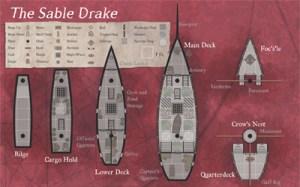
An Unfortunate Lapse Indeed… Once aboard, the characters waited for their hosts to shuck their host armour and head below, secured la Belle Dame sans Merci’s inert body, and then set about another fine round of slaughter. Waiting until the majority of the soldiers were below, they sealed the entrance to the hold and cast a spell to paralyse the soldiers on deck. Their followed a vicious battle, in which the characters had to force their way below decks against the mass gunfire of the marines, take on the Captain, and were ultimately charged from behind by a group of enterprising marines who had used grappling hooks to escape the slaughter belowdecks. Dave Black was nearly killed in this last rousing charge, but the characters prevailed and at the end of a good couple of minutes’ hard work stood atop the blood-slicked decks of their new possession, the light Corvette Unfortunate Lapse of Discipline, her dead complement of marines, her two cannon, her (living, and cowed) crew, and all the secret plots which she contained.
All that remained was a decision on what to do with her…
-
I have seen two presentations in the last week in which the William Gibson quote “The future is already here, it’s just not evenly distributed” has been used. This elevates it, in my view, to the level of a fly-blown cliche. I’m now officially starting a game of Cyberpunk Bingo. When I get four of these events in a row, I get to cry “FUUUUCK!” and murder the speaker with my cybernetically enhanced skull-gun, and you guys (if you exist) have to arrange my legal defense. I am going to claim diminished responsibility. I think it’s reasonable.
-
Much joking has been occurring among those playing the Feng Shui future of 2056, where the world is ruled by the ruthlessly benevolent “Architects of the Flesh” about how much it looks like London now. In short:
- excessive amounts of money are spent on rent
- the food is grey and tasteless
- police violence is the norm
- mindless consumption is heavily encouraged
- everyone wears the same clothes
- the transport system is hideously overcrowded
- everyone is paid crap, even though anything nice is really expensive
- There is omnipresent cctv
The Feng Shui authors were fond of attaching numbers to their dystopic world. But I bet if you challenged them to tell you how many cctv camers were present in the entire world in 2056, they would still underestimate the number in London now. All that remains is to have the current government ban cars and introduce a legal limit on maximum wages, and we’re there. Although the real limit in Feng Shui – about 1 million pounds by my calculations – is more than anyone in England can ever hope to earn, so it’s the same difference really.
Anyway, this led me to think that perhaps the authors of Feng Shui were dyed-in-the-wool social democrats, and their vision of a dystopia was therefore a vision of what happens when social democracy goes horribly wrong. An illiberal version of social democracy, if you like. They just didn’t realise that a year later Tony Blair would take their future world as a manifesto for change…
-
Goddamn! The things one has to do just to get an argument these days!
This is a response to my friend’s response to my previous post about Feng Shui’s 2056 dystopia. In essence, Paul objects to everything I say on principle, which makes it easy to argue with him. I just need to disagree with every sentence line by line. I’m cross-posting as well as commenting on his blog, because arguing is fun and dystopias are fun. All indents are Paul’s arguments, everything else is my response. I’ve indented for clarity, and so I can italicise lots of wanky references to George Orwell. Fuck, it makes me feel like a Decent. Quick! Invade Sri Lanka!
I’m going to take what the book says at face value
…. why would anyone do that? Kind of kills my review right there doesn’t it? so we’ll just pass right by that…
the central argument Stuart is advancing is that dystopian (and utopian) settings give us an insight into the writer’s politics
and yes, criticism of those settings also gives an insight into the reviewer. This is not a shock. But if anyone wants to read 1984, Brave New World, The Dispossessed and any of those weird anarchist tracts from the 19th century as anything but transparent screeds, they’re really pushing it[1]. In fact, we know they’re pushing it because everyone who ever wrote a utopia or a dystopia has identified their political reasons for so doing, and then gone on to write about it (or, in Orwell’s case, gone to war for it). That should count as a bit of a hint.
I assume that all factions in the game are meant to have some attractive angle to view them from
This has got to be arguing for the sake of it, right? We are talking about role-playing here, a sordid little corner of the world whose central focus for the last 30 years has been developing worlds where the bad guys are so relentlessly and completely evil that you are morally justified in exterminating their entire race. The only games which don’t do that have tended to be based on morally grey novels. There is no sense in taking “the benefit of the doubt” as your point of departure for rpg criticism because chances are that the kung fu game you are playing – you know, the one where you are self-consciously playing a good superhero in battle with the supervillains – isn’t planning on showing any uncertainty about the moral fibre of its participants.
In short, there is no reason to assume that 2056 under the Architects is anything but the Mordor of our world. They stole my god (and my virginity, to boot![2]) so they could destroy the world. They’re made of poison, folks. Also, they’re called “the Architects of the Flesh”. I recommend taking this as a hint that you don’t want them shagging your sister.
Given this, I think it’s reasonable to assume that this world is designed and presented as a dystopia.
But everyone gets enough food. This is morally ambiguous because the setting also has hunger wiped out from the world, at the cost of food that makes McDonalds look tasty. Because of this, the food is a subverted utopian element, not a dystopian one.
Despite living in one, I’m no expert on dystopias, but I don’t think they are intended to be the same as “untopias” (or whatever). I think they are meant to represent a world corrupted by good intentions, which is why no-one in 1984 goes without food, and everyone in Soylent Green is happy. So a world you look at and don’t like, full of subverted utopian elements, is a dystopia. (This is why a lot of people refer to The Dispossessed as an anarchist dystopia).
The reason I saw in it [here Paul refers to the wierd 40x wage differential] was to contrast the gleaming ideals of the future (reasonable wage restraint) with the actual implementation (all the good stuff is still owned by elites). Again a utopian element is presented and then subverted.
I’m thinking of coming back to this on my blog, because it occurs to me now that if a bunch of hard-core (hah!) social democrats living in 1996 wanted to imagine a dystopia caused by social democracy gone wrong they could well have written this Feng Shui world. Alternatively, they could have waited until 1997, voted for Tony Blair, and sat back to enjoy the ride…
This assumes that a dystopia must be written as if everything is bad.
I think more one assumes that a dystopia is written as if everything is failed. The central tenet of good dystopian writing is that the human traits of the characters give hope for the future (which should be crushed, obviously) despite the huge power advantages of the world they are in. Hence Vincent finds true love (briefly), Shevek and Takver struggle to reclaim the revolution, etc. Part of the beauty of The Dispossessed, and the reason it is a genuinely “morally grey” dystopia (if it is a dystopia at all) is that Shevek and Takver do offer hope to reclaim the revolution at the end, in a triumph of human will (and love!) over systemic oppression. So adding a few elements of playability doesn’t render something dystopian[3]. Having a social system based on good intentions gone horribly wrong does, however.
By default it would [here Paul means it would be reasonable to assume that a dystopia represents a writer’s views, except that…] any reasonable amount of work will allow an author to drown their bias in the appropriate biases for other political views – unless you want to argue that a social democrat is totally incapable of writing 1984?
I’m going to go out on a limb here and say that a Social Democrat did write 1984. We’re talking here about a man who cashed in his commie mates to MI5 (with quite nasty comments about their intellect too) yet wrote a very nasty book about pre-war Imperialism (Burmese Days, where the protagonist passes the moral event horizon at the end of the book by literally kicking the dog), as well as a viciously bitter attack on communism (Homage to Catalonia) whose final chapter is a clear intimation of 1984’s genesis. He is a hero of the so-called Decent Left. I don’t think we need to assume he was anything else, even if he briefly flirted with anarchism in the 30s[5].
The scenarios you call dystopian contain a summary of your political views.
Certainly. If I say something is dystopic and you disagree, we might as well be arguing about politics. But there are some clear signals of dystopian writing, tropes if you will, and “grey food”, “no cars” and an all-powerful time-travelling government who want to control your thoughts are usually a big giveaway. Also, yes, when I claim London looks like a dystopia, I am making a claim which reflects my politics. I am, in effect, writing a text (shudder) and by inferring my politics/morality from that text you are engaging in literary criticism (though I don’t think either of us are being post-modern here except in the cliched sense).Regarding London, we can safely assume that the govt doesn’t intend to create a dystopia. It’s their failed “good intentions” which make it so. My labelling it so enables you to (rightly) infer things about me politically – that I dislike high rents, police violence and cctv would be a good guess, because that’s what people generally criticise about this government. Alternatively you could infer I spend a lot of money at cheap brothels.
But if you did either you would be critiquing the text and before you know it, you’ll be having post-modern gay abortions, and snorting cocaine from baby’s bottoms. Also, you would be conceding my argument – unless you want to argue that FS 2056 has any good points strong enough to redeem it from the claim it is dystopic?
PS I really really ought to look up the definition of dystopia. But I don’t think that’s going to get us anywhere, is it?
—
fn 1: I have an excellent one about pirates, btw.fn 2: Not that it was doing me any good at the time
fn 3: consider The Culture, who you can’t help but sympathise with, and who are clearly a good place to live, but who also seem somehow fundamentally rotten[4]. And the process of viewing them as rotten – inevitable for most readers – is, I think, intended to cause one to question one’s own assumptions about how the world could be. This makes the Culture a morally ambiguous dystopia in a really subtle way. I think Iain Banks has written about this aspect of the dystopia himself.
fn 4: Interestingly, Iain Banks is a strong opponent of the Iraq war, even though The Culture are the apotheosis of Decent Liberalism.
fn 5: which at the time didn’t count for much anyway. Social Democratic unions were pro-anarchist until the Central Committee called them off (a central criticism of the Stalinists in homage to catalonia), and if that’s not enough proof: my Grandfather fought for the POUM, but voted Thatcher 40 years later.
 Compromise and Conceit