• Having promised it in comments, here is my attempt to put forward a very simple, balanced, and pretty much entirely skill-based d20 system. In keeping with previous entries on this topic, it aims to:

    • amalgamate combat, magic and skills under a single compatible skill-based framework
    • get rid of saving throws
    • make armour a damage reduction system

    After 20 or so sessions testing my previous attempt at this system, and after playing Exalted, the main things this iteration aims to add are

    • a unified system of damage which extends the wounds and fatigue framework from the previous version and makes it more flexible and useful, including for social attacks a la Exalted
    • a balancing of primary and secondary skills, so that there is never a risk that, like Anna Labrousse, your primary attack is +21 but you have defenses as low as +2

    So here’s how it works.

    Ability scores

    We have the same standard 6 ability scores, ordered in this way: Constitution, Strength, Intelligence, wisdom, Dexterity, Charisma. The ability scores are represented as bonusses only, with a standard human considered to be +0 in everything, heroes having a total distributed bonus of +2. There are no ability scores per se. It will become apparent that we could do away with ability scores altogether, but for historical and aesthetic reasons we won’t.

    Skills

    We have 6 primary skills, one for each ability, and 6 secondary skills, one for each ability. So each PC has a Constitution (Primary) and a Constitution(Secondary) skill which, as in d20, have a total adjustment calculated as ranks+ability score+magic.

    For starters, assume that every primary skill increases by 1 rank per level, and every secondary skill by 1 rank every 2 levels. We could then have points to distribute across both, but that’s just window dressing for diversity. Assume for now 1 point per 3 levels to distribute across primary skills and 1 per 4 levels for secondary skills; assume a maximum rank of lvl+2 for primary and lvl/2+1 for secondary skills.

    For example, a 12th level character will have 12 ranks in every primary skill, and 6 in every secondary. They then have an additional 4 points to distribute on primaries and 3 on secondaries; let’s assume 2 primary skills are maxed at rank 14, and there are 3 secondary skills at rank 7. Obviously this is just accounting and can be fiddled for balance.

    Disciplines

    Each ability has four disciplines, which are: offense, defense, use, state. At first level, a PC starts with four disciplines across all abilities, and can spend feats at later levels to purchase more. If a PC possesses a discipline, then all actions covered by it are resolved using a primary skill for the corresponding ability; otherwise use secondary. So for example, a fighter has offense and defense in strength. When attacking with a melee weapon the fighter uses their primary strength skill; but without offense in dexterity, this fighter will use dexterity secondary skill to attack with missile weapons. Some classic discipline distributions at first level might be

    • Fighter: strength offense, defense; constitution state; charisma state
    • Wizard: intelligence offense, state, use: dexterity defense

    Some disciplines will have requirements for their use. Strength defense will require the PC have medium/heavy armour and a shield; constitution defense will require heavy armour and a medium/heavy weapon and/or shield. The disciplines also come with proficiencies, so dexterity offense comes with a proficiency in a single missile weapon of they player’s choice.

    The state discipline determines which skill (primary or secondary) is used to determine the maximum wounds a character can take against the corresponding ability before suffering a corresponding penalty. So a fighter with constitution state discipline takes a maximum number of wounds equal to their primary skill in constitution.

    Wounds

    Wounds incurred against an ability apply a penalty to all skills for abilities at or below the given ability in the order given above. So constitution wounds apply  a penalty to all skills for all abilities; dexterity wounds only apply to dexterity and charisma-related skills. When the number of wounds a PC has taken equal the total of their state score, they suffer a specific state: dying for constitution, unconscious for strength, confusion for intelligence, rage for wisdom, knocked down for dexterity, and, well I’m not sure for charisma but for the moment let’s call it susceptible.

    We can construe most standard penalties as wounds. Armour penalties are dexterity wounds. You can’t wear armour that applies a penalty greater than your dexterity state skill will allow, and wearing armour applies a penalty to all charisma-based skills as well, i.e. to all social interactions. It’s hard to pull chicks in full plate. Feeblemind can be construed as intelligence wounds, which means that wisdom-, dexterity-, and charisma-based skills also suffer. It’s hard to do anything requiring judgement, fine motor skills or charming people if you’ve been rendered dumber than you’re used to being.

    Charisma wounds are slightly special. If you have charisma wounds they obviously make it hard to resist charm and intimidation-type effects, but they can also be construed as applying a penalty or bonus (depending on the situation) to combat checks against the people who caused the wounds – this is an effect of fear. Also, constitution-based wounds could be considered as wounds against charisma when the person who caused the constitution-based wounds attempts to intimidate the injured party. Once a person has sustained their total in charisma wounds, they’re considered to be unable to act against the person who caused the wounds, and susceptible to further suggestion/intimidation from others. I’m not sure how this would work in practice, but possibly it would mean they can’t apply special social powers to defend against intimidation/charm attempts, and can only take 10 on defensive attempts. Constitution and strength wounds should be seen as bonuses rather than penalties in defenses against non-intimidation checks by the person who inflicted them,

    Consequences of this are:

    • Bashing someone helps you to intimidate them but if you subsequently try to bluff or persuade them, the amount of damage you did will be added to their defensive skill check against you
    • Talking to someone before battle in a way that is intended to question their allegiance or scare them (through intimidation) will do charisma-based wounds that are then incurred as a penalty in battle – propaganda, intimidatory displays, and reputation can all work in this way
    • Trying to use diplomacy when you’re pissing blood from multiple wounds generally won’t work, because they give a penalty (but in some circumstances the wound total could be construed as a bonus)
    • Spells like confusion can be partially successful, and there’s a natural mechanic for determining the effects of casting multiple partially successful charm, confusion or fear spells.

    Saves

    All saves are handled by the appropriate defense discipline for the appropriate attribute, based on the situation. So dodging falling rubble is a dexterity defense, resisting a bard’s attempts to get you to kill yourself is a charisma defense, and so on.

    Skill resolution

    Ordinary skill-based tasks use the appropriate primary or secondary skill corresponding to an ability’s use discipline (so swimming is strength use, etc.) Target DCs can be determined based on how you want performance to work, so for example if you want a 1st level character to do an easy task 50% of the time and a 5th level character to do a medium task 50% of the time, the appropriate DCs are probably 15 and 20 respectively. These DCs (and the skill points per level, too) can be adjusted for low/high skill or heroic campaigns.

    Spells

    Spells are cast using the appropriate use discipline against a DC determined by the spell level, and attacks are resolved using the appropriate offense vs defense challenges, with the outcome determining the number of wounds applied. Spells can have various maximums, with a recommended maximum being caster level. A spell like charm person will be assumed not to work if it does less damage than the target’s charisma state; perhaps a spell can have a higher DC in order to bypass the wound mechanic and give a guaranteed effect. So save vs. death is just a higher-level version of inflict wounds. A caster can know that partial success with charm person repeated multiple times will charm their opponent, and the partial success will reduce their effectiveness.

    Spell resolution can be sped up by combining use and attack rolls. In either resolution method (1 or 2 die rolls), failure to beat the DC leads to a single wound incurred against the chosen state discipline, which then applies a penalty to all subsequent spell use (and attributes lower in the attribute order). Failure to beat the target (DC-lvl) leads to spell failure plus a wound.

    Different magic domains may have different required disciplines, so bardic magic uses charisma, cleric magic uses wisdom, and so on. A cleric who casts too many spells becomes enraged (my god has left me), a wizard becomes confused (my brain has fried) and a bard becomes an antisocial jerk, easily frightened, intimidated or seduced (i have exhausted my charms).

    See the section below for taking 10 on defense.

    Combat

    Combat is a challenged skill check, offense discipline vs. defense, with the difference between the rolls, minus damage reduction from armour, determining the amount of wounds of damage done by the attacker. This damage will have a maximum determined by the weapon, probably capping at about 5 for a 2-handed sword. If the difference is zero or negative the armour is assumed to have absorbed all damage but the target takes a single strength wound.

    To speed up combat (and spell-casting if necessary) the defender can be assumed to be only able to take 10 if they also want to attack, so the attacker rolls vs. a DC equal to 10 plus the defender’s appropriate defense skill. The dodge feat will enable the defender to roll for this DC at the beginning of the round, and choose the maximum of 10 or the dice roll. This mechanism can be applied to magic too.

    Social combat example

    Consider the case of a noted cleric trying to convince the local guardsmen not to attack a witch. The cleric rolls her charisma offense against their defense, and the difference is damage against their state. Failure could, under some circumstances (such as in a debate) be construed as damage to the cleric’s state, representing being swayed to their point of view. Let us further suppose they’re in a wagon going to the witch’s house, and the journey takes 30 minutes. Each persuasion attempt takes 10 minutes, so the cleric has 3 attempts to do enough damage to the guards to render them susceptible. Once susceptible, they can be assumed to do what she wants within reason (reason being determined by the context, the nature of the arguments the player decides the cleric uses, etc.) Critical success could represent a change of worldview by the guards, or some additional outcome (they guard the witch against her true enemy, etc.). Suppose by the time they reach the witch’s house the cleric has been unsuccessful, but has damaged them all with 3 charisma wounds. At the house, the cleric’s companions lie in ambush. When the guards begin to break down the door they attack, and because the guards have taken 3 charisma wounds these are applied as a penalty on the guards’ actions – they’re no longer committed to their task. Let us suppose that the guards all have charisma state values of 5. As soon as any guard takes 2 wounds, fatal or non-fatal, we will assume that these wounds stack with the charisma wounds, and the GM can choose either a) they flee the battle or b) they will stand down as soon as the cleric tells them to (but the cleric has to notice and choose to do so).

    That’s the whole system in a nutshell.
  • I don’t know the history or provenance of the Old School Renaissance movement, though it seems from the recent rash of “two years old today” posts to be about 2 years old. No-one in that part of the blogosphere is writing their own history, because they’re too busy writing hagiographies of Gygax et al, but while they may not be too interested in talking about how their movement started they do seem to be very fond of developing their own systems, essentially versions of their preferred flavour of original D&D. This is a pretty interesting project, not least because it’s hard to see how you can have versions of such a simple game – but they’re a creative bunch and I’m sure they can find ways.

    This development process presents an interesting phenomenon, as does the renaissance approach to D&D generally. Compared to modern games D&D is very stripped back, and the people playing it in the OSR have gone back to it because they think of this as a good thing. They’re all big on house ruling too, and when they started this OSR process they seemed to have a few common views about a few aspects of the game, particularly to do with skills. The OSR generally rejected skill systems, there was a lot of objection to the thief class and the trend towards “role protection” that it started, and a general belief that all the mechanics of the thief class – picking pockets, disabling traps, finding secret doors, climbing walls, opening locks – should be handled by GM/player interaction. There’s still a lot of talk on OSR blogs about how crap skill systems are and how they should be avoided.

    My view of the skill system issue is that skill systems are an essential part of a good role-playing system, and a really important part of making the game flexible and enjoyable for everyone. Sure, if you’re a mechanically-inclined or educated person who is good at arguing with the GM and imagining technical details on the spot then you can do this type of interaction, but in general players aren’t expected to know about the thing their PC is doing.  It’s worth noting too that the players don’t have to be ignorant of these things to fail continuously in game – it just requires the GM to be ignorant. I could, for example, run a game in a modern military setting, with all combat mechanics handled through GM-player interaction, and even if my players were soldiers the game would be a disaster because I would be required to pass rulings on something I know nothing about. That’s why skill systems were invented. Recently, I read an OSR blogger referring to this process as “ask mother” gaming, and it’s true – rulings not rules is a nice idea in theory, but in practice it just leads to a bunch of crap decisions by some guy who knows no more about anything than you do, which given the nature of most gaming groups leads to a lot of arguing and not much fun.

    Original D&D had a skill system, of course, but the OSR don’t want to admit it (actually, a few of them do, like at Robertson Games). Combat is clearly a skill system, but outside of this there was the skill of find secret doors, find traps, etc. This can be presented as an act of DM fiat – you roll a 1 on a d6 and you find the door – but in reality it’s just a 6 rank skill system, with racially-based differences in starting rank (e.g. for Dwarves) and no improvements. i.e. it’s an arbitrary and naff skill system, which had the designers any precedents for thinking about, they would have extended to 2d6, applied to a wider range of skills, allowed attribute bonusses on, and given ranks in. They didn’t because D&D being the original game was arbitrary and naff, and needed a lot of exposure to players and their incessant, unreasonable demands before it could become good. It’s worth noting too that a task resolution system based on “GM sets a percentage chance of success, adjusted for how you approach the problem and your class” is a skill system of sorts, with heavy flavours of arbitrarity and stunting. So in  subsequent years, game designers (including TSR) developed new and better skill systems to encompass all the things they discovered their players wanted to do, and GMs didn’t want to adjudicate on. My contention is that this is a natural development in the game, in which the rule systems were modified to do what the vast majority of players want them to do; it’s inevitable and good .

    If my theory about the development of the game is correct, open-minded people playing the original games will begin at some point to house rule in proper skill systems as a natural development of the game. So here’s the natural experiment: how long do people have to play Old School D&D for before they run into all these problems, and start developing a functional skill system, superior to the original, which handles all the things they’ve realised players want to do and GMs are uncomfortable adjudicating on?

    Turns out, based on recent reading in the OSR, that it’s about two years.

  • Reader note: this is a game report by one of my players, posted here for the Japanese players. It’s vastly superior than anything I could have written. It also contains pictures. Enjoy!

    始めに:このレポートはくまさんに書かれています。私より面白い日本語ができるから!

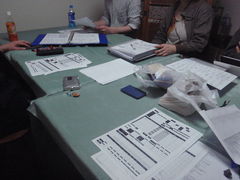
    そんなわけで、土曜の夜に軽めのTRPGセッションを囲んできました。

    行ったゲームは Pathfinder RPG。言わずとも知れたD&D3.5の流れを組む、色々と面白どころ満載のシステム でありんす。

    今日のテーム は。。。小さくて危ないひとだ!

    場所は、別府駅近くのリングテイルさ ん。
    閉店後のお時間を戴いて、GMにflashy.sanを迎えてのセッションですよー。
    参加者はflashy.san、リングテイルの店長さん、shiga、”の人、馬、ワタクシの合計六人。ワタクシと馬はPathfinderを プレイするのは初めてで、店長さんに到ってはTRPG自体が初めてという初心者満載、夢満載。
    日本語でGMがんばるよ! と気合い十分のflashy.sanの音頭で楽しみました。

    古寺さんの好きなダイニングテーブル

    舞台となったのは、山の上にある温泉施設。
    裕福な老人の護衛役として、一冬を越すまで温泉施設に滞在しながら、裕福な老人の世話と依頼をこなして行くという背景情報です。

    ある晩秋の日、ちょっとしたパーティの最中に発生した襲撃事件。
    石つぶてを散弾銃のように発射する、凶悪な飛び道具で武装したノーム部隊に襲われた温泉施設テルマエ・ロマエ(笑)にて、とりあえずは襲撃を退 けたPCたち。
    けれど襲撃は陽動で、隠し部屋に幽閉(?)された”温泉妖精”を連れ去るのが主目的。
    この温泉妖精の魔力で、普通の温泉に過ぎないお湯を、万病の癒しを可能にする優れものの温泉へと変えていたのだという。これを知った裕福だけど 傲慢な老人は、PCたちに温泉妖精の奪還を依頼(命じ)するのでありまして。
    ところが連れ去れた先は、濛々たる温泉の噴気に満ちた渓谷の向こう側。
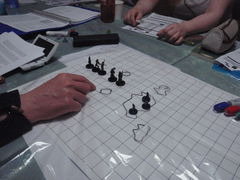
    届く視界は僅かに20フィート(約6メートル)ほど。しかも場所によっては高熱の蒸気が噴出し、間欠泉すらあるかも知れないという危険地帯を、 レンジャーの足跡追跡だけを頼りに、逃げたノーム部隊の跡を追いかけていく。
    そして受けてしまう、蒸気の中からの奇襲。

    濃霧の伏兵と神の手

    相変わらずの『石つぶて散弾銃』が降り注ぎ、蒸気の中から続々と現れる後続のノーム兵士たちに、PCたちは大苦戦!
    何しろ視界は利かないし、主戦力たるバーサーカーは蒸気と魔法と奇襲によってノックアウトされ、ソーサラーの必中呪文《グリース》もあまり効果 を与えられない。
    それでも何とかノーム部隊を削っていくものの、ノーム・ソーサラーの呪文によって「霧の中から更に大軍がやってくる」ような幻聴を聞かされ、 バーサーカーとクレリックがまともに混乱したことで更に長期戦の様相を呈し始めてしまう。
    そんな状況を引っくり返したのは、バードの呪文と機転であったという。

    ………とまあ、こんな感じの三時間ほどのセッションでした。
    時間的制約で最後までプレイすることは叶いませんでしたが、初めての方がGMを勤めるセッションということで、とても目新しく新鮮でしたよー。
    NPCの演技も気合いが入ってましたし、視界を遮る”温泉の噴気”や”石つぶての散弾銃”というギミックを、最大限に活用して印象づけた flashy.sanの手腕はお見事でした。
    またチャンスがあれば、ご一緒したいですねっ。
    おまけ。

    なんとなく

    “の人が開けようとした天井の扉。
    って、ここでもやはり”の人は”の人でした(゚▽゚)

    おまけそのに。
    席順の都合上、馬・shiga・”の人という並びに座りました。

    shiga「くまさん、場所変わってくれん?」
    くま 「だが断る」
    shiga「いや此処はくまさんの位置やろー」
    くま 「そんな史上最●の『両手に花』は、ワタクシには重過ぎます!」

    いちおー写真は撮ったので、今度渡しますネ☆

  • As I mentioned in my previous post, I (slightly foolishly) offered to DM a group of 5 players, in Japanese. The game was last night, so here are a few notes.

    We played at my friendly local gaming store (FLGS), upon which at some point I need to blog. The owner only has experience of warhammer games, and in fact the FLGS (called Ringtail, with a website here) stocks largely only warhammer and citadel miniatures. It’s the only store in Kyushu that stocks them, as far as he knows! Warhammer war-gamers are so rare that once a month the store owner visits Kitakyushu to play with a foreign (British?) chap. This chap also asked him to order in Warhammer Fantasy Role-play version 3, and he ordered an extra copy which he is willing to buy for himself to play, but which he would need me to DM (it’s in English). I advised him that he should try role-playing before buying a 10000 yen book from his own stock, so he agreed to a trial pathfinder game.

    So we had five players, names and PC classes described, along with an outline of the adventure, here. We played upstairs in the wargaming room of the ring-tail store, at a long table big enough for about 10 people. As ever, Shiga-san brought his huge stock of miniatures, dice, multiple printed copies of the pathfinder rules, etc. – it took up half the room! As ever, Furudera san ate continuously. This time the group, which consisted of 6 people including me, contained two women – Furudera san and Era san, who was playing for the first time in a year because she has taken time off gaming since having a baby, which is less than a year old.

    So my first note here is about the gender dynamics. I have never played in a group constituted entirely from within role-playing circles which had two women in it. I’ve managed to shoe-horn friends into a group with two women, but I’ve never met two women simply through the circles of gaming. It’s interesting that in supposedly sexist Japan this happens the first time I ever game here; and even more interesting given one of these women is a new mother, and shoe-horned her husband into child-minding their less-than-year-old child on a Saturday night so she could game. I’ve previously mentioned that I think maybe Japanese nerd culture is more gender-balanced than in the west, and this is further evidence in support of this tentative theory.

    Also, further evidence that something interesting is going on in the gender politics of Japanese nerddom is the strange use of pronouns. Kuma-san, a man, refers to himself as “watakushi,” which is extremely formal language only usually used by women outside of Shinto ceremony; Era san refers to herself as “washi,” which is a pronoun typically used by older men. There’s some kind of gender bending going on here, and I think there must be some kind of gender politics that is particular to the nerd scene. There’s gotta be anthropological value in this…

    This week, in addition to Shiga-san’s massive horde of stuff, we had lots of snacks. The Japanese role-player’s snack horde includes:

    • black pepper chips
    • “thin flavour” salted chips
    • orange juice
    • coke
    • oolong tea (a necessity for all Japanese women, who take it continuously)
    • potato croquettes
    • fried chicken
    • popcorn
    • pocari SWEAT, a type of rehydration drink that is really rather delicious

    plus Furudera san’s infinite supply of food, which includes such mysteriousnesses as bread she eats crust-first, without toppings, and fresh spring rolls, and TWO full flasks of coffee. The room where we played was another “shoes off” room, of course.

    Subsequent to the game, reading the social networking sites of the participants, there seemed to be some agreement about what was “surprising” or unusual about the game. Some players were expecting a different experience because the game was being GMd by a foreigner, but they seem to have been largely disappointed. However, it appears that they aren’t used to the following:

    • fighting in only a bath towel
    • extensive use of terrain for the ambush
    • describing their characters’ appearance at the outset (this didn’t seem to be a problem for them, though)
    • the DM employing voice and actions for the NPCs

    Japanese people being generally extremely shy and diffident, I’m not surprised by the last two points – shy role-players tend to avoid this stuff where possible, and certainly Japanese people tend to be quite shy and retiring. I’m not actually a big fan of fussing around with terrain, so I hope they don’t think that’s part of my style – I only put it in because of the ambush.

    These differences aside, from my point of view I really have to say that very little about DMing the group was different. I still occasionally had to pressure people to make decisions, they interacted in very similar ways to Western players (bar the politeness, of course), and they seemed to employ the rules and respond to the situation in just the same way. The only difference I really observed that there was less of a tendency for a single player to dominate the discussion, which is consistent with Japanese group interactions generally. Oh, and Furudera san and Shiga san played “scissors, paper, stone” (janken) to determine who should play the bard. There’s your moment of Japanese uniqueness right there…

    Language-wise, a lot of interactions passed me by, but the core of it made sense, so everything flowed okay, and nobody seemed fussed when I had to look up words or check them, or correct myself or be corrected. No-one seemed to lose interest at any point and it didn’t interfere with the flow much. There were a few moments where I said words in English by mistake and people just kind of got it; or when I thought a word would be an English transliteration but wasn’t (like “rage”). The next day, Era san commented on how Japanese players of pathfinder don’t understand the meaning of the transliterated spells, and when they are translated the words and effects make more sense. That’s interesting, because it maybe means that the gamers here are using a book of several hundred spells which largely just sound like gobbledigook. And certainly when Furudera san said “hijius rafuta” it took me several attempts to work out that she meant “hideous laughter.” But we manage. Today, Era san looked up “Pathfinder” in her Japanese dictionary and was confused, because the Japanese translation sounds like “pioneer” in the sense of “settler” and she can’t understand why a role-playing game would be called “coloniser.” This language issue is interesting.

    But at its core, the game flows the same, and feels the same. That, in itself, is fascinating to me.

  • Last night I DMd my first session of Pathfinder in Japanese. It was mostly successful, and I’ll be putting up my thoughts about the DMing in a separate post. This is a brief report of the session.

    The adventure took place in an Onsen (hot spring) resort in the Steam Mountains. This resort is blessed with healing onsen, soaking in which can remove many mundane and supernatural diseases. The party have been hired to escort an old, rich man to the onsen, and the events of this adventure happen in early Autumn after he has already spent some weeks soaking in the rejuvenating waters of the resort.

    The PCs are:

    • Akuni, human female bard (played by Furudera san)
    • Yurianusu, male elven sorcerer (played by Kuma san)
    • Isoda, female human cleric (played by Shiga san)
    • Nomai, female half-orc barbarian (played by Era san)
    • Myuta, male half-elf Ranger (played by Miyao san)

    All PCs were 4th level.

    The onsen resort is set in a small bowl-shaped valley deep in the Steam Mountains, many days’ walk from civilisation. A narrow valley to the south of the resort heads down to civilisation, and to the East is a second, even narrower valley constantly shrouded in steam from many onsens and volcanic fissures which run the length of the valley. The bowl-shaped valley of the resort itself is also misty, but not to the same extent as the Eastern valley, which is almost impenetrably murky. To the North and West, mountains shrouded in eery forest loom above the resort. For some reason in the Steam Mountains fireflies emerge in Autumn, so the night the adventure started was the night of the firefly festival, when all the patrons of the onsen gather on its western balcony to watch the fireflies dancing in the mist. The characters also gathered, except for Nomai, who was taking the opportunity of peace and quiet to bathe in the staff hot spring, from which she is otherwise banned on account of her race; and Myuta, who was required to be on guard and was standing in an inner garden keeping an eye on comings and goings.

    So it was that when the resort’s two guards died noisily in the Eastern garden, only Nomai and Myuta were able to respond quickly. Myuta immediately dashed to their employer’s side and Nomai, grabbing a bath towel and her dagger, dashed to the garden. She was followed by Akuni and Isoda, while Yurianusu (who had been chasing fireflies for spell components) doubled around the resort’s outer wall to come at the garden gate from the rear. Nomai, entering the garden, was immediately struck with a full blast from a Gnome Steam Rifle, but could see nothing of the source. Only when Akuni arrived did anyone see what was happening – two gnomes were guarding the gate to the Eastern garden, and the two resort guards lay murdered by an open doorway leading into the staff area of the resort. As the characters entered the garden, the other gnome unleashed a burst of fire from his rifle, and the first gnome dashed away. Yurianusu, however, cast grease behind both of them, and the first gnome slipped over. The second fled in terror with the characters in pursuit. The Barbarian soon caught the gnome and overbore him, stabbing him into submission, then dragged him back. Meanwhile, Isoda, Myuta and Yurianusu subdued the other gnome, and they hung both from the gate while they tried to determine what had happened.

    Investigating the room the guards had been “defending,” our intrepid heroes discovered the owner of the resort, crying about the end of his business. The gnomes had broken into the room, opened a secret door and taken something from inside a small volcanic pool that the room contained. The resort owner revealed that this spring had housed a special cage in which was held an imprisoned onsen sprite. This sprite grants the onsen waters their special powers, and without it the waters of the onsen are simply hot water. Without it, the man’s business is ruined – and by extension, the PCs’ employer’s health. And indeed, their employer, realising this, demanded that they recover the onsen sprite.

    There followed a brief scene in which the PCs “persuaded” other guests and the boss into paying them money for their mission. They then “persuaded” the gnomes to tell them a little more about their mission. The gnomes quickly told them that:

    • they had come up the valley with two other gnomes to steal the sprite
    • their employer had told them about the secret door
    • their employer was waiting for the return of the sprite in a camp at the base of the narrow, steamy valley, which provided perfect cover to come stealthily to the resort
    • there was an ambush set halfway down the valley, in case they were followed

    Knowing this, the characters set off down the valley, with Myuta’s tracking enabling them to identify when they were near the ambush site. Unfortunately visibility in the valley was only 20′, so though they knew where the ambush was, they could not spring the trap easily. Instead they blundered into an area in front of a jumbled pile of huge rocks, and 3 gnomes atop the rocks opened fire on them with steam rifles. Battle was joined.

    Myuta the ranger took cover behind the only available rocks, while cleric, bard and barbarian charged forward to try and gain the relative safety of the larger rocks beneath the gnomes themselves. Akuni threw a tanglefoot bag, which failed to take effect; Isoda cast bless, while the barbarian charged around the rocks to try and climb up the far side and attack the gnomes. Unfortunately the gnome sorcerer behind the rocks was ready, and knocked her out with a color spray spell. Then a fighter charged out from the cover of the rocks to engage the Cleric, while the gnomes set furiously about gunning down the sorcerer, Yurianusu, who cast grease on the rock to no avail. Another gnome appeared from nowhere and surprise attacked Akuni the Bard, but missed; Yurianusu cast sleep on that gnome, and Myuta moved around the large rock to take on the sorcerer, who Isoda the cleric also now tried to attack. Yurianusu’s grease spells on the rock did not make the gnome riflemen fall, so he switched to using sleep, which did work: one fell off the rear and died, while the other slid forward from the rock and landed in the tangle foot bag, so that he hung, upside down and snoring, from the front of the rock.

    The barbarian now recovered from her unconsciousness and laid into the fighter with a vengeance, but the sorcerer used ghost sound to trick her and the cleric into thinking that a new squad of gnome soldiers was approaching. With typical berserk single-mindedness, Nomai paid this little heed; but Isoda was fully suprised by it and distracted for a full round. The gnome sorcerer also attempted hideous laughter, which manifested as a phantasm of a strange-looking face which the viewer must surely be amused by; fortunately his target’s were all able to resist the lure of the funny face, until Myuta shot the gnome through the neck and put paid to further ensorcelments. Akuni then repeated this trick, casting hideous laughter on the gnome fighter. Akuni’s hideous laughter manifests as funny stories yelled into the ear of the victim; to all around the victim they sound for all the world like taped songs played at extremely high fast forward speed; but to the target they are heard as multiple fascinating, amusing stories which he is compelled to hear and be entertained by. Unfortunately for the fighter, Akuni’s magic was very powerful, and the spell became for him a curse that will never go away – wherever he goes the fighter will forevermore be laughing and accompanied always by the sound of songs in fast forward[1].

    Thus the battle came to an end and, it being 11:30 pm on a Saturday night, and the remainder of the adventure will be played out at the next session. Thus endeth the report of the strange doings of the Steam Mountains.

    fn1: saving throw fumble by me. Sorry, Mr. Gnome.

  • Note for my English readers: I’m now using this blog for communication with my Japanese players, just as I did for my English ones, so there will be occasional Japanese posts. In some cases I will also put English with them, in some cases not. My apologies if this causes your browser to render the site very very ugly.

    ノームは小さいですから、普通の武器は大きいダメージができない。自分の強ささえ攻撃すれば効かないから、ダメージを強化するために,機械的な武器をよく使っています。さらに、普通の機会工学が足りないから、ノーム工学者は、機械工学と召還術を組み合わせて、いろいろな異能武器が使える。

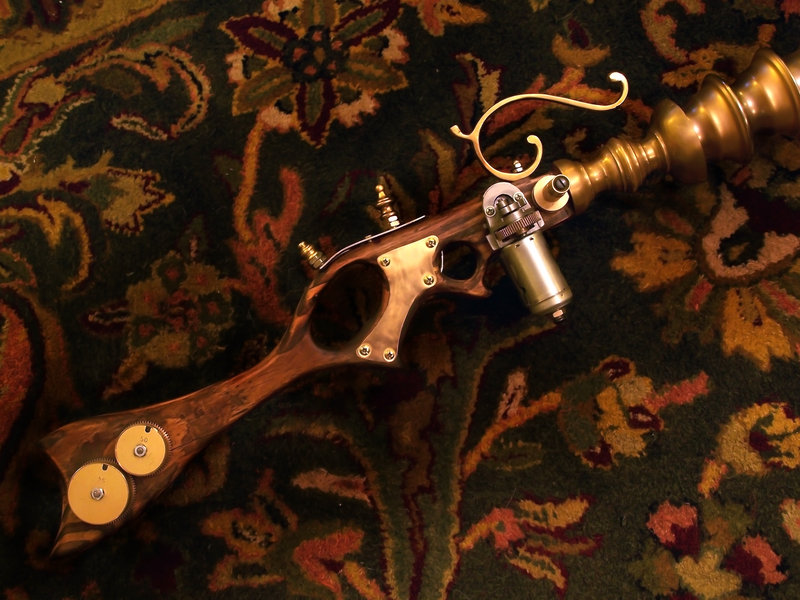
    この「蒸気散弾銃」は、ノームローグかソーサラー向けの機械的な遠隔武器である。散弾銃のなかには、幽閉された小さいスチームメプィットがある。弾薬は壊された石である。幽閉されたメプィットはこの石をつぶる。この弾薬は、使う前に壊さないといけないか、ノーム武器屋で買える。弾薬ケースの交代は1ラウンドをかかるが、ノームローグはフリアクションで交代ができる。

    この散弾銃はもう1つの使い方がある。自由に、標準アクションとして、全ての弾薬を一発で打てる。この時に、円錐形攻撃をして、円錐形の中の相手は怯えさせる。このアクションは全ての弾薬を使うから、早速新しいケースを入れないといけない。

    蒸気散弾銃は少し危ない。攻撃ロールは1の場合に、散弾銃が壊れるおそれがある。壊れる事件は:

    • スチームメプィットがのがれて、使用者を攻撃する
    • 散弾銃が使用者の変に爆発して、使用者は3d4ダメージを受ける
    • 散弾銃が爆発して、使用者の周りの10フィート以内の人が皆1d4ダメージを受ける

    この散弾銃を使うために、特殊武器習熟が必要である。特殊武器習熟を習うように、ノーム先生を見つけて、適当な値段を払わないといけない。

    詳しくは:

    • 価格:250gp
    • ダメージ(S):1d6+1
    • クリテェカル:19-20/x3
    • 射程単位:30′
    • 重量:5ポイント
    • タイプ:殴打
    • 弾薬:20発
    • 特別な攻撃:30‘x10’円錐形、中の相手は3d4ダメージを受ける(反応セーヴで半分)、反応セーヴが足りなかったら、怯え状態になる。セーヴ難易度は使用者の攻撃ロールである。

    以下は英語版である。

    Because Gnomes are small, their normal weapons are unable to do significant damage. Because their own strength cannot be depended upon to achieve a good effect, they use mechanical weapons to increase the damage they do. But even normal mechanical advantage can be insufficient, so they often combine mundane engineering with conjuring to produce devices that can be used for various strange weapon effects.

    This Gnome Steam Rifle is an example of a type of ranged weapon ideally suited to Gnome sorcerers and rogues. A small steam mephit is trapped inside the rifle, which uses a block of pre-fragmented stone or ceramic as its ammunition. The Steam Mephit hurls pieces of this pre-fragmented cartridge from the gun. Before using the gun, the ammunition needs to be pre-fragmented and shaped, which is easy for gnomes to do with their advanced stone-working skills; but it can also be bought from gnome weapons dealers. Reloading an ammunition case takes 1 round, but gnome rogues who use this weapon are automatically able to load the ammunition case as a free action.

    The rifle also has a secondary effect. At any time, the user can choose as a standard action to fire all the remaining ammunition in a single cone-shaped burst. Everyone within the area of effect of the burst takes significant damage and is at risk of becoming shaken. This action uses all remaining ammunition.

    The rifle also comes with a risk of backfiring. Anytime a 1 is rolled on an attack, one of the following may occur:

    • The Steam Mephit escapes and attacks the user
    • The gun explodes back on the user, dealing 3d4 damage (no save)
    • The gun explodes outward, causing 1d4 damage on all within 10′ of the gun

    In order to use this gun, an exotic weapon proficiency is required. To learn the proficiency, one must seek out and pay an appropriate fee to a Gnome trainer.

    Stats:

    • Price: 250gp
    • Damage: 1d6+1
    • Critical: 19-20/x3
    • Range: 30′
    • Encumbrance: 5 points
    • Type: Crushing
    • Ammunition: 20 shots
    • Special attack: 30’x 10′ cone. Those within the cone take 3d4 damage (reflex save for half). Those who fail a reflex save are also shaken. Save DC is determined by the user’s attack roll.

    Picture: The picture is the Sonification Rifle by Vladislaus Dantes.

  • This scene demands evil gnome sprite thieves

    I’m DMing a Pathfinder session in Japanese tomorrow night, for 5 people, 3 of whom I’ve previously met and 1 of whom is a raw beginner from my FLGS. I kind of arranged this tentatively before I met the gaming group 2 weeks ago, so I’m in a bit of overload here. It’s a trial adventure for the guy who hasn’t played before – if he likes it, we’re going to switch to Warhammer 3rd Edition, because he’s got a copy in shop but can’t play it himself. But first I want to be sure that he can enjoy role-playing. His previous experience is with wargaming, so it may not be his cup of tea.

    It’s a bit of a worry because some of my players’ Japanese is extremely hard to understand, and I’m running the group. But I think it’ll be okay, I’ll manage somehow. If I’ve bitten off more than I can chew then I’ll just have an extra beer…

    I’m setting the adventure in some mountains, in a generic fantasy world with an oriental/Japanese feeling, at an onsen (hot spring) resort. The characters are guarding an old man who is there for the healing properties of the hot springs, but a group of thieves steal the onsen sprite, the fairy that gives the onsen it’s special powers. Hijinks will follow. I set it up this way so that I could have a valley full of steam from the onsen, where I can set an ambush. I also set it up this way because the area where I live – steamy Beppu – is full of onsen and famous for the views of the nearby mountains wreathed in steam. So I can tie it into a world that everyone here likes. And after the slaughter, the PCs get to soak it off in a hot spring.

    Thinking about this while myself soaking in my local onsen this afternoon, it occurred to me that I could come up with a cosmology for this region of my fantasy world, in which the hot springs are not consequences of volcanic activity, but arise because the area of mountains is close to a conjunction of the elemental planes of earth, fire and water. This would explain the steam mephits hiding in a cave near the resort, and it would also explain the role of magical sprites in giving onsen magic powers – ordinary fairies corrupted by the influence of the elemental planes infiltrate the hot springs and give them special powers.

    Gygaxian naturalism, it’s what I’m all about.

    Anyway, while I was looking at the Japanese pathfinder wiki, I had to look up Steam Mephits (“Suchimu Mephitto”), and I discovered that the Japanese translation of D&D’s term “outsider” is raihosha[1], which my inestimably valuable Firefox add-on, rikaichan, tells me means “visitor, caller, client.” If my business gets off the ground, I’m going to have a great deal of fun every time I deal with a “client,” thinking of them as being like the “Senior Partners” from Angel.

    Fun Times…

    fn1: I cannot for the life of me understand why this class of monsters gets a Japanese name, as do all the states that a PC can be in (shaken, etc.) but the spells and classes don’t. What capricious logic drove this process!!!?

  • Over at tenletter, there are some example abilities for Fighters to take when they have leader training. This reminded me of some of the more fun feats that my players chose for their characters in the Compromise and Conceit campaign, and which I thought I would reproduce here. These feats are sometimes overpowered, either because they were given at first level or because I like people to have feats which add to the character, even if they’re nasty. Each feat described below also includes the name and “class” of the character who used it.

    Powerful Voice (Anna Labrousse, enchantress)

    Can be used 3 times / day, using a presence vs. will challenged skill check. The target suffers a suggestion-like effect for 1 round per point of failure (Max. duration=Anna’s level).

    Infernal Tango (Lord Merton St. Helier, sybarite)

    Lord Merton and Russell Ganymede, his batman, have an almost supernatural understanding of each others’ moves in combat. Whenever Merton is able to use his ranged weapon, he gains an attack of opportunity against a single target in melee combat with Russell Ganymede.

    Infernal Synergy (Lord Merton St. Helier, sybarite; and Russell Ganymede, his faithful batman)

    This feat must be taken by both Merton and Russell; it extends their innate understanding of each others’ combat style, and enables each of them to gain a +2 attack bonus when fighting attacking someone who is engaged in melee combat with their ally. This also applies to ranged attacks.

    Horrid Death (Dave Black, King’s Torturer)

    If Dave delivers a killing blow, he can choose to kill his opponent in such a horrid and gruesome fashion that all allies of the target who witness his/her/its death must immediately suffer a will vs. presence challenged skill attack. If they fail, they are shaken and suffer a -2 to all actions for 1 round per point of failure.

    Torturer’s Tale (Dave Black, King’s Torturer)

    Once per day, Dave can touch one target and, on a successful will vs. presence check, learn the truthful answer to 1 question.

    Locking eyes with the Damned (Father David Cantrus, Jesuit)

    Cantrus catches the eye of another spellcaster in order that both parties can appreciate the inevitable damnation of their souls, reflected in the eyes of another destined for the same flames. If Cantrus succeeds in a challenged will vs. will skill check, he and the target are unable to cast any magic until Cantrus deliberately breaks eye contact. The effect can work around corners/through walls if there is a mirror or other reflection by which they can be seen. The target takes 1 fatal wound every round that they fail a will vs. will challenged skill check, thus hastening their descent into hell. The target may yell for aid from fellows, but cannot cast spells or attack Cantrus, though they can attempt to move to escape Cantrus. Cantrus can move, but cannot attack or cast spells.

    Because some of these feats were chosen at quite high level, I didn’t put any particular pre-requisites on them. Had I been writing them from the very first, I would obviously make some of them have attack bonus and feat pre-requisites. They were also intended, obviously, to personalise the PCs and make the player’s vision more personalised. In fact, some of these feats – particularly Locking Eyes with the Damned and Powerful Voice – were not used as much as expected. After Cantrus took Locking Eyes with the Damned, I chose battle with the final enemy to depend on it.
    The remaining PC, Brian the Woodsman, didn’t have many specialist feats but he did have to regrow one of his arms, which was reformed in a dark ritual of faerie magic so that he had a massive, thick-thewed limb of wood and moss, wreathed in shadow. With this limb he could cast a spell, The Long Arm of the Lore, which I also describe here.

    The Long Arm of the Lore

    Range: Touch

    DC: 25

    Challenged: vs. Spellcraft

    Effect: Brian’s shadow-wreathed arm grips the target and wraps them in a flickering halo of shadowy force drawn straight from the depths of the Faerie kingdom. For 1 rd + 1 rd per point of success, the targeted spell-user loses the ability to use their spellcraft skill in casting spells, but must instead rely on will.

    As an example of this spell in action, Anna Labrousse finished the campaign with a spellcraft skill total of 21, and a will of 2. This significantly reduces her ability to successfully cast higher level spells. In future iterations of my system, it is likely that all secondary skills will be closer to primary skills, so an equivalent Anna Labrousse would have a will of about 10-12. This would still vastly reduce her power to cast more serious enchantments, like her infamous Grendel’s Demise. Sadly, the campaign finished before Brian got a good chance to use this spell.

  • This being a report of the actual adventure I participated in at Konkon April 2010, Oita, Japan.

    We were playing 3 4th level PCs developed only from the basic Pathfinder rule book:

    • Philip Blackstone (“Firippu Burakusutonu,” a 4th level Dwarven Fighter), played by me
    • Machiruba, a 4th level Human Cleric, played by Furudera san
    • Kelp (“Kerupu”), a 4th level Human Rogue, played by Ichinose san

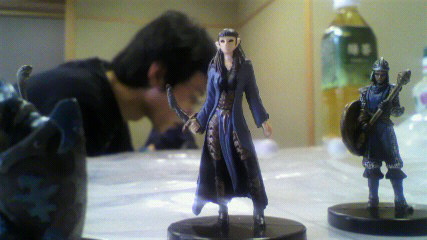
    All feats and skills were pretty standard. We used the 24-dice pool method for rolling up stats, so that the characters were pretty hard-arsed. Philip Blackstone, for example, was STR 18, CON 20, DEX 17, WIS 18, INT 12, CHA 10; which for a Dwarven fighter is pretty good going. We also had a 4th level Human Sorcerer NPC, called Kama (after her weapon), as backup. She can be see, with the Dungeon Master, Shiga san, in this photo:

    Black sickles in the sunset…

    The four characters turned up at an unnamed village in the morning of an early spring day, just at the change of the seasons. The village was nestled in the foothills of a Mountain range, and the hills were still coated in snow and ice but the paddocks of the village were expected to be free of ice by this time, and ready for planting. Unfortunately, the villagers had been waking every morning to find their fields frozen over right up to the snowline of the foothills. A ranger living in the mountains had tales of a family of white dragons living higher up, and the villagers thought that perhaps the dragons were freezing over their fields. So they asked the party to intervene to drive away the Dragons. Being only 4th level, we of course agreed.

    However, first, we wanted to make sure we maximised our income in the negotiations over payment, so Kelp sneaked into the village storehouse and had a good look around for any valuable items we might be able to bargain for. He found a collection of golden statues, and so in our negotiations the following day Machiruba was quick to mention these and demand additional payment. When the village headman wavered over the fee she was demanding (4 times usual), Philip Blackstone conveniently charged in, fresh from his once a year bath, wearing only a loincloth and dripping filthy water from his beard over his heavily tattooed chest, and pointed out to all and sundry that disturbing a Dwarf’s annual bath is not a good plan. The village headman folded and offered us 4 times the usual fee.

    So, we hatched a plan. We assumed the fields were being frozen by a dragon, and decided for our first trick to draw some massive Hill Giant footprints in the fields, and to place evidence of a Hill Giant camp, because Hill Giants are likely to live in the area and a family of Hill Giants might be sufficient threat to dissuade a white dragon from pointless harassment of a “poor” village (although did it know about those golden statues…?) So this we did, and remarkably successfully (Kelp proved to be very good at hattari, or trickery). So then we settled into a good hiding place, some distance from the site of the frozen fields, to watch.

    Evening came, and what should we see but … a Frost Giant (“Furosto Jianto”) wandering down from the hills, leading a medium-sized white dragon (“huwaito doragon”) on a leash, and forcing it to freeze a pathway down to the paddock with its breath. The Frost Giant and its enslaved Dragon froze a good stretch of the villagers’ farms all the way back to the hills, and then when it had finished beating the dragon into this task, turned and waved its massive arm in the direction of the mountain. There in the distance, two other Frost Giants waved in return, and leapt onto the slopes. From the far distance they came sliding down the icy path the dragon had made, swishing and swooshing all the way to the bottom on their huge icy slide.

    The characters realised then – this was like that moment in Street Fighter 2, when the evil genius points out to his captive that the day he destroyed her village and changed her life was for him just Tuesday. These Frost Giants were slowly destroying the village’s livelihood and screwing their hopes for the future – so they could build a giant slippery dip! The gods (and their 22′ tall white-skinned relatives) are truly capricious!

    So the Frost Giant got a very good opportunity to view the footprints the party had laid with the intention of fooling a dragon from the air, and dismissed them as a cheap trick. Then they wandered back to the top of the mountain, and slid down again. Plan A, foiled. On to plan B…

    In the morning the characters wandered up the hill with 8 doughty villagers, and found a suitable bend in the ice slide. Suitable in the sense that they expected the Giants to be sliding very fast, so that a well-disguised hole filled with spikes would do a good job of turning them into Giant sukiyaki. They set about digging a big hole. Unfortunately, they were halfway through when (surprise!) everything collapsed and one of the men found himself sliding into a 30′ deep pit! He caught himself on the edge and we dragged him out, then sent Kelp the Rogue in to investigate. The hole clearly opened into some kind of lair. Unfortunately, Kelp went a bit too far, and this happened:

    Often, Rogues don't pay attention in Dungeoneering 101 classes

    That’s right, Bugbears (“Bugbea”). Two of them, reducing Kelp to 1 hit point in very short order. Philip Blackstone was just preparing to hurl himself Thunderstone first into the pit but Kelp managed to flee up the rope into the hole, with the Bugbears following much more slowly. This was bad news for the bugbears, since hanging from a rope is not a good place to be. While Machiruba healed Kelp, Philip threw a throwing axe, and then when the Bugbears reached the top Kama cast Grease (“gurisu”), which was remarkably effective at putting both bugbears on their arses. Which is never a good place to be when there’s an irate Dwarf with a warhammer standing next to you. Chalk that up as 1 point closer to genocide for the Dwarven race (we kept one alive for interrogation).

    Initially the characters thought they could leave the bugbear lair to complete the trap for our unwary Frost Giants, but upon interrogating their captive bugbear they discovered that actually the white dragon they saw the night before was being held prisoner in the bugbear lair; and that furthermore there was a large-sized dragon being kept there too. The Frost Giants were planning to use the large dragon to maintain their region of the mountains in the grip of ice and snow well into summer, so that they would not have to move. So, it was decided that the best way to solve the problem would be to set the trap, but prepare the dragons to help the group.

    So, once more into the hole… after a little more exploring the characters found the medium dragon. A little negotiation with its bugbear guards and some suitable persuasion (violent and monetary) encouraged them to look the other way while the characters spoke to this dragon, which agreed to help the characters. It also agreed to provide information to the larger Dragon, when they briefly met while their cages were being swapped. In the evening, the medium white dragon would be removed from its cage and the larger one stuffed in. The characters’ plan was for the dragon to free itself when it heard the trap sprung, and come to help them[1].

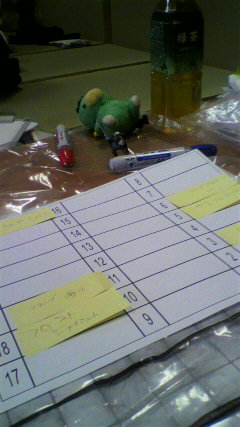
    So, the characters waited in the lair until the trap was sprung and with a massive sound (“doooon!”) the two sliding Frost Giants crashed down the hole into the trap. They were immediately beset with tanglefoot bags and alchemists’ fire, and battle was joined. The photo below shows the initiative sheet for this battle, on which the words “Frost Giant” are just visible, written in katakana. To the rear is a bottle of oolong tea, and the club mascot (“Kappa san”).

    Frost Giant slower than Dwarf arrrgh!

    The first Frost Giant went down pretty quickly under the combined burden of a lot of different fire sources, but the second was not so quick to die and, before the characters could finish him off the third one appeared at the top of the hole, having perhaps missed his friends. Simultaneously, the large dragon freed itself from its cage and burst into the room. The characters made way for it, slaying the second, injured Frost Giant as they did, and then the third Frost Giant came slamming in, though temporarily slowed by another grease spell. This Giant, completely untroubled by damage from the trap, was going to prove a little problematic. It first took a single strike at Philip, doing a fairly scary amount of damage; but Phillip is a bastard, and ignored it. The dragon lunged in then, but in response the Giant took a full round action and did 100 hps of damage. That’s bad news for a 4th level fighter, even if he is a bastard. At this point everyone was cheering for the 24-dice ability score pool.

    Fortunately for everyone but the Frost Giant, Kama had a single scorching ray (“sukochingu rei”) remaining, and after it did a fairly solid amount of fiery pain, Philip lunged in with a critical and a whopping smack to the knee that finished the last giant. A couple of good rolls and the Frost Giant was toast. Victory, once again, for the forces of good (well, actually, Lawful Neutral, aka “chitsujo churitsu,” in Philip’s case). And so to the treasure, as the White Dragons flew away to higher ground, and the assembled players breathed a huge sigh of relief.

    Thus ended my first adventure in Japanese Pathfinder.

    fn1: Truth be told, there are some salient facts here I think I’m missing due to language difficulties. Or, there’s an implausible part of the adventure.  I don’t know which.

  • Yesterday I played my first ever role-playing game in Japanese, at the Oita Evil Spirit club Konkon convention. This convention is held every month in a public hall in Oita, which is near my town, and runs from 10am to 6:30pm. As far as I know not many English-speaking Westerners get to experience Japanese role-playing, so I’m posting a report of how the convention ran and what happened.

    First I should mention that my Japanese is not that great, so this was a big challenge for me – maintaining conversation in Japanese for 8 hours on any conversational topic is difficult for me, and something as bizarre and abstract as role-playing is another level of challenge entirely. However, the kind chap at Oita Evil Spirt club (Mr. Shiga) who I contacted was good enough to alert me to the possibility of a Pathfinder game being played. Not only does Pathfinder have a Japanese translation on a wiki (which I previously mentioned I was going to start reading), the translation is in many respects a transliteration, so for example all the character names, races and spells are straight transliterations – Protection From Evil is called Purotekshon furomu ewiru, rather than aku no mamori, for example, so it’s a lot easier to come to terms with the language. Also, the online wiki enabled me to prepare some of the language, which was marginally useful. It’s really helpful in Japanese to know the words before you enter a conversation, because it’s not like French or German where you can guess the meaning of words you don’t know. You just can’t do that, in general, in Japanese.

    So I came armed with some information of use, and got the organiser’s permission to bail early if my Japanese proved inadequate. So how did it run?

    Firstly, there were 14 people, 2 of them women, all of them nerds, and we played in two Japanese style rooms – which have tatami mat floors, no furnishings of any kind, a closet full of cushions, an enclosed verandah with windows looking out on a courtyard, and an alcove for decorations. One enters the room through an antechamber where one takes off one’s shoes, so everyone sits on the floor. There were floor-tables to sit around, and we all started sprawled on the floor. People knew each other, but no-one knew me so we went through the usual range of questions (“Where are you from?” “What are you doing in Beppu?” “Have you played in Japanese before?”) The staff had been warned I was coming, and everyone was (as ever in Japan) very welcoming. The first thing I noticed is that everyone’s Japanese is really really weird, being a combination of the worst possible set of problems an amateur Japanese speaker can face: a) men’s speech; b) regional weirdness; c) nerdy complexity. For example, when one chap asked me how I came to Oita from Beppu, his question was (literally) “by what movement method did you honour us with your presence?” (For those unfamiliar with the strangenesses of Japanese honourable speech, the weird part here is “movement method.”)

    There was a half-hour long opening speech, in which the games being run were written on a whiteboard, and the GMs did a brief presentation of the key points of the game, and players got to ask questions (which strangely consisted mostly of “what sort of dice do you use?”) The games being run were:

    • A Japanese-made superhero game whose name I forget (but don’t understand anyway)
    • Warhammer, the older versions of which have a Japanese translation, and which really seems to appeal to Japanese gamers – they introduce it as “a dark fantasy made in England and set in a European world” and everyone seems to like this.
    • Shadowrun! The old version I played as a kid has a Japanese translation!
    • Pathfinder, being run by the staff member who I originally contacted, the honourable Mr. Shiga
    Are you satisfied yet?!

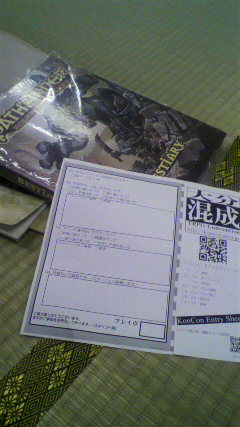
    The photo to the left shows the next amusing stage of the process – the prepared “anket,”or questionnaire, which comes in 3 pieces. The right-hand side was where you wrote your name and your first and second preference for gaming group (I chose pathfinder, then shadowrun). The middle part is the name of the convention, a QR code so you can access the website on your mobile phone, and the timetable for the day; the left-hand part (pictured, on top of an English version of the pathfinder rules[1]) is a client satisfaction survey for afterwards, which we kept till the end of the day.

    These opening speeches, by the way, were conducted in the formal way that one expects of a Japanese circle (a group with a shared interest). So the leader-figures (the “staff”) open the speech with a brief thank you and “please be good to me,” everyone bows and repeats this formula, and then the speech proceeds. It also finishes with a standard phrase like “let’s all enjoy a wonderful time together,” and the language in the middle is very formal, even though the people in the circle know each other well – so stock respect language like “honourable and exalted players,” and “those of you who have seen fit to notice this humble fact,” and other convoluted Japanese honorifics. This manner is not peculiar to nerds or role-playing, so you’ll also see it at soccer circles, kickboxing groups, etc.

    So with the formalisms out of the way, the staff took the right-hand portion of our anket and put us into game groups according to our first and second preferences, and we then divided into two rooms, with one group (playing the Japanese-made game) in a different tatami room, and my group and the Shadowrun group in one room. There weren’t enough players with an interest in warhammer, so that was dropped. Poor warhammer!

    We then prepared the room for playing, which meant unloading some low tables from the storage space, scattering mats, setting up maps and miniatures and snacks, etc. My group then spent several hours preparing characters for play. It was the first time Shiga had run a pathfinder game, and he wanted to go through character creation with us, which involved discussing character choices. I said I wanted to play something with limited skills, so I didn’t have to learn lots of complex words and language and didn’t have to interact too much with monsters, so everyone agreed I should be the fighter. Unfortunately, this was a bigger challenge than if I had played a skill-focused character like a rogue, because in Pathfinder the fighter basically gets a feat every level, and the feats are not straight transliterations of English, so I had to suddenly understand a whole bunch of new Japanese words and characters. Intimidation, for example, is called iatsu, not a transliteration, and the feat “dazzling display” is called “intimidating performance” (iatsu enbu). Weapon focus, weapon specialisation, cleave, etc. are all given Japanese names, and – just to piss me off more – the rules for cleave are different in pathfinder so I found myself having a rules discussion with the GM within minutes of starting the game. meep. Fortunately we had the English-language text, so if I could check anything I didn’t understand (in fact I did understand this).

    So this meant I had to learn a bunch of new words and characters on the spot and write them on my character sheet. This also extended to equipment but not to armour and weapons – a throwing axe is called “suroingu akusu,” a transliteration, and a shortsword is not translated to whatever the Japanese equivalent would be (wakazashi?) Weird, the decisions people make when importing words.

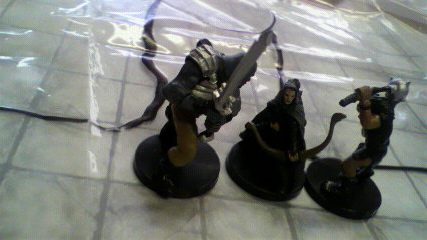
    Anyway, so I made a Dwarf fighter, and the photos below show my character sheet and the miniatures for our party – Kerupu the rogue and machiruba the cleric, with kama the sorcerer.

    Familiar, yet so different…

    gwaaaaaagh! desu.

    I finished my character before the others, having no spells to choose, and having chosen very simple equipment, and then I did the next classically Japanese thing – I went out with two other players to buy a bento (lunchbox) and some coffee from starbucks, and came back to eat grilled salmon and rice with my coffee. Bento, coffee, and role-playing – shiawase! (Perfect happiness).

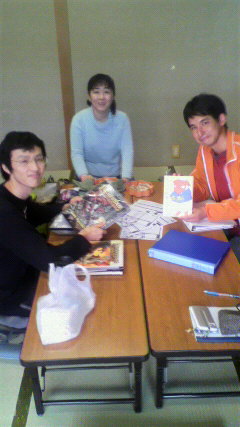
    By the time I’d eaten we were ready to start. Below is a picture of my group, from left to right: The honourable and exalted Mr. Shiga, our Gamesmaster; the Honourable and exalted Ms. Furudera, our Cleric; and the Honourable and Exalted Mr. Ichinose, our Rogue; your own ignoble and humble correspondent is behind the camera, which, incidentally, I humbly abase myself for using so poorly – these photos were all taken from my phone.

    Three Honourable Nerds

    Exactly the same, except for the snacks...

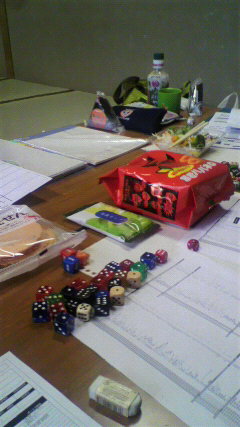
    The next photo shows our game table during play, and as can be seen it’s exactly like a western table, but for the snacks, which are, going counter-clockwise: Prawn rice crackers; a packet of wet tissues (these were to the wipe the mat, not to eat, obviously, they’re in the small green packet); semi-spicy potato rings; a convenience-store salad, with chopsticks; and an onigiri (rice ball wrapped in seaweed). At the rear is a milk tea.

    So, the game began, and went just exactly like a western game. Some scene-setting, then straight into the adventure (which I’ll report separately). I understood maybe 50% of the language, which was sufficient to get the essential facts and to miss some faint nuance. Sometimes I needed to check things and get my facts straight, because some of the things you hear at a gaming table are really out of left field – for example, the bit about the Frost Giants making a giant icy slippery dip kind of took me by surprise, and I had to get that repeated from a few different angles before I figured it out. I quickly learnt the words I needed to know for skills and the like – intimidation, diplomacy, stealth, attack, etc. The thing about language use is that if it’s not concretely about what is in front of you, it’s really difficult to understand sentences that aren’t really familiar (this is why phone conversations are harder than the equivalent conversation when someone is in front of you). Most of role-playing is in the abstract, not about what you’re pointing at, so new words have to be judged in context, not by the physical object they refer to, so if you don’t understand a certain amount of the language, you don’t get the whole. A lot of this session revolved around the verb “to slide,” which fortunately I knew[2], and as a consequence I was able to pick up other things. Also somehow without ever reading it I had absorbed the word for Giant, so “giant slippery dip” was guessable and I could fill in other blanks. I now know several more useless words than I did before (like “intimidation” and “opportunity attack.”) Given that I understood the context for many of the words (being familiar with the skill system), I wasn’t all at sea with strange new words, and was able to understand the flow of the action and even make suggestions (the fake hill giant footprints were my idea). There was some nuance with freeing the baby white dragon that I didn’t get, but I didn’t lose so much in translation that I couldn’t enjoy it. Also, I killed a giant.

    Incidentally, while this was going on the group behind us was playing shadowrun, which involved lots of transliterated phrases as well, like “Former Company Man” and “Street Samurai.” I grew all nostalgic!

    At 18:00 our adventure finished successfully, with no-one dead (though Kerupu the rogue came dangerously close). At a fixed time the group regathered, and there was a closing speech. This was more casual than the opening, and involved each DM reporting on their game, how they found it, problems with the system, etc. Players also gave their opinions. Finally, I was asked to report on how role-playing in Japan compared to role-playing in the west, and I was forced to tell them the same thing I tell you, dear reader: It’s exactly the same, but the snacks are different, and you sit on the floor. They also asked me if I would be interested in trying a Japanese-made rather than foreign-made game, to which I said a tentative yes. This made them all very happy, but first I have to get more used to their language and manners, because I looked at the Japanese games and they are radically different. Every single character class is unreadable for me – even the ninja has a weird name – and games seem based entirely on powers, like D&D4e[3] or Exalted, and I have to learn the names of these powers, which are all mystical or weird. Also, one game involves a complex resource-management rule which I couldn’t easily understand. I might try buying one of the books for a read (and more on these later too, I think), but first I need to diversify my vocabulary and get used to the complexities of nerd conversation.

    A few final observations about the social milieu. The players seem to be from a lower salary or social class than western gamers, with less IT professionals, and they have quite strict working schedules – mostly 1 day off a week, and only 1 weekend a month where they get 2 days off on the weekend. This means a lot of them only meet or game once a month[4], so on the day that they meet they really go into it with passion. Usually after gaming they go for dinner and then to a games arcade or karaoke, and they were making jokes about how intense and nerdy they must seem to outsiders. They’re also all pretty close, I think, and have a comfortable little friendship group going on. Finally, there seemed to be a higher ratio of women gamers than in the West, and they were very well accepted (there are more, too, who couldn’t come). Also, everyone was thin (of course), and there were no beards, no weird t-shirts with gaudy prints of dragons and big-breasted chicks, no self-important know-it-alls[5], and the usual level of system-discussion and out-of-game movie/cultural discussion as one would expect to see in the West.

    So, all in all, the day was a success for the gaming group and for me personally. I have managed to enter a Japanese gaming group and survive a day of gaming, and I may have made some new friends. I’ve also widened my experience of Japanese snacks. If my Japanese continues to improve and I stick at it, I could also have a regular and enjoyable gaming group. Next step, world domination!

    fn1: The pathfinder rules are massive! But very pretty, and I think aside from a few power ups, better than D&D

    fn2: I knew this verb from statistics, because I studied semi-parametric smoothing, which uses the same character as “to slide” or “to be slippery.”

    fn3: One player, Furudera san, told me that she has tried 4e but she thinks that for people who are used to 3.5e, it’s impossible to like. Even the edition wars are universal…

    fn4: which had Shige-san, another player, making some hilarious jokes comparing himself to Porco Rosso – a pig’s gotta fly, a guy’s gotta DM.

    fn5: there are many forms of social dickhead in Japan, of course, but for some reason the arrogant know-it-all is really rare in any setting.