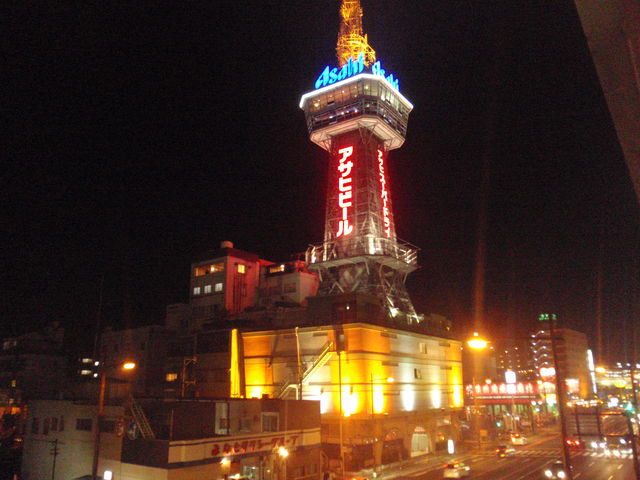
Looking from the Tower of the Sky over the city of lights…
Neil Gaiman did this first of course with his excellent Neverwhere, and its imaginative reinterpretations of London Underground station names. London Underground stations are in reality completely unromantic despite their names, and the same applies to Osaka, whose residents don’t think much about the romantic and inventive meanings of the station names all around them – to them, they’re just names. The meanings derive from the Japanese characters (Kanji) of which the names are composed, of course, and on my recent trip to Osaka I was struck by how romantic a role-playing world would sound if its regions and place names were built from English translations of Osaka (or Tokyo) place names. For example:
Nanba, Wave of Hardship
Shinimamiya, New Palace of Now
Shinsaibashi, Bridge of Heartful Worship (thanks Noisms!)
Tennoji, Heavenly King’s Temple
Kujo, Nine Clauses
Tsuruhashi, Crane Bridge
Fukuoka, in fact, has a street in the drinking and night-life district whose name literally translates as “Disrespecting parents street.” The challenge here is to think of something interesting about the area which justifies its name – is the area called Nine Clauses a town in the juncture of 9 competing kingdoms? Is it a series of 9 standing stones with ineffable powers? What is the New Palace of Now, and does it ever change? Is the Heavenly King a lost God whose temple is falling to ruins, or does the cult of the Heavenly King wish to violently overthrow the parliament and restore the King as a God? If so their temple must be remote, and very well defended.
It doesn’t take many of these names to construct a world with a romantic feeling (too many would, of course, be very tacky). One could even do it sandbox style, lay down the names to start with and have the players decide what they mean when they arrive at the location. Creating a world based on names, and filling in the adventures later… could be fun!
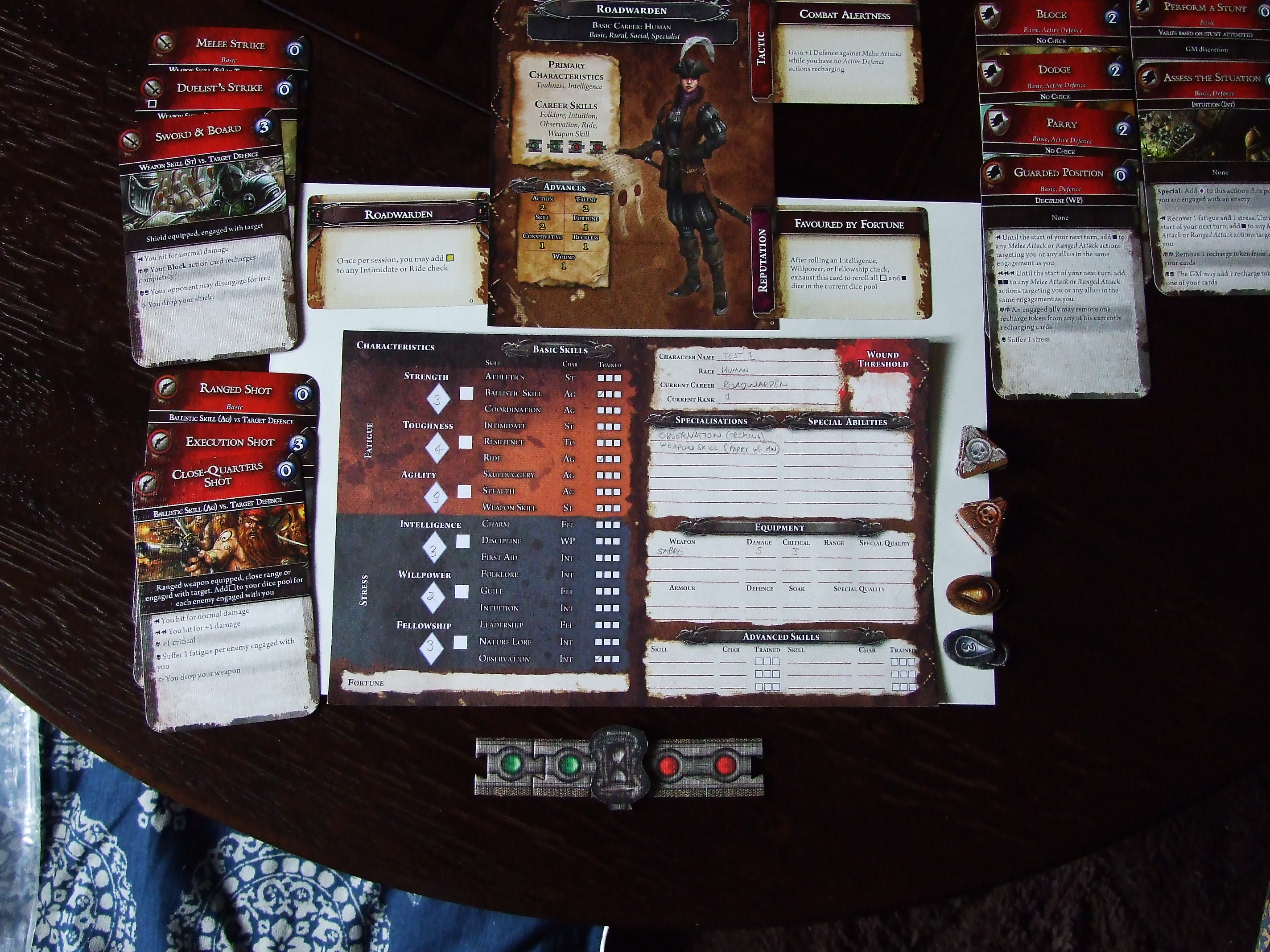
This is the report of the warhammer session I participated in 2 weeks ago, which I haven’t had a chance to report on yet. The group consisted of the GM and 3 players, one of whom didn’t introduce himself[1]. Our characters were:
Dwarven Runebearer (played by Ichinose, who was part of my last Pathfinder experience)
Human Nightwatchman
Human graverobber (me)
We rolled randomly for our characters, so I also had a choice of playing a fanatic, which I was inclined to do, but it would have been even more of a disaster than graverobber. My graverobber’s main traits were that she was female, with wide, staring eyes and a slightly mad, twitchy manner – as if she has seen things you wouldn’t believe. Seemed suitable.
The adventure started in Middenheim, where we three found work with a church organisation. The forces of chaos had once again surged down from the North, and many of the Northern towns had been reduced to ashes[2], so there were missions heading north to rescue people, treasures, and the remnants of the non-chaotic civilisations that had been crushed there. The church mission would be straying near a town (name now forgotten) which was famous for its milk tea company, now all sacked of course, and particularly for the family that ran the company – the daughter of which Suzette Crepe, was famously beautiful and kind. All three of us had met Suzette Crepe in the past, the Watchman guarding her when she was on volunteer duties to the South, and me being healed by her during those same volunteer duties after a close shave with some chaotic scenario (perhaps a badly run funeral?)
So, North we went. We were soon attacked by a mob of Snotlings, which we soon put paid to despite my concerns about the combat system (possibly because they’re piss weak, but also because they weren’t defending themselves properly). Having cracked some chaotic heads, we settled into the mercenary camp in the town. Here our evening reveries were interrupted by an encounter with a filthy waif, who was attempting to steal some of our hard-earned bread. She was caught in the act by the resident mercenary bully, a racketeer who I shall choose to name “Tony,” who began roughing her up a bit and causing trouble. It was at this point that we realised the waif was actually Suzette Crepe, and we were watching the heir to the Milk Tea fortune being roughed up by some Southern German lout.
This is the point in any cartoon where the scrawny, dodgy girl at the back – you know the one, with the staring eyes and the twitchy expression – suddenly gets dollar signs spinning in her eyes like a crazy pachinko machine. It’s the point where Luke Skywalker says “She’s rich…” and Chewie sighs.
Some people, as Black Adder said, will fight for glory, love of country, the glistening tear on the cheek of a golden child… but my graverobber will mud wrestle her own grandmother for a stack of cash and a sack of french porn.
So, of course, we stepped in to intervene. And found ourselves in confrontation with a racketeer (“yurusuya,” or ゆるす屋). Things went badly from here, and my attempts to appear mad and unhinged and not-wise-to-approach didn’t work. Fortunately, just as things were beginning to heat up the head of the church force, a Judicial Champion, waltzed in high-handedly and “resolved” our dispute with the usual diplomatic style of a paladin – dispatching us all to our posts and ignoring the obvious injustice I was suffering.
We returned to our tent and, seeing the possibilities inherent in our having a rich girl suddenly homeless, orphaned and at our mercy, we did the obvious thing – dispatched the girl with the only female in the vicinity (me) to a bathhouse, where I determined her story. It was the usual tale of woe – family all dead, fortune lost behind enemy lines, goblins, etc. Turns out she didn’t even have any special “teas” which might be useful in, say, combat[3].
So, having endured her sobstory, back to camp it was, while she melded into whatever shadows people not as skilled as a grave-robber meld into[4]. Unfortunately, on my way back to camp I was accosted by the aforementioned yurusuya (you’ve forgotten this word already, haven’t you dear reader? See how hard this is for me?!) He was just about to grab me and start doing what racketeers do to shifty-eyed graverobbers when, again, along comes the Judicial Champion and recommends the only solution Judicial Champions can recommend – a duel. Knockout style, our 3 PCs versus three NPCs, including said yurusuya. I bet this guy chooses his underwear the same way (if he wears any[5]).
So, a knockout duel between some kind of Dwarven scrivener, a glorified lantern carrier, and a shifty little minx whose idea of a good time is digging up the bones of your daddy, in the red corner; and in the blue corner 3 trained mercenaries. Fortunately, I now know that probabilistically this was doomed to go on so long that eventually the DM would send in an extra-melee-icular resolution, which was exactly what happened. After 20 or so rounds of faffing, the scrivener finally managed to smash the first mercenary into submission[6]. This mercenary was followed by the next mercenary, who managed, after taking quite a beating, to reduce our scrivener to a bloody pulp (this took another 10 rounds or so), so then battle moved on to the watchman vs. the mercenary. Watchman soon stomped mercenary (a critical was rolled) and the final member of the mercenary duelling team, our friendly neighbourhood racketeer, entered the battle. What followed was an interminable series of rolls, and many announcements of “attari” and “hazureta” (hit! miss!) before finally the racketeer beat our loyal watchman to the pulp he deserves to be[7]. This left little me, all wild eyes and sparrow-like twitchiness, up against The Big Man, who was badly wounded but, you know, kind of … big! So battle commenced, and it just so happens that my character, even though not very big and a bit scatty, has a rather high toughness – so she could take that one extra wound before going down. So there she stood, swaying, on exactly 0 hit points, obviously looking way tougher than anyone had given her credit for (and having previously done a bit of intimidation with the twitching-eye thing, and a rare successful social check), with the racketeer on exactly 2 hps and leering at her after a quite long fight, when in burst one of his hangers-on to beg us to desist (out of fear for the racketeers life!), only this is illegal, so the Judicial Champion stepped in and declared … us… the winners!!!
So do most Warhammer fights end, methinks…
So! Victory was ours! (Did you doubt me, dear reader?) So we took Suzette aside and discovered that she knew of a country house where perhaps her dad’s treasure was buried. At this point we discovered that amongst the entertainers following the camp was a clown who was a friend of Suzettes. So between them they instructed us on how to find this country house, and off we went.
Of course the country house was empty, and occupied instead by beastmen. So I crept up and spread some oil around the house, to burn it down, but they smelled my oil (stupid beastmen!) and most of them ran away (some of them got caught in the conflagration). We followed them to their cave, where we ambushed the leader and made short work of him. Inside the cave we found they had dragged off the treasure from the country house, which included a large case containing… a golden gun. And it was at this point that the clown and Suzette revealed they didn’t trust us, and were scared we would kill them and take the treasure. Suzette Crepe, being too good to be true, suggested we sell the gun and use the money to help resettle refugees from our old town. I twitched my eyes and suggested we should split the money and she could do what she wanted with her share. The Dwarven runebearer agreed, but our friendly watchman took an awful long time deciding what to do with his opinion. Finally, he weighed in on the side of divvying up the loot. We rolled social skills and ended up with … 100gps each, not the 300 we deserved. Still, better than poke in the eye with a golden gun… or not!
And so around us the war with chaos raged, while we scuttled back to Middenheim with our ill-gotten gains, to spend them on whatever second-rate goods the residents of a warhammer adventure purchase for fun. And I scuttled off to dinner with a sensei from the University, so missed the post-game review… zannen da ne!
—
fn1: There’s a whole strange phenomenon here. In Japanese “circles,” or hobby groups, by dint of being part of the group one doesn’t need to introduce oneself or have a proper name – names are almost irrelevant to native Japanese speakers, since they don’t need to use subject or object in constructing a sentence, and amongst your circle you are obviously part of a group, so don’t need to be named in many instances anyway; and when you are, a nickname will suffice.
fn2: It’s cute, the rulebooks contain a table for this war, with a list of cities and their populations, many simply recorded as “0”. Warhammer is British … any chance it was influenced by WW2 and the Cold War, just slightly?
fn3: This will be relevant later
fn4: It doesn’t bear thinking about, does it?
fn5: And assuming he ever changes it, which… he is a Paladin…
fn6: I’m really not sure what a runebearer does, but it fills me with fear of the kinds of disputes they have in Dwarven academia
fn7: I’m pretty sure that the first fight, between rune-bearer and mercenary, would have lasted even longer, but the player in question kept switching his tens and units dice around when it suited him.
This post describes the probabilistic structure of the feint in 2nd edition Warhammer, and its effects in combat, and concludes that it is a highly risky manoeuvre not worth using in any situation. The feint increases the opponent’s attack benefit more than the user’s in all cases, with the penalty for its use increasing with the increasing weapon skill of the user. This post will also show some more remarkable facts about the structure of probabilities in Warhammer 2, particularly the effect of the rules on attack probabilities for evenly-matched antagonists with very high or very low ability scores.
Introduction
The feint is a risky manoeuvre in Warhammer 2nd edition, which enables the user to disable the target’s parry/dodge ability, rendering them easier to strike. It is risky because it uses a half action, requiring the user to give up their own defensive parry/dodge ability in order to make the manoeuvre. Because the parry ability relies on weapon skill, it seems reasonable to assume that the manoeuvre should provide most benefit when the target’s weapon skill is higher than the user’s, since in this case the user’s parry ability will be of lower utility to them than the target’s parry ability is to the target. It is not clear that a straight trade – dropping one’s own parry for the chance to remove an opponent’s – is practically a very sensible suggestion. Here we test this.
Method
To test the effect of the feint ability we consider two fighters, one with weapon skill p, the other with weapons skill q, and, for simplicity, both having equal toughness t. We then calculate the probability of doing damage on a standard attack, and the probability of doing damage for a feint. We also calculate the odds ratio of a hit for the user vs. the target, i.e. the odds that the user hits with a feint divided by the odds that their target subsequently hits them. For the feint to be a useful manoeuvre, the odds ratio needs to be greater than one (indicating that the feint has increased the user’s hit chance more than dropping the parry has increased the target’s hit chance). All values of p,q and t are here represented as values between 0 and 1, to represent their probabilistic nature – on the character sheet they are of course expressed between 0 and 100.
The probability of succesfully doing damage with a feint is the probability that the feint succeeds and the subsequent attack succeeds OR the feint fails but the attack succeeds anyway. This can be expressed as
which is the probability that a standard attack hits plus p*p*q*(1-q)*(1-t). This in turn can be expressed as (1+pq) times the probability that a standard attack hits. The feint increases the chance of a successful attack hitting by a factor of pq. In practice this is a very small amount, and is maximized when both the attack and defense values are high. However, as we shall see, the normal chance of success is smallest when the attack probabilities are highest, and this is the point in time when dropping one’s own parry is most dangerous.
Tables of probabilities were calculated in Microsoft Excel for attack probability p ranging from 0.3 to 0.9, target attack probability q ranging from 0.1 to 0.9, and three values of toughness of 0.3, 0.5 and 0.75. Odds ratios (OR) were calculated as follows:
Odds(Feint user hits) = P(Feint User hits)/P(Feint User misses)
Odds(Target hits)=P(Target hits)/P(Target misses)
Odds Ratio =Odds(Feint user hits) / Odds(Target hits)
with an OR greater than 1 indicating that the feint has increased the success probability for the feint user to a greater extent than dropping the parry has benefited the target (and vice versa for an odds ratio less than 1).
For the remainder of this post, the word “hit” should be taken to mean a blow that penetrates all defenses (parry and damage reduction) to do actual damage.
Results
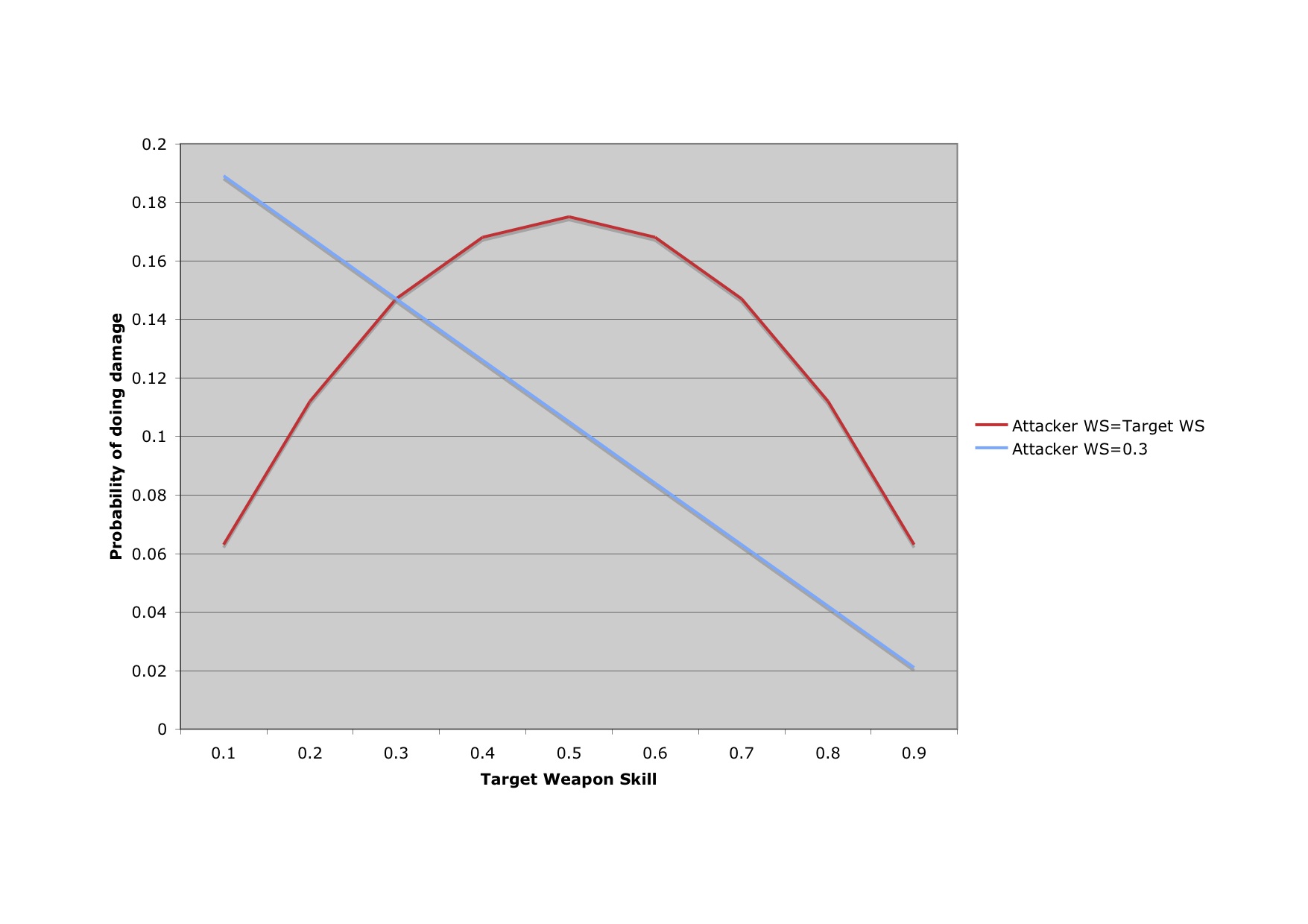
First we present the curve of successful hit probabilities without using feint for two cases: the attacker has a weapon skill of 0.3, against all target weapon skills between 0.1 and 0.9; and the case of equal weapon skills for attacker and target for every value between 0.3 and 0.9. In both cases, toughness is assumed to be 0.3. These two curves are shown in Figure 1 (click on the figure to enlarge).
Figure 1: Probability of attack success for two cases, no feint
It is clear from Figure 1 that fights between characters with very low or very high weapon skill will last for a very long time. Previous analysis showed that a total attack success probability of 16% is associated with a 50% survival of 17 rounds; with attack success less than half this, we can expect a battle between two antagonists with WS 0.9 to last considerably longer, perhaps as long as 30 or 40 rounds, in 50% of cases.
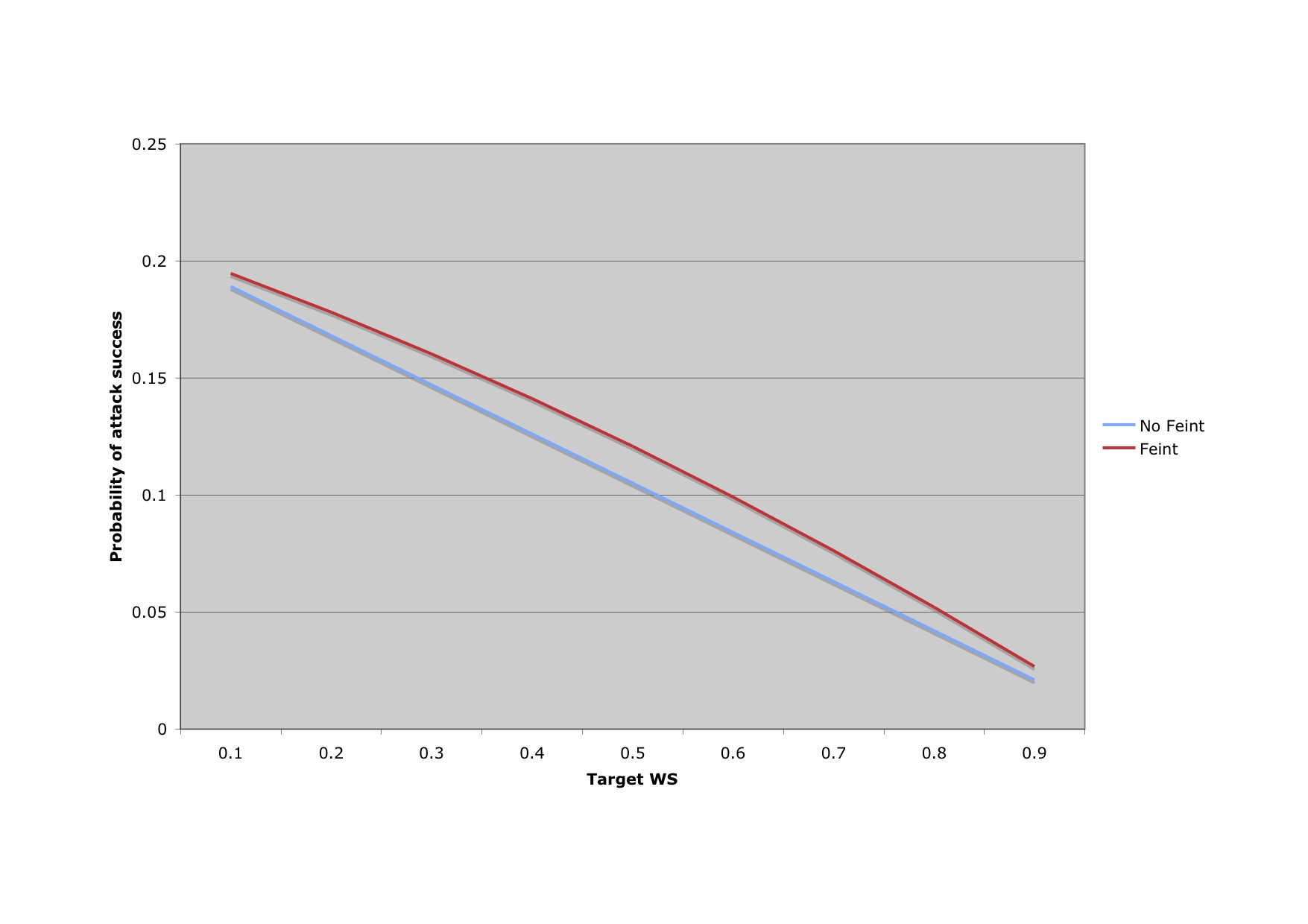
Next we compare these curves separately for attacks with and without a feint. Figure 2 shows the probability of success with and without feint for a character with WS 0.3, against a range of weapon skills from 0.1 to 0.9 (click to enlarge).
Figure 2: Probability of attack success with and without feinting, wS=0.3
Clearly the benefits of feint for this character are marginal and not equal across targets, with the largest benefit lying at roughly the middle of the range of target Weapon Skills. In Figure 3 we show the probability of successful attack with and without feint for antagonists with equal weapon skill ranging from 0.3 to 0.9 (again, click to enlarge).
Figure 3: Probability of successful attack with and without feint, equal WS
This chart clearly shows that the benefits of a feint technique are greatest for Weapon Skills around 0.5, when both antagnoists have similar values of WS. However, this is not the complete story, since in all cases the attacker is giving up a parry move, thus lowering their own defenses. To consider the full effect of the feint an estimate is required of the relative benefits to attacker and defender. We represent these benefits as the odds ratio of a successful attack, that is, the odds that the attacker is successful divided by the odds that the defender is successful. Ideally, applying the feint should lead to an increased odds ratio relative to an attack without the feat, in some circumstances. Note that an odds ratio of 1 indicates equal chance of attack success for both attacker and target, and should occur in the case of two antagonists with equal WS and toughness attacking each other without a feint. To illustrate this, we first present the odds ratio curves for two situations – an attacker with WS 0.3, against a range of target WS from 0.1 to 0.9; and an attacker with WS 0.4 against a similar range. This is shown in Figure 4 (click to enlarge).
Figure 4: Odds of successful attack without feint, two common WS
A grid line has been placed in this chart at an OR of 1 to show that the equal success chance lies at the point where the WS are equal. Note that a WS of 40 significantly improves the odds of a successful attack compared to the target when the target has a lower WS, but makes little difference against large weapon skill values.
Finally, figure 5 plots the odds ratio of success without feint against the odds ratio with feint for a weapon skill of 0.3 (click to enlarge).
Figure 5: Odds of success with and without feint, WS=0.3
Using a feint reduces the success rate relative to a non-feinting enemy for all values of the enemy’s Weapon Skill. In the case of a WS of 30, the reduction in relative success is about 30-40% across all values of target WS; however, for an attacker with a WS of 90, the reduction is about 90% across all weapon skills. For example, against a WS of 0.1, an attacker with a WS of 0.9 would have an odds ratio of 185 without feint; this drops to 21 with feint.
Conclusion
Although superficially an appealing mechanism, the feint technique leads to a significant loss of relative success in combat against an opponent not using the feint skill. This loss of success occurs regardless of the target’s Weapon Skill, and increases with the increasing weapon skill of the attacker, so that the penalty for using the feint technique increases as the combat skill of the users increases. This penalty at high attack values is extremely large, but even at standard WS values (of about 30) the penalty is significant, representing an approximately 30% reduction in effectiveness relative to the opponent.
An additional conclusion of this post is that the probability of success in a single combat round for equally matched antagonists is not consistent across all weapon skills, with the antagonists most likely to hit each other being in the middle of the weapon skill range (about 50), while those with much higher or lower weapon skills are doomed to very, very long combats regardless of the attack techniques they use.
A week ago, at the monthly konkon Convention in Oita, Japan, organised by the Evil Spirit club, I joined a Warhammer 2nd Edition game. This post is a brief report of the game and some additional comments about the convention, gaming in Japanese, etc.
I have reported on the convention procedure before, and this time was little different. This time the game was held in a single very large room, again with tatami mats and everyone sitting on the floor, and there was a total of about 20 attendees. One chap was wearing a chain mail shirt, and some people had brought anime figures or soft toy mascots to position at their table. There were 5 games, 2 western (Pathfinder and Warhammer 2nd Edition) and 3 Japanese (I didn’t catch their names). I had to leave immediately after the game so didn’t get to do a post-game rundown with the GM or do any post-convention dining or karaoke. However, I was exhausted, so probably by then my Japanese wasn’t up to the task.
I chose Warhammer on the somewhat foolish expectation that I could enjoy it as much as Pathfinder, and that it would help me diversify my gaming vocabulary and experience. I’ve previously expressed some dissatisfaction with Warhammer 2nd Edition, but was willing to believe this was largely the fault of the GM, but I think actually it’s true that the problem is at least partly the rule system, which at low levels is about consistently failing, and long-drawn-out battles to nowhere. I don’t see how anyone can think this is fun.
Playing Warhammer in Japanese is much harder than Pathfinder, however, so there were some non-system-related reasons why this session was a lot harder to play than Pathfinder. Particularly, Warhammer has an official Japanese translation, which means that a lot of the words that have been transliterated in the Pathfinder version have their own Japanese forms in Warhammer. Anyone who is familiar with the Warhammer character classes will be aware that names like “Bone-picker,” “Camp Follower” and “Judicial Champion” are not readily accessible to foreign-language learners, and in fact I have a friend living in Oita who studied Japanese at University, is married with children and is to all intents and purposes fluent in Japanese, but for whom the words I was exposed to were completely new. This makes the game a lot harder to follow in play than Pathfinder – at one point I was rescued from a racketeer by a Judicial Champion, which doesn’t make much sense if you aren’t very familiar with a language.
Also I didn’t know the rules backwards, so I had to have them explained to me without proper reference points, which makes the accurate comprehension of language more important. I got this pretty well, but it does make the game a lot harder to play smoothly. Fortunately Warhammer characters don’t have many special abilities, and the skills overlap with Pathfinder skills, so that aspect of the game went pretty smoothly.
The main language problem I faced, however, was that Warhammer seems to be played in Japanese with a very similar feeling to my experience of it in English. There is a lot less combat, and a lot more talking and assessing situations and finding the best solution to problems, than there is in Pathfinder. This is because the PCs are so godawfully terrible at everything that resolving any situation by the use of skills or combat is pointless. It revolves more around old-fashioned “role-playing” (the players present a viable story for what they’re going to do, and the GM pretends that a different story would have resulted in failure, while rewarding the one they chose), and this kind of role-playing naturally leads to long descriptions and explanations from everyone involved. The GM had scripts prepared to describe various situations, and there was a lot of negotiation. The final scene – where we uncovered the golden gun and had to negotiate about its disposal with the woman who helped us find it – was 10 long minutes of this kind of discussion, with a hastily-cobbled-together resolution mechanism by the GM which he had to explain to us. This kind of thing is naturally very hard to grapple in a foreign language. As ever, however, everyone was patient with my limited Japanese and willing to explain things simply, so I understood the majority of what happened, if not its nuance. The GM’s scripts used quite technical and abstract Japanese, like having a combination fantasy novel/rules description read to you at very high speed, with occasional excursions into the slang or regional dialects of the main protagonists, and this is extremely difficult to follow.
I was very interested by the way that the Warhammer system encourages in Japanese exactly the same play style as it does in English. The GM presents quite low-powered, low-fantasy situations which the players attempt to resolve through negotiation or some sort of lateral thinking, rather than through applying their characters’ abilities, and the successful resolution of tasks depends a lot on their knowledge of the world and accurate interpretation of the the GM’s explanations. It discourages any kind of craziness or attempts at doing unusual stuff, because any stuff you do naturally fails if it falls back on a skill check, and can’t be resolved without GM fiat otherwise. And every situation the GM throws at you, because it naturally ends with your failure, inevitably leads to the GM resolving it through some NPC interaction – i.e. GM fiat. So, our first encounter with the “Milk Tea Princess,” in which we try to help her, attracts the ire of the head bully in the mercenary team. Our attempts to negotiate a way out of the situation are rapidly heading into a painful end – we’re obviously not able to intimidate him, we obviously can’t fight him with his followers around, and there’s no reasonable outcome of the situation which won’t end with us being beaten up and the “Milk Tea Princess” sorely treated; so in waltzes a Judicial Champion to send everyone to bed. Similarly the duel with this same racketeer, which appeared to be carefully poised, fell apart near the end and was resolved through another GM Fiat (a follower of the racketeer’s fouling the duel so we won). I don’t think this was bad GMing either – it’s just really hard for a GM to set up a game where the players can make any progress, when everything they do is doomed to failure. How do you progress a story when the protagonists themselves are the main obstacle to progress? This happened in my previous Warhammer game, and I thought it was bad GMing, but last week’s GM was clearly quite good, and it still happened. It’s a flaw of the system.
So once again, my experience of playing in Japanese was very similar to playing in English, to the extent that even the different feeling of two systems I’ve played in English – D&D and Warhammer – was preserved across the language and cultural gap. I think that’s a very interesting observation on the universality of system and its impact on player choices. Also, the GM used a style I’m familiar with in the West – scripts to set out the scene, and extensive use of voice and characterisation to make the characters come to life. I’m beginning to think that there is a limited range of GM styles, and they’re language-independent. It’ll be interesting to see how if these similarities disappear when (if) I start playing Japanese-developed games.
The adventure itself was quite interesting, and I’ll give a separate report on the story later in the week. It’s been holidays here, I have German friends staying, and blogging time has been a little limited, so this comes out a little late.
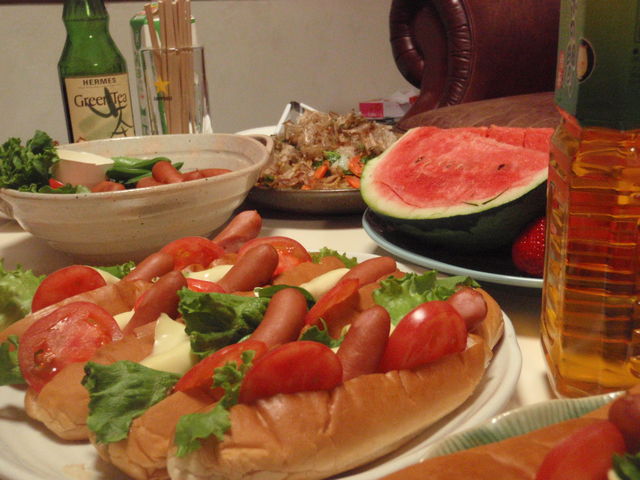
Friday night last week was the culmination of my brief Pathfinder game, in which the PCs venture further down the valley, beat up some gnomes, and discover that yes, even in the idyllic Steam Mountains treachery abounds. This week’s session was played not at the ringtail store, as it was last time, but at the family business of one of the players, Era san, who has an 8 month old baby called Mizuho. This family business is on the main road in our steamy town, and is a tax business sprawled across 3 floors of a large building facing the sea. The ground floor (first, as they say rather sensibly over here) was all car park; the second floor the business; and the third floor was a small apartment and bbq area, which seems to double as Era san’s home but is used for entertaining. It has a spare room with an automated mah jong machine in it (complete with little ash-tray holders sticking out from each corner), a draught beer machine, a kitchen, a huge cooler, and a fine view of Beppu Tower and the sea. In summer, it was suggested, we should play some games on the balcony. Era san cooked food for us all, depicted below.
Somewhere in this are two dita-milk cocktails
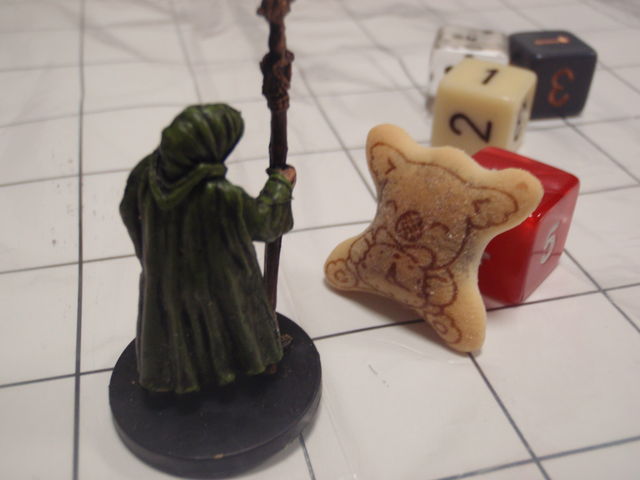
The food consisted of hot dogs, fried chicken, fruit salad, stir fried noodles, fried chicken wings, and some sausage salad (!). There is also the ubiquitous 2 litre bottle of oolong tea, and a couple of other fancy drinks. I was plied with beer all night, which is much more like my western role-playing experiences. Era san drank non-alcoholic beer (she is still breast feeding) and kept saying “It’s beer! Really it is!” Furudera san seemed to have left her endless supply of food at home but did drink two dita-milk cocktails; apparently she’s a strong drinker. No-one else could drink due to driving or poor drinking skills, and Era san’s husband drifted in and out with the baby, who was very well-behaved and very shy. My contribution to the food was a bag of crisps and a packet of Koala March biscuits[1] (it seemed fitting), pictured in action here:
Drop-bear does 3d6 damage, then drops as a free action…
It took us a while to get started due to dithering, delays, food and chatter, but eventually we started, and we didn’t finish until nearly 1am. This was because the only battle just kept going on and on and on. Pathfinder battles take a long time! I’ve done some comparisons and been thinking about this, and I’ll be getting back to this in more detail later, but I think some of the game mechanics we commonly use are designed to get boring in battle. I think Kuma-san certainly thought so – he started playing with the baby while he waited for the battle to finish. I wanted to join him, actually, and the same thing happened on Sunday at my warhammer game actually – battle stopped early by DM fiat due to lack of interest in continuation by all involved. This is not a stunning recommendation for a rule system.
Everything else went along much the same lines as before. Players now used to being expected to give descriptions and make decisions about how things played out, they were much quicker to do this. One doozy was Myuta the ranger shooting a gnome through the neck, and pinning him to the music box so that he stopped it playing. This session involved some planning for a big assault, and here, folks, is my conclusion about that:
MY PLAYERS DID NOT DITHER!
I’m a little stunned by this. Players who don’t dither?! Who would have thought. Decisions were made, a cunning plan tried, and then another plan come up with in short order and enacted. Sadly, Myuta cocked the plan up by fumbling his stealth check (and setting off the music box). Also, although the players don’t dither in planning, some of them dithered in execution, spending a lot of time wondering what spell to cast while the battle raged. I move this stuff on pretty quickly though, with the time-honoured GM five-count. Dithering in action is vastly superior to dithering in anticipation.
All-in-all a successful game, with demands to continue; but we may be moving on to Warhammer 3rd edition first. We shall see…
—
fn1: This website has a blog by the Koalas from the box. I strongly recommend this site.
When last we left our heroes, they were recovering from a horror ambush, in which gnomish guns almost beat them. However, having prevailed (and left one gnome permanently enveloped in a shroud of high-speed comedy stories, in response to which he could only ever laugh, laugh, laugh…) the characters were soon ready to push on down the valley towards the camp of the Gnomish thieves.
After another hour’s walk the characters emerged from the constantly-enveloping mist, and before them could see the valley stretching down to the green lowlands. They walked for another hour through the greening valley, until they came to a wider river valley. A river flowed before them, and on the far side lay the gnomish camp, a group of caravans arranged in a circle. The only way across the camp lay upriver, in a ford mercifully protected from the view of the camp by a copse of trees. After a little discussion, the characters decided to cross at the ford and wait until nightfall to investigate the camp more closely. They settled down to wait in the copse of trees until dusk.
At dusk Myuta the ranger crept forward to investigate the camp. He was greeted by a scene of anger and confusion. A group of gnomes stood around an empty pot in the middle of the camp, and an older gnome – obviously the leader – was hitting one of the watching gnomes on the head while ranting about his useless followers. Listening carefully, Myuta realised that the open pot was the prison for the Onsen fairy, and it had been delivered empty by the ring-leader’s thieves to his camp. The onsen fairy was missing! Myuta also learnt that this gnomish leader had gambled away the title to the onsen resort 10 years ago and, having finally made his fortune in the cities to the south, had embarked on a quest to regain by foul play the onsen fairy he had lost fairly all those years ago – now, when his health was looking less reliable, and perhaps he might have need of a captured sprite to lengthen his life. But the fairy was not in its cage. The leader’s followers assured him that they had followed his instructions to the secret room to the letter, and that there was no evidence it could be anywhere else. All were mystified, until the leader decided: Simple enough, we shall move to the resort in force and take the entire building, then search it from top to bottom.
Myuta returned to his group, and they hatched a plan. They had noticed that one of the caravans was topped by a very large version of a gnomish steam rifle, the discharge from which would be considerably worse than they had experienced so far. Any attack needed to avoid this weapon. First they tried casting light spells onto pieces of wood and throwing them into the river, to lure a few guards down to the river and kill them ahead. Unfortunately the river was infested with glowfish, which seeing the glowing bark pieces began themselves to glow, and the guard atop the caravan, looking through the scope of his steam gun, concluded the event was simply glowfish breeding. No one responded to the lure. So the characters moved up to the camp, and prepared an attack from multiple angles. They waited until morning, when the wind blows down the valley from the mountains and draws mist from the mountains with it. Yurianusu the sorcerer cast a fog cloud spell, and three of the characters drew close to the camp under cover of the fog, while the remainder drew up near the caravan with the steam gun, and prepared to sneak in.
Unfortunately, Myuta the ranger loosed an arrow early. This arrow flew into a cooking pot, bounced into a metal helmet, and then sailed through the air to strike a gnomish music box, which sprang open and began playing its annoying, inane music. Everyone in the camp woke, and battle was joined. The Barbarian charged straight to the steam gun, and Myuta began cutting down enemies with his bow while the remainder of the group attempt to prevent the gnomes from concentrating their attacks. Yurianusu used grease spells to keep gnomes from charging forward, and Isoda fought to keep the gnomes from overwhelming the barbarian. Once the barbarian had felled the gnome on the steam gun, and Yurianusu’s grease spell had caused a gnome to fall into the fire, then set the flammable grease alight, and Myuta had killed a gnome or two with his arrows, the leader stepped out of the shadows and called a halt to the battle.
So, the gnomes withdrew and the characters spoke to the leader. He explained his situation to them and told them he would withdraw from the battle, leaving them with the pot in which the onsen fairy had been stored. In exchange they would not follow him or fight him further, and would not reveal who he was to the onsen resort owner. Since his efforts had all come to nought so far, further attempts to pursue the fairy now would be a waste of time. He would withdraw peacefully, and in exchange the characters could keep the stupid pot.
The charactes agreed – in truth they had been starting to feel a little pressed in the battle, and unless the barbarian upped her slay-rate, someone was going to die. They took the pot and retired from the scene, lugging it back uphill to the onsen resort.
When they returned they went to find the owner of the onsen, to ask him why he had offered to pay them to recover a missing fairy that was never in the stolen pot. He wasn’t in his office, however, and even a cursory search could reveal that he had fled, taking his basic belongings and a lot of money with him. Further investigation revealed the title deed to the onsen – now easily forged into the names of the characters – and buried in some documents, about 10 years ago, a sale of “sundry goods” to a rich Southern landowner which netted a very significant amount of money, not at all consistent with such a lowly title.
The onsen resort owner had sold the fairy almost as soon as he took possession of the resort, and in the 10 years since the sale had been trading in the healing reputation of his spa without ever, actually, having anything magical or special to offer his customers.
The characters’ employer, obviously clearly vexed at such duplicity, began tearing apart the office in rage. The characters, of course, set their eyes on that property title, and the home of a certain now very-long-lived Southern landowner…
In this post I will use some basic probability theory to show that, in essence, the Warhammer 2nd edition combat system is not deadly, as I think is often claimed, but is actually really slow and boring, and inherently survivable.
This assumption of deadliness arises, I think, from the fact that PCs at low levels are poor at doing anything, and the assumption is that if you’re bad at stuff then you’ll die quickly doing that stuff if it’s also dangerous stuff. I think this assumption also lies beneath claims that early D&D was deadly, an assumption which I don’t test here (due to lack of familiarity with early D&D rules) but which is probably somewhat better placed than any assumptions about Warhammer’s relative riskiness.
I came to this comparison because on Friday and Sunday last week I role-played respectively in Pathfinder and Warhammer 2nd edition, and I was struck in both instances by the length and inevitable dreariness of the combat, and by the fact that both combats had to be ended by a non-combat act of the GM’s. This post, about the probability of survival in each of three systems, will serve to show how this comes about and also I think reveals some obvious conclusions about tactical combat rules in role-playing. I aim to expand on this post in future with a proper simulation and statistical analysis, complete with survival curves, but that will take a bit of time.
Introduction
The probability of surviving a single round, and the cumulative probability of surviving multiple rounds, are calculated here based on the underlying combat mechanic of three systems – Warhammer 2nd edition, D&D 3.5, and my own Compromise and Conceit modifications of the d20 system. All three are compared with a putative “control” system in which the mechanics are not specified, but are assumed to result in a 50% probability of a hit in any given round, and death after 3 successful hits. The chief conclusion for each system is the number of rounds required to fight before reaching a 50% chance of death, referred to hereafter as the “median survival time,” though strictly speaking this is not a median survival time. In practice of course time to death varies according to the good or bad luck of the player, and how much they lie about their rolls to the GM, so survival time should here be assumed to be roughly representative of a long-run probability. The methods presented here also use various simplifications and approximations, specifically ignoring the role of criticals, fate points, and the death spiral in the Compromise and Conceit system, which makes the order of hits important for survivability.
In all cases, the survival probability is calculated for a fighter-type PC attacking an NPC with exactly the same skills as themselves.
The fundamental mechanics assumed are set out below. The fundamental problem with Warhammer can be seen to derive from the number of defensive manoeuvres available to a fighter in a standard combat round. Once a successful hit has been scored, the defender can then roll a defensive roll using their own combat skill, and then (if a fighter-type character) can roll a damage reduction check against their constitution. For a typical fighter we will see that this reduces a fighter’s successful hit chance to just 15%, and in a series of binomial trials requiring 3 successes, this can significantly extend the run of rolls required.
Method
For each system, a typical build of first level fighter was generated, using average statistics that might be expected for such a system, and pitted against exactly the same fighter character. No special feats were assumed in D&D or Compromise and Conceit (C&C), and the special feat of “Damage Reduction” was assumed for the Warhammer fighter (though as we shall see, it is not an enormously important feat). Other assumptions are outlined in detail below.
The combat method for each of the systems was summarised as a single probability of successfully scoring damage against an opponent. Damage was assumed to be the average for the type of character, and the number of hits required to kill the PC for the given average damage was used as the number of hits required before the PC or their opponent was killed. In each round, the cumulative probability of death was calculated as the probability that the given number of hits occur by that round, which is practically given as 1-P(less than that number of hits occurred). Formally, given a requirement of x hits to achieve death, the probability that a character survived to round k is the probability that they have received at most x-1 hits in k trials. The adjusted probability is the probability that they have survived to round k, or that they killed their opponent in round k-1. This probability in turn is given as the probability that they survived to round k-1and they delivered 3 or more hits by round k-1.
This problem reduces to a simple binomial distribution for a given probability of a hit. Note that inclusion of critical hits, special moves, fate points, or death spiral effects renders this calculation completely different, and will be handled subsequently in a simulation.
Assumptions for each system are set out below.
Warhammer
A fighter-type character (for example, mercenary or watchman) is assumed to have rolled an average attack and constitution value on 2d10, giving values of 30 in each. The character is further assumed to have added 5 to the attack score, giving a value of 35. The chance of a successful attack is thus 35%, the chance of a successful defence is also 35%, and the chance of a successful damage reduction is 30%. The character is assumed to absorb 3 points of damage (30/10), and does 1d10+3 damage, and so final average damage is the average damage on a d10, or 5.5. The character is assumed to have 13 hit points, and be wearing leather armour (AP 1), so overall average damage is 4.5. Probability of doing any damage in one round is given as the Probability of a successful attack AND a failed defense AND a failed damage reduction. Since the opponent is exactly the same, this gives us the following results vis a vis the PC:
Chance of being damaged by the opponent in one round=0.16
Number of hits required to die: 3
D&D3.5
The D&D fighter is assumed to have a +2 strength bonus, BAB of 1, and weapon focus, for a total attack bonus of 4. Armour is chain with a shield, +2 dexterity bonus, and +1 dodge bonus, for a total AC of 19. The fighter is assumed to have maximum hit points, the Toughness feat and a +1 constitution bonus, giving 14 HP. Damage is from a longsword with +2 strength bonus, giving average damage of 6.5, so 3 hits are assumed to be required to kill the fighter. No other feats are assumed. This means that the chance of a successful hit is 25%, because the PC needs to roll over 15 on a d20, giving a 25% chance of success. This gives the following results:
Chance of being damaged by the opponent in one round=0.25
Number of hits required to die: 3
Compromise and Conceit
The Compromise and Conceit (C&C) fighter is assumed to have 4 ranks in attack, with a +3 strength bonus, and 4 ranks in defense, with a +3 agility bonus. The fighter is assumed to be wearing armour with Damage Reduction 3, and to have a maximum damage of 5 wounds. The fighter is also assumed to have 4 ranks in fortitude, with a total of 7 wounds. When fighting against himself, this means the fighter would need to roll a 10 to hit, but a 14 to do damage. Calculating average damage is tricky because the probability distribution is truncated between 1 and 5 with uneven probabilities, so for now we assume it is weighted towards the lower boundary of the damage distribution (due to the nature of the 2d10 roll), so assign an average damage of 2. Recall that this system uses a 2d10 attack roll, so we have a final result of:
Probability of successfully doing damage = 0.34
4 hits required to kill the PC
Control system
This system assumes a 50% chance of doing damage, and 3 hits required to kill.
With these results we construct the probability distributions.
Results
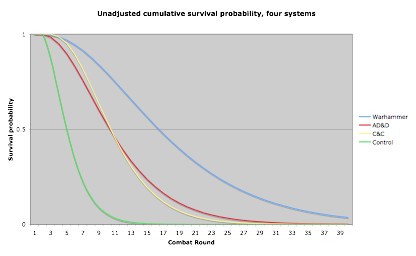
The median unadjusted survival time for each system is:
Warhammer: 17 rounds
D&D: 11 rounds
C&C: 11 rounds
Control: 5 rounds
Figure 1 shows the unadjusted survival times (D&D has been misnamed AD&D).
Figure 1: Unadjusted survival times
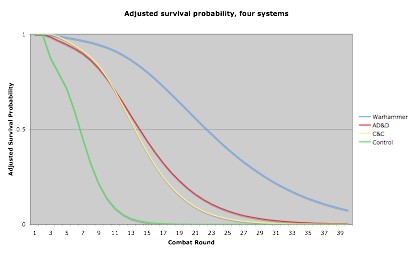
The adjusted times were:
Warhammer: 23 rounds
D&D: 15 rounds
C&C: 14 rounds
Control: 7 rounds
and the probability curves are plotted in figure 2.
Figure 2: Adjusted survival curves
Recall that these are not true survival curves, but simply cumulative probability distributions.
Conclusion
It actually takes a long time to die in Warhammer, with a concomitant number of die rolls. At the unadjusted median survival time, if the player wins, he or she will have rolled 17 attack rolls and 3 damage rolls (on average); he or she will also have suffered an average of 6 attacks that required defensive rolls, giving a total number of defensive rolls of between 6 and 12, for a total of 26 – 32 rolls. The D&D player will have rolled 11 attacks and 3 damage rolls, for a total of 14 rolls. The C&C player will have rolled just the 11 attack rolls, and the control player will have rolled 5 attacks and 3 damage rolls for a total of 8 rolls.
It’s worth noting that, fiddling with the underlying parameters of the game assumptions for warhammer shows that damage reduction is a significant factor in the slowness – losing this feat increases the base hit chance to 23%, similar to D&D. However, the relative ability scores of the enemy are not that important. If the enemy has only a defense score of 15, half that of the PC, hit probability increases to 20% and the survival time drops (for the person with the higher skills) to 13 rounds, only shaving off 4 rounds. Also, if both fighters have an attack ability of 55%, the overall chance to hit remains roughly similar, at 17%, so gaining levels doesn’t significantly speed up combat.
Even if we assume that the warhammer system represents reality in its long drawn-out slugfests, we have to ask if this is a system that we want to actually play – fights this long are very boring. Also we note that a player has fate points to spend, and that in the “low power” world of warhammer these are one of the player’s main advantages over NPCs. But the average player will have 3 fate points, which can be used to reroll a single roll. Given they have to roll 26 – 32 times to win, it seems that these fate points aren’t going to make a significant difference to the battle’s progress. Also, unlike in D&D and C&C, the absence of other powers and magic means that the player has little else to do in combat but roll to hit, making these 26 rolls considerably less interesting than in other systems.
We also can note that there is no particular reason for a given number of rolls to be made for one attack. Combat systems abstract combat, so we could in essence reduce combat for the Warhammer case to a single roll against a 15% hit chance, and have the same result as described here, at the cost of 6-12 rolls less. Players want a certain amount of argy-bargy in combat, but I think most people would argue (and I think certainly the people I’ve played Warhammer with have agreed) that a little less argy bargy and a bit more fun could be had from a different system.
In a subsequent post, I will consider a full simulation for a set of sample fights, include criticals and death spirals, and give a statistical analysis.
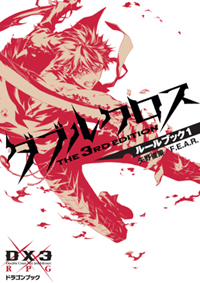
I’m playing at my local gaming convention this Sunday, and there’s a risk that I’ll be invited into a Japanese-made role-playing game, so against this risk I thought I’d read one of the more popular (and cheaper) Japanese-made games, both to get an introduction to the feeling of Japanese games and to learn some language; and also in the hope that this actual game is being played. The game is called Double Cross, 3rd edition, and in this post I aim to give some outline information on it. So far I’ve only read up to the beginning of character creation, because I’m using my standard translation technique, which I’ve become better at in the past year but which is still slow. And I have computer games to play, so nothing is happening fast at the moment…
For more background information, the website for Double Cross 3 (entirely in Japanese) outlines the main products available, and the J-RPG webpage has an outline of some of the basic elements of the game, including background on the origins of the character class names. The “Download” section of the Double Cross 3 website contains some example character sheets, and the J-RPG group also has a link to some of the character class concept sketches, which look very cool. The English writing in the background of each picture gives a rough idea of the character concept behind the picture: the first character, for example, translates roughly as something like “Fighter to protect dreams,” (yume no mamorishu) and is written in English as “Dream Fighter.” If you download the firefox add-on called “rikaichan” you can translate individual words in some websites, but sadly not in the character pictures. Anyway, the first picture contains all the information you need to know about this game: it includes schoolgirls. Can’t go wrong there.
So here is the outline of what I’ve read so far.
Presentation
The book is a B5 hand-held book, purchased for 840 yen (5 pounds, or $AUS10, or $US8) new, and it contains everything you need to play – player guide, GM guide, world information, character sheet, sample characters, example of play, and scenarios. Eat that, WOTC! It starts with an outline of the world, and then has a short comic strip involving some demon-summoning school children (de rigeuer, I think we can all agree). Then it goes into the standard RPG stuff – what an RPG is, guidance for using the book, glossary of terms, character creation, etc. It’s all black and white, and the B5 format means some stuff (e.g. pictures of the character sheet on the page) is very small. The sample characters have pictures just like those in the link above, in black and white. I think a benefit of the Japanese language is that you can stuff an enormous amount of information into a very small physical space using the pictograms, and this shows here. The language is simple and business-like, which is a bonus for me, but it has occasional slang/crime language (in the comic, for example) and some lyrical introduction language that is completely wasted on me (see the translation on the J-RPG page above). I think Western game designers really need to consider this game book format, because it’s a really good idea to present the whole game in a $10 package. I think they have a proper A4 size colour version for ¥3000 (20 pounds, $AUS35, $US30) but the separation of the game into luxury and practical versions is I think an excellent plan.
Game idea
The game is set in a modern world, everyday Japan, which has been beset by a virus called renegade which corrupts people and gives them superpowers. The PCs are people with these superpowers who stand “in the space between human and superhero” and fight the evil forces unleashed by the virus. These powers are essentially dangerous, because the renegade virus “erodes the human sense” and every use increases the risk that a person will go mad, becoming a germ, a human overcome by some evil trait who is not considered human anymore. In the game, people with powers from the renegade virus are referred to as what has been transliterated as overed, though I wonder if it is actually meant to be transliterated as overawed (it’s hard to tell). So you start the game as an overed person, and have to manage your powers carefully lest you transform into a germ and have to be hunted down like a dog by your friends. The characters also all start with important personal connections called Lois, and if they lose these connections the connections become a Titus, which is some kind of evil bastard, at least according to Shakespeare. The PCs also are supposed to have a cover, and may or may not work for UGN, a company or government organisation in the classic Anime style, which hunts down the bad guys (I haven’t read that far yet).
Character classes
Characters are chosen entirely on the basis of their mutation, or syndrome, of which there are 12. These give different types of powers, and the PC can be a pure breed (with powers in one syndrome only) or a cross-breed, with two syndromes.For example, our happy school-girl dream fighter is a cross-breed combining the syndromes of “Angel Halo” (controlling light) and “Salamander” (controlling fire). Mmmm, dreamy… I haven’t read the syndrome descriptions yet but judging by the TRPG translation they look very cool. Each syndrome comes with a brace of powers, maybe 15, of different levels, some combat, some investigative. This means that in total there are… 66 possible character classes (if my calculation of “12 choose 2” in my head is correct). For example, our schoolgirl (whose picture in the book, btw, has her sucking a lollipop, wearing a short skirt, and pointing a big gun) can choose the level 1 power Eyes of God, which increases perception, from her Angel Halo syndrome; or Wrath of the Fire God, which wreathes her in fire and increases her attack power, from her Salamander syndrome. That’s the kind of girl you want in your high school hostess club, or your high school basketball team. I haven’t read this far yet, but it seems like the syndromes control your starting ability scores, of which there are four: physical, sense, mind and charm. There’s also a section for choosing life path. I get the impression that character development is simple, but we’ll come back to that when I’ve read it. It seems to involve a lot of choices from tables using the mechanic they call “Roll or Choice,” wherein you roll on the table or choose, according to your preference. Some tables are choice only. So you can randomly roll your cover, or choose it.
Some similarities
I was struck by the inherent similarities of the introductory sections about what a role-playing game is. The explanation was very familiar to anyone who has read a few Western-style games. There was also a section called “Golden Rule” which is just what one expects: a brief paragraph on how the game is for fun and you only use the rules you want to use, with final judgement on anything resting on the GM, who is responsible for coming up with appropriate rulings in consultation with the players. Sound familiar? Also in common with a lot of Western games, there was a brief section on “The Third Person,” in which the authors state that they will use “he” or “several hes” as the third person singular/plural, and this is done to preserve readability[1] and not for any reasons of discrimination. The glossary also contains the usual definitions of GM, Player, etc. and the layout of the book is very similar – introduction, faffy bits, character development, player guide, world guide, GM guide, scenario section. This is yet more proof that the RPG world is actually really similar across the cultural divide.
Differences
The main differences in the game will probably lie further on, in its development of the world, but a few that were immediately evident were the heavy manga focus, with all the illustrations being done in a manga style and the inclusion of small manga strips at crucial stages in the book. Obviously, the world setting is very consistent with a lot of Anime and Manga ideas, with a secret organisation using superheroes to hunt down superheroes. Witch Hunter Robin springs to mind immediately. The book itself is set out in a more formalised style, which is very useful, with for example a page giving a flowchart to explain the character development process, an initial page with a picture of all the items you need to play, and so on. This is consistent with a Japanese style of presenting information that can be much clearer and more ordered (in print) than in the West. My local town’s onsen guide, for example, has a scatter plot of every onsen in Beppu, plotting its water mineral content against some other water property, so you can immediately find the onsen that suits you. The magazine Tokyo Graffiti[2] has some really interesting examples of graphical presentation of information for the lay reader (about hair style choices, or shoes!) that shows a much more ordered and advanced approach to information than in the West. This gamebook follows in that style.
The system seems to be heavily focussed around powers, rather than spells and class-specific abilities, but I think there is a skill system as well. More on this later, when I’ve read it. It also seems to be low complexity, aimed at starting quickly and resolving actions quickly. Also, it has the phenomenon of erosion, in which using your own powers increases the risk of losing your PC, so there’s a type of insanity-check based resource management system which is not too common in western games, I think.
A few other notes
The JRPG site translation of the powers also includes references to the original source of the power’s name, and as can be seen, there is a lot of reference to classical western and ancient literature, as well as Chinese and Japanese history. The use of the word Titus to describe vengeful ex-associates is a very cool touch, and apparently there’s a supplement set in an Eastern European country in the throes of a civil war. This kind of Western-influenced anime style reminds me of Full Metal Alchemist or any of the famous Miyazaki Hayao movies, and I think it’s a really impressive and interesting style. It’s also classically Japanese, to merge Shakespeare, ancient fallen Japanese Gods, and a reference to a Stanislaw Lem novel.
The book also includes an example of a “Play Report,” which is written like a play, with the actors being the GM and the players. Apparently there are whole novels written in this style, and play reports are very popular here. I will at some point try reading one, but I suspect there’ll be too much casual Japanese for my skills, at least for a while.
In my next update on this game, I’ll talk about character creation and the game mechanics.
Oh, and the name of the game is taken from the idea that the characters are traitors to those with superpowers caused by the virus, I think. So there’s a sense of their being in hiding, looking out for evil virus-infected superheroes to kill.
—
fn1: “Readability” was a classic moment of Japanese-language obstinacy. I can read all three characters in “readability”: 可(ka),読(doku) and 性(sei) which mean, in sequence, “ability,” “reading,” and “essence,” and from their combination I could guess what the word meant. But when I put these characters together and search them in my electronic dictionary, they don’t exist. I also couldn’t find them in my mobile phone dictionary, which is slightly more convenient for finding words with unusual readings. I had to email a friend and ask her! She’s Japanese, she read it instantly, but she said she’s never seen it before. This is classic – not only does the character system throw a physical barrier in front of you when you try to read, but the word for “readability” doesn’t exist in simple dictionaries.
fn2: I really really recommend this magazine, btw. My other blog has someexamples of its contents.






 Compromise and Conceit