… and I will give you the world cup winning team[1]. This from the Spanish coach, in support of my comments about the demise of European soccer. I wonder if Holland has a similar approach? At the end of this article the Spanish coach mentions that the Germans developed the same approach to fostering young talent, but that Spain have been doing it longer.
This is similar in aspect to the remarkable phenomenon of the UK doing better than Australia in the 2008 Olympics. This was a direct result of money being poured into elite sports in preparation for 2012, and will undoubtedly be repeated in London.
But, lest one think that this makes for better sportspeople… the guardian had a graphic showing the most successful teams by GDP, and they largely weren’t from rich nations. But I can’t find it anymore.
Incidentally, my kick-boxing gym is training children as young as (my guess) 5 years old, and it’s very, very cute (you can see them in the third picture)… the teacher was trained in Thailand, and I wonder if he’s thinking of a Thai model for developing fighters – get them at 5 and make it their life. There’s an 8 or 10 year old boy (on the right in the pic) who is ferociously good, though apparently he bottles it a bit during fights. But it will be interesting to see the results when they’re adults…
In my previous post about playing this game on Sunday, I mentioned that we used a type of module called “Scenario Craft,” in which every element of the module except a vague skeleton of the plot is random. This post gives a little more detail about the scenario craft process.
The book
The scenario craft book we used was called “Public Enemy” and can be viewed here (Japanese). I’m not sure what the background to this module is, but it contained some expansion information for the game, some new NPCs, and the website indicates it has information on the history and development of the False Hearts organisation, which is the evil underworld for crazy superheroes. I didn’t see much of the module book itself, since the GM was using it a lot. The book presents 4 types of adventure based around interaction with this organisation.
The basic idea
The basic idea of the Scenario Craft plan appears to be that the adventures are built collaboratively by the GM and players, through some outline decisions and choice of scenario that the players and GM decide on together, followed by a kind of collaborative decision-making process about some aspects of the PCs that are required to fit the adventure. After this, the players and the GM between them roll up all aspects of the main NPCs, including the bad guy, so we all know what we’re up against and its relationship to the party. The remainder of the adventure plays out through a semi-structured flow chart of action, and a lot of random events, clues and conflicts rolled up during the different stages of the adventure.
The scenario choices
The scenario choices are presented as a vague outline idea, and each scenario choice affects the structure of the action flow chart, the nature of the adversaries/NPCs, and the random tables on which the action is determined. We were presented with 4 possibilities, but I can’t remember the other 3. The one we chose was “Everyday life should be protected” (mamoru beki nichijou, 守るべき日常). The outline idea was that someone in the False Heart organisation was about to find a way to reveal the virus infecting our superheroes, and we need to find a way to stop it.
Scenario plots
Each scenario comes with its own plot, which is very broadly outlined. Here is ours:
The “cooperating NPC” approaches the PCs to tell them he thinks that his underling, the “Rival NPC,” has joined the False Hearts. Simultaneously, the “Heroine NPC” tells one of the players (with whom she has a close relationship) that she is worried about her friend, the “Rival NPC.” The PCs agree to find the “Rival NPC” and bring him back to UGN for questioning.
That’s it. These NPCs are worked into our characters’ lives through a very simple plot mechanism, the Lois (see later).
The action flow chart
Almost all of the adventuring is constrained to two pages of the book. The right-hand page contains necessary tables for randomly generating everything, and the left hand page contains some outline information and a flow chart which breaks the adventure down into 5 main scenes. The scenes are:
PC Opening, 4 separate subscenes in which each PC appears briefly to have their intro to the adventure explained
Grand Opening, in which the four PCs join together to determine their attitude to the adventure
Middle Phase, in which the majority of the adventure happens
Climax, in which the PCs get in a big fat fight
Flashback, in which the PCs attempt to return to normal life and shed the corruption of the adventure, get XPs, etc.
The main action happens in the middle phase, which is divided up into separate stages in the flow chart. These stages may or may not be sequential or conditional (I think in our case they were sequential). Our main stage within the Middle Phase was “Research Event,” in which we did investigative stuff which triggered encounters.
This action flow chart provides the GM with a structure around which to hang an actual adventure, just like in any normal module, but it really only provides an outline from which to hang all the random tables.The Middle Phase here is also set up to include a lot of random variation in how long and diverse it is, how many encounters there are, and what they are, through the use of a progress tracker.
The progress tracker
The progress tracker seems very similar to the method of Warhammer 3rd edition for resolving drawn-out challenged tasks. Basically, the GM sets a target number of “successes” for some investigative or challenged action occurring in the Middle Phase. Every day, the PCs set about resolving this action, using some kind of skill check (we used our social skill for information gathering). We have to accrue a certain number of successes before we can proceed to the next section, and can only get one each a day. Every day we adventure trying to gain these successes we incur a d10 of corruption points and a risk of a minor encounter, which we will win at the cost of further corruption points. Corruption points make us more powerful in battle but also drag us closer to becoming irredeemably infected (“germs”) and at risk of having to burn all our social contacts to drag ourselves back to reality, so rapid progress up the tracker is a good thing.
There is a separate progress tracker for “prize points,” which are bonusses gained from very high skill rolls. These prize points are rolled randomly on a table, and are essentially hints as to the nature of the problem we are trying to solve. More prize points makes it easier for us to find the correct solution and progress along the tracker to the next stage, i.e. ideally they will help us choose a way of solving the problem which gives bonusses to our rolls, increases our combined successes, and kicks us along the tracker. In fact, this didn’t happen in our game because our GM was a little weak in this regard, but the idea is solid I think. At the end, if you get to the end of the progress tracker, you learn the solution to the problem and go to the next stage (though I presume the GM can short circuit the tracker if the players solve the problem).
I like this because a) it gives an idea of how long the task takes to solve, and solving the task quickly is useful, b) the prize points thing can be used to give XP rewards – particularly if creative thinking gives players bonusses on their rolls and thus more prize points and c) if the PCs are having success in the tasks but the players just aren’t thinking the problem through, the GM has a trigger point at which to allow the skill rolls to determine the outcome, and stop the game getting bogged down because the players just can’t figure it out (or the GM can’t explain it).
Choosing the NPCs
We chose the NPCs by rolling, together, the details of their relationships to us, their appearance, name, their goals, and pretty much every other aspect of their personality except their stats and powers (which were either already chosen, or secretly rolled by the GM). There’s no reason these couldn’t be rolled too, I suppose. But then, would you even need a GM? We also had to choose a PC to be linked to the Heroine NPC and the Cooperative NPC, which was done semi-randomly (scissor-paper-stone). These relationships are a really important part of Double Cross 3, and being able to choose even relationships with NPCs and enemies is interesting too. Especially when you burn them for an extra 10 dice in your attack pool.
Random tables and the progress of the adventure
The random tables included information about where we went to do our research into what the Rival PC was up to. Every day we did research, we rolled up a possible encounter, so on the third day we stumbled into an area that had been “warded” by False Hearts agents, and on other days nothing happened. There were also random tables for where we finally confronted the boss guy, and I think our adversaries in non-boss encounters may have been randomly generated too. Also, the “prize points” were randomly generated, only we kept generating the same two prize points, until we reached the end of the progress track.
Reaching the end of the progress tracker showed up one of the big flaws of any kind of randomized adventure scheme, because our GM wasn’t up to the task of wrapping up all the random encounters into an information package from which we could extract the clues we needed, so he ended up just kind of … handing us the information we needed. This is a good aspect of the progress track if the failure to draw a conclusion is the players’ fault, since we incur a corruption cost but don’t fail the adventure; but if it’s the GM’s fault it leaves you feeling like you didn’t succeed in the adventure. I don’t think there’s a way around this aspect of randomized gaming, except to have adventures without a plot or a conclusion. The progress tracker at least gives the GM a trigger at which to get rid of the investigative phase of the adventure and get to the finish.
Conclusions
I like this schema for mostly-randomized adventures, and the layout of the module was such that it was very easy for the GM to run the whole game collaboratively with us without giving away any details early, or getting too confused. It was fun generating our own adventure as we went, but it was also frustrating when it wasn’t tied together properly and we just skipped from progress track to ending, a problem I’ve always had with adventures that aren’t fully prepared by the GM beforehand. in truth this can happen with traditional modules that have been badly designed, or with work that a GM does by him/herself. I think when a GM writes their own adventure they tend to go through a wider range of scenarios in their head, and know the plan better, so that they are more flexible at adapting to player stupidity/their own gaffes. GM-written adventures are hardly immune to the problem though.
In general the Double Cross stuff I’ve seen so far has been very well laid out and clear, and they’re fond of very easily understood flowcharts and diagrams. I think that this is a strength of this adventure setting too, and a lot of careful thought has gone into making these modules playable on the fly. Also, of course, they’re ideally suited to day-long conventions.
I don’t usually open up this blog to political debate, but my only commenter has been challenging me over the “incompetence” of the Australian Home Insulation Program recently, so I thought I’d try my statistical skills at investigating it, given that I’ve already used them so effectively to prove that all British people are ignorant. In this post I’m going to analyse the rate of fires occurring in houses before the advent of the Home Insulation Program, and after, and show that under a wide range of assumptions (some realistic, some unrealistic), the Insulation Program probably led to a reduction in the rate of house fires after newly-installed insulation relative to the time before its implementation. I will also attempt to give some explanations for this. This builds heavily on the work of Possum at Crikey, but with the addition of a time-dependent element to the analysis, a wider range of assumptions (within which Possum’s are special cases), and a bit of risk analysis. This isn’t to say Possum can’t do such things, but he/she didn’t, and since the linked analysis the Coalition have released new figures showing that the program is “even worse” than previously believed.
Introduction (skip if you’re Australian)
For my foreign reader(s), it may be a little puzzling that I’m diverting from discussion of Double Cross 3 to a relatively trivial statistical analysis of something as tedious as home insulation in Australia. In 2007 the Australian government changed after 11 years to become a Labor Government (left wing by standard definitions), and its response to the Global Financial Crisis (GFC) was to introduce a bunch of Keynesian pump-priming, including the Home Insulation Program (HIP). The then government became the opposition Coalition, and ran a heavy campaign against the pump-priming under its ludicrously maniacal leader, a failed monk called (appropriately) Tony Abbott. Their campaign relies heavily on accusations of wasteful spending and inefficiency, and they attacked all aspects of the government’s programs.
The HIP was intended to provide householders money to install installation in their home, generally through the use of contractors, whose numbers exploded overnight. The Coalition quickly realised that post-insulated homes have a heightened fire risk, and started making hay out of the fact that there were lots of insulation-related fires. They just didn’t mention that there have always been insulation-related house fires in Australia, and Possum’s analysis above was the first anyone has seen (as far as I’m aware) that compares pre- and post-HIP rates of fires. The central Coalition claim – that the government endangered householders through its poorly-run program – depends on the assumption that rates of house fires went up, since these insulation installations were a choice people made, so if the rate stayed the same there is no argument[1].
Method
Numbers of fires before the HIP, and numbers of installations per year before and after the HIP, along with total numbers of houses already with insulation installed, were obtained from the ABS and the Federal Government via the above-linked Possum post. The number of post-HIP fires was helpfully provided by Coalition press-release today[2]. Details of the length of time the HIP was running and some other minor figures were obtained from the Department Secretary’s statement linked to by Possum at http://blogs.crikey.com.au/pollytics/files/2010/02/Secretarys-opening-statement-220210.pdf.
The number of fires was converted into a rate of fires per insulated house-year. That is, a single house that was insulated for a full year was considered to contribute 1 insulated house-year (IHY) to the risk pool, and the rate was presented as a rate of fires per 1000 IHY. The number of IHY was calculated under a set of analysis cases.
Case 1: All fires were caused by insulation installations in the year that the fire was recorded, and all such installations happened in the first day of that year, contributing a full IHY to the period of the study.
Case 2: All fires were caused by insulation installations in the year that the fire was recorded, but the installations occurred smoothly over the year. If there were N installations in the period, then 1/365 of these occurred in the first day of the year, 1/365 in the second, and so on. This means that N/365 installations contributed 1 IHY to the risk pool, N/365 contributed 364/365 IHY to the risk pool, and so on.
Case 3: All installations from before the HIP were assumed to have an equal risk of a fire, so that every insulated house in Australia before the HIP was in the risk pool for one full year; these houses were also in the risk pool for the post-HIP period.
Case 4: An exponential rate of decay of risk was assumed over years, so that the risk of a fire decayed by exp(alpha) for every year since the installation. So in year 0, all houses contributed to the risk pool; in year 1, exp(alpha) houses, and so on. alpha was chosen for this case so that 25% of houses in year 1 contribute to the risk (but we will also present some sensitivity analysis).
Case 5: Information from the Secretary’s letter was used to identify the total pool of risk post-HIP, and compared to the year before the HIP under the conditions of case 1 (a full year’s risk). Under this case, the post-HIP period was assumed to be 15 months long. 176000 homes were installed in November 2009, 3300 in March 2009, and the remainder were assumed to be installed in between these periods, at an arbitrary point assumed to be September 2009.
As an additional note: Cases 1 to 4 were calculated based on a silly piece of rhetoric from the Coalition, which claimed that “reported house fires from her [Julia Gilllard’s] program [are] still running at around one a day.” There were 191 fires post-HIP in the same press release, so the Coalition seem to think the post-HIP period was only 200 days, when in fact it’s 15 months. However, assuming the 200 day period benefits the Coalition in this analysis, since a shorter post-HIP period means a smaller risk pool and thus a higher rate of fires. This is conservative statistics at its best (literally!).
Headline figures
The headline figures used here are:
Pre-HIP fires: 85
Pre-HIP installations per year: 70000
Houses insulated pre-HIP: 3183625
Post-HIP fires: 189
Houses insulated post-HIP: 1100000 (1.1 million)
Post-HIP period: 200 days (15 months in case 6).
Results
Case 1:Assuming fires occur due to installations in the year of the fire only, and all installations at the first day of the year
This gives us 85 fires in 70,000 IHY pre-HIP, and 189 fires in 1100000 IHY post-HIP.
Rate of fires pre-HIP: 1.21 per 1000 IHY
Rate of fires post-HIP: 0.31 per 1000 IHY
Relative risk of a house fire post-HIP vs. pre-HIP: 0.26
Case 2: Assuming fires occur due to installations in the year of the fire only, but installations are evenly distributed over the year
This gives 85 fires in 35095 IHY pre-HIP, and 189 fires in 165959 IHY post-HIP.
Rate of fires pre-HIP: 2.42 per 1000 IHY
Rate of fires post-HIP: 1.14 per 1000 IHY
Relative risk of fire post-HIP vs. pre-HIP: 0.47
Case 3:Fires in a given year are due to any house ever insulated up until that point; all post-HIP insulations occurred in the start of the year
This gives 85 fires in 3183625 IHY pre-HIP, and 189 fires in 3786364 IHY post-HIP.
Rate of fires pre-HIP: 0.027 per 1000 IHY
Rate of fires post-HIP: 0.050 per 1000 IHY
Relative risk of fire post-HIP vs. pre-HIP: 1.87
Case 4: Assume exponential decay of risk, all installations post-HIP at the start of the period
Assuming a exp(-0.3)% decay in risk per year, this gives 85 fires in 270,080 IHY pre-HIP, and 189 fires in 802820 IHY post-HIP. In this model we assume 70000 houses a year were insulated over 46 years until the start of the HIP period, when 1.1 million more were insulated in 200 days.
Rate of fires pre-HIP: 0.31 per 1000 IHY
Rate of fires post-HIP: 0.24 per 1000 IHY
Relative risk of fire post-HIP vs. pre-HIP: 0.74
This case can be modified to incorporate the assumptions of case 2 or 5 about the distribution of installations post-HIP (smooth over the period or end-loaded), but it likely won’t make much difference, since in this case large amounts of the risk pool come from previous years of data, which are the same for both the pre-HIP and post-HIP installations.
Case 5: Using the departments figures to approximate the risk pool post-HIP
We can do this using the assumptions of Case 1 or Case 2 for the pre-HIP risk pool. Case 1 is more favourable to the Coalition, so we use that one.
This gives 85 fires in 70,000 IHY pre-HIP, and 189 in 829792 post-HIP.
Rate of fires pre-HIP: 1.21 per 1000 IHY
Rate of fires post-HIP: 0.23 per 1000 IHY
Relative risk of fire post-HIP vs. pre-HIP: 0.19
Sensitivity analysis of the exponentially decaying risk
The analysis that is most consistent with any kind of modern frailty or risk analysis is case 4, where the most at-risk houses are assumed to go up soonest. That is, the bodgiest ones burn first. The model I have used above assumes that, effectively, the risk of a fire decays at a rate of exp(alpha*year)% , so in the year of its installation a house contributes 100% to the risk pool, but in the next year it contributes only exp(alpha)%, and then exp(2alpha)%, and so on. We can change this rate by fiddling with alpha. I’ve fixed alpha in the assumption at -0.3, which means the year after installation a house contributes 75% to the risk pool, then 58% and so on. We can fiddle with these figures to estimate the decay rate of risk at which the pre-HIP and post-HIP rates of fire would be equal. It’s actually alpha=-0.175, which corresponds to 83% of the risk transferring from the first year after installation, 70% from the 3rd year, and 17% from the 10th year. Note that case 4, where all houses are assumed to contribute equally to the risk pool no matter when they were built, corresponds with alpha=0, and represents the maximum relative risk of a fire that could occur under any assumptions for the post-HIP period.
I don’t think it’s reasonable to assume that houses insulated 10 years ago are still significantly contributing to the risk of fires today, and I think in fact a decay to almost no contribution over 3 or 5 years is better; hence my choice of -0.3 for alpha. I think everyone would agree that alpha is likely to be between -0.3 and 0, but the 0 assumption is silly. If we fix alpha at between -0.3 and -0.15, the highest Relative Risk of fires for the post-HIP period vs. the pre-HIP period is 1.07. This is a meaningless increase in risk, but it corresponds to houses from 10 years ago still contributing 22% to the risk pool[3].
This sensitivity analysis suggest to me that there is no sense in which the HIP has increased the risk of house fires; in fact, it has decreased the risk of house fires. I should note though that I’m no expert on risk analysis, though I’m good at survival/frailty analysis. So someone else could probably handle this better.
Discussion
It’s easy to imagine that an increase in risk of house fires is inevitable with an expansion of a program that, individually, carries a risk of house fires. But it’s not actually a contradictory finding when considered in light of other types of risk we are familiar with in our lives. It is often the case that the more an activity is performed, the more accurately and efficiently it is performed. Contrary to the claims of the Coalition that the HIP has unleashed an army of “cowboy contractors” risking the lives of ordinary Australians, what may actually have happened is a three-fold reduction in the main risk factors of fires, specifically:
Homeowners are less likely to do it themselves, and this is probably the single biggest risk factor for insulation-related fires
Where previously insulation was installed by general builders on an occasional basis, we now have an army of dedicated installers. Though their initial efforts may have been bodgy, the scale of their work – repeatedly doing the same installations for months – may have led to a significant improvement in the quality of installations. We see this with hospitals, where error rates reduce significantly as the number of operations performed increases, and transport, where professional drivers have much lower rates of accidents due to experience. Specialisation is a key way of reducing error-rates, and the HIP may have led to a massive increase in the specialist workforce[4]
If it’s true that this program is “throwing money” at these contractors, with all the associated inefficiency and waste, presumably their profit margins are much higher than used to be the case for insulation installers. So with higher profit margins, maybe there is actually an increased incentive for them to use higher-quality materials, not cut corners, and actually do the job better – particularly if a quality job leads to referrals, and easier business. In this case these people, in addition to becoming very efficient at the work they do, might actually be doing it to a higher standard of care than was previously the case[5]
My money is on 2) as the cause, in this case, of a possibly quite significant reduction in the risk of fires due to insulation installations in Australia.
Conclusion
This report has found that under a wide range of conditions, including a general model of risk relating existing and new installations of insulation, the HIP likely led to a reduction in the rate of house fires in Australia. The relative risk of house fire after the HIP compared to before was probably about 0.75, though it may have been as low as 0.2. The highest possible relative risk that can be realistically obtained under any set of assumptions appears to be about 1.05, which represents a level of risk broadly similar to that existing before the HIP was introduced. The findings of reduced risk apply even when using the Coalition’s stated estimate of the post-HIP period as 200 days, which approximately doubles the post-HIP rate of fires.
In addition to reducing recipients’ electricity costs, the HIP has reduced the risk of fires in most homes compared to insulation installations done under the pre-HIP program. The most likely explanation for this reduction in risk is the increased specialization of the installers and the scale of their work; but there may also be a contribution due to reductions in poorly-installed home DIY jobs, and also the purported high profit margins of the work may inspire the use of higher-quality materials. Regardless of the explanation, the statistics do not appear to support Coalition claims of reckless endangerment of human life due to the HIP.
—
fn1: of course this Coalition campaign flounders a bit on the fact that it’s private contractors doing the work, and they love encouraging private contractors, so if the contractors did lead to an increase in fires, there is a bit of a credibility problem for subsequent arguments in favour of private sector contractors doing government services cheaper than the state can.
fn2: This is High Science we’re doing here, kiddies
fn3:Finally note that the three scenarios assumed by Possum in his/her modelling fit into the risk model presented here. Scenario 3 (90% of fires from existing stock) corresponds to a value of alpha=-0.1, while Scenario 1 (10% of fires from existing stock) corresponds to alpha=-2.2. Both of these values are, in my view, outside the reasonable range of values we can assign to the relative mix of risks from existing and new stock, but obviously this is just a matter of opinion.
fn4: This could have negative ramifications for the employment rate when the scheme stops and a bunch of insulation specialists have to find new work, I suppose
fn5: I remember a hospital I once worked in did the whole “lowest cost bid” thing for some wiring, and employed a bunch of unqualified building contractors to lay down the ethernet cables. The result was fire and electricity risks, and a network that didn’t work. A year or two later, when a state government renewal project was launched in our area, the project managers visited our hospital and were appalled at the quality of work. They told me that in the early dotcom boom lots of building contractors switched to computer infrastructure jobs like this, and offered bodgy jobs done dirt cheap to people who didn’t know any better. It’s not necessarily the case that a process aimed at driving down bidding prices and ruthless competition will increase quality, especially in a newly-growing industry where the standards aren’t well understood and the job is being commissioned by non-experts
At this month’s Oita Evil Spirts Konkon convention, I got a chance to play in a session of Double Cross 3 (DX3), which is the Japanese RPG I’ve been putting up information about here. This was my first (and only?!) chance to play this game, and so even though I was sorely tempted to join in a Japanese Old School D&D session, I took it. This proved to be a good plan, since it was in the DX 3 adventure where all the sandboxing was happening.
A few outline notes
We completed character creation and a full adventure in the single session, which lasted from 10:30 to 18:30. The game we played used Rule Book 1 (which I have), Rule Book 2 (which I don’t) and some additional information from the Advanced Rules in combination with a module book called “Public Enemies,” which is based on a mechanism the DX3 company, FEAR, appear to have pioneered, called Scenario Craft. There were 4 players – 2 women and 2 men – and the GM. We were playing characters with a little bit of experience, so we didn’t start entirely fresh-faced; but three of the players were beginners, and one very experienced. I will talk about Scenario Craft separately, but essentially it’s a way of introducing as much randomness as possible to the strict structure of a module format. We rolled up every aspect of this game except our characters (though we rolled up a lot of them too!)
The Characters
The players and characters were:
Handleless Mr. Mutabe, who played Rugaru, a High School student with the Chimaera power
Ms. Furudera, with whom I’ve played a few times, who played Watermelon (that’s the codename), a High School student with the cross-breed Orcus/Salamandra powers
Ms. Ryo, who played Doumeki Rin, a Housewife with combined powers of Orcus and Solaris
Me, playing Kintaro “The Noble,” a Section Head in the UGN organisation whose cover is Robot Engineering (i.e., Mecha) and who is a purebreed Black Dog (electricity) user
I’ll put up the details of my character later. I had 3 Lois’s at the start of the game: My mother, the memory of a dead client from back in my Robot driving days, and Silk Spider, a UGN agent. I also had to choose an NPC as a Lois. There are 3 NPCs in this adventure, and I chose the NPC who cooperates with us as my Lois. Now that I’ve played, I understand the whole Lois/Titus thing better and will explain its effects in practice later.
The story
The cooperative NPC, Kanamoto Saburota, my Lois, is a doctor within UGN who has failed to realise his true purpose in life, but loves collecting information and learning things. He aims to nurture and support the PCs, but his serious and gentle character is hidden behind a cheap, gaudy exterior – this is a doctor who wears Hawaiian shirts and cheap jewellery. He approached Kintaro, his Lois, to tell him that he thinks his underling, a UGN agent called Hasebe Kappei, has joined the False Hearts and is working as their agent in my area. Simultaneously, the Heroine of the story, Kano Kasumi, approached Rugaru to tell him she was afraid for Hasebe, who had gone missing. The characters convene at Kintaro’s mecha workshop, and decide to find Hasebe.
Kano Kasumi, the heroine, is also a High School student. She is a mere slip of a girl, described in the book as being “in every way like a fairy in appearance” (we rolled this randomly). I take this to mean she’s tiny, thin, birdlike, with elaborate and complex eye makeup, fake eyelashes, nails, and glitter and colour wherever she can put it. Definitely thick white knee-socks and lots of cellphone straps. I didn’t write down the details of her relationship with Rugaru, but I think it might have been brotherly love. Kasumi is in every way ordinary – but she’s guessed that Rugaru is not ordinary (must be the Wolverine-style claws and powerful physique that gave it away; or maybe it was his 21 Jump Street style not-really-high-school-age look?)
Saburota Kappei is another High School student, described in the book as being “so gigantic in physique as to be almost entirely unusual,” and having a relationship to Watermelon that I also failed to write down (along with Watermelon’s proper name). Anyway, he’s going to be our enemy, so his personality matters not a whit[1].
So, having identified the threat (the big guy) and the goal (protect the chick), we move into the “middle phase” of scenario craft, which is primarily the “Research Event.” Every day we went information-gathering to find out where Kappei might be, and rolled up random events. Kintaro mostly worked his UGN contacts, Watermelon and Domeki did the whole computer intel thing, and our wolverine-y Rugaru did the streetwise gossip thing. The GM was keeping some kind of progress tracker a la Warhammer 3, with a certain number of successful checks required for us to meet our goal. There was a lot of incentive for us to get these successes early, because every day spent researching increased the risk of an encounter with False Heart agents, and every day we researched we also had to add 1d10 to our corruption level. Corruption level determines the risk that you’ll go native, turn into a Germ, and become an NPC on a rampage. You finish an adventure on a certain level of corruption, and there’s only so much you can recover, so efficient resolution of scenes is important if you want your character to last a long time and not have to be hunted down by your mates and put down like a dog.
During the research phase, we discovered rumours that if we stick around near Kasumi, something’s bound to happen; and we also worked out pretty fast that Kappei is a False Heart. Then, suddenly, Kasumi manifested as an Overed (infected with the virus we have), and had to be hospitalized. At this point we moved on to the climax.
In fact, before we could finally work out where kappei was, we ran into an area that had been warded by False Hearts thugs, and when Watermelon worked out that they were doing this, we had to have a fight with them.
False Hearts Encounter: My first DX3 Fight
So, there were four of them, two who attacked with darts formed from their own hair, and had bodies covered with spikes; and two who were using some sort of disruptive light-flash attack. I charged straight into battle using my patented Thunder Arm combination, and Rugaru sprouted talons like scimitars and leapt to join me using his Child of the Supreme Wolf combination (that’s a lyrical interpretation – there was a word I couldn’t read in the combo name, but it was something about a wolf-child, so bugger it, there you go). Combat was slow because we were learning, but in essence everything was over fast. The sequence of events was something like this:
Round 1: thorny guys attack with a flurry of darts, everyone takes half their HPs in damage
Round 1: the two girls in our group cast disruptive attacks on the False Heart light-wave kids, knocking them into a dazed bad status effect, and keeping them out of the battle
Round 1: I charge into the first thorny guy, turn him into a human battery with a powerful smash in the face and blast of lightning, and he nearly dies
Round 1: Rugaru charges into the other thorny guy, and tears him nearly limb-from-limb (both thorn guys are nearly dead)
Round 2: Thorny guy 1 hits me, killing me. I use my resurrect power to regain 8 hps at the expense of 8 corruption, and come roaring back from the dead
Round 2: Thorny guy 2 hits Rugaru, nearly killing him
Round 2: Domeki heals me for another 13 or so hit points, so I’m back just past halfway
Round 2: Watermelon destroys one of the dazzly-light kids
Round 2: I fry my guy while punching his face out the back of his head
Round 2: Rugaru dismembers his thorny guy
Round 3: I turn the remaining dazzly-light guy into a flesh-based capacitor, fight over
So, 3 rounds, 4 people vs. 4 people, one of us died once but used the DX3 version of a healing surge, and now we’re all up near 70 or 80 corruption risk. This becomes significant soon.
Resolution
So we visited Kasumi in hospital and Watermelon identified that Kappei was watching us using a scrying power, and traced it back to its source – his favourite bar. We paid him a visit. Moving to the final scene cost us all a lot of corruption points, and by the time we arrived there Kintaro and Watermelon were up above 100 corruption. This, you will see, causes significant problems, as well as making your powers much more powerful, and leads to some interesting character decisions, as you’ll see. I imagined my character crackling constantly with undischarged static.
We had a short chat with Kappei, during which I helped myself to shots from his Keep Bottle (High School Students shouldn’t drink anyway!) He revealed that Kasumi had manifested a power which causes normal people near her to manifest their virus too (recall that 80% of humans are infected with this virus but most never manifest), and the False Hearts – who happen to have a remedy for this power – want to take her as a way of using her to spread the number of manifestations of the virus. Having established motive, we went to work killing him. The fight went like this:
Round 1: Kappei wins initative by a long shot (he’s fast) and blasts us all with a massive ball of lightning that does 28 damage and dazzles us. Me and Watermelon die instantly.
Round 1: I’m above 100 corruption, so I can’t use my healing surges anymore. Instead I have to “burn a Lois,” meaning I have to permanently sever all ties with a Lois, render them outcast from my life, and then I get to regain 16 hps. I chose Mum, and came screaming back from death (see my next post on Lois/Titus/Corruption for my interpretation of what this means)
Round 1: Watermelon is just below 100, so she uses a healing surge to recover, and this tipped her past 100, so no going back for her either
Round 1: Domeki casts some kind of awesome combination of powers which adds 6 to all our dice pools, reduces the number we need for criticals by 2 (see here for the task resolution system), and adds 6 to all our ability scores
Round 1: Rugaru charges in, thorns out, Child of the Supreme Wolf in every way, rolls a 22 dice pool for a total of 77, does 62 damage, but Kappei is still up and running
Round 2: Kappei attacks Rugaru for quite a large amount of damage, knocking him down, but Rugaru does a healing surge and hauls himself out of a pile of his own fried entrails to reenter combat
Round 2: Domeki heals everyone for 2d10 of hps, very timely. I think now everyone was over 100 corruption
Round 2: I attack, rolling an 18 die pool for a total of about 50 damage with my Thunder Arm combo; Kappei shrugs it off.
Round 2: Watermelon does some kind of supporty thing
Round 3: Kappei attacks me and kills me. Again. I’m past having any healing surges, so I have to burn another Lois. This time it’s the good memories of my dead customer from my mecha days, he’s out the window and I’m back on 16 hps.
Round 3: Domeki does another round of healing
Round 3: Rugaru attacks Kappei, doing negligible amounts of damage
Round 3: Watermelon does a beam attack on Kappei. To boost it, she decides to burn a Lois, and add 10 dice to her pool. I didn’t realise I could do this. Furudera san, a mild-mannered and soft-spoken young lady who blinks a lot, yells “Sayonara, Mother!” checks her mother off the Lois list, and picks up a veritable handbag-load of dice. Kappei shrugs off the resulting attack, and that’s it
Round 4: Kappei kills Watermelon again
Round 4: Watermelon says, “Bye bye, Kintaro Sensei” and crosses me off her Lois list, back from the dead (again)
Round 4: Domeki gives everyone the die pool boost effect again
Round 4: Me and Rugaru give Kappei everything we’ve got (but I don’t burn a Lois – had I done so I would have had a total dice pool of 29!)
Round 4: Watermelon scratches a third Lois (I think Furudera san was enjoying the tabula rasa approach to family history) and rolls another massive dice pool. This time whatever beam attack she was using manages to finally smash through Kappei’s armour, and he goes down like the oversized sack of overripe DNA that he is.
Now that the battle is over, we get to regain 2d10 corruption points for killing the boss guy, and then we do “Flashback,” in which memories of our ordinary lives draw us back from the brink of corruption. This is represented in game terms as a reduction in our corruption risk of 1d10 per remaining Lois. I started the game with 4, picked up 1 during the middle phase (that 1 being Domeki) and burnt two staying alive, which leaves me 3. I remove 3d10 from my corruption, leaving me with a grand total of 77. I started this game with 35 corruption and end up 32 further along, having made a conscious decision to abandon all the memories and attachments of my pre-UGN days. I have been cast adrift from the mortal world, and only my UGN associates (not all of whom do I trust or feel affection for) are keeping me tethered. I need to make some new connections to the real world fast, or I’m going to be a germ before my 3rd adventure is out…
That’s it for the day’s slaughter.
Some opinions
this game is deadly. Once we’re used to the rules and the dice pools, this system will churn through battles very fast. Also, a conservative approach to combat is needed – 4 rounds of combat using my Thunder Arm increase my corruption by 24, and I only have 3 Lois to get that back with. So two or three combats in a session and I’m already tipping over the edge into becoming a reckless will-o-wisp on a mission from hell.
this game really encourages you to think about the relationships you have with your other PCs and the world in general, and represents the importance of those relationships in terms of their ability to keep you from becoming inhuman. I like that a lot, and I think it would be a really interesting thing to explore in a campaign setting.
with the correct descriptive passages and attention to character detail, this game really encourages a lot of role-playing.
the Scenario Craft idea is kind of cool, and means that the adventure was collaborative and interesting. Unfortunately, our GM was indecisive, weak and a little shy, so every time he was presented with a random choice he would say “oo, this is tough,” and um and ah, and Ms. Ryo had to help him through quite a bit, which made gameplay slow and meant we lost a lot of the opportunities the randomness offered. This is a problem with these types of approach to gaming, they rely on a certain robustness that not every GM has.
the dice pools are fiddly, but they are also fun.
Conclusions
Once again the world is safe from the corrupting influence of the secret evil superhero, so you can rest safe in your bed, dear reader. And I will be playing DX3 again if I get the chance.
—
fn1: DX3 is definitely set up so that these kind of “just gimme the fight” sentiments don’t really work.
Is what happened today, at my monthly convention. I turned up at 9:30 with Ms. Uma, on time, carrying a huge bag of rice balls, and thus well placed to hear the introductions to the various games that were being played today. One of the choices, by Mr. 123, was a session of old school D&D, based on the Japanese D&D Rules Cyclopaedia, which you can see examples of here. Now, Mr. 123 ran a Warhammer 2nd edition adventure, in which I participated, two conventions ago, and now he’s running an OD&D adventure. Which makes me think: he is a Japanese Grognard. I think I will have to interview him about this.
I didn’t play in this session, because another DM was running a session of Double Cross 3, which I’ve been presenting piecewise on this blog, and which I couldn’t turn down a chance to join in (and it was worth the effort). However, during the breaks I managed to have a look at Mr. 123’s presentation style and it was the same for this OD&D session as it was for his warhammer session – a heavy focus on set-piece scenes and talking (as opposed to combat). My Japanese ain’t up to that style of play, especially in a small and crowded room, so I made the right decision (though I sorely wanted to do Japanese OD&D). However, I think it’s interesting if we can identify the presence of cross-cultural grognards. The Grognard scene certainly gives the impression of being transnational, but the possibility that it had hit East Asia hadn’t occurred to me before today. I now need to find out if Mr. 123 shares Mr. Maliszewski’s views on Conan, art, movies and Appendix D… stay tuned, gentle reader…
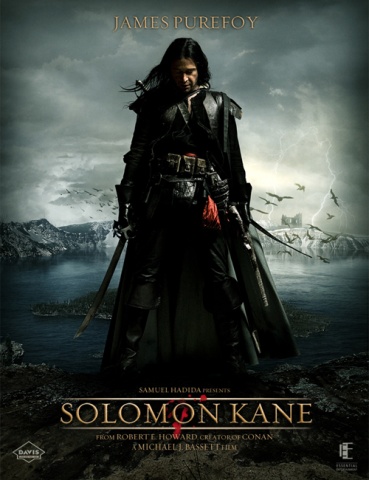
Based on the Robert E Howard novel of the same name, this movie will probably attract the usual ire of Howard fans, who worry perenially that his work will be mocked in film – a fear I can understand, though I don’t agree with it. In any case, in this situation it doesn’t matter, since I’d never heard of Solomon Kane or read the novels, and in fact I barely knew it was based on one when I watched it. So I was forced to watch it not as a grumpy fanboy, but as a person watching a movie.
The basic story (of the movie) is about a chap called Solomon Kane, originally a local of 16th Century Devon, who spent most of his life being thoroughly evil, until he discovered that were he ever to kill again, he would go straight to hell. His evilness, his viciousness, his skill and his fate are all shown very nicely in an action-packed first five minutes, in which it is also hinted that all his evil acts were performed in the service of Christendom (a nice touch, fortunately not explored further). Pacified by this sword of Damocles hanging over his head, he retreats to a monastery to begin a life of contemplation and prayer, which is cut short abruptly when he is cast out by the abbot, out of fear that he is bringing doom upon the church. He is forced to return to his homelands, and on the way he encounters what could perhaps mildly be described as a … situation … in which he has to decide between his soul and a girl’s life. The purifying power of a year in a 16th century church being what it is, he chooses to lose his soul, and this is all the pretext we need for an hour of outrageous slaughter and destruction, as he carves his way through everything and anything in his path. How can he redeem himself? Your guess is as good as mine, dear reader, but I feel his sins can be washed away if the river of blood is wide enough, and flows fast enough.
So, on the plus side, this movie has a simple and reliable plot (but for a silly and kind of pointless hiatus in the second third). I’m a fan of simple plots in action movies. I don’t care about the hero’s third cousin’s secret plot to sideline the third prince of Umar – I want to see who the hero kills, and how, and the third cousin might as well join the pile, and I don’t need to see much of a reason for it. It also has an excellent lead character (within the standards of an action movie), who fits a nice trope – used to be evil, balancing on a razor’s edge, hair-string temper – and a simple moral (redemption). All we need is a suitably thick red line to join these dots, and some nice fight scenes.
Which we get, in spades. It’s pretty standard choreography, but keeps a good pace and manages to introduce new and improved adversaries just when you’re getting bored of the current crop. There’s a lot of blood and gore and some very nasty death scenes, and there’s really no mercy to be seen anywhere in this story. No-one deserves any, and no-one gets any. So far so good.
The best part, though, is the style. I was reminded often of The Brotherhood of the Wolf, which I really love, by both the setting and the costumes. Solomon Kane himself looks very nice in his swish 16th century outfit, the bad guys are suitably freakish and feral, and the landscape he wanders through (and kills in) is blighted by war, mud and constant rain. It combines the mud and rain of Brotherhood of the Wolf with the by-now derigeur olden-days poverty depicted so well in Robin of Sherwood. Mud and rain is a good setting in which to carve your redemption out of the flesh of the Evil-doers, and my loungeroom is a suitably safe remove from which to view it. Also, at the beginning and the end the nature of the magic of the bad guys, using mirrors and shadows, is very nicely done. It’s reminiscent of the scenes in Alien when they find the hall full of eggs. If ever I walk into a room under a castle full of strangely non-reflective mirrors, here’s my plan: a) don’t stand too close to them, b) get out fast.
Also the guy who plays Solomon Kane, Michael Purefoy, is really very good. His acting was good and his voice perfect for the role of the irredeemably damned.
So, overall, unless you’re a Howard fan-boy and really can’t stand to see any version of his writing except the one in your head, I recommend this movie. But with one caveat: it is very violent. There is a scene of infanticide which I think will shock many viewers just a tad too much, and there’s quite a bit of gratuitous cold-blooded murder (by the hero). So, if you like your movies to remain fixed above a certain lower moral bound, probably don’t bother seeing this one.
Oh, and as a postscript: I stumbled on the advert at the website for The Daily Mash, which I strongly recommend.
So, that festival of the boot is on again, and although since I moved to Europe my interest in soccer has waned considerably[1], I still watch the World Cup quite avidly. Of the 6 European soccer giants – Spain, Italy, Germany, England, France and Holland – only 4 made it to the round of 16, and in that round already another – England – has been knocked out in a match they lost 4-1 to a German team that beat Australia 4-0. This is the same England team that struggled to get through the group stage. The two finalists from 2006 went out in the group stage, and in such an ignominious fashion as hardly befits European minnows, let alone France or Italy. Italy was beaten comprehensively by Slovakia and only drew with tiny New Zealand after pulling a penalty with traditional Italian diving methods[2].
I noticed that the three European giants who have bombed so far all have quite old players. Italy and England particularly, but even France still has players like Thierry Henry. Holland has also been playing a little poorly – they really struggled against Japan – and they also have quite a few holdouts from previous cups. On the other hand, Germany has a very young team. This article in the Guardian makes the point that this is not a coincidence, and that the Germans have been putting a lot of work into developing local talent. It’s also the first German team to be representative of Germany’s multicultural modernity, with 5 or 6 players being of Arab/Turkish/Eastern European/latin American origin. I take this as a sign that the German FA has been searching far and wide for talent.
So what is with the old teams that bombed? I think that these three countries – the UK, France, Italy – have opened their football markets simultaneously[4] to easy foreign transfers and massive television marketing money in the last 20 years, and the consequence of this has been an easy-come-easy-go attitude by the clubs. Instead of doing the hard work of developing local talent, they’ve taken the low-risk approach of buying in talent from abroad. This makes FA Premier league games fun to watch, but it has had the dual effect of a) importing players from smaller countries and giving them exposure to world-class coaching and playing techniques and b) reducing the pool of talented local players. The consequence of this at the world cup is that these countries’ national teams not only have to select their line-up from a shallower pool of talent, and thus rely increasingly on has-beens like Rooney; but they also find themselves facing a wider pool of nations with quality players who have been groomed by these big football nations’ leagues. New Zealand, for example, has a line up whose entire transfer value was a third that of one player on the Italian team (de Rossi, I think). They had one player from Blackburn in defense, another player from an English team in midfield, and another in offense, and they assembled around this spine a team that included several amateurs. In 1982 their team was entirely composed of amateurs. So while the available quality for NZ has increased considerably, England and Italy find themselves relying increasingly on old men, and in the washup of last night’s defeat the press are also claiming that the young players aren’t so great.
Make no mistake, this is good for football. Having an increasingly diverse pool of finals contenders, with 2 Asian teams through to the round of 16 (and one a favourite, I note, to go to the quarters!), an African team through to the quarters, and a selection of latin American teams, is good. But from the point of view of the football giants of Europe, something has gone wrong. Compare the British approach to football with the Australian or NZ approach to rugby. If a NZ player ever plays for a foreign club, they can never again play for NZ. So even though the foreign clubs pay vast sums more than the local clubs, NZ players wait until their world cup hopes are over before heading overseas – after their (shameful) 2008 World Cup loss, a whole stack of players who knew they wouldn’t be selected again headed to French and British clubs to earn the real money. As a result of this the All Blacks have players lined up 3 deep for most positions, and the lead players can’t guarantee selection in the next game if they don’t keep their act together – and this is the stated policy of the NZRB[5].
This should also be the case for the European soccer giants. There is no way that in a nation obsessed with football, as England is, a 30-something second-rate striker like Rooney should be able to even get in the squad, let alone onto the pitch. There should be a 28 year old and a couple of youngsters ahead of him – the same for Lampard, Cole, etc. Beckham stayed in long past his prime, and was a crap captain to boot. I think this is a result of market forces operating in England, and although one should rightly observe that although these market forces have had a good effect on the rest of the world game (and on the viewing public’s enjoyment of football), the British FA needs to think about some countervailing mechanisms to groom up a new generation of English players.
I suppose it could be argued that the Italian problem is not so much an effect of broadcast TV as the general corrupt and moribund nature of Italian institutions. But I think that Italy and France have similar broadcast models to the UK, and I wonder if the Northern European countries have (as is traditional up there) opted for a more genuinely social democratic approach to the game, that strikes a balance between the market model of “buy the best team you can” and the long-term good of the game. Because football is notable for its intense nationalism, I think that the long-term good of the game and national success are inextricably linked, as you can see from the excitement about soccer that is stirred up in rugby countries (like Australia) when we have international success. It strikes me as interesting that some of the European countries with the most intensely nationalistic fans – Italy and the UK – have managed to somehow water down their own national teams in a way that pours cold water on that nationalism. Transferring that national allegiance to clubs is not going to be a good thing for social order at local soccer grounds, and the game isn’t going to maintain its populist appeal if it loses its nationalist appeal (not that it will ever be unpopular – soccer is a very very good game to play and to watch). But Associations like the FA have an important role to play in fostering local talent, otherwise why have them? And I’m sure there must be more than a few people in England and Italy and France this week thinking “why do we bother with an FA at all?” when their national teams perform so badly, their local leagues are essentially deregulated in every significant particular, and the FA doesn’t even properly monitor on-pitch referee or player behaviour.
The Italian captain made a comment last week to the effect that not beating NZ would be like the All Blacks failing to beat Italy in rugby. It’s noticeable that recently Italy have beaten England at Twickenham, and the IRB is moving to include Argentina in the Tri Nations. I wonder if this week a lot of Italian soccer fans are thinking of teaching themselves the rules of rugby, and diversifying their football interests? If Australians can do it[6], so can Italians.
—
fn1: Football culture in England (and probably much of Europe) is a horrible, macho and nationalist display of male tribal bonding that I just can’t get behind or support. From afar in Australia the Champions league was fun to watch, but in England it feels like you are participating in a form of ritualized abuse. The complete and total exclusion of women from all aspects of the sport, the hyper-macho posturing of the fans, their sudden exaggerated Englishness, it’s all horrible, as is the tense atmosphere the football areas, the armies of police, the dogs, the chanting aggressive dimwits wandering around in dangerous gangs, the implicit acceptance of this phenomenon as a side-effect of the game that has to be tolerated in order to enjoy its limited benefits. And, of course, there is the gender divide – with women thoroughly and completely uninterested and excluded. If you’re wondering why British women are so thoroughly unsporty, you don’t need to look any further than the crowd of a British football match, completely and utterly devoid of women. To people from outside Europe – or people from a rugby tradition inside Britain, for that matter – this all looks very strange.
fn2: Note as well that Italy had a particularly easy run, being drawn in a weak group and being given amazing referee favouritism – in their final game against Slovakia with 10 minutes to go their two strikers attacked the Slovakian keeper, kicking him and punching him, and the Slovakian keeper received a yellow card. The whole thing was caught on camera too – if it were Aussie Rules Football or Rugby those two men would have been sent packing immediately; and this came after another unprovoked attack in the first half. Italy should have finished that game with an 8 man team and a much less flattering scoreline[3].
fn3: In case you hadn’t noticed, I really hate the Italian national team. I have done ever since they beat Australia in the 2006 quarter finals with a shocking piece of diving. The sooner FIFA accepts the inevitable and introduces video refereeing and summary execution for diving, the better.
fn4: After that British player won a case in the European court, a case which ended up not benefiting him at all but completely changed the face of European football.
fn5: On a side note, I don’t much go in for the complaints of some in the British press that the English players are paid so much that they don’t care whether they win or lose internationally – I think they care very much, although I do think that injury-wise they probably assign their first loyalty to the club that pays them so much. But Southern hemisphere codes have a salary cap, which I think does have the consequence of reducing the prima donna element of player behaviour, and preventing the players form influencing the selectors as much. I also wonder if the greater respect rugby players show the referee compared to soccer has anything to do with their relative pay grades. At a rough guess, an Aussie football player is paid maybe 5 times as much as a referee, while an English star would be paid 50 times as much as a referee. Obviously institutional factors are the main driver of this, particularly the post-match judgements made in rugby which mean that you can’t just argue your way out of trouble on-pitch. But surely that pay grade differential makes a difference to on-pitch behaviour. As an example of down-to-earthness, when I did weights at the University of New South Wales I spotted bench press for a professsional rugby league player, who was doing rehabilitation weights during the summer break[7] in between contracts, before heading to Europe to play with a French team. I somehow doubt that your average premier league player ever has the misfortune of having to share training space with us mere mortals, let alone having a non-professional human being assist them with their weights.
fn6: Australia has 4 codes of football that we divide our attention between, and we’ve been world champions in three of them.
fn7: “rehabilitation weights” for a dislocated shoulder in this case meant doing 85-100kg bench press sets of 12, with clap push ups in between and 30 second rests; followed by dumbbell flies with 35 kg on each shoulder, and more clap push ups. The man himself probably weighed 100kg. That’s some rehabilitation!
It’s time to turn my attention to describing the powers and effects in the Double Cross game, so today I’m going to attempt to translate the description of the first power in the book, Angel Halo, and some of its associated powers.
You can't escape the light…
With the light as your ally, destroy your enemies
Angel Halo is a syndrome that enables you to change your own body’s refractive properties, or to manipulate and modify light itself. Also, this ability can produce glowing effects like a jellyfish or a deep-sea squid, and bedazzle people with their radiance; or arrange the wavelengths of light to attack people with a laser beam. Strengthening the five senses is also a feature of this ability. With perception so strengthened, one can aim correctly and, with the laser attack at its disposal, this is the strongest or nearly the strongest in attack power of all the syndromes. The Angel Halo Syndrome also has a lot of attack methods that use stealth or bedazzlement. Angel Halo is a syndrome which enables one to flourish in any field of endeavour by virtue of its many ways of being used.
Because users of this power can be easily identified by the faint glow that they give off when the effects are invoked, the syndrome has been named “Angel Halo.”
Effects
Eyes of God
Maximum Level: 1
Timing: Reaction
Ability: Perception
Difficulty type: opposed
Target: Self
Range: Close (same engagement)
Corruption: 2
Restrictions: None
Effect: You use all your senses to avoid an attack. You are able to effect a dodge using your ability check for this effect.
Bedazzling Radiance
Maximum Level:1
Timing: Major Action
Ability:Renegade Control
Difficulty type: Opposed
Target: Any
Range: Sight
Corruption:2
Restrictions: None
Effect: Using a pattern of glowing lights, you hypnotize your opponent and reduce their movement ability. Make a ranged attack, and if you hit your target receives the distracted bad status effect.
Flash sprint
Maximum Level: 3
Timing: Minor Action
Ability: None
Difficulty type: Unchallenged
Target: Self
Range: Self
Corruption: 1
Restrictions: None
Effect: Deceiving your opponents with a weak flash, you can move while they’re off their guard. Make a combat movement, and with this movement you are able to disengage, and you can move through other engagements without having to enter them, or being affected by them. You can use this power a number of times equal to your level in any one scene.
Blessing of the Lord
Maximum Level: 3
Timing: Minor Action
Ability: None
Difficulty type: Unchallenged
Target: Self
Range: Self
Corruption: 2
Restrictions: None
Effect: This effect gathers radiance inside your body, and amplifies it before its release. Combine this effect with another Angel Halo effect, and you can add your level to the number of dice you use for the other effect.
Eyes of Crystal
Maximum Level: 3
Timing: Major action / reaction
Ability: Perception
Difficulty type: None
Target: Any
Range: Any
Corruption: 2
Restrictions: None
Effect: This effect quickly projects a scene like a mirage before your eyes. Add your level in dice to an ability check used in combination with this effect.
It’s as if James Cameron sat down one day 10 years ago and asked himself (as everyone should!), “how can I make a movie that is perfectly designed to please faustusnotes?” and, before he’d even had a chance to put his hand to his forehead, out of the blue came the answer: combine Nausicaa, Last of the Mohicans and Aliens! A lesser director would probably balk at this plan, but not James Cameron! He managed to pull it off, and throw in more than a little Princess Mononoke while he was at it.
The result of any such attempt, if executed by a good director – say, for example, James Cameron – and including Wes Studi in the cast, would just have to be brilliant. And Avatar is brilliant. I really can’t understand what all the criticism was about, because on any of the points where it supposedly failed, it clearly didn’t – at least within the context of big budget hollywood – and it excelled itself on so many other levels that it thoroughly deserves praise.
In essence it’s a classic anti-colonialism/anti-imperialism story with an excess of noble savage imagery, in which a representative of a powerful culture invades a supposedly savage or less-powerful culture and attempts to destroy them in order to take their resources. Like most imagined anti-imperialism stories along this line, it throws in the standard elements of the plot, with a soldier going native and the noble savages being brave but ultimately hopeless, though unlike in the standard noble savage story, in this case they aren’t doomed at the end. The story does what a lot of previous iterations of the story explicitly refuse to do – it has used the medium of science fiction to grant the natives the power they think resides in their own myth, and thus enables them to emerge victorious. This fundamentally undermines the original racist underpinnings of the noble savage myth, incidentally, which is based on the assumption that the beauty or pride of the natives is full of pathos because of their inability to endure in the face of a superior western culture – they’re doomed to die out, and we have to mourn their loss but accept its inevitability, which may also be a reflection on our own fall from the state of grace we supposedly once enjoyed in our more primitive forms. This doesn’t apply in Avatar, because the Nabi aren’t museum pieces, but a thriving culture with special technology, and in the end they use it.
I should say at this point that, although I portray the tale as “a classic anti-colonialism/anti-imperialism” story, I’m hard pressed to think of many in the modern era. “Classic” stories of this ilk are actually few and far between. Sure, we have some stories that are anti-war, or anti-particular wars (such as Platoon, or Three Kings) and we have a few tales which tell the sad story of the end of an indigenous tribe (like, say, Last of the Mohicans) and we have a few that are transparently glorifying in the conquest of the natives (Pocahontas?) and even a few which just attempt to portray them as the mysterious other (Black Robe), but do we really have very many anti-colonialism stories floating about? Sure, there may be some in print, but I think in the movies they’re actually few and far between, which probably explains the visceral right-wing response to a movie which so transparently puts America, rather than 19th century Britain, in the imperialist picture. It does so, too, with all the button-pushing tricks which James Cameron used so effectively in Aliens, deployed viciously to get us to think both ways, and to see the humanity of both sides. No wonder supporters of wars of choice don’t like it.
So what does Avatar actually do? It gives us a disabled hero, Jake Sully, whose legs are useless, who has been dumped against his will into a role he can’t perform, surrounded by people unlike him, because his brother died back home and he has the genetic fit to replace his brother in a very expensive job. The job in question is remote-control driving an avatar, the body of a Nabi alien grown in a lab, and using it to engage with the local Nabi on the planet of Pandora. He doesn’t have much else to do, the pay is good, and the military pressure him, so he goes. And as soon as he begins remote piloting that body, everything changes. Then the plot starts and he ends up being faced with some difficult choices between the needs of the soldiers and the corporation who want to exploit Pandora, on the one hand, and the needs of the Nabi amongst whom he is (literally) going native, on the other. Unusually for a hollywood movie, too, there is no artificial resolution here – he has to pick sides, and it looks likely that picking the Nabi side isn’t going to work for him.
From the moment I started watching this, I was struck by the complex ideas the avatars can be seen to embody. I immediately thought of Thomas Covenant, who thinks he is dreaming but refuses at first to engage with his world because the moment he wakes up, he’s back to being a leper; better to hang on to his reality than allow false hope, which is a problem surely Jake is going to suffer when he spends half his days in a body he can’t own, able to run and jump and fly, but the other half in a body with no legs. I was also reminded of the very new ethical controversies surrounding our real life versions of these remote pilots – the people flying drones over Afghanistan and Iraq from safe bases in the UK or America, who are a million miles from the (usually incorrectly targeted) actual people they are killing. The thought everyone has about this type of war is that its remoteness prevents people from making accurate moral decisions, because there is literally no interaction between them and the target, not even at the level of risk. But Jake Sully, while he is remote piloting, does interact with his targets, and that makes the offer of treachery he so easily takes early on in the movie all the more callous when it comes to its cruel fruition.
This movie was very well crafted, from beginning to end. Of course the actors are great, especially Sigourney Weaver and Sam Worthington. The world is wonderful, though I understand its blueness may not appeal to everyone. It’s clearly modeled on the jungles from Nausicaa, though there’s a strong undersea influence that I really like, and which really suits its low-gravity physics. The flying scenes are also beautiful, and very very redolent of Nausicaa at her finest. Just when the tension and boredom of his daily life begins to get too much, Jake Sully thrusts us into a beautifully-rendered combat, chase or action scene, so the pace of the movie is good despite its length. The mecha are James Cameron at his best, and also (again) the comparison of Sully on his tiny flying thing against the great corporate machines is very close to Nausicaa on her Mehve versus the Corvettes of her enemy. The Nabi themselves are very similar to Native Americans, an image which must have offended all those many Americans who don’t want to accept any particular hard realities about the behaviour of previous incarnations of Jake Sully, or the moral culpability of those corporations which “explored” the “wild” west. This similarity reached its cinematic perfection for me when I noticed Wes Studi, of Magua fame, playing the Nabi chieftain – reprising his role of Magua on the side of the good guys! And there’s more than a hint of Princess Mononoke in the relative positions and roles of Sully and his lover (whose name I didn’t quite catch).
In many ways, too, I think viewing this movie is like watching a version of Aliens remade by a more mature James Cameron. Aliens is shallow in the very best of ways, an action movie which glorifies a bunch of macho soldiers while it glorifies in destroying them; but it is devoid of any cultural context, any sense of the soldiers as having a military past, or any moral questions about who they are or what they have done in the past. The corporate operative is a cardboard cutout wall street bad guy, who from the start has no humanity. In their new incarnations in Avatar, these characters are fully fleshed out and human. The soldiers hint at their pasts, referring to conflicts in trouble spots we know of – Nigeria or “the desert” – and though they are the same rich, interesting characters from Aliens, we don’t see them in this movie in the same sense as uncomplicated representatives of the human race. These people, the first ambassadors of humanity to the Nabi, have killed humans, and are proud of it. Their leader is a noble savage figure of his own, vicious and strong and proud of it, loving his men and ruthless in his disposal of them. The corporate rep is just as scummy as in Aliens, but this time he has a conscience, and we see him struggling with it as he acts in his own and his corporation’s interests in heartless and destructive ways. As the tension mounts and the cost to his humanity along with it, we see his rhetoric escalate through a pretense at callousness to outright hatred, but it’s impossible not to notice the occasional nervous gulps, and the uncertainty. This is a man who knows that what he is doing is wrong, but he doesn’t have to do it himself, and he knows where the benefits lie. To back it up we’re given regular hints that the situation on Earth isn’t so pleasant, and the mission to Pandora isn’t just a mission of enrichment, but that there may be an edge of desperation to it. No one on the human side in this story comes out unsullied, but no one goes into it a cold inhuman monster, either. James Cameron has attempted to construct, within the limited confines of an action movie, a real semblance of the moral and cultural imperatives of soldiers and corporates in a colonial administration.
This inversion and maturing of the Aliens mythos is beautifully represented in film through the reversal of some of the key images from that movie. In that movie the hive mind was undoubtedly evil and the soldiers good and helpless – in this movie the soldiers are not good, and in control of their own situation and the escalation of the conflict, while the hive mind is portrayed as good from the start. That movie finishes with a memorable final scene of the frail human in her mechanised cage, destroying the highest representative of the hive mind. In this movie the most evil representative of the humans is in that metal cage, and the good guy is the representative of the hive mind that is being destroyed outside of it. The figures in the battle are reversed just as the moral sides have been flipped. I don’t think any of these images arose by accident. This is masterful work by Cameron, renegotiating his own opus to represent a more mature view of war and soldiers and the Other.
I’ve heard of a few other criticisms of Avatar that I’d like to look at, both political and aesthetic:
It’s just another anti-colonialism movie: what are the other ones?
It’s anti-American: It’s anti-imperialistic, and the only way it can be therefore construed as anti-American is if we equate imperialism and America. Does America still have a policy of manifest destiny? I’m yet to see anyone who criticized Avatar on this basis make a coherent claim that America is an imperialistic nation, or that it is still following a policy of manifest destiny. So how can this movie be anti-American? If the problem is that everyone doing the bad stuff is American, well, I think that there have been many many movies made with Americans playing the roles of Nazis, Russian spies, super-villains, etc. that were not decried for their anti-Americanism. The essence of this objection is that the movie too closely resembles a critique of the formation of America; but most of the people objecting to the movie also simultaneously object to claims that America was a colonialist project, so how can they then claim this movie is anti-American? Only by studiously maintaining that any history lesson with America as the bad guy is wrong – and any such objection is unscholarly, anti-historical, in short just plain stupid and wrong.
The plot is crap: I don’t get this at all. The plot is very simple – soldier goes native, picks sides in a colonial war, helps the natives, the war unfolds, things happen. There is nothing complex in this plot, and as far as I can tell the only real holes in it are the usual action movie holes where people get away with things that in real life they wouldn’t (like refusing to fire on a sacred site, but not being punished; or running through a building full of cctv without being noticed). The plot of this movie is a third as complex as Last of the Mohicans, and I would say pretty much on a par with Aliens, so where’s the problem? Action movie plus simple plot, with a few minor slips to enable smooth flow of the action, is perfection, in my view.
The anti-colonialist ideals are ruined by the going native imagery[1]: under this criticism, it’s bad that Jake Sully helped save the natives, because in doing so he removed their agency and ability to control their own destiny, and weakened claims about their own power. This is a valid criticism, from some purist post-colonial perspective, but it fails on basic aesthetic grounds, and more vaguely on a post-colonial grounds. The aesthetic grounds is that, of course, you could make a movie in which all the people in the movie who are like the people in the audience (i.e. American) are bad, and all the people who are unlike the audience (i.e. the 10′ tall blue people with brains in their tails) are good; but good luck with that. You need a person to bridge the gap in the races to maintain the key ideas of the anti-colonial tirade, namely that we all share a common soul, and that the act of colonialism itself was not some kind of racial or cultural inevitability – it was a set of choices by people like Jake Sully who, like Jake Sully, could have chosen differently. And, more practically, you need the audience to be able to identify with the hero, while identifying with the Other through him or her. This is the radical threat of the soldier who goes native, and precisely the reason that such behaviour was so widely scorned in colonial times. Secondly, from a post-colonial perspective this complaint is overdone because colonialism usually requires interaction and interrelations between the colonised and the coloniser, it involves treachery and compliant local powers, and there is no simple sense in which the colonials and the colonisers are simply divided by a line that sets them apart. The idea of an anti-colonial narrative in which everyone amongst the colonised is pure, and everyone amongst the colonising is evil, is as simplistic as a 1920s cowboys and indians movie in which the indians are all savages who have to be wiped out[2].
The noble savage thing[see footnote 1]: the thing about noble savages is that they fit into action movies a lot better than if they were just noble and not very savage; and anyone who has watched Black Robe or Apocalyptica knows that it’s really hard to feel too much for a character who is just unremittingly savage. If your movie opens with you knowingly eating raw capybara testicles, things just are going to go downhill with your audience. If, on the other hand, it opens with the opening chase scene from Last of the Mohicans, we’re immediately on your side, and we don’t want you to die. The noble savage is an idea that rightly pisses off the people on the savage end of it, but when done well it is the main vehicle by which indigenous people are able to enter the consciousness of their western colonisers as real, worthwhile people while also retaining their difference. It’s also worth noting that the full and proper definition of “noble savage” requires a kind of acceptance that the “noble” part of the native character is an anachronism, and has to give way to the modernising influence of the white man; that the concept involves a fundamental assumption that this culture must pass, and that we should mourn its passing the way we mourn the passing of the dinosaurs, with a shrug of our shoulders and a guilty relief that they aren’t stepping on our car. This doesn’t happen in Avatar, because the sci-fi medium enables Cameron to imbue their “anachronistic” gaia-worship with a magical force which prevents their passing. So what we’re left with is more of a “noble warrior” or a “paladin savage” image which is not going anywhere, thank you very much (and is fun to watch in combat).
The deus ex machina ending: I have no problem with a deus ex machina that is set up in the plot and is a fundamental requirement of the narrative context. Joseph has to squish the Egyptians with God’s Help; Jake Sully has to have his moment with the birds
An action movie with a disabled lead: I think that not enough has been made of the fact that Cameron cast the lead character of an action movie as a person with a disability – a significant disability. I think this is quite revolutionary for hollywood, and should be used in all future conversations in which high-minded film buffs who think David Lynch is great tell you that action movies are shallow. Piss on them from a great height with the moral superiority of your equal opportunity action movie cred. But don’t mention the interesting and unresolved tension in the movie – the utopian society Sully wants to enter clearly has no place for the disabled, and as soon as you fall off a tree in Pandora that’s it, you’re deadweight on a very anti-disability society. I didn’t see many wheelchair ramps or braille signs on Home Tree.
The squishy ending: I really hate fantasy stories where the character goes into a world they love so much more than this one, but at the end they return to the mundane world – in this case returning to life with no legs. I am willing to settle for any kind of compromise in order to have them get their wish and stay in the paradise they want to be in. This is part of the reason I love Neil Gaiman. Also, I note that the ritual in which Sully achieves this goal looks very much like that weird dance-ritual thingy in Baraka.
I think it should be pretty clear from this review that I loved this movie. My partner first saw it while tripping, which I think she recommends; I don’t know about that, but I strongly recommend watching it, and if you like it but haven’t seen them already, check out its main influences too, because they’re great as well. And if the supposedly rabidly left-wing anti-colonialism shtick pisses you off (because you, you know, like killing people and taking their stuff[3]), then just sit back and enjoy the awesome fireworks. Or take a chill pill.
—
fn1: what is it about the left that, when presented with a brilliant left-wing anti-colonial polemic, widely popular and brilliantly done, they have to bring up these second-rate, second-order nitpicks of the work? I don’t particularly care if there is some aspect of modern “ism” politics that it fails on, it still does a damn good job of attacking the thing it sets out to attack, and we should be happy about that and save our complaints about it for some more deserving project
fn2: in fact I suspect most early cowboy-and-indians movies were more sophisticated than this, portraying indians on both sides of the battle and giving them a great deal of agency, even if it simultaneously portrayed them as inferior and bad
fn3: which obviously all my role-playing readers do
a computer-generated, manga-esque promotional image designed and maintained by a team of priapic teenagers working shifts in a dingy, fetid bedroom in Stoke littered with copies of White Dwarf magazine and a job lot of Triple Velvet.