• At the end of the campaign described here, the characters destroyed a sinister force known as The Iron House. However, a previous group (run in Australia) played in a campaign set in 1872 where they worked for an organization known as The Iron House, in the interests of the Queen. In an early session, they were dispatched to the 1872 Manchester Cornucopia of Arms and Armour, where the latest battlefield technology would be on display and one of the inventors was planning on defecting from Prussia to Great Britain. The characters’ task was to identify agents who might interfere with the defection, and if necessary kill them. This meant spending two days in the grounds of the Cornucopia posing as merchants, and so they were able to witness displays of a couple of the latest developments in infernal weaponry. Here are three examples of the kinds of things they saw.

    The Steam Tank: In the age of the Essential Compromise, steam engines can be rendered very small through infernal summoning and materials, though the process is very expensive. A steam engine consists of two chambers separated by a turbine; in one chamber an imp boils water to impossibly high temperatures, which then passes through to a turbine before entering the second chamber, where it is condensed back to water and pressurized by a second imp. This imp forces it back through another turbine to the first imp. Thus a perpetual motion machine is produced based entirely on steam and the ceaseless labours of two very unhappy imps. The latest infernal materials prevent heat or cold leaking between the chambers or from the engine into its environment, so the small engine can be mounted in the middle of a small room or vehicle – though heaven help the occupants in the rare occasions that the engine bursts and the imps escape their confinement.

    This engine has been put to its ultimate use in the development of the Steam Tank, a wheeled armoured vehicle crewed by two intrepid soldiers, one who directs its movement and one who fires a small cannon mounted atop the vehicle. In early models the cannon was a static mortar, and the vehicle little more than mobile artillery; but realizing the cost of the engine was such a great part of the whole, the Prussian Steamworks expanded its power and used it to drive a mobile turret, which now contains the latest in heavy infernal weaponry – an infernal cannon, or a nest of field rods of some kind. Rumour has it that a larger version is in development, that carries prisoners of war (or just prisoners) who feed an autonomous sentinel cannon from within cramped cells on one side of the vehicle, though the experimental version is said to have been simply a tumbrel dragged behind the tank itself.

    This tank is being used only by the Prussian military but – perhaps as a political symbol of Prussia’s growing military might – one and one only has been sent to the Manchester Cornucopia for demonstration purposes[1]. Invulnerable to infantry weapons and too mobile for artillery, it forebodes a revolution in cavalry warfare.

    The Reanimator Field Rod: The ultimate in infernal field rods, the Reanimator Field Rod carries this line of weapons to its ultimate conclusion. Usually carried into battle by a priest or wizard, the rod fires a cone-shaped blast of dimly visible grey-green light, which animates any fresh corpse in its area of effect. This corpse is then under the control of the Rod’s wielder, who must himself be attuned to the rod through a specialist ritual. The French army is said to have established a few squads of their infamous battle-priests armed exclusively with these rods, and will send them to the rear of the first wave of soldiers to enter the fray. Though these soldiers may be cut down or horribly decimated, their opponents will find themselves then facing the dread prospect of fighting again not only those they just killed, but those of their friends and allies who were also sacrificed in the melee. Every defeat of the enemy is redoubled by these priests, and every loss partially reversed. Who can doubt the terrible effect of this on the morale of those who fight, and on the judgment of those who lead[2]?

    Persian Anti-personnel bombs: aka Turkish Delights, are a nasty little invention of the Ottoman Empire, which has been developing considerable skills in pacifying aggressive populations during the food riots of the past two years. These bombs are barely large enough to significantly injure an armoured man, being roughly marble sized. Presented by the handful in a special magical bag, they are completely inert in the bag, so a Turkish soldier has no risk of blowing his chest out when he dives for cover from an Anatolian death-archer. However, once out of the bag they are immediately primed, and explode after three sharp impacts, such as occur when they are thrown down steps into a basement, bounced along a corridor, or skipped across the surface of a fountain. The resulting explosion is concussive, but will easily kill or seriously injure an unarmoured rebel (or his family, if they are sheltering in the basement with him). Such devices have obvious uses in England, given the recent riots over corn laws and the other unrest being fomented by capricious foreign powers. They are also useful in ship-to-ship warfare.

    fn1: During the adventure this tank was stolen by the defector’s Chinese lover, and they finished the adventure chasing it through the streets of Manchester while Prussian agents attacked them and tried to capture it and the defector it held. Much of central Manchester was laid waste in the process.

    fn2: Not to mention the judgment that will be placed upon those who use such a weapon…

  • Fame & Fortune is running this month’s blog carnival on the theme of preparation, which has inspired me to do something I had been thinking about for a while but never got around to – posting up the contents of one of my session preparation documents, in order to show what I do to prepare for a session. Unfortunately most are too long or involve too much knowledge about prior events in the campaign, but I have managed to find one from late in the Compromise and Conceit campaign which provides a reasonable example. I may put up some other background material too, for the players of that campaign to see how I planned the final stages of the campaign, and also to share some ideas I had that I’m quite fond of.

    My preparation typically consists of writing a single document that covers the main goals of the adventure, with an introduction linking it to any campaign arcs, and sometimes some material on key scenes I want to describe. I plan adventures from 3 main starting points:

    • A simple cog in a campaign that needs to be turned
    • A set of scenes that I’ve had in my mind and want to play out
    • An idea for an adventure setting that occurred to me and that I want to run

    and usually a bit of all 3. The adventure given here is purely a cog in the campaign, but easily worked up into some quite frightening and ferocious scenes. Here is the essential background:

    The setting is a magical colonial America, in about 1770. The characters have previously established that there is a sinister fourth force at work in America, and that it employs Irish mercenaries to help it fight. Following the trail of a dragon bone they stole from this group, they learnt from a Dragon in Greenland that the bone came from a Dragon in Ireland. Since dragon slayers tend to be unforgettable, they travelled to the Irish village to find out what people there knew of the dragon slayer, and discovered upon arrival that the village had been enslaved and all the men-folk turned into mercenaries; the womenfolk were trapped there and doomed never to die. This magic was invoked using a powerful ritual based on a dragon’s corpse, the dragon having been killed nearby and dragged to the town. The characters also happen to have a special summoning book that enables them to summon a powerful demon of Lore, and that Demon can tell them what to do to reverse the dragon ritual and free the Irish mercenaries. This will significantly weaken the mysterious fourth force, and they can then travel to its hideout and learn what its goals are. They know where its hideout is because they caught a wizard who works for this organisation, and it just so happens that a wizard “not yet in the fullest of his powers” is a good sacrifice for the Demon of Lore ritual. The players have decided that they’re going to go through with the ritual (and boy aren’t they well placed to do it!) so the adventure is about the ritual, its consequences, and their subsequent journey to Bodmin to infiltrate the fourth force (called The Iron House).

    The preparation document follows, and constitutes the background material for the adventure written up here. I think some of the information had been shared over email ahead of time (my players could be a little bit dithery, so I got them to discuss some decisions in between sessions).

    Introduction

    In this adventure the characters enact a reversal of the ritual of the dragon, to free the men of Killarney from service to the Iron House; in order to do this they enact a ritual of Lore Demon Summoning, which will involve killing the mage they hold captive. First they may want to question him, to find out what he is doing. They will then travel to Bodmin to infiltrate the newly-weakened base of the Iron House and learn more about its purpose. By the time they arrive the land around Bodmin will be in uproar, as the newly-freed men of Killarney go crazy trying to find their way home. The characters can perhaps lead the way.

    Summoning the Lore Demon

    First the characters will have to summon their lore demon, using the book they obtained from the lich and the mage they captured. The Lore Demon will be able to tell them what to do to complete the ritual, and they can choose to use the existing magic circle (though they will need to refresh it). The characters can decide the content of the ritual, the key points being:

    • The mage must die, preferably horribly (Dave Black’s responsibility – base DC 22)
    • A priest must conduct the ritual

    The base DC is 30, with every point above the target giving a +1 to the roll in the subsequent dragon ritual. Dave Black’s success grants a +1 on the priests’s roll for every point above the killing target (to a maximum equal to his level)

    The Dragon ritual

    For the dragon ritual:

    • A part of the dragon must be used (they need to remove a rib from Anna’s corset, -1 DR on her gear)
    • A priest and a mage need to conduct the ritual together (Anna and David – the better each of their DCs the more powerful the effect)
    • The circle needs to be imbued with infernal essence (Ganymede – base DC 17)
    • It is better if the ritual is conducted in a storm (+5); perhaps Brian can conjure this

    Every point of success on Russell’s roll increases Cantrus’s roll by 1 (to a maximum equal to his level). The information gained from the lore demon gives a bonus to Anna’s roll (+1 per point of success, maximum equal to her level). Anna’s roll determines what proportion of the soldiery is affected; Cantrus’s roll determines the means by which they are freed and their degree of lucidity:

    DC Anna’s effect Cantrus’s effect*
    20 Failure Death
    25 25% Frenzy: 2 days/pt below
    30 50% Confusion/lethargy: 1 day/pt below
    35 75% Suggestibility: 1 day / pt below (contest against Cantrus’ roll)
    40 100% Clear

    *Cantrus’s effect only applies if Anna is successful

    The effects are cumulative, so after frenzy comes suggestibility, etc.

    [editor’s note: I actually meant by this that the soldiers have to step their way through the success grades, so if Cantrus rolled a 36, they would be frenzied for a day, then confused for a day, then suggestible for 4 days, then clear. In the event I think that’s what happened. But Death doesn’t step through anything – the mercenaries just die – and “clear” doesn’t step through anything. So really the DC for this roll is 40, and lower results are partial success. Also, I think that Anna’s player wasn’t here this night, and whoever rolled for her rolled up a fumble. We – the players and I – consulted extensively about this and decided that since this was a really important roll for her and she wasn’t there, it was unreasonable to keep her roll. The campaign could go on without her success (this was just a side adventure to weaken the Iron House) but they thought it was a bit cruel for her PC to screw up so badly the one time she wasn’t there. So I called her (she was studying) and got her to reroll the result].

    What the mage can tell them

    The mage can tell them that he was asked to keep an eye out for people journeying to Killarney on suspicious grounds, and paid with a piece of dragon bone which he has fashioned into an amulet, which he will one day use to make a powerful magic item (when he has more power – this day, obviously, will never come!) The man who told him to do this was called William de Bouverie, 1st Earl of Radnor, the seat of Bodmin. He pays the mage an annual retainer for the service, which he is saving to help him go back into training.

    Bodmin

    Having conducted their two rituals, the characters can travel to Bodmin, Cornwall, to find the home of the earl of Radnor, a stately home called Lanhydrock. Here they can enter the building and hope to find the truth of the mission of the Iron House. It takes about 3 days to sail to Newquay, and then another day to travel overland to Bodmin by fast horse, through Bodmin moor. On the outskirts of Bodmin the characters will find evidence of the movements of the soldiers of Killarney, depending on the results of Cantrus’s spell.

    Death: the soldiers will be scattered in the lands around lanhydrock, in concentric rings, dead but peaceful, and strangely untouched by animals.

    Frenzy: the soldiers will be scattered about the land in small uncontrolled bands, looting and destroying anything they find, in battle with the local constabulary or other soldiers of the Iron House (who are better, but in the minority). Signs of this battle will be clearly visible on the horizon as smoke.

    Confusion/lethargy: the characters will find groups of the soldiers wandering confused through the area around Lanhydrock or on the moors. They can be gathered together, fed and watered but will not be open to any kind of orders or commands.

    Suggestibility: Similar to confusion/lethargy, but slightly more active and they can be directed to, for example, travel overland to the boat at Newquay. They can also be suggested into becoming troops for the PCs. Suggestion is a social attack at -1 per target, lasting initially for 1 day per point of success (or 1 week per point of success if done magically). Note that other people can do this and the characters may meet groups of soldiers subject to the same effect.

    [editor’s note: I think Anna Labrousse used the suggestibility effect on the first 4 soldiers they met to enlist them as assistants in an assault on Lanhydrock].

    Those soldiers from Killarney not affected by the spell will fight their affected friends. They will be distributed evenly between Bodmin and the Americas.

    Once the characters reach Lanhydrock they can try and invade the house, since they will find it largely empty and/or partially burnt. They should still have to deal with roving bands of Iron House soldiers.

  • You gotta ask yourself… are you feelin' lucky, punk?

    I think this idea could work well with warhammer. I watched the 8th episode of the BBC documentary Oceans today[1], hoping to see video footage of polar bears killing whales, and the documentary featured a visit to the old whaling town on Svalbard. Apparently – according to the scientists who were chatting on the screen while something actually interesting happened in the water just out of sight – the whaling station was established in the 16th century and caused massive slaughter, whales being so plentiful that it was like shooting fish in a barrel. They would drag them onshore and boil the blubber down to fat, in a town called “Blubbertown.” This immediately conjured up an image of a group of people approaching that town, perhaps through a couple of scenes of horrific whale-killing, to a small and brutal settlement overhung with the foul stench of burning fat, its frozen streets piled high with bones and reeking smoke drifting across every rundown doorway. It would be a mixture of brutal environment and charnel house horror, all enacted in plain view on the beach[3].

    Of course, this group of people would be our heroes, arriving in the small town on business. I imagine the town a bit like Deadwood, a frontier outpost still in the process of creation, its big men still forming and breaking alliances, and acutely aware of the risk to their nascent enterprise from the big powers in Europe. Their work is hard and brutal, the environment harsh even in its best season, and the future unknown – these would be the toughest of frontier workers. The setting offers some natural details which lend themselves to role-playing:

    • Omnipresent horror: the setting itself sets a grotesque and vivid scene, that lends itself to a natural atmosphere of horror and dread. The drifting smoke, the reek of fat, the cold hard winds and the continuous visual and olfactory reminders of the presence of death all combine to give a grim and unsettling feeling to the environment
    • The Environment as enemy: any expedition out of the town carries with it the risk of death just from the environment. A wrong path taken, staying away from camp that little bit too long, misjudging the weather – everyone would need to be on their guard, and it’s fine work for weather-witchers and charm salespeople. But you can easily turn even the simplest adventure (“that guy stole my walrus tusks! A gold for the man who stops him!”) into a death trap
    • Big nasty beasts: All those dead whales would attract a few polar bears, and in the water of course you have killer whales and some very large walruses. You can spice up any period of quiet by chucking a polar bear into the mix, particularly in the more brutal game systems where every encounter with a random polar bear is to be dreaded
    • Regular minor fracas: the whalers would of course be jealous of each others’ possessions and catches, and stealing whalebone, fat, etc. would be common, as would ships fighting each other over kills. So there would be regular simple jobs – stealing back someone’s goods, guard work on a whaling ship, tracking hidden caches, getting vengeance, etc. – in fact ideal for making a table of random minor adventures

    There are some more detailed scenarios which I think could make for excellent adventures and campaigns in the frozen North, though:

    • Hidden civilizations: Much is not known about the North, and perhaps there are lost Elven kingdoms in Svalbard; or worse, dark secrets in deep holes in the ice… hidden chaos cultures, or maybe the secrets of cthulhu… this kind of stuff begs for a good, sturdy group of adventurers to go and find it, and come back mad
    • Horror: From the very mundane (ghouls picking over whale corpses) to the cliched (Vampire nests coming to Svalbard to take advantage of the deep night of winter) to the particular (ghost ships crewed by Undead whalers) the continual atmosphere of death and slaughter begs for horror.
    • Native incursion: Maybe there are a native people in Svalbard who were driven off by the first whalers, or who live alongside them, and take up arms against them. They could take up arms for venal reasons (they want their share of the loot), reasons of justice (they were pushed out) or environmentalism (the whales are gods) or all three. They don’t have to be human either. Imagine a scenario where a Northern Orc tribe were pushed into the wilderness, and the humans are killing off the gods they have always worshiped. So they take up arms out of a sense of injustice, to kill their oppressors, and also to replace them in business, so that the Orcs can kill their own gods and sell their fat to Europe…
    • The starving cult: an idea I got from the novel Sun Dogs, perhaps the characters on a routine mission stumble on a tiny settlement of crazy religious ascetics, who are living in the deep wilderness, fighting off native marauders and slowly starving to death, but who refuse to leave until their prophecy is fulfilled. Maybe a few of them want to leave secretly and ask the characters for help… or maybe the cult are really sitting on a magical source of great power, and great evil
    • Industrial rivalry: the classic, in which two whaling groups set out to destroy each other, and the characters get involved
    • Industrial takeover: the Whaling town is composed entirely of small operators, but a big company from Europe has sent agents with the intention of taking over all the operators and turning the whaling town into a plantation-style whaling factory. The characters find themselves in the middle of it, able to take sides – or take over
    • Industrial espionage: the characters are sent to the town by a wealthy alchemist in Europe, who thinks he has found a way to synthesize the key ingredients of the whales’ oil[5] but needs a certain amount of samples from a part of the whale not usually harvested. In doing so he will destroy the economy of the island, but he doesn’t care. A local interest finds out about his mission and sets out to stop (or mislead!) the characters, and they have a fight on their hands. The characters need to find a sympathetic whaler to help them get the parts while dealing with their enemies. Perhaps the aforementioned natives find out about the characters, and, seeing a chance to pull the bottom out of the market and stop the slaughter, they step in to help. Better still, to help they need to kill a certain number of the whales they revere (for the greater good!), a responsibility which creates splinter groups amongst the natives, and against a backdrop of armed insurrection the characters are in a race against time to harvest their whale parts through theft or slaughter…
    • Environmentalism: perhaps in killing so many whales the locals have aroused the ire of some local spirit, which turns the environment against the camp, and the characters have to help. Or perhaps the whalers turn their attention to a rare and supernatural beast, and arouse the ire of some sleeping avatar
    • Creeping chaos: perhaps Svalbard’s remoteness and potential wealth makes it a perfect target for chaos agents, who want to turn it into a secret settlement of chaos, trading oil to the enemies of chaos while building up wealth and land for their own purpose. Or perhaps the oppressive atmosphere of death and flensing affects the spirits of the locals directly, causing some to corrupt and become agents of darker powers. Eventually a witch-hunter arrives from Europe to investigate, and it all becomes very grim…
    • International conflict: several countries start a low-grade diplomatic conflict to annex Svalbard. The characters are asked by the independent locals to intervene in some way. But why are these nations suddenly interested? Is there something the locals don’t know about?
    • Oil: A gnome turns up with a lot of strange bunch of heavily-guarded equipment, which he sets up just outside of town. Someone discovers that he has found a new, vastly larger source of the same ingredients they are killing the whales to sell… perhaps something needs to be done about that gnome…

    I might suggest this as a locale to my warhammer group. There’s a double element of peskiness in running a role-playing campaign for a Japanese group in a whaling station…

    fn1: Which isn’t very good, by the way. What’s with the modern practice of making wildlife documentaries more about people than about animals? There are belugas hopping around in the background and the doco is focussing on some poorly-spoken British scientists telling each other how beautiful Belugas are. I’d know if I could see them, instead of seeing the stupid scientists. I blame it on global warming[2].

    fn2: No really, I do. Before the general acceptance of global warming – e.g. back in the 70s – nobody believed that humans could actually affect nature. Sure, we were killing off the odd species here and there but nobody believed we could actually step in and change the work of nature itself, so all you could really do was stand back and watch in stunned amazement as the Earth went about its business. But now we know that actually humans can affect minor details like whether or not a planet has frozen poles, it’s pretty clear that all that shit happening in the background with polar bears and belugas and great big animals being majestic is a sideline to the central egotistical fact of the 21st century, which is that we can fuck the entire planet. Who cares if lions can fuck each other? Wildlife documentaries are now explicitly about the human race to understand nature, whereas before they were subliminally about that, and primarily about nature itself.

    fn3: When I was in Langmuir in Tibet someone slaughtered a yak by the river. In the time it took me to have breakfast and lose at Chinese chess[4] it had been reduced from a fully functional and quite aggressive animal larger than a man to a blood stain.

    fn4: an excellent game, incidentally, though fiendishly difficult to play when the locals are interfering with your every move and refusing to let you move a piece while they argue amongst themselves about how you should move.

    fn5: Apparently Beluga fat can be turned into a lubricant for watchmakers. Who knew?

  • I note that recently this blog has been getting a more political bent, but I’m trying to avoid it with a recent flurry of role-playing/fantasy related posts. I fully intend to restrict the political analysis to a) health-related stuff, b) stuff I can apply stats to and c) very occasional commentary on really big stuff. The post below is a bit exploratory, it by no means represents my finished thoughts on the topic, so comments (particularly from those ideologically sympathetic to the HSA idea) would be welcome.

    So recently I stumbled again on that old fancy among libertarians, Health Savings Accounts (HSAs) (also called “Medical Savings Accounts”), which are offered up by some free-marketeers as an alternative to current insurance systems, public or private. You can find a summary of the idea as put forward by the Cato Institute here, and an explanation at the “Institute for Health Freedom” here. Reason magazine has an amusing attempt to justify them on the basis of the experience of a minority of wealthy people in South Africa, and also an amusing article about one person’s attempt to set up a Health Savings Account for his own employees, which was stymied by government (of course). Amusingly, his opinions don’t match the WHO review of HSAs at all. That review (pdf) is available from the (surprisingly empty!) wikipedia page on health savings accounts. They appear to have been tried with varying degrees of success in 4 countries: Singapore, China, South Africa and the USA.It looks like China is pressing ahead with them.

    How a Health Savings Account works

    In an HSA, your employer puts a fixed amount of money (all the examples say $3000) into a savings account in your name from which you can only draw money for health care. They then also purchase you a catastrophic insurance plan, which typically has a very high deductible ($1500). In the US at time of writing these catastrophic insurance plans appear to cost $3000 or so, and this makes the total cost of the employer-provided insurance $4500, which is apparently equivalent to the average amount that employers paid at the time of writing (1993 for Cato). The whole amount (savings account and catastrophic insurance plan) is tax deductible. The same rules apply if you’re self-employed or your employer is not offering health insurance; you put your $4500 of pre-tax money into the same scheme, and it is tax deductible.

    Then, when you get sick, you have this $1500 to pay for standard procedures, like visiting the doctor; but if any thing “catastrophic” happens you’re covered by the employer plan (except for the deductible, of course). Any money you don’t spend at the end of the year is rolled over into the following year’s savings account, which accumulates over time. When you are sick, you negotiate the cost directly with the doctor/hospital, etc.

    Justifications for Health Savings Accounts

    There seem to be three primary justifications for health savings accounts:

    • They remove the current favourable tax considerations given to employer-based health insurance
    • They offer patients choice
    • They restrict costs

    I won’t talk about the second justification, since choice is obviously good. However, I want to talk a bit more about the logic of the first and third.

    Better tax arrangements

    Under this justification, one of the main reasons that there are 35 million uninsured Americans is that their employer doesn’t offer them health insurance, and they can’t afford to pay for it themselves because health insurance purchased individually (i.e. not through employers) is not tax deductible. Using post-tax income makes your insurance cost more, due to the loss of tax deductions. I think there are two problems with this justification:

    1. It has nothing to do with health savings accounts. You could reform these tax arrangements tomorrow without changing a thing about the way the insurance industry works, and if this argument is correct then suddenly your uninsured 35 million will vanish. I can’t see a particular reason why there should be a relationship between the tax deductibility of non-employer insurance and HSAs
    2. I don’t know that the evidence is that strong that the tax arrangements are the main reason Americans can’t afford health insurance. Health insurance is offered by employers in lieu of income, and it’s possible that employers not offering it will pay more in cash instead. In this case, although the employee has to pay more after tax for their health insurance, they also have a higher after tax income than a person in an equivalent job who gets health insurance, which makes individual insurance more affordable for these people compared to their employer-insured cohort. Furthermore, if this is not the case – i.e. those not offered insurance by their employer are not paid more – then the lack of insurance must be at least partially related to the existence of two tiers of job. If this is the case, then introducing a different system of insurance will not fix the problem, since the problem is caused by income inequality. The solution here is to make health insurance cheaper or to reduce inequality between workplaces, not to make it tax deductible.

    There is a related claim that insurance costs are lower for people with HSAs, and so more people can afford to take them out, but this claim is based on a RAND study (cited in the Cato Institute paper) that compared people paying out of their own pocket with those receiving free health care. This study is obviously useless – you can’t compare those two groups of people in America. The comparison here, in any case, is between people paying out of an insurance system and people paying out of their own pocket. In fact, the WHO review found limited evidence of cost reductions in the US on this comparative basis – 12% compared to insurance, in a study with dubious methodology that covered only a very small number of non-randomly-selected employers.

    So, if health insurance becomes 12% more affordable under this plan, it’s probably not going to make big inroads into the number of uninsured, and in any case the tax arrangements cited in defense of HSAs have no relationship to the HSAs themselves.

    Cost containment

    The other reason for using HSAs is stated as containing costs. As we know, health care costs are increasing in all developed nations, and every health care system is trying to find ways to contain costs. This is where the disingenuity starts from the libertarian sites, because of course almost every existing financing arrangement is based on some form of collective action or risk pooling, and everyone knows that libertarians hate anything like collective action. For example, here is the hideously disingenuous explanation for why health care costs are increasing in the US, from the Cato Institute paper:

    Of every health care dollar spent in this country, 76 cents are paid by someone other than the actual patient–by the government, insurers, or employers. Consequently, in most situations patients neither benefit when they spend wisely nor bear the consequences of spending foolishly. With those incentives, it is no surprise that costs are soaring.

    Elsewhere, they refer repeatedly to “spending someone else’s money.” Now, fair enough, that might count as a justification for rising health care costs – except that every modern financing system involves “spending someone else’s money” and health care costs are increasing faster in the US than anywhere else. In fact, the US has a much higher level of individual payment than other systems. In the UK it’s almost 100% – you almost never pay out of your own pocket, because either the NHS pays or a private insurer pays. The same is true of every other system. True, in Japan it’s possible that up to 30% of your costs are paid by you, but there is a cap on what you spend so it’s probably not the case that “only” 70 cents in the dollar are paid with “someone else’s money.” In general, however, the huge majority of health care expenditure is “someone else’s money.” It’s almost as if this fact has no relationship to increasing health care costs or, alternatively, is the cause of them.

    In fact, the reason health care costs are going up is because health care gets more and more sophisticated, and as we get wealthier we demand better and better care, so we spend more. This is independent of the particular system in place, but it does appear that the more private insurance there is, the faster costs rise. Why libertarians think this is a bad thing, I don’t know. After all, in a private system increasing costs just represent consumer preference, right? Well, in fact, in health care they don’t. They represent the doctor’s decision, and the doctor will always decide the maximum treatment that the system can afford. Which brings us to the next bit of rhetoric attached to health savings accounts: patient power.

    How Health Savings Accounts will lower costs

    The key virtue of health savings accounts is supposed to be that they give the patient power, and that this power will lead to a reduction in costs. This is because the patient pays for non-catastrophic health care from their own money, rather than the insurance company’s or the government’s, and thus have more power to choose. So let us consider two scenarios:

    1. I am self-insured under an HSA, with a fixed limit on how much I can spend ($1500 x years enrolled), and I can choose my health care from a set of menus within this fixed price
    2. I am insured by the government under a universal provider, and I can choose any health care I want

    Which of these gives the patient more power? Choice is not power when choice is constrained by finite resources. Economically it may be a good thing, but power it ain’t. A HSA only gives a patient “power” if it widens their choice relative to the existing system – which it may do given the caprice of the modern American private health system, but that is an issue that can be fixed by many mechanisms other than HSAs.”Patient power” is just another piece of disingenuous libertarian spin, because “constraining patient choice” doesn’t sound so nice.

    So what is the specific mechanism by which giving the patient a choice under the HSA system lowers the cost of health care? The patient chooses their health care subject to their available budget, so presumably they shop around a bit, and choose the cheapest option.

    What this system actually does is reduce total health care costs. It doesn’t reduce health care costs. Some patients – typically those earning less, or those who know they’re sitting on a condition that will be a time bomb in future, or those with a chronic disease – will spend less than other patients, and the main way they will do this is by choosing not to receive certain treatments, or choosing a treatment that isn’t as good. Let’s consider two examples.

    1. HIV-positive health care worker: let’s say this person was infected from a needle-stick injury, to avoid any moral panic. They are going to be on anti-retrovirals for the rest of their life, and this will eat up some percentage of their $1500 a year. They know that some time in the future – probably 30 years away – they’re likely to get AIDS, and then they’re going to need every spare dollar in that account. So, from amongst the (100-x)% of their HSA remaining after anti-retrovirals, they aim to save a little every year. Any other non-AIDS-related health concerns in the current year need to be paid for from the remainder of their $1500. So, they’re going to purchase less healthcare overall – they will restrict the total cost of health care available to them.
    2. Non-catastrophic orhopaedic surgery: Presume you’re me, and you came off your bicycle in a stupid accident that broke the little bone on your elbow that controls movement. There is only one treatment for this – surgery to reattach the little bone. The alternative is to do nothing, and lose the mobility in your arm. If you do this twice in a year, and the second time your $1500 is not enough, you either pay extra or go without. Again, you haven’t reduced the cost of healthcare; you’ve reduced the total cost of health care

    Of course the libertarian view is that HSAs will reduce health care costs through the magic of competition. There are several problems with this view.

    Problems with arguments about competition and cost (in HSAs)

    The three problems are, basically, as follows.

    Health care consumers are not informed or rational

    When you go to get treated, the informed consumer of medical care is not you: it is your doctor. They are the person who knows what needs to be done and how, and you are the person who says yes or no to their suggestion. In this situation, shopping around “for the lowest price” means asking the doctor if there is a way they can do it for less. In this case the doctor will tell you what you can get rid of and you will say yes or no. It is true that you could sit at home, phoning around all the doctors in your area to find out what price they offer their services at, but you’ll find that they won’t tell you until you go in and visit them, during which time they charge you for a consultation. Given these visits need to happen during office hours, you aren’t likely to do many. Doctor’s services aren’t like buying clothes, where the quotation is free and the price is on the item, and you get to see the effect before you buy it[1]. The conditions under which you exercise your rational informed choice are limited.

    Available reductions in health care cost are marginal

    Consider my example above of the non-emergency orthopaedic surgery. First of all, it’s not really non-emergency – I have maybe 2 days to work out what I’m going to do before the decision has been made for me by the natural workings of my body. Working out what to do involves getting an x-ray and a consultation, and takes time. It may require appointments, of which I can only get a few in 2 days. In fact it took me half a day to get a decision about what to do, so at best I could compare 4 hospitals’ prices, and the comparison would be expensive.

    This situation has only one treatment: surgery. So what are the ways in which surgical costs can be reduced? You could choose to use a cheaper (i.e. generic) antibiotic after surgery, and you can choose to get the treatment in a hospital with very bad hotel services (mixed-sex wards, no food, etc.). But the main costs of the surgery – anaesthetic and surgery – are going to be unavoidable. Although competition in these areas will push prices down, there is a significant lower limit on how low they can go – doctors don’t get cheaper than a certain amount, and anaesthetic equipment ain’t cheap. So it’s likely that the costs that patients are able to skimp on will be the ones that don’t really affect the bottom line that much.

    Individuals cannot negotiate healthcare effectively

    Negotiating the costs of health care is tricky, and it’s made doubly tricky by the fact that you don’t have a choice. Consider my elbow example, and suppose that due to a previous health problem I only have $200 remaining in my account. Note first of all that I have very limited ability to shop around here, since shopping around will cost me in consultation fees. The doctor tells me that they can do the treatment for $300, but I only have $200. So what do I do? I pay the extra $100 “out of pocket,” i.e. from my non-HSA. The alternative doesn’t bear thinking about – I lose the use of my arm, essentially – so I pay. How did that interaction contain costs? It didn’t, is how. Basically, when I “shop around” the doctors are going to be asking me an implicit question: how much do you value that arm? And the answer is, “how much money can I get together by Tuesday?” However, when my health insurance company shops around on my behalf, the question becomes “how much will you provide orthopaedic surgery [insert casemix code here] for?” The doctor then sets a reasonable fee, and the health insurer says “I’m offering you probably 1000 of these services a year. If you want them, you shave 10% off that,” and the doctor agrees. Shopping at a doctor isn’t like when I bought those pants at muji and they fell apart after a month, so I don’t buy muji clothes anymore. I only have 2 elbows, so it’s unlikely that I’m going to ever get the chance to refuse service to the doctor a second time, and although if I subsequently discover the doctor down the road was cheaper, if I tell all my friends that they shouldn’t use the doctor I did, the chances are that none of them will break their elbow anyway, so the doctor will never suffer from my recommendation. I know many people who have shopped at muji, and not many people who have broken their elbow.

    I believe this has been born out in studies – the cost of health care paid out of pocket is higher than the cost of healthcare negotiated by a large insurer. The most obvious example of this in the US is the HMO, in which hospitals and doctors are screwed blind by the health insurance agency, and costs stay low. Interestingly, the most functional HMOs tend to occur in areas without much competition in insurance providers. Health is one of those areas where monopolies can be good for consumers, rather than bad.

    The other aspect of competition and its effects on doctors is that, though they earn a lot of money, health care professionals in general are driven primarily by professional pride, not economics. It’s unlikely, for example, that you would be able to negotiate with your doctor to receive that elective surgery without anaesthetic, at half the price. “Come on doc, my mates are rugby players, they’ll hold me down.” There are lots of doctors in the US who won’t provide circumcision services, even though they’re lucrative and risk free. Doctors act on more than crude financial motives, and because they know that your health is at stake, they know that you’ll pay the extra if they offer it to you. And because you’re an individual, with no negotiating power, you can’t push that price down effectively, or even choose your treatment. The HIV patient mentioned above, for example, won’t be able to say to the doctor “I’ll take AZT instead of HAART.” Not only will the doctor refuse, but probably AZT is no longer available, because doctors will be refusing as a group to offer it once a better treatment comes along.

    This is the part of health care cost containment that libertarians really don’t understand, because it relies on a basic understanding of non-financial motivations and collective action, neither of which are familiar concepts to them. Healthcare is the perfect storm of all these issues: non-rational consumers with weak negotiating power purchasing something that they didn’t want to buy in the first place, but really really need, often in a hurry. In this circumstance, having a large and powerful organisation negotiate the price ahead of time is a much better idea.

    The tyranny of time

    Consider two individuals, perfect rational consumers in a perfect HSA world. Label them “Peon A” and “Peon B.” Both are earning the same amount, and putting the same amount aside for their discretionary health care costs, at $1500 a year. Let’s suppose that they are earning and being taxed in such a way that their tax rate is 30%, so their HSA payments are 30% tax deductible – that is their $1500 actually costs them $1000, so they’re getting $1500 of healthcare a year for $1000.

    Peon A has no significant health concerns for 10 years, and at the end of 10 years has $15000 in his health account, plus interest. Let’s assume the interest is $1000, just for the hell of it. So Peon A has $16000 to spend on health care. At year 10, Peon A discovers a non-emergency medical problem that will become painful after a year, and chooses to treat it at a cost of $10000, paid for from the fund. This $10000 was essentially purchased with $7000 of Peon A’s money due to the tax deductions – the other $3000 was born by the government, so in essence Peon A has paid $7000 for this problem. Also, Peon B has $1000 of interest, which is 1/15th of their account, that they can pour into this problem, so really they have only paid $6000 of their own income on it.

    Peon B experiences exactly the same problem at the beginning of year 1. So they pay $1500 of it from their HSA, and the remaining $8500 out of pocket. The $1500 used $1000 of their own money, so in reality they have paid $9500 of their own money on the same treatment as Peon A. In addition, they lose 10 years of interest on that $1500, which means that in ten years’ time they will be able to purchase $(compound interest x 1500) less health care than Peon A.

    Purely due to the vagaries of time, Peon B has paid between 36% and 58% more for the same treatment as Peon A (depending on how you calculate interest foregone). It’s possible that Peon B would have paid more due to health care inflation during that period, but we’re in a perfect HSA world here, so health care costs are being restrained to the rate of inflation, which we’re assuming 0% in this example (in order to work in static money – we could inflate all the values but it makes the calculations fiddlier). The only way that Peon B is not disadvantaged relative to Peon A is if the HSA is not working, and health care costs are increasing at least 3-5% more than inflation per year.

    Now, it’s possible that the HSA could be arranged so that in subsequent years you pay back the $8500 at a tax deductible rate through your HSA – i.e. you put $1500 into the HSA and then siphon it straight to your bank account. But this will only work if you can guarantee that for the next 10 years you won’t need the money for any other health care, which of course you can’t, so Peon B has to siphon extra money into their account – i.e. reduce their take home pay – in order to benefit from the tax deductibility to the same extent as Peon A. In any case, what this option basically does is make all health care costs tax deductible, rather than making them only tax deductible if paid for from the HSA.

    Of course, if Peon A and Peon B were paying that $1500 into a standard health insurance plan, they would both pay the same amount for their treatment, since it would be averaged over the 10 years for both of them as part of the insurance company’s risk pooling process. But under the HSA arrangement, Peon B has been disadvantaged to the tune of $2500 – a 4 week holiday in Hawaii, probably – simply by the vagaries of time.

    This seems like a bad design flaw to me.

    Some advances on HSAs

    If we look back at the HSA concept, note that it involves a division of health costs into two parts: a catastrophic insurance plan and a health saving account. The catastrophic insurance plan could, of course, be provided by a single government payer, at reduced cost compared to choosing between private insurers[4]. In fact, you could  extend this model slightly to allow the “catastrophic” plan to cover all hospital-provided services (elective or not), and then have the HSA cover just physician visits and drugs. You could even then have the “catastrophic” plan extend further, to cover some fixed minimum of physician fees, and all the remainder – drugs and any “extra” services – paid for by individuals. You’d soon find that insurance agencies would step in to offer an account you could pay into to cover those extras – for example, your own room in a hospital, jumping any queues on the “catastrophic” plan. These accounts would be quite cheap to maintain, since they would only cover the above-mentioned marginal costs, not the core costs of hospital treatment, and so they’d probably be constructed as standard insurance plans (rather than HSAs), to make them more attractive to the consumer (i.e. to offer patient choice rather than the misnamed “patient power”). Eventually, seeing the numbers of people paying out of their own pocket for these plans, the government would offer a rebate – say, 30% – through taxes.

    Then you’d have the Australian system, but for one small detail – in the Australian system, the hospitals are all block-funded from the government, rather than reimbursed through a government insurance system on a fee-for-service basis.

    Alternatively, you could have a health care system funded entirely through block grants, in which all health services are provided free at the point of use. Then, to try and contain costs, you could introduce a system of “personal health budgets” in which people are offered the opportunity to construct their health plan from a fixed budget, to try and get them to think about how they arrange their care. This is being discussed in the UK now[5], but has attracted a lot of flak because the “personal health account” (i.e. HSA) while non-mandatory, obviously tries to get people to constrain their costs by dumping health services they need. It also attracts flak on the basis that, being non-mandatory, it’s essentially useless. Which brings us to the point of HSAs: they restrain costs by forcing certain people (i.e. the poor) to decline some health care services. The only way they will work is if this “option” to decline services is mandatory, i.e. you can’t escape it. That is, they are established to ensure that, the less you earn, the sicker you are; also, if you are born unlucky enough to have a chronic illness, then you will be able to afford less health care for other illnesses than someone in the same social class as you. Health care that for other people in your class is essentially “basic” will, for you, be “discretionary.” What is the biggest single discretionary cost for a woman in her 20s? That’s a nice choice to be faced with, isn’t it?

    This is the cruelest element of these types of systems: they punish you twice for an unlucky birth, either because your parents are poor or you got a bad gene – or, worst of all, both. Sure, no-one’s choosing to punish you, but that’s the cruelty: if you establish a slightly different system, the other, luckier people can help you at very little cost to them – and it appears that in the long run those systems have lower health care costs overall as well.

    fn1: libertarian rhetoric actually likes to make this facile comparison – “clothes are sold by private providers!” But the modern clothing shop is nothing like the medical model. If we bought clothes the way we bought medical services, the shop would actually be a small office, and when you go in an extremely well-educated person greets you. For a fee, you tell them what clothes you need, and they offer you a small selection of clothes that they think suit you. Measuring you will cost extra, as will testing the colours that best suit you, and the store in any case only has a limited range – but they can refer you to another shop where you can meet another highly-educated person, who will do another investigation of your needs and offer you a further range of more specialised clothes. You can’t return the clothes if they fall apart too quickly or the button comes off, and you can’t just waltz into a shop and tell them that you want to compare their prices with the guy down the road – you have to pay to do that. Also, you’re incapable of making the judgement about what suits you yourself, or taking the measurements – if you do, the chances are that you’ll leave the shop wearing the wrong clothes, fitting badly, but most likely they won’t fit at all, or may even kill you[2].

    fn2: This is why if an argument depends on a cheap analogy you should probably not bother with it[3].

    fb3: Religion and libertarianism seem to have this trait in common.

    fn4: He asserts, without proof.

    fn5: The NHS has actually been doing some interesting experiments with patient choice, to try and contain costs and improve efficiency.

  • これは、私が書いたセッションレポートです。ネタバレを含みますから、Warhammer 3 Adventure Book のサンプルシナリオの「目には目を」にプレイをしたかったら、読み続けないでください!
    注意:ネタバレ!
    BYF達[1]がグルーンヴァールド城を調べた:
    • 医療室で、ドワーフと入信者と話して、何か変な状況があるとおもって、ドワーフの無意識的な言葉でかれのハマーを見つけに行った
    • 医者が怪しそうだったから、医者の部屋を見に行って、睡眠生毒を見つけた。
    • ドワーフの鍛冶場に行って、ハマーがなかったと分かった
    • 入信者の祭殿に行って、隠されたハンマーを見つけた
    • また入信者と話して、怪しい行動が周りに起きているからドワーフが彼女にハマーを隠すのを願ったと習った。
    • 変な犬ブリーダーがクロゼットで殺したビーストマンの惨死隊を置いておいて、惨死隊から肉を取って犬達に食べさせている。。。
    • アッシャッフェンバーグ様の部屋を調べたときに、召使い2人が来て掃除して始めた。一人のポッケットから紙が落として、「鴨が大丈夫だ」が書いてあった。毒の事に関してのノートと思っていたから、BYF達がキッチンに行った
    • キッチンで、チェフと話して、怪しいことが見つけなかったが、信用ができなかったから、アルソンが隠れてみて残って、他の3人が他のところを調べに行った
    • 図書館で不安な本を見つけた
    • 客室で恐ろしい絵を見つけた で、最期に、盗賊は、キッチンを見て、医者がシェッフと話しに来て、シカの肉に毒を入れた。

    その感じだ!!!!恐ろしい絵は混沌関係で、図書館で混沌本があって、医者は城の人の半分くらい毒している。。。ここには混沌修道がありそう!

    皆が、絵を客室から取って、図書館に行ったが、図書館についたと、係員がいなくなって、床の穴が見えた。。。あの本もなくなった。BYF達がついて行った!それは次回です。。。

    このセッションの中を使ったウォーハンマールールについて。

    このセッションは基本的に調査だから、progress trackerで操った。10個のコースで、5個でイベント点を置いて、10個でもイベント点を置いた。PC達が成功ができた時に、PC達の札を1個進出した。失敗したときか、敵がPCの怪しさを気がついたときに、敵の札を1個進出した。PC達が先に5点のイベント札についたから、大きいヒントを教えてあげた。もしかして、敵が先に5点のイベント札についた場合、晩ご飯のエンカウンターが始まったはずだ。晩ご飯でschlafという睡眠生毒をさせてみたつもりだ。

    PC達があのヒントをもらったから、すぐ調査を早くした。同時に図書館と客室に行って、そしてあの本を取るようにまた図書館に入って、図書館係員の逃げるのが分かって、progress trackerの10個について、調査が終わってしまった。これからは、戦闘!PC達は早くて上手にこの部分を解決したから、運命点1点をあげた。

    fn1:BYF達っていうのは、PC達のグループの名前。意味は、「Brash Young Fools」です。

  • 以下は、Mr.123のWarhammerレポートです。Mixiで書かれたが、私のレポートより上手だから、ここでちょっとコピーさせていただきました。この投稿の上に、ネタバレのあるレポートを書いてみます。。。がこのレポートのほうはゲームの雰囲気を発表すると思います。

    Mr.123は、Mixiで2編で書いたから、ここで全編、後編に分ける。

    全編:

    ゲームの舞台は前回の続きで、森の中にあるお城からだ。

    お城といっても、王族が住むような豪華絢爛な城ではない。
    どちらかというと、砦や出城に近い。

    この城は2週間ほど前から、ビーストマンの襲撃にあってる。
    なぜビーストマンの襲撃にあってるのか、城主のアジャフンバーグは頭を悩ませていた。
    ここはエンパイアの首都近くで、そんなに治安の悪い場所ではないのだ。
    ビーストマンに襲撃されるなんて、そんなのある訳無い。

    だがPCは知っている。
    この城近辺には 【何かデッケーお宝】 が眠ってあるのだ。

    PCは2週間ほど前に、ゴブリンを退治した。
    その時洞窟から一遍の手紙を入手し 【何かデッケーお宝】 の情報を手に入れたのだ。

    PCがこの城に来た目的は 【何かデッケーお宝】 を、ビーストマンより先に手に入れる為である。
    ぶっちゃけこの城の住人がどうなろうと知った事ではない。

    ただそんな事情を知らない城主は、PC一行が現れた事を天の助けと取ったようだ。
    城主はPCに依頼をする事にする。

    「最近、この城の人達がおかしい。原因を突き止めてほしい」

    この城の人達がおかしい・・・それはPCも感じてた事だ。

    PCはこの城へ入る前に、ビーストマンの襲撃に会っていた。
    PCは力の限り戦いビーストマンを退けたのだが、そこで納得の出来ない出来事にあった。

    城の兵士は塔の上からこの戦闘を見ていたのにも関わらず、何の助けを遣さなかった。
    つまりPCを見殺しにしたのである。

    「何故俺達を見殺しにした!」

    プンプンと兵士を問い詰めるも、兵士は眠たげな目をしたままうな垂れてただで、話が通じない。
    何一つ納得はできないが、これ以上の問答は無理と判断し、貿易商人を連れ添いしぶしぶと城の中へ入る。

    城の中に居る住人もおかしかった。
    非社交的な人が多くて、体の一部には包帯を巻いてる。
    包帯を巻いてるといっても、この世界で包帯を巻いてる人は珍しくない。生傷の耐えない過酷な環境なら、当然だろう。
    ただ兵士だけでなく使用人まで包帯を巻いてる姿に、PCは小さな違和感を覚えた。

    こんな不思議一杯のお城、PCはあまり関わりになりたくないが 【何かデッケーお宝】 の為に、出て行く訳にはいかない。
    そんな折、城主から依頼が舞い込んできた。
    これはPCにとって、渡りに船である。
    報酬も悪くないので、PCはその依頼を受ける事にした。

    城の城主アジャフンバーグは、1年程前にこの城へ越してきた。
    城主は比較的新参で、まだこの城には馴染んでない。
    古くから居る使用人との確執もあるらしい。

    また彼の立場も微妙だ。
    この城はとある豪商が買い取った訳だが、彼はその豪商に養子縁組で入ったのだ。
    同じ一族の者とはいえ、周りに味方は少ない。
    味方といったら・・・側近のヘンリックか、金で動く冒険者ぐらいだ。

    「城主様、この私めにお任せ下さい。かならずや真相を突き止めてご覧に入れましょう」

    依頼を引き受けたPC。
    城主がのべる礼を聞いて、PCは満更でもない様子だ。

    さて、ここからはアドベンチャーパートの開始。
    城の中を探索し住人から話を聞いて、事件の真相を突き止めるのだ。

    ただこれはビーストマン相手にするのと訳が違う。
    武器を振るのが大好きな脳筋PCは、荷が重いかもしれない。
    慎重に調査を進めないと、ドエライ目に合うだろう。

    後編:

    シナリオはADVパートに入った。
    どんな情報も聞き逃さないよう、僕はノートを開く。
    よーし、どんとこい。

    ① 何か事件が起きたり
    ② 登場人物が出る度に
    ③ 不審な点をみつけたり

    そんな度にノートにメモをするが、このシナリオは登場人物が多い。
    下働きも含めると、総勢15人にはなるだろう。まぁ、重要人物だけに絞れば、もっと少なくなるだろうけど。

    あと城の中の調査と言う事で、調べる場所が多い。
    城の中には篭城ができる一通りの設備が揃っており、調理場・鍛冶屋はともかく、図書館や犬小屋まである。

    そんなおっきなお城を、隅々まで調べるPC一向。
    途中に出会った人達からも、話を聞く。
    GMのスチュりんとの会話もスムーズだ。

    出会った人達は、一癖も二癖もある曲者ぞろい。
    盲目のシスター・頭のいかれたドワーフ・残忍な犬のブリーダーなど、どいつもこいつも近づきになりたくない人ばかり。

    そして慎重な調査の結果、驚くべき事実が判明した・・・!
    この城に隠された、恐ろしい秘密・・・!
    それは【瞬かない瞳】と言わ・・(ドカ!)
    バタ(倒れる音)ガッシ・ボカ(追撃)
    あたしは死んだ、ウォーハンマー(笑)

    と、書いてる人が死んだので、レポはここまで。
    これ以上はネタバレになるので勘弁です、サーセン、マジサーセン

    このシナリオの題名は
    【瞬かない目】
    と言って、ウォーハンマー3のサンプルシナリオです。

    ウォーハンマー3が日本語化するかどうか分からないけど、公式シナリオのネタバレは皆の不幸を呼ぶと思うのです。
    そりゃそうです、サンプルシナリオをネタバレなど、ナーグルのデーモンより下劣な行為です。

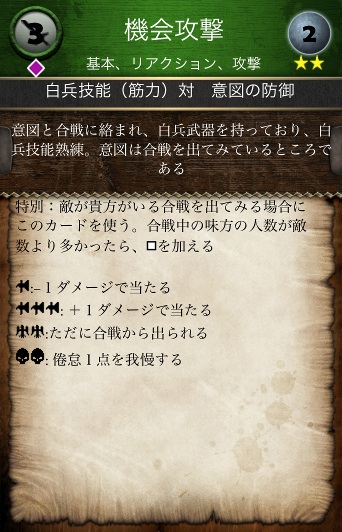
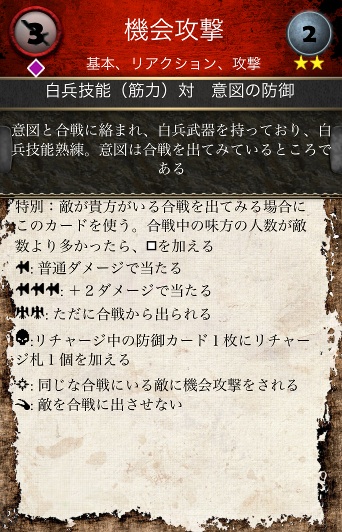
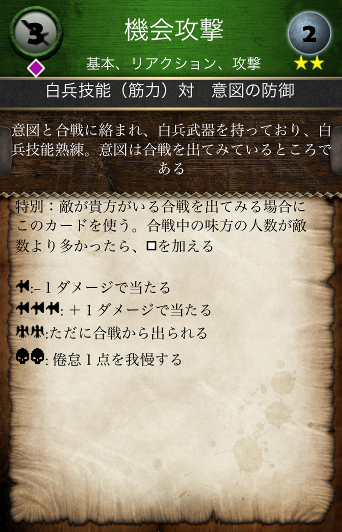
  • One of the particular rules from D&D 3rd edition that I really like is the attack of opportunity, which solves a lot of concerns about how to solve the issue of people drinking potions, casting spells, or using missile weapons in combat; and also enables the GM to penalize people who try to run away. Of course, in its direst incarnation it really slows the game down, since multiple people get multiple attempts at anyone who does anything not combative, but in essence I think it’s an excellent idea. I’ve adapted it for use in enhancing the effect of weapons with long reach, and I think it’s generally an excellent idea. I’ve noticed in reading the Warhammer 3 rulebook that there are hints that attempts to disengage from combat should incur some kind of penalty and risk provoking an attack, but there don’t appear to be any rules for it. So, in the interests of furthering the influence of D&D in the universe, I’ve come up with an action card for attacks of opportunity. The card is presented here, but here’s the outline idea:

    • unlike in D&D, one person can only ever suffer one attack of opportunity, so the party chooses which person will do it, and then adds a fortune die if they outnumber their opponents
    • you can’t do multiple attacks of opportunity in a round, which is handled by giving the card a recharge value
    • it’s harder to hit with an attack of opportunity than an normal strike (+1 challenge die)
    • if you get a bit lucky you should be able to escape the engagement without provoking an attack of opportunity, in order to pursue/reengage your opponent
    • if you get really lucky, you prevent your opponent disengaging, but only if you’re in a reckless stance

    So here are the card’s two faces, conservative:


    Note that the damage is lower than for a normal melee strike, and there is a risk of fatigue, but no other serious effects. The reckless face:


    My thinking here is that, if you really get lucky you can stop the enemy escaping. So if the person escaping is your target in the adventure, you choose your most reckless and skilled fighter, he or she loads up with fortune points, and you go all out to either stop the enemy getting out of the engagement, or at the very least the chosen attacker is likely to get out of the engagement as well.

    I’m not sure if this card is relevant in one-on-one engagements, or even one-vs.-many. A few notes on the conditions:

    • I have required weapon skill be trained for this action, in order to a) restrict the number of times it happens (since the downside of attacks of opportunity is that they really slow the game down, and prevent people being creative in combat or trying to escape) and b) reflect the fact that, actually, when you’re in the middle of a battle, taking time out to just whack a passer-by is not as easy as it looks
    • The conditions also only allow the card to be used when someone is attempting to disengage from combat, so the card can’t be used against someone casting a spell or using a potion
    • The conditions don’t state this, but if the target is taking advantage of a “disengage freely” outcome from another action, this card can’t be used

    I’m going to translate this to Japanese and try using it in combat in my session this week. Comments would be appreciated…

  • Without basset hounds, this would be impossible

    This is basically Mamoru Oshii (of Ghost in the Shell fame) does dogfights. Great movie. Didn’t understand anything though. And what’s with the dog?

  • I am presenting a Special Lecture on Global Crime and Public Health this semester, which is really the culmination of my work on international drug cartels, prohibition and harm reduction. In preparation for the lecture on harm reduction, at the end of the lecture on sex work and sexually transmitted infections (STIs) I thought I should give an overview of the “changing” attitudes towards public health and sex work and STIs in the medical literature. I remembered a few years ago reading an archived letter to the British Medical Journal (BMJ) in which a doctor advocates not treating syphilis because syphilis serves as a moral warning to society of the dangers of promiscuous sex (this was before Tuskegee, by which time we were so enlightened that only black people got no treatment). The BMJ now has all its issues since 1840 online, so I went trawling through back issues looking for admonitions against sleeping with “loose women” and ways of preventing said women from returning to their “vicious life,” and although I didn’t find that original letter I found a lot of other fun stuff. However, in the process I stumbled upon a doozy of a letter from a certain Surgeon-Lieutenant-General E.M.Wrench, MVO, FRCSEng (and if ever anyone deserved a medal this man did!) describing his experiences as a military surgeon in the Crimean War. It was published in 1908, so by that time he must have been quite old, but it presents a crystal clear image of his experiences in the war. Reading this I was both impressed by how primitive British war-making was in the mid-19th century, and reminded of why I really enjoy working with medical  doctors. Their sense of humour, their writing style, and their earthy view of the world is truly a rewarding combination to work alongside.

    I’ve put in a few bold elements to indicate the bits I find truly disturbing, and a series of footnotes (of course) with cynical/salutary (take your pick) lessons for the modern NHS. But please don’t let them distract you from the horror that is a Doctor’s cynical report on life in the Crimean war. Incidentally, this report was entitled “Lessons from the past.”

    The surgeon begins with discussion of the nature of his arrival, but we’ll skip that…

    I will not, however, talk of these generalities, but describe my experience when in charge of a ward of what might be called the base hospital at Balaclava in November, 1854, shortly after the battle of Inkerman, some of the wounded from which were under my care, together with cases of cholera, scorbutic dysentery, and fever. It was situated in what had been the military school of St.Nicholas, which contained several rooms about 30 feet square. There were no bedsteads or proper bedding; the patients lay in their clothes on the floor, which from the rain blown through the damaged windows and the traffic to and from the open-air latrines was as muddy as a country lane. There were no nurses, no washing conveniences, either personal or for clothing. Two old soldiers, called orderlies, did their ignorant best to attend to the wants of the patients, but were chiefly occupied in rude cooking and burying the dead. There was no bread, of course no milk, and if I remember rightly, no tea, only the famous green coffee. There was certainly no beef tea – Liebig’s extract and similar substitutes had not been invented, and tinned meats were almost unknown. About midday a large iron witch’s-cauldron was carried into the middle of the ward; the patients crowded round to dip in their tin canteens, those bedridden dependent on the generosity of their comrades for a share of the contents of the pot – a mixture of lean mutton and fat salt pork[1], floating in the weakest of oily broth. Notwithstanding the shortcomings of the commissariat each surgeon had to make out a daily diet role, showing what each patient should have – full, half, or spoon diet – to satisfy the red tape system and prevent the purveyor being surcharged for the cost of the scanty food he was able to supply. We were practically without medicines. The supply landed at the capture of Balaclava was exhausted, and the reserve gone to the bottom of the Black Sea with the winter clothing and several surgeons in the Prince-steamer, so that in November, 1854, the base hospital was without opium, quinine, and ammonia. Sanitary science was in its infancy, and sanitary precautions were not capable of being carried out when the living were so hard pressed to live and dead men were for days floating about amongst the ships in the harbour.

    You will not be surprised to hear that many of our patients died, but, probably owing to our unglazed windows, we were free from what was then aptly called ” hospital gangrene,” which carried off, I believe, every one of the thirty wounded Russians in the Town Hall not many yards away[2]. The stench of that building I shall never forget. You may ask why, with so many ships in the harbour, we were not able to obtain bedding and medical comforts. The reply is: The medical department was, in those days, powerless to incur expense[4], and the purveyors’ department was likewise in such a subordinate condition that they were afraid of responsibility. It was to Miss Nightingale’s bravery in setting all red tape at defiance that the success in reforming the great hospital at Scutari was due, and if there is one lesson more than another to be learnt from the breakdown of the medical department in the Crimea, it is that if the department is to be held responsible for the cure of the sick and wounded, it must have the power not only to administer pills and potions, but to secure at all costs the quite as – nay, more – important food, shelter, and equipment of the hospitals. The initial breakdown in the Crimea was the result of the military – monopolizing all the transports, and hence the landing of the army devoid of hospital equipment and the absence of hospital ships, so that the only apology for bedding in a ship full of sick and wounded, of which my brother-in-law, Mr. Swinhoe, had charge from Balaclava to Scutari, were the mats previously provided in the ship when conveying horses to the seat of war[6].

    The condition of the base hospital being such as I have described, that of the field hospital, seven miles away on an exposed plateau under canvas, was, if possible worse; hence it was the object of most regimental surgeons to send away their sick and wounded, as often as the French could lend their mule litters, for embarkation at Balaclava; though their chance of arriving alive at Scutari was not good, for 10 per cent during the winter were cast overboard as corpses during a voyage of 160 miles, none of the ships being fitted for the purpose, and some, as I have already described, intended for the conveyance of horses.

    Much was said in days gone by of the advantages of the system of regimental surgeons, and as one who spent eight years in that capacity I can endorse it as very pleasant for the surgeon, and possibly, in those days of long service, of some advantage to the regiment, from the knowledge acquired of the history of the men, but in time of war no system could be worse. To give an example: During the month of June, 1855, my regiment, the 34th (now the Border[7]), in addition to their share of the fifty daily wounded[8] in the trenches suffered heavily at the assaults of the quarries on the 12th and 18th. On the latter date I marched down to the trenches with twelve officers, and back to camp with two, the other ten being killed or wounded. The men suffered nearly as heavily, and there being no division hospital we had to convert three regimental barrack huts into hospitals, and staff them with men from the ranks entirely ignorant of ambulance duties. Two of the three regimental assistant surgeons soon knocked up, and were temporarily invalided. The surgeon was very shaky; he died of delirium tremens shortly afterwards, and I had to work single handed. As a consequence some of the slightly wounded were not properly attended to for several days, the wounds became infected by maggots, and operations were performed under the greatest difficulties. I remember a case of amputation at the shoulder-joint, when I had to administer the chloroform, compress the subelavian and pick up the axillary artery, whilst the surgeon, with trembling hands, tied it; yet possibly in the same brigade there were several regimental surgeons almost unemployed.

    Here I may allude to the dread of the use of chloroform (then recently invented) by the older surgeons, and to the famous memorandum issued by the Director-General condemning its too frequent use, and adding that the cries of the patient undergoing an operation were satisfactory to the surgeon as indicating the absence of syncope, and that pain was a stimulant that aided recovery. Surgery was then little advanced from classical times; antisepsis was unthought of, and the resection of a wounded joint so novel, that Fergusson invented the term “conservative surgery ” to describe it.

    The duties, as well as the practice, of the regimental surgeon differed from those of the present day; one of his most unpleasant, was his enforced attendance alongside of the prisoner, at what was called “punishment parade,” when his duty was to watch the man being flogged lest he die under the lash of the cat-o’-nine-tails or faint from loss of blood, which usually flowed freely after the first few strokes. The parade over, the man was removed to the hospital for the surgeon to cure him and render him fit for duty as speedily as possible.

    Wars always have been, and always will be, cruel. It is, however, the pride of our profession that, while sharing the fatigues and dangers of the campaign, our sole duty will be the protection of the soldiers from what, after all, is his most deadly enemy – disease[9] – and the alleviation of the sufferings of the wounded. The report of the Royal Commission on the Crimean War reported that the medical breakdown was the result of the system, and not of the surgeons – a lesson that I trust will not be forgotten by the nation. The medical department, unless made efficient and given proper authority[10] during peace, cannot be expected to do its duty satisfactorily during war.

    Of course, in a Compromise and Conceit-style campaign, this would all be different, since there would be magical healing, the healer’s guild would have “a long, low-roofed white building” set up to receive the injured, and all would be peaceful sage candles and tender moments between red-headed chicks and their injured lovers. When, oh when will the NHS find faith healing?[11]

    fn1: So, the hotel services in the NHS haven’t changed…

    fn2: Hospital Acquired Infections were novel even then… and, the Daily Mail was right, it was all the foreigners’ fault[3]

    fn3: You may laugh at this silly joke, but I have actually read newspapers in the UK trying to blame hospital infections on foreigners… more than once!

    fn4: Whereas, under the current straitened conditions, the NHS is “quarantined” from cuts, and able to purchase such luxuries[5]

    fn5: I have worked in an organisation subject to hiring freezes and budgetary constraints, so I understand exactly this man’s feelings

    fn6: I think it’s worth noting that, while modern armies are well capable of providing hospital services, in certain recent wars their administrative organs certainly seemed to forget other aspects of planning for the post-invasion situation, with similar consequences (for the Iraqis, at least)

    fn7: That’s right, the same regiment as George McDonald Fraser, of Flashman fame. Do they teach writing classes in that regiment, perchance?

    fn8: It’s quite well-remarked (as we’ll see below) that compared to subsequent wars casualties in the Crimea were remarkably low, and in fact military engagements of the time were remarkable for their low casualty rates compared to modern wars between mechanized armies. The main killer in the Crimea was disease, which makes the war all the more tragically pointless.

    fn9: In fact, the Crimean war had a role to play in the development of epidemiology, since the aforementioned “Miss Florence Nightingale” led a campaign to change conditions in military hospitals, and did so using some very cunning graphical devices, which presaged later methods for the comparison of disease. As I discovered in my trawling through the annals of Britain’s response to sexually transmitted infections, the military and their fighting fitness have played an important role in the development of modern public health practice, not just through direct intervention in their health problems, but through the peacetime health policy implemented in support of the health of soldiers.

    fn10: And out of tragedy… a doctor demands more institutional authority!!! Who could have guessed it would end this way?

    fn11: when some quack gets Prince Charles’s ear, obviously.