They’re few and far between, but finally the Sydney Morning Herald has managed to produce an article which gives some kind of sense of how Japan feels when you’re here, instead of just swarming the reader with cliches.
Compromise and Conceit
Infernal adventuring…
-
The last session ended with our heroes capturing clues about the mysterious rat-catchers’ guild – a second prisoner and a safe house, in fact. We rejoined them this week in the midst of their inquiries, with Heinze, Shultz and Suzette dragging their second prisoner to their dubious makeshift prison in the Labour Quarter, and Aruson the Elf spying the front of a Ratcatcher safe house.
Infiltrating the Safe House
The safe house was a warehouse on the docks of the Warehouse district, that could be entered via a highly conspicuous front door, or through a delivery door at the rear which, sadly, could only be accessed by boat. Aruson being a thief, he immediately set off in search of a suitable boat, and soon found a nest of rowboats suitable to the task. His first attempt to get onto the pier at the back of the warehouse succeeded, but in tying the boat to the pier Aruson managed to entangle the ropes of the delivery bell in the boat-ties, and alerted all inside to his presence. He aborted his attempt and leapt back onto the boat, flowing downstream in time to appear as nothing more than an annoying passer-by. He tried again, stealing a second boat; and this time he stopped the boat at an upstream warehouse, intending to climb onto the roof and cross to a top-floor window by that means. However, he realized upon alighting on the pier that his climbing ability is very poor, and he couldn’t identify who (if anyone) was inside the targeted warehouse; so he cast off from the pier and drifted downstream, only to find the same problem. So, he gave up, and entered the warehouse through the door, unable to discern its occupants. Luckily for Aruson (who regularly gets beaten near to death), noone was there. He exited to the warehouse rooftop and ran along to the target warehouse, where of course the same problem applied – he had to climb down. But this time he could use rope, so the problem was trivial (and anyway, there was a river to catch him), and he soon found himself inside the safe house.
Passing through the upstairs room, he opened an inner door to find a set of steps leading down into a warehouse full of crates of apples. In the middle of the warehouse floor sat a group of ratcatchers around a fire. One of them was heartily declaring “I will tell the Lieutenant about this situation,” with the others urging him on. Without further ado he marched up to a crate of apples, opened a secret door in its side, and disappeared down a flight of stairs…
With this knowledge, and a sure suspicion that this crew are not normal rat-catchers, our suspicious elf returned the way he came, and thence to the dubious prison for act 2…
The Rat-catcher’s Dilemma
Tonight I had a chance to learn the Japanese for “Prisoner’s Dilemma,” though it passed me by in a blaze of mumbling. Fortunately wikipedia serves as an excellent translation device for concepts and phrases, so I now know it. Because it turns out that my players are not shy of a little bit of rough play, and their version of the prisoner’s dilemma involves death rather than release or imprisonment. Both prisoners were offered a simple choice – if you don’t talk, your friend will, and then you’ll be surplus to requirements. And this is a grim and perilous world.
Both prisoners chose to cooperate with each other, because they appeared to have a supernaturally strong trust in their guild. They both initially refused to offer any information about their guild, being sure that the other would not either[1]. However, the characters noticed that one was looking a little shaky, while the other was looking very solid indeed. They threatened the shaky-looking one, and broke the tough-looking one’s finger, just to make a point, then decided to wait a day to soften them both up.
Rat-catcher attack
After 10 hours of waiting, the unexpected happened – a ratcatcher attack. Suzette, on guard duty, heard it, and had a moment to warn the others before the 4 ratcatchers struck. Although their foes weren’t strong – in fact, incapable of hurting Schultz through his armour – they took time to grind down, and after 3 rounds the characters’ prisoners somehow escaped, running for a window at the end of a hallway. Three of the PCs followed while the Soldier took on the remaining two ratcatchers, and they managed to recapture all the escapees and hold them back from the window until Schultz could eliminate the remaining two ratcatchers and come to their aid. They restored the prisoners to their cells, and decided to have a frank exchange with the weaker-looking one. By now they had killed or injured or captured 10 of his colleagues, defeated one escape attempt and uncovered his safe house, and he could be fairly confident that ultimately they were going to find and destroy everyone else in his guild, so he decided to talk.
The Rat-catcher’s Guild
The rat-catcher told the characters that
- His rat-catcher’s guild was not a normal guild, but did sinister jobs for a local nobleman, whose identity he did not know.
- The members did adventurer-type things, such as spying, assassinations, and investigations
- He was largely responsible for security in a part of the sewers
- This guild had about 30 or so normal members, and a few exceptional folk
- The worst thing he had ever done was visit the daughter of another member, to admonish her against foolishly leaking their secret – by killing her horribly
- A colleague of his had broken into Sigmar’s Temple to steal a holy item
- The safe house that Aruson had seen gave access to a tunnel that led to a different safe house and also to his superior
The rat-catcher, now convinced he was at risk of death, begged the PCs to spare him, and offered a deal – he would turn spy for them if they promised to spare him. The PCs weighed up his situation – 1/3 of his guild slaughtered, the likelihood more would die, them threatening to deliver him to Sigmar’s church, and him in their custody – and decided he was probably being honest. They agreed to do this if he would meet them in three days time. He then asked them to kill his friend, to ensure the story of his escape would make sense.
Nice folk, these rat-catchers.
The PCs agreed, and originally intended to actually kill the man in cold blood. I pointed out to them that such an act carried a risk of insanity, so instead they arranged a trick hanging (using Aruson’s guile skill), which would preserve the victim so that they could hand him over to Sigmar’s Shrine (who would almost certainly execute him). Aruson arranged this fake hanging so well that not only did they convince their prisoner that his friend was dead, they horrified and terrified him with the violence of the death, and further convinced him that he had escaped a terrible fate. He left their prison eager to prove his worth and so avoid an equally awful fate.
Here the session ended.
Other notes
The characters all reached Rank 2 tonight, so a frenzy of spending xps on skill training ensued. The PCs remain greatly afraid of even minor battles, and are desperate to improve their skills, and the best way to do that is through skill training (it really matters in this system!) Soon some of them may choose to progress to the next career – which may mean purchasing new spell books…
—
fn1: the original prisoner’s dilemma doesn’t include a third game theoretic option, a fate worse than death.
-
In a previous post I noted some reasons (that I hope are largely practical rather than ideological) why the Tory reforms of the NHS won’t work, based on my superficial understanding of them. Yesterday I discovered that the Tories have introduced a second – and in my opinion completely mad – reform of the NHS that (it appears) will do the exact opposite of what every sane policy reform in modern healthcare aims to do[1]. This new reform will undermine one of the central planks of any universal health system. In this post I’ll give my opinion of the new reform, explain why I think it won’t work, and describe what I think is a key part of modern healthcare systems, be they private or public.
This post is very long…
The latest reform
In a nutshell, the latest reform is a decision by the government to remove the power of the National Institute for Health and Clinical Excellence (NICE), to refuse approval to market new drugs. NICE used to have the power to ban drugs on the basis of their cost-effectiveness rather than their clinical utility, which makes it a different body to, say, the FDA in the US. However, this role is very important in the control of modern healthcare costs. The Tory decision essentially hobbles the ability of the NHS to control costs and gives the pharmaceutical industry carte blanche to market overpriced and ineffective drugs to desperate people. It also represents the culmination of a 10 or 15 year campaign by the pharmaceutical industry to break down the powers of organizations like the Australian Pharmaceutical Benefits Advisory Council (PBAC) and NICE.
What NICE Did
NICE was charged with assessing new therapies, drugs and interventions for their cost-effectiveness, and recommending whether or not they should be used by the NHS. It is in fact Sarah Palin’s famous death panel, which opponents of Obamacare sometimes claim is responsible for deciding “whether patients live or die.” In fact, it does no such thing – it’s not possible to assess the cost-effectiveness of a new therapy without comparing it to an existing therapy, so NICE can only recommend whether or not a given treatment is worth recommending relative to the existing standard. What actually happens[2] is:
- where there is an existing treatment, whose clinical effectiveness is established, a pharmaceutical company proposes a new, more expensive (usually) therapy
- NICE assesses this therapy, typically by calculating the additional cost of treatment per quality-adjusted life year (QALY) saved[3]
- If the cost per QALY is less than 30,000 pounds (or so) then NICE recommends the treatment be adopted
Note this isn’t 30,000 pounds per life saved, but per QALY. It’s a pretty easy standard for a new treatment to beat. Consider this brief example:
- some drug (statins?) taken annually for the remainder of a person’s life will prevent a repeat heart attack, and the life expectancy of that individual is about 70 on the drug, which costs $100 per year[4]
- On average this drug is taken from the age of 50, so the mean cost is 20×100=$2000
- A new drug (say, kingsfoil) is recommended by Aragorn Inc., that will cost $120 per year but extend life to 80; however, the side effects are such that in a well-designed survey of early-adopters, each year of life saved was valued at 0.7 healthy years. So assuming the same average age of commencement (50), the QALYS saved are 30×0.7=21 years, and the total cost is $120×30=3600. So really we gain an average of 1 QALY at an excess cost of $1600, or 1600/1=$1600 per QALY. NICE would recommend this drug, since the cost per QALY is <$30000
- In fact, for this drug to be not recommended it would have to cost an extra $30000 over 30 years, or $1000 per year, i.e. it would have to cost $1000 more per year than the existing drug, or 10x as much.
It’s worth bearing in mind that my example is for a pretty cheap drug, but there are many treatments that are much more complex than this. Consider the cervical cancer vaccine, which (I think) is about $400 per woman, but which needs to be given to very large numbers of women to prevent one death. The drug is cheap but the QALYs saved are few and far between; but how do you consider the possible elimination of cervical screening in the cost-effectiveness analysis?
In short, NICE’s job is not to tell doctors what treatments they can offer their patients, but to tell them what treatments are publicly funded, and what treatments patients will have to shell out their own cash for. This recommendation is only made when an existing, effective treatment is already in use – to the best of my knowledge NICE has no power to refuse a treatment on cost grounds where no effective treatment already exists[5]. So it is in no sense a “death panel,” unless by “death panel” you mean “a group of people who decide whether you will have to pay yourself for a drug that you will, on average, have to pay $30,000 per year to use, and which is replacing an existing perfectly adequate drug.”
I’ll come back to what that decision (“30,000 per year”) means when we discuss the vulnerability of sick people, and the corpse-crows who prey on them with expensive treatments.
The new policy
The new policy is for NICE to continue to “review new treatments” whatever that means, but to lose the power to refuse registration of treatments on the basis of their cost effectiveness. Instead, the Tories have proposed a system of “value based pricing,” in which the NHS would negotiate directly with drug companies over the price of a new drug. This is what the Australian system does, but the Australian system does it through the decisions of the PBAC, which basically tells the health department what it should pay, and then the health department tells the drug company “this much or fuck off.” This is exactly what happened recently in negotiations with CSL (an Australian company!) over the cervical cancer vaccine – the PBAC said the price that CSL was offering was too high, the health department pointed this out to CSL, and a few months later CSL offered the drug at a lower price.
So it’s possible that the new policy could lead to an equally effective system of price negotiations, except that any such price negotiations require the input of a committee whose advice is treated as final, and based on cost-effectiveness analysis… i.e NICE. So why is the government getting rid of this power of NICE, and why is the new process going to include considerations such as “how innovative the company has been in producing the drug”[6]?
Some key points about the policy from the Tory website are that it will:
- Introduce a new system of value based pricing, while supporting risk sharing deals with drug companies, meaning that all new clinically effective medicines should be available for clinicians to prescribe.
- Allow NICE to take into account the wider social cost of denying a drug to patients when assessing its value or benefit.
- Shift the decision making power over the supply of new drugs from NICE to front line doctors.
- Shift the burden of proof as to the effectiveness of new drugs from NICE to the manufacturer – the drugs company will have to prove it will work rather than NICE prove it does not.
So they intend to maintain the current procedure of requiring the drug companies to pay for high-cost drugs that don’t work in the patient groups for which the drug is claimed to be effective (“risk-sharing”), but there are two key ideas in these 4 points that are very deceptive:
- take into account the wider social cost of denying a drug to patients: colour me purple if this isn’t a rather extreme example of eco-feminism creeping into the Tory party. Since when was conservative economic and health policy concerned with judging the “wider social cost” of providing or denying medical care? Isn’t this Old Labourism at its core? Who will make this judgement, and how will it be adapted to meet the brutal reality of modern health care cost containment? And how will this accounting be matched to the Tory aims of localism and accountability? This kind of jarring language in a conservative document is cause for suspicion – not because it’s theoretically wrong (it’s a great idea!) but because it doesn’t fit the Tory ideals and it is practically unsupportable madness. The “wider social cost” is only ever assessed in favour of those who have the governing party’s ear – and we’ll see that the people with the governing party’s ear are the pharmaceutical companies, not the rest of the “wider” community.
- Shift the decision-making power… to doctors: This is straight from the Palin playbook, implying that NICE is interfering in individual treatment decisions. This is bullshit. NICE decides what drugs are funded, it’s no more interfering in individual treatment decisions than the government is when it tells a doctor they have to obtain consent for treatment, or that they can’t use homeopathy to treat HIV on the NHS budget[7]. Doctors only ever have clinical decision-making power within the framework that the health system sets, and to pretend that economic decisions are somehow interfering with doctors’ decisions is always propaganda. Doctors’ clinical decisions are always economically constrained – either by what their patients can afford or what the system can afford. If a patient attends a doctor for a free consultation that results in free treatment, no-one can claim that the doctor is able to make decisions unimpeded by economics – we have just shifted the economics away from the individual patient to the system, which usually <i>increases</i> the doctor’s freedom to treat[8]. Given that doctors will always prescribe the best treatment regardless of its marginal cost effectiveness, giving them unfettered power to choose treatment means that the cost of drugs will massively increase, and some other constraint will be put in place to control them.
At the same time the Tories have introduced a 200 million pound cancer drugs budget, which will increase the amount spent on cancer drugs. Removing NICE’s power of recommendation at the same time basically means a bonanza for the drug companies to start selling their most expensive, most ineffective treatments – the ones that they spent lots of money researching for marginal results, and can’t sell under a strong regulatory regime.
The effect of the policy
Based on this information, it seems likely that the “value-based pricing” system that the Tories are introducing is intended to widen the range of high cost, low effectiveness drugs on the market, and to allow for non-economic considerations to enter the decision-making process, including, it would seem, the amount of effort the drug company put into developing the drug, and the “wider social costs” of refusing it. This is going to lead to increased costs of therapies at a time when the NHS is again entering an era of funding constraints and poor future economic growth. Just when the NHS needs every tool at its disposal to contain costs, the very government that has put those funding constraints on it has removed one of its most effective tools.
What this means is that decisions on what drugs to fund will now rest on the individual Primary Care Trusts, who control budgets. This means that the high cost drugs will be most available in the wealthiest PCTs, or that (worse still) poor and badly-run PCTs[9] will make foolish drug purchasing decisions and then be left with funding shortfalls requiring stricter health rationing. This will increase the inequality in health between these areas, where of course the wealthiest PCTs already have the best health outcomes. As Maynard observed in the Guardian, rationing is inevitable in modern healthcare, and the decision is between having it done on an ad hoc basis at the local level, or by experts centrally.
Inequality at the local level is referred to somewhat euphemistically in the UK as the “postcode lottery.” It’s ironic that on their website the Tories are claiming that Labour failed to reduce this postcode lottery, so in response they’re going to do away with NICE; when NICE is one of the most effective tools for preventing inequality from widening. They are instead going to introduce a policy that risks widening health inequality at a regional level.
Good points of the Tory policy
Going on the statements on the Tory website, this new policy will lead to a faster drug approval process, since NICE can be quite bureaucratic, while negotiations between government and drug companies can work quickly. I think this is a plus, but only marginally, since the only drugs NICE affects are those for diseases that have an existing treatment. Making fast decisions without the benefit of an organization like NICE to advise you is also a bad policy plan, since the drug companies will hold all the knowledge and professional expertise; but it appears that the Tory policy will enable NICE to retain its ability to make cost-effectiveness judgements – they just won’t be binding. What this means in practice, I think, is that the price of drugs will be fixed before NICE can complete its assessment, which will then show that they are overpriced and achieve little.
In principle I suppose that taking into account the “wider social costs” of refusing a drug can be good (there is some discussion of its effects on carers in the statement) but I’m suspicious about what this means, and whether these “wider social costs” will largely be presented to government by the pharmaceutical industry-controlled rare diseases lobby, rather than by doctors and social researchers.
Finally, a move to value-based pricing could be an improvement on the NICE system if its done in a coherent, well-organized and structured way, like the Australian system. Unfortunately, the policy as currently presented seems to suggest an ad hoc process with no strong economic analysis behind it. So I suspect that this means that the negotiations will heavily favour the pharmaceutical industry.
Conclusion (at last!)
Ultimately, I think this seems – based on the information currently available – to be a very bad policy, being released at the very worst possible time. With most government departments facing huge cuts and the NHS facing funding cuts in real terms over the next 5 years, it’s madness to introduce a policy which will lead to cost inflation in one of the NHS’s key spending areas. The 200 million pound cancer drugs fund is going to be a bonanza for the pharmaceutical industry that will be of limited benefit to patients or the NHS as a whole, and undoubtedly wouldn’t pass a cost benefits analysis. At a time when immunization rates are plummeting in the UK and many hospitals are suffering serious problems of overcrowding and care quality, that 200 million could undoubtedly be better spent on the front lines, either increasing immunization rates or improving frontline care for all patients, or reducing waiting lists. It looks suspiciously like a sop to the people who funded the Tory election campaign, rather than a serious cost containment policy for what everyone in the UK claims is the most cash-strapped era since world war 2. This is the time to be strengthening NICE and reducing the influence of the pharmaceutical companies on spending decisions, not throwing money at the most marginal drugs.
—
fn1: bar a few minor caveats, that is
fn2: To the best of my knowledge
fn3: QALYs are used because in many cases the treatment may lead to increased lifespan but increased disability, and a QALY adjusts for the perceived value of a year of life with a disability compared to a healthy year – it may be, for example, that people prefer to live 5 disability-free years than 10 disabled years, if the disability is severe
fn4: I’m doing this in dollars because I don’t seem to have a pound sign on my Japanese keyboard
fn5: This would be a cost benefit analysis, but NICE considers cost-effectiveness. My understanding of the economics is that cost benefit analysis is done to compare opportunity costs of two different treatments – so if you had two new treatments with no existing comparator, you could calculate the cost and benefits of each and fund the one that gives a better benefit per pound; but NICE doesn’t do this, and would in fact recommend both treatments on health economic grounds, though I think there are some other aspects of treatment approval on which it can take an FDA-like stance and bar a treatment, though I’m not sure about this
fn6: This is based on the Guardian’s report, so should be taken with a grain of salt
fn7: Rumour has it that this particular rule has been ditched, so who can say what else is going to go pear-shaped?
fn8: Because systems pool risk and/or buy in bulk, enabling costs to be shared and individual treatment costs to be pushed down, making a wider range of treatments available
fn9: and these things often go together!
-

Come on baby, you know you want it! Today, while preparing lessons, I was reminded of one of my two favourite journal articles of all time, which reminded me of the other one, and thought I’d give a brief review of both of them here. One is an example of the kind of research that is often sneered at for its social sicencey-content, but is very important for public health, and the other is interesting for no other reason than that, well, it’s very interesting. The two articles are

 Highway cowboys, old hands and Christian Truckers: risk behaviour for human immunodeficiency virus infection among long-haul Truckers in Florida, by Stratford D et al, published in Social Science and Medicine; and Autoerotic fatalities with power hydraulics, by O’Halloran RL, published in the Journal of Forensic Science. Here is my brief review of each. Both reviews are based largely on memory (I don’t yet have full versions), but my memory of both is pretty clear.
Highway Cowboys, Old Hands and Christian Truckers
Overview
This article is a classic example of good quality, detailed research into the social determinants of unsafe sex and HIV risk. From memory, it stemmed from research done as part of a project in the late 1990s aimed at identifying HIV risk behaviour on trucking routes in the US. As such it is an interview-based extension of some snowball-sampled research of truckers on a long-haul route starting in Florida, so the article combines some basic tabular information on unsafe behaviour (condomless sex, gay sex, drug use) and some interviews to flesh out the research from the original questionnaires. The authors have gone further, however, using the findings of the study to divide the truckers they meet into three key groups, who will probably be accessed by different health promotion methods, and one of which may be useful for peer education training.
The research identified several types of high risk behaviour amongst long haul truckers, which are generally understood to exist but which aren’t easily quantified and which they explored in detail through interviews. Before we examine these three types of risk, it’s worth bearing in mind that truckers are actually a pretty hard-to-reach group, and although we have anecdotal reasons to believe they are high-risk for certain diseases (injury, HIV, sexually transmitted infections), getting details on this risk can be hard. The three risk types are:
- Unsafe heterosexual sex: truckers use prostitutes, and the particular type of sex worker who serve the long-haul trucker market are cheap, transient and extremely vulnerable. This gives truckers the opportunity to negotiate unsafe sex easily, and they do. For example, one type of common sex work on long-haul routes was euphemistically referred to as the “lot lizard,” young women who move from truck to truck at truck stops, knocking on doors and offering sex for cash in the cabs of the trucks. These women are sometimes retained by the local truck stops and sometimes independent. Some of them exchange sex for transport, that is they need to move interstate so they pay for the trip by a night in a cab. This type of informal sex work is, classically, the type most associated with unsafe sex and least amenable to safe sex messages.
- Drug use: some truckers use a lot of speed to maintain their hectic schedules, especially if they have a young family to support or are new to the industry, and these guys may shift to injecting the drug, a high risk activity for HIV, though probably in the case of truckers sharing is uncommon and injecting in groups is unlikely. The risk, of course, is that they will share their needle and drugs with a sex worker, creating the classic combination of vectors for HIV
- Gay sex: all the truckers interviewed “knew someone” who has gay sex, but they all refused to identify the person in question as gay; the person in question was a trucker, and axiomatically truckers aren’t gay (it’s impossible). But men who have sex with men are the highest risk of unsafe sex, since they aren’t being accessed by community-focussed safe sex messages, and in recent years most HIV-related health promoters have been recognizing this problem and addressing it through more diverse and targeted safe sex messages. One of the messages of articles like this one are that the range of sexual behaviour people engage in is much greater than the range of easily definable human beings; but health promotion messages are much easier to broadcast successfully if targeted at easily identifiable categories of person (such as gay, sex worker, rugby player, doctor). It’s not the fault of health educators, but it’s often the people who fall through the cracks who are the most at risk. Truckers who define themselves aggressively as straight, but have sex with other men, are a classic example of this.
In addition to identifying these risk behaviours, the authors also, through the interviews, identified three key groups of truckers for whom safe sex messages could be, or needed to be, targeted:
- Highway cowboys: young, working very long hours at high intensity with few breaks, often taking speed, supporting a young family but also using sex workers and taking all sorts of drug-, sex- and driving-related risks, the highway cowboys were the key risk group who needed safe sex and safe injecting information pronto
- Old Hands: Men who have passed through the cowboy stage, learnt the ropes, have less responsibilities and a better grasp of how life works, these men were respected by other truckers and less likely to engage in extreme work and recreational activities. They might still see sex workers but were much less likely to take drugs or risks. These men are the best candidates for peer education outreach; that is, they can be taught to proselytize for safe sex and drug use
- Christian Truckers: highway cowboys who have found god and think the behaviour of other highway cowboys is reprehensible. I recall a quote from one trucker complaining that he couldn’t sleep because of all the sinful activity going on in his parking lot, and sneering at the lot lizards for their role in it. These guys are beyond risk, but not so well respected by their fellows that they could provide outreach or education
The tone of this article is consistent throughout; amused, but respectful of the research subjects and their particular needs. It manages to convey the authors opinion of the truckers’ attitudes to their own milieu, while maintaining a respectful distance and offering non-judgemental commentary on the public health issues. While the truckers themselves may say quite nasty things about the women who service them, the article refrains from judging the truckers’ opinions or from giving negative opinions about those women, while recommending practical and sensible suggestions that will improve the health of everyone involved. My main criticism of the content of this article is that a) it suffers from the usual problem of interview studies, that you don’t know how objective the interview component is, and the number interviewed is small; and b) it misses a chance to also describe injury-related health problems (the focus is very much on HIV). The latter is not a big deal in my opinion, and the former an inevitable problem with interview studies; but this one also has basic questionnaire data on risk behaviour to back it up. Also, the sample is a snowball-sample, I think, which is bad, but this is unavoidable with these kinds of studies – you can’t do a random sample of truckers.
Public Health Value
This is a classic example of the importance of social research for public health. It identifies high-risk behaviour and the groups of people who do it; fleshes out the culture underlying the risk-taking through interviews; and identifies the groups who can be most effective at changing it or are most resistant to change, as well as the key public health risks. It gives information for both sexual health practitioners and health educators, and gives basic data on what the risks are. Note, too, that although it might seem amusing and trivial, the topic here is, fundamentally, deadly serious. HIV is a serious disease and truckers (and the sex workers with whom they inevitably interact) are a key vector for its transmission. HIV probably entered France on trucking routes from Africa, and probably also Haiti; it has spread rapidly through Africa and no doubt truckers were a key vector of transmission. In the USA, where there are areas of high HIV prevalence, truckers are one of a small number of key vectors by which the disease can break out into a wider community. Truckers travel from high- to low-HIV prevalence areas, engage in multiple risk behaviours, and have families with whom they practice unsafe sex. This makes them very important to understand, but their particular workplace culture also makes their community very hard to penetrate. This paper achieved that through careful, meticulous research, and deserves credit for providing a powerful insight into a very hard to reach group.
Full reference
Stratford D, Ellerbrock TV, Akins JK, Hall H. Highway cowboys, old hands, and Christian truckers: risk behavior for human immunodeficiency virus infection among long-haul truckers in Florida. Social Science & Medicine, 2000: 50(5); 737-749.
Autoerotic fatalities with power hydraulics
Again, I’m reporting on this article from memory, but I think the abstract speaks for itself:
We report two cases in which men used the hydraulic shovels on tractors to suspend themselves for masochistic sexual stimulation. One man developed a romantic attachment to a tractor, even giving it a name and writing poetry in its honor. He died accidentally while intentionally asphyxiating himself through suspension by the neck, leaving clues that he enjoyed perceptual distortions during asphyxiation. The other man engaged in sexual bondage and transvestic fetishism, but did not purposely asphyxiate himself. He died when accidentally pinned to the ground under a shovel after intentionally suspending himself by the ankles. We compare these cases with other autoerotic fatalities involving perceptual distortion, cross-dressing, machinery, and postural asphyxiation by chest compression.
Unlike the previous article, this article is presented in an entirely professional and medical tone, just like reading medical notes. I can still recall reading a phrase like, “The family were somewhat surprised to discover the case’s sexual habits,” presented as if the sexual habit were completely normal and merely unknown to the wife, in a dry tone that doesn’t contain any indication that the activity in question is, well, unusual. And it’s pretty likely that it was a family member who discovered the victim in both cases – and in the latter I seem to recall there was a complex arrangement involving a broomstick to the anus and some rubber tubing to control the digger machinery. This is not the sort of thing you want to see when you go down to the shed to collect your husband for lunch.
The dry tone provides its own humour, but at the heart of both stories is an unavoidable tragedy of forbidden love, shame, stigma and auto-eroticism that would leave Shakespeare flabbergasted. Truth is indeed stranger than fiction, and presenting it as a medical case report just makes it … stranger.
Public Health Value
Pretty limited, really, but it’s worth noting that there is a lesson in these deaths that extends to much more risky and epidemiologically relevant tales. Shame, stigma and the need to hide one’s inclinations don’t stop one from doing them, they just make one do them secretly and dangerously. Unable to discuss one’s habits, one hides them, works out how to do them oneself and, if doing them unsafely is possible, one learns to do them unsafely. This is what these two men did, with sad and fatal results. This is why in public health we should always be concerned about the health consequences of an activity for the person, rather than what the activity says about the person themselves. Which isn’t to say that personally we should approve or disapprove of someone fucking their tractor; but our public health concern is to stop them dying, not to stop them doing it.
In this case, of course, there was no hope that we could help these people share and control the risk of their behaviour, since sharing inevitably involved loss of family connections, a powerful inhibitor to honest discussion of “deviant” behaviour. But it tells us a story about exactly what the consequences of secrecy are, and reminds us that if there is a way that we can reasonably prevent people from experiencing these costs through revealing their behaviour, we can make a huge difference to the risks they face and the risks they inflict on others. So next time you feel like judging someone else’s victimless behaviour, ask yourself: “how would I feel if it was me fucking my tractor, and my jury-rigged shovel control had broken?”
Full reference
O’Halloran RL, Dietz PE. Autoerotic Fatalities with Power Hydraulics. Journal of Forensic Science. 1994 Sep;39(5):1143-4.


-

Nothing to see here, move on… I get my inspiration from a variety of places, and I find the natural world offers a variety of spectacles beyond compare, on every scale from the minute to the gigantic. So I look forward every year to the Veolia World Wildlife Photographer of the Year prize. This year’s have just been announced, and were I still living in London I would no doubt be visiting soon, because these pictures are quit astounding up close. Since I’m not, I have to satisfy myself with viewing very small versions online (bastards!), but they’re still pretty stunning. As always, my favourite is an underwater one, this time involving a young sperm whale approaching the camera. I strongly recommend visiting the Natural History Museum, either physically or virtually, to check out the exhibition, and buying the associated “coffee-table book” if you have the chance. The pictures are stunning, and the settings for the photos, and stories behind the scenes, often inspirational for game content and ideas.
-
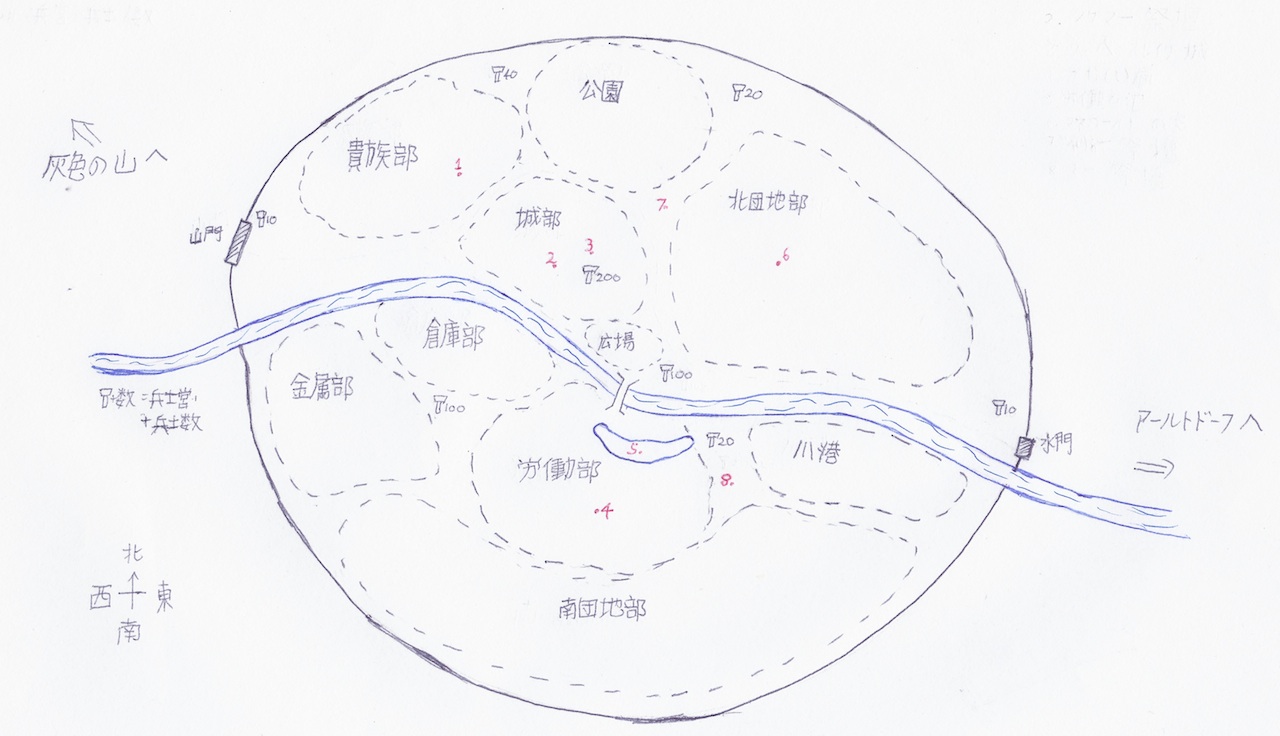
ちょっと悪くて手で書いたが、以下はウバーズレイクの基本地図である。クリックをすると、大きくなる。

- ウバーズレイク
ハンマーと数字の意味は、書いた所で兵士宮があって、兵士人数は書いた値である。
赤い数字の意味は:
- ニーダさんの家
- シグマーの祭殿
- ウーバーズレイク城
- 悲しい盾
- 労働者池
- マネガールドの家
- シャリャーの祭殿
- モーの祭殿
その以外はPC達がまだ分からない。
-
-
This semester I’m teaching a course on Global Crime and Public Health as a special lecture series (in fact I should be preparing material now instead of posting here). This course represents a culmination of 15 years’ research experience in the service of a general model of what constitutes a “good” response to the public health threat of movements in global crime. The key public health threat in the West is, of course, HIV spread by injecting drug use and/or sex work[1]. Both HIV and sex work have an international criminal connection, since the former is fed by international crime syndicates and international criminal connections drive the movement of women from high-HIV areas in Asia to low HIV areas in Oceania, to work in unregulated sweat shop-style brothels. The movement of these drug- and sex-work markets in Australia is also tied into its multicultural history and movement towards open markets and trade, so there’s a lot to take in, but basically it’s about HIV.
A lot of people – including quite a few in positions to know better – seem to think that HIV is no big deal, perhaps through their having looked at it through the prism of the developed world’s good luck, but in my wandering through this topic at the University I have had to review both the history, recent epidemiology and effects of HIV. It’s certainly the case that, had the developed world had the singular bad luck that Africa had, or reacted more slowly, our lives here in the pampered Western world would be very different. I wonder if our luck in dodging this bullet might be partly responsible for the growth of zombie/disease movies in the last 10 years, and while I was wondering at that it occurred to me that a slightly different set of historical circumstances could create an alternate history earth with a lot of cyberpunk elements, that could be an interesting setting for a gritty near-future cyberpunk campaign. To understand it, we should take a look at a brief potted history of HIV, and its effects.
The history of HIV
The first known death due to AIDS was a Norwegian sailor and his family, who died of AIDS in about 1972[2]. He almost certainly got his HIV while travelling through Africa, where it is believed to have appeared during the 50s at least, and from where it spread to Haiti in the 60s. It is then believed to have circulated through America, but it appears to have been confined to gay men at first in America. Unfortunately for the Africans, AIDS appeared simultaneously in 3 separate, geographically distinct locations in heterosexual populations in the early 80s, and it’s possible it was already endemic in those areas by that time.
In the USA, UK and Asia, however, it was not endemic – having come to those countries from other countries – and it did not appear first in the heterosexual community. The huge benefit of this is that it could be contained, because of the good luck of its originating in a separate community with different behaviours and a strong community identity. This combination meant that it wouldn’t spread fast outside of the group, and health behaviour messages were easily communicated within the group.
On the other hand, in Africa it appeared in the most diverse community possible – heterosexuals – and because of its incubation period (10 years) and the fact that it was native to the region, it was already endemic by the time it was identified. It’s very hard to control a disease that is already widespread in a group with a very vague shared identity, if the only form of prevention is behavioural change.
The Effects of HIV in Africa
HIV in the west is a scary disease that affects a small portion of the community. Strong public health systems can handle scary diseases in minority communities very easily. However, in Africa the disease has spread amongst heterosexual populations very quickly, and is now at epidemic level within nations. Prevalence of HIV in Swaziland is 26%, and in Lesotho 24%; even in countries with a model response, like Uganda, the prevalence is around 5-6%.
HIV exacts a cruel toll on its victims, both in terms of their horrible suffering as they die, and the effects on their family and friends. In Africa the disease’s high prevalence has also had economic effects, especially:
- Reduced food production, as labourers either die or leave the land to care for relatives
- Poverty, as people drop out of work to care for relatives
- Reduced school enrolments, as children are withdrawn from school to support families whose main earners are sick or dead
In a lot of countries in Africa, HIV is expected to lead to long-term entrenched poverty, loss of food production, and loss of economic growth because businesses cannot find suitable labour. Recently Lesotho petitioned South Africa to be absorbed into the South African nation, because Lesotho itself is facing economic and social collapse specifically because of the HIV epidemic.
Alternate HIV History
Suppose, then, that the disease had developed in the USA rather than Africa, and appeared spontaneously in three areas in the heterosexual community, rather than the gay community. Suppose further that it was already endemic in these areas. Even if all three areas were rural, it’s hard to believe that the US could have done better than Uganda, and given the amount of travel in the US compared to Africa in the 70s and 80s, the sexual looseness of the time and the presence of the pill, it’s pretty easy to imagine the disease getting out of control. It would spread rapidly to the UK and Australia through travel, but not so rapidly to virgin Africa, since there wasn’t so much contact between the two at the time. By the time it was identified and isolated (and maybe first it was called “Heterosexual Related Immune Deficiency”?) the Africans would have been in a position to ban travel from the US, and gain a few years’ grace to teach Africans about safe sex. i.e. the situation that the West experienced, in reverse. It’s possible to imagine, too, that the economic costs could have been larger in the US than in Africa. Much of the economic cost of HIV in the early years in Africa was handled on the cheap, by letting people die or giving very basic palliative care, while in the US it would be all-hands-to-the-pump in what was then still a quite well-run system.
The difference, of course, is that the US and Europe were the key drivers of economic growth in the 80s and 90s, and if they suddenly collapsed in on themselves due to HIV, the world would have gone along a very different trajectory. Asia – or at least those countries untouched by HIV – would have been the key drivers of economic growth in the 90s, and those countries of course would be the nations isolated from US involvement, or relatively untouched – China, Vietnam, Korea and maybe Japan. Japan, if untouched, would have continued the development aid to the region which enabled most of Asia to grow during that time, and we would be looking at a world where the West was collapsing in on itself while Asia grew, and Africa went on its own, possibly quite isolated trajectory to growth. How would African growth be affected by a collapse in the West? Would trade with Asia be a less protected and more open affair, so Africa could grow out of its problems? Without Australian and Canadian wheat, would Africa become a major food supplier and thus grow in a way it didn’t in the real world?
The world that would come from this strikes me a lot like the world of Appleseed, where a few isolated Asian countries have achieved great wealth and security while Europe and the US struggle and collapse in on themselves. However, the cause wouldn’t be some kind of global war, but a global disease catastrophe that changed the economic development model of the last 30 years.
Some HIV-driven cyberpunk scenarios
A world where nuclear-armed, militarily sophisticated states collapse in on themselves under the burden of epidemic disease is a scary one indeed, and suggests a variety of interesting scenarios for adventuring:
- The Isolated Survivor: Perhaps a couple of countries acted early to isolate themselves, and while the rest of the world (or the rest of the world that we’re interested in) struggles and dies, they soldier on. Such a society might be a lot like the world of Children of Men, grotty and nasty but trying to cling on to its past social structures while it slowly and inevitably decays into a post-apocalyptic mess. Adventuring in such a state would be something between cyberpunk and post-apocalypse, as the scenes in the refugee camp in Children of Men show. There would be many factional sides to take, and very little to be gained from being self-interested except power.
- Dictatorship and War: With economies failing and populations in unrest, an obvious way for Western governments to reassert their authority, regain popularity, and regain resources, is to launch foreign wars, either for material gain or for the simple distracting power of a good, cleansing war. War overseas is a good excuse for dictatorship at home – as is a state of permanent disease – and the PCs could find themselves suddenly on the wrong (or the right) end of a fascist, communist, or even religious dictatorship. Dictatorships in a society slowly falling apart from the inside are an excellent dystopian cyberpunk setting, with the PCs able to position themselves as freedom fighters, spies, death squads, innocent victims of a plot, etc.
- Homesteading and survivalism: With no cure in sight, and large parts of the populace infected, maybe the wealthy, the brave, or the stupid would try to set up their own kingdoms or survivalist enterprises. The best ones are always at sea, but there could be other places too – the arctic, the deep mountains, enclaves inside fast-collapsing cities. The PCs could be hired on as guards, or could be members of the original community who find themselves caught in a plot – or sent on a mission.
- The Cure: Maybe someone finds a cure for the disease, and the PCs stumble on it or are enlisted to protect it. What do they do if they find that a local power-broker/government/corporation wants to keep it secret to use as a political tool, to assure world domination, etc? Do they go along with the plan for a slice of the goodies, steal the cure, or reveal the truth to the world? What if the cure is a bio-weapon that instantly kills the infected? Would the PCs disseminate it for the greater good, destroy the last sample, fight to prevent its use?
- The Truth: Suppose that in fact HIV were not a natural disease at all, but one of the conspiracy theories about its origin proved to be more than true, and it was in fact a bioweapon gone wrong. A campaign leading up to this revelation could change the world – especially if a government of an uninfected country had secretly released it, and was sitting on the cure.
- Drug dealing: In an America with a properly cyberpunk economic system, crumbling infrastructure and declining wealth, very few people would be able to afford anti-retroviral drugs, which would become a new kind of treasure. The PCs could be dealers in ART, or even Robin Hood style liberators of stashes of the drugs, constantly running from criminal rivals and the law. Or they could be dispatched by the government or a corporation to break up such a group.
My favourite is the first or second, or a combination of the two, though elements of any of the rest could be thrown in for effect. HIV-related collapse has the advantage of not being as catastrophic as modern disease/zombie movies, so it creates a crumbling cyberpunk society as opposed to a post-apocalyptic one, but it gives an opportunity to create a future with an economic order that has been changed in a semi-plausible way, and a reason for the moribund state of western nations. It also gives a plausible background against which genuinely fascist or radical, but powerful religious movements could be resurgent, and the slow development of the virus gives a long time frame for corporations and governments to work their schemes, rather than the kind of disaster-management scenarios we often see in zombie/outbreak-type movies.
Beyond HIV
Of course, invented diseases could be more tailored to the scenario than HIV. A disease that causes madness, so that the victim never recovers and never dies, and is a constant burden on society, could create an even more disturbing future. Maybe the mad are easily contained, but in some places there are just too many… Diseases with catatonic or similar semi-stuporific states would create a challenge of an interesting sort, as do diseases that lower fertility or prematurely age the population. All that’s really needed is a disease that appears suddenly after a long latency, so it is insidious; that is highly contagious; and that creates a huge, irresolvable social burden out of its victims, sufficient to create the conditions of economic decay and apocalypse that would characterise the campaign world, because the purpose of the disease is not to create physical enemies of its victims, like zombies; but to create the context for a debilitated society, suspicious of its own members and falling from its previous greatness due to disease and rapid economic decay. Under these conditions one can create the backdrop for a game of gritty urban cyberpunk semi-apocalypse, which I think could be an interesting setting for some unpleasant and challenging adventures.
—
fn1: Though it’s of course not the only such problem. I’ve been thinking of setting my students an assignment based on the problems that the Italians are having with rubbish disposal and the mafia, but I suspect that there isn’t much published on this. Contraband olive oil created significant public health disasters in Spain under Franco, and there is now of course the potential health consequences of smuggling animals and plants. But I think these don’t compare to the real, identifiable effects of heroin importation to countries like Australia and Kyrgizstan.
fn2: Doesn’t even bother checking the lecture he gave last week for the exact date…


 Highway cowboys, old hands and Christian Truckers: risk behaviour for human immunodeficiency virus infection among long-haul Truckers in Florida, by Stratford D et al, published in Social Science and Medicine; and Autoerotic fatalities with power hydraulics, by O’Halloran RL, published in the Journal of Forensic Science. Here is my brief review of each. Both reviews are based largely on memory (I don’t yet have full versions), but my memory of both is pretty clear.


 Compromise and Conceit