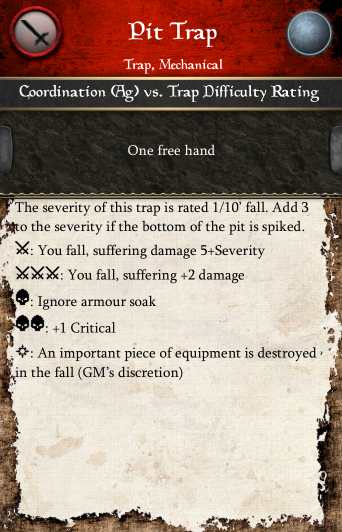
My previous post described some ideas for setting traps in Warhammer 3; in this post I present the pit trap card.
The resistance side:
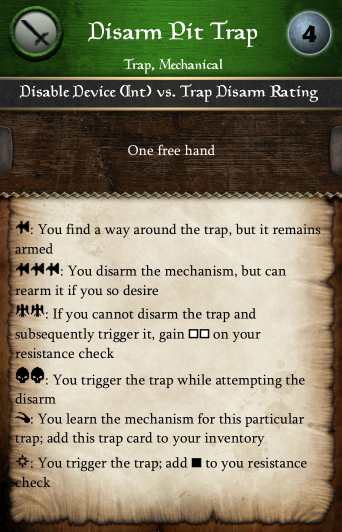
This is the disarm side:
Infernal adventuring…
My previous post described some ideas for setting traps in Warhammer 3; in this post I present the pit trap card.
The resistance side:
This is the disarm side:
One of my (several) problems with Warhammer 3 is that it doesn’t contain rules for some basic aspects of adventuring that we all take for granted, including (rather annoyingly) traps. I don’t often use traps in adventures, since I’m not a great fan of dungeon adventures, and I understand that dungeoneering isn’t a big part of the warhammer milieu, so I can see why they don’t want to include the rules in a basic book, but traps are a very handy GMs tool, and it’s nice to have the designer’s ideas on how to handle them. WFRP3 doesn’t have a clearly described saving throw system of any sort, so in order to set up a trap I have to come up with some kind of scheme. Since the most recent adventure I’ve been running depended on traps, I need to design some method, and these are thoughts towards that method.
The Basic WFRP3 Saving Throw Mechanic
I’m not a fan of separating saving throws from the other mechanics of the game, so I’m happy to use a system like WFRP3 where the saving throw is not a special set of rules. However – and probably as a throwback to my days of using saving throws – I like any accidental event that the PC has to resist (like natural events or traps) to be resolved by a dice roll that the player does, rather than me. So if a trap is set off, the targeted PCs should all make some kind of ability check to avoid it. This is easily handled in WFRP3 as, for example, an attribute or skill check vs. a fixed difficulty determined by the trap. However, there is a small unorthodoxy built into this approach. Typically in WFRP3, action checks are constructed in such a way that the results are determined by the number of successes and boons rolled up. But in the case of a saving throw rolled by a PC, the results should be determined by the number of failures and banes.
There’s nothing wrong with this per se, but it seems to be a variance from the standard system.
Traps as Attacks
We can get around this by making the trap an attack, that the GM rolls against a PC’s skill or ability score, and then resolves damage etc. accordingly. This is entirely consistent with all the other rules of the game, but vaguely unsatisfying. Especially for save-or-die type traps, players should always be able to make the roll that determines their fate. Even though it’s exactly the same if the GM does it, it feels too … narrative … if it’s handled by the GM. The same applies to skill checks in which one PC or monster uses a social combat mechanic to control the actions of another PC – resolution of this should always be performed openly by the affected PC.
Disabling Traps
There also needs to be a mechanic for disabling traps, which pits a specific skill against the trap itself. The act of disarming the trap then has results depending on the number of successes gained, and also a standard result for banes. I’m thinking the standard results are:
This allows for the possibility that PCs might be interested in developing trap-making abilities of their own, and requires the inclusion of special trap-making rules.
We can put all of this together through the construction of Trap Cards.
Trap Cards
Of course traps don’t have to be represented by cards, and neither do items (or actions, or anything else) but it’s consistent with the way the game is laid out and it’s a convenient way of setting out rules. I don’t have the ability to make cards beyond those in the Strange Aeons software package, so I am going to recommend a card design based on cannibalizing the basic Action Card format. The Trap Card will have two faces, one (the red face) representing the trap’s effects, and one (the green face) representing the disarming process. The red face doesn’t have a recharge number, but gives the skill the PC needs to use to defeat the trap. The green face has a recharge number, which in this case is the number of rounds it takes to disarm the trap. The body of the card then shows the success and failure lines and their outcomes. Each card is for a type of trap, so will refer to a trap difficulty. This difficulty determines how hard the trap is to evade and how hard it is to disarm. Note that traps basically come with three difficulty types – search, disable and resist. These are not specified on the card, but the card will specify the results and skill checks in terms of these ratings. Note that there could be a fourth value, which would be the strength of the trap and would affect damage.
My next post will contain an example of such a trap card.
I received The Windup Girl, by Paolo Bacigalupi, as a christmas present, and the lazy season being as it is started reading immediately. I was initially interested and a little disappointed, but the book soon turned a corner and became an excellent and impressive read.
The book is set in a medium-future post-collapse Bangkok, after global warming has devastated the climate, peak oil has devastated the economy, and international agribusinesses have (possibly deliberately) devastated the biosphere. In a world without oil or significant biodiversity the economy depends heavily on calories – energy for large swathes of the population is generated through human or animal motion, i.e. through converting calories to electricity, and stored in springs and batteries. It is a world of windup radios and huge genetically-engineered elephants generating power through treadmills. It is also a world in which basic foods and animals we take for granted have disappeared through the reckless (or perhaps deliberate) behaviour of the calorie companies, whose genetically-engineered disease have gone wild and destroyed much of the plant and animal life of the world, leaving whole nations dependent on the genetically engineered crops that the calorie companies release every year.
In amongst all of this the kingdom of Thailand survives independent of the calorie companies and free of starvation, and is slowly reintroducing species of plant that have passed out of living memory. The suspicion is that they have a seedbank, but were this to be confirmed the calorie companies would happily destroy the kingdom to find it. The story concerns the interactions of several characters – a foreign businessman seeking the seedbank and his Malaysian Chinese refugee assistant; a Japanese genetically engineered “New Person,” (the eponymous “windup girl”); and a representative of the Thai Environment Ministry. These people are slowly brought together in an environment of intense pressure as the political pressures within the city slowly build up to breaking point.
My initial disappointment at this book was the standard trade in racial stereotypes. The Malaysian Chinese man was so racist and thought in such stereotypical “old” chinese lines as to be a caricature; the Japanese girl is genetically designed to be subservient, obedient, and enjoy sex even when it is rape – she moves with strange, awkward movements and attracts and repulses foreigners; and the Thais are all lazy and corrupt (bar one). Everyone distrusts every other race and everyone follows their own racial tropes. But in a rare achievement for any book of any genre, the characters quite quickly begin to overcome supposedly powerful racial and cultural traits, becoming instead well-rounded and interesting individuals whose personality reflects their cultural background without being overwhelmed by it. The Malaysian Chinese refugee, initially quite a detestable character, is portrayed (I think) quite sensitively in the light of the traumatic events of his flight from Malaysia and his new-found paranoia and trauma, and his behaviour becomes increasingly understandable as the story progresses. The Windup Girl’s continuing battle against her genetically-designed instinct to serve makes her a strong and interesting character, even in the face of her obvious personal weaknesses; and the Thai characters very quickly differentiate themselves from a common mass of corrupt and lazy “Asians” to become a society who, despite their many flaws, survive proudly where all around them have collapsed.
This book also does something which I am disappointed to say is very rare in science fiction: it attempts to portray a post-global warming, post-peak oil world. We know these things are coming to us, and although we don’t necessarily expect them to be catastrophic (as this book portrays them) they nonetheless make excellent fields of inquiry for speculative fiction, but they’re sadly rather thin on the ground. Why is this? It seems like a woeful dereliction of duty by the speculative fiction world to have not bothered to create such settings. It’s not as if Sci-fi hasn’t concerned itself with post-apocalyptic stories, so why doesn’t it make more effort with post-semi apocalypses? I would have thought that even if one rejects the claims of climate scientists, it still makes a very interesting world to explore. But there seem to be precious few. This book does a really good job of portraying the kind of world one might imagine would arise after the end of oil, as well as the consequences of a general biodiversity catastrophe, an interesting challenge to think about. Even though at its heart the spring-driven energy storage concepts described in the novel are completely unrealistic, and the calorie economy probably overly optimistic (modern agriculture turns oil into calories, and is unlikely to survive peak oil), the presentation is believable and sets up an interesting set of constraints and demands for the characters to work within. The concept of a seedbank as a treasure worth destroying nations for (as is implied happened in Finland) is a very nice touch, for example.
This book also has a tight plot and a really good way of merging a couple of different stories together. My only complaint about the plot is that ultimately the thread involving the foreign businessman seemed strangely unnecessary (except for its role in an important coincidence) and it could probably have been made more relevant in the final third of the book with a few minor plot tweaks. There were also a few unnecessary sidelines involving the Environment Ministry workers, which could have been cut out I think. But besides that, the plot was tight, believable, exciting and tense. It reminded me in many ways of a good Neal Stephenson book without the sudden collapse at the ending, and where everything comes together well instead of looking all a bit confused and wayward.
This book is, overall, an excellent read, with a believable post-apocalyptic world with a really interesting back history, engaging characters who you really come to feel for, in an exotic and novel setting where everyone plays for very high stakes. Well worth trying out, even if you don’t think environmental apocalypse is on the cards, or aren’t that interested in Asian settings.
Last night was the 6th session of the Rats in the Ranks campaign, so about my 9th session of Warhammer 3rd Edition. This time, we again were missing one of our players (Mr. Camphor) so we again decided to put off the main plot of the campaign for a random side adventure, which is fine because the PCs are waiting to get a report from their dutiful spy, and so side adventures are all the rage. I could have seeded the town with rumours and let them do whatever they want, but in truth I haven’t had a lot of preparation time and (as I think will be obvious in a moment) I’m not yet confident making up encounters on the fly in WFRP3. It’s a bastard of a system if you get it wrong.
So, instead, I used an old Warhammer 1st Edition adventure, Fear the Worst, converted it to WFRP3, and assumed everything would come out in the wash. And it almost did.
If you’re planning on running this adventure, in any system, then it probably would suit you to read this. If you’re going to play it or at risk of playing it, then don’t read on. But if you are planning on playing it, you should note that my general preference is to avoid TPKs, and this one came damn close.
A standard mercenary advert and a sausage festival
The PCs having just returned from a near-death experience and spent most of their money on healing, they were naturally in need of a new adventure and a new chance to get themselves all killed, so when they stumbled on the following handbill posted up in some dubious corner of Ubersreik, they naturally responded immediately:
Men and women of a brave and adventurous bent needed for work of a sensitive nature. Seeking wide range of skills, from strong-armed warriors to learned scholars. Excellent opportunity for neophytes. Ask for Karl Taunenbaum at the famous Dancing Dragon Inn, Heideldorf
So, being in need of money and lacking their main meat-shield, off they went to investigate this simple Heideldorf job. When they arrived they found themselves in the midst of a sausage festival, thronging with nobles from the Reikland and full to overflowing with delicious sausage. Viewed with suspicion by these nobles, and having already had a rather unpleasant roadside encounter with some approaching nobles, they went straight to the Dancing Dragon Inn and asked for Taunenbaum. Taunenbaum in turn served them some sausage and sent a runner for the head of the village, Heinz Schiller, who turned up about 10 minutes later. Before speaking to the PCs he deigned to spend 5 minutes scolding Taunenbaum in front of his guests, complaining about the speed of service and the slovenliness of Taunenbaum’s staff, before joining the PCs. Schiller himself was an overdressed fop, noble in bearing but done up in a slightly tawdry version of last season’s fashions… in short, an overpuffed rural dandy. Not that this stopped him looking down his nose at the PCs as he explained their job to them…
[Slight cultural note here: most cafes and bars in Japan worth their coin have on the menu “sosseji moriawase,” a sausage mixed plate, and most Japanese know a little about German culinary and festive culture, so a mid-winter sausage festival where you get served a mixed plate of delicious sausage is exactly the kind of environment that makes the players feel like they’re part of a German-themed but chaotic world]
The Job
So, Shiller set about explaining the job to them, though first he needed to assure himself that the PCs were, in fact, capable adventurers. Since the group contained two girls (one just 15 years old!) and an elf, this probably isn’t surprising, but after a bit of poking and prodding and some judicious questions he was satisfied, and proceeded to tell them that this sausage festival was his own exclusive idea, built up over 10 years, and he couldn’t afford anything to destroy it. But this year,some bandits had gathered in a ruined castle near the keep and were attacking visiting nobles. If even some nobles left Heideldorf with the impression it was unsafe, he would be ruined. So he needed the PCs to visit the ruins and … deal with… the bandits.
He initially offered the PCs 10 silver coins each to do this. Given they had entered their first adventure on a 20 silver coin payment, and bargained up from there, they were kind of shocked. So they bargained, and secured a 2 gold coin payment each.
Having done this, he told the characters to head off in the morning, and then left the pub.
Investigating the Job
As we will see, the PCs are nothing if not thorough in their preparations, and promptly set about finding out more about Shiller and the town. They started, of course, by drinking with the locals. From various locals they found out the following:
So… Delicious sausage… regular adventurers… the characters were becoming suspicious. Still, with no definite cause for their suspicion they could hardly refuse to do their work. And what could possibly go wrong if they went into their adventure aware of the possibility of a trap…?
Entering Black Rock Keep
The following morning the PCs headed off to Black Rock Keep. When they reached the surrounding area they entered with typical caution, surveying carefully and checking for guards, etc., but found no evidence of bandits of any kind, so entered the grounds proper. They were just about to enter the main wooden double doors of the ruined keep when a crossbow bolt thudded into the doors in front of them. This bolt had a note of some kind wrapped around it.
Unwrapping the note, they found a map, with the following note written on it:
From a concerned friend. Heinz Schiller is more than he appears. Beware the cellars!
The map itself appeared to be a detailed map of the cellars, complete with secret doors marked, and several traps detailed on the map. Unfortunately, none of my 3 players paid any attention to the map. They didn’t really even look at it.
They explored the ground floor of the keep, finding some evidence of habitation but no living things, and then entered the aforementioned cellars. The thief moved ahead to investigate rooms as they found them, and so within a few minutes he encountered the first trap – a 10′ deep pit filled with spikes, which he managed to avoid through a feat of dexterity that left him clinging to the floor under a door while the remainder of the party threw out ropes for him to grab onto.
After they had overcome this trap, rather than checking their map or checking for traps, they moved on, soon stumbling onto two more. Both of these traps were hammer traps, huge warhammers falling from the side of doors, and one delivered a nasty blow to the thief, knocking off quite a few wounds[1].
Having sprung all the traps and ignored their map, the PCs finally managed to discover a secret door and loot some sarcophagi of about 4Gps worth of gems and jewellery (this is a lot of money in WFRP3). However, they hadn’t found any outlaws, just evidence of an ancient, well-looted tomb. So they decided to leave, and returned to the entryway.
The Mutant Ambush
When they reached the stairs the PCs were ambushed by a grotesque pair of misshapen mutants, who dashed out of the stairs to lay waste to the thief and the roadwarden. These mutants were vaguely human, with huge bodies, massively strong arms, and tiny tiny heads, inset with vacant, staring eyes showing no intellect of any kind. Perhaps one was a woman; perhaps they were a couple. The thief and the roadwarden didn’t have time to tell, as a single blow from their huge arms was sufficient to cripple normal people.
Battle was joined, at which point another five mutants burst from the secret door in the stairwell, to attack the PCs from behind. These mutants were:
The battle that followed was evil, bitter and desperate. The PCs realized they had only one hope of survival, which was to block the stairs so they only had to fight two mutants at a time; but even then they still had to face two ranged fighters and a wizard, though fortunately the wizard was a Tzeentch Wizard, and Tzeentch’s magic is disgusting but weak. Nonetheless, the PCs found themselves in a desperate situation, with the Cleric falling unconscious and recovering (through her own magic, mostly) three times; the Roadwarden fallign unconscious and recovering once, and the thief being knocked out just once (and staying there). The battle ended with all the PCs except the wizard unconscious, and all the mutants except their wizard; the final three rounds were an old-fashioned magical duel, which the party’s wizard won by perhaps one round – at the end the mutant wizard was so low on power and so desperate that he was forced to charge into melee with a knife. This didn’t end well for him, and the session ended with the party down to its last 6 hit points – all of them belonging to the wizard – while a pile of mutant bodies slicked the floor with blood, and the players all cursed their stupidity for not using the serendipitous message they had been sent.
Next session, we will find out why they met mutants not bandits, and what exactly was happening in this remote outpost…
—
fn1: I actually messed up here, giving the thief an agility check instead of doing an attack roll. The thief’s agility is impeccable, so nothing touches him when he gets to do a save. An attack roll, though, would have left him in a sorry state indeed. I realized during this session that in addition to WFRP 3’s many other flaws of incompleteness, it has no rules for traps and no suggestions about how to do traps.
The Transitive Property of Gaming blog, which I read a lot for warhammer information, had a post a while back about the relative merits of conservative vs. reckless stances in combat. The post compares the success rates of a theoretical attack using the Troll-Feller Strike (a fairly nasty card) in reckless versus conservative stances, and argues based on the results that the reckless stance doesn’t deliver rewards that match the apparent benefits written on the card. I think there might be a few errors in the calculations of average damage for this analysis, and in fact I think the difference between the damage done in the two stances is quite large (see my addendum below). Even with these mistakes though the post seems generally correct – on an analysis of success rates and the differential damage which flows from them, reckless stance is not worth the risk it entails compared to conservative stance. However, I don’t think this is correct because the analysis at Transitive Property of Gaming fails to consider the extreme risk of delay symbols, which only appear on conservative dice.
Delay symbols appear in conjunction with success symbols, and basically give the GM the option of either placing two recharge tokens on one of the player’s cards, or moving that player’s initiative token one step down the initiative ladder. The risk of this is very high as the stance depth increases. I tested the probabilities using 40 dice rolls on this convenient simulator, and found a delay occurred in 48% of all skill checks, with the longest run of checks between delays being 5 checks, and the usual run being just 1 or 2 checks. This is actually a ferociously dangerous result, as I will describe based on last night’s adventure.
Last night the PCs got into a fight with 6 mutants, two of them quite nasty melee combatants, one a vicious ranged attacker, and one a wizard. The entire party went into conservative stance for the fight, and delay symbols were flying about with gleeful abandon. I restricted myself to using delay symbols only on action cards, but this is how I used them:
The wizard spent a portion of this battle in a very deep conservative stance, which is probably a good plan for a wizard since it reduces the risk of miscast. But it opens the wizard up to all sorts of challenges – as a rule I don’t do this but I could keep the Channel Power card on recharge, which would basically prevent the wizard from using any magic for most of the battle.
But worse still, with 4 PCs fighting 6 mutants, I could have moved their initiative cards tokens down the initiative tracker, which by mid-battle would have left the PCs facing 4 unanswered mutant attacks before they could act. This means that the wizard could have unleashed some bad-arsed support spells, rather than having to respond to incoming damage directly.
In short, I think the delay effects on conservative dice are very risky, and you need a good justification for going into a deep conservative stance, especially if your main role is delivering melee damage. With a reasonable toughness you can manage a few fatigues, and you’re much better copping a few fatigue-related penalties on your available actions than not having those actions available at all.
—
Addendum regarding Transitive Property of Gaming’s calculations
The calculations in the linked post are of average damages, but when I put the given probabilities and damage outcomes into a spreadsheet and run the calculations, I get very different results. Using the same assumed damage (10) and average armour soak (2) I get a post-armour average damage in reckless stance of 11.69, vs. 10.14 in conservative stance (an average difference of 1.55). As armour soak increases the difference increases too – for an armour soak of 4 it becomes 1.79, and at 6 it is 2.03. For these calculations I’m using the standard method for calculating expected costs of an action: Expectation (Damage) = Sum over ( Probability (event)*Value(event) ), where here Value(event) incorporates the damage bonus, +1 for a critical, and the soak effect. I assume this is what was used in the linked post, but I think the calculations are wrong.
It’s important to note though that the issue in combats is not average damage done but survival, which is determined by the probability of a hit and the probability of death on a given hit. Typically a troll-feller strike will kill most opponents in 2 blows, so the best card is the one which delivers those blows as quickly as possible. In fact the conservative and reckless stances deliver the same chance of a hit, so survival is similar in both cases, but the conservative side makes the second – essential – hit much less likely to happen. There’s a 45% chance that the troll-feller will be hit with a delay, meaning that the next troll-feller strike won’t happen for an extra 2 rounds (increasing target survival) or – worse still – the GM will put those recharge tokens on the PCs basic melee strike card, rendering the troll-slayer useless in the following round. Alternatively the GM could put those tokens on a defense card, which will probably render the troll slayer defenseless in the next round.
Conservative stances, then, are particularly good if you have a lot of action cards available to choose from, so you are safe if you get one hit with a delay.
As a further aside, WFRP3 probabilities are fiendishly hard to calculate and fiendishly hard to game. Being a combination of different sets of dice with the same outcomes, an analytic solution to the problem of the probability of any event in a dice pool is theoretically calculable as the convolution of several multinomial probabilities. But there are as many as 5 different multinomial distributions, so this calculation would run over many pages. This means that we need to use simulated empirical estimates of probabilities (as I have done here) for most situations, or we need to use up an entire amazon’s worth of paper on the calculations. It would be much easier for me to write a simulator in R and calculate empirical probability distributions than it would be to actually calculate the analytical probabilities of any given event. How hideous!
The 2010 remake of Clash of the Titans is a fun movie, with some interesting hat-tips to modern RPG theological theories and excellent monsters; it is, moreover, a vast improvement on the original. Of course it butchers the original greek myth, but who cares about that? Greek myths are there to be fiddled with.
This movie follows a pretty straightforward story: mortals are rebelling against the gods, refusing to pray to them, and so Zeus allows Hades to extract vengeance on them, ostensibly to force them to again pray to the gods for salvation. Hades has his own plans and the reprisals turn into a cunning scheme by Hades to overthrow Zeus; but Zeus’s demi-god half-son, Perseus, is loose in the world and has a strong desire to kill the gods, so everyone’s schemes get thrown into disarray. During his adventures Zeus gets to fight some giant scorpions, medusa, some harpy-like demons, and the kraken.
There’s an interesting role-playing style twist, in which the Gods depend on human’s prayers for their existence and power, so the humans attack them by simply … going on strike. This is very much like some old ideas from the nerd-o-sphere, in which Gods’ power is directly related to the number and fervour of their followers. This movie takes that concept to its logical conclusion, and it’s nice to see.
Perseus is played well by Sam Worthington, essentially reprising his wtf ?! role from Terminator 4 (but with a better director). To me he comes across as strongly Australian in this movie, and he also plays Perseus’s rebellious streak very well. I have a suspicion that Sam Worthington can’t act anything outside of a kind of dumb-innocent-soldier-guy, but he does that role well, so it fits in here nicely.
The special effects in this movie are excellent and fit in well with the story. They’re not overblown and they really feel natural a lot of the time. The pegasus, particularly, is good. The Kraken is well done by being just glimpsed – there’s no point where you can see the whole of the thing, which adds to the sense of its monumental size and power. The Stygian witches are really cool, simultaneously coquettish, grotesque and savagely dangerous, and Perseus deals with them well. The inclusion of a chaos/Hades cult in Argos is a nice touch, as is the role Aio plays in directing Perseus along his path.
Also, they ditched the stupid clockwork owl.
Overall this movie is a fun bastardization of various greek myths in the interests of killing shit. If you want to see how to kill a god, Princess Mononoke remains the standard; but if you want to see how to kill a bunch of really nasty god-like stuff, rebelliously rather than implacably, this movie is your thing. Also, if you like men in skirts.

As part of my new year plan to improve my Japanese, I am on a manga collecting binge, starting with Psychic Detective Yakumo (Shinrei Tantei Yakumo,心霊探偵八雲) by Manabu Kaminaga. This is a series of case files about a cynical and slightly misanthropic college student called Yakumo, seen mostly through the perspective of the slightly eccentric college girl Ozawa Haruka. Yakumo was born with a single red eye that enables him to see spirits and ghosts, and the trouble that this eye has brought him has turned him into something of a recluse and a bit of a bastard. His mother even tried to kill him and then abandoned him when he was a kid, so he’s understandably a little cynical about people. Haruka, on the other hand, wants to help others because when she was about 8 years old she accidentally got her older sister killed, and ever since she’s wanted to be the child who everyone loves, but behaves eccentrically in her quest for this fulfilment. What she doesn’t know – but finds out through Yakumo’s red eye – is that her sister’s ghost is following her around as a kind of guardian angel – and maybe this is why Haruka is the impetus for the adventures that we read in the manga.
In the first episode we also discover that Yakumo is a bit of a fraud, cheating at card games through a mirror pinned to the door of his club room in the University, and then offering to exorcise a ghost from a completely normal memorial picture of the English professor’s dead daughter – in exchange for higher marks and attendance records. “I sell peace of mind,” he tells Haruka, “And it’s an awesome business!” However, he is basically good at heart, and although very off-hand and cool with Haruka maybe he has a bit of a thing for her. By the end of the first instalment we have seen hints of a love triangle, and then tacked on to the end of the book there is an amusing “interview” conducted by the intrepid report “M” who ambushed Yakumo as he was waking up, in which we see the depths of his misanthropy and lack of interest in ordinary life.
The story itself is simple but effective. From here on I shall give a few spoilers, but since there’s no english translation of this manga as far as I know, i doubt you will be reading it, gentle reader (if you can read Japanese, maybe skip this paragraph). Haruka approaches Yakumo for help, having never met him before, because her friend Miki is in a coma in hospital after a strange incident, and a friend suggested Yakumo could help. Miki visited an abandoned house with her boyfriend Kazuhiko, and was attacked by a ghost from behind the door of “the forbidden room,” a room whose door had a sign on it saying “do not open.” Subsequently Kazuhiko “commits suicide” on the train line. Yakumo visits the girl and identifies that she has been possessed by the ghost of a girl called Yuri. Haruka and Yakumo do some investigating on the computer system of the university (which Haruka has access to through a part-time job) and discover that a girl called Yuri went missing a little earlier. The girl was from Haruka’s class, and by tracing rumours of attachments they identify Yuri’s ex-boyfriend, who Haruka goes to talk to. He tries to kill Haruka, revealing as he does so that he had a brief fling with Yuri and got her pregnant, even though “after we had sex just a few times she started acting like my girlfriend.” But Haruka’s sister’s ghost gets Yakumo, who comes and saves her, revealing as he did so that he had guessed that the boyfriend killed Kazuhiko as well. The reason? When Kazuhiko and Miki were fooling around outside the abandoned building, Kazuhiko took a photo of Miki and in the background was the faint image of Yuri’s boyfriend carrying her body away from the scene of the crime. In good Japanese style, having been discovered, the boyfriend turns himself in. The story closes with Haruka and Yakumo getting involved with the case of a serial killer.
The story is pretty simple, but it works as a basic detective story, and a lot of it is about boy/girl interactions between the lead characters. In fact, the manga is probably better called “bumbling helper Haruka” because it seems to focus more on her (and the story of her sister’s tragic death) than on Yakumo, who remains an enigma. The narrative force is largely with Haruka, who though a little ditzy and physically weak is a clever and forceful character, possessed additionally of an emotional depth and moral depth that Yakumo definitely lacks. In all it’s a good story and an amusing tale of a burgeoning friendship (or love affair?) between two people whose characters are guaranteed to create trouble for each other, and it is clearly set up so that we will slowly learn more about Yakumo, while we watch Haruka become a skilled ghostbuster and reconcile herself with her sister.
The artwork is fine, typical manga black-and-white drawings, though everyone seems to have the same features, which makes it hard for me to work out who is talking. But the clear plan in this series of manga is to focus on the story and interactions, not the pictures, so it works as basic background information to support the basic story. I can recommend this to anyone who is able to read Japanese (and I might add, the kanji are entirely supported by furigana, so it’s smooth and easy to read compared to, say, Emma or Shuna’s Journey). If you’re looking for an easy introduction to intermediate Japanese with a fun story and good characters, this is the manga for you!

I crawled out into the freezing cold with a hangover today to visit the Asami Shrine in Beppu, to burn my 2010 demon-breaking arrow and purchase a new arrow for 2011. Burning the arrow that symbolizes the year before gives one time to pause and think about what one did in that 365 days, and to think about the year to come. My year to come promises to be busy, but I have a variety of plans I want to put into action in my gaming, research and real lives. Here is a brief outline.
Gaming Plans
Continue the Rats in the Ranks Campaign: My players indicated they want it to continue, and so I’m going to try and play it right through until I work out at what point WFRP 3 breaks. Whether this happens or not I don’t know, but I have a long-term goal for this campaign (or rather, the adversaries I’m controlling have a very distinct long-term goal in Ubersreik, which hopefully my players will discover before everything goes pear-shaped). After that we’ll see where the campaign takes us. It’s fun and my players are good, so let’s see what happens.
Start an Oriental Steampunk sandbox: Based on the one-off Pathfinder adventure I ran last year for a Japanese group, I’ve been thinking for a while now of expanding that into a genuine steampunk (literally!) sandbox. The players from that group have a hook for one more adventure, and from there we could start exploring. I’m thinking of using my ideas for adapting WFRP 3 to steampunk, or even to high fantasy (depending on the direction I want it to go) and just playing along until it gets boring. This will give me the opportunity to get my Japanese players to collaborate in building a semi-oriental/semi-western steampunk world based around a Meiji-era image of the place we are all living in now, with (at the very least!) gnomes.
Introduce the local convention to some English-language-only games: I’m in something of a unique position here to introduce my local Japanese-language gaming convention to untranslated games, and I’m thinking of running a session of WFRP 3 and maybe Exalted for just this reason. Recently a player at the convention said she wanted to play a game “that used loads of dice!” and it occurred to me right then that Exalted was just the game for her. This type of international exchange segues into my biggest possible plan for the year…
Start a TRPG Club at my University: This may seem a bit trivial but it’s actually a plan full of possibilities. My local University has about 100 nationalities of student, many of them nerdy, from all over the world, and they all meet to study and hang out using two languages that I speak – English and Japanese. So these students could bring an untranslated game from their own country – most likely in Thai, Mandarin or Vietnamese, but you never know what else is lurking out there – and run it in a different language for the other students. Or, they could play a game that isn’t translated to their language for a group of their compatriots. This opens up all sorts of options for language and gaming exchange, and a few people I’ve spoken to have been interested, so I’m thinking I might look into doing that this year.
GM Make You Kingdom in English: I’m going to Australia for a few weeks twice this year, and on at least one such occasion I will be in Melbourne, so I’m thinking of inviting regular commenter (and previous player) Paul to join me in a game of Make You Kingdom, translated of course. This depends on me being able to translate the necessary information by the time I go there and also being able to explain the rules for him (and get to Melbourne). I reckon I can do it, and I can even put stuff on this blog. Maybe I can also GM Double Cross 3 at some point too…
All of these plans are going to depend on a few crucial meat-life plans as well, though…
Meat Life Plans
Go to Iceland: I’ve never been and I really want to go. It’s vaguely in the pipeline to do this year, in which case I might pop into filthy scummy London to see some old friends at the same time.
Improve My Japanese: Today I received a New Year’s Card from the Japanese language school in Fukuoka where I did a 6 week intensive last year, and this year I think I’ll be in a position to do skype lessons with them. So, this year I really want to improve my Japanese to the point where I can do the following:
This is obviously an essential meat life goal if I want to be better able to role-play in Japanese. Or just live here happily.
Get fit: I have never been so unfit as I am now, and although my current fitness level is acceptable for a 37 year old, by my standards it’s awful. This year I need to do something about this!
Research Plans
I’ve got a whole research plan written for the next year (it coincides with my starting a PhD through an Australian University), so I aim to do quite a bit of research. This year’s plans are:
An overview of advanced statistical methods for intervention research: Modern research into intervention in health systems requires quite advanced statistical methods, including heirarchical linear models, time series analysis and probability survey research, but combining these can be very challenging. I aim to get a good, solid overview of what is being done in the field and what can’t be done, with the view of using it or improving on it.
Combining heirarchical linear models in Probability surveys: There has to be a way to do this, and I want to work out how. Or alternatively, work out approximations and workarounds to the problem.
Systematize time-dependent difference-in-difference models: Difference-in-difference models are a fancy way for economists to say “linear regression with interaction term” but all the fancy language doesn’t hide the fact that understanding of how to use these models in the health economics literature is remarkably poor. I aim to systematize this, to point out the (trivially obvious) problems in doing this research without considering the time dependent component of the data, and to make recommendations for its application in health services research.
Who knows what trouble this is going to throw up? But that’s my main research goals for the year.
It looks like it may be a busy year for me, but I think I’m going to enjoy it…
This movie was, frankly, pretty stupid, though quite fun. It’s by Cristopher Nolan who made The Prestige so it should be good, but it was too self-consciously complex, if I bothered to trace the story through all its complex layers I’m pretty sure it would have huge internal holes in it, and most annoyingly the ending was obviously deliberately set up to spark a circle jerk of wanky speculation as to whether or not the whole thing was a dream. Which is shit, because we all know that “he woke up and it was all a dream” is a huge narrative cop-out (or, in this case, a feeble excuse for an equally long-drawn-out and painful sequel) and we all know that a movie can only sustain this kind of wankery at interesting levels of debate if the movie itself was good enough, which this one wasn’t.
There’s a point I think where every movie director needs to recognize that the complexity of the movie is too much, not only for most of their audience, but also for their own skills, and the movie is suffering from the complexity. There’s also a point where movie directors need to recognize that sticking to existing relationship models in a new setting is better than trying to create complex new ones. In my opinion, the relationship between Cobb (one of the lead dream-snatchers) and his dead wife Moll was weak and silly, and all aspects of their backstory were unbelievable and silly. Also the resolution between them was stupidly weak and I think it broke a fundamental rule of the dreamworld and wasn’t a resolution at all.
So overall this movie was pretty ordinary – even the action scenes in the dream world were pretty uninspiring – so here’s my attempt at describing how this movie would have been better.
SPOILERS BELOW
First, the attempt to plant a dream in Fischer’s head should only occur at a second level of dream, not in the third, and there should be no limbo. The extractors simply try to go one level deeper than usual, something they have shown they can do but which has also been shown to be unstable in the first scene. This creates the tension, with the second level of dream-adventure being shaken up by the actions in the first level. To add tension, the sedation used should imply that anyone who dies in the dreamworld dies for real, so Saito san’s injury is the cause of the race against the clock. Though I think they hardly need the death thing or Saito going along for the ride.
Also, all the scenes in the dreams should be more surreal.
Second, Moll should be treated as a straight-out environmental enemy, not some kind of weird psychological dooby-thwacker, and resolution can be obtained by Cobb finally having the balls to just shoot her in the face. Perhaps the architect, who discovered what was going on between them, can help him do this, giving her a somewhat more interesting role than “I know what’s really going on but all I can do is constantly appeal for Cobb to do something he doesn’t do.”
Also, the reason that Moll is vengeful and angry would be more relevant to the story if it indicated something fundamentally evil about inception, and Cobb. If Cobb had implanted in Moll’s mind the idea that she should marry him, and then she had committed suicide to frame him because incepted ideas always create suicidal confusion, then we see that the mission they are on is going to kill Fisher eventually, and Cobb is genuinely and truly a bastard. This also maybe gives the architect a basis for helping Cobb kill Moll (“she’s got to be put out of her misery . You didn’t know inception would do this,” etc) and he could even pull out of the mission to save Fisher, thus ensuring his own arrest in LA and a kind of redemption for killing Moll.
Three possible forms of resolution involving Moll:
Then the last scene could be a redeemed Cobb lying down to dream normally.
Either way, the whole thing would be less complex, more coherent, and less wanky. Which was the problem with this movie.
 Compromise and Conceit