• This is a description of a magical tome that the PCs discovered in the grave of a wizard near Ubersreik in a recent Rats in the Ranks adventure. It’s designed for Warhammer 3 but it follows a general principle of mine for tomes: you have to read them over time and make a skill check, and the difficulty of the check is adjusted by the research environment, time devoted to the task, etc. Reading a tome is not risk free, so blunders and fumbles can create serious problems for the reader, but depending on the degree of success in the check various skill bonuses and spell benefits are obtained. This usually takes time in-game, and may cost money.

    This tome is a simple book, containing 88 pages of very soft leather tanned to a very fine weight. The cover is dark wood edged with a thin, geometric pattern carved from some kind of delicate and unusual ivory. Nothing is written on the spine or the flysheet and there is no table of contents or apparent structure to the text at all. It is a collection of research notes, interspersed with a typical mad wizard’s ravings, some references to additional secondary texts, and some basic experimental results (which need to be repeated by the reader). Fortunately none of the secondary texts or the experiments are evil or chaotic in nature, though they nonetheless are not particularly pleasant. The book radiates a gentle glow of dark magic, but it is mainly the type of magic used for preparing a text to last the ages, and perhaps some residual magic from the laboratory where the notes were taken; the book itself is not intrinsically magical. It is written mostly in High Reikland, with occasional passages in various mystical languages with which most wizards are passingly familiar.

    In order to read this book, a PC must possess the Education advanced skill, and be trained in Spellcraft. This is not a book that those with natural talent but no training can hope to make use of. The PC must spend a month reading this book, and although they can adventure while reading (they are assumed to be reading during rest periods, etc.) they are much more likely to gain the full benefit of the book if they devote a month exclusively to the task, and spend that time in a major city where they have access to a decent library (with the associated costs).

    Reading this book requires a Spellcraft check with medium difficulty (2 challenge dice), and carries some risk due to the nature of the dark magic in the book (1 misfortune die). The following conditions add bonuses to the roll:

    • PC foregoes adventuring: 2 fortune dice
    • PC is in a large city (larger than Ubersreik) for the entire month of reading: + 1 fortune die
    • PC spends one gold coin on research and experiments: +1 fortune die

    The skill check produces the following results:

    • 1 Success: The PC learns one dark magic spell of rank 1
    • 3 Successes: In addition to the above, the PC gains 1 level of training in Channel Power
    • 2 Boons: PC gains a single fortune dice on skill checks for a single existing spell of their choice
    • 2 Banes: The PC suffers a single insanity with no resilience check
    • Chaos star: The PC loses one point of willpower

    All effects are permanent. The bane and chaos star affects apply even if the check is successful. If the PC commences reading and abandons the task within the month (due to interruptions to the reading process or loss of the book) the check must still be made and the negative effects can still be suffered, but there is no opportunity to gain the positive effects. Note that the dark magic spell can be learnt regardless of the PC’s order, but its use may need to be very carefully guarded, as possession of this power is heretical. Note also that the PC cannot choose not to learn the spell after they complete the reading; they can only choose not to use it. Knowledge of the spell itself will not taint the PC’s aura, but use of dark magic will, which may make the PC’s life somewhat more complex.

  • This is the third book I have read in the Takeshi Kovacs series, by Richard Morgan. It’s set maybe 100 years after the last one I read, Broken Angels (which I seem strangely to have neglected to review) and features an older, much angrier Kovacs returning to his homeworld, Harlan’s World, for personal reasons. The story traces the problems he gets caught up in, and the way things fall apart around him as his anger and built up psychological damage drive him deeper and deeper into trouble.

    The defining philosophical concept for this science fiction universe is the process of “re-sleeving,” in which most people can save their souls into a small unit in their body (their “stack”) and be brought back to life after death in a new “sleeve,” or body. These bodies are either the bodies of people being punished for serious crimes or bodies specially grown for the purpose. Takeshi is a demobbed member of an elite commando unit whose members get broadcast across space, re-sleeved at their destination, and sent in to trouble spots to commit heinous acts of slaughter. In this universe, faster than light travel is impossible so travel between the stars is primarily done by broadcasting souls into new bodies. We saw in Altered Carbon that this process can have strange philosophical consequences, which can be interesting to explore.

    The defining setting for this book is Kovacs’s home planet, Harlan’s World, which was terraformed by a combined team of Eastern European and Japanese, and is basically owned by the families who originally settled it. It’s an ocean world, but travel and even weather forecasting is difficult because it is ringed with orbitals, set up by a prior civilization, which destroy any flying object more sophisticated than a helicopter. No-one can enter or leave Harlan’s World physically, and the air is off limits. The society is corrupt oligarchic capitalism, a system of exploitation of the poorest that was so bad that 300 years ago the world was torn apart by a revolution, the Unsettlement, at whose head was a mysterious prophet-politician called Quellcrist Falconer.

    Into all of this returns Takeshi, intent on revenge for a wrong done to an ex-lover, and happy to live cheaply in a low-grade sleeve for years while he embarks on an extended mission of extermination and torture. His targets are a new religion, the Knights of the New Revelation, who are clearly analogous to the worst excesses of Islamic Fundamentalism. Unfortunately events transpire to entrap Kovacs in a society-shattering scheme, and he and various groups of unfortunates who get caught up with him soon find themselves reeling within schemes within schemes. We discover, indeed, on the second page that the First Families of Harlan’s World have an old copy of a much younger Takeshi, which they have sleeved and sent after him, though he doesn’t know why. The fact that they’re willing to commit such a crime – an “erasure mandatory” penalty exists for “double-sleeving” – indicates he is up to his neck in trouble, and our task as readers is to watch him navigate, then inflame, then (maybe) try and escape all this trouble.

    This book concerns itself less with the philosophical ramifications of sleeving as it does with the history of the prior civilizations, the martians, and their unique effect on Harlan’s World. We get to learn a lot more about just how strange these martians were, and perhaps uncover a little more about them. But the central concept we investigate at some length in this book is the long-lasting consequences of Quellism, Harlan’s World’s homegrown marxist/anarchist revolutionary ideology, as originally spouted by Quellcrist Falconer. This revolutionary tendency is not dead in Harlan’s World, and as Takeshi gets deeper involved in plots within plots we find him confronting his own dialectic: the tension between his natural proto-Quellist anger at the exploitation of the poor, and his natural resistance to ideology and political movements of any sort. Takeshi has put down revolutions on several planets and strongly believes that their leadership are as cynical and destructive as those they aim to replace, but at the same time his origins in dirt poverty, and his anger at the events that led to his discharge from the Envoys, mean that he really wants to believe a revolution could happen on Harlan’s World – that maybe it’s “time to burn the motherfuckers down” at last. Watching him bouncing between these extremes, and resolving all of his conflicts by resort to anger and/or intense violence, is grim work to say the least.

    As an aside, I really like Quellism as presented by Morgan in this book. It’s a pastiche of carbon-copy Marxist/Leninist/Anarchist material, held together and given a life of its own by the uniquely streetwise prose of its author. It’s not cloaked in the revolutionary sloganeering and turn-of-the-century intellectualism of the original upper-class revolutionary thinkers (Prince Proudhon the anarchist, Marx the maid-shagger, or any of the rest). Rather, it’s wry, witty, down-to-earth, cynical, vicious and very very angry, and where the original thinkers had dry political debate, Quellcrist inserts poetry and laughter. Quellcrist was a clever, thoughtful but very very angry revolutionary, and a lot of her sayings have over the years become streetwise aphorisms. Takeshi himself, though he has spent 200 years or so wandering the galaxy killing people a lot like Quellcrist, remembers her sayings and falls back on them occasionally. He also retains her class analysis, though he obviously doesn’t share her goals, and when he brings his own special, personal anger to bear on the First Families, the Yakuza, or the Knights of the New Revelation, he doesn’t miss any details of their political position and class antagonisms. This is a joy to watch, as if someone had loosed a Marxist-Leninist assassin on the bad people of the world, but infected him with a strong strain of nothing more noble or constructive than chaos and a desire to punish.

    And this is where the book is maybe hard work for a lot of people. Takeshi Kovacs is not a happy man, and while his anger in Altered Carbon was an entertaining and witty personal force, by the time he returns to Harlan’s World it has become a brooding, overwhelming aspect of his character. From the moment we meet him to the close of the book he spends his time destroying anyone he hates or believes has wronged him, with an intense and unrelenting passion that by the middle of the book is beginning to become hard going. Even when he is trying to enlighten those he would like to save he is shaking them, yelling, and unable to comprehend why they aren’t listening. He is the antithesis of the Quellist ideas about how to change the world, that are slowly welling up around him as the book progresses. I think for some people Takeshi’s intensity and unhappiness will spoil this book, but I found it believable and engaging, and enjoyed the feeling in the second half of the book of a larger and larger revenge building – and I also enjoyed it when the whole thing fell apart in political schemes and realpolitik. I also found the ending very satisfying, though there were (again!) elements of Deus ex Machina which, though believable, are starting to shit me a little in modern literature.

    This book moves at a good pace to a violent, surprising and not undesirable conclusion, where a whole series of separate strands of the story are woven together very nicely to a final resolution. In fact I would say that the plot is very well crafted, the expositions of the things you missed along the way are natural and welcome, and the story itself is big enough to just get lost in and enjoy, but tightly enough told that by the end you can put everything together and marvel at the results. It’s an excellent read and my only reservation is that I think some people will find it too grim and angry. But if you think you can do that and you want to read some really interesting, modern ideas in cyberpunk and space opera, then I recommend this highly.

  • I watched Joss Whedon’s Serenity last night, for about the fourth time, and loved it just as much as ever. It is in so many ways such an excellent movie, and like the TV show, Firefly, that it is based on deserves many more plaudits (and much more popularity) than it gets.

    Watching Serenity, it really is impossible for me to shake the feeling that Joss Whedon is really latching onto a confederate lost cause symbolism in his story, and risking importing a very racist and particular political subtext to his movies. I’m not American and I don’t know how Americans think but it seems to me that this is a pretty hot-button issue over there, and the implicit connection of confederate lost cause ideology with libertarianism must surely be controversial.

    It’s not as if it’s hard to see in the movie or the TV show, and Serenity particularly has a very strong libertarian message. There’s no direct racism, of course, with some good strong black characters, no evidence of racial ideology or consciousness in anyone’s interactions, and an episode where it is made clear that Mal is opposed to slavery, while the Alliance (at least tacitly) approves. So it could even, I suppose, be imagined as an allegory for a world where the confederacy won and the “browncoats” are actually a Unionist rump. But I don’t think anyone sees it that way, because the genre conventions and the imagery of the story are too strong to allow it.

    I did a bit of fossicking online for opinion on this, and I noticed that libertarian reviews of Serenity seem to completely miss the confederacy issue altogether. This William H Stoppard review, for example, is quite thoughtful but seems to miss the obvious symbolism of the browncoats. This review on Stockerblog seems to give a sympathetic overview of Whedon’s libertarianism and the central messages of the movie, but glosses over the relevance of the civil war imagery, which seems a little untenable. I would observe that the Guardian’s review also doesn’t mention it, which is a surprise from a generally anti-libertarian newspaper giving a not particularly positive review[1]. Fraggmented mentions it, and probably isn’t alone in being suspicious of Joss Whedon’s attitude towards race.

    I think it’s probably possible to see the civil war in the Firefly universe as reflective of a kind of combined American War of Independence / Civil War mixture, with the Alliance at least partially based on the British, as well as the Union. You could also probably argue that Whedon has done enough work in the series to neutralize the toxic politics of modern Confederate Lost Cause-ism, through the additional material he puts into the setting and through the actors themselves, so that he’s reconfiguring classic Wild West stories to pull out their racist overtones, but retaining their frontier/libertarian message. I think this is probably what he’s done, and it’s a testament to his powers as a script writer, and the skills of the actors, that he can present an otherwise quite misanthropic man – Mal – and a strongly libertarian political message, wrapped in suspiciously pro-confederate imagery, in such a way that those of us who aren’t misanthropic, libertarian or racist can enjoy and sympathize with.

    Addendum

    If you appreciate my views on science fiction and fantasy, consider heading over to my Royal Road account, where you can read some of my science fiction, fantasy and speculative fiction writing for free.

    fn1: but then it’s worth noting that the reviewer knows nothing about science fiction – he claims that the original star wars is “now reconfigured as Episode IV: A New Hope, ” so I think we can reject the conclusion that the reviewer knows anything about film, science fiction, or indeed even the reviewing process.

  • It doesn’t take me long, does it? Eight sessions of a system and I start thinking about tinkering with it…

    The main causes of excess complexity in Warhammer are:

    • Resource Management
    • Action Cards
    • Stances
    • The Dice
    • Critical Wound Cards

    Now, the dice are non-negotiable – they’re a core part of the reason WFRP3’s system is fun. I actually like the resource management ideas, so would prefer to keep them (though there are ways around them).

    But the single biggest source of complexity is the use of Action Cards and their interaction with stances. So, I’ve been thinking about ways of dropping the cards and writing them out on a character sheet like a normal special ability in any other system, but somehow retaining the resource management system. The problem with this is that the cards are two-sided, so even a small number of cards takes up a lot of space on a character sheet.

    The reason cards are two-sided is stances. So, we can simplify the card/stance system into a system that can be regularized on a character sheet quite easily, by reforming stances and regularizing cards.

    Reforming Stances

    We can reduce the complexity that stances introduce into the system by re-envisaging them as reflective of a kind of alignment (chaotic vs. lawful). Then at first level every character chooses an alignment and is only able to progress along that single stance direction (green or red). Careers then allow an increase in stance depth, but always to a maximum of one step per career.

    This means that characters only ever have access to one side of an action card. So each action card potentially takes one line of a character sheet.

    Reforming Action Cards

    The next simple way to reduce complexity is to give action cards 6 possible lines only: 1 success, 3 successes, 2 boons, 2 banes, chaos star and sigmar’s comet. Then you can write a table on a character sheet with a column for each of these lines, a column at the end for recharge tokens, and a column for name. That’s it.

    Each PC will start with the basic 6-8 cards, then a maximum of 2-3 from their development process and 2-3 from experience gained, so by the end of their second career they will still only need 15 rows in a table – easily set up on one page of a character sheet. Talents, of course, can easily be written on a character sheet, not as cards, which leaves only one set of cards relevant to the PC – wound cards. If we get rid of these, the PC is back to being represented by a standard character sheet.

    Reforming Wounds

    In my experience so far, critical wounds tend to consist of a nice description along with an effect, which is usually a misfortune (black) die on ability checks. So we could get rid of cards and, when a player suffers a critical wound, they simply roll up the stat location and assign a misfortune die to that stat. There is currently a box above each ability score for fortune dice; you could put a second box below each ability score for misfortune dice. Then, when the total of your misfortune dice exceeds your toughness, you’re dead. Descriptions are left to the GM. We could also have the number of dice compound; so 2 misfortune dice on a single attribute turn into one challenge, and so on.

    There are some critical wounds that do other things, and we’d be dropping them from the system, but that doesn’t really matter.

    Having done this, all that remains as a card is insanity. Insanity is rare enough to be okay  retained as a card.

    Revising Resource Management

    Some people think it’s unusual that PCs can’t use seemingly quite normal abilities every round, and one way to rethink this is to think of special combat attacks as requiring some kind of chi. A simple way to revise resource management would be to give all abilities a kind of chi cost, just as spells have a power/favour cost. This chi doesn’t have to be mystical – blocking someone with a shield may actually leave your arm stunned, or knocked aside, so you can’t recover quickly, so it’s mere physical strength. So we could switch the resource management system from recharge tokens to chi, which is always at an equilibrium equal to your toughness, and give all characters access to a Recovery action that works just like a Curry Favour action. Then instead of tracking recharges, they can use any action which requires chi less than their current total. Running out of points can easily be construed as losing energy, being put into a bad position, etc. The basic actions would require 0 points, of course, or maybe 1 point, since this guarantees that someone with 2 toughness (the minimum at first level) can conduct 2 actions in the first round and 1 every round thereafter, without using their recovery power.

    Further Action Card Simplification: Feats

    We could further simplify action cards by getting rid of them altogether, and having a basic set of actions that everyone can perform in combat. Players can then buy feats which change the difficulty of a line in a card, or give access to new lines. For example a fighter could use a feat to reduce the difficulty of extreme success from 3 successes to 2; and then could use another feat to buy a higher level of extreme success. These feats thus make the fighter better at basic attacks.

    These feat purchases could vary by the stance you’ve selected. So Reckless stance characters find it very easy to buy better lines for boons, and to buy extreme successes, but hard to buy better lines for banes, chaos stars and the like.

    PCs could also improve the basic outcomes of the existing actions using these feats, so e.g. you could use a feat to improve the outcome of a basic parry from a misfortune die to a challenge die.

    The system could then introduce some common rules for firing into combat, using two weapons, casting spells in combat, etc. and apply these to everyone. Other special actions in melee would be entirely at GM discretion.

    Then, the only action cards which would be necessary would be spells, which could be written in a separate spell book section.

    Furthermore, since all the basic actions are available to all PCs every round, you could get rid of the resource management option altogether. You could also then get rid of recharge restrictions on parry/block/dodge, and instead say that if a PC has access to this basic action (due to meeting the conditions) they can always use each one against one enemy per round.

    Handling Delay

    The big problem with getting rid of the resource management system on ordinary cards is that the delay symbols on conservative dice become meaningless. We can give conservative stance a continued difference to reckless stance by:

    • In a chi-based management system of combat actions: the delay symbol means the card costs an extra point of chi
    • In a feat-based system: the delay symbol becomes meaningless, so we weaken conservative actions a little

    Eliminating Stances Altogether

    I like the stance system, but another way to simplify the game is to just get rid of this, and to have conservative/reckless dice either drop out of the game altogether, or be substituted for attribute dice at the GMs discretion to represent PC behaviour, with the delay symbol stripped out. Then conservative dice might be added to PC rolls if they’ve got a good plan and they’re working well together; reckless symbols could be added if they tell the GM they’re going to launch the attack all gee-d up, without a plan… or if they go into a situation not knowing the layout of the battlefield, etc.

    In this case you could still allow PCS to choose which side of a card they will use as their default action (written on the character sheet).

    A secondary advantage of dropping these dice is that players take less time assembling dice pools.

    Conclusion

    I think these simplifications would strip a lot of the unique colour from WFRP3 but would make it faster to play, take less table space, and make the GM’s interpretations of dice effects even more important. It would also shift the game from its warhammer-specific feeling to a more generalized fantasy RPG feeling.  GMs could encourage players to stunt ordinary actions, instead of hunting through decks for special cards, and to use the environment to add reckless or conservative dice to otherwise stance-less gaming.

    The potential upshot of this would be that combat would become extremely quick (it’s already often quite fast) without losing its deadliness, and a lot of management faffery would go away. I don’t think the current level of management is extreme, but I’m sure many people differ with me on this, so it could be an easy way to make the system more generally fantasy-based, and quicker to play, as well as (potentially) more intuitive, while keeping Fantasy Flight Games’ unique contribution to the game – the dice!


  • Last night I watched Salt, the Angelina Jolie spy movie. This is basically an action flick, with maybe 12 seconds of character development at the beginning that is only required as background explanation for a cold look near the middle of the movie, and a brief explanation at the end. After that Angelina Jolie kills a bunch of people, does a bunch of stunts, kills a bunch more people, rinse and repeat.

    So, overall, a lot of fun. There’s a plot in there, sufficient to keep you interested in why Salt is jumping from that truck to that truck, or sticking her pen in that man’s neck, or whatever. As plots go it’s got the standard elements of trickery, twist, and ludicrousness that one comes to expect of modern action movies. Gone are the days when a chap turns up in town and kills a bunch of people ’cause they hurt his dog. Now they have to have a hidden secret and a bunch of social connections.

    See what happens when you let chicks into action movies?

    Anyway, my main problem with the plot was that the fundamental bad guy plot was ridiculous. I don’t think I’m spoiling anything here when I reveal that it involved a Russian plot to start world war 3 by deception, only the entire plan revolves around the most ludicrously high-stakes spy action that you can possibly imagine. The Russian plot has so many points where it could go off the rails that it’s just silly.

    Nonetheless, we don’t really care, do we? Because the more ludicrous the plot, the more elevator shafts Angelina Jolie has to scale, the more times she has to throw her lingerie on the camera, and the more people have to die horribly.

    So if your shtick is a kind of feminized version of Die Hard crossed with James Bond, and you enjoy watching unbelievable stunts and unbelievable killing scenes, and you don’t like Russians, then this is the movie for you. Also, of course, if you like Angelina Jolie. Interestingly, I have managed to make it to 2011 without ever previously seeing an Angelina Jolie movie. I think she’s okay, kind of like a female Sylvester Stallone, though I doubt she’s ever been in a movie as thoughtful and intense as First Blood[1].

    Overall: worth watching on a quiet evening.

    As a tiny postscript to this, I think working in public health has destroyed some small part of my brain. Watching this movie I could suspend my disbelief when she jumped out of helicopters, leapt from truck to truck across layers of highway, etc. But when she reversed off an overpass at high speed, while not wearing a seat-belt, and then walked away from the resulting smash unhurt, I found myself thinking “there’s no way that would happen.” Maybe it’s because I was in a low-speed car crash with a seat-belt on, maybe it’s the public health training… but whenever I watch car-chases now I find myself thinking “If you want to walk away from this you need to put your seat-belt on,” and they never do. I wonder what proportion of real-life car-chases end because the perp was unbelted, and managed to whack himself into insensibility halfway through the chase?

    fn1: I recall First Blood was derided as highly violent when it came out but I wonder if it looks really weak in comparison to an average modern movie? Maybe I should check… I don’t recall a single moment of violence from First Blood, just the setting and the desperation of Rambo. I predict that 20 years from now I won’t remember a single second of Salt.[2]

    fn2: I have a friend who I swear is not a masochist, who has watched Episode 2 of Star Wars (that is, Attack of George Lucas’s Brainfarts, or whatever it’s called) maybe 5 or 6 times – for what nefarious reason he will not say – and he still, to this day, does not understand the plot. Nor can he, apparently, remember a single part of it clearly after he leaves the cinema. This isn’t film, folks, it’s an elaborate form of mind-destruction through visual media.

  • Trawling through my spam box I just found this comment:

    The text is jambled is there something wrong with this site

    from the website of a company called Armoured Apparel. Now, I don’t usually like having my prose style critiqued by a fucking robot, but in this case my interest was piqued by the website name so I went and looked it up and it is exactly what it says – an online purveyor of women’s and men’s armoured garments. It even has a list of ballistic gear standards for those who aren’t sure they’re getting the top drawer stuff.

    Check it out, it’s so cyberpunk it makes your eyes bleed.

  • Noisms at Monsters and Manuals has written a comparison of gaming systems with political theories, dichotomized into “top-down” games (D&D 3rd Edition) and thinkers (Marx) and “bottom-up” games (OD&D) and thinkers (Hayek). Noisms makes it clear what side he falls on (he’s a “bottom-upper,” oo-er), which he characterizes as “the right” (vs. “the wrong”), but even if you swap sides or dispute the particular product placement (I don’t believe Orwell is a bottom-upper, and others dispute Marx in the top-down category), the idea is interesting and has some bearing on a few common topics in the role-playing world. Noisms isn’t clear in the post about what this top-down vs. bottom-up distinction means, but in comments he adds:

    The phrase “bottom-up” as I use it here doesn’t refer to the position of the agents of change on the social scale. It refers to the nature of the social change (i.e. not planned, emergent, incremental, intuitive)

    which seems like a reasonable way of simplifying the political theories and the games.

    I think in his post though, Noisms is ignoring the importance of structure and planning for achieving emergent or bottom-up change. I think this applies equally well to game systems, and I think a bit of new left anarchist debate (genuine bottom-upping, not the crypto-statism of libertarians like Hayek) can help to inform what I mean.

    In essence, “emergent” social change that occurs genuinely without structure or within a limited set of rules leads to a type of tyranny; an unstructured and intuitive game system, without a reasonable extent of rules and systems, leads to a type of tyranny as well.

    The Tyranny of Structurelessness

    Back in the 1970s the feminist Jo Freeman wrote a little pamphlet called The Tyranny of Structurelessness, in which she described the problems anarchist and left-wing feminist groups faced in trying to do organized political activism from a framework of having no organization or rules. The key phrase in that pamphlet that critiques both the political theory of unplanned emergent change, and (implicitly) the gamer’s ideal of unplanned and intuitive play, is this:

    A ‘laissez-faire’ group is about as realistic as a ‘laissez-faire’ society; the idea becomes a smokescreen for the strong or the lucky to establish unquestioned hegemony over others. This hegemony can easily be established because the idea of ‘structurelessness’ does not prevent the formation of informal structures, but only formal ones. Similarly, ‘laissez-faire’ philosophy did not prevent the economically powerful from establishing control over wages, prices and distribution of goods; it only prevented the government from doing so.

    In political systems we temper these effects by putting strict rules on how much can be achieved through individual contracts. You can’t sell yourself into slavery, there are strict rules about inheriting debts, etc. We further, in the modern world, introduce laws about manufacturing and employment processes – such as clean air laws and equal opportunity laws – because it is very very obvious (from long and painful experience) that without these kinds of structures, the powerful ride roughshod over the weak. Without these systems in place, society goes to the rich, the socially connected and the nastiest people, rather than to those who strive. This is the essence of most rational critiques of laissez-faire capitalism and systems of dispute based entirely on property rights and contract law. Creating a blank space for “intuitive” change opens up the social space to being captured, not by the most intuitive in society, but by those with the most power to act on whatever intuitions they do have.

    In game terms this difference is summarized by Barking Alien in comments at the original post:

    you get games in which the designers/creators try to govern play as much as they possibly can by coming up with a system that can cover many eventualities, and games in which the designers do not do so in favour of devolving the power to arbitrate, as much as possible, to individual DMs/game groups

    What this means in practice is that in-game, the power and benefits accrue to the PCs whose players have most sway over the GM. And, given the fractured and socially backward nature of nerd social interactions, this generally means the most socially manipulative, or those with the loudest voices. It does not mean the most creative people, though it may mean this in a well-run group with a judicious and skilled GM. Even then, though, it rewards a particular creative impulse – the desire to express your clear plans in a way that influences the world. But there’s another type of creative impulse common amongst gamers, which is to enjoy the unfolding of the world through your actions even though you are not yourself capable of expressing your aims well. This type of person is stymied by an unstructured system of arbitration.They may be very good at describing what happens to their PC after the event, but not good at suggesting what they do before the event.

    In short, this type of gaming rewards the expressive, not the creative. And it is especially vulnerable to exploitation by manipulative and bullying players, who are actually very common.

    A good summary might be that, under one system the player suggests an action and then bargains the cost with the GM and/or players. Under the other system, the player suggests an action and then bargains the cost with the GM through reference to a well-structured system of action resolution. The former system rewards[1] good negotiators, while the latter rewards good ideas – or even, just rewards participation, which is what we want from a game.

    The main way that this structure is reflected in practice is through the skill system and the magic system. An extensive, well-designed and well-described skill system gives the GM an excellent framework within which to handle novel tasks, to set the difficulty and to distinguish PC roles. And in terms of game enjoyment, the main thing this system prevents is a situation in which a single player gets to do everything, because they’re good at arbitrating with the GM over every single task. In open, purely “bottom-up” systems, the socially confident player is able to seize many fields of action for themself, such as trap-finding, diplomacy, fighting, information gathering, etc. while the shyer or less expressive players stand by and wait for the only time when they can fit their actions to a structure – combat. But once you throw a skill structure onto the PCs, suddenly the player loses the power to do some of these things well, and other players pick it up. Those other players may not express their actions so well, but they get to be a part of the group.

    This is particularly noticeable in OD&D, which is one of the few old school games not to have a skill system of any kind. It seems to me that the OSR is full of comments and posts by people who exalt this ability to express actions and negotiate them with the GM over the desire to be involved effectively in a group (in the sense that I mean it above), and I don’t think this is a coincidence.

    Essentially in these kinds of games, social ability is like temporal power in the real world, and the lack of structure in the game rewards social ability just as it rewards temporal power in real life. But this social ability doesn’t make you a better person, just a louder one, and shy or ineloquent people should be able to enjoy these games too. I think it was in response to those peoples’ lack of enjoyment of the game that the later systems incorporated much more extensive structure.

    The Tyranny of Tyranny

    The classic response to Jo Freeman’s article was the pamphlet The Tyranny of Tyranny, by Cathy Levine, that reads like a bit of a gender-essentialist screed (oh, radical feminism, how you have failed women…) and argues, essentially, that structurelessness is a cultural alternative to existing ways of thinking, and that small groups coming together in voluntary association without a movement behind them can both protect themselves from exploitation and generate new (revolutionary) social change. The key quote relevant to gaming would be this:

    What we definitely don’t need is more structures and rules, providing us with easy answers, pre-fab alternatives and no room in which to create our own way of life. What is threatening the female Left and the other branches even more, is the ‘tyranny of tyranny’, which has prevented us from relating to individuals, or from creating organisations in ways that do not obliterate individuality with prescribed roles, or from liberating us from capitalist structure

    Dropping all the politically specific language here, we find a claim that less rules governing interaction will give more freedom to individuals to create new social organizations and new ideas.

    In game terms we see this with the common complaints about D&D 3rd edition, with its extensive feats and skills and every situation covered by a rule, in which people stop thinking about what they want to do and start worrying about what they can do. There is also a strong risk of gaming the rules when they’re at this level, and also of a type of regulatory capture – that if you can get the ear of the GM you can bend the rules in ways that others haven’t, and this will leave you significantly more powerful or capable than everyone else. I think in fact every GM in a system like Rolemaster or D&D 3rd edition has seen this happen – it happened to me in 2nd edition AD&D, for sure. Also, gaming under these rules systems includes a lot of “red tape” in the form of rules checking, character development, etc. that can be seen as a hidden cost or regulatory burden stifling creativity. This regulatory capture and red tape is exactly a common complaint libertarians make against organized social structures, which brings us full circle to Noisms’ synthesis of Hayek and OD&D.

    The Balanced Approach: Social Democracy of Gaming

    Of course, the most effective model we have for social organization in the western world is social democracy, which protects people from the worst excesses of laissez-faire society while protecting peoples’ freedom of action. Such systems are commonly misconstrued by libertarians as “central planning” or “socialism” (see e.g. Glenn Beck on healthcare), but they’re so far from such a scheme that the comparison is silly. In game terms I think the analogy is with rules-light skill systems, flexible combat and magic systems, and an immediate reward system for creative self-expression (stunting) that isn’t essential for game satisfaction. This rewards all the different social types at the table and guards against excessive effects of bullying and social manipulation without falling victim to regulatory capture or high costs.

    In my view the games that best fit this model of a social democracy of gaming are probably the three versions of Warhammer (but especially the third), Exalted, the Japanese game Double Cross 3, my version of the d20 system (or in fact any version that isn’t loaded down with D&D’s heritage), and maybe (? I can’t recall clearly ?) Shadowrun. Original D&D is too unstructured to fit this description, and D&D 3rd edition has piled a huge edifice onto an otherwise quite functional system, so that it carries a high cost in-game and is vulnerable to rules manipulation. I think Rolemaster can meet my conditions for “social democratic gaming” if it’s run by a good GM with a lot of experience, but usually it’s the ultimate communist game – a good idea in theory but it doesn’t work in practice[2].

    I think a lot of people who laud earlier versions of D&D are ignoring the often quite toxic social dynamics that sprang up in early gaming groups, and don’t care about the game being available to the shy or the socially inexpressive. I think that just as good GMing has to take into account the social dynamics at the table, good game design has to take into account the many ways the game design can reward or discourage certain types of personality type from playing. Being a good social democrat, I’m all in favour of equality, and I think the game should be available to as many different types of personality as possible, so I think we should eschew strong ideological brands like Marxism or libertarianism, and instead focus on practical, simple systems for enabling everyone to get along…

    fn1: by “rewards” here we mean, “provides a chance to act and have your actions resolved in a way that you can have faith in,” not “gets to succeed at the action”

    fn: I don’t actually believe this about communism, but I think it’s an excellent phrase.

  • Another of my (several) complaints about Warhammer 3rd Edition is that it doesn’t seem to contain a great deal of flavour about the world, compared to the 1st and 2nd editions. I think this is largely because it is new[1], though I think Fantasy Flight Games are doing the rather nasty trick of assuming that everyone is just going to use old 2nd Edition source material for the flavour. In a way this is good because it means you don’t have to buy a whole new range of background material when you buy a new system, if you just want to upgrade to a system that actually works. After all, Black Industries may have produced a completely and insanely shit system, but the quality of their work on the world is unparalleled and unlikely to be bettered by any other company[2], and I think that the reason most people who play WFRP2 love it is the world, not the system – you love WFRP2 despite its myriad flaws.

    So combining the two is the perfect way to play warhammer. And that’s what I did recently, when I started running the (excellent) first edition Fear the Worst adventure in WFRP3. I won’t spoil this adventure for readers by describing the content in detail, but suffice to say that it’s a really good example of the best kind of module. It has lots of material on the setting and a general structure for how the module should run, so that GMs can run it as intended and get a rich and interesting experience, but also leaves huge sections open to free-form development, so that the GM can drop things he or she doesn’t like, and players can make their own path to the conclusion (which occurs on a fixed timeline). It also openly allows for the possibility that the players will “lose,” with catastrophic consequences for the town if not for them. I like this style of adventuring a lot. And also, it’s quite lethal if the players are stupid.

    The module was also very easy to fit in with WFRP3, with one caveat – played as written in WFRP 3 for the PCs as described in the module (novices), it is lethal, far more than I think must have been the case in the original. The module was easy to convert because the basic worlds overlap so well – the available flavour in the WFRP3 books makes you feel like you’re in a 1st or 2nd Edition Old World, and all the concepts described in the module are familiar to readers of 3rd Edition. Also, many elements of the module are very similar to those of the introductory module in the WFRP3 Tome of Adventure, with the same feeling of brooding trouble, everything on the surface happy and normal but chaos beneath. In short, the personalities of the different versions match up.

    So what particular challenges faced me in converting the module?

    Converting statistics: The WFRP 3 basic book and the Winds of Magic supplement include the monsters you need to make your adventure work, and all the NPCs in Fear the Worst can be mapped to them, so it’s no trouble to generate statistics. I fiddled a few details on some stat blocks to make the NPCs match up, and there were one or two spells that I had no analog for, but this didn’t bother me at all. Stat blocks in the original module are easily read and understood, and can be converted easily if you know what an average value should be in each system. This took very little time and produced creatures which in combat behaved roughly as the module suggested they would.

    Handling traps: There are no rules for traps in the WFRP 3 rules, so I made my own, with corresponding cards. On the night my thoughts on traps were half-formed so I winged it a bit, which ended with the thief hanging by his hand over a pit full of spikes, looking very worried. But the joy of WFRP 3 is that it is the ultimate system for winging it. You can produce anything you want with those dice, and as I get more familiar with them I’m having a lot of fun making them do their creative work. This adventure depends on traps being dangerous, and I certainly made them so. Had the thief had a little less saving throw luck, he’d have been dead.

    Handling the lethality:Quite unlike earlier editions of Warhammer, WFRP 3 is singularly lethal, and this was the third time my party came to a near TPK. This one was particularly dire, with the party cycling through unconsciousness several times (a very risky proposition) and their entire fate resting on a duel of wizards. My party were on the cusp of a second career, with all the extra power that entails, and so considerably tougher than the original module requires, but even if they had been smart and seen the ambush coming they would still have been in a very challenging battle. For novice WFRP 3 PCs the encounter at Black Rock Keep would, I think, be deadly on about 70-80% of runs, even without the ambush. The deadliness needs to be dialled down, either by reducing the size of the enemy group or by rolling some into a minion stat block, which is what I should have done with the two toughest fighters and the two weakest fighters. The original module calls for 7 unique creatures to do battle with 4 PCs, and gives those unique creatures reasonable strength in an ambush setting. I should have had 3 unique creatures and two pairs of minions, with the minions in melee and the unique creatures ranged/spell-casting. By not doing this I set a really challenging battle.

    So the main take home lesson from this is to be careful in converting stat blocks and arranging enemy groupings, to take into account WFRP 3’s additional lethality; or to be ready with a backup plan for a TPK scenario (I had one vaguely mapped out in this case that would have been a lot of fun to run). Don’t be sucked in to the common myth that WFRP 2 or WFRP 1 are dangerous – compared to the third edition they are, in my (limited) experience much much less so. Module conversions need to take this into account, or GMs need to be ready to fudge it or wing it to make up for their mistakes half way through the adventure – or be willing to rain regular TPKs on their group, which in my opinion is not fun and soon loses you players.

    I am thinking of trying to run one of the longer WFRP 2 campaigns (one of the famous ones) in WFRP 3 to see where it leads. It’s good to see that conversion is easy, because it means that I will be able to do enjoyably in WFRP 3 what would have been very frustrating in an earlier, less well designed system for the same world.

    fn1: and actually I would say that there’s a higher ratio of background material to rules material in WFRP3 than any other system I’ve ever read. The magic and priest books are basically entirely about the world, as is the tome of adventure. By shifting all the rules into the cards, the books themselves get to have a lot of non-system content. But they’re chaotically laid out and it can seem like that material’s not there, and I think it’s not as good as the material from the 2nd Edition.

    fn2: and I think Fantasy Flight Games are in a bind here. If they release a bunch of new companion material and background flavour they’ll be accused of fleecing fans a second time over, but if they don’t -and assume that fans will use existing 2nd Edition material – they’ll be accused of neglecting the warhammer world in favour of the system. More evidence that games need rescuing from their fanboys, if this happens.

  • Everyone knows the political compass, and many people think it’s a good idea but I’ve been thinking ever since I found it (well, since someone showed it to me) that it’s a cheap knock-off of the AD&D alignment system. We’ve all been through the process, haven’t we, of trying to work out what our own alignment is? Well, Sir Grognard (James) over at Grognardia has posted up an ancient picture of the original AD&D alignment system, which basically confirms my suspicions: the political compass folks are simply systematizing what D&D did first.

    I think that says a lot about just how sophisticated modern political theory is. Chaps, if what you’re doing – if all of Marx, Hitler, the Tea Party, Paul Keating and Stalin – can be summed up in a page of a quite second-rate role-playing game … you fucked up. Go back to the drawing board and try again. Gary Gygax is pissing on your grave. (In this I’m referring to the polticians, not to the political compass people, whose attempt to map the AD&D alignment system to real life is an excellent idea).

    But the iconochasms thing is really good.

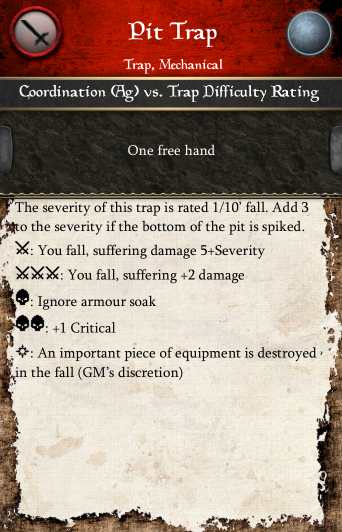
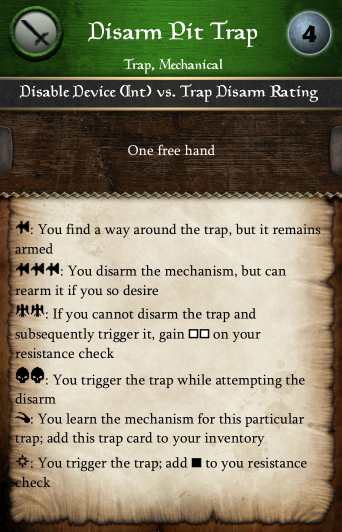
  • My previous post described some ideas for setting traps in Warhammer 3; in this post I present the pit trap card.

    The resistance side:

    That sickening feeling of falling…

    This is the disarm side:

    Every party is spoiled if the thief doesn't come…