On the 20th of November I went with my friend Miss Y and her sister Miss N to view the Grand Sumo Contest in nearby Fukuoka. This event was supposed to be the event when the current grandmaster (Yokozuna), Hakuho, was due to set a world record for consecutive victories; unfortunately he got beaten on the Monday before, so no record viewing. Also, Misses Y and N are teachers at the same Ninja High School, and as you know Ninjas never rest, so they could meet me until 13:30 on the day, which meant we didn’t get to view the full day – we only saw the Makuuchi, the most important Sumo wrestlers, in the last 1.5 hours of the day. Sumo is a bit like a Japanese version of cricket, which means that it is a full-day event where you lounge around, drinking and talking and occasionally noticing that there’s a sport happening in the background. Here is an example of what I mean when I say lounging: Miss Y and I got a “Pair Seat”:
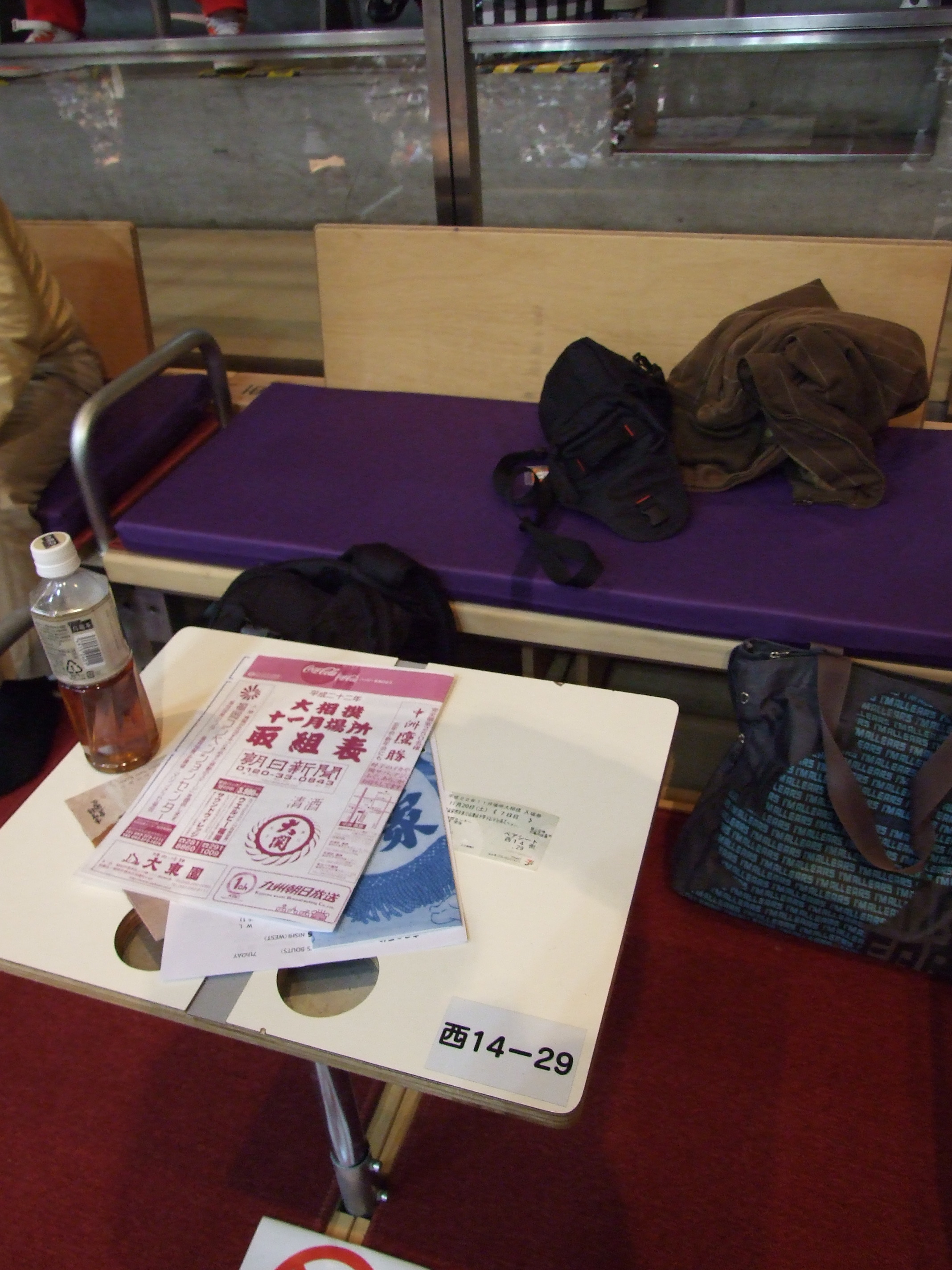
Special Big Man Viewing seat for normal people

Had we been here all day then just like in an Aussie cricket day, we could have spent the day drinking beers and enjoying the view. Instead we sat on the edge of our seats while the various wrestlers tried to tear each other apart. Here’s an example of two wrestler’s in preparation for the titanic clash:

All Ritual and No Trousers…

For those of my readers who aren’t familiar with Sumo (is there any such person left in the world?[1]), the preparatory rituals often take longer than the actual fight, which typically is resolved within 10-20 seconds of its commencement. Some wrestlers make a big show of the preparation, and the crowd is generally as appreciative of the stand-off before the bout as they are of the actual fight. So you see a lot of salt-throwing and not so much person-throwing.

There are certain things about Sumo that I find surprising. Here is a short list…

  • Sumo Wrestlers are really big: you get to stand near them at the match (there’s not much security or separation) and they really are big, bigger than the few rugby players I’ve met, giants among men. This is even more striking for Japanese people – I’m small in my own country but big here, and these guys make me feel small.
  • The constant flux: Sumo is a serious business – that ring they’re standing in is a significant religious object, kind of like a shrine, and every aspect of the sport is steeped in ritual. But as they prepare for and conduct the fight, there are constant distracting mundanities happening around them – men cleaning up the salt from the ring, new wrestlers entering the area around the ring, people running by. It’s strange to see this holy activity surrounded by such a buzz of normal life
  • Lack of professional distance: The Sumo wrestlers move around the outside of the hall with almost no separation between themselves and the crowd – you can actually stand right next to them and take photos as they line up, and see them wandering around the halls around the changing rooms. This is quite different to western sport
  • Weakening of the sport: A lot of the victories I saw were oshidashi, that is one person pushing another from the ring. I think this is the easiest way to win a fight and I think it indicates a slow loss of skill in the sport. I think in previous eras there was more agility and skill, and I wonder if the size-related arms race has led to a loss of delicacy and finesse in the sport
  • Intrusion of the everyday: As Hakuho, the grand master, was preparing for his bout lines of men entered the edge of the ring and walked around carrying banners advertising Tea Rice and McDonalds. These men were so numerous and their line so long that they actually interfered with Hakuho’s preparations – he was retreating to the salt bin but had to wait for the advertisers to pass! This happened twice in the run up to his bout. I’m surprised that even though the ring is like a shrine and he is the most revered participant, mere advertising is allowed to intrude on his preparations (see the picture below). I can’t figure this out
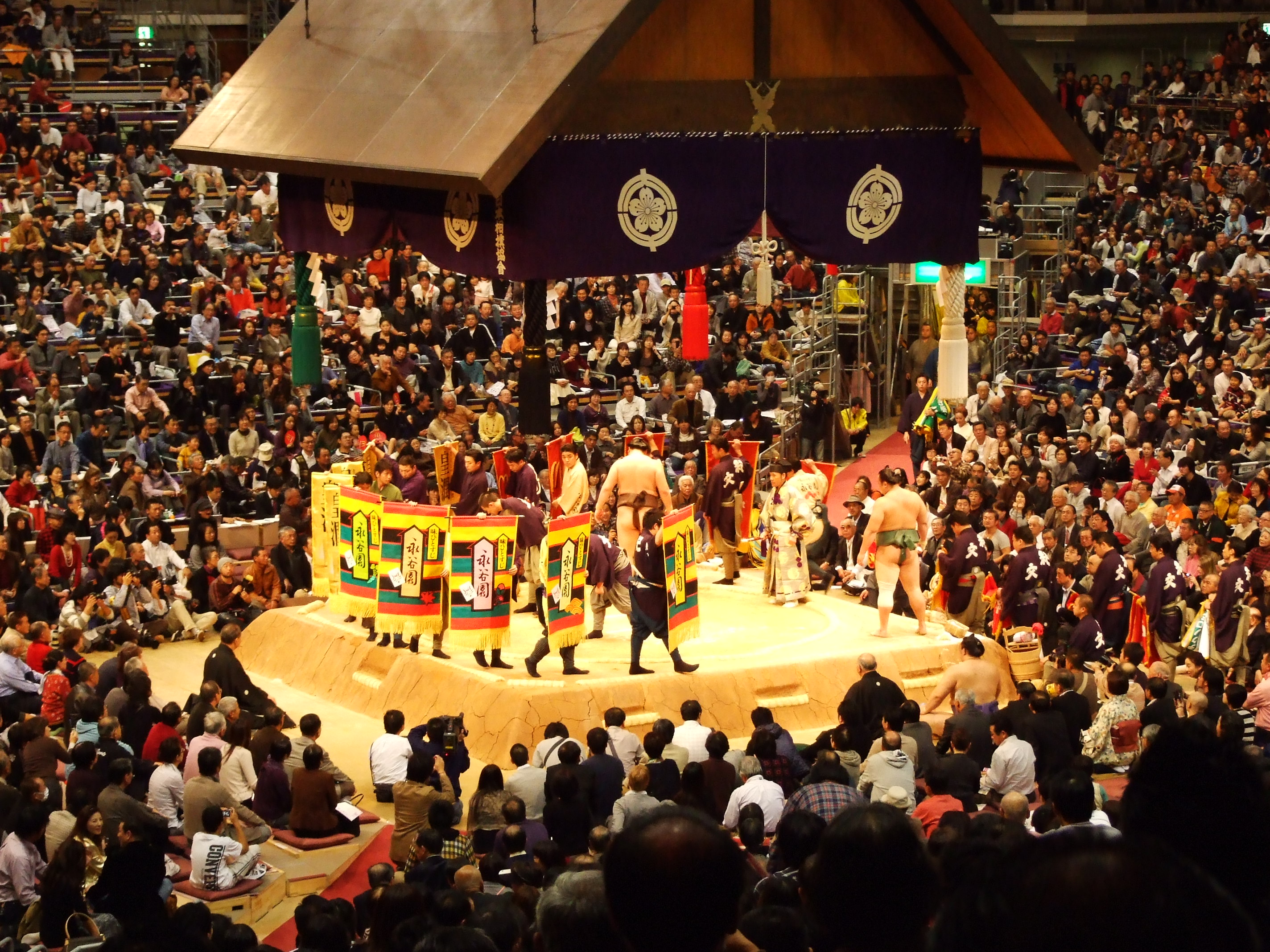
Who said advertising and religion don't mix?

Sumo is Japan’s national sport, but the top ranks are top-heavy (literally!) with foreigners, but during the day I didn’t get any impression of racist abuse or comments being yelled at the wrestlers. In fact quite a few of the top flight’s most popular members are foreign (e.g. Kotooshu), and my friend Miss Y was recently mortified when a gambling scandal overtook Sumo, but only the Japanese wrestlers were implicated[3]. I don’t think you’d see quite the same attitude in European soccer, though it seems to be common in rugby. For all its many charms, even in NZ rugby is not a religion, though, and if it were I can’t see the English-speaking world being as accommodating of foreign involvement as the Japanese are. But this will never be tested, it’s just supposition on my part.

I’m generally of the belief that sport is better watched on TV than live, but if you get the chance I do recommend a visit to the Sumo, particularly if you go with some friends and spend the day eating and drinking and making merry while Big Men smash into each other in the far distance. Especially if you like the sport, as I do. But ultimately, like every other sport, Sumo is probably better seen on TV.


fn1: People unfamiliar with Sumo, that is. I know that there are a few people in outer Mongolia who are as yet unfamiliar with my blog[2]

fn2: Though in a strange coincidence those people already are familiar with Sumo. Maybe this post will complete my saturation coverage of the globe?

fn3: I think this is for the simple reason that Yakuza hate foreigners and won’t deal with foreign wrestlers, not any particular moral superiority of the foreigners[4]

fn4: Though I do think that Sumo is an environment of bullying and abuse that probably encourages only the people with the worst characters to join or stay. So maybe foreign wrestlers raised in foreign sumo schools – e.g. in Mongolia – avoid this culture? I don’t know how they train though, or if they train there or here…

Posted in , , , ,

7 responses to “Current Viewing: Sumo”

  1. noisms Avatar

    Oshidashi can be the most exciting finishing move in Sumo – depends on the fight. The most annoying for me is the hikiotoshi, which usually involves somebody moving backwards at the last minute so their opponent stumbles forward and falls flat on his face. With hilarious consequences. It’s both dishonourable and really boring.

  2. faustusnotes Avatar
    faustusnotes

    I can see that it could be exciting but mostly it’s pretty bland. I like the intense short struggle followed by the lift and carry or the huge twisting throws (I don’t know what they’re called). I think I once saw Asashoryu use hikitoshi (or maybe it was the one where you step aside) and it was considered beneath his station. Nobody booed but there was this kind of stunned whisper as everyone took in the rudeness of it.

  3. Grey Avatar

    Sounds like a cool event to go through.

    Do you think the weakening of the sport is tied into a similar effect in what we might see in mixed martial arts? Everyone goes with what the most effecient way to win even though there are certainly flashier and more entertaining ways to do it?

  4. faustusnotes Avatar
    faustusnotes

    I’m by no means right about it being weakened, but my thinking is that the growing size of the contenders has made them less mobile, and more prone to use frontal assaults and raw power.

  5. faustusnotes Avatar
    faustusnotes

    I also, incidentally, have a theory that good sportspeople have to be intelligent and motivated, and strong economies in well-functioning first world countries provide intelligent, motivated people a lot of alternatives to sport as a way of making a living. In order for these countries to continue to recruit talented people (that is, smart and motivated people) to sport they either need poverty traps that sport provides an escape from (think sports scholarships in the USA) or a really strong culture of admiring and respecting sportspeople (think Australia) in combination with good opportunities for people to get quality sports training.

    I think Japan doesn’t have either of these conditions. Poverty traps here aren’t very significant, and there isn’t a strong culture of idolizing sports people outside of baseball. The result of this in an economy with very low unemployment is that smart, motivated people go into good, well-rewarding jobs rather than take the hard road to sports glory. And the road to sumo success is a really hard one, involving a lot of bullying and hard work. Sumo is physically demanding in a way that few other sports are, and it’s pretty clear from recent reports that it’s an extremely nasty internal culture. So in a country with lots of alternative routes to happiness, it will only encourage mediocre people who function in an environment of bullying and suffering. In the long run this will lead to a decline in the quality of the sport, which I suspect we’re seeing now. This is also, i think, the underlying reason for so many foreigners excelling in the sport – they are escaping international poverty traps (most of the foreigners are Mongolian or Eastern European).

  6. Grey Avatar

    There is a lot of alternatives to sports but as you know, sports are an addictive drug unto themselves. I’d like to think most people that play them at a collegiate level in the states know they’re most likely not going to be playing professionally, even if it is a twinkle in their eye. That bit of culture there will always have a stream of people that are willing to compete, for whatever reason. I would imagine Sumo dosen’t have such an underlying structure?

    As for your above post – that would make a lot of sense. Most likely they would avoid the crap that is involved internally as well, as least as far as the bullying is concerned.

  7. faustusnotes Avatar
    faustusnotes

    True, but I think that entering a sport professionally requires an enormous amount of additional commitment, and cultivating those talented and committed people through all the lower layers of the sport while encouraging them not to take up much less demanding routes to happiness (like a full-time job) is actually really challenging. Also you have to identify them early enough to divert them from other pathways. For example, Japan has a pretty egalitarian education system, so bright and committed kids from poor families are pretty likely to be identified at a young age and directed down the route towards the company-employment system. Even if these kids are doing sports club activities at school, someone somewhere has to channel them into that activity, but in a full employment society where sport isn’t revered as it is in Australia, there’s little incentive for anyone to do that. So by the time these bright and talented kids discover they could have made a career as sports stars, they’re already on a different path – which leaves the not-so-bright kids going down that sports path.

    This is especially true of Sumo because it requires an additional level of physical commitment that other sports lack. In addition to all the usual intensive training and the cloistered lifestyle of any serious sport, it also requires massive physical changes – bulking up to a huge level – and many people will look at that and baulk. In addition, it’s only really done by the very biggest men. So the available pool of talent for continuing the sumo tradition is: bright, committed, really big men who are willing to radically change their body shape for the rest of their lives.

    The only people who will do that are crazy or don’t see alternatives. But Japan offers alternatives.

    In the same vein, I suspect that Thailand’s (awesome) strength in Muay Thai will weaken as it becomes more developed, because currently it’s a path out of poverty and is drawing on children from a very large pool of urban and rural poor. When Thailand is fully developed (not too far away, I suspect) these kids will have alternatives to the insane life of a kickboxer, and the pool of talent from which champions are drawn will dwindle. Foreigners will enter the field and begin to match the locals, instead of being basically meat punching bags (which is what they are now). I think economic development + equality is not good for sport unless you have a strong culture to defend it; and a sport being a country’s national sport is not sufficient cultural driver. You need a general culture of worshipping sporting prowess, as in the antipodes, and strong international rivalries (as in the antipodes). None of these things exist for Sumo, and I suspect not for thai boxing in Thailand either.

Leave a comment