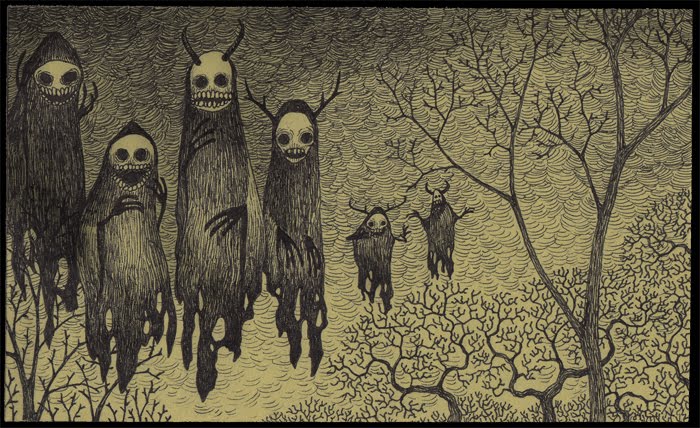
Infernal adventuring…
Simon Jenkins, Guardian columnist, ex-HIV Denialist and public health skeptic has a column up at the Guardian that contains his recommendation for dealing with the NHS. Unsurprisingly, his basic recommendation (like every other article he writes on public health risk) is – let them eat cake. Essentially worthless, in a roundabout way it aims at a solution and provides a couple of examples of the kind of magical thinking that lots of free market “solutions” to the NHS’s problems are prone to – and shows why they discredit the real, simple market solutions that might make the NHS work better.
But before we get onto the substance of the article, let’s just contemplate what Jenkins’ presence on the pages of the Guardian has to say about journalism as a profession. This is a man who for several years in the early 1990s was so staggeringly wrong about the science of health that he sided with the HIV denialist movement, writing articles that opposed the link between HIV and AIDS long after the dust settled. The consequences of HIV denialism in Africa are pretty well understood now, and very sad, but here we have this man still writing on health-related topics – and specifically, on disease prevention – in the pages of a major UK newspaper. This is like giving editorials on NASA to a moon-landing skeptic. But somehow journalism manages to struggle on in this way, giving a dangerous idiot high profile space to spread idiocy and lies. And the lies haven’t even changed – his work on swine flue alarmism used pretty much the same arguments as his HIV Denialism. Oh journalism, what happened to you?
So now Jenkins has moved on to health policy, ever an important topic in the UK, in the wash-up of a report from the NHS Ombudsman on appalling mistreatment of old and/or very sick people in some hospitals. The report itself is summarized here and here. Jenkins provides us with a long list of the reorganizations that have been tried in the NHS over the past 50 years, and concludes that the NHS is “too big” and is best broken up – sacking 24,000 back office staff is a good start, apparently. We find Jenkins wondering why no-one has bothered to try and properly reorganize the system, and instead done all this tinkering at the edges, and suggests that the NHS is so big and powerful that it won’t allow internal change. And he also suggests that instituting top-down targets will encourage staff not to care about their patients. I want to look at these ideas in a little more detail, because they illustrate some of the common problem ideas that strident armchair observers force into the debate – ideas that are unproductive or even harmful to the interests of health policy in the UK.
The NHS Is Too Large To Change
Jenkins’ first point is that the NHS is too large to change, that it can successfully resist external tinkering because it is its own monster. He points to the long history of attempts at reorganizing the NHS and asks why they all fail. He says that
Its interests are too institutionalised, its lobbyists, especially the doctors, too powerful, and its internal controls so pervasive as to seize up the system.
but he doesn’t consider a far simpler explanation. The NHS is the main source of healthcare for 64 million people, and there is currently not a great deal of health care capacity outside of it. Has it occurred to Jenkins that the reason attempts to reorganize the NHS fail is that they need to occur slowly and cautiously? It’s very easy to propose radical solutions from the outside, as a senior journalist who can guarantee himself access to what little private health capacity exists in the UK. But for someone like David Cameron or Andrew Lansley actually attempting to modify the system, there are the interests of another 63,999,999 people to consider. You can’t afford to just break that shit overnight with a radical change – you need to be absolutely certain that the system won’t tip over. Yes, let’s break it all up – and if rather than breaking it up, we just break it, who suffers? Certainly not the top opinion writers at the Guardian.
The reason that the NHS has so much institutional weight is that, even though it isn’t the best system in the world, it works, and it works for 64 million people, most of whom have grown up with no alternative system, and couldn’t afford it if it were there. As a politician, it’s not just your own career on the line if you fuck that up – it’s a lot of people’s health. You tread carefully with a system that has that much weight.
The NHS Is Too Large
The next complaint Jenkins makes is that the NHS is just too large. It should be less mammoth. But if it is so large, why is it underfunded relative to the rest of Europe? As a nationalized health system, there is every possibility that it is not large enough, and needs further injections of funds before it can be said to be large enough to do its job effectively. It may be the case that the NHS as a single institution is too large to be effective, but it may just as well be the case that it is not large enough to serve the needs of its population. The more diversified health systems of Europe may be doing better, but they’re also getting a lot more money and have been getting a lot more money for a long time. We don’t have any evidence that the NHS would be performing worse than those systems if it had received the same historical funding.
Targets Discourage Caring
This is arrant nonsense. Health care organizations have always had top-down targets, regardless of the system they work in. Here’s an example of a target: we want 0 post-operative mortality this year. Here’s another: We want 0 prescribing errors this year.
Do those targets discourage ordinary staff from caring for their patients? No, quite the opposite. The impact of a target depends on the system it is instituted in, its suitability for the staff it effects, and the amount of funding and system support for the achievement of that target. It also depends on staff supporting it, and on the existence of infrastructure and management systems that help that target be achieved. The oldest Doctor’s target – first do no harm – is pretty useless, for example, if you have to treat HIV with ineffective medicines because some thick journalist convinced the government that HIV doesn’t cause AIDS.
For some reason a lot of British journalists and health critics have a problem with targets that way exceeds their meaning. Sure, targets can be useless – they can even make it harder for staff to get their job done – but this critique doesn’t necessitate the level of demonization and magical thinking that attends the dreaded T word in some journalistic and (largely, though not exclusively, Conservative) policy circles in the UK. Caring, wholesome nurses don’t suddenly become dark eyed witches because the government set a target on the number of teen pregnancies in their health area that year. Such a suggestion is magical thinking at its finest.
Sacking “Back-office staff” will get the System Working
This is another common refrain of the “common sense” brigade, the old-school unionists and (again, largely, though not exclusively, Conservative) policy radicals throughout the world. Its of a piece with the misperception of publicly-funded health systems as inefficient “public service” that employs people for make-work jobs. And, it’s largely impossible to conceive of as a sensible policy recommendation if one has ever actually worked in a hospital environment. Once one has, it is pretty obvious that these “back office” staff – supposedly so useless compared to their brave and peerless contemporaries, so-called “frontline staff” – are much harder to define and much more necessary than the policy radicals recommend. Exactly which back end staff should we be sacking here – the ones who process the salaries? The ones who enter the data that we use to track hospital quality? The ones who clean the floors? The ones who process the purchase orders that get the syringes to the bedside?
I worked as “Back office staff” for 3.5 years in a community health centre in Sydney. During this time:
So, who was going to do this if I didn’t? And how in the long-term is the health system going to continue to operate at its best if these functions are retarded and slowly disappear from the organizations that form the whole? Do the policy radicals and idiot journalists who vent this type of inane policy “fix” consider that every private organization beyond a certain size has a similar set of “useless” back office staff, who keep the frontline people working smoothly? No, because they see the word “National” in “NHS” and a red film descends over their eyes. It’s a publicly funded service, so anyone who is not directly and immediately doing something that can be described as “health” must be wasting the public dollar.
This is ideology, not sense. But you’ll read it all the time in critique of publicly funded services everywhere.
The Private Market and the Grain of Truth
Of course, Jenkins has managed, by driving his buick very haphazardly, to swat the fly. The NHS could be improved – it could be made more responsive to patients, to health problems, to new threats and new technologies – by
denationalising, regionalising, introducing market forces, contracts, choice, anything to reduce bulk
and he correctly notes that this has been the plan for 20 years. Ultimately the way to improve the NHS is to “break it up” in some sense – to move towards the more decentralized mixed systems of Europe and Australia and Japan, where private and public providers compete for public money to treat patients who largely pay for the service they receive through taxes. Every movement in the NHS over the last 20 years has been towards this system, if not in essence then in practical fact. But no matter how much policy radicals and idiot journalists rant about it being too big, the fact remains that the health system in the UK is underfunded – in private and public contributions – and has been for a long time, and until it catches up with the European standard, too-rapid decentralization would be a disaster. Furthermore, with the British private sector very underdeveloped relative to other nations, time and investment is required. This can’t happen overnight because to dump 64 million people onto the tender mercies of a system that has been moribund and underfunded for 30 years, with no alternative, would be a policy disaster. So health policy in the UK moves slowly and consistently towards this goal, as successive governments find ways to loosen up the NHS and prepare the groundwork for a more flexible, more modern system, while people on the far left and the far right of the debate[1] watch the whole thing, and miss the point.
But the absolute worst thing that could happen while that movement occurs is for the people in charge of it to start thinking that the cause of the NHS’s problems is its overall size, and start hacking into it with gleeful abandon. Which is why people like Jenkins really need to stop talking about health and talk about something better suited to their moral and intellectual stature. I propose football.
—
fn1: And with health care, in the UK at least, it seems like you don’t have to stray very far to the left or the right to start behaving like you are “far” from the centre. The state of commentary on healthcare in the UK is really rather woeful.
I think everyone is probably familiar with the idea of this novel, which is the original tale of Pride and Prejudice set in an England beset by a plague of zombies (or “unmentionables”). I’d been meaning to see how this story worked for some time now but, sadly, it was a little disappointing. The basic story is the same, except that the Bennett’s 5 daughters are all highly trained zombie killers, who spent years under the tutelage of a Shaolin Master Liu in China, and are pledged to His Majesty to devote their talents to killing zombies until they marry. Elizabeth, particularly, is a vicious and bloodthirsty killer, used to eating the hearts of her human enemies, who sees violence as the solution of every problem. Darcy is also a famous zombie slayer, the militia are in town to kill zombies, and Lady Catherine de Bourgh is also (supposedly) a trained zombie killer, who maintains a personal squad of 25 ninjas and sneers at the Bennett girls’ inferior education in China. The zombie menace, and this twist on the original characters, provides for some entertaining alternative interpretations of famous scenes in the original story, but these original interpretations do not change the plot. So, for example, Lydia’s elopement with Wickham doesn’t change in essence, though some aspects of its resolution are tweaked to suit the setting.
I read the book constantly hoping that the plot would take a turn away from the original story, for example towards some kind of Victorian-era survivalism, or a revelation that Lady de Bourgh was experimenting on humans, or something… but it just folllowed the original plot, with these occasional zombie references thrown in to the original text. The zombie references – and the references to the girls’ training and combat skills – were largely well done, fitting both the style and substance of the story, but this left us with one big problem: Pride and Prejudice and Zombies is, at heart, Pride and Prejudice. Which means that it’s a shit boook.
Jane Austen’s work is fundamentally shallow, boring, and useless, and her books have the rare distinction of being easily improved by being set to film, because their content is itself so lacklustre and wan. Furthermore, there’s nothing in the characters of her stories to appeal to either the broad populace of their time, or to the modern reader. What about the shallow, empty lives of a bunch of silver-spoon middle class loafers can possibly be of relevance to the modern reader? These people don’t work, they have “three thousand pounds a year” and spend their days at such leisure that the only real entertainment they have is fevered imaginings as to who is going to marry. Somehow, in Sense and Sensibility, when Edward Ferrers is disowned of his fortune, we are supposed to have the utmost of sympathy for him because he will have to find a job. How is the modern reader supposed to relate to this? And looking at their lives, it is obvious that this round of marriages and inheritances and worries about position in society is nothing but a great big ponzi scheme, supported at the bottom by a huge pool of the real “unmentionables” of Victorian society – the lumpen proletariat, who slave away in the harshest conditions so that these rural “gentlemen” can have the privilege of never having to do a moment’s work. Is this the lost rural idyll that was destroyed by the first world war, and that Tolkien pined for? Good riddance to it, and the sooner the shallow ravings of the Victorian chick-lit writers (the Brontes and Austens &c) can be forgotten along with that cruel and unusual period of British history, the better. Though the dialogue in these novels can at times be charming and carefully crafted, they have nothing else to recommend them, even as historical documents. Comparing these works to those of Thomas Hardy, it is clear that the Victorian England that he saw has nothing in common with them – nor do the rare attempts at description in an Austen or Bronte novel compare in any way with the genuine literary prowess of Hardy. They are simply moral tracts, advertisements for a new image of marriage as a binding contract that wraps love and property together for the first time in British history – and in Hardy’s work, again, we see that this new model of marriage was not yet so popular with those real “unmentionables” whose face is never seen in the Austen novels.
As my reader(s) are no doubt aware, I’m fond of finding parallels between real political and social issues and the zombie threat, but in this case I sadly could not see much evidence that the “unmentionables” in the revised novel have any symbolism to be drawn from them. I think this is partly because they aren’t central to the plot, being only rarely inserted into the original story, so don’t have much power in the tale; and also the original books are so self-sufficient in their conceited dwellings on trivial Victorian romance, that the zombies just can’t stack up against the central “love” story. Certainly I don’t see the “manky dead” in this story taking on any imagery, for example, of the true British underclass. And perhaps this is why the two page “reader’s guide” at the end of the book (intended as a set of questions for the literary student) contains questions that are largely quite weak – because the zombies just aren’t that persuasive a part of the book.
So I see little reason to soldier through this romantic waffle if I don’t have to, and I had really hoped that Pride and Prejudice and Zombies would give me a completely fresh take on the novel – whether it be in plot, in resolution of the key stories, in interpretation of the Victorian world, or in politics. But it just scratches the surface of the possibilities, so that what we are really left with is – Pride and Prejudice. Against which – despite my enjoyment of the films – I must, I am afraid, remain prejudiced. So, don’t read this book unless you really are capable of suffering 325 pages of Victorian chick lit, with the odd zombie thrown in.

In a recent game report I mentioned that I have a singular talent for convincing people of the truth of outrageous lies, and gave the example there in a footnote of the time I convinced a friend that a hawk had carried off a baby at Matsue castle. This got me to thinking that I should start a new irregular series on this blog, in which I catalogue some of my more ridiculous lies. I manage to pull off a doozy on Wednesday, which is particularly admirable for having been conducted in Japanese, with a friend who already knows my reputation for outrageous fibs. So, without further ado, here is the lie of the Drunken Whale.
The Drunken Whale
So I was at a cute little izakaya with my friend Yumiko, and decided to have a single glass of sake (Japanese rice wine, that the Japanese call nihonshu). Perusing the menu I found they were selling suigei, 酔鯨, which happens to be a favourite of mine[1]. So I said to her, all innocent-like, “ooo, I’ll have the Drunken Whale!” Yumiko is an expert on sho-chu (Japanese vodka-like drinks) not nihonshu, so for some reason I can’t fathom she asked me “Is it special?”
Well … and that was all the encouragement I needed. I could have said “no, but I like it.” Instead I told her the story of how it is made, and she, silly sho-chu drinker, listened attentively and believed the lot…
Basically, when nihonshu is made it gets to a half-way point where the original rice ingredients have been reduced to a kind of mash[2]. It is at this point that suigei becomes special. Instead of simply pressing the juice from this mash into the next stage of the fermentation process, the suigei brewer does a special thing. Sheets of whale baleen[3] are laid over the barrels that the mash is to be filtered into, and then the mash is spooned on top and allowed to drip through the baleen into the barrels. As it passes through the hairs of the baleen it acquires a slight salty taste, and thus when you drink the final product you feel you can actually taste the sea.
The Response
Yumiko was amazed by the production process and said to me “Really! Can you taste the sea?!” When I began laughing at her gullibility, she threw her hand towel at me. The joy of this lie is that there is no such thing as a salty or sea-flavoured nihonshu (they’re classified in terms of sweet or dryness, like wine). So even a rudimentary objective assessment would have been suffiicent to show I was lying (not to mention – how valuable must baleen be??!!)
My Assessment
The main trick I used here was to weave together things we both know are true – the mash stage of the nihonshu process, the baleen of whales – to form a stupid, unbelievable whole. I further impressed Yumiko with my honesty by going off briefly on a tangent while we tried to work out what the word for baleen is – these sorts of tangents convince the listener of your honest intentions, since if you were just trying to tell a bald-faced lie you wouldn’t spend several minutes arguing over a word, would you? Then of course I finished it off with a credible but completely wrong culinary trick (“you can taste the sea”) which on one level adds to the believability (there was a reason for all this baleen-filtering) but on another completely undermines the story. So there are multiple tips that the story is false, but told earnestly on the spur of the moment, in connection with a drink I appear to know about, the lie comes together naturally and powerfully.
Degree of difficulty: I’d give it a 4.2 out of 5, because Yumiko was sober, she knows a bit about alcohol, she knows I’m a liar, and I was doing the whole thing in Japanese. But Yumiko is not naturally suspicious, so it wasn’t impossible.
Degree of preposterousness: I’d say it’s a 3.8 out of 5. Sure it’s stupid, but who knows what goes on in the making of craft beers and the like? If people can eat moldy cheese as a delicacy, than filtering wine through baleen isn’t completely beyond the pale.
Degree of success: Thoroughly believed, so 4 out 5. This rating gets a 4.5 if the victim is able to leave the scene of the lie still believing the story, and a 5 if next time you see them they still believe it.
Overall rating[4]: 16 out of 25
—
fn1: Yes, I’ve become the kind of wanker who is beginning to understand differences in taste between brands of nihonshu, and has favourites, and calls it nihonshu rather than sake. You’ll find me at the end of the bar, without a girl.
fn2: I learnt this from reading a wall at the town of Hita when I visited there for a lantern festival.
fn3: Neither Yumiko nor I know the Japanese for this, and for good reason – the characters for it are very weird, but I think it basically means “whale beard.” And baleen whales are classed as “beard whales.”
fn4: Calculated as the average of difficulty and preposterousness, multiplied by outcome. Scores over 20 are going to be extremely hard to achieve.
Australia has a compulsory superannuation scheme, and I have questions about it. These questions have been floating around in my head for a while, but the catalyst for thinking about them this week was this article by Brian Toohey, which I discovered through the Australian political blog Larvatus Prodeo. I’ve always been a supporter of Australia’s compulsory superannuation laws, which seem to be popular across the Australian political spectrum and were introduced by one of the two great men of modern labour politics, Paul Keating, but over the last year I’ve seen an increasing range of criticisms of the underlying concept and the Australian system in particular. I’m no economist, but some of these criticisms seem so basic that it’s hard to believe they haven’t been thought of and dismissed by people who understand these kinds of systems, and the logical answer to them appears to be a shift away from the neo-liberal model of personal retirement savings and back to a Keynesian (?) version of government-funded pensions. The conclusions of a sustained criticism of the Australian system, one way or the other, probably have relevance to the ongoing US debate about privatizing social security.
This post, then, is an attempt to frame these questions in the hope someone out there will answer them. It’s clearly off-topic, so sorry about that.
How it Works
The Australian superannuation system basically works like this: all Australian employers are required under law to contribute 9% of their employees’ salaries at least every three months to a registered superannuation fund. This 9% is on top of the employer’s wages, and is meant to represent a kind of top-up of their wages into a pool of funds that are reserved for their future. Soon this top-up will go to 12%, and many employers choose to top-up more. Employees can also choose to set aside some proportion of their wages – I typically put a small amount aside – and all of this is sequestered away in an account until they turn 55 (or older), when they get the resulting vast scads of cash. Employees who put their own money aside get tax breaks on that money which can be quite lucrative (especially for the higher income earners).
The system was introduced in 1992 by Paul Keating, at which time the compulsory contribution was 3%. This contribution is generally seen as taking the place of a pay rise, that is Australians forewent a 3% pay rise in order to obtain this superannuation security in their old age; but many commentators have pointed out that this is a disingenuous comparison (one made by Toohey in the linked article above) since it’s unlikely that the government could have mandated a 3% pay rise for all employers – if not diverted to superannuation this money would be going into the pockets of employers, not employees, and then (in theory) 30% of it would be taxed as corporate taxes.
For the purposes of my questions about super, though, I want us to assume a few basic principles about superannuation as it’s presented to us:
So, let’s consider the objections I have heard over the past few years.
The Libertarian Objection
As I said, compulsory superannuation seems to be generally well supported across the political spectrum in Australia. Free market types like it because it moves responsibility for retirement savings from government to individuals, but at the same time it doesn’t leave (many) people uninsured, which is always the risk with wholly private systems. That is, it introduces a private savings mechanism without having a problem of free-loaders. Government intervention types like it because it maintains a safety net through its compulsory nature. Most libertarians in Australia are pretty practical about their libertarianism, so tend to accept limits on the economic “freedoms” that their libertarianism would lead to, so I think many libertarians would support this kind of policy too. However, there is a common libertarian objection I have read, which is this: for the lowest earning people in the labour market, their compulsory superannuation contributions will also be low, and at the end of their working life they will get a very small pension from their superannuation account. So, accepting that the contribution to superannuation is foregone wages, these people are being forced to forego a small improvement in their current poverty, in order to guarantee them a retirement future of … poverty. A 9% pay rise at the bottom end of the income distribution is much more valuable than at the top end; yet when they retire, low income earners’ superannuation will provide them nothing better than they would get from any economically reasonable state pension. So from a libertarian perspective, these people are being forced to spend their money now in a way that doesn’t benefit them later. They’d be better off receiving that 9% now, spending it on cocaine and dancing girls, and retiring on the state pension.
Note that this libertarian argument assumes the existence of a state pension. So it’s contradictory in libertarian theory, but I think it’s very true in a real world. The superannuation system benefits the wealthy far more than the poor. Of course, this argument fails if assumption 2 (the contributions would otherwise be a pay rise) were not true. But a variant exists even then: if the employers pocketed that 9% contribution, 30% of it would go to the government as corporate taxes, and some proportion of that would support a higher level of state pension, and poor people would benefit most from that increased state pension.
The Perverse Tax Cost of Compulsory Superannuation
The system as currently constituted provides tax breaks to people who make voluntary contributions to their superannuation, in order to encourage individual contributions. These tax breaks are now estimated to cost up to $100 billion, which is more than the state pension would cost if everyone were accessing it. We can see this through a few simple calculations of what we could spend this money on if we didn’t blow it on tax breaks for superannuation:
Regardless of the particular spending benefits of this money, it seems crazy to me that the tax breaks on superannuation should exceed the cost of a decent government-funded pension.
The Equity Objection
One of the strongest ongoing objections to these kinds of social insurance systems – where your contribution to the system and your ultimate repayment from it are proportional to your income – is that they benefit the rich more than the poor. A 9% foregone pay rise at the bottom income quintile is a much more punishing idea than 9% foregone at the top, but at the end of their working life the people at the bottom income quintile get a much lower return for that foregone pain than the people at the top. Under a fixed state pension, funded from general taxation, the rich benefit much less from the scheme than the poor. Both have received that 9% pay rise, both have paid taxes, but at the end of their lives the poor have gained more from those taxes than the rich because the pension is a much higher proportion of their pre-retirement incomes than it is for the wealthy. This is the essence of progressive taxation, and it’s a strange quirk of history that a labour government introduced such a regressive system.
The Boom-and-bust Objection
One significant consequence of the superannuation scheme is that it has led to a massive increase in the amount of Australian money floating around in investment funds, causing trouble. Current estimates are that $1.2 Trillion are floating in the investment market, paying $18 billion in commissions to fund managers. All this private money looking for somewhere to invest is supposed to do good in the local economy – fund managers invest in shares, which promotes the growth of industry, which is good for economic growth. But this money also is a lure for all sorts of ponzi schemes and economic bubbles – bubbles tend to happen when large amounts of money are available to invest. Other countries (e.g. the UK) are operating similar schemes, and naturally once the pool of available funds exceeds the capacity of the real economy to absorb the money, the remaining funds start being invested in capital growth schemes, which then burst because they have no real foundation, and cause crashes. Is it a coincidence that the world’s last few big crashes correspond to an era when huge quantities of money are available for investment through 401(k)s, superannuation schemes, and sovereign funds? I don’t think so.
Also note the cost of this money – it’s $18billion to invest $1.2 trillion. Is it possible that if that money were collected as taxes, the $18billion would be spent on jobs in the public sector spent administering that money? Is a job in the public sector worth less than a job as a fund manager? Does either person contribute less to society? And can we say after the GFC and the subsequent economic troubles it has caused that the $1.2 trillion would not be better spent on government infrastructure investment? Especially given that one of the major causes of inflation in Australia is infrastructure bottlenecks and environmental problems?
There is a general argument that the private sector distributes money more sensibly (?) or efficiently (?) than the public sector, but is this still true when the available investment funds exceed the capacity of the market to spend them? Governments can store that money as surplusses, against hard times; investment funds piss it against the wall in investment bubbles and ponzi schemes.
The Stored Wealth Objection
Money invested in superannuation for the future is seen as providing for one’s retirement, but that money doesn’t suddenly appear when you retired as a golden watch, a bottle of champagne and food and medical care for the next 20 years. It appears as money to spend on those resources, but if those resources haven’t been secured in the period between your investing the money and realizing the returns, or if they have become scarce in that time, then your money won’t actually provide for anything. The superannuation funds focus on increasing their own value, but they don’t necessarily do that by increasing the size of the actual economy where you actually live. So for example your fund could invest in high-return farming projects in Iceland, Africa and Russia, so that when you retire you get lots of money – but then you have to buy food imported from those high return farms overseas, because no-one was investing locally.
Superannuation funds are under no particular obligation to improve the economy of the people who invested in them, so in the long run do they actually help to maintain a good environment for the superannuant? Shouldn’t at least some of this money be being spent by the government, to avoid the risk of market failure? (And is this objection any different to the Boom-and-Bust objection?)
The Poor Returns Objection
The Stored Wealth Objection can probably be answered by pointing out that the issue it addresses is handled by inflation. But the performance of superannuation funds over the past 20 years has been dreadful, with their average returns only 0.1% higher than long-term inflation. So really, the money would be better spent if it were just saved in a normal bank account, or invested in cash or government bonds. So why the special system of compulsory superannuation? The money from the foregone 9% pay rise might be better used if it were kept by the companies to use in investment or profits (which are taxed, and then used by the government to fund infrastructure development, which lowers inflation) or paid directly to employees (where it is taxed, and then used by the government to fund infrastructure development, which lowers inflation) to be spent (economic growth) or saved (future economic security). None of these alternative options could possibly provide a lower rate of return than the superannuation funds have offered.
It’s all a Big Scam
(This is also an objection). Some have implied that the whole thing has been set up by the finance industry as part of its 10 year long march into control of the economy, and the main beneficiaries of the whole process over the long term have been the funds management industry. This is partly ameliorated by the observation that the biggest superannuation funds in Australia tend to be union-related, industry-specific funds, not big bastard international banks; but I’m sure the people in charge of those industry funds are still managing to feather their nests nicely compared to doing a real job. So who really benefitted from this program?
Final Notes
Looking at these objections, it seems to me that Paul Keating conned us (or, more likely, got it wrong). We’re better off with a state-funded pension system supported through taxes, and the problem of the demographic shift that will undermine our ability to support old people in the future is better dealt with by addressing it directly – through schemes to increase the birth rate, lengthen the working age, etc. The huge flood of money into the private sector has led to increased boom and bust cycles, reduction in affordability of housing, and inflation, at a time when Australia needs its government to be spending huge amounts of money on infrastructure development and environmental improvement. However, my understanding of the details of these arguments is limited so please, if you have an alternative opinion, out with it in comments!
—
fn1: and obviously everyone would also get a pony
Changes in my plans for the next year or two mean I’ve been thinking about future campaigns I could run – possibly even in English! – and this leads me, inevitably, to think about some of the campaigns I’ve thought of running or wanted to run in the past but been unable to, either because a) I don’t feel up to it or b) I haven’t had a chance or c) players aren’t interested. So here’s a short list of some ideas I’ve had, and the reasons I haven’t/won’t/can’t do them, and what I might need to do to run such campaigns.
Interstellar Sandbox
I’ve long wanted to run a sandbox game set in a Space Opera universe, where the PCs have no purpose but to wander aimlessly from planet to planet causing trouble. i.e. Traveller, but I have never had any success trying to run a campaign in this type of universe. I really like the Traveller universe but I hate the game, so I’d probably switch to a different system, e.g. d20 Modern or even my own adjustment of d20. I’m really interested in the ‘Verse, the universe of the Firefly TV series, and would love to set a campaign in that universe. It has all the benefits of space opera, but incorporates just the right grittiness to make the play style more interesting. I think it comes with the challenges of Nihilism I’ve previously expressed concern about in “punky” and hi-tech settings, but the poverty of the edges of the universe means that you can easily restrict access to more advanced tech; and in the more “civilized” planets the Alliance is clearly an anti-smoking, gun control New York city council gone hyperspatial, so there’d be no problem controlling access to the most advanced tech. There’s also a huge amount of adventuring opportunities in the ‘Verse, and even humanoid monsters.
The big problem I have with space adventures is that I really like my campaigns to include some magic, and there’s very little of that in most Space Opera. I could do Star Wars, but I always find that setting strangely limiting. Technology can be its own magic, of course, but for some reason it never seems to work out that way. Unless…
The Culture
The Culture of Iain M. Banks’s novels would be a very interesting setting for a campaign. The universe is huge and easily-explored, the technology is so advanced as to easily be treated as magic, and the biotech of the Culture universe gives lots of opportunities for the creation of strange character classes. Furthermore, Iain M. Banks has already provided a range of outstanding settings to gallivant around in, some of them quite remarkable. The classic adventure hook would be to set the PCs up as agents of Contact, and to set them a task they can go about achieving any way they want. Unfortunately, adventuring in the Universe of the Culture has significant GMing hurdles, not the least of them being that PCs basically can’t die, so you need to present adventures in which failure is not built around death, but mission failure. Also, the range of available technology is infinite – the PCs can simply ask a GCU to accompany them on a mission, and if it agrees well, that’s that, the PCs have a world-destroying space ship of infinite intelligence at their disposal. Plus of course, they will always have a knife-drone to protect them, which makes them immune to pretty much any attacks. This would create the challenge of adventuring without combat. Weird. This is essentially a type of superhero adventuring, and although the universe and settings appeal, I think it’s too challenging for me to GM.
Surprise Apocalypse
This campaign idea sets the players up as a group of completely ordinary young people in a standard 1960s city. Each PC is completely and utterly 0 level, but has one special skill connected with a hobby or their work. The campaign starts with them having lunch together in a setting where they could, potentially, gain access to privileged information. What follows is a series of increasingly bizarre warnings that something is about to happen – either over a period of days or minutes, depending on the scenario I envisage. The PCs have the chance to take the initiative and get the right, or wrong, idea about what is happening. After a fixed amount of time the apocalypse hits, and they’re either in a safe location or not. They then have to survive the post-apocalyptic circumstance they find themselves in. I envisage the apocalypse as a classic nuclear attack, though the aftermath might be heavily influenced by horror, with mutants, monsters and/or slow leakage of magic. The original plot I envisaged had the PCs lunching together in the canteen of a government department, with one of the PCs a telephone operator for that department. Seeing activity nearby, they can investigate over the afternoon using their contacts, and identify an imminent attack. They then have a chance to infiltrate the government’s dedicated shelter, which they aren’t authorized to enter. Once in it (if they’re successful) they have to explain their presence, and/or kill everyone. While trying to live this lie, some kind of horror scenario unfolds.
An alternative plot would have the PCs having to untangle multiple strands of possible warnings – nuclear war, invasion, or disease – before the actual apocalypse event hits. I even envisaged the PCs being able to learn magic in the new world, as previously-buried secrets come to light in the new world. From 0 level nobodies to wizards and post-apocalyptic gang lords, they could even build their own kingdom in the new era…
Nausicaa
I really like the world of Nausicaa, Princess of the Valley of the Winds, and think it would make an interesting setting for a game. My limited internet searches tell me there is not an existing TRPG for this world, but it’s a lush and interesting setting, that could easily furnish many adventurers. Taking the role of someone like Yupa, the PCs could wander the earth uncovering old secrets and getting into trouble. It includes the opportunity for tomb robbing, dungeon adventures, piracy, forging kingdoms, everything that a normal campaign should have – plus massive insects. Also an excellent setting for a sandbox campaign, as the main kingdoms are outlined but there are huge unexplored spaces to delve into. The original movie and manga contains just enough hints at magic to make at least low-level magic acceptable, and certainly suggests feats of the impossible (massive corvettes, little girls taking out teams of armoured soldiers, the mehve, etc.). I don’t think there would be any problems playing in this world if the players had all read the manga and/or seen the anime.
The world of Mononoke would be an excellent setting as well.
Carcosa
I haven’t bought this product, which was the focus of much controversy when it was released, and I’m not very into old school D&D, but the setting and some of the ideas seem really interesting, and the evil summoning angle certainly seems to suit my style of campaigning. Also, the flavour of the text and the narrative style seems interesting. I really like the idea of a world where dubious “ancients” of some kind designed different colours of human as experimental material, mingled with the swords and sorcery style of the gaming. I’d like to try this someday.
Faeriewhere
Neil Gaiman’s two best books, Neverwhere and Stardust, both present excellent settings for gaming, and because I read them consecutively I’ve always thought of them being somehow linked. Neverwhere is set in a magical alternate London, broken into regions with characteristics based on the names of the tube stations, full of magic and sinister powers, in which all significant business arrangements seem to be based on the exchange of favours. Stardust is set in a faerie land connected to the ordinary world of Victorian England by a town called Wall. I ran a brief adventure once in which the world of Neverwhere was linked to the world of Stardust through the Roman camp at the edge of London, and it really seemed like an excellent adventure setting. The physical laws of Neverwhere are very well established but completely vague, and the general principles of the world clearly enough arranged that one can construct a self-consistent adventuring setting that is extremely dangerous. Stardust is the same. There is scope for almost any kind of adventure in these two worlds, from high fantasy to the grittiest of film noir-style detective agencies. It would be well worth exploring, but players would have to have read the books… unless I used the trick from both novels, of displacing a group of ordinary earth-folk into the world, and having them learn it the hard way…
Compromise and Conceit: Greek Independence Campaign
I have long considered running a Compromise and Conceit campaign in Greece during its war of independence. This war has the unfortunate distinction of having attracted the attention of the British Romantic poets, which means that it could, in my alternate universe, form the crucible in which the Romantic College of Magic was created – or it could be the destruction of the whole artistic and cultural movement they represented. What were they up to in that war? Did they have some secret purpose? And, could the PCs be involved in the war in such a way that they could both choose sides in the war (between the Ottomans or the Greeks) and in whatever intrigues the established colleges of magic in Europe were up to. A brutal battlefield in which the latest Infernal technologies are being tested, a secret and sinister conflict between the magical colleges of Europe, and ultimately the full display of the magical powers of the Persians… this could be a very exciting and dangerous setting for infernal adventuring, as well as giving me the opportunity to flesh out the history of the Colleges, the powers of the Persians, and the realpolitik of Infernal Europe. Plus, the PCs get to meet Lord Byron!
Spelljammin’
I have always liked the Warhammer 40k/Spelljammer idea of magic and orcs in space, but I always thought Spelljammer was a bit naff, and the Warhammer 40k series seems very specific. I’ve wondered if there is some way of using these kinds of ideas (shall we call it Fantasy Space Opera?) to unite my desire for sandbox Space Opera, magic, and some inclinations to planar adventure into some kind of cohesive whole. The easiest way to do this is simply to run an extra-planar adventure in d20/Pathfinder. But alternatively maybe we could move into a different setting, a fantastic space opera where the cities and planets are more like Gondor in the Lord of the Rings than the Old World of Warhammer (ie. splendid and heroic, not grotty and cynical), and the highest powers of the universe are gods and god-like beasts.
The problem with this type of campaign is that I just can’t quite seem to find a way to merge it all together in a way that feels right. Spelljammer seems too much a mix of the bizarre, the stupid, and the Larry Elmore-esque in one weird pastiche, while Warhammer 40k feels too grim and dark. Planar adventures also sometimes seem too weird, and also not space-like enough. So until I can find a way to get this sense of place happening properly, I don’t think that I can achieve this goal.
A final note
I don’t know what campaigns I will be running next – maybe I want to continue warhammer a little longer, or use the system for something similar, or maybe I will try a few short adventures with Japanese systems, it really depends on how my future role-playing groups pan out. Some of the ideas I have presented here are too challenging to run (for me, at least) and some are too specific, I think, for a group of players to approve of. I’m also not generally fond of – or capable of succeeding at – adventuring in other peoples’ settings (at least, not literary settings). So probably any attempts at these ideas would fail. But nothing tried, nothing gained, so…
I just discovered a new book, Theories of International Politics and Zombies, by Daniel Drezner, which is nicely summarized and reviewed at Inside Higher Education. There is much speculation on the explosion of zombie cultural material in the 1990s, but little consideration there of the possibility that it’s related to public health awareness rather than international politics. I personally don’t think that this growth in zombie-related product has much to do with fears about the post-cold war world, myself.

Revealed through a friend, the Don Kenn gallery of monsters drawn on post-it notes. They have an Edward Gorey-meets-Where the Wild Things Are feeling about them, along with a childhood nightmare atmosphere. I like them! Especially the floating baloony ones, and the child’s cthulhu imaginings.

I always liked the Slaad, those vicious froggy bastards from another plane. Recently the Australian Museum discovered a flying vampire frog[1] in Vietnam, which would surely be the inspiration for an excellent and very terrifying undead Slaad.
—
fn1: This is a slight exaggeration