This is a follow-up to an old post on reduced fire risk under the Australian Home Insulation Program (HIP). Blathering critics of that program have suggested that, in addition to “causing more fires” it also “killed Aussie workers” because under the HIP it is known that 4 installation workers died, two of heat exhaustion and two of electrocution. This has led to (mainly political) claims that the HIP was badly implemented and dangerous. I say “political” claims because no one making these claims has bothered to find out whether people died installing home insulation before the program was introduced, or how many people died. People often die in workplace accidents; the question is whether suddenly increasing the rate of home insulation led to an increase in bad workplace practices that might have led to reduced safety and higher death rates. This question is best answered using statistical methods. We can’t do this properly because no one making the claims has presented any data about deaths before the scheme[1]. But we can use the estimates of risk exposure in my previous post, along with the known death rate under HIP, to make some plausible estimates of what data would be required in order to claim that the HIP led to an increase in deaths. As we’ll see, with “only” 4 deaths under HIP, it’s highly unlikely that one can make a strong claim that the HIP led to an obvious increase in risk.
Methods
Using the most basic assumptions about risk from my last post[2], I calculated the death rate per 1000 installations under the HIP program. Under the assumption that deaths are a rare event and poisson distributed, and assuming the best possible situation in the pre-HIP program of 0 deaths, I calculated a confidence interval for the 0 death case using a simple online calculator. I then estimated how many years of risk exposure would be required for the upper bound of this confidence interval to fall below the point estimate of the death rate under HIP. This indicates 95% confidence that the death rates in the pre-HIP era were lower than under HIP.
Results
There were 1,100,000 home insulation installations in 200 days under HIP, giving a death rate of 4/1,100,000=0.36 per 100,000 installations.
There were 70,000 home insulation installations per year pre-HIP, giving a death rate of 0 per 100,000 installations. The upper bound of the 95% confidence interval for 0 deaths under the poisson distribution is 3.7, which calculates to 3.7/70,000=5.3 per 100,000 installations, much higher than the HIP rate. For this confidence interval to fall below the point estimate of the death rate under HIP, we need to observe 0 deaths for 5.3/0.36=14.7 years.
This result arises because the rate of death under HIP is very small. Under a poisson distribution with 0.36 deaths per 100,000 installations, the probability of 0 deaths in 70,000 observations can be calculated as 78% [3]. So under the null hypothesis that the HIP death rate is the same as the pre-HIP rate, you need to go back well past 1 year before you can find a significantly elevated risk of death with any degree of confidence.
Conclusion
In order for critics of the HIP to claim that it led to an increase in death rates, they need to claim that there were no deaths in the home insulation installation business for more than 14 years preceding the implementation of the HIP. This is a pretty tall claim to make in an industry which is known to have had dodgy installations prior to HIP. The CSIRO’s report on the HIP makes this latter fact patently obvious in its risk profiling section, and although it’s possible that there was never a home insulation death in Australian history, I find the possibility quite remote.
Of course this whole issue is a complete furphy, since HIP is a federal program and workplace safety is a state issue. If critics of the HIP want to argue that federal laws can affect workplace safety, then they need to recognize that for the 10 years preceding the HIP, federal workplace safety laws were set by the current critics of HIP, and any risk accruing to workers under HIP has to at least partly be blamed on the previous 10 years of Federal laws. But the likelihood is that there was no increase in workplace deaths, and just as in the case of fires, if the data were available we would probably find a reduction. Criticisms of HIP on this basis essentially use publicity over 4 tragic deaths for purely political aims, with no interest in either workplace safety or greenhouse gas abatement on the part of the critics.
—
fn1: I wonder why? Could it be because they don’t really care to?
fn2: I did a lot of work to establish different risk exposure profiles in that last post, but in the preceding time period no one who is critical of the HIP program’s “dangers” has bothered to advance the state of knowledge one whit. So I’m feeling a lot less charitable a second time around, and can’t be bothered with further shenanigans in the interests of conservative analysis. If some conservative hack has an interest, they’re welcome to find proof of the data they need to make their case. They won’t.
fn3: I did this calculation very quickly in excel and could be wrong, so don’t quote me
In my experience energy conservation is often given short shrift as an effect means of carbon emissions reduction, especially by opponents of the concept of anthropogenic global warming (AGW), and by people with an economics bent who see conservation in an anti-progress framework. In this framework, conservation is seen as an idea promoted by “hairshirt”-wearing hippies, who want us all to regress to the stone-age. I think a lot of economists who support mitigation for AGW see conservation in this light, while opponents of the science of AGW, who often frame AGW-science as a hippy conspiracy against capitalism, see conservation as the ultimate goal of this conspiracy and thus A Very Bad Thing. Here at the faustusnotes academy of Climate Science, we’re not interested in the organized opponents of AGW science, whose lofty interest in the purity of science has always been a front for their political goals[1]. Some of the economists who look dubiously on energy conservation as a mitigation tactic are, I think, recent converts to AGW science, but in general the low regard in which conservation is held as a mitigation tactic is, I think, simply a reflection of the bias in modern economics and politics towards the politics of eternal growth[2]. The main criticisms of conservation seem to be that a) it won’t work, b) it will affect our quality of life (we will all have to sit about in the cold and the dark, is often the type of line used) and c) it will have significant economic effects.
However, a recent natural experiment in Japan suggests to me that conservation can be an extremely effective way of controlling emissions with limited economic effects, limited effects on our quality of life and general community support. After the Great Tohoku Earthquake and the destruction of the Fukushima nuclear plant, Tokyo lost about 20% of its electric power generation capacity[3]. Immediately after the earthquake there were rolling electricity blackouts for a few weeks, and then a campaign of voluntary energy conservation measures. Currently we are all doing setsuden, energy conservation, and every day on the train we are presented with charts of our success for the day, presented in terms of the percentage of peak capacity that we have reduced our usage to by the hour. The plan is to keep this figure below 80% across the whole of the day, because brownouts will happen if we go much above 80%. In general, except on a few hotter days, the figures are below 80%, peaking at 75-85% during the busiest part of the day. I don’t know if this means that energy use has been redistributed – I presume some has – but there are large parts of our urban baseload electricity, especially cooling, that can’t be redistributed, so I’m presuming that this chart I see every day indicates an overall large reduction of energy use to about 80% of the previous daily peak, and I would guess therefore to somewhere betweeen 85% and 95% of the previous daily average.
The effect on my lifestyle has, however, been minimal to negligible. The only time I notice setsuden is when I go into some shops and they’re a little warmer, or when the train turns up with all its internal lights off (during the day only). A lot of neon signs have been turned down too, and other minor things like that, but basically the major aspects of everyday life here – transport, computer usage, shopping, eating out, and sports that I do – are largely unaffected. Oh, and the heated toilets have all been turned off. But in general, the effects have been quite limited. I suspect that this is, rather paradoxically,a result of the Japanese economy’s investment in heavy engineering. Although steel mills use huge amounts of power, this also means that if they try, even small improvements in energy efficiency will lead to large reductions in energy use at the margins. It may be that in an economy like Australia’s where energy use is more focussed on personal consumption/services, the ability to achieve conservation goals without affecting quality of life might be lower.
I think this process has some obvious economic benefits too. With most people – even love hotels! – engaged in setsuden, there is limited competitive disadvantage for individual companies, and so their conservation efforts will be reflected in reduced costs. These reduced costs will, I presume, be partly offset by an increase in the cost of energy at some point, because supply has dropped – but so has demand, so maybe this will balance out. Also, the energy sector has lost a nuclear plant, so the remainder of the sector is now using a higher proportion of carbon- and import-intensive power (largely natural gas). I presume these are now producing more, so the overall effect on emissions will be neutral. But if the plant that had shut down were a natural gas plant, we would see an overall reduction in imports of natural gas and carbon emissions, leading to an improvement in Japan’s balance of trade which would be even greater if we were in a carbon-trading economy. This is a particularly powerful lesson for China, which is importing high-emissions energy sources (coal). It’s also a useful lesson for Europe, which is increasingly dependent on Russian gas. Reducing demand for Russian gas would lower the price of gas, and weaken Russia’s political levers in the west.
The big issue for Japan is summer, when this electricity conservation will be much harder to maintain and may even be deadly, leading to increased cases of heatstroke. Last summer was evil, and if this summer is anything like it setsuden may be a big problem. But from an emissions point of view, achieving a 20% reduction for 6 months of the year is a huge achievement, and although my guess is the reduction in average energy usage in Japan wasn’t that high, with appropriate investment in energy conservation methods plus the types of personal change seen here, I think this could easily be attained within a few years.
The long-term results on Japan’s economy won’t be known for about a year, and I guess they’ll never be known clearly since the effect of the shutdown is confounded by the effect of the tsunami. But my guess is that the economic effects of the shutdown of that plant are going to be seen to be minor, even though its effects on Eastern Japan’s electricity supply are known to have been quite strong. Overall, this gives us three important lessons:
Energy conservation may well be a very effective way of reducing carbon emissions, especially in economies with large industrial sectors dependent on emissions-intensive power sources (i.e. China and the US, the major emitters). It may have limited lifestyle effects, and be neutral in its effects on economic growth even when the effect is very strong. The short-term cost of implementing this policy may be nothing more than the cost of a few months of advertising
Contrary to a lot of the claims made by the anti-AGW movement and some economists, a simple and immediate policy to reduce emissions, of mandating the closure of 20% of all electricity generation[4], would not be the economic and social catastrophe that people think – it wouldn’t push us back into the stone age and we won’t all be shivering in the dark in our hairshirts. In fact the main sacrifices we’ll be making are a bit of temperature control, slightly darker love hotels [is this a sacrifice?], and cold toilet seats [this is, quite literally, a bummer, but we all have to do our bit]. Obviously in some seasons this conservation process is more difficult, but in general its achievable without “threatening our way of life,” as some have phrased it
When economists talk about scarcity one should be extremely skeptical. Scarcity isn’t scarcity if it’s brought about purely by our own profligacy. At the point where economists are telling us we need to increase prices to manage our “scarce resources” when some non-negligible proportion of those resources are being burnt to keep the toilet seat warm, they’re using a loaded word to describe something else. We need to increase prices to manage our profligate overuse of resources that really aren’t very scarce at all
Finally, it should be noted that the change achieved in Japan was made without passing any laws or raising any electricity prices, and it happened very fast. Meanwhile, in the face of a looming climatic catastrophe the world has been debating for years what to do, and the main suggestion from Western economists has been that we need to raise prices to force people to change their behaviour. This is an example of the economic framework of the rational consumer and market solutions overtaking good sense. While raising prices is a very useful and effective method for achieving rationing, it’s not the only way, and it is still a form of rationing. Perhaps a little more creative and diverse range of ideas can be considered, and we can look beyond the narrow frame of the current debate.
—
fn1: This is most clearly seen in the resounding silence of the “climategate” critics in light of the recent revelations about the dodgy behaviour of their own side. Edward Wegman, a prominent statistician in the anti-AGW movement, is in serious trouble – as is his employer, George Mason University – over revelations that an article he wrote criticizing peer review corruption in climate science was a) plagiarized from wikipedia and b) published only through a process of peer review corruption. But where are the “climategate” critics, with their lofty concern for the integrity of science and the peer review process? Out to lunch, apparently.
fn2: I mean “bias” here in the strictest definition, not the perjorative sense. Think “oh dear, modern political discourse has a bias towards democracy.”
fn3: What this meant exactly when we were told this I’m not sure. I assume it means “peak generation capacity,” rather than average; but I don’t have a clear idea. For this post I’m assuming “peak,” since it leads to more conservative results than “average”.
fn4: This is not a serious policy prescription by the faustusnotes academy, btw.
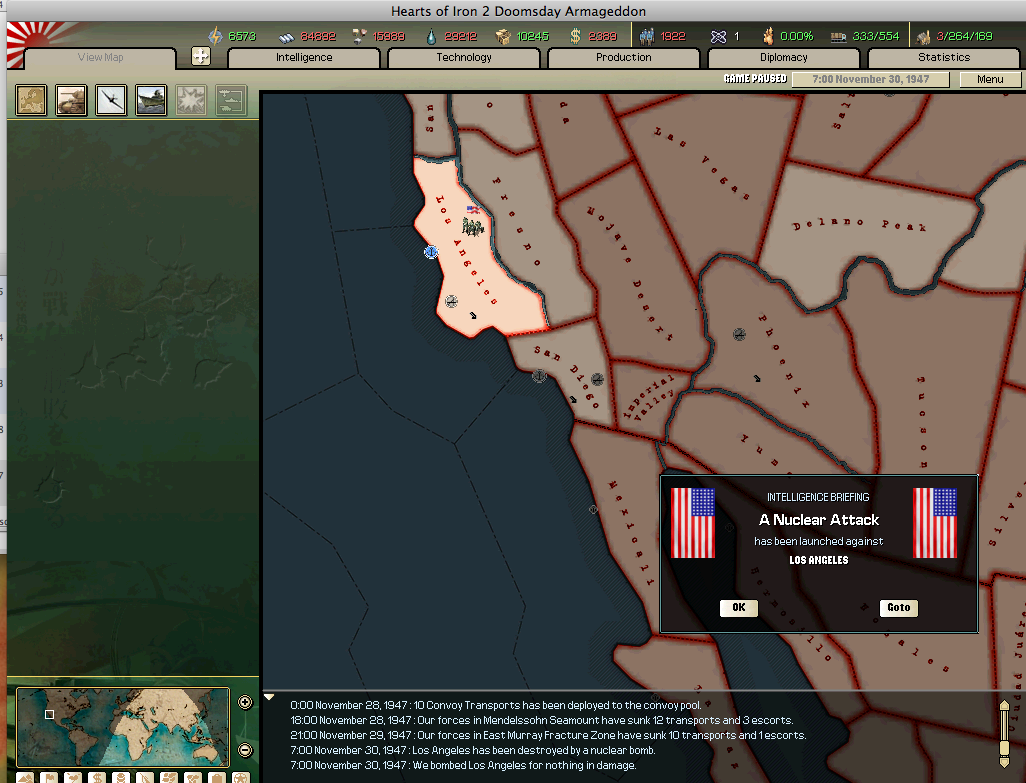
The hardest battle of my war so far has been the occupation of Pearl Harbour, which took just over a year and was bitterly fought on both sides. Final victory came after a year of fruitless land battles, a near-successful starvation campaign on my part, the death of probably 30000 merchant seamen, the near total destruction of the US surface fleet, and ultimately the complete annihilation of Los Angeles and San Francisco. By February 1948 I had lost about 6 divisions of soldiers, 6 submarine flotillas, 6 transport flotillas, a single aircraft carrier, perhaps 50 or so convoy ships and a couple of light cruisers. The US had lost about 30 divisions of soldiers (including advanced marines, motorized divisions and heavy armour), about 10-12 carriers, 5 or so battleships, its entire complement of troop transports[1], all supply convoys operating in the Pacific and their cruiser escorts, probably 40-50 destroyers, and its entire complement of mid-sized ships. By the end of the Pearl Harbour campaign, with its supply lines disrupted by nuclear attack and dissent, a force of 3 advanced carriers would be so weak that in one instance it was annihilated by a group of interwar heavy cruisers escorting my transport ships. I estimate the total human cost of this for the USA to be quite staggering – 300,000+ soldiers, 30,000+ merchant sailors, possibly upwards of 30,000 sailors, and the entire populations of Los Angeles and San Francisco.
A long campaign proceeds from a very simple mistake
The campaign dragged out for so long because I lacked sufficient transports to safely invade two Hawaiian islands simultaneously. Concentrating on the key island (Pearl Harbour), I managed to win a brutal amphibious assault, but I didn’t realize that the soldiers on that island could island hop without ships, so they skipped over to the neighbouring island without losing any significant numbers. My own forces, exhausted and worn down after an amphibious assault that took several days, could do nothing to pursue the enemy while it was in tatters, and I hadn’t organized a second set of reserves to bring in to the fray quickly. I had, in essence, failed to prepare for the invasion properly, fielding a force of only 8 divisions of marines and having nothing in reserve for a second attack. By the time I got my act together, the US had consolidated some 15 Divisions on the neighbouring island, and was attempting to land more. It’s just not possible to attack a force of 15 Divisions when you have to cross a narrow channel to do it, and worse than that, US soldiers are excellent fighters. When they’re well supplied you’re lucky if you can beat one division of well dug-in modern soldiers with all 8 Divisions of your marines. Dug into mountainous Kauai, with more troops landing on nearby Niihau, there was no chance I was going to complete the conquest of Hawaii. There followed a short period of stalemate before I was able to capitalize on a tactical error to capture all the more eastern isles (Hawaii and Maui), but the problem remained. America was facing its own Iwo Jima here, and any assault on it would be disastrous for all involved, but probably unsuccessful for me. A different approach was me.
A campaign of starvation
The main method for defeating overwhelming forces is to cut them off and starve them into a condition of weakness, so I decided that, with my navy in command of most of the high seas and only one significant carrier group still functioning on the US side, I could probably attempt to shut down the US army on Kauai by a blockade. I set my main carrier group (a force of 15 carriers plus screen ships) to work in the northeast Pacific, and set other smaller fleets to work immediately around Hawaii. I also redeployed ballistic missiles to Hawaii, in anticipation of the development of my first atomic bomb. During this campaign I also starved out the smaller US forces on the Line Islands and, eventually Wake Island – the latter was proving a considerable problem, since its naval bombers were disrupting my naval activities, and its capture in late 1947 left the US with nowhere left to base aircraft anywhere in the Pacific.
This starvation policy worked well in some respects. I quickly reduced the US to a very small number of convoy ships, reproducing results like the Disaster of PQ17 very regularly. This means that the US would be unable to supply other forces, to import materials from distant outposts, or to trade properly. However, somehow the convoys continued to get through my cordon, and the soldiers never properly starved. The US also introduced a similar scheme on me, operating from Diego Garcia in the Indian ocean to reduce my Indian Ocean convoys.This had the same effect on me – diverting supply ships away from Pearl Harbour. In late August 1947 my Samoan expeditionary force was disbanded due to lack of supplies, and I suddenly realized a huge problem. Troops in Hawaii were now out of food for large periods of time, and I couldn’t supply my ballistic missile squad, so I couldn’t operate my planned nuclear attack. I had to act fast to divert production to convoys, but it wasn’t until December 1947 that I finally restored regular supply to Pearl Harbour. This was potentially disastrous – had the US attacked at that time I probably would have lost the defense. Perhaps they didn’t attack for the same reason as me – lack of reliable supply. But I think they didn’t know my situation, and saw the numbers of troops on Pearl Harbour as too difficult to break. In fact these numbers were part of the problem – I had so many troops and ships in the area that I couldn’t supply them fast enough with my available convoys (or even when I doubled my convoy force!) This is a big problem for Japan in the Pacific, because holding all these scattered islands and possessions (in my case, from Oman to New Zealand) requires huge reserves of convoys that are very vulnerable to attack.
So, I redistributed some of my troops to other islands (Midway, Wake, Kwajalein) and rebalanced supply by December. I then decided to strike the final blow in my policy of starvation before shifting to the attack – a nuclear strike.
Nuclear apocalypse comes to America
At this point I discovered that I’d misunderstood the game interface, and had probably been in possession of a bomb since May some time – my next bomb would be ready in December. So I had one to play with in November, and another coming a month later. My first attack was on the highest value target on the West Coast, Los Angeles. I reduced the entire city to ash, setting all its productive, industrial and infrastructure capacity to 0. A month later I followed up with San Francisco, and also a conventional missile attack on San Diego and Portland. By January dissent in the US was running at 10%, which is a huge drain on their fighting ability, supply effectiveness and industrial capacity. After this attack I think the masterminds of the US war effort decided to redouble their efforts to supply Hawaii and recapture Pearl Harbour, because my carrier fleet in the East Pacific intercepted several larger fleets, all of which met a similar fate to the rest of the ill-fated US navy. The remains of the US’s carrier fleet went to the bottom of the sea, and I now possess the largest, most powerful navy in the world, in control of the largest empire. But, the US still controlled half of Hawaii, and remained a threat to my installations there. I began reshuffling my forces to strike the final blow, beginning with the naval capture of Niihau. Still lacking sufficient transports, I was again reduced to shuffling forces one at a time, but due to the supply restrictions I was now basing my marines in Midway Island.
The final battle: grasping the chance of a desperate error
While I was shuffling my forces around the US launched a desperate attack from Kauai against Niihau to try and recapture it. Were this to work, I would lose some 12 Divisions of troops to the US aggressor, and given their supply situation I doubt the survivors of that battle would be treated according to the laws of war. I had to launch a desperate counter-attack, which I did first of all by flank-attacking them from the neighbouring island of Pearl Harbour. Even throwing 12 more Divisions into the battle didn’t turn the tide though, just slowed down the inevitable destruction. But I had a force of semi-battle ready marines in Midway, which I sent in to attack the island on which the US was based – an enveloping attack that, in my past experience, was still not a very reliable tactic against a large and dug-in US force. I also dispatched my central carrier group to bombard the island, and threw more soldiers from Pearl Harbour into the battle to prevent the US from achieving a preliminary victory in Niihau. The extra troops delayed the inevitable just long enough for my marines to hit the beaches, and this turned the tide. The defenders in Niihau repulsed the US attack, and then my marines slaughtered them on the beaches. Some 12 infantry and 3 armoured divisions were cleaned up in that final, desperate battle, and all of Hawaii had fallen into Japanese hands.
The aftermath
First I want to make it clear that Japanese forces won’t treat our prisoners with the same callous disregard that the US were willing to show in those final twilit hours of their illegal occupation of Hawaii. They will be treated with honour as prisoners of war, and given the situation in their homeland now I suspect they’ll be glad of the rest and recuperation that time in a Japanese prison camp has to offer them. I now control all of Asia from Oman to Hawaii, Korea to New Zealand, with the exception of Nationalist China and Australia (which is in any case a puppet of mine after its earlier conquest). For now I’m leaving Nationalist China while I finish off the US, because capturing China opens a huge border with Russia. I will have another nuclear weapon ready in May, and I’m confident that by then I will also have several ICBMs built. My plan is to strike New York, which will probably throw the US into such disarray that they will suffer a coup or collapse to barbarism (partisans). I will then invade through Seattle.
Some lessons learned:
Dissent is a powerful tool: Not only does it weaken armies, but it reduces industrial capacity (10% dissent in the US equates to 40 points of IC – I only have 230). Reduced IC can only be recovered by increasing the amount of money produced[2], but liberal democracies[3] require a lot of consumption to reduce dissent. This means that the US not only loses IC from dissent, but then has to devote more IC to quelling it. Once my third strike pushes dissent up higher, I aim to destroy other industrial centres, and capture the remaining West Coast centres in Seattle. Then it will be virtually impossible for the US to stifle its dissent and thus to continue to fight the war
Starvation is difficult: Even with complete control of the seas it’s very hard to blockade an island like Hawaii that sits at the juncture of several ocean regions. This, I suppose, is why it’s strategically important
Nuclear weapons turn the tide: There was a noticeable degradation of combat ability after I nuked the US. Dissent, loss of supply capacity all worked to prevent effective combat
Watch your convoys and supply load: As your territories expand – especially across many scattered islands – your supply convoy load increases dramatically. If you cluster too many troops on one island they will inevitably lose supply, and you open the risk of the entire lot of them being wiped out in one mistimed battle. As your empire grows, your convoys need to grow in accordance. Convoys don’t develop, so are perfect beneficiaries of gearing. Set a train of 9 or 10 running when you start expanding, and you’ll be fine. And if you see lots of little messages saying they’re being sunk, send one of your navies out to deal with it. And if you aren’t tough enough to protect your convoys, give up – you’re done for.
From here on I just have to work out how to capture the whole USA without marching across it, which will take forever. I’m thinking of a strategy of spies and launching a coup, but I really don’t fancy my chances. In the meantime I need to capture Diego Garcia to prevent attacks on my flank; and then I need to decide whether to head into Europe through the Suez canal, or deal with the last part of Asia that isn’t already mine – China.
With nuclear weapons at my disposal, these decisions are a lot easier than they were before. Unless someone else gets them too … and there’s only one way to make sure that doesn’t happen…
—
fn1: which, if they were sunk while carrying troops, means that the US may have lost an additional countless number of soldiers. I don’t know how many transports I sank, but if they were all populated with troops in movement, I may have killed another 200-400,000 soldiers by this means.
fn2: Hearts of Iron 2 uses the George W. Bush approach to controlling dissent during war – higher consumption!
fn3: Ha! It is the twilight of their age. From here on the world will see only Shogunates.
It’s not exactly unsung at the moment, but I thought I’d link to this excellent news article announcing the death of Obi-Wan Kenobi in a firefight with Imperial Storm Troopers on Alderaan. It’s a rare occasion that I enjoy humour based on morphing real life figures into fictional characters, but this is one of those moments. The delicious peskiness of casting Obama as Darth Vader is so perfect in so many ways, as is the satire of modeling Obi-Wan Kenobi as a terrorist mastermind. It makes very nicely the point that one man’s terrorist is another man’s freedom fighter, but at the same time pokes fun at the semi-mystical powers ascribed to bin Laden by the American intelligence community – by giving him actual semi-mystical powers. This isn’t the first time the US security apparatus has been compared to the Empire either – the brilliant parody Troops does a similar job of turning the evil bad guys of Star Wars fame into everyday men trying to bring order to the Universe, and is well worth watching.
The real brilliance of this Galactic Times article though lies in the comments, which manage to take the piss out of every single conspiracy theory floating around in the war on terror, from September 11th onward, without ever straying from the Star Wars format. We have demands to see the body, claims that Vader was actually born on Tatooine, accusations that the destruction of Alderaan was done by the Empire, demands to cut spending on war, suspicion that Vader is himself a Jedi, and fears of further losses of personal freedoms. It’s like the entire 10 years of the GWoT can be morphed into the Star Wars framework, reduced to farce and genuinely criticized all at the same time. It also does a great job of undermining conspiracy theories – we know that in the Star Wars context most of the conspiracies are true, but precisely because it’s an insanely cool science fiction story set somewhere else, a long time ago.
Conservatives of course are pissed about this, because it doesn’t take the GWoT seriously and implies Osama is the good guy, but even here the irony is perfect. After years of unrestrained attacks on Obama, they find themselves defending him against accusations he is Darth Vader – even though they have spent years accusing him of wanting to introduce “Fascism” to the US, of being a closet muslim, of planning “death panels” who will decide who gets health care and who dies, of sympathizing with Osama, of not being American, and of course of wanting to undermine the Republic with his health care socialism. The Australian conservative ex-Prime Minister, John Howard, even claimed in 2007 that Osama bin Laden would be “praying for” Obama to win the election [how wrong that was!] So now they find themselves defending him from comparisons with someone they have until recently quite openly implied he wants to be.
Perhaps because its construction was based on a theory of the development of myths, Star Wars will always be amenable to parallels with significant real world stories; but I think it says a lot about the lies, misinformation and hyperbole connected to the war on terror – and particularly to Osama bin Laden – that the real world story fits so well with a silly myth from another galaxy. Dishonesty, bad motives, incompetence and lack of faith in our own governments have combined to turn the war on terror into a story so incomprehensible to most of us that it might as well be fiction.
It has come to my attention recently that some people consider Shrek to be a model libertarian, because he sets up his home in a swamp and defends his private property against all comers. Of course, in the sanitized version of this private property myth he doesn’t repeatedly sign and then break treaty agreements, kill the original occupants of the land and call on the full power of the state to defend his property “rights” when the relatives of the original occupants come to get him; but this strengthens the value of the story as a libertarian model, rather than weakens it. Presumably somewhere on earth there is a society of private property that isn’t based on killing people and stealing their stuff, and it’s in that place that we might be able to look for a libertarian model. So let’s suppose that such a model is possible, and look at whether or not in this case Shrek provides us with a good example of the possibility of private property as a concept of political value.
I think Shrek’s unilateral decision to expropriate land previously held for the common benefit is a good example of some of the problems with the libertarian romanticisation of private property. I believe libertarians call Shrek’s expropriation of land “homesteading,” but even assuming he didn’t “Homestead” over someone’s grave, there are still important issues of consent and community cohesion to be considered. For example:
it’s well established that in setting up his swamp, Shrek drove a small number of will ‘o wisps and troglodytes away from the area, increasing the rate of attacks by these pests in other, nearby communities. It’s well-established that one should drive these creatures away but there are also systems in place for balancing the risk and coordinating activities with other communities that Shrek ignored.
run-off from his farming activities is known to have contaminated valuable stocks of fairy floss in nearby forested areas. Communities of boggarts that market products based on fairy floss have been dislocated and may have to move to urban habitats, which both reduces their wealth and creates costs for urban communities. Everyone knows that boggarts are particularly difficult to integrate into complex multicultural (and often multidimensional!) fairysteads
he will undoubtedly start producing children soon, and this will place a heavier burden on the fragile swamp ecosystem. This swamp provides an important component of downstream water supplies for a community of sylphs, who you are no doubt aware cannot move away from the river they are born in due to their ethereal connection. Thus Shrek’s “individual” decision to set up his home here may lead to the destruction of a community of (admittedly slightly pesky, but no doubt still sentient) fairies
his decision to move there led to significant social order problems for his immediate neighbours, in the form of (amongst other things) dragons, crazy donkeys, kung fu princesses and, ultimately, war. When the neighbours are rebuilding their homes after the strife he brought with him they probably won’t be thinking about how admirable his rugged individualism is
due to unfortunate and unavoidable aspects of Ogre personality, it’s well known that property values go down after an ogre moves nearby. I think we can see why clearly from the available documentary material. I’m not racist, but the neighbouring fairies should gain some compensation from this, and from the environmental effects of his decision to set up a small band of adventurers and launch a violent attempt to overthrow the fairly appointed leader of a neighbouring state.
Surely the fairies should be allowed to consult with him and others, and perhaps to levy some kind of compensation for the imposition of this situation on their previously ordered lives? Just as in real life, in the fairyworld there is no such thing as genuinely private property.
In my previous post, one commenter asked how the Japanese handle election politics. As far as I know, voting in Japan is non-compulsory, elections are held on a Saturday, and they use first past the post (though I’m not sure about this). I don’t follow politics here much, but I think Japan could probably be safely said to be suffering a crisis of legitimacy in its political leadership, having brought the popular political notion of “tweedledum and tweedledee” to new heights (the two main parties are splinters of each other). Nonetheless turnout can be quite high by the standards of these things; it was 58% for the Tokyo gubernatorial election in March 2011. I think for national elections it is much lower, and there is a rural gerrymander (a typical problem of single member representative systems); this gerrymander is part of the reason for the continued practice of whaling in international waters.
As a consequence of this typical problem of non-compulsory voting systems, the Japanese electoral commission used a typically Japanese campaign to get more people to vote: they got a group of idols dressed as schoolgirls to run a cheerleading campaign for voting, that can be seen here. The actual campaign starts at about 20 seconds. This was running non-stop on the trains here up until the election, and its main theme is that voting isn’t just for the day; you can pre-vote for up to 14 days before, and I think they also mention postal voting. It’s hilariously cute, especially the way after the girls run to the front to talk their head bobbles about, doing nothing for a moment or two. I saw this video soooo many times during my daily commute… I think in addition to advertising pre-poll voting it also served the secondary use of generally reminding people to vote: one at least has the benefit of sharing a polling booth with a schoolgirl.
This shows the problem of non-compulsory voting and the way it creates biased samples very nicely. Will this advert appeal to all sections of society equally well? If not, will it function to raise representation in some groups relative to others? If so, you have created a biased sample of your community. Unless you put a chip in everyone’s head to accurately read their voting preferences, you can’t be sure that your sample is unbiassed. Maybe they’ll try that next time around… or maybe someone will suggest making it compulsory, as the next best option…
The UK is having a referendum soon on whether to change their voting system, from First Past the Post (FPTP) to Alternative Vote (AV). Under the latter system, you get to give some kind of preference statement, so if you are e.g. faced with a choice of Stalin, Hitler or George W. Bush but Bush isn’t so popular, you can vote 1 Bush and then vote 2 Stalin, thus ensuring that the genocidal maniac doesn’t get in[1]. Actually, I’m not sure if that is the correct description of AV, but I don’t really care about that so much, because this post is about the things that the British are not debating.
AV is a furphy in the debate over British election procedure, because the British have a much bigger problem: they don’t have compulsory voting, and they hold their election on Tuesdays. So only 3 people get to vote, but the people pushing this referendum are worried about improving the ability of those 3 people to have their choice represented.
What’s the best analogy for this kind of idiocy? It’s like you’re shuffling around the deckchairs on the Titanic, but your main worry is whether you should be shuffling the leather ones or the plush ones. Of course, both the leather ones and the plush ones come from the first class lounge, but nobody gives a flying fuck, because you’re all about to drown.
In Australia, of course, we have figured this problem out. Not only do we hold our elections on a Saturday, but voting is compulsory. If you are enrolled to vote, it is illegal not to vote, you have to turn up and if you don’t turn up you are fined $50 (I think – it could be more now, inflation in Australia is pretty bad at the moment). You can write a letter of excuse, but claiming “I’m an anarchist” doesn’t cut it (I know this, a friend tried it). It is by this yardstick that one is able to judge that there are only two truly civilized countries in the whole world – Australia and Turkey (the only other democracy that understands the importance of eliminating sampling bias).
Now I know that (some of) my reader(s) is (are) American, and so while you’re chomping away on your Freedom Fries and reading this, you’re probably thinking … wtf? Civilized!! But… they took away my freedom! And here’s the thing… you don’t deserve the freedom not to vote. That’s it. You should have that freedom taken from your cold, dead ballot box. You should be marched at gunpoint to the polling booth and forced to choose between two old white men[5]. When you choose not to vote, you choose not to participate in the most fundamental aspect of our modern political system. It’s like choosing not to wipe your arse (literally, in most elections). Friends don’t let friends do this sort of thing. You don’t get to tune in and turn off, not over this. And not only that – society, through the only means by which it can tell you what it thinks (the law, as promulgated by government) needs to tell you that we care what you think. And we’re willing to spank you to make you tell us – it’ll hurt us more than it hurts you. When people are given the choice to switch off of this process, the result is that the sample of the population from which the government is formed is no longer representative – it’s highly unlikely that the 45% of voters who chose not to participate in Britain’s last election were missing completely at random, and whatever bias infects that non-vote is represented in the smug visage of Nick Clegg fap-fapping around the country to tell us all about AV. The only way to ensure that the government represents the will of the people accurately is to force the people to vote.
Now, I know what you’re thinking as you reach for your gun, and look out the window for the unmarked helicopters. You’re thinking that even if people are marched to the poll-booth at gunpoint (or the end of a $50 fine), they will still cast an invalid vote, and so all you’ve done is waste half an hour of their life[6]. But this is not what happens in reality. If one views the wikipedia description of Democracy in its Purest Form (the 2007 Australian federal election), one will note that in addition to a 95% voter turnout, only 4% of voters cast informal votes. You can just feel the resentment oozing out of the page, can’t you? The evidence here is that in the most apathetic country on earth[7], forcing people to vote results in them… voting. Even though under Australia’s complex preference system, it’s really really easy to cast an informal vote by accident (you just have to put a 2 next to “Wake Up Australia” and “Wake Up Australia Queensland Reform Splinter 2” on your ballot paper). So, the evidence is that people who are forced to vote figure they might as well make their morning march worthwhile, and cast a vote that, you know, changes the country they live in.
So, those of you who are contemplating the AV referendum (or Americans who haven’t even got that far), contemplate that set of numbers – 95% turnout, 4% informal voting – and think about whether you’re being presented with a reasonable constitutional change, or a complete sideshow. First, you need to focus on fixing the basics. You need:
Elections to be held on Saturdays
Compulsory voting
A democratically elected upper house [admittedly, this doesn’t apply to Americans]
Once you’ve figured out those fundamental principles of democracy, maybe then you can worry about extending preference choices to all the people who currently can’t be bothered voting at all. But, you know, you have to learn to crawl before you can walk[8].
As you were.
—
fn1: Note from this example I am implying that I think Bush was not as bad as Hitler or Stalin[2]. Bleeding-heart leftist my arse[3]!
fn2: Though also, I’m officially Weighing in on The Debate, in favour of Stalin.
fn3: Note the British English spelling, which enables me to distinguish between your face, dear reader, and a donkey[4]
fn4: I’m not even drunk as I write this!
fn5: or a very old, crazy white man and a young, handsome black man who will go on to win the nobel peace prize before he’s even sat in his chair, and prove his authority to own that prize by escalating a war in a foreign country and ordering his soldiers to execute their captives in cold blood
fn6: though they do, usually, get a free sausage
fn7: Actually, Australians like to make this claim about ourselves but the evidence is, in every aspect of life, that we aren’t apathetic at all, but are quite energetic and creative and focussed
fn8:Apparently this isn’t true, and there is a proportion of babies who progress directly from lying on their backs doing nothing to walking
Everyone knows that Leonard Nimoy’s greatest achievement was his participation in the music video to The Bangles’ song Going Down to Liverpool[1]. This song was actually written by Katrina and the Waves, a British band, and covered by The Bangles in 1984. I have been a big fan of The Bangles ever since I first heard Manic Monday (and fell in love with Susannah Hoffs’ sly sideways glances from those smouldering eyes), but had never seen the video – my partner showed it to me this morning and mentioned that “it has that guy from Star Trek in it.”[2] Listening to the song, I was again confused by the lines
Hey now
Where you going with that UB40 in your hand
I said hey now
All through this green and pleasant land
To the best of my knowledge UB40 is also a band, but surely you don’t write a song about carrying another band’s CD in your hand? My partner told me she thought it must be the name for a gun or something, some kind of street slang of the time. So this issue got me thinking about a) what this line actually means and b) how a kid in the 1980s could possibly work this out.
What it means
So according to Wikipedia (and the song facts I linked to above) a UB40 is either a World War 2 U-Boat, the band of the same name (an execrable effort they were too), or … the name of the form that British people used to apply for unemployment benefits in the ’80s. The Bangles are a US band but Katrina and the Waves are British[3], so the likely interpretation of this is that the song is referring to someone going to collect unemployment benefit. This then gives proper meaning to the combination of lyrics “Where you going with that UB40 in your hand… going down to Liverpool to do nothing, all the days of my life.” Once again we see the collapse of the British manufacturing industry[4] pervading 80s music, in this case getting all the way to New York. The Bangles’ Kim Peterson supports this interpretation of the lyrics in her interview (linked to above), so it’s all pretty clear.
How would you find this out?
Imagine that you’re a teenager in some US rust belt town in 1986, you’ve stumbled on the Bangles and love everything they do, but whenever you hear this song the only meaning you can ascribe to the word “UB40” is the band of the same name. You know nothing about British culture and history, let alone the modern British angst about their collapsing manufacturing base or the stereotypes of Liverpudlians as dole-bludging[5] losers. So naturally, you would, like me, suspect that the Bangles are not referring to some other godawful band; instead, you would wonder what they really meant. At this point, what do you do? You want to find out the information but you don’t have access to an indexed, searchable database of any kind. You could go to your library and try and find it out, but they only have card catalogues – it’s unlikely that they have a computer database of any kind in 1986, and even if they do it won’t be searchable on the sorts of key words that pull up something as subtle as “UB40”. So you are limited to searching through the titles of the books, which if the library is big is going to be very tedious. You could just restrict your search to the Us, but this is unlikely to turn up much. You could ask a librarian, who might know what “UB40” means or might, alternatively, have an idea like my partner’s (“maybe it’s a kind of gun?”) Then you could start doing the long search through books on war, armaments and the like, and might eventually stumble on a book with UB40 in the index.
Alternatively, you could ask your friends. One of them might have heard something. But friends are as likely to be wrong as right, and there will be many urban myths about this sort of thing. Chances are your friends think it’s a gun, and you take the song’s meaning to be something to do with gang crime, which it is not.
Or, you might look through a Melody Maker magazine. If you are the proud owner of a back catalogue of these, you might remember the interview where it was discussed – or maybe your friends do. But if not, you again have to go down to the library and search the back catalogue of Melody Maker magazines – without any keyword search functionality. To do this rigorously is going to require some special search logic – first you identify the dates when the song and its original version were released, and you search the magazines published in the months after that release for any interviews with the bands in question. This is going to be a couple of hours’ work, realistically. And of course Katrina and the Waves are British so you may need to run through NME as well.
All this to investigate one line in one song.
How the world has changed
Now, of course, you don’t have to do anything like this. You scoot over to your desk, type UB40 in google, and up comes the disaggregation page on Wikipedia, problem solved. What was, in the 1980s, an afternoon or more of work with quite limited chances of success has been reduced to a couple of seconds in front of your computer. Thus it is that there is only one question in the modern age that is truly unanswerable: “How did people live before the internet?” I was there, and god knows I don’t have the answer to this question!
—
fn1: We like to start sentences with uncontroversial statements of fact here at the Faustusnotes Institute for the Study of Very Serious Topics
fn2: Chicks, mate…
fn3: Which could have fooled me. It’s a really California-sounding name and they also wrote the song Walking on Sunshine, which just sounds American…
fn4: Or its destruction, depending on your view of Thatcher and Britain’s long march into the GFC
fn5: for my non-Australian reader(s), this is the second time in two posts that I have used the verb “to bludge.” By way of explanation, this is an Australian word meaning “to hang around doing nothing,” to “skive off” or “shirk responsibility” and can have a good meaning (“I bludged at the beach with Kylie Minogue and a box of condoms”) or a bad meaning (“Kevin Rudd is bludging at the beach with Kylie Minogue and a box of condoms instead of visiting the flood-affected areas”).
Today marks the 10 year anniversary of my first date with my partner, the Delightful Miss Ember, who I met in a nightclub called Oblivion in 2001 in Australia. We were set up by a mutual friend, a speed-addicted anorexic girl who was almost certainly a compulsive liar and probably also schizophrenic. She lied to both of us to set us up (“Oh, faustus, Miss E thinks you are very handsome”[1] and “Oh, Miss E, faustus thinks you’re so very elegant”). In fact the basis for the lie that our mutual friend told Miss E was that a month earlier she had pointed out Miss E across a crowded dancefloor and said to me, “don’t you think she’s cute?” I, squinting through the haze, said “Yes” just by way of pacifying my friend (in truth I could see an elegantly swaying red dress, but that’s all). And they say white lies are not a good idea…
In truth the night of our introduction included an amusing coincidence. I knew I was being introduced at some point, but I spent the hour or two before the introduction with my friend, Sergeant M. So there we were, sitting against one wall of the club, doing what Sergeant M and I do best – perving on girls. And there, on the other side of the club, was a couple playing pool. We couldn’t see the whole pool table or much of the girl due to the positioning of the table, but we were both mesmerized by a splendid, peachy bottom in a shimmering peach dress. So an hour later, I’m talking to another friend when up bobs my crazy friend, and in tow she had… a pretty young woman in a shimmering peach dress. While the introductions commenced I could look over her shoulder and see Sergeant M giving me very energetic thumbs up signals from his perving vantage point[2].
I think this introduction was an auspicious signal of how our lives would play out over the intervening 10 years. It’s been good! So today we’re having our anniversary celebrations, and we’re managing to fill our day with some of the more traditional things we’ve got up to in the past 10 years:
drinking too much coffee and watching a tv show we’re obssessed with (currently, Castle)
Eating in good restaurants
bludging on the internet
going clubbing (tonight will probably be psytrance)
Ideally we should also find time for me to play computer games while the Delightful Miss Ember does something incomprehensibly girly, but we probably won’t be able to fit that in…
Anyway, it’s a lazy day in celebration of the best thing ever to happen to me. Here’s to another 10, or 50…
—
fn1: This is surely a lie that deserves a perfect 25 out of 25!
fn2: He denies this now but I think he is pretending not to remember such a delightful bottom, in order to avoid angering his wife…
The Royal Wedding has led to a new round of debate about Republicanism in Australia, particularly since the Queen somehow managed to ban a particular comedy group from providing satirical coverage of the wedding on the state broadcaster[1]. The debate was reflected last week in a panel presentation on the state broadcaster’s current affairs TV show, Q and A, and this can be viewed on the internet.
I thought I’d provide a link to this debate here for my non-Australian readers, because it’s a good example of the quality and style of political debate in Australia: robust but polite, with good use of the English language and, in general, direct and clear statements of opinion. There’s not a great deal of waffle, there’s good humour all round, and a lot of “piss-taking.” American readers may be interested in the Australian view of American republicanism (a “tragedy” according to one panel member) and British readers may be interested in the nuanced view of the monarchy held by the panelists. The strength of debate within the political class is also on display here : two panelists, Nick Minchin and Amanda Vanstone, are from the same political party (the conservative party, aptly called the “Liberals” in Australia), but they disagree vehemently over the issue of whether Australia should become a republic. Bob Carr, the representative of the “left” party, the Australian Labour Party, is actually an expert in American history (I think he has a PhD though I could be wrong), and although republicanism in Australia is often associated with the left of politics, he is decidedly equivocal about the whole thing. The strongest advocate of a republic is Craig Reucassel, who is from the comedy team who were banned by the Queen. There’s also an example of their work in the show, which American viewers might be interested in – would this sort of thing be played on your public broadcaster? And rest assured, this is mild compared to some of the other stuff this team were going to do (and have done in the past). Even Marcia Langton, an Aboriginal activist, is equivocal about the future of republicanism, and respectful of the Queen, though this doesn’t stop her appearing on a panel show with a comedian who wanted to present a skit about the consummation of the wedding vows…
The other noticeable trend in this debate is the importance of “modern” Australian issues. Bob Carr is “more passionate about saving red gums” than the republic; questions from the audience target the role of migrants in shaping republican debate (our current PM is a migrant, as is the leader of the opposition). Reconciliation and the attitude of Aborigines towards the crown is also reflected, with the presenter asking Marcia Langton the thorny question, “how do you think Aborigines should view the Queen, given she is the leader of the nation that invaded your country?” (Well answered, too). Modern Australia has certainly changed a lot since the constitutional crises of 1975…
It’s a long show, but if you’re interested in seeing how Australians approach each other and their leaders, I recommend viewing the whole thing.
—
fn1: she did it through application of contract law, not the repressive apparatus of the British state, but still this isn’t a good message to send to one’s loyal subjects…
 Compromise and Conceit