This is a semi-sandbox adventure module for Warhammer 3rd Edition, and my god would it have been useful a year ago when I was running a semi-sandbox campaign in Ubersreik. My adventure even had Skaven, just like The Edge of Night. Though I think my approach to the skaven was better, my map definitely wasn’t, because The Edge of Night is a well-presented product, with a great deal of content.
The Edge of Night presents an adventure in the town of Ubersreik, based on a skaven conspiracy, against the backdrop of a political conflict between three noble families. To facilitate this adventure, the book provides background information on the town of Ubersreik sufficient to, essentially, ground an entire campaign in the setting. The adventure itself builds up to a climax that occurs at a ball held by one of the noble families, but the path by which the PCs can reach this ball is left open, with the adventure description making it clear to the GM that he or she has an almost infinite range of ways of handling the PCs progress to this ball. In order to facilitate the adventure, the book contains a map of the town, with key locations described not just in terms of their contents, but their relationship to the three noble families, and a couple of rumours at each location that may or may not be relevant to the adventure. These rumours can open up into whole other adventures if the GM wants to do the work, or can be dead ends or red herrings or clues to the adventure plot. This gives the GM an almost infinite amount of time to track the main adventure; or if he or she wishes, to have the events of the main adventure happen anyway if the PCs fail to get in tune with it, which leaves the PCs having to deal with the fallout. It also means that the adventure setting essentially can be turned into a campaign setting with a bit of extra work, which means that you’re getting a lot of value out of your 56 page module (and this is important with Warhammer 3, because the products aren’t cheap).
A key part of the build up to the adventure is the development of patronage with one of the noble families, and as is typical with a WFRP 3 product, the designers have developed the progress tracker/party sheet mechanism to include a system of patronage. Basically, each noble house provides its own “family sheet,” which the PCs advance along according to how their actions affect the noble family. As they advance, they gain recognition, an invitation to the ball, and finally patronage. Each house has its own traits and allies, and each family sheet provides benefits in the form of a talent accessible to the whole party when they achieve patronage. Because the map describes which locations contain people sympathetic to specific houses, it is easy for the PCs exploration of the town to lead to opportunities for patronage. Furthermore, the adventure itself contains a few simple encounters for the GM to use to offer advances along the family sheet. Patronage is valuable in its own right, so the family sheet is of use if the GM decides only to use the town as a campaign setting; or, if the GM decides to deepen the political intrigues, the patronage system could be useful in helping to place the PCs on particular sides of political and military conflict, possibly without their having realized what is happening. The family sheet is a good example of the way Fantasy Flight Games have developed a flexible mechanic and found ways to extend it to cover a wide range of possible contexts. It’s a creative idea.
Like other modules, The Edge of Night comes with a wide range of suggestions on how to lure the PCs into the adventure, including but not limited to references to other modules. It also comes with a set of new cards (actions and magic for skaven), new adventure locations, new cardboard standups, and the new mechanic for patronage. I don’t use the standups in this system very much at all (I’ve never been able to incorporate miniatures into my gaming) but the patronage mechanic is useful not just in its own right, but as yet another example of the versatility of the progress chart mechanic, which I thoroughly recommend to all gamers.
I would go so far as to say that The Edge of Night, in addition to providing a fairly complete setting and an interesting adventure, is easily as good as the classic warhammer settings, but with the addition of some very nice descriptions of, and mechanics for handling, political tensions between families in the world. I think this aspect of the game makes it possibly on a par with the classic warhammer modules, and reaffirms for me that WFRP 3 is providing a lot of new and interesting ideas for both Warhammer and for role-playing games generally. I’m hoping to set up a gaming group during the next year, and I will be aiming to run a campaign in Ubersreik with the material in this module. I think that, even if you are planning on sticking to WFRP 2, this module could provide some useful material for your campaign, as well as a complete setting. It’s another example of Fantasy Flight Games’ commitment to high quality work, and to maintaining the authentic feel of the warhammer setting.
… in Japanese, for my work. Yesterday a group of 40 first year high school students came to my department from Soma City, a town in the tsunami-affected region of Tohoku. I’m not sure why, perhaps as a quid pro quo for research we’re doing up there, but they were brought down for the afternoon and as part of the day’s events we organized them a two hour workshop on Global Health Policy. How do you do this for a bunch of bored 16 year olds? My department’s students, being very much closer in time to bored 16 year olds than me, managed to come up with a cunning scheme. After an initial greeting, they divided the students into eight countries, and set them a role-playing task based on public health.
The task: the students had to imagine they were representatives of their country at the UN. A new disease, “Disease X”, has been identified and declared an international emergency, and they have to decide what their country is going to do about it. Each group was assigned a “policy advisor” from the country in question – i.e. one of the students or staff – and where necessary a Japanese graduate student to help translate. They were given background information on all the countries in the room, including a few salient details about the country that might be relevant to the disease. Then the properties of the disease were explained. Disease X was in fact tuberculosis, so the basic properties were:
one third of the world population is affected
Treatment takes 6 – 9 months
Vaccines are only effective in children
It’s potentially fatal
It is transmitted by coughing and sneezing
Because there weren’t enough grad students to go around, me and my student from Hong Kong (whose Japanese is very good) were given our groups without a single translator – the grad student who organized the session was nearby and could come over if we had any trouble. Our task was to guide our students to a plan for what to do, in 20 minutes, including time to write up the intervention on a shared presentation (conferenced through google).
The Plan: The background for Australia gave the students the salient numbers about Disease X (low incidence, low prevalence, low death rate) and the key aspects of Australia’s health challenges, which were high migrant inflows, inequality in health between Aborigines and non-Aborigines, and inequality in health between urban and rural areas. In fact, I had downloaded an article from the Australian and New Zealand Journal of Public Health that makes these differences pretty clear: incidence in Australia is 5.4 per 100,000, but in native Australians[1] is 0.9, and in new migrants and Aborigines 6.6. Also in some parts of Australia it is even higher amongst Aborigines, as high as 13 times the rate for non-Aboriginal Australians.
My students didn’t have these detailed figures, only the bullet points highlighting Australian health challenges, and they immediately fixed on migration as a possible key driver of the disease. I had already told them about the three possible levels they could intervene (regional, national, international) and so, when they settled on migration as the challenge I asked them whether they would do national or international-level interventions. After a bit of debate they decided that there’s no point in trying to better control it at the border if the disease is going gangbusters overseas, so they decided to focus on development work in countries with high rates. They then started scrabbling through the country descriptions, comparing incidence and prevalence, and found the two countries with the highest incidence. Once they had identified which one had higher immigration rates to Australia (Bangladesh, made up by me on the spot – I guess the immigration rate is higher than Nigeria but I really don’t know), they examined the challenges written on the Bangladesh country sheet. One of the key ones was lack of access to healthcare amongst the poor, so they decided to send doctors and medicine to Bangladesh, in collaboration with local doctors (I had to point out this detail).
They actually decided on Bangladesh because (in their words) there’s no value to Australia in providing aid to a country it has no migration connection with, so it’s better to spend the money a country where the aid will benefit both countries. This may seem harsh, but it means they recognized a basic principle of tackling inequality (whether global or local) that I try to focus on in my work: with infectious diseases, there is a significant benefit to the community as a whole from reducing inequality by targeting those worse off, since the people with the highest disease incidence are also the ones who will drive the epidemic. By recognizing this they had identified a key difference between targeting those easiest to reach (who usually have the least problems) and those hardest to reach (and having the most benefit both in that group and in the community as a whole).
Once they had done this I told them the statistics on incidence amongst Aborigines, and pointed out that they didn’t necessarily need to look to Bangladesh to target a group that might be vectors for the disease. But actually rates of TB are much, much higher in Bangladesh than in Aboriginal Australians, so they probably ultimately made the right choice.
So, 20 minutes of group work, largely free of railroading by me, and my students had managed to come up with a fairly reasonable intervention plan that might even have some chance of working, and mostly through their own efforts to analyze the data in front of them – and this was their first ever experience of thinking about public health. It wasn’t entirely sandbox-y, but close enough – you can’t run a completely open session in 20 minutes. All but one of the other tables completed their work on time, and I like to think that this is at least partly because in our planning session the day before I gave a few basic pointers to the grad students about how to GM. I didn’t tell them they were GMing, of course, but that’s what they were basically learning how to do.
The denouement: Once the groups had all presented their results, one of the grad students gave a 10 minute presentation on what disease X really is – TB – and the important role Japan has played in developing prevention strategies. He then gave an overview of international health and our role in it, and one of the high school students gave a very cute bouncy speech – in English! – thanking us for the experience. It was all very cute and effective, and the students seemed genuinely happy to have solved the world’s problems in 20 minutes.
Reforming the WHO: Now, many people might have criticisms of the WHO, and might have expected that if our High School students were genuinely going to role-play a WHO experience, they would all sit down and refuse to compromise, and ultimately come up with a wishy washy motherhood statement that enabled every student to go home and make empty promises to their families[2]. They didn’t do this! So this leads to three possible suggestions for ways to reform the WHO:
Send the students from Soma City to the WHO and give them 20 minutes to solve the world’s problems
Send the grad students from my department, whose boundless energy is truly a wonder to behold, and whose ability to ignore the magnitude of actual barriers to implementing a plan, and just do it anyway, is quite amazing
Teach the current representatives at the WHO how to role-play, so they can come to solutions more efficiently
Which would be most successful? I’m guessing suggestion 1…
A well-rounded Graduate Education: I’m sad to report that the students of my department, though great in many ways, lack all the fundamental principles of a well-rounded classical education. None of them have watched Star Wars or Aliens, they don’t even know what role-playing is, and the primary texts necessary for a good understanding of public health – Lord of the Rings, Bladerunner,Conan – are not in their curriculum. How can they assess a problem if they haven’t been taught the critical skills outlined in the clash between good and evil in Star Wars? How can they be qualified to research women’s health without the basic grounding in feminism provided by Aliens? How shallow is one’s understanding of the human condition if one hasn’t been led to consider one’s basic humanity through the eyes of Deckard in Bladerunner, and indeed – how can they properly comprehend the real social and political impact of shortened life expectancy if they haven’t heard Roy Batty’s final speech? My god, at the end of the presentation they were reduced to quoting from a completely peripheral text by Jeffrey D Sachs. But I like to hope that yesterday they learnt a little bit about how to GM, so I’ve gone one small step towards laying the groundwork for a proper classical education. We’ll see if I can get them through the other texts by the end of their degree.
In fact, it’s essential, since they won’t understand my jokes until they have watched those movies …
—
fn1: since the early 80s, Australia has had a principle of not recording race on census and hospital forms. Instead, we record country of birth, so anyone who is a second generation Australian is recorded as “Australian.” We also record language spoken at home, and Aboriginality, but when we talk about “Australians” we don’t identify race. Eventually, one hopes, Aboriginality will also be able to be dropped from hospital records, but that’s a long time coming.
fn2: This is unduly harsh on the WHO. I know bashing international institutions is like shooting fish in a barrel, but actually the WHO does some pretty good work, in e.g. polio eradication, disaster response, handling outbreaks like SARS, etc. They may not be the best model or the best institution, but given their circumstances they’re doing an okay job, I think
Last weekend I visited Snowy Hokkaido for a rather fantastic Japanese wedding that had it all: romantic music, over the top dresses, and boxing. It was very traditional. This is a brief description of the events of that day, in case anyone out there is wondering what a Japanese wedding is like.
The wedding was for my friend Miss HighBridge, who I met at Tottori University when I was studying Japanese. She’s a native of Snowy Hokkaido, from the town of Kushiro, but after she graduated from Tottori she got a job with Nissan and ended up in nearby Obihiro. As I write this it’s -11C in Obihiro, and -4 during the day. When we arrived it was 1C, with an overnight forecast of -6, and the snow was only about 20cm deep. We flew to Obihiro airport on Saturday morning, and spent the afternoon exploring the centre of Obihiro. Miss HighBridge was right when she told us Obihiro is a nani mo nai machi, a nowhere town. So with nothing to do in town it was back to the hotel, a dip in the volcanic hot spring and off to the Hokkaido Hotel for the wedding itself.
Our invitation made it clear to us that in Hokkaido weddings are slightly different to the mainland: in the mainland guests are expected to offer goshugi, a present to the new couple, that is anywhere between 20,000 and 50,000 yen ($200 – $500, I guess) in normal circumstances. In a Hokkaido wedding, you pay an admission fee and then don’t need to pay the goshugi. This wedding’s admission fee was 13,000 yen (about $130), but we also took a present of some ornate teacups and a pot from Tokyo (Miss HighBridge is a bit of a hippy). As is typical of a Japanese wedding, friends of the couple were running the reception desk at the hotel, where you hand over your money and present, and receive a little schedule for the evening. The first hint of what was to come was at this reception desk: 8 friends were running it, and there were four queues divided alphabetically to make the process go faster. This wedding had a lot of guests.
In fact, we discovered later, there were over 300 guests, and they were all listed in the schedule. The main ballroom had been divided into 33 tables, each labeled with a country name, and we had been assigned to Costa Rica, which was the table for people form Tottori University. My friend Miss Wisteria Village was there, and a couple of other people I could not remember from the University. The table also was home to the only 3 foreigners amongst the guests – me, the Delightful Miss E (my partner) and a nice Nepalese chap who is now working as a system’s engineer at a major electronics company (poor bastard). Because we had all traveled from far away, at our table was a little envelope containing some travel money (about $50), and a hand-written note from Miss HighBridge (for the Delightful Miss E: “Miss E who is always so fashionable and beautiful, I love you!”). So really we only paid $100 each for this event. Plus the airfare. And the suit. And the present. And Miss E’s new shawl. And the hotel room. And the new inner wear to deal with the arctic weather. And the team of hirelings to walk in front of us ready to shoot polar bears.
About 70% of the guests were men. This, it turned out, was because Miss HighBridge’s fiance, in addition to being a licensed pro-boxer, was the son of a significant family whose barley/potato/vegetable farm has been around for more than a hundred years. As significant members of both the local rotary club and the local farmer’s organization, they had a lot of social connections to invite to this event, and most of them being business connections, most were men. The nearest three tables to us were all men. What we were witnessing here was a textbook example of the maintenance of social connections through social rites – not that Miss HighBridge and her fiance were pawns in some sort of sordid family bonding exercise, of course – this is the modern era – but the age old principle of using a ceremony for a rite of passage to grease social wheels was well in evidence. Very interesting!
Once we’d all had time to gather, the wedding started. First, the MC – yes, there was an MC (there is always an MC!) – gave a brief speech to thank everyone for coming, and then the lights were dimmed, the music came on, and the bride and groom entered through the main double doors. Miss HighBridge was in a kimono (not the traditional white one, but a red and gold one) with an amazing high hairstyle (actually a wig), and her fiance in Hakama, giving a very traditional look. They walked carefully through the tables of close relations, and took their position at a high stage, while everyone applauded.
Next there were speeches (mercifully short) by the town mayor, the head of the farmer’s association, Miss HighBridge’s boss, and then the friends of the bride and groom: the fiance’s friend got so nervous that near the end of his speech he lost his lines and had to finish early; Miss HighBridge’s friend started crying and sputtering but finished her speech very proudly. It was a very sweet speech about important Miss HighBridge is to the people around her.
During all the speeches, the two tables of young men to my right were chatting loudly with each other and smoking, and completely ignoring everything that was happening on the stage. We’ll hear more from these two tables – Cambodia and Australia[1] – later.
While this was going on an army of hotel staff were filling glasses with champagne, so that a member of the local council could give the kanpai (toast) to the bride and groom, and their families. We all stood, and raised a toast. Then, the meal began. During the meal, there were various performances and crazinesses involving the bride and groom, summarized below.
The second dress: Somewhere during dinner, the bride and groom disappeared and returned through the main doors, Miss HighBridge now in a white dress with a 2-3m train, and her fiance in a blazing white tux (to match the dress). They returned to their high seat, just as before.
The pouring of the drinks: all through the meal, young people queued at Miss HighBridge’s table to pour her and her fiance’s drink for her. They would then dutifully sip the proferred booze, before subtly tipping it into a champagne bucket beside their chairs. This was a wise move; neither of them had a chance to eat, so liberal administration of beer was probably not a good idea – especially given what was to come
Photo ops: gangs of friends beset the couple, and demanded to have their photo taken. Team Costa Rica, being 10 people, had to burden one of the groom’s friends with 10 cameras, and he duly took one shot with each while we stood around the couple. This was the first time I ever met Miss HighBridge’s groom (Mr. Young Mountain). We exchanged a brief “how do you do” before the next team pressed me off the stage
The friend’s dance: in the middle of the meal, a group of 6 friends of the couple came into the room, in hip-hop/suits mixed costumes, took position on a small stage near the main doors, and performed a hip-hop dance – complete with minor attempts at break dancing – for the amusement of the couple and assembled guests. It was great. Note that this was all very staid compared to the last wedding the Delightful Miss E attended (more below)
Cutting the Cake: The bride and groom cut the cake and fed a little piece to each other – well, except that Miss HighBridge cut off a huge piece and nearly choked her fiance on it. I am led to believe that this is traditional, as well.
Lighting the booze: The bride and groom poured some alcohol into a mechanism, something like a champagne fountain, only this was a series of tubes that fluoresced as the alcohol entered them, and stayed glowing through the rest of the ceremony
The third dress: Somewhere before the candle service, bride and groom returned in a third dress, this time red with a train, and her fiance wore a pinstriped tux and tails with red shirt (to match the dress)
The Candle service: Bride and groom passed from table to table, lighting a candle in the centre of each table.
But the craziest part of the wedding was the part just before the candle service: the boxing match.
The Boxing Match
As I mentioned above, Mr. Young Mountain has a pro-boxing license, and a professional record (I think it may be only a few fights). So of course, there had to be some recognition of this in the wedding. This recognition took the form of a boxing match, between Mr. Young Mountain in his suit and some nameless friend of his, introduced simply as “the current champion,” in full boxing gear. A referee was found, Miss HighBridge was brought to the edge of the ring to watch, and the bout began. After about 30 seconds Mr. Young Mountain knocked the champion down, but it was a standing 8 count and Mr. champion was soon back into the fray. The next victory was Champion’s; he knocked Mr. Young Mountain down and it certainly looked like Mr. Young Mountain was out for the count – until Miss HighBridge stormed onto the stage with some kind of white bat, took out the referee with a single double-handed strike, and then set about the champion in a frenzy of blows. Down he went for the count, and the crowd cheered as she helped her fiance to his feet and turned him to face the crowd, victorious. Justice (apparently) had been done, and the symbolism of the couple working together to overcome all adversity had been clearly displayed.
A Tale of Two Weddings
Let us compare this show with that of another wedding from two years earlier, much smaller and in very similar style, attended by the Delightful Miss E. This wedding also featured the “friend’s dance,” only they were wearing horses heads while they performed the dance. For the main set piece performance, instead of having a boxing match, they had two short games. The first involved the groom: he was blindfolded and all the young women from the audience were lined up in front of him, along with the bride. Each kissed him on the cheek, and his challenge was to identify which of the kissers was his wife-to-be. He was successful. Then, the bride was blindfolded and all the young men in the audience similarly gathered. Her task, however, was to feel each man’s arse and determine which was her lover. To hoots and catcalls from the audience, she successfully identified her fiance.
I think it’s safe to say that the more recent ceremony was a much more serious affair.
Finales and Farts
With the boxing match out of the way, the final toast needed to be proposed. First there was a brief interlude in which the parents of the bride and groom stood in a line on the stage. The bride and groom then approached and stood solemnly in front of their parents, while Miss HighBridge read a short but very sweet speech thanking her parents for all they had done for her over her life. The tradition in Japanese family life is that the bride moves in with the groom’s family, so I guess in the past this may have been her last chance to say something important to her family. Of course in this case she’ll be visiting them regularly in the neighbouring town, so it’s not the same context at all, but it’s a very nice gesture.
Finally, there was the “banzai”. I don’t think this is a regular component of weddings in Japan, but in this one it was performed. Basically, for a banzai, everyone stands facing the stage, someone on the stage makes a brief speech, and then yells “banzai!” three times. Each time, we all yell banzai and raise our arms (you see this at political victory speeches). It’s a kind of encouragement to success, or something akin to “three cheers.”[2]
So anyway, we had to do banzai. During the preparatory speech for this banzai, someone on table Australia farted really loudly, and someone on table Cambodia said “Akira!” in a loud and scolding voice. Everyone on the closest four tables broke down laughing, but no one at the front noticed, and we all started our banzai.
Second Stage
This marked (trumpeted, even!) the end of the ceremony, but the young friends of the bride and groom were off to second stage, where we spent another two hours carousing at a local bar and congratulating Miss HighBridge on her efforts. She can’t remember any of it, of course, and doesn’t know what it was like. She was too busy charging around lighting candles or taking out referees or pouring beer into a bucket. During this second stage I had a nice chat with the vanquished champion (a real estate agent) and a handsome young dairy farmer who explained some things about Obihiro farming life. Then it was back to the hotel, a 2am dip in the hot springs, and an exhausted sleep. And I wasn’t even the one getting married!
The next morning Miss Highbridge was up early, met us at 11am, and took us to a crazy warhorse sledge race where the Delightful Miss E won 300 yen. But that’s a story for another day …
—
fn1: Oh, the shame!
fn2: Banzai is also the word mothers use when bathing young children – when they say it, the child lifts his or her arms and the mother washes the armpits.
I received the pdf version of James Raggi’s re-release of Geoffrey McKinney’s infamous Carcosa “supplement V” two days ago, and have been reading it voraciously since. I haven’t received the physical version yet, so can’t comment on that, but my main interest was the content so I’d like to give a review of it here. It’s my first reading of Carcosa – I missed the original version and the controversy surrounding it – so I’m going to review it as if nobody knew what it was. I have wanted this product since I read the controversy, since much of the material contained within it is relevant to my own campaign ideas, which can involve a certain amount of ritual sacrifice and happen in worlds with an underlying morality that I think has similarities to that of the “lawful” or “neutral” residents of Carcosa – that of sometimes making very unpleasant bargains with evil powers in order to further a greater good.
Background
Carcosa is a science-fantasy/swords and sorcery setting, a planet far from earth in which the ancient gods of the cthulhu mythos slumber (and sometimes wake), and humans live in small and scattered settlements, terrified of the evil powers that dominate the world. The appendix to this edition describes the state of Men[sic] nicely thus:
Man has not populated the world of Carcosa with the monsters of his imagination. Instead, the monsters of Carcosa infect the nightmares of man. Nor has man imagined mythological spirits and projected them upon his surroundings, later refining his mythologies with philosophy and theology. The world of Carcosa is fraught with the like of the Old Ones and their spawn, the legacy of the extinct Snake Men, and Sorcery.
Humans were created by the Snake Men and placed on Carcosa as slaves and chattel to be used in vile sorcerous rituals by which the extinct Snake Men summoned, controlled or banished the Old Ones and their related entities. The Snake Men are long gone, but their legacy remains in the world that is presented to us: Spawn of Shub-Niggurath, the Old Ones, strange mutations and sorcerous effects, and lesser and greater Old Ones who are either imprisoned within our outside the planet, or roaming the planet itself looking for prey. The planet also hosts some Space Aliens, whose artifacts and high-tech items adventurers may be able to find and use.
In this world there is no magic, though there are some psionics. The only magic available to humans is that of sorcery, which enables one to summon, bind, imprison or banish evil entities. However, aside from banishment these sorcerous invocations depend upon rituals which invariably involve the degradation, torture and murder of humans. The 13 races of humans come in distinct colours, and these colours are coded to different rituals; in order to gain power over the elder gods one must find a suitable number of the correct humans of the right colour, age and sex, and then do what is necessary to raise the entity, in a ritual whose contents are themselves difficult to learn, and require precise ingredients collected from rare locations across Carcosa. Being a sorcerer is neither easy nor sensible. Being a sorcerer’s chattel is far, far worse.
So, the world of Carcosa is a brutal and nasty place, where humans were invented to be used, and continue to use each other in the manner that their extinct progenitors planned for them. It is a world where moral decisions are made in a very, very different framework to that of many other fantasy worlds; but it is my contention (and I’ll outline this below) that the moral framework for decisions in Carcosa is simply reflective of a different period in our own history, and the decision to play in Carcosa will simply represent a preference for playing in a different historical milieu to the one we’re all used to. No big deal, really, right?
The Rules
Carcosa is presented as a supplement to Original D&D (OD&D), so it doesn’t present a system per se. Rather, it contains a new character class, the Sorcerer, and some kooky ideas for dice rolling and determining hit dice that I’m not sure I’ll comment on until I’ve played with them. It also presents a wide range of new technological items (of the Space Aliens), new monsters (connected to the Old Ones) and a set of rituals for the Sorcerer. The book also makes clear that on Carcosa there are no PC classes except the Fighter and the Sorcerer (and the Specialist, if you want). There is no magic but sorcery, and no clerical magic of any kind. If you want magic on Carcosa, you have one choice: summon an entity of purest evil, and bend it to your will.
The Sorcerer character seems little different to the Fighter, though I don’t have any OD&D rulebooks so can’t tell the details. Perhaps its XP progression is slower and its saves slightly better, but otherwise it seems broadly similar. In my opinion (and I think Grognardia agreed with me on this) this is a big weakness. The sorcerer is basically a slightly inferior fighter who gains levels more slowly, and can only differentiate him or herself from the Fighter through the long and arduous task of learning a ritual and then binding an entity to his or her will. At this point the sorcerer becomes almost invincible, or dead. I think it might be better if the Sorcerer started off with some differentiating power, such as e.g. a single banishment ritual, or psionic powers. The way the rules are structured, they open the very real possibility that you could start play as a sorcerer with no special abilities or powers of any sort, while your fellow player started off as a fighter with psionics! If, on the other hand, Sorcerers gained psionics from the start and advanced in them slowly, they might be more … enticing. The possibility that one day you can summon Cthulhu and maybe, if you’re lucky, he won’t eat you but will serve you for 72 hours, is not a great lure for the average player. Especially if summoning Cthulhu means you have to rape a couple of children and murder them in a pool of acid.
Also, learning rituals appears to be very difficult, so it’s possible you could play a sorcerer for a lot of levels and never get to use any special powers. So, I can’t see the point of distinguishing the sorcerer from the Fighter.
The Rituals
In truth, the rituals are one of the main reasons I got this book. There are six types of ritual, and only one of them can be conducted without doing something nasty.
Banish: these drive a specific entity away, for varying times, and are usually quick and easy to perform
Invoke: these put the sorcerer in contact with some horrific extra-dimensional being that will answer questions that the sorcerer puts to it
Bind: these grant complete control over the subject entity for a given period of time. At the end of this time, it’s wise to have your banish ritual ready
Imprison: these trap an entity in some extra-dimensional or subterranean prison, possibly forever, and are the surest way to ensure that it doesn’t come back without the intervention of another sorcerer. All imprisonment rituals seem to involve human sacrifice.
Conjure: these summon an entity, either from wherever it is now or from its prison. They don’t guarantee control over the conjured entity, however, so it’s a good idea to bind it first
Torment: these cause a chosen entity to suffer horribly, reducing its hit dice and/or forcing it to obey the sorcerer and/or answer questions
So, it’s possible to see that there are ways in which these rituals, even though they involve human sacrifice, can be for the good of all. In fact, one can imagine a “lawful” sorcerer traveling the earth, forcing every sorcerer he finds to teach him their rituals, then killing them and imprisoning any deities they had the power to conjure. This would involve a lot of pain and slaughter but at the end of such a successful campaign the world would be free of deities and no one but the PC would be able to conjure them again. Is this worth a bit of child murder? Don’t answer me unless you live on Carcosa.
The rituals themselves are very nicely written, in a portentous style that is very evocative of the Cthulhu ethos, and involves a lot of words like “blasphemous,” “ineffable” and “canticle.” The descriptions have an underlying sense of horror, but are themselves clinically written and detailed, capturing both the mechanical elements of the ritual, its arcane meaning and its horrific consequences in just one or two concise paragraphs. They’re also key to establishing the philosophical and theological background of the world of Carcosa, and in my opinion one can’t really properly describe the world without reference to these rituals. Once one has read this tome of rituals, the descriptions of the communities of the world – tiny enclaves of humans, largely the same colour, suspicious of outsiders and often treacherous and warlike – make a great deal of sense. It also sets the tone for a world steeped in horror.
My main criticism of the rituals would be that it’s not clear how they mesh together – does one bind a creature before or after conjuring it? Why would one torment an entity, and what are the key differences between banishment and imprisonment? Ideally, I would have liked a couple of examples of rituals in use: perhaps a description of a sorcerer’s attempts to conjure a particular entity – how he found the ritual, the order in which he enacts them, and the benefits. For a GM’s section this would be particularly useful, since it would enable a GM to work out how to mesh the quest for and consequences of a ritual into adventure planning. Without this we have to work out the details ourselves, which is fine, but I paid 35 euros for this book so I could read the ideas of the person who wrote it, so I’d have liked a few examples or ideas to support the use of rituals in the game. Also, I would like to know more about what one gains from summoning the entities. The entities all have their stat blocks given, but they are largely for combat, and this means that really the sorcerer seems to be just taking a great deal of risks to invoke a great big weapon. It would be nice if conjuring a given beast gave the sorcerer some benefits (like a kind of familiar), so that even without going into combat the sorcerer got some non-Fighter-oriented benefits. Otherwise, why not just go to hex XXXX and grab the Space Alien Tank there – a much safer way to do 4 dice of damage than summoning It of the Fallen Pylons, which, incidentally, requires casting eight Red Men through an extra-dimensional vault into outer space, and making a save vs. Magic at -4 to avoid joining them yourself.
Despite these limitations, the rituals lend the world of Carcosa a particular feeling of grim horror and foreboding that is both very Cthulhu-esque, and very atmospheric even if, like me, you haven’t read much Lovecraft.
Entities, Monsters and Maps
I really like the entities and monsters presented in Carcosa. The entities have evocative, sinister names and are very, very nasty, and the main monsters arise in almost infinite variety through the random generation tables. Robots and cyborgs follow a similar range and would make both interesting allies and formidable adversaries. The book comes with a hex map of a section of Carcosa with two possible encounters for every hex described. Some of these hexes offer opportunities for further adventuring in dungeons or castles or forests, and give simple adventure hooks; others present towns to explore and conquer, or simply monsters or the opportunity to learn rituals, find ancient technology, or uncover strange objects. It’s a really weird and compelling map that sets out a world completely different to the average D&D setting. This world is definitely not to everyone’s tastes – brilliant Yellow-colored men carrying laser pistols and riding mutant dinosaurs to war against Cthulhoid entities is maybe not everyone’s cup of tea – but if you like science fantasy then it has a lot of material to explore.
Presentation
I can’t comment on the physical book, since I haven’t received it, but I certainly can commend the presentation of the pdf format. I’ve been reading it on my iPad, and it’s a joy to use. The pdf is extensively hyperlinked, so if you’re reading a ritual and want to know what the creature it summons is, you can jump to the creature; then you can use the list of rituals related to that entity to jump to a different ritual, or to go back to where you were. Ingredients that can be found in certain hexes include a link to those hexes; if a particular hex in the map is related to other hexes, those hexes are listed next to the text, so you can jump to them. The hex map itself is hyperlinked, so you can click to the description of any hex – sadly, on my iPad the bit of the map I tap doesn’t work, and I get directed instead to the column left of where I wanted to tap, but this is not an insurmountable problem (I just tap slightly more to the right) and I don’t know if it’s a problem in the original text or in its translation to my iPad. It would be nice if the hex descriptions included a link back to the map (perhaps in their name?) so that one could explore the map more rapidly, but this too is not an insurmountable problem. The linking is an excellent idea and really makes the pdf useful.
Other elements of the presentation also really appeal to me. I like the font and the style on the edges of the pages – perhaps the patterns at the top of the page are a little overdone, but they suit the theme. I like the layout of things like rituals and monster descriptions, with the text next to the title and then all the hyperlinks below the title, next to the text; and the artwork suits the world very well. Unlike usual OSR artwork, it’s actually good, and the sketch-like style gives a sense of hurriedly glimpsing horrors, like seeing a massacre through grainy camera footage rather than being a direct eyewitness. This suits the content – especially the rituals and monsters – very well. It’s a very well-presented and laid out text.
The content is also very well written and maintains its Cthulhoid theme pretty much seamlessly across the whole book. This is a fine achievement and really makes the book stand out as a work of fiction as well as a gaming supplement. It’s rare I think to find a world setting that maintains a coherent theme across world content, presentation and writing style, and through the combination of the three builds up a distinct atmosphere. This book does that, in spades, and in that sense I think it’s a masterful work.
I do have some complaints about the content, though. In addition to wanting more detail on the mechanics of rituals, I would have liked more context to the world as a whole. After just a page or two of introduction the book jumps straight into the rules, and further exposition of the background to the world only comes in an appendix, which is very short. Even though the rationale for this – not wanting to bias the Referee, so that they can be free to interpret Carcosa as they like – is perfectly understandable, I’m not into it. I want Geoffrey McKinney’s bias in my interpretation of his world, and I’m adult enough to get rid of what I don’t like. I would like his bias at the beginning, because as it is I have waded through the whole book before I discover why certain rituals use certain colors of human, etc. This problem is even more pronounced in the sample adventure, Fungoid Gardens of the Bone Sorcerer, which is not really an adventure at all but a more detailed exposition of a single hex in the map. Some context to this adventure, perhaps background details to the tensions and regions of the hex map, how PCs might be drawn into differing factions or adventures, and what the political circumstances in the region are, might help. The motivations and perspectives of the various denizens of the map are not clear, and the reasons for selecting it as an adventure are just not there. It’s usable, but it doesn’t add anything to the main hex map except more detail. I would say this is a general structural problem in the text: it isn’t set out in the flow of Introduction/Body/Conclusion, but just as a random scattering of information with a rough flow. Even the appendix setting out the basic circumstances of humans on Carcosa is missing a conclusion: it just ends with a description of the uses of Space Alien technology. Repeatedly missing this structure means that the work is sometimes contextless, which is a shame given the depth of its actual content.
The layout, though generally excellent, suffers some minor flaws and I think James Raggi may have been guilty of over-egging how much he has added to the original. The editing is sometimes a bit weak, with obvious errors in presentation (such as italicizing a book title, then putting other book titles inconsistently in quotes, in the same paragraph of the introduction). Indeed, there is even an error in the preview – e.g. page 129, Hex 0502, has inconsistent pronoun usage (it and he to describe the Mummy). Also I think the linking is incomplete – sometimes a description will say “cf. [ritual name]” where it would have been much better for it to have the link to [ritual name]. Of course I’m happy to forgive tiny errors, because overall the layout is excellent and the writing very concise and clear.
The Controversy
This review isn’t meant to be about the controversy, but I guess I should cover it. Two (?) of the rituals involve the rape and murder of children, and most of them involve the torture and murder of humans. This has led some to say that Carcosa goes too far, that it brings disrepute onto the gaming world, and that it is itself a morally repugnant work. Well, it’s certainly morally repugnant, but much of what happens in role-playing is morally repugnant. In standard D&D most adventuring parties happily torture and murder captured enemies, and exterminate without mercy those who are racially different to themselves, on the very dubious moral assumption that our enemies have no humanity of any kind. D&D explicitly states that elves have no soul. This is a moral framework that is taken pretty much straight from the playbook of 19th and early 20th century western Imperialism[1], and although we are supposed to believe that our D&D worlds make these ideals objectively true, rather than subjectively true, I don’t think this really exonerates the worldview contained therein.
So the world of D&D as most of us are used to playing it is pretty morally repugnant as well, and it explicitly allows for or describes the use of human and non-human lives as tools for the benefit of the PCs. What else is necromancy but the most horrific misuse of humans? What about the Imprisonment spell, or Dominate Monster? Sure, the Player’s Handbook doesn’t say “You can use this spell to rape anyone you want,” but it’s pretty obvious that this is what evil people will do. And most PC groups at some point have used enslaved/captured/charmed/dominated NPCs as meat in the grinder – for trap finding, for attracting the monster’s first, worst attack, etc. I think the old school blogosphere makes quite a point of doing this with henchmen and hirelings.
So what is the difference with Carcosa? It makes the moral framework of D&D explicit, and I think this offends a lot of people who would otherwise have enacted many of the components of the rituals in their ordinary play. But in presenting this moral framework explicitly, is Carcosa asking us to play in a world that is any different from 15th century Europe, which is the moral exemplar for much of our gaming worlds? What distinguishes a sorcerer in Carcosa from the leaders of the USSR in Afghanistan, any of the players of the Great Game, or the British in India? D&D’s implicit morality is, largely, that of 19th century colonial Europe; Carcosa’s implicit morality is that of crusader Europe or the vikings. If we can accept one, and play it at its most invidious, then we can surely play in the other without compromising ourselves overmuch.
Furthermore, I don’t think these rituals need necessarily be construed as irredeemably evil. In Hex 2013 of the Carcosa map is a village of 497 Jale Men ruled by “She of the Lake.” She is slowly building up an empire and “her hunger for slaves and captives to fuel her sorceries is bottomless.” So if my PC summons the Lurker Amidst the Obsidian Ruins through the murder of four Black Males, and binds it to me using the horrific Primal Formula of the Dweller (which requires my PC to kill 101 Dolm Children with an axe), then sends the Lurker to kill She of the Lake and her main minions, have I not done the world a great service? And what harm have I done to the world if instead of killing the two Yellow Men bandits who survived a bandit attack on my party, I inflict them with a fatal disease and sacrifice them in the ritual called The Encrusted Glyphs of the Deep, which imprisons the Leprous Dweller Below in a primordial city in the Radioactive Desert?
Carcosa presents us with a morally repugnant setting, but as mature adults we can negotiate it in a more sophisticated way than merely averting our eyes and declaring it wrong.
Conclusion
If you like your worlds to be dark, cruel, primitive and full of evil and hard choices, then Carcosa is for you. If you want to play in a Science/Fantasy Swords and Sorcery setting with or without bizarre and evil sorcerous rituals, this book is a great starting point and will give you endless hours of crazed sandbox adventuring. It’s a very nicely laid out, excellently written and well-crafted addition to the gaming world, and I think James Raggi should be encouraged in his efforts. He brings a huge amount of energy and creativity to the OSR, and should be justifiably proud of his achievement in presenting this setting in this format. But of course the ultimate credit should go to Geoffrey McKinney, who has crafted a genuinely disturbing, morally dubious, occasionally repugnant, but very well-written and ingenious world setting that, while not to everyone’s tastes and a little more controversial thank I think is warranted, is definitely a brilliant and amazingly creative work. I hope that he and Raggi will work together again in the future to produce more material of the same high quality and style, and I would definitely like to see more material for the Carcosa setting – whether or not I ever get a chance to play it.
—
fn1: please do not take this to mean that I think only Imperialists believed these things; this is the particular historical framework that western Europeans draw upon when they make these moral statements.
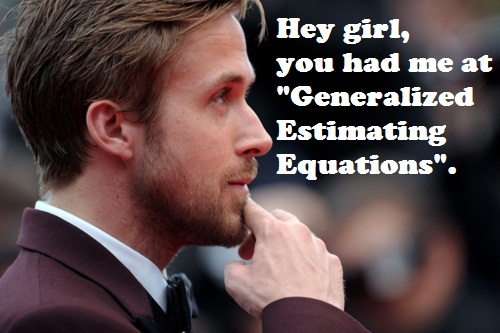
I’m way too busy at the moment to make substantial contributions to the internet[1]. I am snowed under trying to prepare two papers for publication, revise another, preparing a project connected to the health consequences of the Great East Japan Earthquake and Tsunami, and getting my first PhD student through the submission process. I got to spend an hour today doing actual stats – a proof of a result on calculating needle-sharing rates using Taylor-series expansions, and a very interesting application of generalized estimating equations, with some unexpected implications for health inequality in Japan. So, in honour of the joys of actually doing stats (instead of sitting around all day in meetings talking about them), here is a link to Ryan Gosling’s Biostatistics Tumblr. I’m willing to bet that my gentle reader(s) thought stats couldn’t possibly be sexy, but look at those pictures – there’s a man who knows how to pull chicks.
Here are a few other science-fiction/science-related topics completely unrelated to Ryan Gosling, that I stumbled on this week:
Apple’s Arcology: Apple is planning a new building in Cupertino, pictures available here, and it looks very much to me like a classic William Gibson-esque corporate arcology. You can trust our Hipster overlords to bring the cyberpunk hell right to our doorstep. Such a shame that I hate windows[2] but find Bill Gates’ politics infinitely preferable to Steve Jobs’s.
Tracking Twitter Riot Rumours: The Guardian has an excellent little interactive showing how silly rumours spread on Twitter during the London riots in August. I usually find the Guardian’s interactive data “analyses” pretty bland, but this one has some nice points, showing how rumours spread through Twitter, giving relative influence of the people involved, and distinguishing them by type of rumour. The rumours themselves are hilarious too.
Helping Categorize Whalesong: Scientific American and the Zooniverse[3] are running one of those crowd-sourcing thingies where they get visitors to compare whale songs and match them, in order to identify dialects of whale language. If you want to help, the website is here. Apparently humans can be much better than computers at matching images so if they present you with a set of images you’re likely to be able to find similar ones more effectively than a computer can. So they have turned songs into pictures, and they want you to match them. Anything that helps us communicate with whales is a good thing – though I note that the communication is with killer whales, primarily, who I reckon speak a debased version of Whale-ese that sounds more like Skaven: “quick quick kill kill! Seal must die die!” If we ever make meaningful contact with them I think their second sentence will be “we support the Japanese whaling fleet!” Because they’re bastards.
My colleague told me you can buy a translator for your cat or dog: she bought one for her dog, and it appeared to work. It’s available in toy stores and the cat version is called nyao-go or something. I’m going to get one and see what my cat really thinks of me. Want to place bets on his first words?
I have a review of a Warhammer 3 Adventure module and a piece on sex work to come. But right now, I need to sleep! Enjoy putting Ryan Gosling’s pick-up lines to work at your local bar or university!
—
fn1: an oxymoron, I know.
fn2: An interesting change in the computer world (for me at least) in the past 5 years has been that scientific computing has become much, much more pleasurable on a mac than a PC. I even have a mathematical modeling software package that doesn’t work properly on Windows 7 but does work on Mac OS X (actually, if you include R I could probably say I have two such packages; but R is so fucked that it’s unreasonable to claim it works on any platform: my windows version can’t handle column names in a matrix object, but my mac os version has RAM problems).
This is a cute example of the power of hindsight. Today’s Guardian has a discussion of the christmas tree that appeared in front of Downing St: you can read David Cameron’s twit about it here[1]. The Guardian helpfully points out that Cameron got a rare “tall” tree, once again proving inequality is a potent force in British life. Apparently tall trees are now rare because the EU changed subsidies back in 2005, causing Irish and Danish growers to switch from this type of fir tree to something else – biofuels for santa’s sleigh, maybe. Which just goes to show that the European Union’s Leprechauns and Vikings are in league to destroy British christmases.
Supermarkets and wholesalers are turning to British varieties of spruce, pine and fir.
After initial worries that British growers would struggle to cope with added demand, their representatives are predicting a £10m increase in profits
Compare with the statement from the same organization today:
While he insisted that the shortage did not equal disaster, Hay said it was inevitable that “the numbers are not going to meet the demand”. Some suppliers have been panic-buying and importing up to 100,000 more European trees than in previous years, Hay said.
I wonder if they ever got their original 10m pound profits? It certainly seems that the “initial worries” were correct. Maybe this is why people just don’t buy British anymore? Finally, we see some evidence that private ownership of environmentally sensitive goods is not necessarily the panacaea for responsible management (at least in Britain):
The other problem was that, as the British public fell back in love with real trees, growers have been selling them at a shorter height, he added. “Over recent years, growers in the UK were inclined to cut their trees as soon as people wanted them and therefore did not allow them to grow larger.”
Maybe the Christmas Tree Growers Association was originally responsible for forestry management on Easter Island?
Privatization of the resources of the commons (fish stocks, white rhinos, etc.) is sometimes suggested as an effective method of conservation, since people will be less inclined to kill off their last white rhino if they have a financial interest in its future[2]. Obviously the Christmas Tree Grower’s Association didn’t get the memo on that one … One argument against this form of stewardship is that as the size of the available stocks decline, the price will go up and the owner may be able to retire permanently on the sales of their last few white rhino horns/christmas trees, giving an incentive to exhaust their stocks as quickly as possible. I think this is why some resource economists would prefer a license system, since an environmentally-minded technocrat can vary the allowable permit as stocks change. I’m guessing that the christmas tree market in the UK is not a perfect analogy for the market in white rhino horns[3], but maybe some of the principles are transferrable. Left to their own devices, owners of a private but exhaustible good may not respond to price signals in a way that is inherently pro-conservation. I guess the perfect market theorist would argue this means that the British preference for christmas trees now outweighs their interest in preserving the stock, and the price reflects this, but I’m not sure if when people pay 10 pounds extra for a bigger tree they are really saying to themselves, “this 10 quid represents the entire extent of the value I place on having a tree at all my future christmases.” But then, the entire concept of perfect information and rational consumers[4] is pretty suspicious if the information marketplace includes the Daily Mail, which will no doubt blame the entire shortage on unelected gypsies in the European parliament.
—
fn1: would you be comfortable living in a country run by a man who can’t properly orientate photos before he uploads them?
fn2: A method of resource stewardship that reached rock bottom in one of the cannibalism scenes in The Road.
fn3: You have to get up pretty early in the afternoon to outsmart me!
fn4: I’m only pretending to know what these concepts even are.
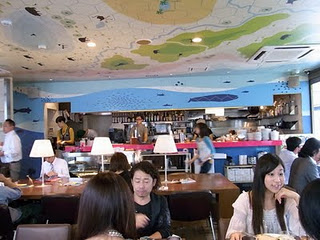
After visiting Unit club in Daikanyama to watch The Big Pink live, my partner and I went for dinner at the Sign Cafe, right next to Daikanyama station. The entire ceiling and most of the walls of this cafe are decorated in hex-map style, and on the ceiling near the door a ring of hexagons has been marked with the numbers 1 to 6, with a 7th hexagon in the centre labeled Random Direction. That’s right folks, this cafe had an old-fashioned hex-crawl map on its ceiling. Only in Japan could this be cool. The official website tells me that the wall graphic was designed by “Groovisions,” and the interior design was by a chap called Matt and a certain Lee Myeong-Hee (a woman’s name, I think). One of these three people is a role-player or a war-gamer, I think. And undoubtedly of a certain age.
You can see more photos of the groovy drink coasters and the decking at this woman’s blog. The food was good and the drinks menu both reasonably priced (unusual for Daikanyama maybe, which has an upmarket image) and quite varied (for a cafe). Unfortunately when I visited the cafe it didn’t look anything like those pictures – on a dark and stormy night it was not quite so sunny, and all the glass made it cold. If you visit, you will undoubtedly do so with a girl; bear in mind that they have blankets under the seats, you may need them in winter. It’s 2 minutes from Unit and last order is at 10, so you can get back there for a drink after a mid-week band. Maybe, if you ask nicely, you can play an upside down wargame on the ceiling…
I read this in response to a request from its author, James Hutchings. The book is self-published, I think, and can be obtained through Amazon or from James’s blog, Teleli, where the second post down explains the giveaway. I’m a nice chap, so I bought it at Amazon.
The New Death and Others is a collection of short stories, many of which are set in the city of Telleli or perhaps in its associated world. The world of Telleli is a slightly bizarre or carnivalesque version of a swords and sorcery setting, like a kind of irreverent Lankhmar, and the gods feature prominently in Telleli life. Many of the short stories in this book feature those gods, or humans or other beings of Telleli attempting to communicate with or challenge those gods. The gods are clearly capricious and not entirely intelligent, and not particularly interested in the affairs of humans – they seem to be caught up often in their own silly little dramas, and the consequences of these dramas for humans do not really get much consideration. There are also a few stories in other fantasy or near-fantasy settings, and at times the stories cross from fantasy into a vaguely fantasy-realism kind of setting. The stories are often irreverent about both the fantasy genre and the gods they describe, and a few of them are straight-out comedy, with humorous footnotes and a punchline. Examples of the kinds of stories in the book are:
How the Isle of Cats Got Its Name: A story about a sorceress in the town of Telelee who has learnt all the magic known to humans, and begins to seek out the secret knowledge of the gods. This puts her into a collision course with the cats of Telelee, and the results are unexpected for both sorceress and reader alike. This is a well-constructed short story, combining two stories (the sorceress and the cats) in a very concise and tightly-worked structure. Weaving the plot and characters from two separate storylines into a single arc, with a twist, in the space of a couple of pages is no mean feat; making the story work and evoking a sense of the town that the tale is set in, the mythology of its world, and the particular character of both the cats and the sorceress deserves, in my opinion, a fair bit of respect. This is a nicely done story
The Face in the Hill: This is an extremely short story about a politician seeking answers to a significant quandary his society is facing, and manages to fit a neat moral message into a very small space, delivering a powerful ending and a nice description of the key conflicts facing the society in question all within the context of the politician’s journey to consult a particular oracle. In this same five pages we also find out the ultimate results of his decision. It’s a well-balanced and entertaining tale, though perhaps a little heavy-handed.
Everlasting Fire: one of the directly comedic stories, this story tells the tale of a demon named Lily, working in hell, and her tragic love affair with one of her underlings. It includes several bad puns, footnotes that add to the self-referential humour, and a lot of cute jokes about hell. It’s also stuffed full of management speech and bullshit bingo, so successfully conjures the image of hell as just another workplace. The ending of the love affair is a little bit 1984, and the asides describing hell are just exactly what it would be like in a really cheap christian morality play (the sort that we all poke fun at, but that has never really been written). This kind of humour isn’t to everyone’s tastes, but it’s well done and funny.
A lot of the short stories in this collection are good examples of the craft of short story writing: pithy, quick to establish characterization and setting without falling back on cheap stereotypes, and often delivering an unexpected ending that keeps you guessing and engaged right through the book. If I have any complaint about them, it’s a complaint common to Australian art: the continuous irreverence and refusal to take the work seriously can, in my opinion, undermine fantasy and sci-fi settings, and I wish Australians would do it less. It’s like Australians are scared to just sit down and write a serious genre novel, or create a serious genre film; this is why Buffy or Star Wars would never be made in Australia. But on the flipside, this kind of irreverence is refreshing if you don’t read too much of it, and I don’t, so I can’t complain specifically about this book. It’s a general gripe about the production of culture in Australia. My main gripe about this book is that it contained quite a bit of poetry and most of it I didn’t like (If My Life Was Filmed and untitled I really liked). I skipped most of the other poems after a couple of verses. But I don’t know if that’s a commentary on the quality of the poetry or on me – I’m pretty tough on poetry generally, and even tougher on theatre (which is, in general, shit).
One other minor complaint I had about this book is that in many of the stories I got the sense that the author was constructing a certain atmosphere and level of irreverence, but sometimes let down the story by overdoing the irreverence or overdoing the setting. This is a hard line to tread in writing semi-humourous or irreverent genre stuff: you need to be sure that your jokes don’t cross a certain poorly defined line, and you also need to make sure that your setting has the right level of seriousness and authenticity to match the tone of the tale. I found that occasionally Hutchings would fall afoul of these traps, and a joke would be out of place or the setting would suddenly become too heavy. I guess that this is a common problem for a new writer, and given the difficulty of maintaining tone and style in an endeavour like this I can’t really fault him.
Overall, I think this work is an excellent first book, a fine contribution to a small field of irreverent-but-serious genre writing, and a collection of tightly-constructed and entertaining short stories. For $0.99 it’s a bargain! In fact, my main question is how work like this can be not picked up by a serious publisher, while the book I read afterwards (review to come) was. But there’s no point in dwelling on injustices: buy the book and give James Hutchings less than his just reward for the work.
I was pretty much guaranteed to like this movie: it has skyships, the three musketeers, some steampunk elements, and Milla Jovovich. I know it’s possible for a modern director to cock up even this basic a combination of win, but I feel that this movie managed to pass muster. The plot is simple and direct, the musketeers are fairly reasonable interpretations of the original, the swashbuckling is excellent fun, and the humour is modern but not stupidly modern. Even Orlando Bloom manages to do a good job, perhaps taking his first turn as a bad guy.
The movie has a nice mix of modern innovations and homage to the original. Mill Jovovich’s Milady is the most obvious modern innovation: she has a corsetry ninja outfit with steampunk Mission Impossible-style rappeling ropes, mad ninja fighting skills, an extremely brazen air and a very athletic style. I don’t remember the original stories having any female characters like that. She’s also powerfully in charge of her own destiny. On the other hand, D’Artagnan is straight from the original text and – to the best of my memory, anyway – the manner of his meeting the three musketeers is just as I remember in the book. The choice to portray D’Artagnan as a kind of rural American chump – he often reminded me of Jason Stackhouse from True Blood – was an excellent one, since that is kind of how I thought of him compared to the elegance and worldliness of his peers. The three musketeers themselves are excellent – my favorite was Porthos, but my partner liked Athos – and carry the story well. In fact, in many ways it seems quite faithful to the original.
The big deviation, of course, and the reason I was likely to enjoy it all the more, was the skyships. These enter the movie about halfway through and are both stylish and sufficiently stupid, as well as offering an excellent swashbuckling platform. They have rotating mini-cannon, flame throwers and grenades, and of course they’re ultimately extremely fragile and our heroes, having never seen one before, can immediately fly one, as well as think up cunning plans involving skyship shenanigans. Which is good, because pretty much any historical movie is going to be improved by skyship shenanigans, and this one certainly was.
If you want a good, solid session of swashbuckling, with Milla Jovovich and skyships for further enhancement, then I strongly recommend this movie. It’s a very enjoyable romp through the skies and streets of Europe with four worthy musketeers and their very enjoyable adversaries, and well worth an hour and a half of your time.
I’m first and foremost a metal boy, with 18 years kickboxing my only sport, so I guess it’s a little strange to be heaping praise on the Bee Gees, but today I read that Robin Gibb has liver cancer. The Bee Gees are, of course, famous for the amazing Saturday Night Fever, but they achieved much more than that, of course, and were ultimately credited with sales of 220 million records (according to wikipedia). And, like me, they’re British migrants to Australia.
Obviously the Bee Gees’ music is impressive and exciting, but the thing that I really admire about them, and which is very clear if you look at any of their videos on youTube, or watch any of the movie Saturday Night Fever, is that they come from a time before machismo. In the modern era – especially in Australia – to be a man means to be big, rough, and macho. But back when the Bee Gees reached their zenith, machismo really wasn’t a necessary part of the look, and you could be as poncy and as decorative as you wanted and still be taken seriously. Watch the intro to Night Feverfrom Saturday Night Fever, or the final dance scene, and you see what I mean: this is a slim man in tight lycra, who is the epitome of manliness in his age. Indeed, back in that time even Dirty Harry didn’t have a physique to speak of, and there was not a tattoo in sight. This is a world where men are judged by their sexual prowess and their deeds, not by how many tough stickers they have or how much time they have spent in the gym. This is the world that metal exploded into, scrawny and spandexed and glittery and bold, only to be dragged down into the dirt 10 years later by the likes of Pantera and Henry Rollins[1] as men’s modern performance anxieties trumped their natural desire to strut, and they withdrew into their brittle modern macho shell. The Bee Gees, with their tight pants and super harmonies, hark back to an era before men had to be tough, when dressing well, moving well and being a man was more important than ranting and raving and looking a man. Is it a coincidence that women of that era were proudly unwaxed? I think not!
So, once again, as we get older we’re faced with the sad reality of the stars of our childhood growing old and getting sick. So here’s to the Bee Gees, masters of disco, and their time that has passed…

 Compromise and Conceit

