I went to a Korean restaurant tonight, which was a bit of a disaster because I don’t know much about Korean food. The menu seemed to consist entirely of large bowls of spicy stuff (I got topkip, I think, rice cakes fried with onion and chilli in a chilli sauce, topped with chilli) or grilled meats. The grilled meat menu was extensive, but I didn’t want to go there. It was also a bit like looking at a butcher’s slab – there were Japanese descriptions of all the meats, and Japanese really doesn’t mess around with euphemisms when it comes to eating bits of a cow. They had “number three stomach” and “liver” and “number one stomach” and “small intestine,” so you knew exactly which bit of the inside of the cow you were getting. And there on the board, slap bang in front of me, was shikyu, 子宮, no mistaking it – uterus. Apparently it has a “light” flavour, and goes well with anything. And, unsurprisingly, it’s cheap – half the price of the cheapest bit of actual cow meat.
Could you eat uterus? Not in the “I was trapped in the amazon so I had to eat raw spiders” sense of “could.” I mean, casually, knowing what it is, on a Thursday evening in the city, when the menu also presents you with perfectly reasonable alternative meat-based options for a couple of dollars more. I vote “no” on the uterus question. How about you?
Today is the day that Japanese men have to repay the largesse they were shown by the fairer sex on Valentine’s Day; and so it’s the day that I have to repay my own massive chocolate haul. The White Day “tradition” in Japan (if you can call a wicked scheme hatched by Big Chocolate a “tradition”) is for men to give chocolates to women in repayment for the chocolates they are given on Valentine’s Day. Typically the man’s responsibilities are lesser: he doesn’t have to give chocolate to women who didn’t give to him, whereas women are expected to shower all the men in their lives (friends, lovers, family and colleagues) with chocolate. I find this imbalance in gift-giving very pleasing. Nonetheless, I’m nothing if not a stickler for tradition, so today I delivered some Godiva chocolates (specially packaged for White Day!) to the Delightful Miss E, and last night I gave a small box of truffles to a friend. I also gave chocolates to the office staff at my work today: they didn’t give me anything but nothing makes life easier than small kindnesses to one’s office staff. Who me, mercenary? I’m not giving chocolates to the one student who observed the Valentine’s Day tradition, because she baked a chocolate cake (a very delicious one!) for the entire Department, which presumably means that she’s now received a year’s supply of chocolate in return, and I refuse to repay that kind of callous profiteering.
At every significant railway station in Tokyo there is at least one stall selling White Day goods, and today when I emerged from the barriers in Kichijoji I saw a long line of harried Salarymen waiting to buy White Day chocolates at the local stalls (there were two). Hell hath no fury like a woman spurned on White Day, and so they lined up … harmony in the home, harmony in the nation and all that… but I did notice a sizable number of women in the queue too. This would probably be because lots of women have taken to buying chocolate for their female friends on Valentine’s Day, which then naturally leaves them obliged to buy repayment chocolate (okaeshi) on White Day as well. Truly, women have it tough …
Though I noticed at Ochanomizu station that the florist had a sign up on Valentine’s Day, which depicted a man giving a woman a rose, and the slogan “Let’s try a new kind of Valentine’s Day.” I hope the flower of Japan’s manhood are wise enough not to let this kind of pernicious nonsense catch on hereabouts …
I’ve started watching Miss Fisher’s Murder Mysteries, an Australian TV show based loosely on the series of Phryne Fisher murder mystery novels by Kerry Greenwood. The basic idea behind these novels and the TV show is simple, effective and fun: Phryne Fisher is a young (28 year old) Australian woman who has returned to Melbourne after serving as a nurse in the Great War (1914-1918), having received an inheritance and a title from a distant aunt in the UK. Suddenly wealthy and flung into the licentious era of the twenties, she starts an investigative agency, and begins meddling in police affairs, as well as having many affairs. She’s “not the marrying kind,” and of course in the twenties this kind of attitude is scandalous but also increasingly accepted. The implication in the TV show (I’m not sure about the books) is that she comes from a poor background and has a sad past (in the books this is her wartime experience as a nurse; in the TV show it’s her younger sister, who was murdered). Since 1918, she tells us, she “hasn’t taken anything seriously,” and this is the atmosphere in which she conducts her investigations. She also collects poor people around her: she has adopted two orphans, and is close friends with a pair of communist activists, one a wharfie and one a cabby.
The TV show definitely has its flaws – sometimes the acting is a bit wooden and it feels like the directors weren’t sure if they were writing a comedy or a drama – but this is the normal experience of watching Australian TV. Typically, the only TV shows that Australian directors can make with any confidence are shit-boring dramas about enormously boring middle-class suburban lives, quirky comedies about rural idylls, or gritty stories of political corruption. Anything else is approached with a kind of self-conscious dread of being caught being pretentious, and this trepidation inevitably spoils the product as the director tries to inject a bit of self-deprecating humour, or gets caught looking over their own shoulder checking that they aren’t taking themselves too seriously. It’s an Australian thing. This self-consciousness is why Australia can make excellent quirky rural comedies (e.g. Seachange) but will never, ever produce a decent science fiction show. Something like Firefly is physically inconceivable to the average Australian movie critic – merely glancing sideways at the script for an Aussie Firefly would cause 99% of Australian movie critics’ heads to explode[1].
So, having attempted to break out of the standard mold of Aussie drama, Miss Fisher’s Murder Mysteries is already painfully self-conscious. But if you can deal with that (and I’m sure it will relax as future episodes are unveiled) you get an actually pretty excellent TV show. Phryne is a fun character: she’s got guts, she’s going against convention, she’s clever, she’s compassionate and she’s lusty. Her two working class friends, the wharfie and the cabby, are intensely Australian men, laconic and kindly and macho all in one, simultaneously shy and big-hearted. Her maid, Dot, is an amusing combination of sassy girl-next-door and Catholic repression. The setting is unashamedly Australian – the Ballarat express[2], the Melbourne University boat club, flying a Tiger Moth out to the countryside to meet “Vic” – who leans in the doorway and talks out the side of his mouth in just the way you expect of an Aussie shearer – the dodgy Turkish baths and the backyard abortionist behind the pie shop, they’re all classic Australian settings. The characters also convey that strange Australian combination of conservatism and vital, progressive energy that makes our politics and culture simultaneously so small-minded and so visionary. For non-Australian viewers this show manages to present Australia in a suitably exotic light even though it’s set in Australia’s second largest city. It’s a nice introduction to some of Australia’s wilder history, as well as to the very special physical environment of South East Australia, which in its own way is easily as exotic as the Top End. At any moment you expect Phryne to just waltz out of the city and go solve the mystery of hanging rock.
Another thing that this show does very nicely is its depiction of gender issues. The twenties were an era of newfound sexual liberation against a backdrop of essentially very conservative sexual values, and this show does a good job of depicting the sexism of the time without making it menacing or overbearing: it depicts this sexism as contested and malleable, as also is the homophobia and racism, so that we don’t have to endure a stultifying atmosphere of overpowering misogyny such as mars shows like A Game of Thrones. Phryne is clearly liberated not just because she is a woman in the twenties, but because she is rich; the women around her are not so lucky, and we see this, but we also see how they make their own place in the world despite adversity, and how the men of the time adapt and respond to these challenges to traditional gender roles. Even though as a crime show it has license to be grounded in “gritty realism,” we get a much better example of how to depict institutional sexism without creating an atmosphere of woman-hating, which I think directors with much bigger budgets might benefit from watching.
I guess for people living outside Australia this TV show is going to be hard to see – it’s been produced by our public broadcaster but it’s not available over the internet if you live outside of the country. I’m sure there are ways, though … and if you’re interested in seeing a nice depiction of how Australians view our own history, through the vehicle of a fairly well-designed (but occasionally overly self-conscious) murder-mystery show, then I recommend this. Obviously, as well, the twenties are a fun era full of progressive girls wearing splendid clothes and men who spout over-the-top English. However, if you can’t abide shows with slightly stilted acting that don’t quite know what they want to be, or you can’t handle anything that isn’t standard American crime fare, then you should probably steer clear. I like it though, and will be watching more where I get the chance.
—
fn1: oh, I wish someone would write one!
fn2: which seems to take all night, even though Ballarat is – what – 3 hours from Melbourne?
It’s a year today since the earthquake and tsunami that devastated Japan’s Tohoku area, and this weekend the people of Japan are pausing to reflect on what happened then, how it affected them, and what could have been done differently. The Japan Times is holding a one year memorial special, some of which is available in English. I thought I’d do a brief review and give some of my own thoughts on the last year before I head out to the memorial.
My own experience of the events of that day was perhaps more distant than most, because I was in Tokyo and I spent the entire afternoon cut off from any form of news or current events, since I was walking across Tokyo and had no knowledge of what was happening a few hundred kms to my North: but for a single message from my partner that somehow slipped through the congestion to my phone, I had no idea that anything bad had happened – it was just a confusing afternoon of earthquakes and failed trains as far as I was concerned. Then, of course, the next few days were full of power cuts and confusion and some very scary aftershocks, so after a few days I bailed by Shinkansen to Beppu, and it was then that I realized that the rest of Tokyo was in a state of panic, which I described here. I came back a week later and by then everything had died down, recovery had begun and although things were still chaotic in the north east, nothing seemed very different in Tokyo.
Now of course everything is much more measured and calm, and media coverage has turned towards learning lessons from the events of that day. The most obvious lessons concern disaster preparedness, especially for the heavy industry and energy sector, which needs to be built on the coastline. It seems possible that these catastrophic tsunami hit the area every thousand years, and although no one knew that a year ago, it does seem that there was some awareness of the tsunami risk in the area. My partner volunteered with the Peace Boat recovery team in Ishinomaki for a week, and while she was cleaning beaches there they stumbled upon a series of tumbled cairns that had been erected a hundred years ago. Written on them was a warning not to build homes around them, since a tsunami had reached their location a hundred years earlier; this warning had been ignored. It’s not just the big power plant makers who ignored the possible seismic risks in the area.
I think this event contains messages about disaster response in an ageing society that extend far beyond Japan. The affected region has a very old population, and we’re discovering that disaster response for such a population is necessarily different. Just as the aftermath of Hurricane Katrina showed that populations with a high prevalence of chronic illness can suffer quite terribly from the loss of modern amenities, even if they’re quite young, so this disaster showed that elderly populations need special responses that take into account their frailty, the dangers of moving them, their ties to homes that they may have lived in for their whole life, and their particular chronic illnesses. On the one hand there was a need to evacuate populations from the fallout of the nuclear accident; but on the other hand, many of them had nowhere to go and no desire to leave the place of their birth – and little long term threat from radiation. Should the response to a nuclear accident be tailored to the population surrounding the plant? Chernobyl was surrounded by a young population with many children, but Fukushima is characterized by a very much older, more settled group of people who are at low risk of radiation-related illness. Should they have been treated differently? In such a period of chaos, perhaps a more tailored and nuanced evacuation response would have been in order.
I have become involved in some research about this and other issues in the town of Minamisoma city, and I’m hoping to explore them in more detail this year. I have visited the town once, when I took these stunning pictures, and although disaster response and radiation epidemiology are not my specialty I’m hoping to contribute in some small way to understanding how the response to a disaster of this kind should be handled in an ageing society. China is going to be ageing rapidly under the influence of its one child policy, and it is not only prone to earthquakes in some regions but also has a large nuclear power program. The UK and France have nuclear power and an aging population, so I think the lessons from Fukushima will extend to those countries as well. What we learn from Japan may be instructive for those countries in the future. Tonight on NHK I watched a documentary about the 4000-odd American marines who responded to the initial tsunami and helped to save lives all along the coast, and this show made clear to me that even the most developed and richest countries are not necessarily able to handle events like this in isolation. I hope that lessons learnt from this event will help us to prepare for future events on the same scale, to respond rapidly and effectively to minimize disruption and loss of life.
Asia has seen huge loss of life from natural disasters in the last 10 years – the Asian tsunami of 2004, the floods in Pakistan, a couple of nasty earthquakes in Iran and then last year’s floods in Thailand. Let’s hope that the 2011 tsunami will be the last such horror to visit the region for a long while, and that any lessons to be learnt from Japan’s experience don’t have to be acted on anywhere for a very long time.
Yesterday a paper I co-authored was published in the British Medical Journal. The paper, available free of charge at the BMJ website, analyzes mortality among Japanese working age males between 1980 and 2005 and estimates the changes that occurred after the collapse of the bubble economy. Our main findings were that a previously existing inequality in health between professional/managerial workers and the remainder of the population was reversed in the 10 years after the economic collapse. This reversal happened not because the health of non-professionals improved, but because professional and managerial workers saw a rapid increase in mortality.
Before 1990 there was a fairly clear pattern amongst the main causes of mortality in Japanese men: the managerial and professional occupations had lower mortality rates. Mortality rates for all groups were largely declining over time, and at roughly the same rate, but managerial and professional occupations on the whole had lower mortality rates. However, after the collapse mortality rates in these two groups suddenly began to increase, while those amongst the non-professional categories largely maintained their previous trajectory. These trajectories and the changes can be seen easily in Figure 1 of the paper, and the changes that occurred at the time of the collapse are summarized in Table 4. For example, before 1995 the relative risk of all cause mortality in managers/professionals was 0.70 (i.e. 70% of that in the other occupations). After 1995 it was 1.18, about 20% higher (and this difference was statistically significant). Table 4 shows that while before 1995 managers/professionals had lower mortality across almost all the major causes of mortality, after 1995 this relationship disappeared or was reversed.
As an aside, the paper also shows that massive increases in suicide rates in all professions coincided with the economic collapse of the late 80s/early 90s.
There is a possibility that so-called “numerator-denominator bias” might have affected the results: if people registered their employment status differently on their death certificate (the numerator) to the population census (the denominator), we might over-estimate the effect of the stagnation in those occupation groups (like managers) that shrank fastest at that time. This effect might be possible if, for example, after the economic collapse managers and professionals moved into other professions or became unempoyed, but after they died their family recorded their profession on their birth certificate as that which occupied the majority of their career. However we checked carefully for this and confirmed that even the most extreme possible effect of numerator-denominator bias doesn’t change the essence of the results, only the magnitude.
It’s dangerous to ascribe reasons and causal relationships to these kinds of phenomena, but the strong implication is that there is a relationship between the economic aftermath of the collapse and this reversal in health inequality in Japan. We postulate that this might be due to the rapid shrinking of the size of the managerial/professional workforce and changes in its working conditions that did not affect the labour/service industries as much. Other possibilities include changes in insurance status and access to healthcare, or perhaps some kind of health-system effect on cancer survival. It’s probably not due to unemployment: unemployment is categorized separately in the labour market statistics and death certificates, so theoretically a person who is sacked in 1985 and dies in 1990 should be counted as an unemployed person, and since we checked for numerator-denominator bias we think we ruled this out.
Japan has very different patterns of mortality to other developed nations, but this paper gives us an indication of the possible large effects that an economic downturn and subsequent stagnation can have on population health. It also shows that an economic downturn doesn’t necessarily affect everyone equally, and doesn’t necessarily affect the poor, or non-professional occupations, more than it does the rich. I guess the results of this paper and its lessons about the role downturn and stagnation can play in health may be applicable to countries like the UK and USA, which are just beginning to experience what Japan did in the 1990s. This paper suggests that we should expect significant effects of the downturn on health, but that we shouldn’t assume it will hit the poorest hardest, and should be aware that every nation’s post-depression experience may follow a unique trajectory. It also tells us that significant health gains made over a long period of time, such as are seen in this data, can be reversed rapidly after a major economic downturn, and economic collapse can undo 20 or 30 years of health gains. In health terms, major economic events are certainly not to be sniffed at!
It’s the little things that can do you in, and watching The Walking Dead recently I noticed that the group have made some serious mistakes in choice of vehicle for their road trip. Who is responsible for their vehicular management? That sanctimonious old meddler, Dale, of course. They really need to start viewing him as “just another mouth to feed.” Here is why they have made bad vehicle choices, and what I consider to be good choices for the zombie apocalypse road trip.
The Winnebago, the hi-tech liability and the chopper
The Walking Dead‘s group drive across America in a Winnebago camper van, a couple of urban runabouts and a Harley Davidson. Three of their four vehicles are bad choices: the Winnebago, the modern urban runabout, and the Harley. Their overall group transport strategy is flawed because the Winnebago is carrying too heavy a load and they haven’t built in any redundancy to account for it. Specific reasons for the flaws in each vehicle are easily identified.
The Winnebago
This is the big mistake in the road trip plan. The Winnebago has many flaws:
It carries too much material, which means that if it breaks down in a high-risk area (near a town or an obviously infected area) the group won’t have time to empty it before they need to move on. They’ll have to leave a lot of important gear behind if they’re in a hurry, because they have too much stashed in one vehicle
It’s not manoeuvrable, so when they reach traffic jams or narrow roads they have to go around. Worse still, if they see trouble ahead and need to turn around in a hurry, they need to do a three point turn rather than a u-turn. To avoid this they need to stay on large, wide roads which are likely to be heavily infested.
It’s inefficient, so that despite its large size it only really carries a couple of passengers and beds. As a hospital vehicle it’s little better than a normal van, but it also carries less people than a mini bus. Furthermore, all the heavy fittings and camping style are simply a waste of space. They won’t use the toilet, and they could get by perfectly well with camp chairs rather than heavy fixed tables. All this stuff is taking up space and using fuel but providing little comfort. As a source of shelter it’s not large enough for the whole group, yet the whole group is constrained in road choice by its size
It’s noisy and has high wind resistance, meaning it draws attention to the group and uses a lot of fuel. Fuel efficiency may not be a long-term issue in a world depleted of competition, but in moving between gas stations and fuel sources it is crucial. If you’re going to use a heavy, fuel inefficient vehicle you need good reason
It’s heavy: hard to push out of the road, hard to replace wheels
The worst case scenarios involving the Winnebago arise from the combination of its lack of manoeuvrability and its excessive storage usage. On a narrow road, if the group see zombie trouble up ahead they will need to turn the Winnebago around, running the risk that it will get bogged off-road. This could potentially trap other cars between the Winnebago and the zombie horde, meaning loss of those cars too. But even if this doesn’t happen, bogging the vehicle down will mean having to empty it into the other cars. This will take a long time, and as the zombies approach the group will have to choose to abandon large amounts of stuff. This wouldn’t happen if that stuff had been distributed between more, smaller vehicles.
The urban runabout
The group also has a green hatchback, quite modern, that is probably highly fuel efficient, comfortable, reliable and quiet. This is overall a good choice of vehicle, but it has a significant downside: it’s too modern. Modern cars can’t be easily repaired by unskilled users, and often require computer diagnostics and specialist service centres, sometimes affiliated with the company that sells the car. Also, parts are often specific to the car and can’t be scavenged. This means that any breakdown more serious than a simple puncture will put the car out of action. That’s fine if your group has significant redundancy, but the group in the Walking Dead don’t have this luxury.
The Harley Davidson
The Harley is probably a good idea for long road trips – I get the impression that these bikes are designed for comfort in long journeys. It also has the potential to carry a rider fairly comfortably on pillion, and carry a small amount of luggage, so is a good survival tool. But it suffers from the drawback that all motorbikes do: it’s uncovered, so dangerous. However, it lacks the advantages of other smaller bikes: it doesn’t have the speed, manoeuvrability and acceleration of a road bike, nor does it have the off road capabilities of an off-road bike. It’s also likely to be noisy and less fuel efficient than other bikes. What’s its use? If it is to be used for long range reconnaissance, a road bike – extremely fast, highly manoeuvrable and quieter – would be a better option, since it will be able to travel far ahead of the group in a short time, and escape any trouble. If short-range off-road scouting is necessary, then a standard farm bike would be better. This can be used to get through partially-obstructed regions (e.g. old road blocks and traffic jams) easily, is highly manoeuvrable so can be turned around quickly to escape sudden gangs of zombies, and can go off-road to investigate old houses and farms. In the hands of an experienced motor-crosser it can even potentially go over some obstacles, though at high risk. A Harley is only good for open-road cruising. But you can do that much, much more safely in a car, which at least has the advantage of seat belts.
The problem of redundancy and overloading
Another significant problem arises for this group from the combination of lack of redundancy and overloading of the Winnebago. If the Winnebago breaks down irreparably, the group will need to move all the stuff out of it into just two urban runabouts, which also need to transport all the people in the group. Short of the obvious solution – shooting Dale for the sanctimonious moralizing loser that he is and using his seat for storage – the group is going to face a hard choice between supplies and people, because their two small cars won’t have enough room for both. This choice is going to probably have to be made in a hurry, and will lead to the loss of a significant amount of important material. If one of the other runabouts dies, the problem is not so severe but they will be immediately forced to hunt for a new car, even if the only locally available cars are in very dangerous settings. They have no choice in this – if one of their runabouts fails and then the Winnebago breaks down in a dangerous place, they won’t have sufficient capacity to take the whole group to safety and will have to repair the Winnebago under pressure. Bad move.
Furthermore, lack of small vehicles means they don’t have the ability to circle the vehicles at night – not a perfect defense tactic but an important part of safe camping techniques. And of course, they don’t have a spare vehicle to use to block a street or set alight as a barrier.
The ideal road trip strategy
Cars offer the benefits of mobility, shelter and security. However, on a road trip one runs the risk of becoming stranded between locations with no source of supplies, so the key to any safe zombie apocalypse road trip is redundancy. Ideally you need lots of small cars with the following properties:
Fuel efficiency
Good storage space
Manoeuvrable
Easily pushed, for jump-starting or getting out of the way
Disposable
Easily accessible (four doors!)
Readily accessible spare parts
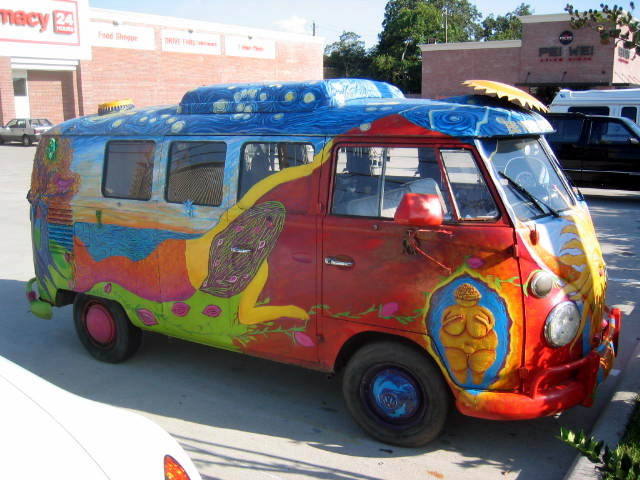
The thought of hooning along post-apocalyptic open roads in a Nissan Fairlady may appeal, but it has very few advantages. The group should choose cars that meet most of the above conditions, and ideally some of these vehicles should be able to be used as excess storage spaces, shelters, or hospital vehicles. Thus a good combination would be VW kombi vans (for space, shelter and repairability) or similar vans, four-door utilities (for storage and convertability), and older four-door hatchbacks. For the utes, ideally they would be the sort of ute that gets used as a “technical” by somali warlords – so an older Toyota or Subaru, something reliable and trustworthy that can use parts from any old car and can itself be cannibalized.
The group should have more vehicles than it needs to carry all its materials and all its people, and some of them (the kombi vans) should be sufficient to provide shelter and security in a pinch (bad weather, sudden unexpected zombie onset). All of them should be able to turn easily to get out of trouble, and be pushable by two adults. All the vehicles should carry enough supplies to be self-sufficient for a short time: basic materials for the engine (pipe, radiator, spark plug, battery, jump cables); a couple of days’ food; water; fuel; basic medical supplies. This means that if any one vehicle needs to be abandoned its contents can be stripped out quickly and moved to another vehicle, but can also be abandoned un-stripped without catastrophic loss of vital materials. All back seats should be left empty and the doors unlocked, for rapid transfer of people from broken cars in an emergency. The utes can be used to carry excess material that isn’t so important and can be dumped where necessary; the utes can also be used as emergency evacuation vehicles or even ambulances where things go wrong. All vehicles should be given a priority (High, Medium or Low) and this should be painted on bonnet and doors so that everyone knows which vehicle to head for if not all vehicles can be saved. The group should travel at the optimal speed for fuel efficiency, well spaced out, and stop regularly to rest and check maps – you never know when you might need to turn around, so it’s good for everyone in the group to be aware of potential hazards in the road behind. All vehicles should be driven with at most 2 people in them (to ensure redundancy) and single occupancy vehicles should be avoided – it’s not fuel efficient and it opens the risk of loss of communication. Ideally some kind of radio contact should be maintained between vehicles – hourly checking in, regular reports, etc.
All vehicles should also be fitted with a usable sharp piercing implement such as a sharpened iron spike by every door, so that zombies that break through window glass can be dealt with easily. When driving, everyone should wear seat belts – what’s the point of surviving the apocalypse only to die in a low-velocity car crash? Or worse, survive but be put down like a dog by your comrades because of a lack of suitable medical equipment to handle serious injuries… Finally, motorbikes should only be used if the group really sees a need for single-person reconnaissance. Otherwise they’re a dangerous luxury vehicle that should be avoided.
I think if a group follows these principles it will be able to survive longer on the open road and escape from even quite dangerous and pressing situations without significant lives or material. As it stands the group in The Walking Dead are one breakdown away from either losing a significant load of supplies and/or having to abandon people; or becoming lunch. Don’t make their mistakes, and instead adopt an industrial design approach to your post-apocalyptic convoy: share the load-bearing and ensure redundancy.
A note on the zombie road-trip of the future
As the world shifts to a low-carbon future, cars are going to become electric. In the further future they may even become robot driven. This means that sometime in the far future, the apocalypse will see a collapse from a much higher-tech society than we have now, to a much lower-tech society, with no pause in the Mad Max zone. Isn’t that interesting?
Addendum
If you appreciate my thoughts on zombie survival strategies, please consider reading my novella Quarantine Breach, set in the world of 28 Years Later, which is freely available at Royal Road.
Being still sick today, I decided to kill two birds with one stone and go see a doctor about a hand injury that’s been getting worse over the last few months. It’s a common kick-boxing related problem, no big deal, just a strain in the area at the base of my thumb, but it has been slowly getting worse (usually this goes away with some stretching) and so it’s worth checking if there isn’t some kind of minor fracture or strain that requires medicinal assistance or complete rest from punching. So off to the doctor I went.
The doctor I chose was the Abe Orthopedic Clinic near Kichijoji station, and when I turned up at 3pm (the start of afternoon opening hours) it was already full to over-flowing with old people, all of whom were waiting their turn patiently for a “rehabiliation massage.” Each would go into a room and sit on a chair where, for about 15 minutes, they would receive a massage from a physiotherapist. Then they emerged, got charged ridiculously small amounts (“100 yen!” “150 yen!”) and go home. After an hour I was called in, told it was just a minor strain and given a prescription for some kind of anti-inflammatory stick-on treatment, and out I went again. Total charge: 1050 yen for the consultation, about $10 US. Before my health insurance is taken into account that would be about $30 US, about the same as an equivalent consultation in Australia. My drugs cost a further $7 US.
Now let us compare with the same process in the UK. First I have to visit my general practitioner (GP), which I can only do with an appointment in most cases. The appointment will require a wait of 1-4 days, so I couldn’t have done it on a random day when I was already home sick. The GP won’t offer me any medical opinion, but will prepare a referral to a local hospital outpatient clinic, which I then book. This referral will take between 2 weeks and 3 months, usually somewhere more toward 6 weeks – unless one of the new-fangled “Referral Management Centres” decides my referral was inappropriate, in which case I’ll be redirected either to a specialist or back to the GP (with further waiting in both cases). So after 2-12 weeks (roll 2d6!) I will get to the outpatients’ clinic in the hospital, and assuming I am seen on time (unlikely) and don’t need an X-ray, will be given my prescription and sent home. Total cost: nothing.
Which system would you rather be getting treated in? Bearing in mind that when I say “health insurance” about Japan I don’t mean it in the American sense of “capricious company with a god complex that will decide whether you get reimbursed,” but “government-run single payer that covers everything.”
Which system would you be more likely to not bother attending for non-urgent healthcare in, especially if you’re a healthy young male who thinks he’s invincible? So, your health problem niggles away but you wait until it becomes acute because, well, this whole thing is too much trouble. Sure it’s still your fault when your diabetes gets out of control, you lazy shit; but wouldn’t it have been better if the unnecessary barriers to care weren’t there in the first place? And ultimately, from a health system perspective it doesn’t matter whose fault it is: you’ll still be turning up at the emergency department with acute unmanaged diabetes.
This isn’t necessarily just a problem with financing (everything in the NHS is free so queues can be used as a form of rationing). It’s a fundamental problem of the gatekeeper system that the NHS uses: if the gatekeeper doesn’t provide a good range of medical services onsite and/or the time from gatekeeper to gate is very long, it acts as a huge disincentive to voluntary healthcare-seeking behavior. And in modern health systems, voluntary healthcare-seeking behavior is very important: in testing as a component of controlling infectious diseases like HIV and TB; in managing chronic illness like diabetes; and in identifying preventable health conditions like osteoporosis.
Anyway, nothing’s wrong with my hand, and no nasty comments about the real cause of inflammation in my right wrist, if you please!
In most social democratic countries (that is, the UK, Australia, New Zealand, Canada, Japan, troll-infested Scandinavia and much of Europe), the government provides some state support to the arts and sport, either directly through grants and training or indirectly through subsidies for community participation and activity. Let’s consider a few examples of these from around the world that I know.
The UK
Before the 2008 Beijing Olympics the UK invested heavily in amateur sports that would be represented in the Olympics, and in that year for the first time in a long time its sportspeople performed at a level that one would expect for a country of its size: this was preparation for the UK Olympics of 2012, where it’s expected they’ll do even better and, in a remarkable turnaround, will repeat the 2008 performance of beating Australia in sports we’re usually good at (I think they beat us at swimming in 2008). The UK also famously maintains free access to its public museums, which is a great thing (though my god they are crowded).
Australia
Australia has a long-standing practice of funding sports at many levels, including a cricket academy and soccer academy. State and local governments also maintain a very large number of public sports grounds that see heavy use: this community participation is the main reason Australia has four healthy football codes, one more than the UK and three more than the US. Women’s soccer in Australia is also booming and in fact the main break on its growth was the limited availability of grounds, which put women’s soccer into competition for resources with men’s soccer. Given the nature of a soccer ground, this kind of problem is often only resolved through public funding (to make more park space available). Australia also maintains a very well-organized system of political support for sport, which is manifested through e.g. the martial arts accreditation scheme and state-sponsored inquiries into the management of elite soccer. This sort of stuff is necessary to maintain momentum in the growth of new sports. Australia also maintains a system of grants for artists (the Australia Council) which fund any kind of new art through a supposedly competitive process. In addition to separate funding for the major elite arts (like opera and orchestras), Australia’s most famous landmark building, the Sydney Opera House, was built from public funds. So the arts at many levels are funded well by the state, through our taxes.
Japan
Japan maintains a network of public halls, kominkan, which are available for use for any cultural pursuit: flower-arranging, book groups, role-playing groups, you name it. The Japanese prefectures and city offices also maintain special martial arts buildings (budokan) for the practice of all forms of combat sport – you can book rooms in these halls to practice your own. Sumo is supported through public funding to some extent, I think (a source of much dissatisfaction to many Japanese when they see match-fixing and gambling scandals, and notice that the best-behaved sumo wrestlers are the foreigners!) Japan’s public schools and universities also maintain a heavy level of sports participation through clubs. I’m sure there’s other types of arts and cultural funding over here too, if I care to look.
Of course before the modern state this type of subsidy also existed, in the form of noble or religious patronage, but this subsidy came with the rather sad downside of requiring its recipients to either directly sing the praises of their patrons, or to at least look the other way from their worst flaws. So subsidy is not new, even if it is more systematized and conducted under more complex institutional arrangements in the modern world.
Since the mid-70s, however, the developed world has seen a flowering of cultural activities that were almost exclusively developed in the private sphere and/or through private sector initiative, without a skerrick of direct state subsidy. As a few examples: plane- and train-watching; martial arts; various forms of collecting; computer gaming[1]; lego and meccano; wargaming; and, of course, role-playing[2]. These cultural activities have developed over a long period of entirely private investment and support, in the sense that there was no government support for them as cultural activities either on the corporate side (in setting up companies to sell the activity); the individual side (in turns of subsidization or support for involvement); or the community side (in, e.g. special halls or facilities for them). Indeed, famously, after 9/11 the state intervened actively (though not deliberately) to make plane-spotting a good deal harder than it was.
Would the government have saved us from 4e?
One obvious question that this raises is whether these activities would have been more or less successful, or even different at all, if they had received state support as burgeoning cultural activities. Looking at the history of TSR, for example, it appears to have folded or near-folded several times, and gone through all sorts of weird product-redesign and marketing strategies to save itself (plus there was all that internal nastiness). Would the company’s history, and thus the game’s development trajectory, have been different if in the period from, say, 1972 to 1985 it had been able to receive some small quantity of government support as a cultural activity? One argument would be that with “handouts” supporting it the game would have disappeared up its own arsehole, becoming some post-modern weirdness disconnected from its market of gamers; the other is that with a bit of basic financial support the designers would have been freed up to focus on quality product rather than chasing the next bonanza, or at least able to spend a few years producing a coherent game system without worrying about matching their production activities to whatever marketing scheme they thought would save the company. I guess this argument comes down to one about industrial policy (should your government pick winners like Japan and the USA do, or should it foster competitiveness like Australia and New Zealand do). But I think we can boil this issue down to one simple question: would TSR have needed to make 4th Edition if they were receiving a government subsidy[3]?
What sort of subsidies would be appropriate?
Taking as read that social democratic societies will continue this practice of funding cultural and sporting activities, what sorts of things would be suited to RPGs if they were included under the rubric of “cultural activity”? Here are a few things I’ve thought of that I think actually would help to make gaming more widespread, more enjoyable, and perhaps more diverse:
Sponsorship of conventions: this would enable the conventions to be held in better locations, to have budgeted conference dinners, prizes, and possibly pay for attendance by renowned designers or GMs. It would also enable the game to spread outside of its heartland areas a little.
Recognition of some games as cultural icons, and their preservation either in print or digitally for common use: for example, the UK government might declare Warhammer Fantasy Roleplay 2 an iconic game and provide funds to maintain it in print or in an online archive, thus ensuring that it didn’t disappear. Some games that I think this would be a really good idea for include ICE’s Middle Earth Role-Playing, some form of OD&D, WFRP2, and the original Shadowrun. This wouldn’t preclude the companies from making new versions of these games, but it would mean that games of cultural significance were retained. Look at the effort the OSR puts into producing variants of OD&D as an example of the benefits of retaining these games in print or online.
Funding and research support for those elements of, eg, the OSR that are trying to piece together the history of the game, for example through funds to travel and do interviews, support in archiving and organization, and specialist research tasks (including translation)
Greater support for academic study of gaming, for example through research grants
Support for copyright issues: no gaming company can afford the rights to Harry Potter, I suspect, but a Harry Potter game would really help to spread RPGs around. If the government fronted up the money for the rights, then maybe this could happen – even a flawed Potter game would be a huge benefit to the gaming community, I think. More generally, access to the rights for game settings and art connected to them could help the industry a lot
Support for culture-specific games: e.g. the Australian government could hold a contest for development of a game setting that was uniquely Australian in feel, or the US govt could give out grants for the development of culturally-sensitive Native American game supplements
Technical support: development of online platforms, more research into the complex probability models used in some games, better editing and book-binding or just provision of support to overcome barriers to entry into new media would be really useful for diversifying the style and types of game and gaming methods
Establishment of an independent, high-quality magazine: most gaming magazines are owned by the publishing houses and have been for a long time. A genuinely independent magazine with high production values and an industry- and community-wide remit will never flourish in such a small culture industry, at least not in print, but I think with government subsidies it could and it would be interesting
Support for the online community: Prizes for bloggers, financial support for annual physical meet-ups, perhaps technical support in the form of grants to expand the use of the internet for gaming collaboration. Also, money for me.
None of these ideas seem to fundamentally change the basic modern business model of gaming, but I think many of them would help start-up gaming companies with both the cultural background of their activities, and access to some of the technical matters that can help a game work out. Other funding ideas here are largely about supporting the community that the gaming industry is built from, because as a cooperative activity role-playing needs more than just our private money. The RPG hobby only flourishes when individuals have the space, time, money and inclination to come together to make games happen, and it’s (rightly) difficult for private companies like TSR to build this by themselves. It’s easy for us as individuals to put in the basics – our money, our time and our living rooms – but when it comes to the deeper, more complex aspects of maintaining the hobby, perhaps we could do with the same support that recognized cultural activities obtain. Communities may not require support to maintain but it certainly helps, and governments are ideally placed to provide that support.
What do you think?
—
fn1: I include computer gaming in this list because although in some times and places the computer game companies have received state support as start-ups (e.g. in Australia), this state support is through industry development funds, as a pure business enterprise, not as a cultural activity per se. i.e. you can approach the government of a social democratic nation (in some times and places) and say “I want to start a business selling X” and they’ll fund it even though it’s a kooky hobby; but the same funds don’t seem to have been available for “X” as a cultural activity.
fn2: My reading of the early history of role-playing in the UK suggests a lot of the early games did actually happen in public facilities, like community halls. But a lot of these were church- or school-run, and when I was gaming in London these halls didn’t seem to exist, so I think this aspect of state subsidization of community art in the UK has died off in the past 20 years. I guess this is because public halls have been defunded, and since certain religious issues arose in connection with D&D it’s hard to ask to rent a church hall for an RPG convention.
fn3: And the related question: if you were a benevolent dictator subsidizing TSR, would you have let them?
Through the website i09 I discovered an entertaining Call of Cthulhu comic, written and drawn in the style of Dr. Seuss. The artist is one DrFaustusAU, an Australian artist with a page on DeviantART. What a mysterious coincidence …
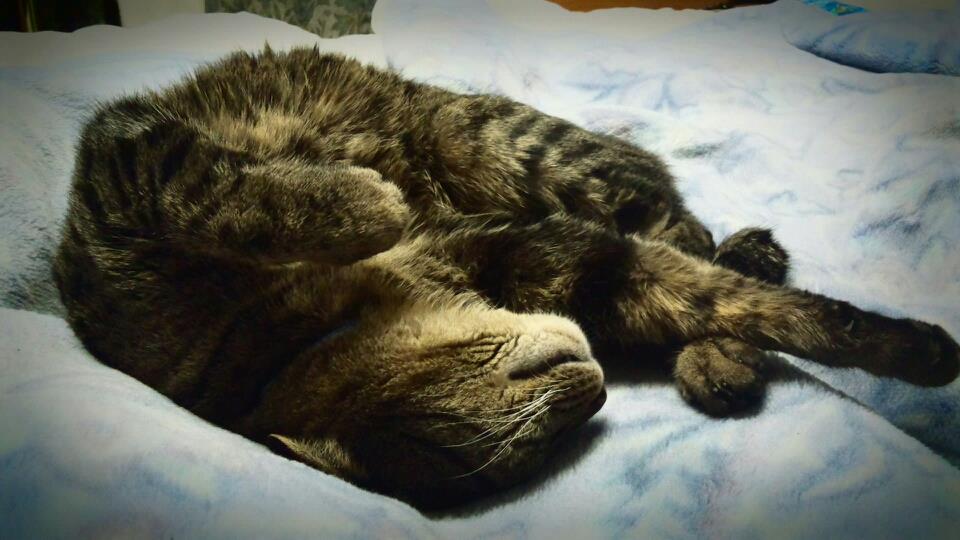
I and the Delightful Miss E both have colds this weekend, so we decided to have a lazy weekend in the house, watching monster documentaries. We weren’t quite as lazy as the pictured monster, who couldn’t even be bothered lifting his head through most of the weekend, but about the only time my pulse rose above resting level was when I learnt about the kinds of horrors that ordinary citizens in Madrid have to endure. And my god, were they horrible. It’s nice to sit safe in your home learning about the kinds of troubles that people in the Western Hemisphere face, being reminded of how much more civilized life in Asia is. Although I must say that I sometimes got the impression that the third documentary I watched wasn’t real. Sometimes it just seemed, well, acted. Here is my review of the three documentaries I watched.
Rec: Violent zombie bio-containment in Madrid
Rec is an accidentally-shot documentary about an incident in a Madrid apartment block, filmed a few years ago. The film starts off as a simple TV show, with a presenter and her cameraman planning to spend a night with the Madrid fire brigade filming their activities for a show called While You Were Sleeping. I think they must have changed the name of this show for the documentary because I can’t find any evidence that it’s real, but it is an excellent idea for a TV show so I think people should make this kind of show. Anyway, after a few hours of boredom the team are called out to an incident in an apartment block, where a woman appears to be locked into her apartment, and the documentary crew go with them. When they arrive they are greeted by the apartment residents, who are in the hallway, and two policemen. The “normal incident” turns out to be a monster situation – some kind of zombie in the apartment attacks one of the policemen, and mayhem breaks out. However, before they can do anything to flee the building is surrounded by police and health inspectors and sealed off, and they are warned that any attempt to leave will have “drastic consequences.” They are then required to stay in the apartment block while, one by one, the residents and visitors turn into zombies. The whole thing is recorded by the documentary crew.
This documentary is genuinely one of the most terrifying films I’ve ever seen, after The Descent – which we all know was just a movie. The people are so ordinary and unprepared: the residents consist of an uptight mother and her daughter, some Chinese migrant textile workers, a seedy older man who thinks he still has it, and an intern from the local hospital. No one has any idea what’s happening until the dead start coming to life, and they all start blaming each other (until they settle on the Chinese as scapegoats, of course). They can’t agree about a plan, refuse to follow the orders of the policeman, and don’t have any community feeling to bind them together in adversity. Meanwhile, they’re being lied to by the police outside and hunted down like animals by a terrible beast inside. The panic builds towards an incredibly tense and terrifying conclusion, and much of the action happens in claustrophobic, tangled spaces, or in the dark or just the light of a single spotlight. It’s one of those situations where everyone needs to understand the basic principles of zombie theory, be ready to apply them, and be ruthless and steadfast in sticking to them. Sadly they don’t do this and every time the group fragments or fails to get it fast enough, someone dies. The editing of the documentary is very well done too so it’s sparse with extraneous details, doesn’t make you feel sick or confused from the jumbling images, and gives you a clear sense of what’s going on. It’s so good it could be a movie, and indeed I did feel like I was watching a movie as the facts were being unveiled. Unfortunately a few years later an American director made a movie, Quarantine, based on the events in Madrid, and in watching the preview for that movie I got a spoiler showing me how the situation finally is resolved. My advice is not to watch the trailer for Quarantine. Why do people put the ending in the trailer? That’s crazy.
This documentary is hard going but very powerful and educational, and it again reinforces the lessons learnt in The Descent: if you’re up against a countable number of undead/generally grey-skinned opponents, and your resources and strength are limited but you have a couple of good weapons, absolutely the best thing to do is to take a stand in one, strong, defensible position and destroy them as they come at you. Do not attempt to run and hide, do not try to find out more about what is going on than you immediately need to know, do not split up and most of all destroy them before you start to run out of energy, light, or esprit de corps. Especially if you are in a building surrounded by police, so all you need to do is survive until they can work out what to do. And most of all, don’t go creeping around in dark hallways and rooms trying to work out who is still alive and what is going on. The lessons of this movie will help anyone who is faced with a supernatural or viral zombie threat of the kind we all need to prepare for.
Trollhunter: The truth about Norway’s troll control program
Trollhunter is a found-footage documentary, based apparently on 283 minutes of footage that turned up at a Norwegian TV station and was verified and pieced together by its editors. The documentary was filmed by some college students who were originally on the trail of an unlicensed bear hunter, only to discover that he is actually a troll hunter. Initially cold, he finally opens up to them and allows them to follow him in the troll hunt. Apparently Norway has always had trolls, but they are confined to specific territories and if they escape those territories the troll hunter, Hans, is sent to kill them. These trolls aren’t like D&D trolls: they’re up to 100m tall and enormously powerful, and they can smell the blood of a christian. The documentary tells us quite a bit about their biology and habits and so we learn that they aren’t supernatural at all, though they can be killed by exposure to sunlight: they’re just very big, very old predators that have been driven into the wilderness by humans. Unfortunately, the government is keeping their existence and the existence of the troll control program a secret, which might explain why the documentary is based on found footage.
This documentary isn’t terrifying like Rec but it is a fascinating, occasionally violent and disturbing, and very exciting kind of animal documentary, like going in pursuit of 100m tall lions or something. It has a good pace, although they do sometimes spend too much time filming shots of the fjords, and it unveils the truth of the situation in the same way that the filmmakers themselves learnt it, which is an excellent technique for documentaries about monsters: by giving this point-of-view style, the documentary maker encourages the viewer to feel like they have themselves stumbled upon these hidden facts about the supernatural world, and so makes the viewer more likely to believe the truth of the story – though obviously as an avid RPG player, I didn’t need any convincing as to the existence of trolls. I just didn’t realize they were so big! Or so well controlled by the Norwegian government, which is apparently up to its neck in conspiracy and cover-up to prevent panic and chaos. Usually when people talk about the dark secrets behind the Scandinavian success story it’s something about suicide or youth unemployment, but I never realized it was actually troll control. A fascinating insight into how the government handles supernatural problems in a stable, social democratic society and well worth watching.
Diary of the Dead: Badly made Zombie hoax
This “documentary” is really, really hard to believe. First of all, although it’s easy to believe that I could miss news about a single weird situation in an apartment in Madrid, it’s really hard to believe that the kind of chaos this documentary describes could have happened in the USA without my noticing it. For the brief period of the documentary it’s as if the world has ended, though obviously that can’t have happened since, well, I’m sitting here writing this and the person who filmed this documentary openly admits that she was able to edit it and release it to us. I really hate it when documentaries about serious subjects like zombie incidents try to exaggerate the importance of them, like the world has ended or something. The second hint as to the falsity of this documentary is its title, which is clearly a play on the names of the famous zombie movies – I even have a suspicion that Romero had a role in this. The third clue that it’s a hoax is that it appears to be acted, and badly acted at that. It’s like a bunch of student actors thought they could reproduce the success of the Blair Witch Project, but through a hoax zombie outbreak. Only they did it really badly.
The documentary claims to be the work of some film students who were out in the woods making a horror movie for class when a huge zombie outbreak occurred in the USA. As the social fabric breaks apart they travel across Pennsylvania in a Winnebago, first to find their families and then to find a friend, while one of the students films everything that happens. It is this film that becomes the documentary. Thus the documentary makers claim to have been in position to film the situation as it happened, though they admit that they edited a little and added soundtrack and effects “to scare you: because perhaps if you’re scared you won’t make the mistakes we made.” Unfortunately, I was really unconvinced that they were doing anything except making a B-grade movie. The acting is so bad as to be self-evidently badly acted, and the narrator tacks on this self-important moralizing about the role of the cameraman and the media, as if they were a seasoned (but tedious) war photographer, rather than a jumped-up student; and this moralizing is almost begging you not to take their “documentary” seriously, especially since in between the moralistic voice-over we’re constantly being reminded that they have no choice in doing what they’re doing. Also they all seem emotionally really shallow compared to the behavior of the people in Madrid. I know those people were Spanish, but they reacted more realistically and emotionally to the deaths of strangers than our student documentary-makers do to the deaths of their own family and friends. While it takes the people in that apartment a good half the movie to work out that they’ve stepped out of ordinary life and into a horror movie, these kids figure it out as soon as they hear a radio broadcast about a single dead person coming back to life. After that, they’re acting like survivors in a zombie movie with nary a whisper of complaint. It just doesn’t work. As a documentary, this movie is uninformative, overblown, overly moralistic and shallow. As a work of fiction (which is what I think it really is), this movie is badly acted, self-referential, poorly scripted and sentimental.
It’s also really cheap to portray a movie as a documentary without warning the viewer. Honesty is essential to the production of documentary film: how are the people desperately trying to tell us what happened in Madrid or Norway going to be believed if there craft is undermined by movies posing as documentaries? People should know what they’re seeing from the start, or the educational and important messages of a film like Rec will be missed amongst the dross. So, give Diary of the Dead a miss but watch Troll Hunter and Rec if you want to educate yourself about how to deal with the ever-present zombie and troll threat.
 Compromise and Conceit