I have always had a strong suspicion that the Pink Floyd song Wish You Were Here is a homage to Ivan Denisovich, the fictional figure of Alexander Solzhenitsyn’s famous novel of the same name. This possibility doesn’t become clear until you’ve churned through Solzhenitsyn’s opus – A Day in the Life of Ivan Denisovich, The Gulag Archipelago, and The First Circle at the minimum – because the references are oblique and cunning. They’re not so sneaky that I couldn’t ferret them out in Year 12 of high school, when I was obssessed with Pink Floyd and doing a full review of Solzhenitsyn for my special topic in English. Do a search on the internet and you’ll find all sorts of theories about what the song is really about, but they’re all wrong, because it’s about the Soviet prison camps and particularly, about the injustice visited on Soviet soldiers returning from the Great Patriotic War.
The big clue is in the following line:
And did you exchange a walk on part in the war for a lead role in a cage?
located somewhere in the middle of the song. This is exactly what happened to a huge number of Soviet soldiers – captured by the Germans but then rescued by the advancing red army, they were suspected by red army political agents to have been corrupted into the ways of the West, and thus to be ideologically suspect, so were banished to the Gulag for a period of 5 or 10 years after the war.
The first line of the song also evokes a strong image of prison camp tales, the train line passing through the vast and unforgiving wilderness of Russia to its cruel destination:
Can you tell a green field from a cold steel rail?
and follows with a sneaky reference to the ever-present stool-pigeons of the society Solzhenitsyn describes when it follows up this “can you tell” with “A smile from a veil?” Large sections of the song also speak to the disillusionment that Solzhenitsyn describes in Cancer Ward and The First Circle:
And did they get you to trade your heroes for ghosts?
Hot ashes for trees?
Hot air for a cool breeze?
Cold comfort for change?
…
We’re just two lost souls swimming in a fish bowl, year after year,
Running over the same old ground.
What have you found? The same old fears.
I think the latter part of this song is also about the futility of revolution, and the way that it always seems to shake the same filthy power mongers to the top. It’s an anthem to cynicism, really, which is pretty much what Solzhenitsyn managed to put together over the best part of his literary career. There’s an enormous amount of cynicism in Pink Floyd’s work – the song Mother (delivered at its best, in my opinion, by Sinead O’Connor) drips with cynical venom, for example, and The Wall Part 3 may seem like overly rebellious stupidity to anyone under the age of 30, but to anyone who experienced British schools in the 70s it is 100% spot on in its nastiness. They certainly give it a try, but it’s a rare Englishman who can match the cynicism of your average Russian, and Pink Floyd during the era of Roger Waters were exemplars of those few who were more than up to the task. So it doesn’t surprise me at all that they would have been able to take on the deep, dark and pure cynicism of early Solzhenitsyn. Without David Gilmour I don’t know how they would have avoided sublimating into pure darkness – how Solzhenitsyn does it I can’t even begin to guess.
So, I think Pink Floyd rote a song in homage to Solzhenitsyn’s experiences and never bothered to tell their fans what it was about. If Iron Maiden can make their most famous effort from Samuel Taylor Coleridge, then why not? Good literature has always been the foundation stone of good rock, and Pink Floyd are no exception. So next time you’re listening to this fine song, spare a thought for all those people who only took the steel rail one way …
Self-organizing Criticality is much preferable to Evil Hive Mind
Zombie hording behavior is crucial to decision-making after the zombiepocalypse. Assuming that our rotting foes are dumb beasts with no mind at all may be our downfall, but all the classic texts seem to contain two fundamental assumptions:
Zombies have absolutely no sentience or intellect
Zombies gather together in hordes
Some texts also assume that zombies retain a very very rudimentary and instinctive memory of their activities as humans (crowding to shopping centres, walking along roads, etc.) but this could be a mistaken conclusion based on their hording behavior. How zombies form hordes is a key part of the zombiepocalypse puzzle: consider the ending of The Walking Dead[1] season 2, where zombies see a helicopter, follow it, and when they lose sight of it just keep walking in a straight line. This is very specific hording behavior, not necessarily matched to any existing understanding of self-organizing behavior. Understanding what happens in these kinds of situations is essential to planning anti-zombie defenses.
In most of my posts about zombie survival spots here I’ve worked on the assumption that zombies are mindless moving objects, kind of like the famous physicists’ perfect point particle. They move slowly away from their point of origin in a random direction, so if one moves away from a city one can imagine the wave of zombies emerging from the city just like a supernova, in a perfect sphere disrupted only by objects. I’ve also assumed that they follow the path of least resistance, so move along roads and open areas in preference to built up areas and forests. This means that a well-designed fence or hiding in a large complex of well-sealed buildings will tend to direct zombies away from a small group of survivors, and once the main wave of initial infecteds has spread outward, survival will become considerably easier.
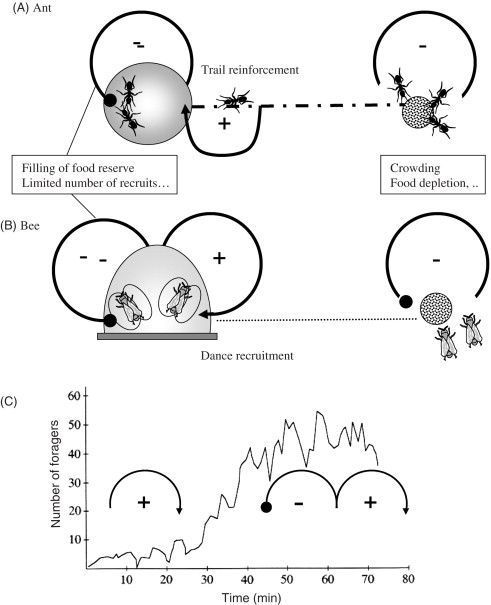
However, this doesn’t seem to be how hordes function in the seminal texts. They seem to stay together and move purposively. This means, I think, that they have some kind of hording technique – some sort of self-organizing criticality, like insects. I think that their moans of bestial hunger serve the same purpose as an ant’s scent – when a zombie hears a moan, it moves towards the sound and itself moans, drawing other zombies. In The Walking Dead they also comprehend the difference between zombie and human scent, so maybe they remain close together due to some kind of scent marking process. The nature of this behavior is crucial, because if we assume that zombies horde together through a signaling mechanism and move along the path of least resistance, our tactics change:
Staying hidden is essential when even single zombies appear, since the sound of their bestial rage may bring others
Staying away from major roads is a good survival tactic
As roads spread out away from cities, remaining out of sight in an area far from major roads will enable survivors to escape the worst hording behavior
Major cities and megacities (like Tokyo, Chongqing) will have hordes of zombies potentially in the hundreds of thousands in size. If zombies have any kind of hording behavior, getting out of cities before the worst of the epidemic hits is essential. Once a significant number of zombies has been created, attempting to escape a city will be close to impossible, since being seen by even a single zombie will likely draw others very quickly
If zombies can horde, tactics need to be developed to enable escape from a situation where a zombie sees the group before the group sees it. This makes choice of bases and camps much harder, and makes subterfuge much more important than weapon use
I think it is reasonable to assume that zombies adopt insect-like scent-marking and hording patterns, and to find ways to fool or avoid them. The best use of this behavior is in setting up traps from which large numbers of zombies can be easily culled, or establishing distractions which enable survivor groups to flee. Understanding zombie hording behavior is essential to identifying good survival patterns. Is it an insect-like self-organizing system, some kind of voodoo, vestigial human behavior that is easily fooled, or simple particle mechanics?
Addendum
If you appreciate my thoughts on Zombie survival strategies, you might be interested in my novella, Quarantine Breach, freely available at Royal Road, which describes a community attempting to thrive 28 years after a Zombie apocalypse.
—
fn1: which I consider to be the seminal text, much more knowledgeable than earlier efforts at Zombie science
picture taken without permission from Detrain C, Deneubourg J.Collective Decision-making and foraging patterns in ants and bees. Advances in Insect Physiology,35; 2008: 123-173.
Six Against the Stars is a two volume space opera adventure by Stephen Hunt, whose work I have reviewed many times before. Six Against the Stars has an unlikely crew of adventurers thrown together against their will to try and prevent a rebellion in a far future stellar confederation. The main character is a useless rocker from Earth, whose only interests are bedding women and preserving his own skin but who has been tricked by circumstance into meddling with interstellar political affairs. The other characters include a strange book-shaped robot, a mass murdering martian who is a member of a weird orientalist death cult, a brain-enhanced academic, a kind of nice version of Novacks from Altered Carbon, and a spunky female clone assassin. The universe they adventure through is a recognizable cross between the universe of Firefly and the Culture, but the whole thing is imbued with Stephen Hunt’s consistent imagination for the slightly strange, the mystical and the chaotic. One of the alien races that vies with humans for control of the galaxy is a race of machines that slaughtered their makers; another race are centaur-like monsters; and at one point we are introduced to distant creatures that swim in gas giants, and were created by a mad king who aimed to forcibly re-engineer his entire population to be gas-living winged creatures. Earth is an isolationist clique of Gaiaists, who have redesigned their planet so that they never have to do any work – they just step outside and pluck medicines off a tree, and even their racing cars are sentient genetically-engineered animals. Just as in the Culture, ships are sentient AIs patterned on humans, and as is becoming increasingly common in many modern SF novels, sublimed races essentially equivalent to gods are commonplace in the universe.
It’s a fun galaxy to romp through, and the lead character is sufficiently open-minded and rumbunctious to be willing to take it all in and make the most of it. Hunt is also obviously having fun with the genre, playing around with silly and far-fetched ideas on many occasions and doing his best to make his galaxy fun enticing. To give a sense of the carnivalesque nature of his creation, I’d like to share a little section from one chapter, in which we learn the back story of a single, largely pointless character who is present for about three chapters of the entire two novels. This cyborg briefly shares a cell with our hero the bard, and has this story to tell about his origins on earth:
I was an officer in a war, a great war, although in the end I think I realised there was precious little greatness in it. Unfortunately for my future prospects, I discovered our war leader was receiving unholy advice from a terrible entity. With the prejudices of my age, I believed it to be a demon, though with hindsight I now believe it was a traveller from the future. When I investigated further, myself and a small group of army commanders uncovered a rival time traveller at work, a woman trying to oppose the madness worming its way through our society. We allied ourselves to her in an attempt to halt the war.
When asked whether they won, he tells our hero:
Hardly. We attempted to murder our leader, but to my shame we failed in the matter. The rival time traveller saved my life from a traitor’s death, if you can call what you see remaining before you saved. My family buried a corpse with no brain inside its skull, and I was secretly transported offworld on the ship of a species called the archivers. How the archivers had been bargained with by my time travelling ally, I do not claim to understand; they certainly made poor hosts. I lost everything that was dear to me when I was forced away from Earth: my son – my darling wife – my career and my name.
The finale of this conversation proceeds to the inevitable revelation of the cyborg’s name:
“We are brothers of Earth. You shall call me Erwin, my friend.”
“Erwin,” Horatio said the new name. “I think there is a world in the Stobb Clouds called Erwin’s Luck.”
“Perhaps,” said the cyborg.”But if so, it is not named in honour of my unhappy life. Never named after Erwin Rommel.”
So there you have it. A throwaway page of book 2 of the story, but it turns out that Hitler was a time traveller and Rommel spent the next 10 or so millenia trapped in a cyborg’s body, wandering the universe at the beck and call of a mysterious alien race known as the Archivers. Who knew?
I think for many people this carnivalesque style will be a disappointment – it certainly sets a very different tone to the gloomy seriousness of Iain M. Bank’s Against a Dark Background or the slightly over the top striving of Star Wars. But I enjoy the creativity and the playing with the genre – sci fi can be a tad too serious at times, and it’s nice to see space opera treated with a slightly lighter tone, without tripping over into Space Balls style puerility. It also has some really good ideas mixed in – for example, like everyone who writes space opera, Stephen Hunt has specific visions of hyperspace, and in this novel we’re treated to the Ebb, a strange area of the galaxy in which hyperspace travel slows down and becomes unpredictable – and where bandit civilizations flourish. He also has a fairly brutal conception of the colonization process, and some nice ideas about AIs and the relationship between human and machine which, though superficially sillier than Banks’s visions, are actually pretty cool.
As always, this novel falls down when we start to experience intervention by god-like creatures to help kick the plot along. I think I’ve read 6 or 8 Hunt novels now, and in all but two of them the plot has been dependent on divine intervention. I’m used to it and it often fits well within the story arc and the cultural framework, but it also leaves me with a slight feeling of disappointment. Fortunately his characters are excellent and his story-telling very pacy, as well as being thick with ideas, so it’s easy to overlook the Deus Ex Machina; but I do wish he would give it a miss occasionally. Otherwise I think that this might perhaps be his best work, though there’s a wide range of material to judge from and the comparisons are hard. But if you’re interested in a light-hearted space opera with cool characters, fast plot and a chaotic feeling, then this is the tale for you. And, once again, I would like to recommend Stephen Hunt’s entire corpus (or at least, everything I’ve read) to my reader(s). He is great!
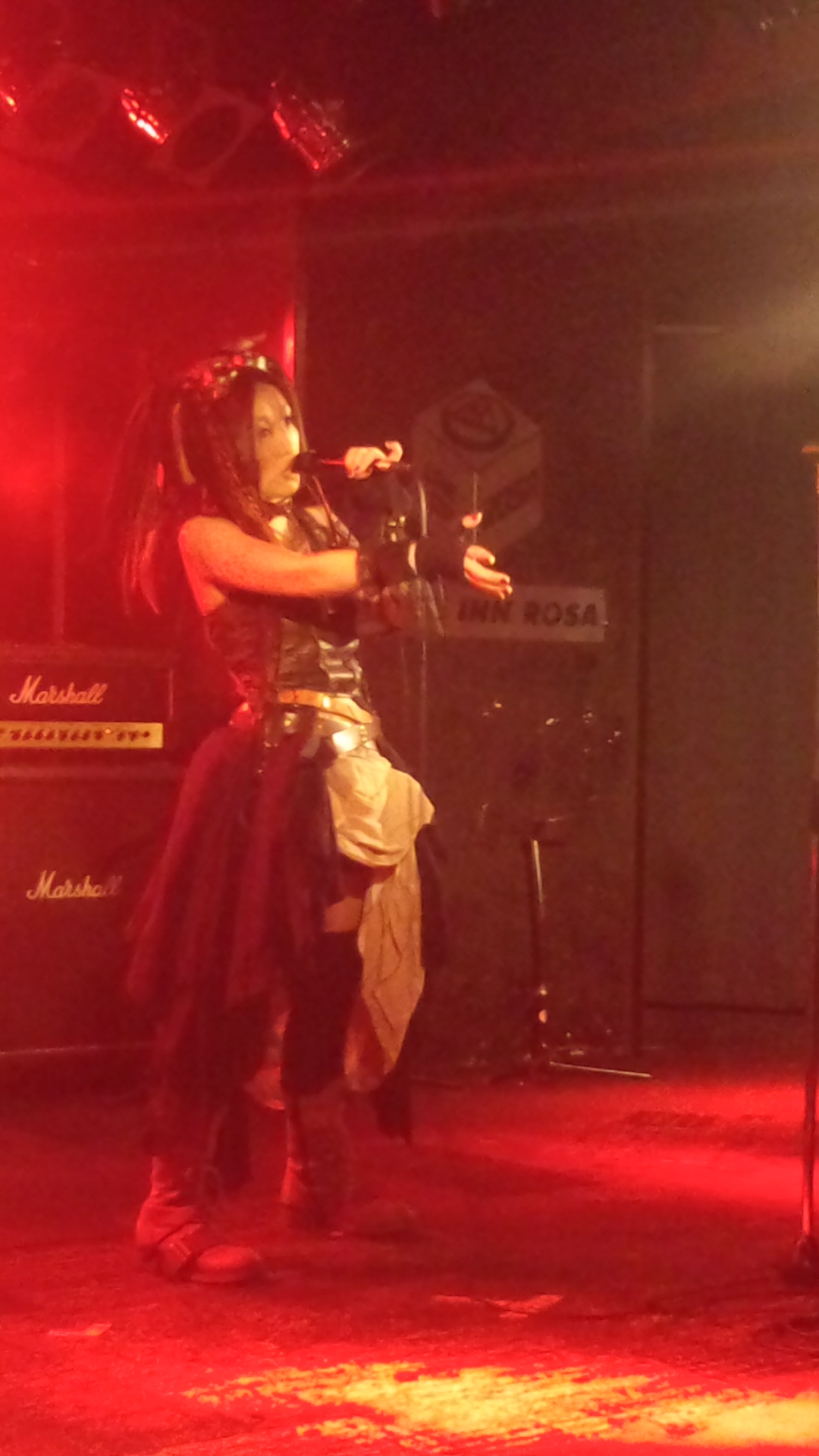
About a week or two ago I went to another goth-lolita night courtesy of a la Mode Tokyo. Three of the bands were the same as the last time I went, and the night seemed to be running on something of a steampunk theme. One of the bands, Strange Artifact, even claims to play “Steampunk Music,” and have been invited to the steampunk worlds fair (in Washington, I think) this year. Which got me thinking, what actually is “steampunk rock”? The picture above shows the singer from Strange Artifact – she is wearing a kind of gypsy/lace/punky outfit. The picture below is her bassist, who was wearing a gasmask last time but this time just looks like a standard leather-and-spandex rocker.
Parlour music, Ikebukuro style…
So I’m not sure what makes them steampunk. The other band that seems to have a bit of a steampunk styling is Black Dead Butterflies, pictured below in their pirate capes. These guys are calling themselves a Gothic Unit and styling themselves as lovers (I don’t know if they are). Surely pirate lesbians have a steampunk element?
Lesbian pirates are steampunk … right?
So what is steampunk rock? As a genre steampunk literature seems to be marked out by a few simple properties:
Victoriana and the general industrial/technological trappings of the steam age
A fascination with Europe and European history
Girls in lead roles
The last part might not seem obvious but it seems to me that there is always a lead female character in a steampunk story, at least all the ones I’ve read. Philip Pullman, Stephen Hunt, Scott Westerfield, Steven Harper, are examples that spring to mind. Obviously steampunk as a literary genre is also not so perfectly defined, but it seems to have this as a strong element. And the goth-lolita scene is really noticeable for the prominence of women as organizers, performers and traders within the scene. So they at least have this in common with steampunk. But shouldn’t music genres be at least partly defined in terms of their musical style? What makes steampunk rock steampunk rather than just rock? Or is it just gothic rock wearing a bit more brass and lace, with the odd lesbian pirate thrown in?
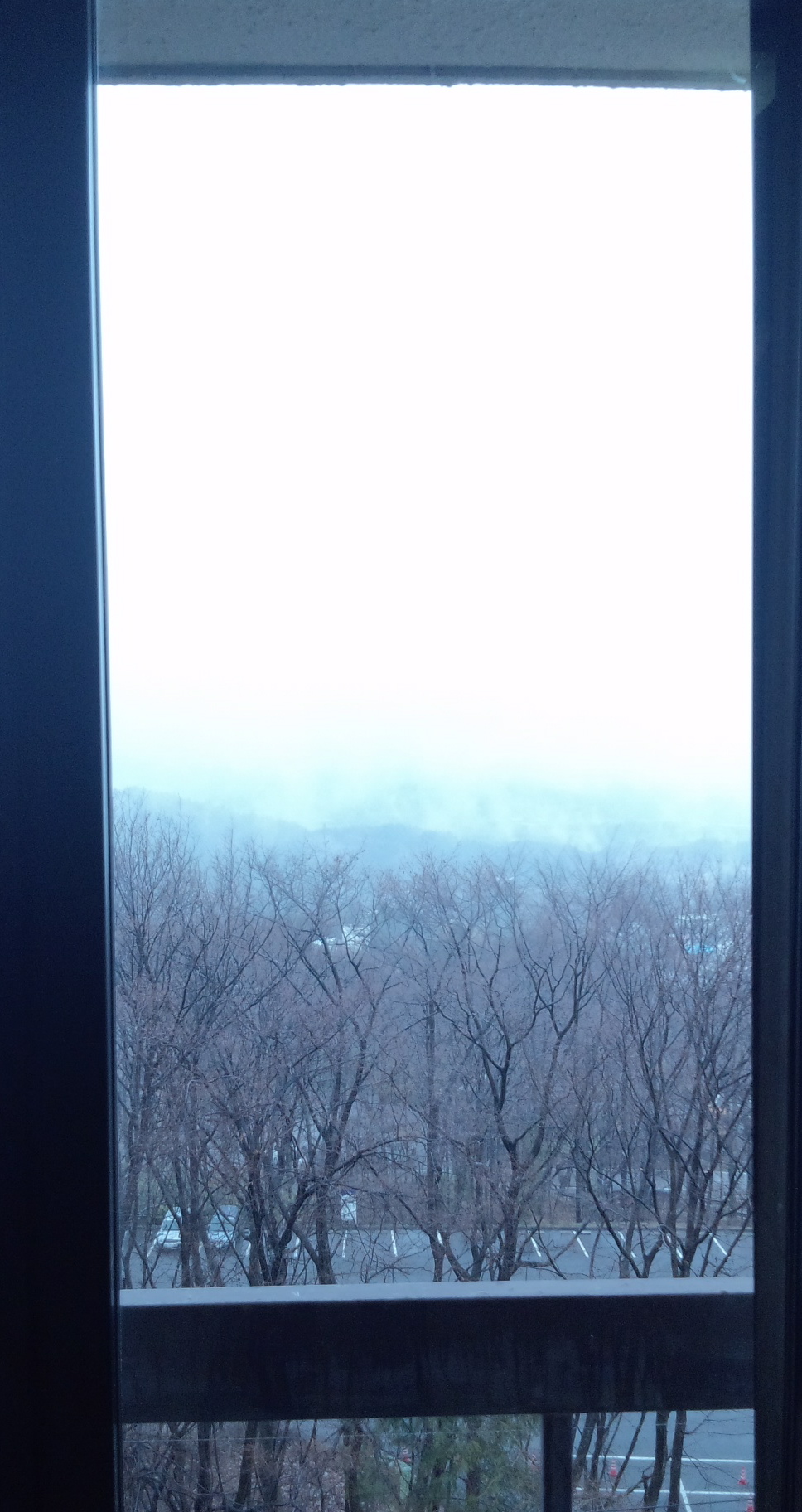
Ikaho is a hot spring resort in the mountains Northwest of Tokyo, about an hour and a half from Tokyo by bullet train and local train and bus. It is famous for being the historical summer home of emperor’s, and also for having a huge flight of stone stairs that runs from the bottom of town to the top. This flight of stairs is lined with shops, and at the top is the source of the town’s hot spring water. I’ve been told that even today, hot spring water is allocated from this source in strict accordance with the degree of nobility of the recipient’s heritage, though I don’t know whether that’s true or not. The town is essentially a resort town, with no other business to be found except tourism. It’s also slowly crumbling, as are many rural towns in Japan, as the population ages and the young people leave for the cities. A good proportion of the buildings in this town, that used to hold thriving businesses, are now derelict. In fact, you can’t see it from the second rate photo I took from my second-rate hotel room, but in front of my ageing hotel there was a wide patch of scrub grass on a slope, essentially untended and growing very tall, in amongst which a few crumbling sheds were being slowly reclaimed by nature. A room with a view indeed … However, Ikaho’s fading charms aside, it does make quite an excellent mountain fastness from which to weather the zombiepocalypse.
Review
Defensibility: Although Ikaho is accessible from several locations, much of the town consists of multi-storey buildings on slopes accessible only through a single road or steps. In some cases (such as my hotel) the area in front of the buildings is open space, and some of these buildings may have an exit to the hillside that is above the entrance (e.g., my hotel had an emergency exit on a higher level than the main entrance, and the exit emerged from the opposite side of the hotel). In other cases, buildings may be quite isolated from the rest of the town and surrounded by quite thick forest. This makes them potentially quite defensible (Japanese forest at its thickest is impenetrable for people). At the top of the town is a long flight of steps, perhaps 200 m long, lined with small souvenir shops and restaurants. These steps are joined at regular intervals by narrow side streets, but these side streets would be easy to block. At the top of the steps is a kind of hotel or administrative building, surrounded by walls and a gate, and near that is the source of the hot spring water. By blocking the streets and closing off the buildings one can establish a quite defensible redoubt – live at the base of the steps and, if a zombie horde encroaches, flee up the steps, drawing them into the natural death trap formed by the souvenir shops – then roll rocks down on them, or close off a single barrier and use stakes and spears to destroy them. In this sense the town is defensible in quite a low-tech way.
Escape routes: In addition to the obvious ways in and out of the town, at the very top of the steps after a short run one can reach a river in a kind of canyon, that is crossed by two small bridges. If one were to park a car on these bridges they would become essentially uncrossable, but there is a road on the far side that – I guess – leads out of town through a little-used route. This gives a good escape route from the town, assuming a zombie horde came from the lower reaches (i.e. closer to the nearest towns) and not from the mountains. By establishing a small car pool on the far side of this bridge and preparing mobile barriers for the bridge itself (or, better still, a means of knocking the bridges down) one would have a fairly reliable escape option. As far as I can tell the only other way across this canyon is through the riverbed, but like most rivers in Japan it is concrete-lined and hard to scale. Ikaho also features a rope way leading up to a mountain top, so another option could be to establish a flying fox mechanism from their back into town – then, lead the zombies up the mountainside, and when you get to the top use the flying fox to rapidly get back down the hillside, leaving them lost and confused on the mountainside.
Location: Ikaho is located far from Tokyo, but it is not in as secluded a location as Hakone. It is a short bus ride from the town of Shibukawa, a typical sprawling (by Japanese standards) rural supply town. The most likely approach will be through Shibukawa, with a stop to get urgent supplies; this would be dangerous. There are bypasses which take the intrepid survivor group through smaller country towns, and this is the best bet if one wants to guarantee rapid and safe access to Ikaho. Ikaho’s slight remove from Shibukawa is useful though, because it gives survivors the option of raiding Shibukawa’s shopping centres (“doing a run” as they say in The Walking Dead) for essentials. Looking at the map of the area, I notice that there are quite a few golf courses nearby, which at least provide a wide range of clubbing weapons and possibly a clubhouse to raid for supplies. However, the nearness to Shibukawa and the main roads running north from Tokyo means that Ikaho may be a target for random zombie encounters and/or hordes. Remoteness is a useful property in a survival location.
Concealment: Like Hakone, Ikaho is largely invisible from the larger towns, so zombies won’t congregate on its distant lights or the sounds of habitation here – it will only draw zombies who are already just wandering through the mountains aimlessly. Assuming zombies radiate outward from Shibukawa randomly once they’ve eaten all its residents, it is likely that they will mostly miss Ikaho and wander into the wilderness. Establishing a solid barrier at a suitable juncture – such as in front of the visitor’s centre at the edge of town – might cause them to turn down a different road leading away from the area long before they receive any indication that there are humans in the town. Thus even small hordes would be less likely to approach the town, and defending it would likely consist of keeping an eye out for occasional lone wandering zombies. Unfortunately, these zombies will still have many places to hide and cause trouble – the crumbling buildings and scrubland make it easy for a zombie to be missed even from the best vantage points in town, so patrols might be necessary in order to ensure the town’s safety.
Sustainability: As a remote tourist town, Ikaho boasts a lot of restaurants and a small resident population. It’s likely that in the short term there would be a large stock of fresh and preserved foods to consume while preparing defenses. It’s worth noting here that tourist towns in Japan contain a lot of souvenir shops selling food, and much of this food is preserved food – dried and pickled fish are very popular souvenirs, as are low-sugar sweets (dumplings and cakes) that are designed to last for up to a month after purchase. So upon arrival, the group could establish a simple consumption order: first the fresh food that can spoil, while the fridges are still running; then the frozen goods once the electricity dies; then move onto the preserved foods. Potentially in a place like Ikaho one would have as long as a month to establish a mechanism for sustainable food supplies, and maybe even longer. There would likely be huge stocks of rice on hand, and these would be easy to cook – one can establish a steaming mechanism using the onsen (hot spring) water from the top of the hill, and in fact there is a little restaurant at the top of the town which serves eggs boiled in onsen water, so the mechanism has already been established.
Most importantly though, Ikaho comes with a supply of fresh meat and a potential farming area pre-prepared. Near the bottom of the town is a tourist ranch, holding cows and sheep and goats, that will likely still be functioning if the survivors arrive fast enough. In addition to holding the animals, the ranch is intended as an educational enterprise so likely contains basic information on how to milk and herd them. If the ranch staff are still there they could even be convinced to participate in establishing the long-term survival of the community. The nearby golf-courses can be converted into rice paddies, as probably could the stepped slopes of the town itself, and there is ample scrubland for planting potatoes and vegetables. Just a short drive away from the town is Haruna lake, which in addition to a source of fresh water for the town (through the aforementioned stream) also probably contains fish. Haruna lake is unlikely to be thronged with zombies, being even more remote than Ikaho, so a pair of people visiting the lake could fish for the group with relative impunity.
Ikaho’s main sustainability problem is its lack of fuel and distance to the local town, but this could be easily solved by bringing a large number of bicycles, and using them to move to and from Haruna lake. Then fuel can be conserved for visits to the town of Shibukawa – and that fuel need only be used for the drive back, since cars could coast to the town. With such mechanisms in place it is likely that Ikaho could provide a good long-term survival spot from which to weather a few seasons of the zombiepocalypse.
Natural hazards: The main risks to life in Ikaho are the possibility of collapsing buildings, forest fires and of course the ever-present risk of rock falls and landslides. Ikaho is far removed from the centre of Japan’s typhoon zone and unlikely to flood, but one problem it does have is winter. Being north of Tokyo and in the mountains, it will have a long, harsh winter. Even in early April when I visited there was no sign of a single new leaf on even one tree – it was barren as far as the eye could see. With potentially 6 months where nothing grows, winters will be harsh if one does not arrive with a very large stock of rice and tinned goods. The local stocks of rice – particularly in the hotels – would likely last a whole season, but the work in the next summer to secure sufficient rice and potatoes for a second winter could be hard. Staying warm in winter would not necessarily be a challenge – in addition to the ample local wood supplies, the onsen water could be used to warm houses, or one could just sit out the winters in an onsen. Winters of this severity also offer the opportunity for a respite from zombie incursion, as zombies will likely freeze, and this gives the residents potentially a three month period in which to work freely on establishing defenses, preparing the ranch, and so on. Winters after the first could be lean times, but provided some farms could be established in the first year, they will be survivable.
Tactics
In fleeing to the countryside one should remember that Japanese rural towns all have many automatic rice-dispensing facilities, which can carry hundreds of kgs of rice. Before the electricity runs out these will be easy to use – take a large supply of money and sacks, and just feed the money in! One great thing about vending machines is that they can’t profiteer, so while the rice sellers in town will soon be hiking up their prices, unless the companies are very organized and somehow immune to the general societal collapse, these rice hoppers will continue to sell rice at peacetime prices. Money isn’t going to be relevant, but a good supply of rice is going to be priceless. If one wants to survive long-term in Japan after the zombiepocalypse, the first thing one should grab is a very very large stash of sacks. Every hopper you come to, loot for everything its got. Then you have both a barter good for dealing with people you meet, and a source of long-term survival that, if treated carefully, may last more than a year.
Ikaho’s defenses are not so intuitive as in Takao, so to prepare a proper defense of the town – with its winding streets and multiple possibly inter-connected crumbling buildings – would require poring over a map, establishing choke points and defensive layers, and preparing fall back positions. It’s probably also not such a good place for a very small group of survivors – I would guess that with less than 20 people in your group you won’t be able to set up the required defensive positions quickly. Upon arrival the best idea is probably to establish a redoubt at the top of the stairs, and to fan out from there securing the rest of the town once the group has its first base intact. Because it’s a tourist town, it’s easy to pick up maps and guides when one arrives, and the town is self-contained and small enough for new arrivals to quickly get a sense of all its ways and byways. Starting from a small base, one could slowly secure the town and establish defensive rings and tactics.
Conclusion
Ikaho is not as defensible as Takao but offers better long-term sustainability options, and is further removed from the hordes of Tokyo. With its local ranch and nearby golf courses, as well as a nearby fishing lake, it offers both short term and long term food supplies, and the presence of a strong and reliable local onsen source reduces the need for electric power for cooking and heating. Provided that some degree of farming can be established within a year and mechanisms put in place for weathering the worst of winter, it may be an ideal spot to weather the initial storm of the zombiepocalypse, and a good base from which to reclaim at least a small part of the world for human habitation.
Addendum
If you appreciate my thoughts on zombie survival strategies, please consider reading my novella Quarantine Breach, set in the world of 28 Years Later, which is freely available at Royal Road.
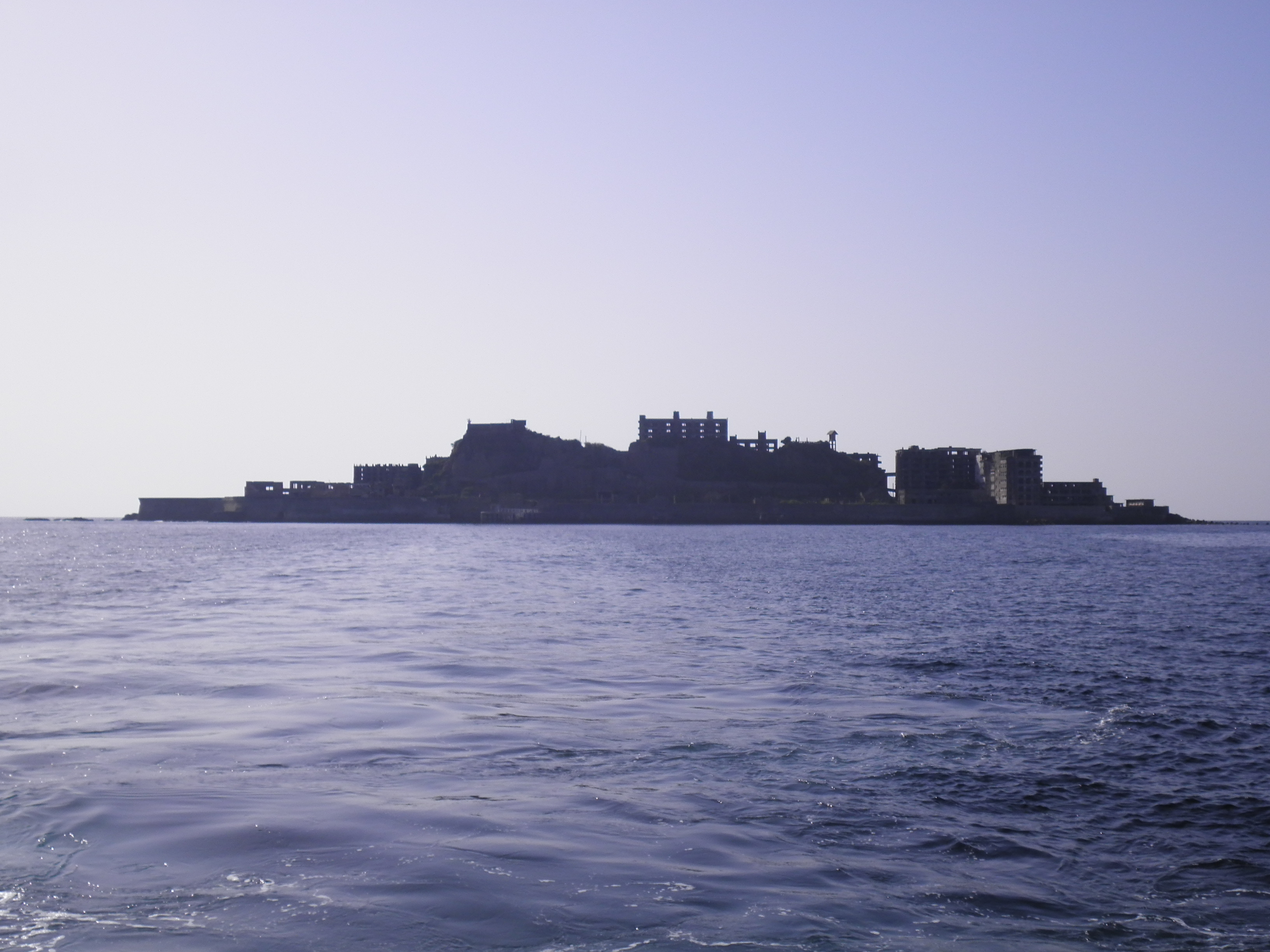
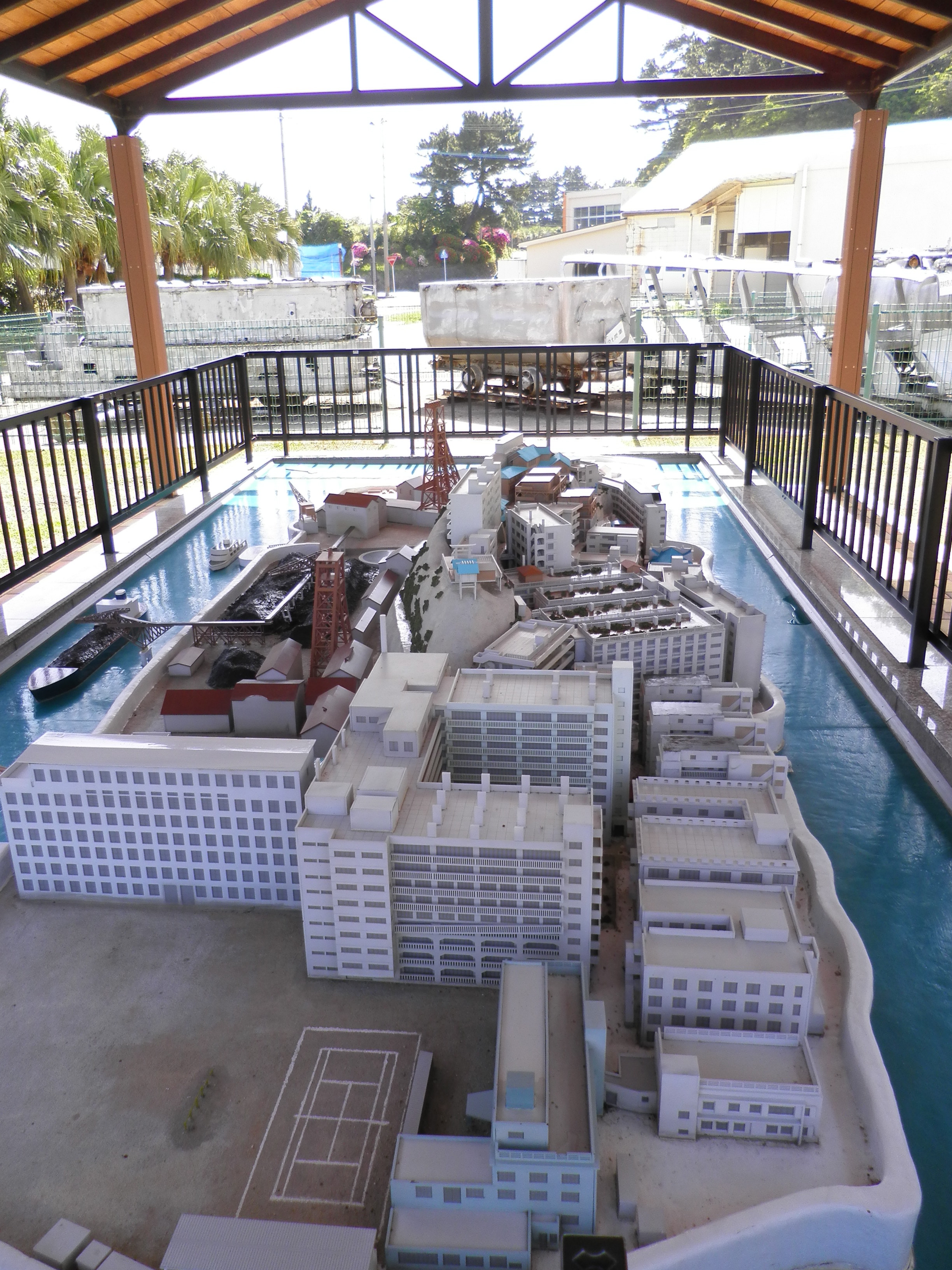
Battleship Island is an abandoned island in Nagasaki, that for some years was the most densely populated island on Earth. It was abandoned over a 3 month period in the 1970s, so most of the buildings were left intact, with even some possessions still inside. The island built up over 200 years for the sole purpose of undersea coal-mining: it hosts two mineshafts that go about a kilometre underground and branch out in a network under the sea. Because the island is too far from the mainland for commuting, a community built up around the mines. At its peak this community included schools at all grades, a cinema, pharmacy, clinic and city hall. The island is only about 500m long and 150m wide, so the community was densely packed, and by the 40s the island was so heavily built up that it resembled a battleship – hence the name, gunkanshima (軍艦島), although the island’s official name is Hashima (端島).
While I was in Nagasaki presenting my HIV model, I took a trip to gunkanshima. It’s a fascinating place in its own right and, I think, for people interested in role-playing settings, could make an excellent adventure setting. Some kind of Meiji-era Outland-style detective story springs to mind, or a Cthulhu-in-the-mineshafts post-WW2 horror story. So here are some pictures and background to give a feel for the place, as both a fine example of modern industrial archaeology and a potential adventure setting – and an excellent zombie survival spot. Also, if you’re in Nagasaki this is an excellent afternoon trip, so I’ll give a few pointers on how to get there at the end.
The Island from the tennis-court end
It takes about an hour to get to the island from Nagasaki harbour, with a brief stop at Takashima to look at a diorama of Battleship Island and visit a museum of coal-mining in the area. This is interesting for its depiction of coal mining through the ages, and its excellent three dimensional cut-away models of the mineshafts under the islands. Here you can get a sense of what a claustrophobic and grim world coal-mining was during the era of the island’s existence, and why the setting is ripe for cthulhoid fantasies. The guide will also give you an explanation of what it was like to live on the island (he grew up there) and set a kind of stern tone of things-that-are-gone that I think is quite helpful for appreciating the decay on the island itself.
The view from the coal-loading side
The boat approaches the island from the coal-mining side, so you see the flat (Eastern?) side of the island with the apartments and schools of the tennis court end on your right, and the shrine just visible at the top of the island. The parts most visible from this approach are the most intact; once you land you can see a lot more rubble.
Coal-processor remnants
From the pier it is possible to see the stilts that used to hold the coal conveyor belt, and which once ran through piles of coal. The buildings in the distance are the old schools: elementary school at the bottom and high school further up, with the top floors devoted to a gym of some kind. From this the proximity of the residents to their only source of employment – and the reason for the island’s whole existence – is pretty clear. As someone who lived in the shadows (literally) of a lead smelter in a one-industry town, I can imagine the importance this industrial infrastructure had on the island – everyone who lived here was either directly working in the mines, or there purely to provide services to those who were. It’s a town that must have closed down as soon as coal mining stopped, and the Japanese economy shifted rapidly away from coal in the 1960s and 1970s, so it was inevitable. In fact the whole island was owned by Mitsubishi – so when they closed it no one had a choice, and everyone had to move out in a very short time. There are apparently still apartments with their televisions left behind, and other markers of residential habitation still stuck on walls or doors.
Coal miners’ baths (left) and pit head (far right)
Further to the south are the pit head and coal mining facilities. The miners bathed in heated sea water, and for much of the history of the island everyone experienced strict water rationing – no fresh water could be used for anything except drinking and food preparation until a pipe was laid from the mainland in the 50s. There were also no private bathing facilities – the apartments were linked to public baths that everyone shared (a very common Japanese practice even now in towns like Beppu, where for example there is a guesthouse for foreigners that doesn’t have its own bathrooms but expects guests to use the local public bathhouse). The building at the top of the above picture held a rainwater trap, I think, and a pipe leads down the hill to the apartments. The lighthouse was added after the island was abandoned, since before then it gave enough light from human habitation not to need its own lighthouse.
The view from the swimming pool
On the western side of the island from these facilities are more apartments, pictured here with a building whose purpose I don’t know (left, foreground). This picture was taken from near the swimming pool, which was a salt water pool filled directly from the sea. The whole island is surrounded by sea walls to protect it from storms but during typhoons these walls are insufficient – on the tour you will be shown photos of waves crashing over the building in the foreground, and residents of the apartment blocks looking down on the storm from the roofs of their homes. All of the apartments in Battleship Island had gardens on their rooftops, because although greenery is visible in these pictures there was none when the island was in use – the green you see here is a recent, natural addition. For the residents the only chance to appreciate elements other than stone and water was the time in the rooftop gardens.
Battleship Island’s eastern side
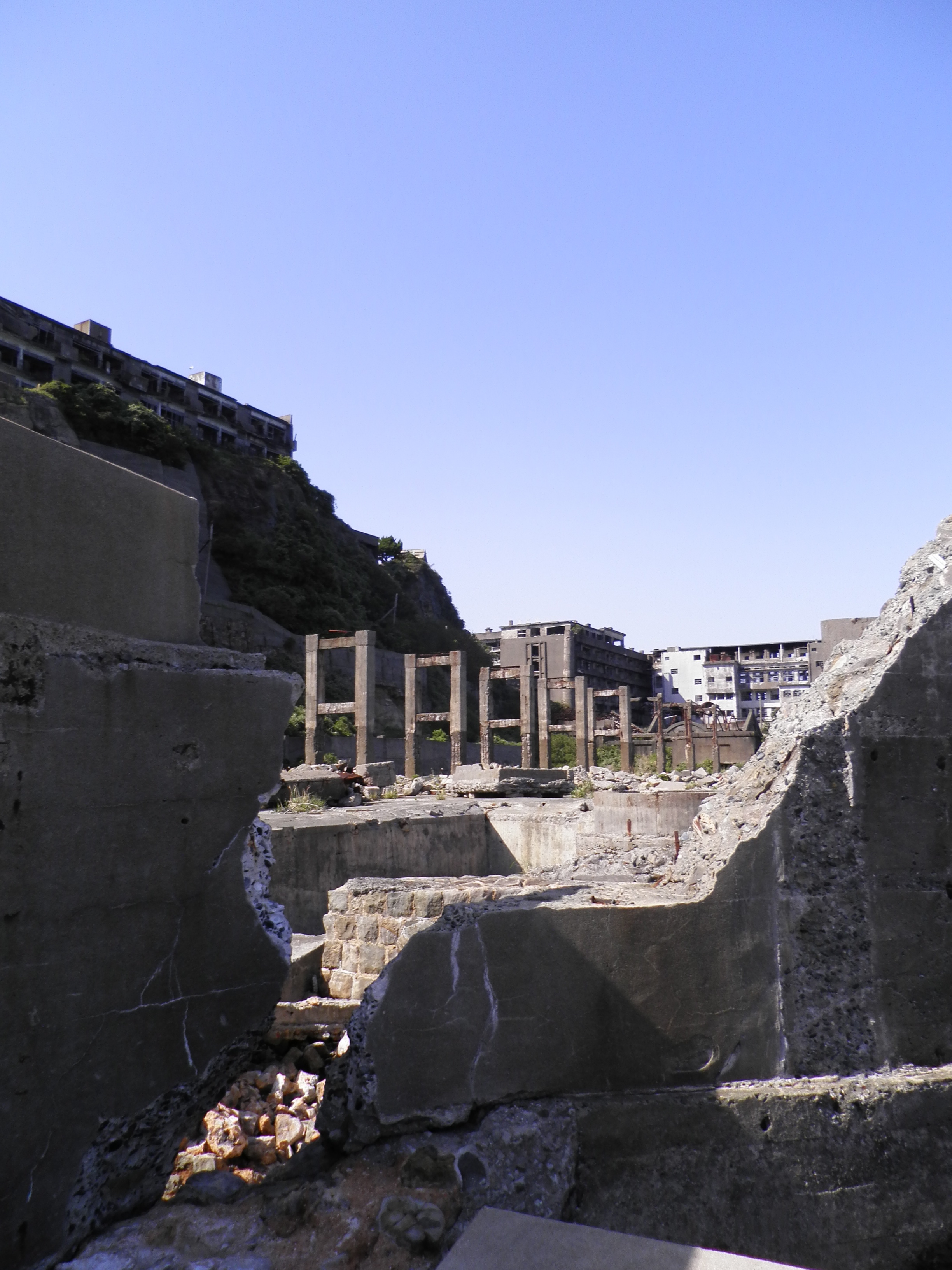
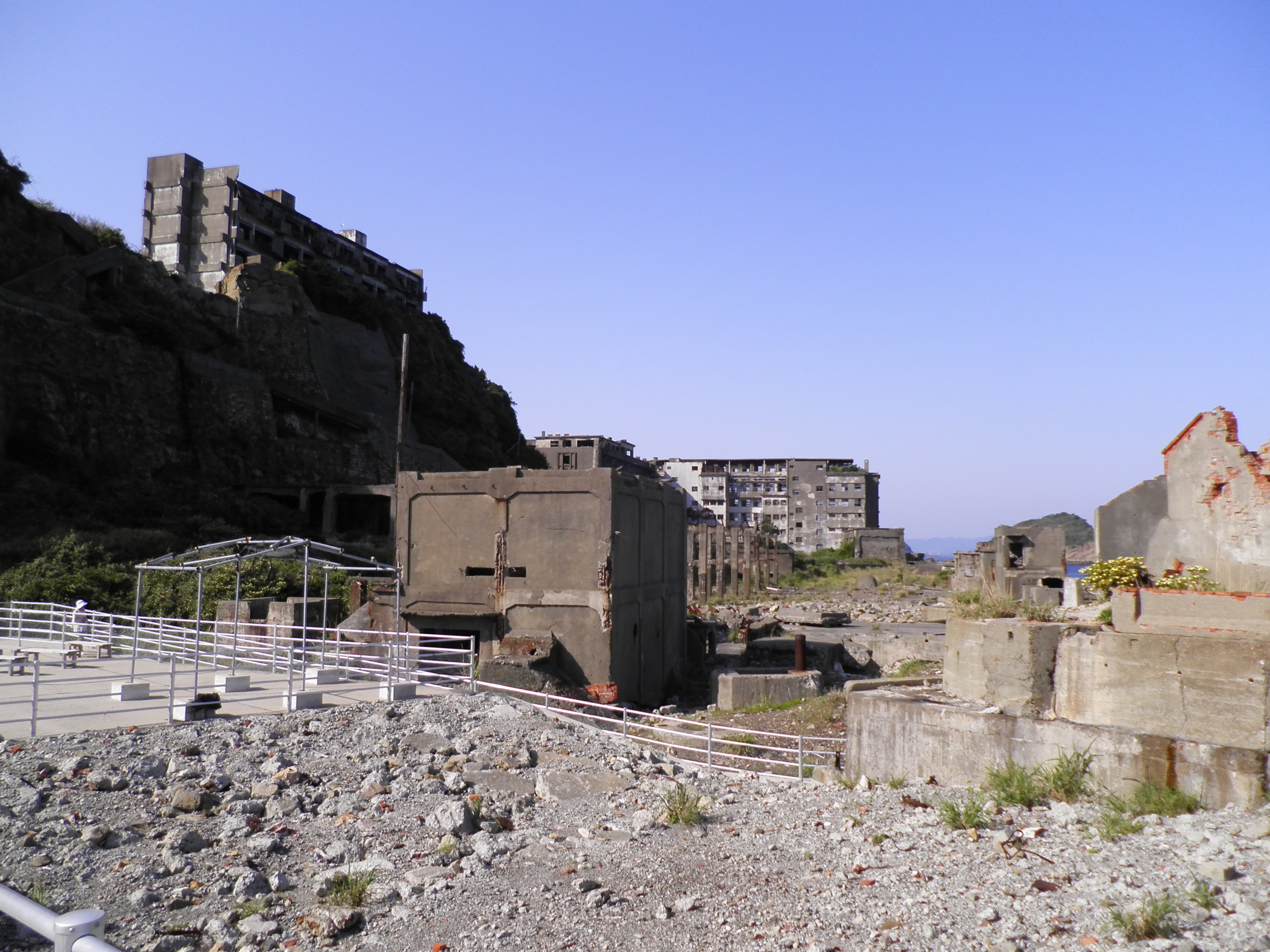
This photo, taken on the return to the ship, shows the island in more perspective. The block in the middle is the second pit head; the building on the hillside is another apartment, possibly containing the city office. The vista stretching away from the foreground is of the coal processing facilities with the school in the background. What you see here is the work of 40 years of typhoons and storms and salt water. Most of this area was reclaimed from the sea in the first half of the 20th century; I guess by the last half of this century it will be reclaimed by the sea, unless someone decides to preserve the island in perfect form. As it is the whole place is a dangerous place, an we all had to stay very carefully inside the fenced off areas, and once the sea has had another 40 years to work its destructive way through the reclaimed areas I guess the island will become unvisitable.
Industry abandoned: the remains of the coal loading dock
The island is in many respects a kind of microcosm of Japan’s industrial history – it grew as Japan’s economy grew, and its economic and physical fate were determined by the powerful economic forces shaping Japanese society; as a result its demographic development mimicked that of Japan as a whole. Our guide showed us a magazine article from the 1960s, when Battleship Island was the most heavily populated place on earth, asking “Is this the future of Japan?” Now it is deserted and crumbling, a fate that will undoubtedly come to many other Japanese towns of similar size. As a model of the way industrial societies grow and decline this island is a powerful example, and an extreme example as well of the way that access to resources shapes the physical and cultural landscape. This isn’t the only such example in Japan – Shimane’s Iwami Ginzan is an abandoned silver mine in a slowly fading rural area that harkens back to the time when Japan was the richest country in the world because of its silver resources. They are long gone, and Shimane is now famous for its religious heritage and its crumbling seaside towns, and not much else.
If you visit Nagasaki I strongly recommend a visit to the island. You will also get a nice overview of Nagasaki’s working harbour, and see some of the scenery in the peninsula, during your trip. I booked my trip with Takashima Kaijo, which at time of writing does 9am and 14:00pm departures for 3 hour round trips, and employs a guide who used to live on the Island. It’s all in Japanese, but they have an English pamphlet that gives you the crucial information you need and some nice pictures. The staff speak enough English to get you on the ship – you need to sign a disclaimer and pay 4300 yen (about $43) for the trip (not refundable if the weather is too harsh to get onto the island). The conditions are described on their website in English, too. Their office is a little distance from the main harbour terminal, but their website has a map and you can find other cruise companies in the terminal if you don’t want to take the risk. They can take up to 210 people, so if you go during a busy time it will be a bit crowded; you probably need to be prepared for a fairly regimented style of tourism but it’s not too cloying (but don’t take photos while the guide is talking – he’ll get angry). You get about 15 minutes to take photos and wander around and since you can’t leave the confines of the viewing area this is more than enough. The staff are very sweet and accommodating, overall. The ship also stops at Yojima, which apparently has an onsen (hot spring) and hotels, so if you wanted you could make a nice couple of days by booking into an onsen hotel in Yojima and making the trip to Gunkanjima a side trip (about an hour shorter from Yojima).
Finally, it should be recognized that Gunkanjima is a heritage site and as such a little respect should be shown: as the guide says, to us it’s a pile of rubble but to him it’s his hometown (実家). So don’t go breaking their rules because you think they’re silly, or get worked up because they wouldn’t land on the island and you lost 4000 yen. Also, if you are planning to go to Nagasaki I think this week – the 24th – 30th – is probably best because it coincides with the tall ship festival, which is quite a nice harbourside event. This season the weather is a little unpredictable, but I think it’s clearing up for the end of spring, so if you are in Japan in late April Nagasaki could be worth the effort. And if you’re in Nagasaki at any time, Battleship Island is a great afternoon trip, well worth the money and of interest to anyone who is interested in history or a little urban exploring.
I’m reading Stephen Hunt’s Six Against the Stars at the moment, I’m only two chapters in and it has already descended into Hunt’s trademark rollicking flow of happenstance encounters, but it’s got a very nice idea for an adventure setting that I don’t think I’ve seen before. The story starts on a far future Earth, its history full of wars and environmental troubles, whose present inhabitants seem not really to fully understand the world they live on or its history. Beneath the earth is the “World Below,” which sounds a lot like a kind of far future Underdark. As our hero runs through it, we have it described thus:
In the heyday of the conflict age, the empire had hollowed out the Earth and refilled it with underground factories and cities, keeping the surface as a park that was only seen by the imperial court.
Some of these subterranean continents had caved in, but others had failed more gradually, only to be reclaimed by the flotsam of the ancient Earth – criminals, slaves, rogue androids, rebels, computer viruses which had become self aware, feral genetically engineered creatures which had broken their own behavioral programming. As the core was abandoned, the pets and toys of the merchant palaces became inbred in bizarre and unanticipated ways, sharing genes and self-splicing where run-down shaping technology lay derelict. They preyed on the safaris that ventured from above. Self-cleaning floors that had learnt to secrete acid to paralyze rodents, drink dispensers which could spray superheated water when threatened, wild herds of protein blocks that had grown armour and gored unwary travellers.
Like much of Hunt’s work, the idea is slightly comic or carnivalesque, but also rich with ideas for adventure settings and a kind of space opera or shadowrun-styled megadungeon. Instead of Aboleths we have ancient AIs residing in abandoned research factories; in place of Mimics, vending machines. Perhaps self-aware cleaning droids float through the corridors like robotic Beholders, and old abandoned tanks or other war machines function like golems and dragons. Were the world above to be fashioned as a post-shadowrun collapse society (perhaps akin to the society from the Amtrak Wars novels?) then the World Below would be a treasure trove of ancient items, and access points that still functioned would be hotly contested by the tribal powers of the surface – or avoided at all costs. Perhaps then some elves would have migrated to the World Below, so it would even have its own stock of shadowrun-styled Drow.
This would be a great setting for a campaign – a post-apocalyptic shadowrun future on the Great Plains of the USA, with a mad max styled surface world where adventurers attempt to enrich themselves and their communities by plundering the World Below. Perhaps more civilized folk use its surface ways as secret routes to attack their neighbours, or to cross deserts and wastelands. Bandits set up kingdoms, and all the rebels and renegades of the surface world flee to the World Below to make their uncertain future. It would be particularly fun to adventure in such a kingdom using Shadowrun, or one of the simpler space opera style systems like Stars Without Number. If you want dungeoneering with a mixture of savagery and high space opera, perhaps Stephen Hunt’s World Below is the perfect place to go looking for adventure …
I’m in Nagasaki this week to attend the 86th Annual Meeting of the Japanese Society for Infectious Diseases, where I have presented the results of my work building a mathematical model of the HIV Epidemic in Japan. The model is currently submitted to a journal so I can’t give any detail about it here, but I can present a chart I used in the conference presentation, that is based on publicly available data from the Ministry of Health, Labour and Welfare. This chart shows the number of new cases of HIV/AIDS notified to the government annually, divided into three main transmission modes (Figure 1).
Figure 1: Annual new cases of HIV/AIDS in Japan by transmission category, 1985-2010
In this Figure, “same sex contact” means “homosexual contact,” since there’s no such thing as a case of HIV transmitted by same sex contact between women. From Figure 1 it should be pretty clear that while the epidemic appears to have peaked and even beginning to decline in the heterosexual population, amongst men who have sex with men (MSM) it is growing rapidly. Now, there are some caveats on such a conclusion in Japan: testing rates are quite low so it could be that these “new” cases are actually old cases that have only just been identified, for example, but it would be a strange world indeed if the entire slope of that line were due to remnant cases finally coming to light. So, it’s reasonable to conclude with some confidence that the HIV epidemic is growing rapidly amongst MSM in Japan. Currently prevalence is probably low, but that was the case in Australia back in 1985, and prevalence amongst MSM in Australia now is probably above 5%.
This comparison is noteworthy because Figure 1 makes it look like Japan’s experience of HIV is Australia’s 20 years ago, and if the epidemic continues to follow Australia’s trend, HIV will spread rapidly through Japan’s gay community. Of course there are big differences in HIV treatment and prevention now compared to 20 years ago, and very few people die of AIDS in Japan because of the combination of low prevalence and good treatment. But the rapid increase amongst MSM shown in Figure 1 suggests that prevention efforts to date haven’t been working, and it would be best if something could be done to prevent the further spread of the disease.
Another minor concern (raised in my presentation, actually) is that MSM in Japan tend to be less open than in the rest of the developed world, making them even harder to study but also raising the possibility that they marry and have at least some sexual contact with women. Sexuality in Asia is, in general, more fluid than in the West and less constrained by categories and boundaries, so the idea seems superficially plausible. If this is true though, it means that there is a small risk that the epidemic won’t be contained within the gay community forever. Unfortunately, no one knows the extent of this overlap in Japan, and no one knows how much injecting drug use is happening here, so it’s hard to make judgments about how such behavior might affect the future of the epidemic. This is what my mathematical modeling is (partially) aiming to do, and although I won’t reveal the results here the future is not pretty for MSM if the epidemic is allowed to continue. Even without the benefit of a mathematical model, it’s pretty easy to see from Figure 1 that Japan needs to improve interventions amongst MSM, primarily by increasing rates of voluntary testing and targeting a test-and-treat prevention strategy at this community. Given the current low prevalence of HIV, even a relatively unsuccessful test-and-treat program will probably be sufficient to contain the epidemic (though the international evidence suggests that it takes a very rigorous and probably unrealistically well implemented program to eliminate the disease). It remains to be seen whether such a targeted approach will be tried here, but hopefully my work will be one tiny step towards encouraging such a change.
The Artist is superficially a silent film about a love affair between two movie stars in the 1920s. On a deeper level it’s an exposition of neo-liberal, or even Randian, industrial policy.
Essentially the movie charts the entrant of a new company into an established industrial sector. The new company offers a new production mode, and rapidly steals market share from the old company. This company rapidly loses sales, and soon is reduced to selling off its assets in order to maintain even a minor presence in the market (in an ironic filmic twist, even though these assets are sold on the open market in a clearing house, they end up in the new company’s asset portfolio). The CEO for the new entrant, being a bit sentimental – and perhap having some New Deal-style political ideals – offers to use some of its considerable assets and popularity to help the old company adapt to the new market conditions[1]. However, the old company have imbibed the Randian ideology of their times, and refuse to accept any form of charity or support – the CEO prepares to liquidate his remaining staff, but at the last minute the CEO of the new company realizes a way they can combine the classical skills of the staff with the technology of the new company, and the old company is revitalized – able to develop into a niche market combining the new technology with the old artisanal skills.
I guess this could be a metaphor for many of the great market battles of the last 30 years, especially in the technology sector – Apple vs. Windows, fixed line phones vs. mobiles, China vs. Japan, Japan vs. the UK, etc. The main weakness in the metaphor, in my opinion, is brief moment of weakness when the CEO of the new company offers charity to the old company – it breaks the otherwise forcefully presented focus on competitiveness and survival of the fittest. In comparison to the seamless perfection of the analysis of homosexual sexual politics in 300, The Artist is a weaker political metaphor, but I think it makes its point well. Particularly, it’s clear by the end that everyone – producers and consumers alike – is enriched by the competitive atmosphere, and that any attempt to protect the old company would have been bad both for its own staff, its rival and society as a whole. As the CEO of the new company says, “people are tired of seeing actors mugging at the camera to get their point across.”
The movie’s medium is, in my opinion, its greatest flaw, although I understand the purpose of presenting the movie in the outdated medium and having the crucial benefits of the new technology break through at crucial moments. The mechanism by which the new and innovative ideas of neo-liberal industrial policy are presented is itself out-dated and old, and makes the characters and ideas hard to engage with. Perhaps the story would have been better presented as a computer game? Also, it’s hard to have sympathy with a lead character who would rather shoot himself than take a job offer from a woman. But otherwise, it’s an okay love story (with very attractive stars) and nice presentation. See it if you like teary love stories and/or Randroid politics.
—
fn1: could this part of the film be an attempt to posit a voluntarist anti-trust atmosphere in Randian market places?
This week my work started the process of buying me a PowerMac – a 12 core, 24Gb RAM monster that will replace my 8 core, 16Gb RAM windows machine. I also received a new macbook, and my colleagues are also going to or planning to buy macs in their next round of upgrades. This means that unless something catastrophic happens with funding in the next week, I will have completely abandoned Windows in my work life. I have long since abandoned it at home, but workplaces have tended to be more conservative about the change, but it’s finally going to happen.
I have noticed over the past few years that a lot of people working at the crunchy end of science are using macs, not Windows machines. This has included people working in computer graphics research, nuclear physics, veterinary epidemiology, medicine and epidemiology. It appears that if you need to do numerical computation, Mac OS X is increasingly the platform that you do it on. I guess this is because Mac OS has been much easier to develop for since it switched to a unix-based system, and so now many of the key tools of numerical computation are available on it: Matlab, Stata, LateX and R are all implemented very well on Apple machines. Indeed, in my experience these packages tend to be easier and more pleasant to use on Apple – LateX editors are much more pleasant and more readily available, R’s script-writing tools are much better, and there is not really any difference that I can see between matlab and R on the two platforms.
I think this means the end of the dominance Windows had in this area since it forced Unix out. This would make the scientific computing market a rare (I guess) example of a company with essentially complete market dominance losing its monopoly place purely on quality-related issues. I’m not a fascist about any one computer system (except Linux – I try to avoid Linux) but I do find Mac OS much nicer to work with, and not just because the machines are pretty. Something about the way it works is just less sticky than Windows, and it seems to trouble me less with extraneous stuff. I think it’s probably something to do with the attitude to design, and also with the greater degree of sympathy between hardware and software (which comes, I guess, from Steve Jobs’s obsession with keeping everything in the one company). I think it might also have something to do with the extra money one pays for the machines.
As far as money goes, the common complaint that you can get the same performance at half the price with a Windows machine is, in my experience, sadly misguided. The very worst thing you can do with Windows is buy a cheap machine that has good stats on paper – or worse still, build your own. You’ll be paying in time and Insanity Points for the rest of the 2 years you use it before you throw it away. I don’t know what it is about computers, but their performance is like a symphony orchestra, and if you scrimp on any part of the process the whole thing leaves you feeling bad. You’re better off getting an Apple that is, on paper, inferior for the same price, than assuming that the extra 0.2GHz in that PC chip are going to work as they should for half the price.
Of course, this is all classic flamewar material, but my observation is that the scientific computing world is moving away from Windows and taking Apple seriously as a computational tool. This is particularly striking given that just 10 or so years ago Mac was seen as exclusively the tool of inner-city designers with black clothes and slanty hair, or girly magazine writers who value a cute case over a decent OS. Well, perhaps those girly magazine writers were right all along …
As an aside, and to give all those reading this a common enemy, I recently downloaded the cute 2D dungeon crawler Dungeons of Dredmor. I can’t say it’s holding my attention, but it is cute. On their blog, the developers talk about the work they’re doing to port the game to iPad (an excellent idea!), and they have a few things to say about the commercial and technical problems involved in porting it to Android. In the process they also reveal some interesting issues about Linux. In answer to the question “Will the game be available for Android?” they say:
This… is an interesting question. While SDL 1.3 supports Android, at least partly, there are two reasons why we might not go ahead and do this. The first is insufficient demand – my personal experience with Android on previous products have been that Android sales are a very small fraction of iPad sales (in fact, less than the ratio of Linux sales to Windows sales.) Consequently, it’s not entirely clear that this is something that we will actually make money on – especially on the tablet market, where Android tablets are still somewhat of an unknown factor and where the iPad still occupies 75% of the market share.
The second reason why we might not support Android is because the infrastructure for Android is so, so, hideously broken. Again, it’s *worse* than the Linux situation, which is kind of amazing. In order for us to ship on Android, we have to be convinced (more specifically, as the Technical Director for the studio *I* have to be convinced) that we can actually ship an Android version of Dredmor and have it work. Given that there are a number of horror stories floating around about people who test their software on 300 Android devices and get everything working, only to release and have everything explode on Day 1… I’m just not confident that we can do this. It is possible that we might put together an Android release for a *very* limited selection of devices (Kindle Fire, Samsung Galaxy Tab, ASUS EEE Pad Transformer) where we have some hope of having things run in a fashion that we’re happy with. That said, we’re still looking into this, and the iPad port (by virtue of the market share we mentioned above) is still the top priority.
There are phrases in there that are genuine music to the ears of someone with a strong anti-linux fetish. “Worse than linux … which is kind of amazing.” ha! Also note the disturbing information about the ratio of iPad to other tablet sales. I wonder if Apple are going to become the windows of the smartphone and tablet marketplace, completely dominating all other products and stifling development on anything else? And if this market dominance is built, in the short term at least, on higher quality product, what are the chances of a rival OS surviving? The “I hate apple” niche market is probably going to get smaller and smaller as the virtues of Apple products become better known (as has happened in the scientific computing world).
I guess we’ll have to just learn to love our new slanty-fringed overlords …







 Compromise and Conceit