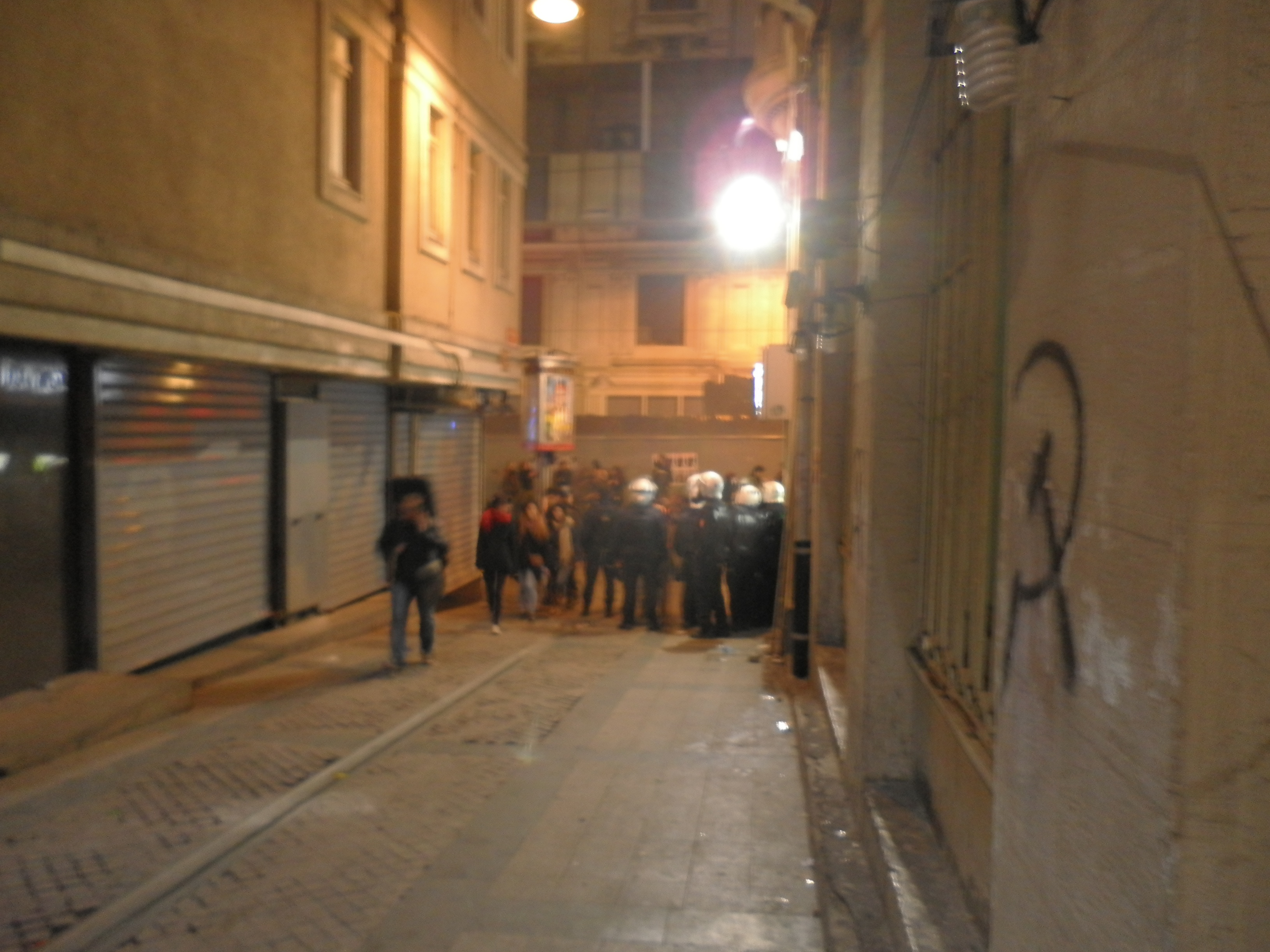
• This is a tale of how I successfully broke all the rules in the travel advisory, and lived to tell the tale of a tear-gassing and a close encounter with a riot policeman. It’s also the high point of the long series of disasters that was my Turkish trip – starting with booking the ticket for the wrong month, and finishing with my shoes falling apart late on Monday evening – with 4 weeks of my round-the-world trip still to go …

    Check for riot police and water cannon tanks in your hotel BEFORE travelling!
    Check for riot police and water cannon tanks in your hotel BEFORE travelling!

    I am on a round-the-world trip in which I am making three stops for work-related training: a week in Konstanz, 2 days in Switzerland, 10 days in London and a week in Seattle. Each training trip is a week apart, but to return to Japan between each trip would be both ludicrously exhausting and ludicrously expensive, and since I haven’t had any time off in a year it seemed like a good idea to fill the in-between weeks with holidays. The first of these is three days in Istanbul. My trip here is so stupidly unplanned that I a) booked my ticket from Zurich for the wrong month (and had to rebook when I got to the airport!) and b) didn’t check the political situation in Turkey. When I booked my hotel I found myself thinking “Taksim square – sounds really familiar” but I didn’t bother to check, and so didn’t discover that protesters have been targeting Taksim square since May last year.

    It's just not cricket!
    It’s just not cricket!

    So I arrived at Taksim square after an enlightening taxi ride, dumped my stuff and went out for dinner. Returning from dinner, I was near my hotel door (like, literally) when my throat started burning and my eyes watering. Now, in Tokyo we sometimes have these things that I call “Shibuya moments” – you can be standing at a very sophisticated part of town, surrounded by classically sophisticated Japanese people, and suddenly be overwhelmed by this huge stench as if the universe had farted on you. So my first thought was “is this the Istanbul version of a Shibuya moment? Because if so they really need some environmental planning laws!” But then my rudimentary knowledge of chemistry kicked in and I thought “no, that’s impossible!” Then my rudimentary knowledge of Europe kicked in, and I thought – “tear gas! … football riot!” The last football riot I saw (in London) was very entertaining – watching arseholes having their arsehole bitten off by dogs is hugely entertaining. So, naturally, I headed towards what I thought was a football riot.

    You have one second to reach Minimum Safe Distance!
    You have one second to reach Minimum Safe Distance!

    My investigation led me into a long shopping street called Istiklal, and I soon realized that this was not a football riot, and it was serious. For starters, there were a royal crapton of riot police. Every side street entering Istiklal was blocked by a single phalanx, and there were probably 100 at the top of the street (near my hotel!) where I first smelt the tear gas. In addition, they had turned up with more equipment than you would usually need outside of the South Korean riots of the 1980s (or Ukraine of the week before) – Armoured Personnel Carriers and a handful of water tanks, plus every policeman had a gas mask and every five or so had a rubber bullet gun. Furthermore, their buses were guarded by men armed with uzis or some kind of even bigger automatic rifle (being Australian, I’m not really familiar with this stuff).

    The calm before the storm
    The calm before the storm

    Mostly everything was calm, and remarkably everyone was just wandering around doing their shopping, ignoring the whole thing. But every now and then you could hear this loud banging, and get a whiff of the tear gas (with immediate coughing and eye pain, just from the merest tendrils of the stuff!) And down the far end of the street there was a definite growing tension, and the sound of chanting. I found myself next to two young women who explained that this was a rally against some kind of nasty new internet censorship law (in which the government would get access to your browser history!), and part of a long-running campaign against authoritarianism that had begun last May and so far had seen six protesters die. I didn’t find out more though because as they were telling me this, a beer bottle came sailing sedately through the air and shattered on a nearby riot policeman’s helmet. At this point everyone started running, including the two girls I had been talking to (who had been at previous demos), and I opted for discretion over valour and ducked around a corner. At this point nothing bad had happened to me or anyone else I had seen.

    These men endorse Bjork's approach to papparazzi
    These men endorse Bjork’s approach to papparazzi

    From here I did a bit of exploring and emerged in a new alleyway facing onto Istiklal. There was a wall of riot police between me and the main street and they didn’t seem interested in letting anyone through, so I stayed in the alley and took a photo. Unfortunately, I didn’t see a lone riot policeman behind me, and turned around to hear him yelling at me and advancing rapidly towards me, baton in one hand and attitude in the other. By now everyone was strung out on the tension, and this guy had probably just been in a fight, he wasn’t impressed by my little 7000 yen camera. I backed up with my arms spread and said clearly and slowly “I’m sorry, I don’t speak any Turkish,” and that immediately calmed him down but he was still fuming – he started yelling at me in the international language of “fuck off” (fortunately now obviously not intending to cave my head in) and I decided to take his sage advice. I probably should have taken, earlier, the advice of my embassy and not hung around large and aggressive gatherings, but hey … so far so good, right?

    Not a romantic mist
    Not a romantic mist

    So now I found myself in another alley, and slightly lost. I wandered around briefly and found a group of people standing at the end of  a street, watching some guy firing a flare gun at the riot police. I guessed this wasn’t going to end well for anyone involved and moved on. I soon found another street that seemed more peaceful, and I was trying to find out how to move back towards my hotel when a group came around the corner, in hot debate with a couple of riot cops. As I watched, these cops grabbed a guy in the group and started wrestling with him, and everyone in the street screamed and started running at the same time. When in Rome, and all that – I headed off with them. I didn’t have much time to see what was going on, but the afflicted guy seemed like one of the gypsy-type characters who hang around the square, one of his assailants was unslinging a plastic bullet gun, and as I headed around the corner I heard a loud bang. My guess is that chap – who seemed entirely innocent – is currently nursing a deep and unpleasant bruise.

    An essential truce
    An essential truce

    From here I ran around a corner to discover another street filled with tear gas, fortunately far enough away that again I only got its outlying tendrils – and again developed stinging eyes and a rapid cough. That stuff is nasty, and the excitement was rapidly becoming warying. Things also seemed to be heating up, and I had the impression that the cops were going to start getting indiscriminate, so I ducked into a nearby pub. Here I found football and beer, and whiled away a pleasant 45 minutes watching Galatasaray win their game. Because Turkish soccer is quite violent the second half had 10 minutes of injury time, so I ducked out after five. On the street I found the above scene, of riot police gathered at the nearby cafe to watch the last five minutes of the game. Only in Europe …

    So, I’ve confirmed that you can safely ignore all your government’s travel advisories. Or, more likely, I was very lucky. That first encounter with the riot policeman could have been a holiday-spoiling (not to mention life-spoiling) moment, and I really shouldn’t have gone sniffing out trouble. I get the impression that this campaign against corruption is a pretty reasonable thing, and the goals of the demonstrators generally laudable. But regardless of who is right on whatever issues beset Turkey (and I think there may be many) I hope that it gets resolved soon, without further loss of life (or interruptions of football viewing). My impression is that Turkey has a rocky but ultimately peaceful and successful future waiting for it. I hope these riots turn out to be a positive influence on that future…

  • Welcome to Turkey, Land of the Imperial Cat
    Welcome to Turkey, Land of the Imperial Cat

    I’ve been in Istanbul for three days, and aside from getting tear-gassed on my first night in town it’s been a nice experience. The city is frustrating, however, and I’ve experienced a cavalcade of disasters (mostly of my own making), so as a balm for my frustrations here are three cute Turkish things I found while I was here.

    1. In the Grand Bazaar, a gallipoli-themed chess set. One side is the forces of the Ottoman empire, the other the invading allies – and the pawns are ANZAC diggers, unmistakable in their slouch hats. This is maybe just one of many examples in which Turks and Australians share a common political sense
    2. Nescafe! In a quite sophisticated restaurant today, two Germans came in and ordered coffee, and were asked “espresso or nescafe”? Many restaurants and cafes have nescafe on their menu, not necessarily for less than the espresso. I also noticed this in Greece, where it was even more pronounced – cafes would put up signs saying “We have NESCAFE!!” Why? What are these people thinking? Especially in Istanbul – the Starbucks below my hotel[1] tells me that Istanbul’s first coffee shop was established in the 17th century, and Wikipedia tells me that the Turkish word for breakfast means “before coffee”[3] – how can such a culture voluntarily serve Nescafe?!? This is like going to France and finding every bakery advertises croissants “made with pure margarine.” The only explanation I can think of that is not embarrassing for Turkish culture is that it represents the pernicious effect of British tourists on local cuisine.
    3. Mussels with lemon! All down the main street from Taksim square you can find men selling mussels from the shell, with lemon. These seem to be raw, though I can’t tell (the shell is closed so I guess they’re raw), and they’re on sale late at night. This means that when people come piling out of the local pubs and bars they suck down a few raw mussels with lemon. Which is particularly strange because Turkey is, obviously, the land of the kebab. While in the UK or Australia the kebab is the late-night drinker’s food of choice, here in Turkey kebabs are food and the late night drinker has a penchant for mussels with lemon. Truly, some cultural differences cannot be understood, and must simply be accepted.

    Overall I’ve enjoyed my stay here and I can recommend Istanbul as a holiday destination. I also recommend coming for more than two days, get one of the museum passes (you can skip queues and save money if you push your museum visits within a 72 hour period), and don’t stay in Taksim – unless you want to get tear-gassed on your way out the door. Also, familiarize yourself with the transport network, it’s good, and if you like metal I recommend a visit to the metal bar in Taksim (can’t give the name or location, but it’s great and really friendly). I prefer Athens (Athens was great!) and the two seem to have a lot in common, generally, but others would no doubt disagree with me, but one thing is for certain: Turkey’s historic sites are more accessible and more impressive. And do visit the Blue Mosque, it’s awesome!

    fn1: Starbucks in Istanbul is really good, incidentally. But it doesn’t serve baklava[2]

    fn2: which is fine: I’m going to make myself unpopular here and state that Turkish baklava is no better than that you can find in London or Sydney; and furthermore, German beer is boring and over-rated.

    fn3: what did they call breakfast before they invented coffee?

  • Today’s Guardian has a classic piece of click-bait by the opinionated and ignorant AIDS-denialist Simon Jenkins, in which he claims that maths is a waste of time for school students, and government obssession with maths will make schools intolerable and authoritarian. His article is leavened in equal measure with sneering at any politician who tries to find a solution to any problem, haughty dismissal of any attempt to regularize or monitor teaching practice, and a sly dose of cheap stereotyping to boot. At time of writing it is completely buried on the Guardian website (at least this newspaper has some shame!) and has attracted 1594 comments, mostly disagreeing with his pathetic and stupid thesis.

    The thing that really stands out for me is not the vacuity and shallowness of the arguments, but the existence of the article itself. Can anyone imagine a Japanese, Chinese or Korean newspaper bothering to publish an opinion piece arguing that maths is a waste of time? Can anyone imagine an ordinary Japanese, Chinese or Korean citizen being one-eyed enough (or worked up enough) to comment on such an article agreeing with it? The existence of such theories in East Asia is pretty questionable, I would say: there are lots of Japanese for whom maths is a waste of time, but the number of Japanese who think teaching maths is a waste of time would be pretty small, I think – certainly not sufficient to support an article on the topic in a major newspaper. If anyone wants to look at why Britain is failing in the (shudder) “global race,” articles like this by “public thinkers” give you a big hint as to the answer: an ex-editor of the Times actually believes that trying to improve maths teaching is a “race to the bottom” against China, and apparently believes schools shouldn’t teach things if they are a waste of time to the majority of their pupils.

    I wonder what Jenkins thinks schools should be doing, if not teaching material that is a waste of time? Shakespeare is clearly out, as is most of history. Apparently philosophy is important because it helps one to understand formal logic (just putting aside the preponderance of mathematicians amongst the classical philosophers, for the sake of “argument”…) Jenkins is an AIDS denialist, so I guess he thinks sex education is a waste of time too. I imagine he thinks geography enormously relevant, but he would probably prefer it to focus on map reading and memorizing the names of capital cities – all that stuff about social geography and global warming is irrelevant, surely. And he wouldn’t want kids being able to calculate age-standardized mortality rates, because then they might notice that AIDS is a big issue in some parts of the world …

    Most of all these articles – which appear fairly regularly in the British press – make me angry because of the toxic mix of contradictory stereotypes about maths (and by extension, mathematicians) that they promulgate. On the one hand maths teaching is a brutal exercise in crushing creativity, because maths is a fundamentally joyless and mechanical process that depends on rote learning and soul-destroying repetition; but only a few people are actually good at maths – presumably due to some kind of innate talent or special powers – so there’s no point in teaching the rest of us anything. Not only are these two ideas fundamentally incompatible, but they also suggest some kind of contrast with the humanities in which studying the humanities is always and everywhere liberating and enlightening, and hours of soulless repetition (or indeed the development of any kind of skills connected to such study) are unnecessary. Tell that to a good writer, or a ballerina … Jenkins’s view somehow manages to simultaneously belittle both mathematics and the disciplines he sets up in opposition to it.

    He also manages to belittle the Chinese when he says

    I once visited Chinese schools; they were like communist drill halls, factories of pressure, discipline and childhood misery

    What’s that, Jenkins? You visited “Chinese schools”? All of them, was it? Maybe just 10% of them? Or did you mean to say “a Chinese school” and just couldn’t quite get yourself to spit it out? A solid grounding in mathematics might help you with that whole singular/plural distinction thing, and it might also help you to calculate what proportion of “Chinese schools” you visited, to help you understand how representative your experience was. But I can tell you this for free, Jenkins: I studied in British schools (probably, at a guess, more schools than you ever visited in China), and I can tell you now: they were like communist drill halls, factories of discipline and childhood misery. There’s even a famous British song about how terrible they are. At least Chinese kids leave their schools capable of doing basic mathematics. You might want to think about that before you make sweeping statements about a nation of a billion people, based on a couple of hours in a Shanghai school.

    Many of the commenters on the article have said this, but I’d like to repeat it here: if you want to see the intellectual justification for Britain’s decline in the modern world, articles like this make it as clear as day. Here we have a senior public figure who was an editor of Britain’s most respected paper (the Times), writing from the nation that invented calculus about how teaching mathematics is a waste of time. That, right there, expresses Britain’s decline in a nutshell. Thank you, Jenkins, for making it clear. Now to the back of the class with you, until you have learnt your times tables.

  • Recent conflicts in Iron Kingdoms (which culminated in my character’s necessary death) have introduced me to the fascinating problem of feat point budgets, and methods for estimating the optimal use of feat points. Basically in Iron Kingdoms every PC has three feat points (in Warhammer 3rd Edition these would be fortune points; I think many games have this system). Feat points can be used to boost attacks or damage (or for various other tasks), and in the case of trollkin for regeneration. They are regained through rolling criticals or killing enemies or through GM fiat. Thus expending a feat point to kill someone can be cost free. But you only have three, so expending them too early or in an inefficient way can be catastrophic (as my party discovered, to Carlass’s great cost!) So it’s important to decide where to spend them.

    The combat system in Iron Kingdoms is very simple:

    • Attack: roll 2d6 + attack value, you hit if you beat the target’s defense
    • Damage: roll 2d6 + weapon power, all points greater than the target’s armour do damage

    That is, you have a threshold for success followed by a threshold for damage, with results above the latter threshold being more important if they are higher. Typically an enemy will have between 5 and 15 hps you can knock down, so a good result on the damage roll can be fatal. However, the attack roll is 2d6 so small improvements in bonuses are very important when attacking high-defense enemies.

    Feat points can be spent to add 1d6 to either of these rolls. Adding a feat point to the attack roll increases the chance of hitting, but can be wasted if your target has high armour; adding a feat point to the damage roll can do a lot of extra damage but only works if you actually hit.

    This scenario has an equivalent in epidemiology: it’s called a double-hurdle model, and is commonly used for estimating models of health-care expenditure in situations without health insurance. The first step (the first “hurdle”) is the decision to spend money on healthcare – this is often voluntary and poor people won’t always make it. The second step is the amount spent, which is inherently random. Amounts spent above a threshold lead to financial catastrophe (this threshold is defined by various means depending on how you spend income) and the intensity of expenditure is determined by the threshold. In the double hurdle model the decision to spend may be assigned a distribution, and the amount spent is often Gamma-distributed with a high probability of low cost and a small probability of extremely high cost.

    In both cases (Iron Kingdoms or out-of-pocket expenditure analysis) the problem is made more complex by the fact that we don’t usually know the thresholds. Usually in the double hurdle model we’re interested in identify risk factors for exceeding the threshold. Typically in Iron Kingdoms we want to know which decision to boost to get over the second threshold – should we boost the consumption (attack) or expenditure (damage) decisions? We’re also often interested in guessing the threshold values – the GM knows them but we don’t, and we may for example roll a 9 and fail to hit, or hit on an 8 but do no damage on a 9, and then someone else boosts and hits on a 9 but does damage on a roll of 15, so the question is – what is the armour threshold?

    In my last Iron Kingdoms session this came up in a beautiful way: our opponent was going to finish off the entire group if it lasted another round, and Alyvia had one feat point left. Unboosted, she was guaranteed to achieve nothing. We knew our enemy was hard to hit and hard to damage, but we didn’t know the exact values. What should she spend her last feat point on? Naturally, since I’m a statistician in my day job, all eyes turned to me. What to do? This sparked a new interest for me: I think there are methods that can be used to answer these questions. So, over the next few weeks I aim to do a few analyses to present some answers to the following questions:

    • Under assumed thresholds and attack/damage values, what are the best ways to spend your feat point budget?
    • Are there guidelines for these decisions when you don’t know the thresholds but have a rough idea of what they might be?
    • If you don’t know the thresholds, are there simple formulas you can use to guess what they are, or to assign probabilities to given thresholds, given that you know the results of other players’ rolls?
    • Can these ideas be extended beyond Iron Kingdoms to other games?

    The first question can be answered easily using basic probability theory. The second and third problems are actually a slightly challenging problem in estimating boundary values of a distribution using Bayesian statistical analysis, and I’m going to have a crack at it. The fourth question is related to the third, and is most easily explored through d20/Pathfinder: in this case my naive guess is that you can set a uniform distribution on the prior probability of any threshold value, and because the observed values (the likelihood) are also uniform, get a uniformly distributed posterior distribution for the threshold given the observed data (other players’ rolls). I think I will work from this example back to the Iron Kingdoms example (which may require simulation). If the fourth question has an analytical solution it will lead to a formula I can post on the Pathfinder forums that will allow players to second-guess their GMs’ monsters, and my guess is that a party of 3+ PCs can work out the most likely threshold required to hit within a round of combat. That’s a convenient little trick right there!

    Finally, it’s possible that this information may be actually informative for the out-of-pocket spending problem, which I occasionally study at work. I doubt it, but wouldn’t it be great if random ponderings on gaming helped to improve our understanding of health insurance issues in Bangladesh?!

    Stay tuned for some Bayesian nastiness, if I can find the time over the next few weeks …

  • Breaker contemplates the challenges of field medicine
    Breaker contemplates the challenges of field medicine

    [Note: this adventure report is rather old, but is precursor material for the death of my character, described here].

    When we last viewed our heroes’ progress, they had stumbled on hints of a secret, evil collaboration between the Cygnaran navy and the undead rulers of Cryx. However, they had no time to further explore this problem, because they had a mission to complete. Leaving unanswered questions behind them, they took their ship back to the high seas and sailed towards the corrupted Scharde Islands, domain of the Cryx. Their first stop was to be the ancestral home of the trollkin fell-caller, Carlass. She and her warbeast Hrif were the last survivors of her village, which was overrun by the corruption of Cryx while she was on a fishing trip, and it was her desire to return to the island where her kin fell, to reconsecrate it to Dhunia. After this short visit, they would head to the location that their employer, Katrina, believed held the fabled Steam Spire.

    Consecration and desecration

    They reached Carlass’s home island a few days later, and put into a small and sheltered bay surrounded by marsh and lightly-forested hills. The marsh, Carlass told them, had once been a productive and pleasant locale, but had turned fetid under the influence of the corruption. They passed through it to the trollkin village proper. This had fallen into decay under the encroachment of blight and the tropical environment. Rough stone longhouses dotted the hillside in a small cluster, their roofs falling in and walls already crumbling as thick and poisonous vines twined through them.

    Carlass and Hrif wasted no time. They swiftly moved from house to house, hanging little windchimes in the corners of the buildings and lighting incense in their doorways. Once they had adorned all the houses, the group gathered in the central square of the town to wait while Carlass and Hrif began a prayer to Dhunia. This little ritual took them some time and involved a little blood, but they waited patiently. As always, Carlass showed no embarrassment about conducting her rituals before others, and ignored them completely. When she was done, Alyvia offered to help her take down the wind chimes, but was met by a confused and cold stare – the chimes must remain up until Dhunia took them. Now they must all walk to the runestones just to the north of the town, to pay their respects.

    Unfortunately, they didn’t make it to the runestones. As they emerged from the village they saw a force of Cryxian horrors sweeping down the hills towards them. They were led by a team of some kind of part-zombie, part-machine monstrosities, being whipped on by a sorcerer of some kind. This little mob of abominations was accompanied by some kind of demonic sharpshooter – and a machine wraith. Unfortunate this, for Alyvia had brought one of their warjacks with them, but their warcaster was still aboard ship …

    Not the kind of remote controller you want by your couch
    Not the kind of remote controller you want by your couch

    They charged to battle, the warjack laying down a barrage of fire as they approached. The machine wraith blinked out of existence and appeared moments later in the warjack. Now the PCs faced their own warjack as a foe! It’s first act was to dismember the three human marines who had accompanied the group up the hill, and then to attack Captain Breaker, who stood near it. Up the hill, Hrif and Carlass made short work of the zombie-machines while Alyvia tried to pin down the sorcerer. The sharpshooter was nowhere to be seen. They soon smashed the sorcerer and his zombie-machines, but by the time the job was done the warjack had defeated Breaker, preparing to stomp on his head once he was down. The sight of Breaker broken and battered in the dirt at the warjack’s feet was too much for Hrif, who charged down the hill and leapt onto the ‘jack’s carapace. He then furiously but methodically destroyed the machine, reducing it to a pile of scrap in his berzerk attempt to drag out the machine wraith. Now the sharpshooter joined the battle but was soon forced to flee, and their final act was the slaughter of the machine wraith as it emerged from its battered shell.

    They rushed to Breaker’s side to help him, and though he was far gone they were able to bring him back. However, they realized that his left arm had been pierced by some kind of Cryxian sword – perhaps the sharpshooter or the wraith had cut him? – and he was already beginning to fall prey to the corruption. There was only one solution – to remove the arm. They looked at each other. No one had the strength to do this quickly enough to spare Breaker pain and corruption. What to do? Carlass grunted, and looked meaningfully at Hrif. He understood. One bite later, and Breaker had lost his arm just above the elbow, but the corruption was gone. The group had triumphed, but at the cost of one of their warjacks and Breaker’s arm. He could no longer wield his cannons, and he could not wear a shield in battle. Sometime soon they would need to find him a metal arm.

    It seemed that Carlass’s home ground could only bring her grief, and her companions pain. They briefly visited the runestones to make their homage, and then in a fit of rage Hrif uprooted the whole thing. They returned to the ship, and consigned Carlass’s kriel to memory. She had a new kriel now.

    The Cryxian nest

    From here they sailed for another few days to the location of the fabled Steam Spire. This unprepossessing island showed no outward signs of being the location of a legendary artifact, but Katrina knew better. She led the group underground, along subterranean tunnels to a wide underground lake. Here they found boats pulled up on the shore, obviously recently used. The boats were large enough to carry the party members and the four marines they had brought with them – but not Hrif. He could swim beside them, but something about the dark and placid lake was strangely forbidding, and the characters didn’t like the idea of Hrif doing that. There was nothing for it but to leave him on the shore. Carlass whispered a few words of reassurance, and perhaps gave him some orders[1], and then they pushed the boats out into the water.

    The lake opened into an underground river. They followed this a little way in, but soon realized the wisdom of leaving Hrif behind. Strange shark-like crocodile things leapt from the water as they traveled, dragging one of the marines off the boat to his bloody death; others began to smash at the bottom of the boats. They rowed furiously, but by the time they reached a sandy beach deeper in the underground complex the boats were almost sunk, and they had lost all their marines.

    They found themselves beached on a kind of dam that stilled and redirected the flow of the river. The beach was overlooked by stone ramparts of some kind of fortress that completely blocked the tunnel. They entered this fortress with ease, Alyvia climbing the walls to open a gate mechanism; no one was here to stop them. Inside they found a few outhouses that might once have been barracks or armouries, and a central room containing a statue that looked something like a shrine. Carlass entered this room, but the walls behind her sealed shut and the statue came to life, attacking her! By the time the others had managed to blow their way through the wall she had shattered the statue with the power of her fell calling, though, and was safe.

    Finding nothing else in this fortress, they left by a gate on the far side from that by which they had entered. They moved on, deeper into the Cryxian nest.

    Captured!

    Again they entered tunnels, now darker and narrower than before, and they were some distance down them before they realized they had entered a trap. A team of six huge, black-skinned Ogrun appeared before them, carrying crossbows and spears; behind them emerged six more. The lead Ogrun demanded their immediate surrender, and after a moment’s pause they agreed. Breaker and Carlass laid down their weapons; Katrina laid down hers too, including a bandolier of six grenades. Alyvia, seeing her chance, yelled “hit the deck!” and opened fire on the grenades. These exploded, killing four Ogrun instantly, and suddenly battle was joined! Unfortunately, our heroes were all lying prone when battle was joined, and were soon at the mercy of the remaining eight Ogrun. They were now forced to surrender, but this time they were roughed up and bloodied before they were allowed to stand. Alyvia’s desperate attempt at escape had bought them only extra injuries.

    And so they were carried away, captive and unconscious, into the Cryxian nest …

    fn1: Though I foolishly didn’t clarify what we told him to do – this would prove both a curse and a boon in the following session …

    Image credit: the first picture was produced by Breaker’s player, Eddie.

  • There is a fascinating passage in Antony Beevor’s Berlin where he describes the bemusement experienced by Soviet soldiers when they entered Germany proper, and discovered how rich the Germans were. Beevor describes this bemusement turning rapidly to anger, as the Soviets began to ask themselves why a nation that was so much richer than them would want to invade them at all. Why didn’t they just stay home and enjoy their riches? Beevor even ascribes some of the Soviet soldiers’ furious treatment of German civilians (especially women) to their response to this discovery.

    I am travelling at the moment, and my travels start with Swiss and Germany. Obviously the Swiss are fantastically wealthy, but when I enter Germany I am always struck by how staggeringly rich Germans are. I don’t mean in the sense that there are a lot of obviously fantastically wealthy people with a million ferraris; rather, the average German is just stupidly wealthy. Furthermore, their infrastructure is stupidly modern: trains are gleaming and new, cars are silent modern things, hotels are well-appointed and modern, farms are always well built and have the latest stuff. Everyone has solar panels. This is a nation not only of private wealth but of public investment. This is particularly interesting because Germany is cheaper than Switzerland or the UK – the price of living is really low – but it’s really obvious that the country is not doing badly despite this.

    My next stage in my travels will be London. London is so remarkably different from either Berlin or rural southern Germany, where I am currently staying. It is filthy, rundown and seething with discontent. Nothing works properly, the infrastructure is crumbling, and very few people take any pride in either the service they provide or in the way their nation treats strangers. The contrast from Germany is remarkable – even though the price of living in the UK is much, much higher. How can it be that a nation of such historical greatness can be so decrepit in comparison to Germany?

    Many leftists wish to blame all of this on Margaret Thatcher, but this isn’t really a tenable argument. For starters, the UK had serious economic problems before Thatcher (see e.g. the three-day week), and it had a long period of Labour rule after Thatcher, during which it could have fixed some of Thatcher’s worst excesses. Not to mention that Germany has had its share of economic troubles, backward-looking leaders, and of course the need to absorb all of East Germany. Furthermore, Britain has highly valuable resources – oil and gas – that Germany lacks. It’s also unusual for a country’s entire economic troubles to be linked to just one leader – they tend to be more systemic than that – and other nations like Japan and Australia have also had serious economic problems, but still seem wealthier than the UK. So what is it?

    Looking around Europe, I note that among the five big ex-colonial powers, only two are still doing well. The five big powers are the UK, France, Spain, Belgium and the Netherlands. If we add in Italy for its African possessions, we have a pretty low rate of economic success for the ex-colonialists. Meanwhile the nations of northern Europe that weren’t colonists are doing very well, as is Japan. (Note that here, by “the colonial powers” I don’t include those nations such as Japan and Germany that tried it for a few years and failed – I mean only those nations who held colonies long enough to benefit from them). I guess some would argue that France is doing okay, but I’m not convinced. But the UK, Spain and Italy are obviously in huge economic trouble. I don’t think that this can be sleeted home to the welfare state – Germany, Japan and the Scandinavians all have excellent welfare states, but they’re much better off than the UK. It also isn’t due to that old British canard, “diversity” – Australia and Germany are actually just as diverse as (or more diverse than) the UK.

    I think it might be that colonialism creates a kind of resource curse – nations with large colonies they can exploit don’t bother building up the cultural, economic and political attitudes necessary to be economically successful in the modern world. They stagnate under the influence of colonialism’s apparently beneficial balm. I remember in reading A.N. Lee’s the Victorians that he tries to understand how it is that the UK never experienced the revolutions and civil wars of Europe, and he mentioned one possible reason was the ability to loot Ireland and India. In this version of history, the Irish famine was partly brought about by the need of the British ruling class to subsidize British food supplies, to ensure the poor didn’t revolt. I think Beevor points out that India suffered huge famines in world war 2 as the British exported as much food as possible to the UK. George Orwell notes this phenomenon as well, and in Burmese Days his lead character gives an anti-colonial diatribe in which he points out that the UK basically set India up as a captive market, preventing any industrial competition on the sub-continent in order to ensure that British industrialists had somewhere to sell their products[1].

    By way of comparison, Germany and Japan have had a couple of revolutions and, in the absence of either colonies or resources, have had to develop a strong industrial base and a society built around competing with the rest of the world. They have the advantage of having populations large enough to support internal markets and a solid industrial policy – but so does the UK. The difference is that they have never been in a position to decide it’s all too hard and resort to stealing from foreign territories. The economic model the UK worked on until the 1950s was a pretty successful one – you have a small group of people willing to do dirty work, who ensure a regular supply of money to the government by ripping off people who have no power to resist. Such a system is a very tempting way of avoiding facing deep structural problems in your economy, and an excellent way of buying off your poorest class but when the system collapses you find yourself in very difficult economic circumstances[2]. And I think that might partly explain the problems that the UK, Portugal, Spain and France are facing – for too long they were able to belay their economic challenges onto others, and loot weaker nations to plug economic gaps of their own. Since the 1950s the UK’s colonial empire has rapidly unwound, with the jewel in the crown (India) lost in the 1940s. The result is that all those structural problems that were previously being prevented by colonial money have come to the fore, and increasingly desperate attempts to solve them have all come to naught. My favourite example of this zeitgeist is the museum of the crown jewels in the Tower of London: it houses a fantabulous display of colonial bling, showcasing the rapacious powers of the British Empire, but when you get to the end you are confronted with a request to donate to maintain the thing – because the British government no longer has the cash to properly fund its public sector.

    Japan and Germany learnt through hard and bitter experience that the colonial powers weren’t going to welcome any new colonial projects in the 20th century, but Japan’s horrible acts and horrible end led directly to the unraveling of the colonies. And when those colonies unwound, I think that Germany, Japan and the other rich non-colonial nations (like Australia and Canada) were in a much better position to face the new world order that resulted. The UK will continue to be unable to adapt to the new world while its politicians, public intellectuals and even its general public are unable to face the true history and legacy of colonialism. Of course, facing this legacy isn’t going to be enough in and of itself – the UK needs to find a way to dig itself out of its economic troubles. I don’t think they will, and instead they’ll be left reflecting on past colonial glories as they slowly slide into the ranks of the low-income countries. Eventually their old colonial possessions will surpass them, and the cycle of colonial history will be complete.

    fn1: the lead character of that book is a racist, sexist puppy murderer, so make your own judgments about whether you think they have much worthwhile to say about politics.

    fn2: any similarity to Tony Blair’s plan to finance welfare through the finance industry is purely coincidental, I’m sure

  • Today’s New England Journal of Medicine has a perspective piece arguing that an HIV vaccine remains an essential medical research goal. This might seem a strange question to even be considering, but in the era of test-and-treat strategies it is possible that HIV can be eliminated without resort to a vaccine. It’s a little early in the evolution of these strategies to be sure, but within five years or so we may know whether the promise of test-and-treat strategies will be sufficient to eliminate HIV. If so, should private and public organizations be pouring money into research on this problem, when other pressing challenges – such as a malaria vaccine – could offer a more effective research investment?

    The argument that the NEJM is addressing is a variant of one of the criticisms that Greenpeace has leveled against Golden Rice – that the research money is better spent elsewhere, or on existing interventions that have been shown to work. Regardless of one’s opinion of Golden Rice specifically, this argument is a challenging one for health policy-makers, because if correctly applied it suggests that policy-makers need to incorporate the risk of research failure into research investment decisions, and consider the possibility of diverting money from the ideal to the good. In the era of judging treatment roll-out on the basis of cost-effectiveness analysis this is particularly important, for two reasons: by the time the treatment is developed other interventions may have reduced the problem to the point where it is no longer cost-effective to implement a new technique; and a high research cost may render the final product cost-ineffective, but this judgment is not easy to make at the beginning of the research process. In this post I will consider these problems as they apply to both the HIV vaccine and Golden Rice, discuss the difficulties in coordinating medical research policy when most agents involved are private, and propose a possible method for encouraging more rational decision-making without authoritarian intervention in private medical research.

    The cost-effectiveness of HIV vaccines

    The first example, HIV vaccination, is a highly topical issue, and in general the suggestion that we shouldn’t try to make such a vaccine is highly controversial. Upfront, I would like to state that I think HIV vaccine development is essential and should continue, for three reasons: vaccine development shouldn’t be based only on cost-effectiveness; the test-and-treat strategies are not going to be as effective as their proponents claim (in my opinion – and I am a proponent of these strategies!); and we already fund other completely cost-ineffective programs (such as polio vaccination) on the grounds that elimination is a moral good. But I also think that the decision to continue with HIV vaccine development should be made with the full realization that we are spending huge research funds on something that may ultimately prove unnecessary, that may be hugely expensive by the time it is developed, and that will deliver huge profits to pharmaceutical companies despite its potential unimportance.

    HIV vaccination may prove to be unnecessary or at least cost-ineffective if test-and-treatment strategies work. These strategies work by identifying people with undiagnosed HIV and getting them into treatment immediately. Treatment prolongs their life and reduces the infectiousness of HIV by about 95%, so they essentially become non-infectious even if they are still engaging in high-risk behavior. The most optimistic estimates of the effectiveness of test-and-treatment suggest that elimination can begin within 10 years of widespread scale-up of such a program, and be effective in a generation. I think here “elimination” means the prevention of new infections: because there is no cure for HIV, the treatments keep people alive and mean that the pool of prevalent cases will only grow until all incidence stops, so until the last case dies there will be prevalent HIV even though it is officially considered to be “eliminated.” Note that because these treatments are essential to keep people alive, huge amounts of treatment will need to be rolled out across Africa regardless of whether a vaccine is invented, so a vaccine strategy cannot be implemented in place of treatment. If Africa were to become rich tomorrow, for example, and implement effective universal health coverage (UHC) and test-and-treat strategies, then everyone would get the treatment, the HIV epidemic would essentially stall, and vaccination programs would be almost completely irrelevant in preventing the further spread of HIV – and they could not be implemented instead of treatment, so they would be a huge cost on top of the existing strategies rather than a cost-effective alternative.

    Furthermore, the longer the vaccine takes to develop, the less effective it will ultimately be in the face of effective test-and-treat strategies. HIV prevalence in sub-Saharan Africa now ranges from about 1% to about 30% (in Swaziland). As treatment-based elimination bites the incidence driven by this prevalence will grow more slowly, and the number of future cases that an HIV vaccine could prevent will be reduced. The number of future cases prevented is essential for deriving the cost-effectiveness of an intervention (cost-effectiveness = cases prevented divided by total cost), so the longer we wait the lower the effectiveness and thus the less cost-effective the vaccine becomes. This is a double whammy effect, too: the longer it takes to develop the vaccine, the more expensive the research becomes and thus the more expensive the final product becomes. So the numerator of the calculation drops as the denominator rises. Eventually this intervention will cross a threshold where it is no longer cost-effective compared to existing programs. Given that the majority of HIV is in countries – like Swaziland – that cannot afford the treatment themselves (and whose ability to pay for such treatments is directly impeded by the economic damage caused by HIV), it is international donors who need to make decisions about the deployment of this strategy in Swaziland. Surely at some point they should be saying to the drug companies that it would be better for them to refocus that money on developing cheaper treatments and tests, or that they should divert that research money to a more useful vaccine (such as against malaria) and leave the management of HIV to test-and-treat strategies?

    This decision seems especially relevant since the financial stakes are huge. At the moment I think every drug company knows that a vaccine will be funded no matter the cost (within certain crazy boundaries), so the company that gets a functioning vaccine first has basically produced a license to print money. The developers will get a Nobel prize, and the company that patents it will be basically guaranteed an income for two or three generations as international donors flood Africa with cheap or free vaccines. The Global Fund and the Bill and Melinda Gates Foundation will sink so much money into an HIV vaccine. So in a sense I think this means the companies developing a vaccine are not too concerned by the long-term research costs of the drug – unlike a vaccine against a disease that hasn’t become a Bugbear, it’s unlikely that their work is going to be subjected to strict cost-effectiveness guidelines.

    Which leads to the simple cost-benefit question: could that money be better spent? And if not now, in 10 years time would it be worth telling these companies either a) to stop or b) from now on we will only pay for HIV vaccine distribution if it is cost-effective? Is there a way to encourage pharma companies to invest in more useful vaccines, at the point when this decision needs to be made? And should we be predicting the future risks of research (in terms of failure and final cost)?

    The usefulness of Golden Rice

    Golden Rice is presented as an intervention to reduce Vitamin A Deficiency. There are many reasons why I think Golden Rice will be both ineffective at preventing Vitamin A Deficiency on a large scale, and is a research boondoggle that consumes resources better spent elsewhere:

    • Vitamin A Deficiency (VAD) is the least important of the nutrition deficiencies, and countries with VAD usually also have high levels of protein-energy and iron deficiency, which are much more serious
    • Protein-energy deficiency is usually caused by food insecurity and inequality, along with large quantities of diorrhea. Golden Rice is a food product and will be subject to the same distribution and insecurity problems that cripple existing food systems in countries with high levels of VAD. As a result it is unlikely to reach the people who need it, and will be vastly less effective than laboratory trials promise
    • Cheap and effective interventions against VAD exist and are in place, so Golden Rice’s cost-effectiveness needs to be assessed in comparison with these interventions
    • VAD has been declining rapidly in many countries, and so (just as with HIV) the longer it takes to implement Golden Rice, the less cost-effective it can be
    • Golden Rice won’t work in countries where rice is not a staple, so the research effort is targeting only a limited number of countries, the largest of which (China) is making rapid gains in reducing VAD

    Given these problems, it seems obvious to me that research money being sunk into Golden Rice projects (whether public or private) is money being spent on a condition that is low priority for the affected countries, in an area of nutrition deficiency that has proven effective and cheap remedies. It also won’t address the fundamental cause of VAD – food insecurity and inequality – and projects based on Golden Rice may even be hampered by these problems. Given this, would the money be better spent on simply scaling-up increasing interventions? Or on strengthening interventions that target the full range of deficiencies, i.e. food security interventions?

    Can we coordinate research policy?

    Of course the big problem here – to a lesser extent for Golden Rice but certainly for HIV vaccine development – is that medical interventions are developed by private companies, and we cannot tell them what to research. In essence, most countries with UHC influence private medical research through two primary means: decisions about what treatments to fund, and the direction of public investment in basic sciences. Decisions about what treatments to fund are made through a variety of mechanisms, including assessing cost-effectiveness of treatments when they come to market, exercise of bulk buying powers, and decisions about what broad intervention strategies to fund (e.g. universal testing vs. condom promotion). Public investment in basic sciences is usually not driven by such “objective” rationales, but by what is considered important by governments and research leaders. Public investment in basic sciences will serve as a guideline for where private companies might choose to focus, and will benefit private research through new developments, but the primary drivers of private research will be the corporate sense of where the money can be made. So the simplest way to control corporate research is through the UHC system.

    This means that pharma companies face significant risks in their research efforts: they can spend huge amounts bringing a drug to market, only to find that major UHC systems (like Australia, the UK and Japan) won’t fund it because it’s cost-ineffective, or drive very hard bargains over price. In the UK, the NICE system determines what the NHS will fund, and is renowned for making decisions that seem perverse on moral grounds but make perfect rational economic sense; in Australia the PBAC will refuse to pay for a drug if they think it overpriced, and because the PBAC determines what the country will pay for, it has huge price bargaining power. Drug companies work well with these organizations to ensure they don’t waste money on drugs that will never be cost-effective, but if I were an exec with big Pharma I would be mighty peeved if after 30 years of development work – pouring millions down the drain – the big governments told me that they were no longer interested in funding any HIV vaccine because the crisis was past. This seems like a very one-sided relationship, and unless one subscribes to the simplistic notion of big Pharma as Agents of Pure Evil, it doesn’t seem very fair.

    But conversely, if major international donors and national aid agencies are going to sink billions of dollars of taxpayers’ and donors’ money into funding a newly-developed HIV vaccine that is largely irrelevant to the long-term progress of the HIV pandemic but represents a massive financial windfall for big Pharma, surely taxpayers have the right at some point to say – no, we no longer want to fund such ineffective interventions, no matter how much we encouraged you to research them 10 years ago. How could we manage these conflicting demands? And specifically, how could we intervene in research plans before the final product is developed to guide them towards the areas where they are most needed?

    Research credit systems

    One possible method for more directly involving social priorities in private research decisions might be to treat development of drugs similarly to the development of mineral resource projects, and regulate them through a kind of Resource Super Profits Tax (RSPT) as was proposed by the Australian government a few years ago. Under this scheme the government becomes a kind of minority partner in development projects, giving tax concessions where the projects suffer losses and drawing extra tax when they make large profits. I don’t think the RSPT was good politics for the mineral industry and I don’t think it would be better for the pharmaceutical industry. It would open the government to large losses, and it would create an obvious conflict between the regulatory arm of government (which wants to stop unsafe or ineffective drugs) and the taxation arm (which would stand to make money from them), especially in countries like America where the government doesn’t fund most healthcare but is responsible for approving the products health insurers buy[1].

    Another option could be to offer some kind of system of cost-effectiveness credits in return for research realignments. That is, when a company invests extra research money in a potentially highly cost-effective intervention, it earns some kind of credit that can then be used to raise the threshold for cost-effectiveness applied to other drugs. So for example a company could invest in research into a cheap and safe substance to put into water supplies to reduce VAD, and in exchange would be granted a slight increase in cost-effectiveness thresholds when assessing drugs for the domestic market. Thus the more it invests in cost-effective interventions, the lower the risk that other medicines it develops will be rejected at the financial approval stage. This might be a little bit similar to a proposal for Global Health Cap-and-Trade schemes that I discussed on this blog a while back. It would mean that healthcare costs would rise slightly (which is what happens when cost-effectiveness rules are weakened) but it would also lead to greater levels of investment in interventions that are either very cheap or very effective, so the total benefit of the rising costs would be positive. Careful tweaking of the relative benefits of the credits could lead to an overall improvement in health research efficiency (or, alternatively, to a long run of cock ups).

    A third option could be a system of tradable research guarantees, similar perhaps to a kind of bond, in which pharmaceutical companies invest in existing interventions or research into highly cost-effective and important interventions, and in return receive guarantees from the government to finance some other existing drug that is still under development. This guarantee would be represented as either a promise regardless of cost, an increase in the maximum price that the government was willing to pay, or an increase in the cost-effectiveness threshold it was willing to consider. Greater investment in some research paths might lead to even larger increases in this cap. So for example a pharmaceutical company could offer to double investment in malaria vaccine research in exchange for a bond from the government promising to fund HIV vaccines even if they are shown to be marginally cost-ineffective (an ICER of >3 and <5 times mean wages, for example, in the case of a deal struck with NICE). This could be extended to allow the bond to be purchased through investment in existing interventions: for example a company could purchase a guarantee of some new cervical cancer treatment being funded when it is finally developed, if in exchange it financed a large expansion in access to HPV vaccines now (e.g. lowering the cost enough to make it cost-effective to give to men[2]). The benefit of such a system would be an increased investment of the drug companies in the actual processes by which health development and health systems function, which would in turn give them greater interest in supporting regulatory and cost-efficiency monitoring systems.

    All of these systems, and any other system that relies on trading off future research risks with current research priorities, requires a method for assessing the level and nature of project risk in major pharmaceutical research projects. I’m not sure if such a method currently exists in any quantifiable form. For example, have drug companies ever given a reasonable assessment of whether they can develop an HIV vaccine, or the time it will take them? One often reads about “vaccine will be available within X years,” but I don’t think those claims are more than guesses. We might not want to encourage big Pharma to develop such a system – they might give up on a whole bunch of essential research if they applied it – but it seems like an essential first step in rational research planning. I think we also want to avoid reducing research planning to a simple case of going for the cheapest and most effective option, since it needs to be remembered that every time any person experiences any serious illness there is a lot of suffering involved, and that suffering cannot be stopped if treatments haven’t been developed. It may also be the case that a chaotic approach to research planning, with multiple lines of research being pursued at the same time, is necessary because successful development depends on luck and the interaction of scientific findings in many different areas – for example, successful development of an HIV vaccine may be extremely important in the development of better preventive methods against other retroviruses, or against a wide range of other incurable viruses generally.

    Nonetheless, it does seem to me that some kind of rationalization of medical research is necessary. If it’s going to take 50 years to develop an HIV vaccine, maybe it’s better to focus all that research money on a disease that doesn’t yet have a fully effective prevention method, such as malaria, and leave eradication and control of HIV to well-understood but not yet fully-implemented strategies that we think would work if done better. But who is going to make such a judgment? Certainly not me!

    fn1: In the case of the mining industry I think this system would create an obvious conflict between the environmental safety and tax-collecting roles of government, with potentially disastrous consequences.fn2: This raises an interesting side problem here: by agreeing to lower costs to support an expanded vaccine program, the company reduces the profitability of all future cervical cancer treatments (since there will be less cases). So such arrangements might be impossible where they concerned interventions targeting different stages of the same disease process

  • I have got involved in a Saturday-morning stoush about genetically modified (GM) crops at Professor Quiggin’s blog[1]. For those who don’t know him, John Quiggin is a left-wing economist and blogger who wrote the book Zombie Economics, and I think is generally well-respected for his sensible policy views, though he can be spectacularly wrong. I like to think that John and I share a kind of “scientific” leftism, that is a generally left-wing outlook that is informed by evidence and reason. For example I support the criminalization of heroin use, think that nuclear power has a potential role in mitigating anthropogenic global warming (AGW) and is safer than many believe, and of course I accept the science of AGW. One thing I have noticed about scientific leftists though is that they tend to have a tense relationship with the environmental movement, and especially with the more ratbaggy, dreadlocked and “deep eco” arm of it. This friction is most obvious in the disagreements many scientific leftists have with the environmental movement over GM crops, and I think this friction is both generally misguided and misguided in the specific instance of GM crops. In this post I’m going to explore why I think anti-GM leftists have a valid point based in science, and I’m also going to explore why these scientific leftists are so often uncomfortable with their patchouli-scented fellow travellers.

    First though I’d like to review the successes and history of the modern environmental movement, because it seems to me that just going on the balance of probabilities, disagreeing with the environmental movement is a good sign that you are probably wrong. I mean this purely in a probabilistic sense, not in a logical sense (I really shouldn’t have to clarify this, but it is the internet). Let’s look at some of the major successes of the environmental movement:

    • They predicted DDT was very bad, and excessive use of DDT for general crop spraying led to the development of resistance in mosquitos, with sad consequences for malaria-endemic countries until pyrethrims were put into controlled use (and note that modern use of anti-malarial sprays follows exactly the guidelines that should have been followed with DDT)
    • They were right about acid rain
    • They were right about GFCs and the ozone layer
    • They were spectacularly right about AGW
    • The clean air act
    • Meat and cancer
    • Meat and malnutrition in the developing world
    • They predicted the collapse of the Grand Banks cod population and after they lost the battle to preserve the fisheries, the entire community that depended on those fisheries died
    • In Australia the Greens and others predicted the collapse of the old growth woodchip industry due to competition from overseas plantations and tried to develop an industry assistance plan based on plantation forests, but the CFMEU fought it because jobs! and now – surprise! – the big woodchipping companies are going under due to overseas plantation competition

    The environmental movement has, of course, been spectacularly wrong about nuclear power. Note also that in some cases – like DDT and AGW – we can now say that the movement was more right than it realized at the time. We now know that the consequences of AGW are going to be way way more serious than originally suggested, and since the advent of the global burden of disease studies we have strong evidence that coal is really really bad for human health – vindicating the intentions of the original clean air act in the USA and various campaigns in other countries. So, just on the balance of probabilities, taking a side against the environmental movement on their big ticket issues is likely to make you wrong more often than right. And of course scientific leftists like John Quiggin will look at all the entries on that list and be firmly in favour of the environmental movement’s position on them – except meat. So why are they so suspicious of the anti-GM movement?  And why do they accuse anti-GM campaigners of being “anti-science” so easily, when the history of the environmental movement is that it has had science on its side?

    Before I address that, let’s look at the anti-GM movement. John Quiggin suggests in his post that they are only concerned about human consumption of GM foods, and constructs a classic straw environmentalist with this attack:

    It would be more effective and more honest for GM opponents to come out and say “we don’t like the idea of tinkering with DNA. We don’t care what the evidence is, or whether there is any observable difference from ‘natural’ foods, we just don’t want to eat this stuff”.

    By doing this he ignores substantive issues that environmental campaigners have raised about the potential threats to the environment from GM crops, and the risk to human health through environmental contamination (rather than simply consumption). He wants us to believe that anti-GM campaigners are scared of eating modified DNA because reasons, and doesn’t want us to think that there might be any other reasons for opposing GM crops. But there are other reasons – much more significant than the food safety reasons – and the environmental movement is clear about these reasons. For example Greenpeace Australia has a long FAQ about GM crops and most of the points are not about food safety. The two other big issues with GM crops – environmental contamination and international food inequality – are very important in that FAQ.

    The science connected with environmental contamination is fairly solid and self-evident. For example, Farm Industry News reports on the rapid spread of glyphosate-resistant weeds in the USA, based on a study funded by Monsanto (who make round-up resistant crops), and the clear recommendation of this scientific research is that farmers need to rotate their roundup-resistant crops in order to reduce the development of resistance. The article states that

    the rate at which glyphosate-resistant weeds are spreading is gaining momentum, increasing 25% in 2011 and 51% in 2012

    and pins the blame on overuse of roundup on roundup-resistant crops. This is a classic case of the need for community action: no matter how sensible you might be on your farm, if your neighbours are over-spraying then eventually you will get infected with their roundup-resistant weeds, with serious consequences (some of these weeds can destroy an entire crop). This kind of over-spraying is also going to contaminate river-water (through runoff) and groundwater, and scientists are developing standards for river-water based on the risks to animal and human health. For example, these South African scientists are developing standards for river water based on the harm to river fish; a search of pubmed will reveal studies showing the potential for glyphosate to interfere with human reproduction, which suggests that consumption through contaminated water is a risk to human health. None of this research is anti-science and all of it supports the need to be very careful about the use of these crops.

    It’s not as if we don’t have a precedent for this either. In 1962 Rachel Carson published Silent Spring, leading to a movement to ban widespread spraying with DDT. She identified the risk of DDT-resistance, and despite widespread opposition by industry to her findings that is exactly what happened. Why people like John Quiggin think it is anti-science to see the same risk in roundup resistant crops is a mystery to me – I don’t think he can be ignorant of the history of DDT or the toxic debate that has surrounded this chemical in the last 10 years. So why repeat these errors and object to a similar approach to GM crops? And instead of lambasting the anti-GM movement for criminal vandalism and anti-science ideology, why not engage with it to try and produce a constructive, scientific-based approach to the regulation and management of GM crops? I doubt, for example, that John is particularly supportive of overturning the generally-agreed upon ban on geo-engineering. But we could probably develop some kind of horrible plankton or algae that would eat CO2 and stabilize it – surely it’s not anti-science to try? Yet the scientific consensus is that this could be very very dangerous, and no one supports such an effort. What’s the difference?

    I think the difference is the activists connected with the movement, and a kind of innate discomfort that a lot of scientific leftists have with their more radical allies who actually do the dirty work on the ground. The anti-GM movement’s foot-soldiers are drawn from the same ranks of dreadlocked hippies as the radical animal rights movement and the anti-forestry movement, and I think scientific leftists – being primarily academics or middle-class professionals – are inherently uncomfortable with the behavior of these scary-looking weirdos. But the reality is that those ratbag activists have achieved a great deal for the environmental movement, which won a great many of its victories through criminal behavior and property damage. This is nowhere more true than in the animal rights movement, which though much-maligned by mainstream leftists has been the most successful international political movement since feminism and has achieved almost all of its gains from a starting point of criminal property damage and theft. In the 1980s animal liberation front (ALF) invasions of vivisection labs produced shocking examples of cruelty that led to the complete revision of ethical guidelines towards animal experiments. Their continued actions against vivisection labs in the 1980s and 1990s forced the practice of animal experimentation into the public mind, and radically changed the way it was done. Similar achievements were gained in slaughterhouses, the live animal trade, factory farming, the fur industry, the pet industry, and especially the cosmetics industry. Laws were rewritten, food production practices changed, and attitudes towards animals revolutionized. Every single one of these campaigns started from direct action and vandalism, often perpetrated by dreadlocked society drop-outs. Many of them involved campaigns against academics – something that obviously won’t appeal to scientific leftists like John Quiggin who are firmly within the establishment academy. But let’s not make any bones about this: those academics needed to be challenged, and this was not happening within the law. The video Hidden Crimes, released in 1986, contains extensive footage of the kind of cowboy behavior and blatant cruelty of these early vivisectionists, and it certainly does not make for pleasant viewing. The great achievement of the animal rights movement has been to force these cruelties into the open, and to completely reshape the institutional landscape within which these crimes are committed. The same is true of the campaign against whaling: while reasonable people talk pointlessly in meetings of the IWC, the sea shepherds are preventing the Japanese from actually catching actual whales. In his biography, Paul Watson makes clear that this action is conducted precisely because no one is willing to act, and before Japan he targeted the USSR and US allies in south America. The whaling issue would be completely under the radar if it weren’t for the behavior of people like Paul Watson, and it is as a direct result of the public pressure arising from Watson’s behavior that Australia raised the whaling issue in the international criminal court.

    Of course, this fringe-dwelling hippy radical movement has its fair share of anti-vaccinationists, fluoride conspiracy theorists and new world order nutcases. The anti-vivisection movement was soon hijacked by Hans Ruesch and his anti-medicine cohorts, just as the Union of Concerned Scientists is heavily influenced by anti-nuclear doctors. Every movement that runs up against powerful institutions attracts these people (and I would suggest the anti-AGW movement has been most vulnerable to these types of people – witness Monckton the birther and Agenda21 conspiracist as one of their central figures). But these people acting as the uncontrolled foot-soldiers of a social movement doesn’t make the ideas behind the movement itself wrong, and it’s dangerous to throw out the lessons of the broader movement just because you don’t like the look and feel of a few of its members. Had this approach been taken by Peter Singer towards animal rights, for example, he would have been essentially arguing that any amount of cruelty is legitimate in the pursuit of science. Instead he wrote Animal Liberation and developed a theory of ethics that is easy to apply, practical and enormously influential inside and outside the academy. Peter Singer chose to engage with the movement that his ideas describe, and indeed now many of the ideas the ALF espouse that were once considered extreme and dangerous are now well within the mainstream – as are many of the ideas espoused by earlier generations of environmental activists about hunting and food production. But always these groups are lampooned as anti-science extremists when they first get involved in an issue.

    I guess moderate rightist academics do the same thing in respect of their fringe-dwelling nazis and street thugs, though I don’t pay much attention to what’s happening in the cultural sphere where centrist approaches to immigration theory are developed – I get the impression that moderate right-wing academia is strongly opposed to the views of its street-level thugs on immigration, but I don’t really know much about it. I don’t know if the same situation applies there. But in debates about science and the management of scientific processes, I think it’s far far better for scientific leftists to engage with and try to understand the environmental movement than just to reject it out of hand as anti-science, as John Quiggin does in this case. The Peter Singer model of offering academic structure and guidance to the theoretical background of a movement is, in my opinion, far better than what John Quiggin and many other scientific leftists do with GM crops, which is to construct an anti-science straw movement and then knock it down. This isn’t going to move debate forward and it certainly isn’t going to stop the spread of herbicide-resistant weeds.

    fn1: My last comment appears to have gone into moderation and disappeared.

  • Many people have pondered the real reasons for the Iraq war, the stated reasons being so blatantly false. Most critics have claimed it was a war for oil; some have suggested it was a stupid mistake by a clique of idiots; others have proposed the darker conspiracy theory that it was intended to unleash chaos specifically to keep the oil in the ground. Well, today Tony Blair revealed the truth: it was a crusade by Protestant extremists. In a piece for the observer, Tony “the Vampire” Blair gives his considered opinion of wars in the 21st century, and decides that they will be primarily driven by religious extremism.

    Well, the Iraq war was the second war of the 21st century, its longest-running new war, and certainly a fairly serious business. Before it was invaded, Iraq was a secular dictatorship. It was invaded by a ragtag coalition of Christians, and the leaders of the coalition of the willing were two Protestant nations. Surely we should apply the Vampire’s logic to the big war that he started? Western religious extremism is surely the greatest threat to world peace …

    We can do better than that though, can’t we? Now we can look to the religious roots of the Senkaku Islands conflict, driven by the irreconcilable differences between Confucian fascists on the one hand and Shinto Extremists on the other. The increasingly tense dispute between Indonesia and Australia is not really over boat people, but over interpretations of whether Jesus was the son of God. And what is this shit about the conflict in the Central African Republic being ethnically based? It’s clearly a threeway fight to the death between born-again christian fanatics, shamanic exterminationists, and moderate Islam. Right?

    History tells me that people in the UK voted in quite large numbers for Tony Blair, several times. I find this hard to believe. Was there ever a time when if he opened his mouth, lies or garbage didn’t come out? Because I don’t remember it, but surely millions of British voters (adults, apparently!) couldn’t have been so easily fooled? Once again there can only be one explanation: Tony Blair is an extremely powerful vampire, with incredible powers of mass hypnosis. Put a stake through that beast! Or at least, keep its hideous rantings off the pages of national newspapers …

  • In stillness a silent weight
    Pausing as the minutes each evaporate

    A desire to leave a scar
    To raise a voice from within the dark

    Decaying, cascading, existence falls apart
    Around me, within me
    So I must leave my mark

    This is a sacrifice
    To prove that I was here
    This is a sacrifice
    To prove I was at all
    And when my voice ceases to be
    Will the echo still ring loudly?
    And when there’s nothing left of me
    Will my memory still go on?

    A flicker, transitory state
    An echo of an instance that burns a way

    A moment, a shard of time
    A solitary thread that threatens to unwind

    Decaying, cascading, existence falls apart
    Around me, within me
    So I must leave my mark

    (Bragg’s last lament, recorded sometime near the end)

    Carlass grunts. The battle has moved and left her, shattered and useless, in its wake. She struggles to raise her head, blinking away tears and fresh blood. The demon that broke her is now facing Captain Breaker, its slender waxen form incongruous against the great dark bulk of the Ogrun. But Breaker is already done, his heavy armour smashed where the demon’s lance tore through it, his arm and chest slicked with thick red blood, now congealing on his hands in amongst the soot that he had used for disguise. The fiend is silent and swift but careful, moving with infernal grace as it prepares to deliver the killing blow, and Breaker has a desperate, hunted look on his face: he knows he is done for, that he cannot run and he cannot win. Just behind this butcher’s tableau the Fire Monk, Shara-jin, stands amongst a pile of murdered Ogrun, her whip dangling uselessly in one hand, looking shocked and confused as if she still has not caught up with the pace of the battle. The anti-magic manacles on her wrist glow with power, and it is clear that she desperately wants to invoke Menoth’s grace, but even Menoth has abandoned them in this dark hole. Shara-jin, too, is covered in blood, listing on one twisted leg and breathing heavily with the pain of her wounds. Near Shara-jin are scattered the remains of their employer, Katrina; her upper body lies on the pile of slaughtered Ogrun, staring slack-jawed at the ceiling, and shreds of the rest of her decorate the charnel pile, some still twitching. Behind them the mysterious Rhulic dwarf, Anya, charges in to attack the demon. A whirling dervish of tightly-contained murder, she runs lightly across the Ogrun bodies, sword in hand, preparing to strike the demon to its flanks as it focuses on Breaker. On the far side of the battle field Alyvia is crouched over her gun, desperately reloading. Her anti-magic manacles also glow, as forgetting their presence she briefly thinks to invoke some deadly charm, only to feel the first sting of their potent restraint. The gun-mage is now just a pistolleer. And no pistolleer will mark this beast. Alyvia’s face is streaked with livid tracks of some vicious whip, one arm moving delicately with pain. She will not last once Breaker is done. None of them will.

    Carlass’s face sinks back to the dusty floor, and she swoons briefly. But her anger resurges, and she struggles back to the hellish reality. Her flesh briefly responds to the ever-familiar spark of rage, tries to knit itself together, to regenerate, but it is done. Every one of her kind knows of this moment, when their special regenerative powers hit their limit. Days of starvation, exhaustion, running and hiding, the constant batterings, have worn out even her prodigious powers of regeneration. When first a Trollkin is wounded, the skin heals itself in an instant, eagerly and without asking; push it too soon within a day, and it will respond sluggishly but willing enough; when need calls a third time, the body will drag itself back from any indignity, though the effort is a screaming horror; but after that, well, that is enough for any life. Carlass’s body is done. She tries to raise herself on one arm but finds it shattered – when she does not know, she thought the demon just pierced her chest with one clean strike but now as she feels the knitting fail and tries to take stock she realizes that she has been ravaged: it gutted her from navel to sternum, her arm is smashed on its whole length, and blood is pouring from one leg that cannot move at her will but seems to twitch with a pointless energy all of its own. When did this even happen? It was a moment, a blink, a shard of time, and her whole life was wrenched from her.

    Still, wounds that would send a human straight to Urcaen do not carry the same weight for one of her kind. There is yet time. There is always time, is there not, to suffer a little more? It is the curse of her kind. She rolls a little, shifts and grits her teeth against the waves of pain that come rolling in over the broken reefs of arm and ribs. Under here somewhere … yes … there … an arm that still works. She drags it out in tortured shifts and starts that feel as if they take an eternity, and pushes herself upward, blinking back tears of agony, half onto her knee.

    Carlass grunts. What had seemed like an eternity was just a few heartbeats. Alyvia has loaded her gun and is about to fire, Breaker is still alive, and Anya the Rhulic dwarf lies sprawled on the pile of Ogrun, blood spreading across her robes from a deep blow in her side, a stunned expression on her face. The demon stands over her for a moment and then flicks back across the battlefield to Breaker, moving with lightning speed and purpose, crossing the space in a blur so fast and otherworldly that it would make a human sick. Breaker is ready, pitiful little scimitar in hand, but he still has that expression – he has seen Anya go down, and he knows his time has come.

    It is now or never. Carlass wants to make one last booming call, but her breath is coming weak and in stuttering gasps, drowning in the blood that fills her chest and bubbles from her nose and mouth, and anyway she cannot see clearly enough through the blood and broken bone to make a mark for her voice. Her rebellious mortal flesh will not even respond enough to heal her voice, her most precious of gifts. She cannot call; but a fell-caller is not just a booming voice to shatter stone and bone. A fell-caller is also the keeper of her people, guardian of the secrets of Dhunia. Now is the time to call upon them. She pushes herself up a little more, so that she can be seen above the pile of Ogrun corpses, and coughs a great gout of blood over her chest. Sucking in a pained breath, she raises her voice in a thin, keening wail, and calls forth in her orator’s voice:

    You, demon, hoy! Hear me! I, Carlass of the Scharde Kriel, I am your last mark. I curse you. I curse you with the wrath of Dhunia! With this blood and flesh of Dhunia’s I bring down upon you her rage and her vengeance! Know that I was your last mark, and that with my death you invoked the curse of all of earth’s children. You will never see the surface, and you will never know the sun, for you are doomed by Dhunia!

    And then she collapses. She does not know if the demon even heard her, though she thought she saw it twitch a sideways glance at her. The Fire Monk heard her, she knows, she saw the dawning horror in her eyes. As death’s dark tendrils reach up to her, Carlass whispers

    Avenge me, Fire Monk

    and then her voice, too, is beyond use. All her flesh has given in. Now she wishes Hrif were here, but he is far gone and lost. She cannot call on their special bond, because these manacles bind her magic from use. Even if she could call him, he is far from helping her now. She is alone. She has failed her new Kriel just as she failed her last Kriel; and just as she was not there to see how her last Kriel ended, so too she will not know how it is for this strange patch-work Kriel she had so recently made her own. She has failed again. Nothing is left of her tribe or her flesh … will even her wrath endure?

    Poem note: Bragg’s last lament is actually the song Document by Assemblage 23, with one tiny change

    I have two session reports to write, which will give the context to this little story.