• The Hobby Lobby decision has opened up a pandora’s box of potential legal claims for exemptions from the Affordable Care Act under the umbrella of religion, especially since it’s very difficult for the court to rule on what is a deeply-held religious belief and what is not. There will be a whole queue of weirdos now lining up to get their particular weird tinfoil belief exempted from insurance, or looking for excuses to not offer insurance under the ACA, and you can bet that one of the first movements to get to the courts will be the anti-vaxxers.

    When Obamacare was first being floated, Republicans made a big fuss about death panels, in which a body of old men with no experience of health care (federal judges, in fact!) would decide whether a person was worthy of care, and what care they could receive, on non-medical grounds. This, we were warned, is the inevitable consequence of socialism. Well, the Hobby Lobby decision – which was supported by Republicans –  guarantees that Americans get to experience just exactly that. A body of old men (federal judges) will decide whether a person is worthy of care, and what care they can receive, on non-medical grounds.

    Because Religious Freedom!

  • Discussion on my last post about how well Obamacare is working led to the mention of a functional free market-based system to solve America’s healthcare problems. In this post I thought I would consider a few possible policy alternatives to Obamacare that might encourage a “free” market solution to the problems that the current system faces.

    Obviously a true free market system doesn’t require any policy – just a let-’em-at-it laissez faire market – but nobody believes this is going to work, and most free markets aren’t really “free” in the strict sense, so some kind of policy prescriptions are required to get the whole thing in line[1]. The obvious baseline consists of basic licensing requirements for doctors and nurses, and mandatory minimum quality standards for hospitals. Obamacare appears to have added to this set of standards with mandatory minimum standards for insurance products on offer on the free market[2]. There is also an obvious basic public health and health management infrastructure – for drug licensing, monitoring serious infectious diseases and the like – that is usually government funded and run but of equal value to all players in health markets, be they private or public. But beyond this a free market-oriented policy framework can – and I guess most people would argue, should – be remarkably light touch.

    The problem with health financing is that such a light touch system will not deliver cost containment and equity outcomes, and over the long term as health technology develops and demand increases more and more people will find more and more treatments becoming unaffordable. So if we want to have a functioning “free” market in healthcare, we will need some additional policy prescriptions. What do these prescriptions need to cover?

    From a health policy planning perspective, a good health financing system should guarantee quality, access and coverage. That is, as many people as possible are able to access as much, high quality care as possible without facing undue burden. As the Chinese government found a few years ago, high coverage is meaningless if the system provides such poor financial protection that people are unable to access care; some nascent universal health coverage systems have good access and coverage but they only provide very low quality service. In contrast, the treasury generally wants to see a system that delivers quality, cost containment and equity. That is, the system is able to deliver high quality care at a reasonable cost, and to as large an extent as possible income should not affect your ability to access that care. These goals can conflict with or complement each other in any system, but in a free market system they’re particularly hard to achieve because of the problems of free riders, moral hazard and free choice. Any policy to manage a free market system has to find ways to handle these problems.

    The main way that Obamacare aims to achieve the cost containment goals is through competition and widening the risk pool, by getting more young and healthy people to sign on for insurance. This is the least popular aspect of the plan, because it does so through the “mandate” – a legal requirement for everyone to purchase insurance, with a tax penalty for non compliance. Competition may also not push prices down – it could be for example that with prices already high and the size of the health workforce acting as a constraint on scaling up services, hospitals decide to compete on quality rather than price, offering boutique accomodation packages and better quality services at higher prices, rather than broadening and cheapening their services. In a truly free market system there is nothing to stop hospitals moving away from offering cheap services if the constraints suggest that’s a better plan. Sow what are some alternatives to the mandate?

    Force back-payments of non-insured when they sign up

    One option is to allow free choice, but to allow people to retrospectively enrol in insurance when they need it – but on the proviso that they pay that company for all the years they were uninsured, back to their last serious full-time insured period. So for example if someone leaves their parents’ insurance plan at 25, then doesn’t buy anything, but gets hit by a bus at 28 and suddenly needs a lot of expensive healthcare, they don’t have to pay it all out of savings – they can sign up to an insurance plan that will cover them. However, that insurance plan will charge them three years’ worth of back pay. Obviously payment plans would have to be generated, and it might be possible for those in need to sign up to some sort of government support scheme so that they are not bankrupted by the cost of insurance. Also, in order to discourage moral hazard in which every young person free rides until they get sick, past premiums would have to be anti-discounted to ensure there was some kind of penalty for late sign-ups.

    This system would encourage sensible people to sign-on early, but would essentially guarantee universal coverage, since it would enable poor young people to go a few years without paying coverage in the hope that a future salary increase would cover the additional costs. It would be particularly useful for people like me, who were abandoned by our parents in our late-teens and have to make our way in the world with no capital and very limited income, but hopes of improvements in income in the future. It would also offer insurance companies some certainty about future income – they could do some fancy accounting on the basis of the market share of uninsured people they would be able to grab in the future as those people age, knowing that the income would be back-calculated. There would be an obvious risk that some proportion of the poor would become health insurance peons (HIPs): after a serious health scare, they had to sign up to a plan with such a huge back payment that they will spend the next 5-10 years up to their neck in repayments. Who would marry a HIP?

    There would also be a residual moral hazard risk. If this system were only minimally regulated, then one would see the unedifying spectacle of insurance salespeople at the bedside of young, healthy people who suffered accidents and injuries. They would offer discounted past premiums in exchange for a promise of future guaranteed premiums, on the logical basis that these kids are not in hospital due to a long-term (expensive) condition, they’re just random bad luck. This would lead to a culture amongst young people of not signing up for insurance until you got injured, then taking the best deal on past premiums that the bedside dealer offered you. This creates a kind of moral hazard through competition, which, while it might suit the insurance companies, would be extremely unfair on sensible hard-working people who signed up from the start. But it would lead to a form of virtual universal coverage, and offer a way to reduce the pernicious effects of income inequality in free market health-financing systems.

    HECS-style loans and late sign-up penalties

    Another way to attack the equity and cost-containment aspects of free markets could be to offer loans similar to the Australian education system. Under this loan system, people who cannot afford healthcare could take out a loan from the government to purchase insurance, and then repay the loan when their income goes above a certain threshold, through taxation. This would remove all disincentives to signing onto health insurance for young and poor people, and help to deal with one of the biggest quandaries of health insurance systems: the people that the insurers most want to buy the product (the young and healthy) are the ones who least need it; and the people who least need it are also at the stage in life where they can least afford it (young people generally being poorer than older people). Whether HECS-style loans have reduced inequality in Australia’s education system remains a disputed point, I think, though as the cost of education increases I think they become increasingly important, but I think they’d have a clearer equity-improving effect in health financing.

    This system would not alleviate the moral hazard problem of people just not signing up for anything until they are older, but it might be effective if combined with some kind of rolling penalty – currently in Australia if people over a certain income do not sign up for private health insurance, the cost of insurance when they do sign up will increase by a few percent for every year unsigned. This is not a “mandate” (you can “choose” to pay the excess) but it incorporates a big stick to encourage people to sign on earlier. In Australia private health insurance is a luxury, but in a free market health system it would be a necessity, so in combination with this stick the HECS-style system would help people who would otherwise be forced to spend years uninsured and then sign up at a grossly inflated price that they could not afford. A system of late sign-up penalties by itself leads to the unedifying sight of two completely equal individuals – same sex, same age, same health state – paying considerably different amounts for the same product simply because one of them comes from a poorer background. But a HECS-style system would alleviate some of this, by enabling the poorer person to pay back the cost of those earlier years of insurance later, when their income was higher. It’s also worth noting that some poor people might be able to afford cheap insurance plans, but unable to also cover the excess those plans contain, so just don’t bother; but a HECS-style scheme would alleviate the cost of the plan in the short term, making them more likely to be able to take the excess, and thus more likely to see even a low-grade insurance scheme as worth signing up for.

     Welfare-based systems

    A very simple solution to the equity issues inherent in free markets is to have a public option for everyone below a certain income (i.e. medicaid) that protects the poorest. This won’t handle cost-containment though, and it creates a kind of drag on the private insurance market, since it’s likely that a lot of the potential customers of the private companies that those companies most want (the young and healthy) will be eligible for medicaid for a few years, and thus removed from paying into the private risk pool by the government. The government could make up for this by cross-subsidizing the private insurers for this pool, in exchange for conditions on e.g. adherence to a fee schedule for a set of basic services. By fiddling with the threshold and cross-subsidies, the government might be able to do something towards controlling the worst excesses of the private industry.

    If I were running this welfare-based system, I would be surely tempted to also market my network as a private insurer to people above the threshold, or offer people on the network to buy into a “gold” version when their income goes above the poverty line. This would mean that the medicaid part of the health-financing system would slowly grow, and begin to put cost pressures on the private insurers. This would lead to a natural choice in the market place – the private insurers have to keep their costs near some government-set level, or slowly the market will be consumed by the government system until it becomes a kind of single payer. The insurers can then make a choice about what segment of the market they want to compete for. If this system worked, it might have a similar effect on cost containment to a single-payer system, but through the competitive pressure on multiple payers.

    Specific interventions to distort markets

    There are a range of interventions that governments can make relatively easily into markets to try and discourage certain activities and encourage others. Some examples include:

    • Tax breaks for companies that sign up their employees into selected larger insurers, in order to encourage the growth of a small number of large risk pools. Fragmentation of risk pools in private markets is one way in which costs grow, since a smaller risk pool is less robust to extreme events
    • Tax breaks for non-profit and industry-wide (industry-assocation) insurers, and support in establishing them. For example, the fishing industry might form a single industry-wide non-profit insurer, that covers all members in the industry. These kinds of associations often have associated mutual benefits – for fishers, for example, there might be low-cost financing to purchase or improve industrial equipment – which make them attractive to younger, healthier people (my industry association here in Japan, for example, offers low-cost mortgages). Again, this process would be partly intended to encourage the growth of very large risk pools, and the advantage of industry-based associations is that they target working-age people, who are healthier than retired people, and their pool of retired members is always in proportion to their employed younger proportion (due to cohort effects). The disadvantage is that they are restricted to the size of the industry, so there is a limit to the risk-pooling benefits they can obtain
    • Block funding for hospitals that sign up for government cost-containment plans, so that hospitals that agree to stick to a certain schedule for the provision of core services receive a guaranteed annual income in exchange. These hospitals will in turn become attractive to HMOs and other forms of restricted-network insurance providers, since they offer predictable and manageable costs, which in turn means that the services they bill are less likely to be scrutinized and rejected, reducing administrative overhead (which is apparently a large problem in the current US system). Such hospitals would also be attractive investment items since, though they don’t offer astronomical profits, they are a stable source of income for an investment portfolio.

    Combinations of interventions

    There is no reason that these interventions can’t be merged. I think it would be interesting to see how rapidly Obamacare expanded coverage if a HECS-style repayment scheme were added to the mix: getting people to sign up would then be simply a matter of overcoming laziness, and would be preferentially effective on the young and poor, improving coverage and equality. My guess is that a HECS-style system would be anathema to most Republicans and a sizable minority of Democrats, though. I also doubt that any Republicans of note have given an alternative, genuinely free-market healthcare plan that aims to improve coverage and access, while containing costs and reducing inequality, any more thought than I have put into this blog post. And that is the really sad thing about the American healthcare system today: while a classic universal health coverage scheme has so many enemies it will never get off the ground, a genuine free-market scheme also has so few friends that it will never happen. Which leaves only one alternative: the highly compromised, heavily contested and distinctly imperfect chimaera that is Obamacare.

    fn1: Plus a blog post about a genuinely free market healthcare policy would consist of “we have no policy” which is pretty boring.

    fn2: And it is astounding to me that the US government only just thought of this. The basic stipulation “you can’t sell products that are a complete rip-off” was only introduced in 2013 … wow.

  • Since I have half an hour to spare and my Obamacare post has triggered some discussion of GOP presidential hopefuls, I thought I’d chuck out two random musings (or questions) on the next US presidential election.

    Was George Bush’s apparent stupidity reassuring to “moderates”?

    A lot of hay was made in the shining sun of Bush’s apparent bumbling stupidity[1]. But I wonder if this wasn’t actually reassuring to non-conspiracy-theory-minded “independents” and “moderates” that he could be trusted in power. While worried leftists assumed that his stupidity meant he was a puppet for the evil shadow-govt of Cthulhu-worshipping Republican activists[2], for people less inclined to worry about threats from beyond space and time they might have actually been inclined to think “this dude seems pretty thick, but also like a nice guy, maybe he’ll put a little more faith in his advisors than the previous guy did”? I don’t know to what extent Clinton was beginning to grate on the electorate in 2000, but I have a vague memory of Republican attacks on him invoking the “he’s too smart by half” kind of approach, and certainly in Bush’s re-election campaign in 2004 I remember attempts to portray Kerry as too thoughtful and out of touch. The only thing worse than an incompetent dude in the presidency is an incompetent dude in the presidency who thinks he is smart. Whereas a dumb shmuck who appears humble enough to trust his advisors might actually not be so bad – and back then in 2000 the Republican rhetorical trick of claiming that all government policy-makers and advisors were corrupt and untrustworthy was not yet in full swing, so voters might still have had the idea that government sometimes actually gets things right. In that case, some “independents” and “moderates” might have actually been convinced that Bush could do okay. And sometimes he did: PEPFAR was his Bush’s response to HIV/AIDS in Africa and has been one of the most successful global health interventions in history. It’s my belief that Bush introduced PEPFAR because he wanted an alternative to condom promotion and behavioral interventions that accepted the existence of pre-marital sex, but by consulting with his advisors he actually came up with a policy that worked. Of course, he also consulted with his advisors on Iraq, so he didn’t always have quality advisors … but in 2000 voters were judging presidential candidates at the End of History, and the idea you’d have some thick idiot in the presidency making decisions about multiple wars on foreign soil probably didn’t really seem plausible.

    Would a similar thick “man-of-the-people” rescue the Republicans from Clinton?

    I don’t think a similar approach would work with current potential candidates (e.g. Paul Ryan). People thought it might work with Sarah Palin (which I think is part of the reason they made her VP for Romney), but it didn’t. I think there’s a simple reason for this: compared to the modern crop of post-tea party idiots, George Bush was not an ideological candidate. “Independents” and “moderates” could vote for him as an alternative to too-lefty, too-smart-by-half Gore on the assumption that he wouldn’t be an idiot in charge of a radical ideology. Sarah Palin, on the other hand – in addition to being brazenly, openly stupid and probably proud of it – is clearly driven by an ideology she only seems capable of understanding on a visceral level. You have to be pretty crazy to think that having someone like that with their finger over the Big Red Button is a good idea[3].

    Are Republican leaders completely adrift from their intellectual roots?

    During his election campaign Romney made a famous gaffe, talking about the 47% of Americans who don’t pay income tax and calling them moochers. He didn’t intend this comment for public consumption, but put it out there in a conversation on political theory for private backers. I find it interesting that the inheritor of a conservative (US-style) political tradition could be so naive about the intellectual history of his own party as to make this comparison at a theoretical level. It has been the goal of conservative politics since at least Reagan to remove people from the federal income tax system. A “compassionate conservative” like Bush would consider it his or her goal to reduce the proportion of people paying income tax, while ensuring that those taxes that were collected supported a compassionate society. A “movement conservative” from the Reagan era would consider the removal of ordinary Americans from the income tax system to be a goal in and of itself. Under the ideology of movement conservatism these people have been liberated from a form of tyranny. In that conversation, if he had any understanding of conservative history at all, Romney should have been saying something along the lines of “our side of politics liberated a lot of that 47% from paying income tax, and I intend to use that achievement to win their votes” or “I consider it a failure of modern conservative rhetoric that we have failed to win votes from people who we liberated from income tax.” Instead he turns on people who are the beneficiaries of conservative political action, compares them with scroungers, and suggests that they are natural friends of the Democrats because they’re all on welfare, rather than keeping the money they worked to earn as Reagan intended. To me this suggests that modern Republican leaders – even the supposedly moderate ones like Romney – are completely out of touch with their conservative intellectual roots. Given the support Romney received from some quarters of the right for this comment, it also seems that a lot of modern conservative pundits have lost it. In place of reasoned political action from a conservative intellectual tradition, they have fetishized a few symbolic components of that tradition (taxes! freedom!) and deploy them as rhetorical weapons in any debate without any consideration for why they are important to conservative tradition, or what the limits of debate about these topics might be.

    It is this intellectual drift which I think makes Republicans vulnerable on healthcare, and so badly unable to handle a post-Obamacare world. Serious health policy planners, Obama and his advisors looked at the problem of moving towards universal health care at affordable cost from the perspective of what is possible, what can be achieved, what needs to be done and how it can be paid for[4]. Republicans looked at the problem in terms of TAXES! FREEDOM!!!1!

    A sad note on Bush’s legacy

    Reviewing Republican behavior in the post-Tea Party World, one almost yearns for a return to the simpler years of Bush. And here I have to say I’m a bit sad about how badly he let himself down. If Bush had not invaded Iraq he would have left a mixed legacy, that would have left historians praising him on some aspects and learning lessons from his era. Instead, he killed a million Iraqis and unleashed the gates of hell in the Middle East: today Obama is considering air strikes on the Islamic State to save the lives of some tens of thousands of christians, who have been left adrift in the chaotic world Bush created. Absent his massive Iraq stupidity, Bush would have been assessed in terms of his compassionate conservatism and his poor management skills, which would have meant:

    • Plaudits and universal acclaim for the success of the Presidents Emergency Plan For AIDS Relief, which Bush initiated and which has been hugely successful in containing HIV/AIDS in Africa
    • Criticism for his poor handling of the Afghan war, but acceptance that any US president would likely have to have invaded Afghanistan given the circumstances, and most importantly assessment of the war on its own merits rather than in the shadow of his huge mistakes in Iraq
    • Criticism of his handling of Hurricane Katrina, tempered with the recognition that many institutions at many levels of government and in the private sector were not ready for that event, and that the lessons learned were really important for handling subsequent disasters
    • Plaudits for his engagement with minorities, both through his promotion of (and in my opinion, respect for) black leadership figures like Rice and Powell, and for his willingness to fight his own party over amnesty for Latin Americans living illegally in the USA

    Obviously given that the GFC happened on his watch, he massively incresed the deficit and his tax cut ideas were stupid beyond despair, he would never be heralded as the greatest president who ever lived, but it would be nice if his achievements and ordinary failings could be assessed without having to presage them all with his war crimes. When I was at the AIDS conference watching Bill Clinton speak, I kept thinking to myself that it would have been nice if Bush could have been there in his place, to talk about the achievements of PEPFAR as it came to an end, and to urge people to commit to preserving the gains that arose from his legacy. Indeed, his recent speech in Africa, while a bit emarrassingly stilted, was an admirable example of his genuine concern for the health of people on that continent. But of course Bush could never come to a conference like the AIDS conference, because everywhere he goes the shadow of his act of mass murder hangs over him.

    And I think it was at that point – or somewhere between there and the GFC – that everything went wrong with the Republican party. Who knows what would have happened in the healthcare debate if Obama had been challenged by an inheritor of Bush’s compassionate conservative, rather than a hyper-wealthy free market nutjob or a bloodthirsty lunatic mummy and his bloodthirsty lunatic Alaskan sidekick? We will never know, because they cocked it up, and Bush destroyed his own legacy with his insane and criminal decision to invade Iraq.

    fn1: I say apparent because I’m not convinced he was as stupid as he acted, and a lack of ability to do basic book learning is not a sign of stupidity anyway

    fn2: Please note, I make no contention that these “people” do not exist.

    fn3: And let’s just think for a moment about how things would be unfolding in Ukraine now if Sarah Palin was President.

    fn4: Within the sad confines of modern politics, obviously

  • Eerily romantic
    Eerily romantic

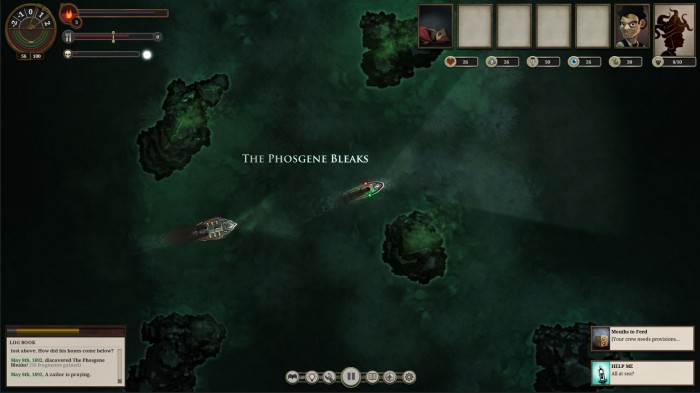
    I have recently been exploring the shadowy and terrifying world of the Neath, in a fascinating and quite engaging game called Sunless Sea. This game is set in a location called Fallen London, an scattering of island archipelagos on a vast underground sea, which was formed at the conclusion of a previous game from the same company, Fallen London. This sunless world is an ocean in a deep cavern, full of horrors and strange stories. The game is viewed from above, essentially on a map, and you play the captain of a steamship who is plying the Neath (the name of the underground ocean) trying to become famous or rich or both. Based in the town of London, you travel between islands trading, picking up stories, fighting pirates, and doing the bidding of mysterious powers. Travel across the darkened seas is fraught with risks, however: in addition to the risk of running out of food and fuel and having to eat your crew, there are also pirates, monsters, and the ever-present growing fear of the darkness. Journeys have to be carefully spaced to ensure you can return to London before the fear mounts and your crew mutiny on you, or the nightmares consume you. There are also mysteries to unravel, and stories involving different organizations and kingdoms.

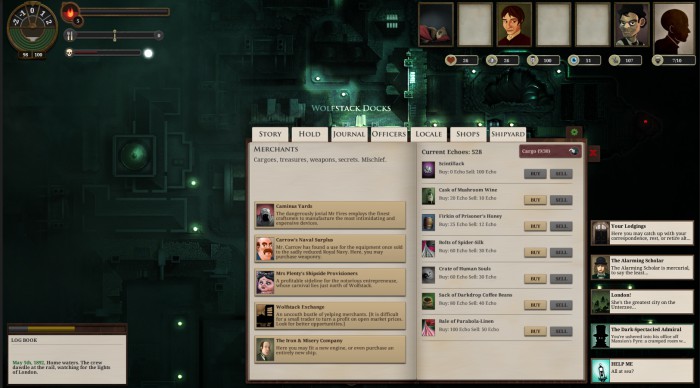
    Strange shops in a strange world
    Strange shops in a strange world

    The game is viewed from above and there are no animations for battles or encounters, just text-based interaction as shown in the picture above. However, despite the lack of animations the graphics are very stylish and engaging, and very carefully build the sense of terror and weirdness that pervades the game. Drawn a little like a comic, but with a grim wash, and with a writing style that is a mixture of dark humour, Victorian prose, and elegant horror, the narrative really gets you involved in the world. It’s also quite challenging, and if you play it the way it is intended, death will be a common event. As the game progresses and the stakes get higher, the struggle with terror also becomes quite consuming, as you try to balance your need to travel the dark reaches of the farthest-flung islands with the compulsion to keep your terror from overwhelming you.

    The game has a few flaws, however. First of all it has quite a sedate pace, so if you’re the kind of gamer who needs edge-of-the-seat energetic game play, it will probably bore you. Also, sometimes the mission details are hard to access, and the game doesn’t tell you when you have completed a task (in some cases), so you can feel lost at sea (literally!) when in fact you have met the conditions of a quest. It is also difficult to piece everything together into a coherent story, so sometimes it feels like the game just intends for you to grind, grind, grind – I still don’t have a sense of a unifying story or theme to the game, and I’m not sure if it will hold my attention if it does not have a theme. It is also quite hard to make money, though I have begun too, and the rules aren’t very deeply explained, so you spend a lot of time making pointless mistakes at first, and I suspect some players have given up early on because of this. However, once you’ve died a few times and googled a few things, the peculiarities of the world and its systems will begin to make sense.

    With that in mind, I thought I’d produce here a list of tips for how to play, based on what I have learnt so far.

    • Always have good stocks of fuel: at first you will only be making small amounts of money, and may find it difficult to purchase things like weaponry; don’t give in to the temptation to spend your cash on a bigger gun when you don’t have much spare, because if you don’t have much fuel, you will find yourself unable to travel to make more money. Always retain enough fuel to at least be able to do a tomb-colonist run, so you can replenish fuel on the return. And always ensure you have enough fuel for the return journey when you head away from London – it is expensive everywhere else (except Palmerston) and if you run out on the high seas you are in big, big trouble
    • Keep your terror down: It is extremely hard to get your terror down from high levels, and/or expensive, so keep your terror down. The main way to do this is to sail through lighted areas, or close to shore. Sure, the pirate raiding requires that you sometimes sail away from the buoys, but you need to make sure that when you travel you stay in the light as much as possible. Especially on long missions, or missions which are going to themselves raise your terror (and many do!) you don’t need to also be burdened with terror built up through frivolous course-tracking
    • Take the blind bruiser’s gift: the only consequence is that later he will ask you to deliver some souls to a far-away place, and you will make your first big cash of the game when you do that
    • Build up admiralty’s favour: it gets you more lucrative and interesting missions, and access to cheaper repairs
    • Keep visiting Hunter’s Keep: Hunter’s Keep is very close to London, and spending time with the sisters will get your terror down. It may seem boring to drop in on a place where you keep having the same conversations, but that soon changes. Hunter’s keep is one of the first stories to reach its resolution, and if you play your cards right you can emerge from the ruins of the story a lot wealthier than you were at the start
    • Watch your nightmares: When you return to London with terror>50 points it automatically resets to 50 (which, btw, is not good!) but your “nightmare strength” increases. Nightmares on the high seas can lead to trouble, including higher terror and ultimately mutiny. It is extremely hard to get your nightmare strength down, but there is one surefire way: travel to the Chapel of Lights north-east-east of London, and visit the well; you can make a sacrifice here and though you incur a wound, you lose nightmares. Do this twice and you can get rid of almost all your nightmares (though having 2 wounds is very risky)
    • Go bat-hunting: bats are easy to kill, and if you throw their corpses overboard you lose a few points of terror. This is the only relatively reliable way I have found to get terror down a lot, though it is not cheap. Basically if you hang around a buoy near Venderbright (or the island of Tanah-Chook, near Venderbright) you will be regularly attacked by bats, but will gain no terror from your location. If you kill 10 or 20 swarms of bats you will get your terror down by 15-30 points, which is really useful. It will cost you in fuel and supplies, though you can recoup the supplies from bat-meat, so make sure you have spare money and fuel before you do this. I think terror affects your abilities, so it’s good to keep it low
    • Torpedos are useful: keep a few in reserve. I was ambushed by a Lifeberg on my way back from the Avid Horizon, and in a moment of desperation I unleashed some, that did it a lot of damage. I took some hull damage but it kept me alive. They cost a lot, but they can be fired early in the battle and do a lot of damage. Combat in Sunless Sea works by increasing illumination until you can see your enemy enough to shoot them, but for the bigger enemies (like Clay Pirates and Lifebergs) you need illumination 100 to get in a really good salvo against them. Getting to illumination 100 without getting sunk is extremely difficult, but torpedos do damage similar to a powerful gun salvo at illumination 50, so if you get ambushed by something much tougher than you they can be a handy way to get out of trouble
    • Keep visiting the old dude in Venderbright: At some point in Venderbright you will get the option to talk to the head of the tomb-colonists, who gives you a mission to explore and find the colours from 8 or so pages of a book. I found two of these colours but the game didn’t tell me I had them, and it took me ages to visit the old dude again. When I did I got an item worth 500 echoes as a reward. So my advice is, once this mission has been unlocked, visit the guy regularly because you can’t be sure you have achieved one of the goals, and the money is worth it. A lot of people say that trips to Venderbright aren’t worth it, but I don’t agree. Not only can you make a bit of money selling news and colonists, but when you explore you can pick up quite valuable artifacts, and as a stop on the way to places further afield, it’s a good way to make a bit of money and get your terror down a bit. Plus some of the story options (the Bandaged Poissonier, Jonah’s revenge, the old dude with the book) can be valuable for you later. So I recommend continuing to visit here.
    • Always go coral-picking at Port Cecil: a single scintillack is worth 70 echoes.
    • Always collect port reports: they can fund your trips, and the admiralty will pay for them no matter how many times you give them
    • Grab stray chances: someone left a coffin on the docks for me once. I took it, and it opened up a whole new island for me. Take any chance you are given!
    • Avoid fights with bigger ships: sure, you can defeat the clay pirates, but unless your mirrors stat is very high you will take hull damage, which will cost about 50 echoes to fix, and all you will get in exchange is a few supplies or a bolt of parabola-silk or something – the maximum profit will be 20 echoes. You can make 20 echoes from a steam pinnace with zero risk. Avoid them.
    • Use the alt-f4 cheat: I’m playing on a mac, I don’t know how to do alt-f4 but I can still do control-command-escape or whatever, and kill the game when I die. Once you are a long way into the game, dying is not such a great idea, so be ready to do this – when you die, kill the game or load before you save, so that you can restart from your last port of call. Otherwise, you have a long upward climb ahead of you …

    I think that’s it. I’m slowly gathering stories and trying to find out where the game goes, and I’m not sure if I will finish it (or if it can be “finished”, per se) but I’m enjoying the experience of this new world. I think it would also make a disturbing and evocative role-playing world. If you’re into cthulhu-esque horror and don’t need fancy graphics to make your games fun, I strongly suggest this game. It can be a bit irritating at first, but once you get up and running it’s a really rich and pleasant experience!

  • The Affordable Care Act has been in place for a while now, and after the initial teething problems it is beginning to settle down into something resembling a functioning system, and serious health policy researchers are beginning to report on its progress. The New England Journal of Medicine (NEJM) reported in July on a series of measures of progress under Obamacare, and the results were generally positive.

    The NEJM article covers some of the more controversial aspects of Obamacare, and also shows how hard it is to understand health financing policy (and outcomes of that policy) in the USA. It notes that 7.8 million young Americans are now covered under their parents’ health insurance where previously they wouldn’t have been, and also notes that this policy has been one of the most popular aspects of Obamacare. In calculating coverage more generally it has to consider the conflicting effects of the medicaid expansion and the newly-affordable bronze plans on the one hand, and cancellations of existing plans on the other. In total, the article concludes

    Taking all existing coverage expansions together, we estimate that 20 million Americans have gained coverage as of May 1 under the ACA.We do not know yet exactly how many of these people were previously uninsured, but it seems certain that many were. Recent national surveys seem to confirm this presumption. The CBO projects that the law will decrease the number of uninsured people by 12 million this year and by 26 million by 2017. Early polling data from Gallup, RAND, and the Urban Institute indicate that the number of uninsured people may have already declined by 5 million to 9 million and that the proportion of U.S. adults lacking insurance has fallen from 18% in the third quarter of 2013 to 13.4% in May 2014.

    On the one hand this appears to be a huge gain (though it depends on your perspective; see below). On the other hand, coverage of health insurance remains at 87% after the ACA (including so-called bronze plans); in comparison, China has 90% coverage of health insurance, and most of the rest of the OECD is up around 98-100%. It may not seem fair to compare America with countries as advanced in health financing as the Europeans, but consider this: Ghana has 65% coverage of its National Health Insurance Scheme, though private payments still make up 66% of total health expenditure, and Ghana is planning on gradually increasing this figure. I don’t mean to belittle Ghanaians by comparing them with a country as disfunctional as the USA, but given the relative wealth disparities it seems that the USA could do better than 87% coverage. Especially when you consider the political cost to the government of implementing this law.

    On the topic of canceled policies, the NEJM can’t provide figures (the studies are not available), but it does point out that many of these policies would not have been canceled if the Republicans hadn’t stymied introduction of the law[1]. The grandfathering clause applied to policies extant when the law was signed in March 2010, but no one expected it to take 3.5 years to implement the law, and had it sailed smoothly through congress presumably most people would have been able to retain their (sub-standard) plans. The NEJM also points out that turnover in health insurance markets is huge, and in the absence of the ACA most of the people whose plans were canceled would likely have changed their plans anyway:

    Health-policy expert Benjamin Sommers and colleagues point out that there was significant turnover in the individual market before the ACA went into effect: between 2008 and 2011, only 42% of people who started out with such coverage still had it after 1 year[2].

    It’s also worth remembering that the reason these plans were forcibly canceled is that they didn’t meet minimum standards – and it’s worth bearing in mind that the ACA’s minimum standards would be considered reprehensible in any other OECD country. I have reported before on the NEJM’s findings about the poor performance of ACA-rated “bronze” plans, but the canceled policies were canceled because they didn’t live up to the standards of these highly flawed bronze plans. Complaining about having your insurance plan canceled even though it is basically an exercise in extortion seems counter-productive to me …

    The other big issue for Obamacare is the risk pool. Obamacare included a “mandate,” a set of rules intended to punish young adults who did not sign on to health insurance before a certain date, with the intention of increasing the number of healthy people paying into the health insurance pools. This is done to ensure that people at low risk of illness are basically subsidizing the sick and elderly, a problem solved in other countries by simply providing financing for health through taxation. The big challenge of market-based systems is that young people won’t pay for insurance they don’t really need, but under a market-based system there is no way to make them. Obamacare is meant to close this loophole and the “moral hazard” associated with it, but it appears that it hasn’t been hugely successful. The NEJM reports that

    enrollment among 18-to-34-year-olds surged as the March 31 deadline approached, climbing from 27% of total enrollment in February to 31% in the month of March. It is widely agreed that there is no single desired rate of young-adult participation. What really matters is whether the observed rate turns out to be consistent with the projections of insurance companies for any period — that is, whether the 31% participation is about what the companies expected for 2014. If young-adult participation fell short of expectations, this could prompt rate increases in 2015. However, even if participation in the pools skews to an older age than companies predicted, an analysis by the Kaiser Family Foundation showed that 2015 premiums might increase by only 1 to 2% to offset higher-than-expected costs. This modest projected effect of an older pool reflects the fact that under the law, health plans can still charge an older person a higher premium than a younger person.

    This suggests (though not very clearly) that the mandate has served its purpose, but has only increased the proportion of total enrolment by young people by about 15%, and no one knows if this is enough[3]. I wouldn’t take this small increase as a sign of great success, and it suggests that in the future insurance premiums will rise, even though one goal of Obamacare was cost containment. It’s also worth noting that there is a large pool of young Americans with pre-existing conditions who were not previously eligible for health insurance (or not at reasonable prices) and some proportion of the increase under Obamacare is likely to be people with pre-existing conditions grabbing the chance to sign on[4]. These people are not going to lower the cost of insurance. But the ACA seems to have included a subtle get-out-of-jail clause for the insurers:

    Carriers with higher-than-expected claims will receive reinsurance payments, for example. This factor alone reduced premiums by 10% in 2014 and will continue to play an important role in limiting premium increases in 2015.

    So, the insurers are protected against the worst effects of signing up a bunch of sick people and failing to recruit young and healthy people. All these premiums, tax breaks, cross-subsidies and protections seem incredibly complicated, and it really does seem like it would be simpler just to introduce a single payer and let them slowly take over the health landscape. But that would be … anti-freedom, or something. Because reasons. So here we are …

    … Which brings us to the question of the future of Obamacare. The NEJM is treating it as a fait-accompli, and is now beginning to publish articles on healthcare policy in the Obamacare world[5], though their articles seem to be predicated on the assumption that Obamacare is fundamentally flawed (they say “major ACA provisions don’t work”, which is surely medical-journal-speak for “you really screwed the pooch”), but they do seem to be accepting the new health financing landscape. My opinion is that the ACA is here to stay, and it seems to be surviving most of the legal challenges. This doesn’t surprise me, because it doesn’t seem to me that Americans have any stomach for genuinely radical (to them) healthcare reform, and it tells me that health policy makers in the USA – on both sides of the political spectrum – are going to have to accept the ACA as the new political landscape, and work within it to reform it rather than trying to overturn it, whether their goal is to overturn it for free-market or single-payer reasons. I don’t think the ACA will ever be as successful as more rational programs in other countries, but if reasonable politicians work within its framework they can continue to improve insurance coverage and, if they can make the cost containment elements work, they can probably improve quality of insurance too. Unfortunately the ACA is complex, works across multiple sectors of the private and public health system, and depends on a lot of goodwill, so it will be very easy for the Tea Party Tendency to undermine it from within government…

    Fortunately, however, the ACA contains the key to its own success. If the NEJM is right, something like 20 million people have gained health insurance where previously they were either unable to pass the hurdles, or unable to afford it. That is 20 million potential Democrat voters at the next election, and I really don’t think one can underestimate the power of security in health care as a voting incentive. These people will be looking at a revolutionary change to their own lives, and the Republicans are going to campaign in the next election on a direct promise to revoke that revolution. On top of that, a lot of big American companies are desperate for healthcare financing reform, and the ACA has proven to those companies without a shadow of doubt that only one party in the US system is serious about delivering healthcare reform. This, plus the demographic slide slowly eating the Republicans, and their lack of talented presidential candidates, suggests to me that the next elections are going to be Democrat victories, and the ACA will be locked in as the health financing policy for the USA for the foreseeable future. In my opinion this is not the best outcome for Americans, but it is certainly a vast improvement on the past. Let’s hope the Tea Party and their apparatchiks in the popular media don’t wreck this chance for ordinary Americans to finally achieve security in healthcare, one of the fundamental goals of modern developed nations.

    Update

    It appears more evidence is beginning to come in from government reports and independent surveys. The blog Lawyers, Guns and Money has a post suggesting that 60% of California’s uninsured have managed to get insurance through the ACA, and that the majority of these are through medicaid, which indicates they probably were uninsured due to financial problems rather than pre-existing conditions (there’s a link to Krugman in the blog, and also some kind of conspiracy theory screed on the Naked Capitalism blog). I also found (through the same bog) a vox article showing striking changes in Kentucky’s proportion of uninsured. The chart in that article is quite powerful, and apparently Kentucky had a functioning exchange from the beginning with an aggressive campaign to get people signed up. I wonder if voters in states that chose to reject the ACA’s medicaid provisions and exchanges might start to look askance at the priorities of their current legislatures …?

    fn1: Well, it doesn’t quite say that … this is my straightforward interpretation of the language of the paragraph.

    fn2: I should mention here that if you can’t read the original article due to a paywall, please don’t make the mistake of thinking that these statements aren’t referenced. I remove the references when I copy and paste text from the original article, because I can’t be bothered also copying and pasting the references.

    fn3: It’s worth noting here that because most developed countries have universal health care systems based on taxation and national insurance, there are very few countries outside of America where research can be done on private insurance financing. So in addition to running a system that from the outside looks to be incredibly inefficient and low quality, the USA is also running a system that cannot benefit from the research outputs of the rest of the world.

    fn4: The pre-existing condition issue has always seemed to me to be the easiest example of why the USA needs to change its system, and also the most obvious example of how inhumane and cruel the US system is. No one is responsible for their own genetics, but in the USA the market for healthcare is basically designed to exclude people with certain random background traits. That’s just mean.

    fn5: For some reason they insist on calling it the “Affordable Care Act.” Weirdos.

  • Pure Evil!
    Pure Evil!

    Today I heard from far-flung shores of the death of my first cat, Grandmaster Flash, aka Flashy Boy, Nemesis of Rockmelons, Master of the Cushions, and Squeaking Death. His exact date of birth is not known (I did not keep a diary then, and was drunk), but 6 weeks before I found him the skies over Sydney turned blood red, hailstones the size of rabbits fell on churches and orphanages across the city, and AM radio channels broadcast nothing but evil cackling for a whole hour – this is the most likely date of his spawning.

    From the moment Grandmaster Flash sprang from the box in which he was delivered to me, he redefined the phrase “You Little Shit.” In infancy he would ambush his Uncle Wurzel when Wurzie was at his toilet; in his adolescent years he was obsessed with other peoples’ corn on the cob and rock melons; in adulthood he would steal chips from the mouths of role-players just as they went to bite; in his dotage he developed a fondness for humping cushions. Grandmaster Flash was also a paragon of bravery and honour: he could torture animals to death that were up to 1/200th of his bodyweight! Truly, he was a creature of remarkable character traits.

    It will surprise none who knew him to learn that he made it to the ripe age of (about) 17; most of us lost our ability to be astonished when he managed to make it out of childhood. Veterinary scientists have told me that he was born with 12 lives, rather than the usual 9, but that he used up 11 avoiding retribution from his Uncle Wurzel, who he constantly tormented. He certainly stretched out that last life well, and with all the cunning and arrogance that those who knew and loved him appreciated about him.

    Nonetheless, that last life played itself out painfully, and his last year was not so pleasant. His voice became querulous and squeaky, and his body began to suffer from long years of laziness and over-consumption of rock melons. He also had arthritis, for which terrible treatments were required, though the loss of full use of his hips did not stop him regularly honouring the cushions scattered about his harem; and I have it on good authority that he finally succumbed to a series of massive strokes brought about by excessive activity with one of his plaid-quilted lovers. I think we can all agree it was a fitting end for a cat the like of which we will never see again: no cat was ever so annoying, so persistently selfish, so craven or so lecherous with non-living things as was Grandmaster Flash. I have no doubt that even as I write this, he has settled into a nest of likely-looking cushions somewhere in cat heaven, to gnaw on the rind of someone else’s melon and plot new ways of annoying his Uncle Wurzel, who preceded him by several years.

    If Wurzel wasn’t waiting at heaven’s cat-flap to toss him into hell, that is.

    So rest in peace, Grandmaster Flash. Your long life of larceny and trouble-making is over, and you will be fondly remembered by all those you insisted on annoying relentlessly – and by all those you loved so unconditionally when you weren’t giving us the royal shits! Thank you for finding me all those years ago, Flashy boy!

  • Last  week I had the opportunity to play an extended session of D&D 5th Edition, using the pre-generated characters and adventure from the starter kit. We had three players so I played two PCs: an elven wizard called Althiel Moonwhisper (Chaotic Good, indeterminate gender, overly elegant in speech and manner but completely lacking in empathy or social skills); and a human fighter called Xander (Lawful Neutral, fancies himself a noble, but turns into a savage, violent bastard when fighting with his great axe). This post gives a few of my first thoughts about the newest version of our old and faithful system. I didn’t have the rules myself, nor did I read them, so what I report here is based on my experience of the rules as played and as dictated to us by the GM, who assured us he wasn’t house-ruling anything – but we’re a fairly rules-light gaming group so we didn’t kill ourselves trying to answer questions about rules. The rules can be downloaded from here.

    First of all, it’s good; and secondly, it’s not really very new. It is essentially a backward step into 2nd edition in feel, using a stripped-down version of the 3rd edition rules and keeping almost nothing from 4th edition. It retains the d20-and-skills structure, ascending armour class and base attack bonus of 3rd edition, but with major simplifications and reorientations to rebalance power. Skills and weapons work on the basis of a d20 roll vs. target DC, modified by an attribute plus proficiency bonus. Proficiencies can exist in weapons and skills, so my wizard had about four skill proficiencies (from memory) and a range of weapon proficiencies (from being an elf). The proficiency bonus at first level for all of us was +2, so depending on attribute bonuses we got total modifiers ranging from +1 to +7 in our core skills, and -2 to +5 outside of them. Proficiency bonuses increase by +1 per 4 or 5 levels, so it’s no longer the case that you’ll have a fighter at 9th level with a +9 Base attack bonus. Essentially attack bonuses scale more slowly than they used to, which keeps them more in line with armour classes. Fighters are the only class that get extra attacks, and I think they also get other attack bonuses and damage bonuses, so the reduced increase in attack bonus is made up for (we thought). Thieves also have less advantage at first level (recall in 3rd edition the skill system meant thieves could get up to a +4 base bonus in a range of skills if they had good intelligence). The skill system has also been stripped down so there is a smaller and more manageable number of skills (only a few more than Warhammer 3, by way of comparison). The reduced importance of the proficiency bonus means that if you need to do something directly covered by these skills, a simple attribute test will do the job. So that makes the GM’s job easier (though maybe this will become more problematic at later levels).

    Most of the ideas from 4th edition have been dumped. Things like daily/at will/encounter powers are gone, and the idea of short/long rests introduced. There are no “recoveries” but fighters can recover d10+lvl HPs once between short rests, and once a day a wizard can recover some spell slots in a short rest.  The short rest is a really good idea, enabling parties to partially regroup once in a day, which seems consistent with how I can imagine adventuring groups actually working (and, incidentally, we really needed this short rest). This short rest/single recovery approach keeps the basic idea from 4th edition of being able to regroup and recover some of your damage, without making it so flexible and powerful that the challenge drops out of the game, and does open the possibility of a group of PCs taking on a fairly lethal adventuring task without a cleric, and having some options other than skulking around and running away, since if a brave assault goes pear-shaped they have something to fall back on.

    The biggest system change I could see was in the way magic works. In overall style it is a flexible mix of 3rd and 4th edition, but consistent with the feeling of 2nd. Wizards have spell slots, arranged by level, and they are quite restrictive (my first level wizard had 2). They can memorize something like their lvl+Intelligence bonus in spells per day, and these can be of any level they know. They can then shuffle these between slots as they like. For example, my wizard had 6 spells in his/her book, but could memorize 4; he/she could use 2 slots a day, taken from any of these 4 spells at will. This gives flexibility without borking the idea of spell slots, and without quite going all the way into power points. Any spell can be cast out of combat as a ritual without using a slot, so Althiel didn’t bother memorizing detect magic. This gives wizards flexibility as utility casters, but doesn’t suddenly give them the ability to do anything in combat. The best improvement, though, was to give wizards cantrips at will, and to make the combat cantrips more powerful. This essentially means that a wizard has a basic attacking power that does 1d8 damage and hits on an intelligence check vs. AC, but which doesn’t scale with level. It was also cute to see that the Sleep spell and been reset to 2nd edition power: it affected 5d8 hps of enemies, which was just great when we entered the goblin caves, and really brought back that feeling of the wizard as once-per-day artillery. These change meant my wizard could participate in every combat effectively, but without the destructive power of rogues or fighters, so he/she could deploy bigger spells without fear of being completely useless once they were used. The short rest recovery option got him/her back one slot, which meant that Althiel could be useful three times in the day. This makes playing a wizard fun from first level, without making them indestructible artillery. There is no sense of controller/striker/tank as was often complained about in 4th edition: wizards and clerics have gone back to their utility roles, and although the rogue’s backstab is more frequent than in 2nd edition (it works whenever an enemy is engaged with someone else), it is not a multiplier, just a +d6 per couple of levels, and the rogue is very much a glass cannon – ours died in the third combat. In fact our rogue wasn’t so useful – trying to explore a goblin cave complex with a halfling rogue who can’t see in the dark is pretty challenging, and we couldn’t find any evidence that the rogue was particularly good at finding or disarming traps (there is no disarm traps skill!) I think the rogue would be more useful at higher levels, and for scouting in a more suitable environment (the rogue’s stealth skill was quite awesome).

    The system has also responded to the way people actually play in some minor but polite ways: any PC can sense that an item is magic by touch, we could check the use of potions by sipping them, and in general the rules on actions and movement were a little looser than in the horrors of 4th edition. Battlemaps are no longer essential, though the rules are still structured around them. Movement rates were relevant in our battle map, but we didn’t spend long periods of time fiddling around with the details of movement. Combats were over relatively quickly, without huge amounts of fiddling, though this will likely change at later levels. This edition of D&D also seems to have dropped the hideous complexity of feats, one of 3rd edition’s clunkiest and most unbalancing aspects. Each class gets a few bonus powers and special abilities, but feats don’t really enter into the development of the class. As I understand it you get a feat at 4th, 8th etc. level but you have to forego an ability score modifier to get it. That enables players to avoid a huge set of complex and frustrating decisions that can really unbalance the game (though at the cost, I guess, of some degree of character diversity at low levels), and makes character creation faster. Also I think when feats do arise they’re going to be big game-changer moves. D&D and AD&D both had relative conformity within character classes (all members of the same class were very similar at first level) and this version of D&D has returned to that, but with a little bit more diversity through skills and unique starting abilities based on package choice – the core rules we used specify only one domain for clerics, but each cleric domain will have slightly different spell choices and some difference in abilities, which was most noticable in the fighter (which had five different starting types available, each with its own skill – Xander was a defender, meaning he gained +1 to AC when wearing armour). I think this idea of broad brushes with small changes in detail that are primarily fluff – due to small differences in skill, and background character descriptions – is more consistent with older brands of D&D, but doesn’t make characters as completely cookie-cutter as they were in those older systems. So, again, a nice balance between the complexity and chaos of 3.5, and the wargaminess of 2.

    This edition of D&D has also introduced the dice mechanism of advantage and disadvantage, which replace +2 bonuses/-2 situational modifiers. This system requires the player to roll two twenty sided dice and take the larger or the smaller of the rolls, respectively. Andrew Gelman’s blog has a discussion of how much difference this makes to outcomes – suffice to say it’s huge – but it is a nice way to enhance attacks and I think will retain its power across levels (as opposed to a +2 bonus, which loses value at later levels in 3rd edition, especially for fighters). There are other small changes too, but overall it feels like a fast-flowing, relaxed and less finicky version of 3rd edition, dialed back perhaps to the freewheeling feeling of 2nd edition, without the deep nerdy clunkiness of that old-fashioned game. It has still kept a few of the basic problems that i think make all versions of D&D look a bit dated:

    • Uniform distributions for skill and damage resolution make long chains of bad results and good results inevitable, and make it hard for players to make plans on the assumption that PCs will be able to do well what they are meant to be good at on average
    • The step from 1st to 2nd level still contains that huge power leap as your hit points double
    • It still has that strange incongruity between the combat mechanics and the explanation of how hit points are supposed to work – e.g. at 4th level the fighter gets an extra attack rather than just rolling once and doing more damage, even though combat is supposedly abstracted, so that the d20 roll doesn’t reflect a single discrete attack
    • It has still stuck to the general principle of spell slots, which I still find restrictive and dumb – a system that keeps the richness and diversity of 2nd edition spells, but makes wizards fully functional as spell-users would be much better, in my opinion

    Overall though the system is broadly functional again, retaining the best aspects of 3rd edition/d20 but stepping away from the depths of complexity that were beginning to make that system a fractal nightmare (and which have, in my opinion, turned Pathfinder into a form of intellectual interpretive dance rather than a RPG). It has gone back to the simpler days of basic D&D, with the adult feel of 2nd edition but the sense and practicality of 3rd edition. Fortunately, 4th edition has basically been dropped: we can all breath a sigh of relief and put “that little unpleasantness” out of our minds for good.

    A word on the introductory adventure too: it is a rich and detailed little gem, starting off with a goblin ambush and opening up slowly into a whole sandbox built around a town undergoing something of a renaissance, but under threat from complex and apparently inter-related forces of human and demi-human evil. It has side adventures, a cast of characters that the PCs need to interact with as more than just purveyors of level-appropriate treasure, and enough detail to form a mini-campaign by itself. It is also linked to the process of learning the rules, so that as you step through stages of the campaign you are introduced to more complex and detailed aspects of the game (e.g., random monsters don’t occur at the beginning of the adventure, so the GM has time to get used to the system before having to handle that most irritating of distractions).

    Overall I think this system is a good forward step in the D&D oeuvre, though hardly a radical advance in game design. It’s a return to the solid and respectable traditions we all know and understand, recognizably D&D again but with enough sense to revise some of the old-school version’s weakest points, and enough wisdom to realize that game design really has advanced since the 1970s. I will certainly be trying to play it again, because it rekindles some of the enjoyment I felt when I first returned to D&D through 3rd edition, before its complexity blew into orbit. It will be interesting to see how Pathfinder and the Old-School rip-off world respond to this system – it could be the death knell for both of them …

  • When we left our heroes they were leaving the dubious safety of the village’s largest house, on a reckless mission to close the hell hole. The villagers watched them fade into the darkness beyond the dim glow from the shuttered windows, and the demons circled cautiously in the darkness, grunting and hissing but temporarily cowed enough to restrain themselves from attacking. The party carried lanterns, and a small marsh light sauntered ahead of them under Thyvalt’s control, the pool of light soon lost from view in the deep blackness of this demon-infested night.

    As they moved away from the village, the group drew together, their lanterns seeming to dim in the inky darkness, strange sounds disturbing the usual bucolic peace of farms and forests. No frogs croaked; no foxes bayed; no fireflies drew up from the pools and streams of the rice paddies to their left as they walked. Where once Thyvalt had known to expect an ageing, wizened toad to croak resonant grunts at his passing there was only silence. The nightingale in the hedges beyond Linus’s bean fields was obstinately silent, and the owls beyond the carp pool dared not stir. They had entered a liminal space, somewhere between two worlds, and soon they were lost in it, all sight of the village obscured in the mist and the impenetrable shadows. The only sound in this cloistered emptiness was the grunt and hiss of the demons circling beyond the light of their brave lanterns; the only movement the gentle swishing and sighing of the trees, and occasional shapes stirring in the mist – shapes that were darker than night, except where flaming red eyes pierced the gloom. The only reminder of the gentle farming community they had left behind them were the post-markers by the road, which loomed slowly on their left side as they walked, even the comforting fenceposts rendered eery and unnatural in the glow of the witch light and mist.

    Cog soon noticed a lull in the hissing and groaning of the lurking demons, and guessed an ambush was coming. He directed the little cluster of mortals off the trail, gesturing for silence and care, and brought them straight on top of a nest of imps lurking near the road. Battle was joined before anyone had a chance to draw breath, and soon over. Lithvard threw a lantern amongst the imps, blinding them in a flare of burning oil and splintered glass, while Cog 11 disappeared into the shadows and Thyvalt drew a useless curse screaming from the netherworld. The imps spread out to attack or spit, and six lumbering dretches dragged themselves out of the shadows to their death. These dretches did not come by choice, but were driven by a giant red flame demon, whipping them with a spiked chain. Ayn called forth the Spirits of the Righteous, and four pillars of fire greeted her entreaties, consuming a dretch and terrifying the others, while Cog 11 appeared from the shadows to gut four of the imps in a sliding, diving whirlwind of wicked knives and mist. Where Ayn’s pillars of fire guttered out they left a huge gap in the mist, and into this gap charged a red-skinned, dog-haired demon, that barked and whumfed its way to its own doom. Lithvard hurled a fire spear at the big demon and Thyvalt yelled imprecations of pain and terror in a desperate voice, hoping to scare away the beasts before they could be surrounded; but to no avail, for these creatures were devoid of fear or mercy. It was then that Syrion hurled himself into the line, singing battle songs in a brave and clear voice, sword singing, drawing all the drenches to him to tear uselessly at his armour. Ayn and Lithvard joined back to back, hurling contrasting bolts of magical energy – one brilliant white and apocalyptic, the other burning with wrathful fire – until all five dretches were thoroughly consumed, their corpses steaming and wreathes of foul-smelling demon-wrack drifting through the mist. Syrion and Thyvalt entered close combat with the giant red demon, but seeing all its minions scattered it turned to flee, taking the dog demon with it. Seeing it injured and terrified the party decided discretion might be the better part of valour, and quickly halted pursuit. They stood on the edge of the road, panting and gasping in the lantern light, Syrion cursing a myriad cuts and small burns and Cog 11 leaning against a fence post, staring into the mist with wide dark eyes.

    They moved on. The hell-hole beckoned, a green glow in the mist ahead.

    Closer to the hell hole the mist was burnt away, revealing the creek bed limned in green light from the hell hole, over which loomed a scraggly willow tree. The willow tree and nearby bushes were cast into stark relief against the distant fog by the green light of the hole, which scintillated and purred in the shadows of the far creek bank, ominous and impure. As they approached a demon slunk out of the hole and into the mist, reality shimmering disturbingly as it hauled itself through the dimensions and into reality.

    Syrion grunted and charged forward, his sword leaving a trail of sparks on the stones of the creek bed as he rushed in to guard the hole. Everyone else followed, trying to hold their fear at bay as they realised that the creek bed was now swarming with demons, materialising out of that hideous gap in space and time as the characters attacked. The two demons they had fought before came crashing through the brush of the far side of the creek to join the battle, as a hell hound and a green-skinned, spiky human-like thing popped out of the whole, stinking of sulphur and rot and snarling with anger. The green thing, the red winged monster and its dog-haired friend all attacked Syrion, determined this time to snuff him out; the hellhound struck at Thyvalt. Syrion, laying about him with his sword, yelled to Thyvalt and Ayn to begin the ritual, but they refused to leave him, and joined battle. Ayn called on her gods, who were apparently more terrified of demons than she, for they abandoned her and her flame pillars fizzled uselessly in the demonic mist. The great red thing took a vicious swipe at Lithvard, a blow so ferocious it would surely have killed the little druid, but Syrion stepped in at the last moment and took the brunt of it on one armoured shoulder, grunting as something important gave way inside his enormous chest. Somewhere a demon cast a spell, and Thyvalt began attacking Lithvard, useless in his confusion but a confusing threat nonetheless. While Lithvard struggled with Thyvalt to try and bring him back from darkness, the dog-haired demon turned on Syrion, halberd striking at shield and armour. Ayn continued to aid him, striking with her sword at any demon that came close enough, while Cog tried to ambush the big red thing and Syrion desperately fended off a cascade of monstrous blows. The demons were grinding them down, but somehow they fought them off. Syrion smashed the halberd-wielding dog-haired demon and Cog disembowelled the green-skinned thing, appearing out of the mist at its feet and gutting it from hip to hip. Thyvalt recovered from his confusion and he and Lithvard dispatched the others – just as a new beast, made entirely of mist and shadows, appeared from the deeps. Gasping with exhaustion, everyone turned on it and cut it to ribbons before it could even fully draw itself from the hole, and for a moment the creek bed was suffused with calm, a calm broken only by the gentle hissing, popping, groaning sound of dying demons dissolving and rotting and returning to their foul brood nests.

    Time being suddenly on their side, Thyvalt and Ayn began the ritual. Thyvalt plunged his sword into the ground, and Ayn began chanting, clutching the sword and swaying from side to side, looking for all the world like a singing shade in her uniform of flowing black robes, dimly illuminated in the sickly green light of the hell-hole and swathed in mist. Lithvard noticed something about the tree and began to investigate it. While this was happening more demons started dragging themselves from the hole, and Syrion, Thyvalt and Cog set about the unpleasant business of slaughtering them as they came.

    A grim and desperate battle followed, as new demons emerged from the hole only to be cut down by the three defenders, who began to suffer increasing damage from the claws and teeth of the fiends. Clouds gathered and mist began to swirl around the fixed point where the sword was embedded in the ground. The sword itself had begun to glow red hot, and Ayn was trembling and shaking in fear. Glowing glyphs appeared and hung in the air, shimmering in the mist, forming a tenuous pattern in the air around the sword. The ground began to rumble and the hell-hole grew gradually brighter, becoming so bright that the branches of the willow tree cast shadows on the overhanging clouds. As Syrion, Cog and Thyvalt fought on, Lithvard talked to the tree and Ayn chanted, and the glyphs began to pulse in unison. Ayn’s voice grew in strength, and she hurled an imprecation at the sky:

    Thou shalt not envy the light, thou shalt not spread thy demonic blight.
    Thou shalt not defile what is right
    Thou shalt perish in the night

    More demons began clambering from the hole, but now the mist and the overhanging clouds were beginning to be sucked into the hell-hole, stray tendrils at first and then larger, thicker strands of mist as the hell-hole began to swirl and groan. Syrion slew the last extant demon, and the demons crawling out of the whole began to waver, fighting now against some powerful force from below that gripped them and began to stretch them. They screamed and struggled, but to no avail – Ayn’s wrath had them now, and the sword was flaring up with purpose. The tree began to move under Lithvard’s guidance, its roots reaching out to curl around the whole and choke it off, entangling the emerging demons and drawing them back in, choking and breaking as it did so. Its branches grabbed arms and spines, tearing them off and beginning to seal up the hole. Demons screamed and the hole began to narrow, glowing brighter and roaring like the wind through doorway in winter. The tree roots tightened their grip, and horrible crunching sounds and screams resounded through the creek as the demons met their horrible end. Moments later, with an anti-climactic sigh and a blink, the whole was gone. Our heroes stood in an empty, darkened creek bed, blinking at the darkness and tripping over the roots of an old, hoary willow tree. The battle was over. They had prevailed!

    Exhausted, they lowered their weapons. Syrion, covered in bruises and scratches, shoulder broken, battered beyond mortal endurance, sank down onto his shield and then, with a shudder, fell sideways, to lie on the dusty ground moaning and gasping. Ayn fell to her knees, shaking in terror at things only she had seen. Lithvard leaned against the tree, panting and muttering his thanks, while Thyvalt looked around in exhausted wonder. Cog 11 emerged from the mist, flicking demon ichor from his face and panting, though unhurt.

    They had closed a hell-hole.

    Somewhere far away, the hooded servant of a giant dragon approaches it, bows and speaks. “My lord, shall we execute the plan? All arrangements are in place.” The dragon moves its huge eye slowly, alien iris narrowing so that only the narrowest slit of black cut through the gold of the iris. “No,” it hissed, the very ground trembling at the restrained power of its mighty voice. “It is too late. The scent is gone.”

    The characters knew nothing of these icons. They rested on the creek bed until some of them had  regained a little strength, and then carried Syrion back to the village. They emerged into the village square with the first light of dawn, Syrion still unconscious on a makeshift litter, groaning in pain and exhaustion.

    They had closed a hell-hole. They had prevailed against all the forces of hell. What next for them? They could feel it moving now – some fate had them in its grip. Where would it take them, and what would become of them? Only time, and many adventures, would tell…
  • [I’m splitting the session report for Eroding Empire session 2 into two parts, because one was a large battle deserving of its own post]

    At the end of the first session of the Eroding Empire, our heroes had just killed a brace of demons, but had suddenly realized that in the heat of battle they forgot to guard Thyvalt’s father. They dashed to his home, fearing the worst, but found him unharmed in his bed, trying to drag himself a little more upright. Once they had assured themselves of his safety, he declared “More will come!” and then whispered in aggrieved tones,

    “They didn’t keep their word!”

    Everyone stopped their fussing to look at him. Seeing he had an audience, he sagged back into his mattresses and said in a low voice, “Let me tell you a tale of treachery and hard choices, son.”

    Many years ago, before Thyvalt was born, the village and its area experienced a terrible drought. For several seasons there was almost no rain, and in the second year the bad weather brought plagues of insects and rats. At first they thought the village could weather it; then they thought they could buy food from other towns like Tameron, but those towns began to sell food at too high a price. In the third year some of them left looking for work to support them until the drought broke, but they returned broken with tales of hardship and failure. After this they began to think that the town was doomed, and Thyvalt’s parents were considering leaving the village to find somewhere new to live when a strange woman came to the town, promising to restore the balance to the weather and replenish their fields. Her price was steep but they were desperate, so they agreed to pay it.

    The woman invoked a ritual of fertility that was shocking and horrific, and so disturbing that though Thyvalt’s father remembers it as if it had just happened yesterday, he refused to speak of it to his son. Suffice to say it was a thing of horror. But it worked, and the villagers woke a day later to find the town’s fields and farms restored, a gentle and refreshing rain drifting over fertile land eager to be tilled. The woman left that same morning, and the villager’s counted their blessings … until they realized that she had opened a hellhole in the willowgrove down by the old creek. It was then that the monsters started to come …

    Again, Thyvalt’s father groaned and whispered accusingly, “They didn’t keep their word!” But they had no time now to ask him more – out in the shadows they heard more demons howling. Another wave had come! Our heroes rushed to the door and looked out into the mist-shrouded night, to see more beasts gathering on the edge of the square. Realizing they couldn’t hope to make a stand all night against these creatures with an elderly man to protect, Syrion charged boldly across the open square to a large house on the far side, where the villagers had gathered together in false hope of safety in numbers. He banged on the door and raged until one of the bolder villagers slid a window open a tiny distance and, poking his nose out behind a knife, whispered a query. Syrion demanded that they let the old man in, and threatened to tear the building down around them if they did not comply. This doughty villager immediately agreed to Syrion’s request, and quickly slid the window shut. Gesturing madly to his fellows, Syrion moved into the middle of the open square to take a defensive position.

    The others rolled Thyvalt’s father in a sheet and began shuffling across the square towards the house. As they reached Syrion a new horde of demons burst from the shadows to attack: 5 imps, a minotaur-like red-skinned demon, and a grey-skinned, winged thing that looked as if it had stepped straight from a picture book by that new-fangled Axis artist Dante. The imps spat some kind of gore that hit Cog 11 and made him retch, but before they could press the advantage Syrion was at the throat of the grey winged devil, slashing and hacking. Cog 11, hoping to make some distance towards the red-skinned bull demon, tried to slide under the old man in his sheet, which Thyvalt and Ayn were still carrying, but somehow tangled in the sheet and pulled the old man free. Thyvalt and Ayn, relieved of their burden, were now free to join the fight … was this a blunder of Cog 11’s, or some cunning plan to sacrifice the old man so as to guarantee the support of his allies …? Thyvalt, Ayn and Lithvard now began throwing spells at the demons, and Cog 11 slid into the mist to prepare an ambush. All of this frenzied activity happened under the continued barrage of toxic vomit from the little imp creatures, but their aim was poor in the darkness and mist and confusion, and they were forced to scatter under Thyvalt and Lithvard’s magical attacks. Ayn left Thyvalt’s supine father to fend for himself and made battle with the red bull-demon, which Cog-11 had ambushed to some effect, slicing it from hoof to groin.

    After a few more moments of desperate struggle the tide turned. The final imp was scorched to death by a fire spear, icy hands appeared from the darkness to tear the red demon apart, and Syrion was able to kick the grey winged thing to the ground and decapitate it. The PCs’ battle cries, grunts and gasps fell still, and they stood in the mist panting and shaking, as the demon bodies suppurated and fumed into nothingness around them. But this time they had no time for congratulations or reflection – demons continued to gather, and they had an old man to protect. They gathered him up and carried him gently across the rest of the square, their ferocious victory having briefly quelled the demons’ appetite for blood. After only a minimum of banging and threats, the courageous villager opened the door to the house and ushered them in. They rushed in, depositing Thyvalt’s father by the fire, and stood to find the village’s full but tiny complement staring at them, as if they were the demons. Cog 11, looking around at them all, whispered to Syrion in a perhaps-too-audible voice, “Beat the elderly until they tell you what you need to know. I check defenses,” and disappeared to inspect the house. Thyvalt and Lithvard set about making Thyvalt’s father comfortable, while Ayn took guard at the door.

    Cog 11 returned shortly to announce that the house was indefensible and vulnerable to fire. He may also have suggested forcing the villagers outside as a distraction so that the group could escape, though no one seemed to pay him any heed. Instead, they decided they would have to find and destroy the source of the demons – the hellhole. Thyvalt’s father told them the next instalment of his sad but predictable story of a contract gone bad.

    After the woman left, the monsters came. Just a single little slimy thing at first, we killed it and thought it a strange beast. But then there were more, and soon we realized they were demons. What had we done? We paid this woman all our savings in good faith, and she gave us what we wanted at a price she knew we would pay with our lives!? At first the demons just terrorized our livestock, which we had saved at such cost … but soon they took the first of us, and our lives became a hell of furtive farming, occasional deaths, and night terrors.

    Until the Crusader’s Knights came. They clattered into the village one evening just as we were returning, weary and wary, to our homes to begin the long, hard watch of the night. They rode huge black horses with fiery red eyes, their hooves striking sparks on our only cobbled road, the riders inscrutable in glyph-adorned armour of shining black. They rode into our square and cantered about it in a rough circle, whooping and hollering, and we were all sure that our time had come. We cowered in our houses, terrified at the form our death would come in. Would they torture us? Feed us to their fell horses? Or worse? But then their captain, a towering giant of a man, dismounted from his gigantic demon horse and strode up to my door. He banged on the door, declaring himself to be a captain of the Crusader’s Knights Eternal, and ordering me to open the door. Of course I did not, so he smashed it in with a word, and strode into my kitchen where I cowered against the bench.

    And it was there, in that kitchen, that the deal was made. I don’t know if he chose me through chance or some evil purpose – perhaps someone needs some innate seed of evil that he can nurture, or perhaps I was just the closest door to his evil horse. No matter. He told me he would close the hellhole and destroy all the demons roaming our fields, but in exchange I would have to give up my first born son to the Crusader. Is this how that fell Icon recruits his servants? I confess I did not ask many questions – it was an offer I felt I could not refuse. I should have asked him to find and kill the woman, but I didn’t. Instead I just gave him you, my Thyvalt, though you were not yet born. He laughed, a booming, chilling sound with no humour in it, spat on his great palm and clasped my hand, promised me a long life and a good one, and strode out the door without looking back. And by morning the hellhole was closed and there were rotting piles of demon flesh scattered around our demesne. We never again saw the demons, and once we had summoned up the courage to go down to the willowgrove we saw it free of the hole that had been summoned there. We were saved. The following year you, my son, Thyvalt, were born, and lost to me the moment I saw you were a boy.

    But I don’t regret having a child, even should you turn to evil. What I do regret is that I never bargained that blackhearted bastard into promising to close the hellhole permanently. He cheated me, and if you do enter the Crusader’s service I hope you can find him and extract payment!

    So, our heroes have to do the job of 20 of the Crusader’s priests, by dawn. Fortunately, they were prepared. Thyvalt possessed a strange sword that he had received many years ago from his master but which he had always felt had some malevolent power contained in it. He also had a long history of fighting demons away in his sleep. Ayn was in close accord with the gods of War, Pestilence, Famine and Death – surely ready allies when a hellhole needs to be closed – and she was well versed in the mysteries of conjuring and abjuration, for her cult were steeped in ancient learning. If they could embed the sword in the hole, and fend off the demons while Ayn invoked the proper prayer, they might be able to close it. No one liked the thought of what would happen if they failed, out there on their own in the dark, but what choice did they have? They had to close it, so close it they would.

    Between them, Ayn and Thyvalt put a magic circle around the building that would last until dawn. The group armed themselves, looked back on the terrified villagers, and stepped out into the darkness…

  • Over the past 15 years, Australia’s immigration debate has focused on whether “illegal” boat arrivals can be prevented by policies in the home country, or whether they are determined primarily by refugee flows in the countries of origin. This is broadly referred to as the debate about “push” versus “pull” factors in immigration. On the one hand, commentators (generally “conservative”) suggest that Australia’s “lax” immigration policies, and generous policies towards refugees, encourage people to try to come here. These “lax” policies seem to be primarily represented by the visa system, and so the Howard (“conservative”) government introduced Temporary Protection Visas (TPVs) which offer no guarantee of a long-term home – theoretically the holder of a TPV will be required to return home when their national situation stabilizes. This seems hardly likely to be a deterrent given that the national situation in nations like Afghanistan and Sri Lanka doesn’t stabilize over periods of less than a decade, but a deterrent it is believed to be. Other policies are often seen as part of this process of reducing “pull” factors – offshore processing, reduction of benefits (a big issue in the UK, where asylum seekers cannot get any benefits or access the NHS), restrictions on family reunions, etc. Of course, all of these policies are predicated on the idea that in amongst this flood of refugees is a certain non-trivial proportion of people who are not “genuine” refugees, and that for some reason these people need to be weeded out and prevented from “taking advantage” of our “generous” systems.

    On the other hand, some commentators (generally “left wing”) suggest that immigration flows are primarily driven by the situation in the countries where people come from, and desperate people are largely unconcerned about the policies of the countries they are fleeing to. Under this “push” philosophy, people flood out of their home country when everything goes to shit, and the policies of the countries they’re heading to don’t amount to more than a temporary impediment. Basically under this model a bunch of people from Syria, Sri Lanka, Afghanistan and Myanmar have been heading away, and some of them have got trapped in Malaysia and Indonesia. From there they dribble out on boats to Australia, and Australia’s specific processing and visa policies aren’t relevant because people will do remarkable things when the alternative is either dying in their homeland or rotting in a transit camp in intermediary countries.

    Unfortunately, the truth of this battle – which to Australians is important, because we’re the 8th richest country in the world, so it would be a disaster to us if a couple of thousand people took advantage of our hospitality – is difficult to resolve in the Australian context. National visa and asylum seeker management policy has changed frequently, but drivers of refugee flow have changed separately in a complex way: the situation in Afghanistan and Iraq has ebbed and flowed, wars have sprung up in Syria and Libya, the war in Sri Lanka flared up and came to an end, and the situation in Myanmar and Pakistan is complex and unknowable. Furthermore, at various times the Australian government’s policies of direct intervention against boats – turning them back, or leaving them to drift against international maritime law, or sending the SAS to raid boats that rescued refugees – has changed. Currently the government refuses to report numbers of arrivals or boats turned back, so it’s impossible to assess the success of the current policy. So the debate in Australia – and let’s face it, knowing whether these people are trying to take advantage is far more important than helping them – has been difficult to resolve.

    This week the Guardian had an article describing how refugee flows have changed in Europe, and this article – if true – gives some further information about the relative importance of push vs. pull factors. The situation in Europe is dire, and dwarfs Australia’s refugee “problem”, and the level of human catastrophe also dwarfs the situation that the Australian Prime Minister was crying crocodile tears about while in opposition – hundreds of people drown at a time on a regular basis in the Mediterranean. From the clinical standpoint of trying to answer the oh-so-important question of whether they’re all grafters, Europe is a much more useful experimental setting, because it involves multiple countries with multiple different policies on asylum and refugee management. The refugees are targeting France, Italy and Greece, and they have been coming overland and by sea. Since Greece built a wall more have been coming by sea, and the numbers have exploded since the war in Syria – 350 in 2012 compared to 7000 in 2013 – and these refugees are targeting several countries that, as far as I can tell, haven’t changed their migration and asylum-seeker handling policies at all. It’s also worth noting that the mediterranean doesn’t have any interim processing centres – people flee straight to the reception countries – whereas Australia is the target of people spilling over from processing centres in Indonesia and Malaysia. So presumably Europe’s experience measures actual changes in flow, rather than changes in interim processing centres. The UN is proposing processing centres to handle the huge numbers and reduce the appalling fatalities at sea, but no one appears to be proposing changes in European policy that would “discourage” asylum seekers – neither is anyone proposing resettling them all on a malaria-ridden remote island where they can riot at their leisure without being filmed. Uncivilized brutes, those Europeans. But this lack of “deterrent” measures is not new, yet the flow has changed – at just the time that the west is also receiving reports of new brutalities in Syria, and the collapse of the rebel efforts there.

    I take the events in Europe as strong evidence for the “push” theory of refugee flows. That isn’t to say that changing “pull” factors wouldn’t affect these flows, but given there is literally nowhere else for these people to go (except Australia?) it seems unlikely they’d make a difference. The European experience confirms my suspicion that refugee flows are primarily determined by what is happening in the origin country, not by the policies of the destination countries. Which, unless we can find a way to stop the chaos happening in the middle east[1], is going to mean accepting that we need to start accepting more refugees, and preparing for bigger flows in the future. An unlikely political outcome, at best …


    fn1: I wonder if not supporting insurgencies might be a good start?