• Recent revelations in the UK have shown that the UK government’s intended efficiency savings aren’t working (shock!) and it faces a huge funding shortfall. This is hardly unexpected, and probably the first of a range of such reports that are going to start filtering around Whitehall soon, but it has spawned a disappointing tirade from a Guardian opinion writer that I feel deserves a little attention because it contains so many egregious examples of the kind of woolly thinking that happens in the media when it attempts to discuss the serious problems facing the NHS. It also shows some of the collective doublethink that exists within a newspaper I get the impression was once great but has been reduced to cheer-leading labour from the sidelines, no matter how crap labour becomes. It also gives me a chance to hold forth at length on my opinion about the importance of mixed markets in healthcare, and why the NHS is a model out of step with modern life.

    First of all, this tiradist, Jackie Ashley, offers a standard explanation for the NHS’s woes that I heard many times while in the UK:

    The apparent mystery about NHS spending was partly answered on this morning’s front page in a separate story which revealed the average British man put on more than a stone between 1986 and 2000. The puzzle is why, given the big real-terms increase in health spending, the NHS isn’t hugely successful.

    Now, these two sentences contain so much misinformation that it’s easy to see why commentators on the NHS get bogged down in misperceptions. For starters, the UK isn’t the only country to have experienced this increase in weight (of “a stone” – that’s a ridiculous measure of weight if ever there was one). Australia, Canada and the US have also experienced the problem of weight gain as, I think, have several European and South American countries. So presumably whatever problem the NHS is facing as a consequence of the fattening of the general population is something that other countries have also had to deal with, but those other countries aren’t necessarily suffering the same funding constraints and poor care that the British system has. And the clue is in the second sentence’s misperception. Yes, the NHS has experienced big real-terms increase in spending under labour, but after 10 years they were sufficient to get the NHS to nearly the EU average funding level. I’ve pointed out before the catastrophic effect this long-term underfunding will have on a health system, and it’s hardly to be expected that the NHS is going to do well when it’s vastly underfunded compared to its neighbours. I suppose you can’t make a hard-hitting article about the government’s political problems by recognizing that the NHS’s funding problems are caused by … underfunding.

    Having presented this false “puzzle,” Ms. Ashley goes on to present us with a false set of answers:

    The answer is a combination of our lifestyles, longevity and a cascade of new treatments which, together, pile up human and inflationary pressures that no other service faces. So despite the promise to ringfence the NHS from deep cuts, the inflation-level increases will feel like cuts.

    So, the reason that the NHS is suffering funding problems is that it faces exactly the same set of problems that every other western health system is facing and dealing with. Perhaps the problem is that the NHS is under-funded? Or perhaps the problem is that it is poorly run and inefficient? Otherwise how can we explain the better performance of similarly-funded systems in Australia and Europe?

    Our tiradist then goes on to observe that if these huge funding shortfalls do occur, this

    translates into new super-drugs being refused to desperate patients (and the media campaigns that will follow); wards being closed; and a return to the waiting times scandals, sadly familiar to anyone who remembers the early years of New Labour.

    Here it would be nice to imagine she would issue a poignant plea for the media to be a little more responsible than to just run silly campaigns about super-drugs being refused to desperate patients, but strangely enough for a journalist, she misses this opportunity to upbraid the journalistic profession on its transparent stupidity and lack of ethics. Do you think the Guardian will bow out of those “media campaigns that will follow,” Ms. Ashley? Ah the power of the passive voice when wielded by journalists trying to evade responsibility. Similarly, it never occurs to a journalist to think that a ward being closed might be a rational decision rather than madness; and it may not have occurred to a labour partisan like Jackie Ashley, but NHS waiting times remain a scandal from the point of view of the rest of the world, and were so at the end of New Labour’s reign. When 13 weeks’ wait is your target, you have scandalous waiting times.

    Jackie then goes on to describe a big problem facing the NHS – its own bureaucratic inertia, and the difficulty of changing the system radically (whether for good or ill) in any kind of hurry:

    Lansley wants to hand 80% of the NHS budget to GPs. This means the same primary care trusts tasked with making radical efficiencies now, also have to prepare for their own administrative suicide by helping set up mini-bureaucracies all over England

    Now in the fantasy mind of your average Telegraph reader Ms. Ashley is a communist, as are all NHS managers, so you’d think they’d welcome the withering away of the state, but here we see a tacit admission that government departments don’t like to do themselves out of a job. Now, I happen to agree with her that the devolution of the NHS budget to GPs is purest madness, but blaming it on the current health minister is a bit rich, as is her subsequent feat of describing this process as “hardcore Tory thinking.” This process of handing PCT budgets to GPs is in plain English (for the non-UK readers) the process of handing the funding for area health services to ordinary family doctors (General Practitioners, aka GPs) who then decide how it should be spent on local priorities. It was originally called “Practice Based Commissioning” and was trialled extensively under the previous Labour government. It’s exactly the opposite of “hardcore tory thinking” because it tries to localize funding and spending decisions without actually exposing them to a proper free market. It’s the bastard child of politics, focus groups, right-wing health funding ideology, and a bankrupt “left wing” party led by a Vampire (Tony Blair). In essence it just makes the area health services smaller and less competent, in the interests of a free market ideology that is too scared to out itself and show its fangs. But a Tory idea it is not – the Tories just see it as an excellent way of achieving their wet dream of localism (which, by the way, why is this so important in a country smaller than an average Australian cattle farm?) and funding cuts simultaneously, and blaming doctors for the resultant fuck up. If the Tories are really the bastards that the Guardian makes them out to be, they’ll (rightly) blame the subsequent clusterfuck on the policy’s originators – the Labour party. But I bet you they don’t.

    And, by the way, it’s funny to see a pro-labour party hack like Ms. Ashley suddenly waxing lyrical about these organizational details when they were just too, well, boring, for her to bring her critical (ha!) gaze to bear on back when Labour were in power and talking about them continuously.

    Of course there is a way that devolving funding to GPs could work – make them properly private enterprises, competing with each other on quality, breadth and depth of service for payment from a single, government-run insurer. Make the hospitals a mix of private and public, with basic funding provided on a (semi-) fee-for-service basis, with private hospitals topping this funding up through private payments and public hospitals getting block grants for capital investment, research and public health work. i.e. introduce a system similar to the Australian, German and Japanese systems. Then GPs get to continue being doctors, area health services shrink to become managers of public health work and overseeing of hospital standards, and the hospitals get punished for poor quality work. However, introducing such a system in the UK would mean admitting that the NHS model, even though revolutionary and of profound importance in 1948, doesn’t actually work anymore and needs an overhaul. No party, Tory or “labour,” is going to do this, especially in an environment of cowardly conservatism and rampant budget cutting.

    And this leads us to Jackie Ashley’s final paragraphs, where she describes the real consquences of a system on the edge of administrative and financial ruin, and fails to even really get angry about how bad it is in the average NHS hospital. It just doesn’t seem to occur to the average British commentator on the NHS that having “elderly patients not being fed” is not a passing matter to be commented on near the end of a discussion of political priorities, but is in fact a massive fucking failing of your whole system that any reasonable healthcare system would stamp out fast and with extreme prejudice. Why is the NHS unable to do this? Because it’s a runaway behemoth which is simultaneously beyond punishment for individual failings, and yet incapable of the kind of central planning and intelligent management that would stop these things from happening. No one has the political will to discuss, let alone tackle its obvious, huge failings, and no-one is willing to discuss the serious increase in funding that it needs, let alone to link these to the improvements in efficiency and outcome which a modern health system demands. So instead everyone, Tory and “left wing” alike, looks for distractions and mentions abominations in care and service quality that would be a matter of national urgency in any other public health system in the developed world as if they were just another simple reality of any modern system. Which just goes to show how much the British have lost perspective on how healthcare should work, and how much they need to start looking overseas, to new models, for an insight into what they need to do to fix the 30 year recurring problem of their decrepit health system.


  • I’m always eager to read the latest Iain M. Banks novel, especially if it involves the Culture, because not only is Banks a great writer but his ideas and settings are really good, and I think the Culture novels have made a significant theoretical contribution to science fiction. So they’re always a pleasure to read even if, like this novel, they’re too long, have unnecessary plots, and suffer from two significant flaws.

    Surface Detail adds a new layer to Banks’s vision of the galaxy the Culture inhabit, this time by expanding on ideas about virtual minds, backing-up minds, and sublimation of whole cultures that he had previously only alluded to. The central plot of this novel concerns a war over the fate of a collection of pan-galactic hells, conducted in a virtual environment in order to prevent it spilling into the real world where it might actually hurt people. These hells represent the natural consequence of the development of technology enabling people’s souls or minds to be backed up – some civilizations provide an afterlife for those who have died and are sick of living; and some of these civilizations also provide a hell, where those who did wrong in life are tortured forever. The Culture, of course, being the most sanctimonious anarchists in pan-human history, object strongly to this phenomenon – even virtual torture offends them, though they might occasionally blow up a habitat containing billions of people, just because they have to – and this story concerns their non-involvement in this war. The idea is excellent, expanding on Richard Morgan’s ideas with a nice post-scarcity, space opera twist, and the idea of virtualized wars is also excellent. The novel also adds further detail to the growing description of the Culture’s place in the galactic order, the nature of civilizational sublimation, and of course introduces new tech, a wide range of civilizations, and some nice concepts about what happens when civilizations die and leave their tech behind. It also has an excellent character, the Abominator-class starship Falling Outside the Normal Moral Constraints, whose personality matches its name exactly.

    I like the way Culture novels work on a theme, so even minor plots match the theme, and I like Banks’s decision to take on the topic of personality back-ups, though I think the aforementioned Richard Morgan’s take on the consequences of this technology in books like Altered Carbon is more interesting. As other reviews I’ve read have observed, this book is a little too long, introducing unnecessary plots and characters (in my opinion 3 characters could have been dumped altogether along with their completely irrelevant plots) but Banks’s writing is so much fun and his ideas so intoxicating (if you like space opera) that this never bothers me. However, there are two significant flaws in this novel that I think have been becoming increasingly obvious in Banks’s Culture novels, to the extent that I can now safely say they are a developing pattern in his work:

    • Too Many Settings: Like the roof of the Cistine chapel, this novel is garish, with unnecessary colour. Every couple of pages there is a new setting, each one as luscious and extravagant as the one before it, and none of them playing any significant role in the novel beyond a few pages. The main story occurs against the backdrop of an essentially completely normal country estate (a common theme in Banks’s novels) but an encounter of a few pages only may occur in some resplendent and insane natural or artificial setting, that we barely have time to revel in before we’re flicked on to the next scene. Every one of these settings in itself is great but it doesn’t do any justice to the setting to flick it away after just a few pages. I remember the main settings of Consider Phlebas very clearly because there were only 3 or 4, but in this novel Banks has gone through 20 or more stupendous settings, and by the end of it I’m numb to their power. He could have spread them over several novels, and given me greater opportunity to enjoy each one. This book basically requires only three – a crazy opera house, an in-system underground city, and the mansion – with the subsidiary setting of a single GSV.
    • Deus Ex Machina: The entire plot involving the Quietus spy Yime Nsokyi was a deus ex machina, with her being spirited from catastrophic event to catastrophic event by the Ship she works with. At one point she is told bluntly: humans have not been able to contribute meaningfully to space battles for about 9000 years. Then she gets in several. There are multiple other points where the humans are basically rescued, dumped into a new plot or have their machinations revealed by Ships. The Ships are so omnipotent and omniscient that they are, to all intents and purposes, gods, and Banks seems to have lost the skill of crafting stories where he doesn’t use these powers. Earlier novels – especially Consider Phlebas and Use of Weapons – avoid this problem by careful crafting and choice of setting, but in more recent novels he’s given up on the (admittedly challenging) task of setting up plots which don’t rely on the Ships just swanning in and fixing/fucking everything up. Don’t get me wrong – I love it when the Ships do this – but it’s poor narrative crafting and a writer who wasn’t so creative in other ways would be punished for it critically. Though I have noticed recently that this seems to be a bit of a phenomenon in modern sci-fi and fantasy – it happened a bit in the Stephen Hunt, Richard Morgan and James Butcher novels I’ve been reading recently, so I’m wondering if it’s a narrative trend in modern SF/Fantasy. In which case someone needs to point out how crap it is.

    Despite these concerns with the novel I can’t say that Iain M. Banks is going downhill. Rather, I think he’s got a lot of creative license from his earlier success and is using the freedom this gives him to explore the Culture as a sci-fi phenomenon. The plot and the narrative detail are secondary to his prime interest, which is exploring the ramifications of his post-scarcity world. I think this post-scarcity concept is very important to sci-fi, and until his actual writing and characters lose their considerable power, I’m happy to go along for the ride with very few reservations, so I recommend this novel to anyone who wants a good space opera novel.

  • Is this really how it looks to you?

    Is a topic I don’t know much about, but James at Grognardia has been pondering how Japanese interpret Traveller and similar science fiction. To reproduce my comment to him there, the concept of the “Frontier,” which is important to Traveller, is not so relevant to Japanese literary history. Aside from a very brief and unfortunate period of recent history that didn’t work out for them, they don’t have a history of imperialism or colonialism. Even their brief foray into imperialism – which ended tragically for them by 1945 – was at least partly geopolitical (to keep up with the West) and also occurred at a very unusual aberrant political period, when they were living under essentially a military dictatorship. Japan also never had a strong history of exploration – in place of an “age of exploration” they have an “age of isolation” and no long naval history, even though their navy now seems integral to their identity. In fact Japan’s most famous naval victory was due to a typhoon, not their own navy, and for many years they had no ships bigger than fishing boats. So the main themes of traveller – exploration, imperium, colonies, etc – don’t have a strong place in japanese literary tradition.

    The sci-fi I’ve seen here seems to be largely near- to medium-future inward-looking dystopias or post-apocalyptic stories, often cyberpunk without the punk. Maybe this is more consistent with their cultural history. There are some catastrophic-war types of stories, in which there are no clear good or bad guys, also consistent with recent history; but expansive imperial stories are not really the stuff of Japanese legend. I have a private theory that the Japanese have a history of conquest and exploration within Japan but it is so old that it is only reflected in myth – I think the momo taro story may be an allegory for the driving out of the Ainu from Honshu, but I have no proof of this of course.

    So this means that stories like Traveller would have no place in or resonance with contemporary Japanese literature, and would simultaneously be exotic and interesting to a subgroup of nerds. The same, I suspect, applies to Star Trek, Star Wars and other similar western imports, so they have less relevance here than they do in the West.

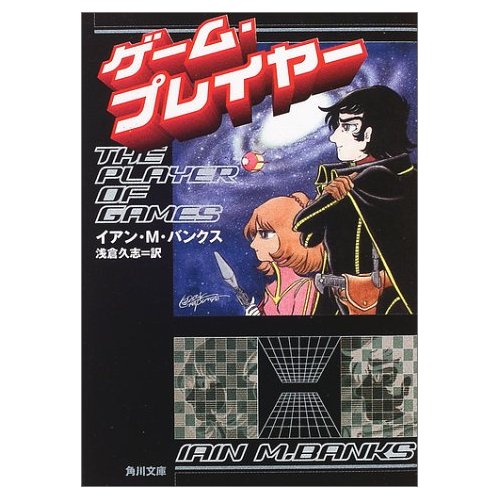
    As an example of Japanese interpretation of Western sci-fi, here is a picture I found on Amazon of the cover of a Japanese interpretation of Iain Banks’s Player of Games. It seems jarring and not serious enough to me, though the grid at the bottom is kind of perfect. But I’m not sure what illustration would suit that novel, so maybe my sense of its strangeness is overdone.

  • I have now had the chance to role-play with gamers from 3 nations – Japan, Australia and the UK – and I’ve seen a lot about American role-players online. From my experiences I’ve begun to get a bit of a sense of the politics, class and background culture of gamers in these 4 nations, so I thought I’d give my judgments here and see what representatives of the countries in question think. Note the word “judgement” in this sentence, it’s hard to do anything but generalize when you only met gamers in London for 18 months, for example, and they were mostly wankers. So, let’s be at it…

    Australian Gamers: Obviously the group I have most experience with, I would characterize Aussie gamers as largely middle class, from managerial or professional backgrounds – IT professionals, managers, public servants and the like – with only a small sprinkling of “working class”[1] professions like gardeners or factory workers. This is unsurprising given that Australia is a largely middle class country, but interesting to compare with, say, Japan. I suspect Aussie gamers tend to focus only on the most popular overseas games, as we’re few in number and quite isolated – often in Oz you have to construct gaming groups from friends rather than experienced gamers, and gaming shops are few and far between. The lack of interest in gaming reflects, I think, our historical distance from the US and a strong anti-intellectualism in Australia during the growth of the hobby that held us back from developing in the same way as the UK. I haven’t lived in Oz for 5 years now so maybe this is changing. Gaming in Australia also seemed to include a high proportion of goths.

    British gamers: were largely a pack of wankers in my limited experience, but otherwise similar to Aussies[2]. I met my British gamers mostly through pub-based gaming groups in London, and I suspect this is not the best environment to meet nice people, since it tends to attract the kind of people who strangely seem to never be invited to games at other peoples’ houses. Also, pubs are an aggressive and unpleasant socializing environment, and good gaming behaviour requires a supportive environment (e.g. where you don’t have to yell just to be heard). So maybe I didn’t see anything like a representative cross-section of British gamers. I also think the gaming scene may be stronger in the midlands and further North, where I believe it developed historically (I think Grenadier miniatures, GDW, and the major early gaming stores all started in the midlands, which is also where The Elfish Gene is set). So London gamers were middle class, mainly, played a wide diversity of games (though there was a heavy D&D focus in the club I joined) but seemed to have a lower goth-factor, and perhaps less students than Aussies. They were also old, I think – a good half of the club I played in would qualify for the classic stereotype of the 30-something fatbeard (and my God did those fatbeards plumb historical depths of know-it-all bastardry). I note that this gaming in pubs thing is at least partly reflective of housing in London (appalling) and public infrastructure (weak), so that people had nowhere else to play. I once went to a pub with a friend for a drink at about 10pm on a Friday night, and there were 3 guys doing their regular D&D session in amongst the revellers, which I don’t think you’d see anywhere else on Earth. Also, they weren’t being beaten up by the other punters, which would surely happen if you did anything that nerdy in an Aussie pub[3]. So this indicates both a poor availability of good gaming spaces, and a generally more accepting attitude towards nerdish pursuits in the UK than in Australia. Which probably explains how the UK was an important site in the development of modern gaming, and has a larger scene than Australia.

    Japanese Gamers: Seem to be from noticeably poorer backgrounds than those in the UK/Australia, with a higher preponderance of factory workers, service workers and the like. They seem to be much more concerned about money and economy than Aussies or Brits, and the gaming industry here seems to take this seriously, releasing most games in an expensive and a cheap format. One of my players doesn’t have a PC, and another has a second hand iBook (6 years old!) which indicates a much lower interest in computers and/or less money. Their online presence is often entirely mobile phone based, largely around the social networking site mixi[4] and they don’t seem to blog much (except for the organizations, such as the club I’m part of). They’re quite formal and very nerdy, and there is a much, much lower level of both rudeness and know-it-all behaviour than one would see in Aussie or British groups. Also, there is almost no culture of home-based gaming, but a very good public infrastructure supportive of public gatherings so no need to visit peoples’ homes. Interestingly, the University I teach at has no gaming club, which would be unusual by Australian standards. Japanese gamers play a wide diversity of games – there are a lot of local games, and then also a reasonable range of translated games. My convention group seems to have a widely varying range of available games, and there is not much D&D focus – one GM is obssessed with Pathfinder but the others seem to change regularly. In fact I detect zero interest in 4th Edition, largely for cost reasons, and little interest in 3.5 because of its splatbooks. Pathfinder is available online for free, and that’s a bit part of its allure, I think. Again, this is partly related to the strong concerns Japanese gamers seem to have about money. I don’t know if Japanese RPGers are different to other parts of nerd (otaku) society here but it’s worth observing that Japan is much more respectful of nerd life than Australia (or even Britain) seem to be, and so I expect much more mixing occurs between nerds. There’s also less evidence of any feeling of exclusivity or reaction against ordinary non-gamers, which one sees a bit of in Australia.

    Another noteworthy point about Japanese gamers is that there are a lot more women in the groups here than in the West. I think this is because of the lack of exclusivity of nerd culture here, and its old pre-RPG pedigree.

    American (online) gamers: Based on what I see from the internet, American gamers seem to be largely middle or lower-middle class, though with perhaps a wider diversity of classes than in Australia. The thing that interests me most about the US gamers I see online though is that a lot of them seem to be military. One almost never meets an Australian or British soldier-gamer, but they seem quite common in the US online RPG scene. I wonder at three possible reasons for this:

    • Americans are much more likely to be in the military than Aussies or Brits or Japanese, and thus so are gamers
    • US soldiers are much more likely to be gamers than Aussie/Brit/Japanese soldiers (certainly true for Aussie soldiers I think)
    • Self-selection: US soldiers are much more likely to travel than non-soldiers, for longer periods, thus much more likely to have a strong online presence and less likely to have a game going; thus more likely to have a blog about the games they can’t play

    I appeal to my American reader(s) for an explanation! Also, another thing I notice about US gamers is they seem to be very white, which on the balance of probabilities probably shouldn’t happen. Is this because the class that gamers are drawn from is largely white, is it because games generally don’t appeal to black Americans, is the internet a primarily white space, or is it that the RPG world is actually quite white only? I think a little of each, and I’ve said before that I think the early history of fantasy and science fiction sets a cultural standard that drives black people away – they can read between the lines the same way a woman does when she enters a workplace and finds it full of girly calendars. It’s not the naked breasts that offend her, but the message it sends her that this is a place for men. I think that a lot of the fantasy canon sends this message out.

    It’s worth noting that this racial exclusivity also occurs in Australia to some extent (Asians and migrants are underrepresented in gaming) and the UK, which has a large black/South Asian population (particularly in London!) but you just never saw them in the gaming groups I was part of. In fact, I suspect that the Japanese gaming scene in my country town contains as many foreigners (me) as the club I went to in London had black Britons. Interesting, that…

    A few political similarities across nations: It’s hard to find a strong political theme in gaming, with some gamers quite likely to be strongly “left wing” or “statist” (or even anarchist) while some are quite right wing or libertarian. But some properties that seem to be quite common amongst the English-speaking gamers are:

    • Civil Libertarians: Whether from the “statist” left or right, or more libertarian in politics, English-speaking gamers seem to be strongly pro civil liberties. In the Aussie case this is obvious, since most Australians are generally civil libertarians (though pragmatic – Australians are quick to ban something if it’s dangerous). In the British case this is perhaps more unusual, and I can’t comment about the American case because it’s all so topsy turvy over there. I think this civil libertarian streak is driven by…
    • Strongly pro free speech: For older gamers the 80s D&D scares were a major incentive for us to reject censorship in all its forms, since we all saw first hand how nasty it is when it is misguided, and how easily it is misdirected. I think newer gamers have experienced a lot of angst and worry about the “social consequences” of computer games, and so are also generally pro free speech. Obviously for Japanese gamers this is a non-issue, since Japan has extremely liberal (though occasionally contrariwise) rules about what you can publish; but for the English-speaking world this is an important problem, especially in the modern “child protection” ethos that has developed since the mid-90s.
    • Suspicious of “political correctness”: Again, not so much an issue for Japanese gamers since polite language is part of their upbringing, but there seems to be a strong fear of political correctness in the English speaking gaming world, and a lot of confusion about the difference between censorship and being asked not to say bad things (or, as I have found in my theme on racism in fantasy, criticizing the things you love). I wonder how much this suspicion is to do with the origins of a lot of modern political correctness in US feminism, and US feminism’s historical political connection to the religious right, who are the worst enemies of free speech and gaming.

    These are just impressions, so please dispute at will.

    fn1: Australia has a strong and excellent history of unionism, but to characterize modern manual labourers in Australia as working class seems a bit simplistic. They’re often quite well-paid contractors, and often tradesmen. Australia’s industrial working class is small and even its historical unionism is based in rural and mining industries as much as industry. Those industries are a highly lucrative and protected area of the economy today, and I’m not sure if their employees see themselves as “working class” in any traditional sense.

    fn2: This just begs a joke doesn’t it?

    fn3: I exaggerate, but gaming in a pub in Oz would definitely attract attention, which would be mostly just interested and slightly confused, but would nonetheless be unwelcome.

    fn4: Mixi is, btw, vastly superior to Facebook.

  • Somehow I stumbled on this gem of architecture criticism.

    I particularly like September 26th. But October 1st is also brilliant.

  • During my otaku bonenkai party, Mr. Shuto opened one of his many storage cabinets and revealed a huge haul of old school gaming products, almost all Japanese translations of originals, that he had collected from Yahoo Auction over the years. Most were in near-mint condition, some he had never played, and some of them I haven’t seen since I was 12 or 13. Apparently they’re cheaper to collect in Japanese than English (less demand, maybe, or more books in good condition). We were all flabbergasted by his collection, and I thought it might interest English language viewers to see some of them here. Taking photos in the low light of his apartment was a challenge (especially after a few beers) so apologies for the glare and the blur.

    Firstly, the Basic-Companion-Master-Expert sets:

    Ancient Treasures

    The red box in this picture is the first RPG I ever owned, and I had forgotten its contents. Unlike the D&D Rules Cyclopaedia, the red box has the same internal art (which I had forgotten):

    Knock-kneed, like every Japanese girl …

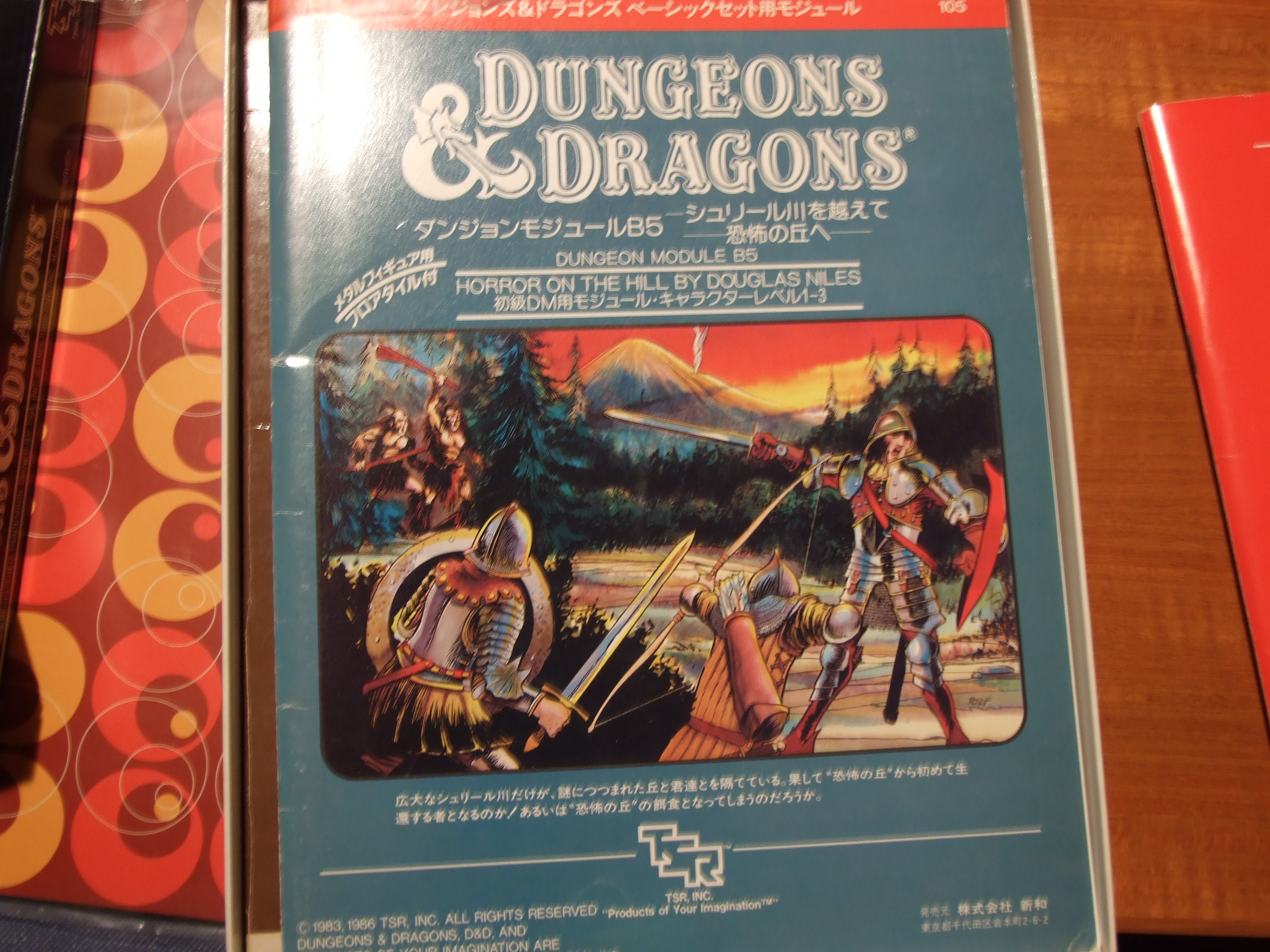
    I remember how the pictures in this book opened up my mind to a whole new world of fantasy and adventure – I’d never read an adult fantasy novel before I somehow stumbled onto this box, and though I never got to play it properly (I moved on to AD&D early), it holds a special place in my heart… Mr. Shuto has never played this system, but it didn’t stop him from collecting a lot of modules:

    Verisimillitude, in Japanese

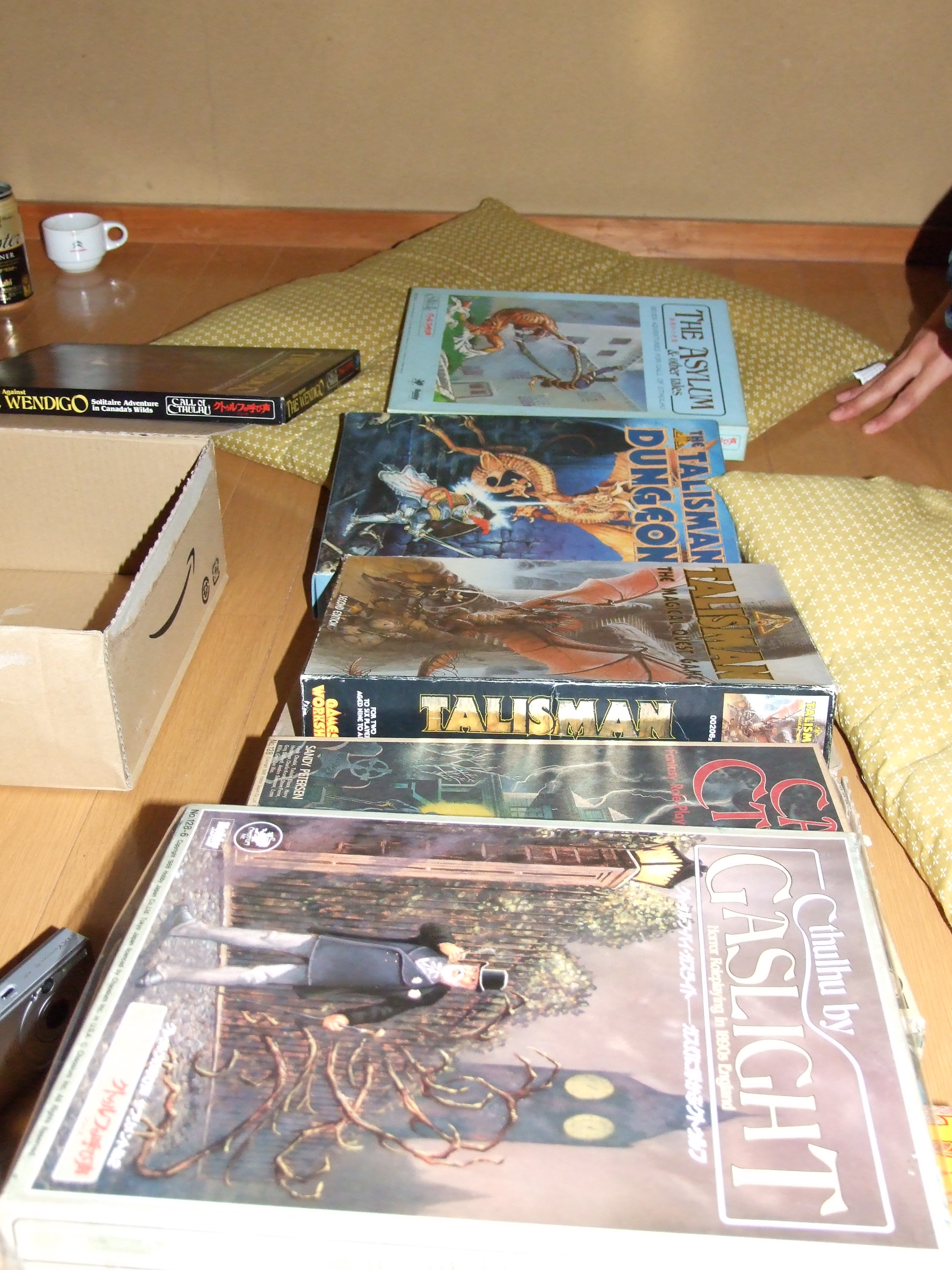
    Mr. Shuto’s collection didn’t end at D&D though. He also had an extensive collection of Cthulhu-related material (which he has played) and other boxed sets, some of which he arranged for us on his study floor:

    Madness in Mie

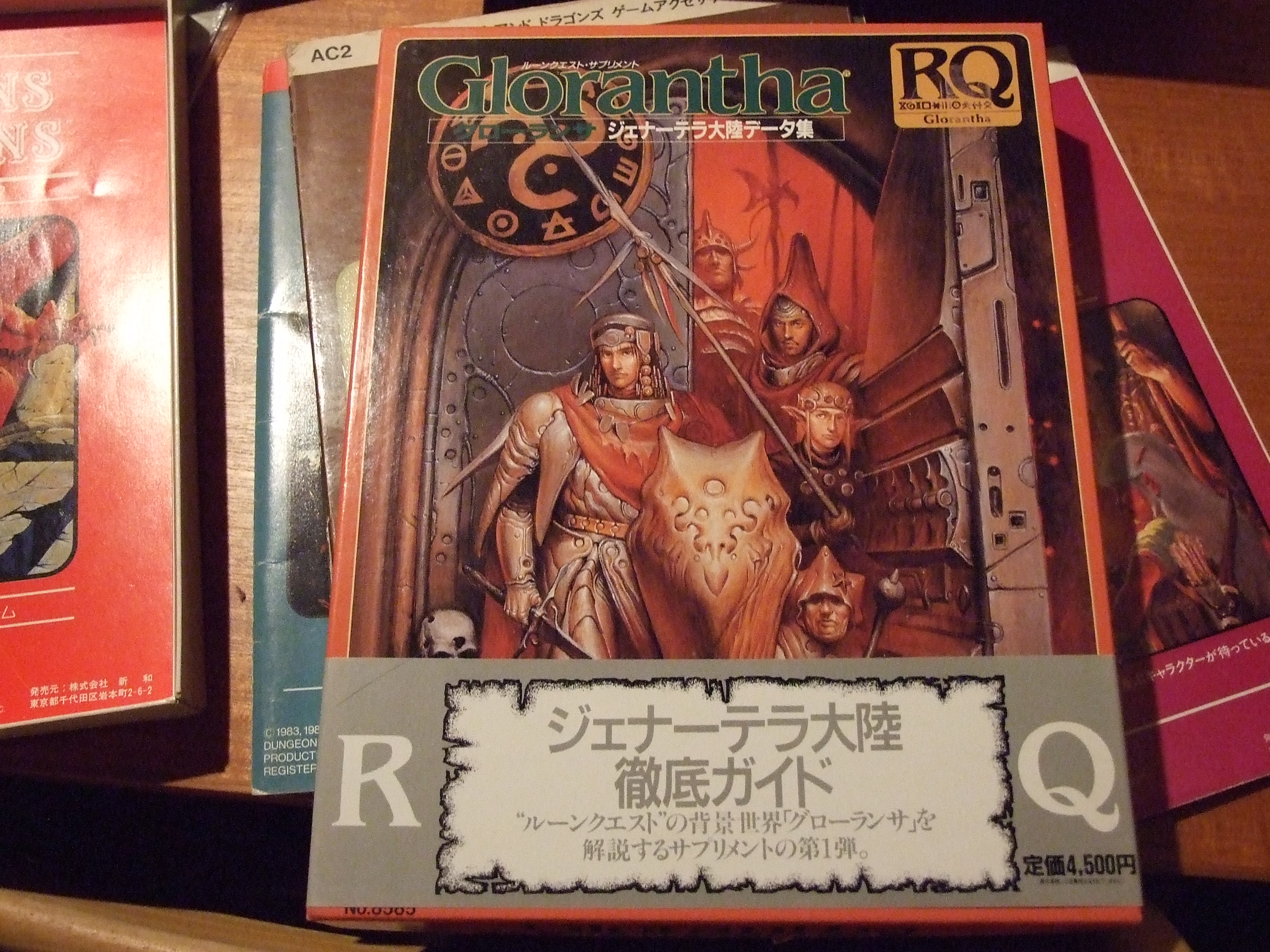
    Mr. Shuto’s boxed sets included some early Runequest, which I think he may have had a chance to play, and which I’ve always wanted to try. I think this is a very early edition, judging by the art:

    Undiscovered country for me…

    This boxed set included a book of secrets, I think, and elder lore:

    Dark secrets in dark languages

    My god, that artwork is bad. But such early Runequest! I don’t know how easy it will be to understand the rules, but I’m tempted to try and cadge them off Mr. Shuto and run a session sometime. Running early Runequest in Japanese has to be a rare experience…

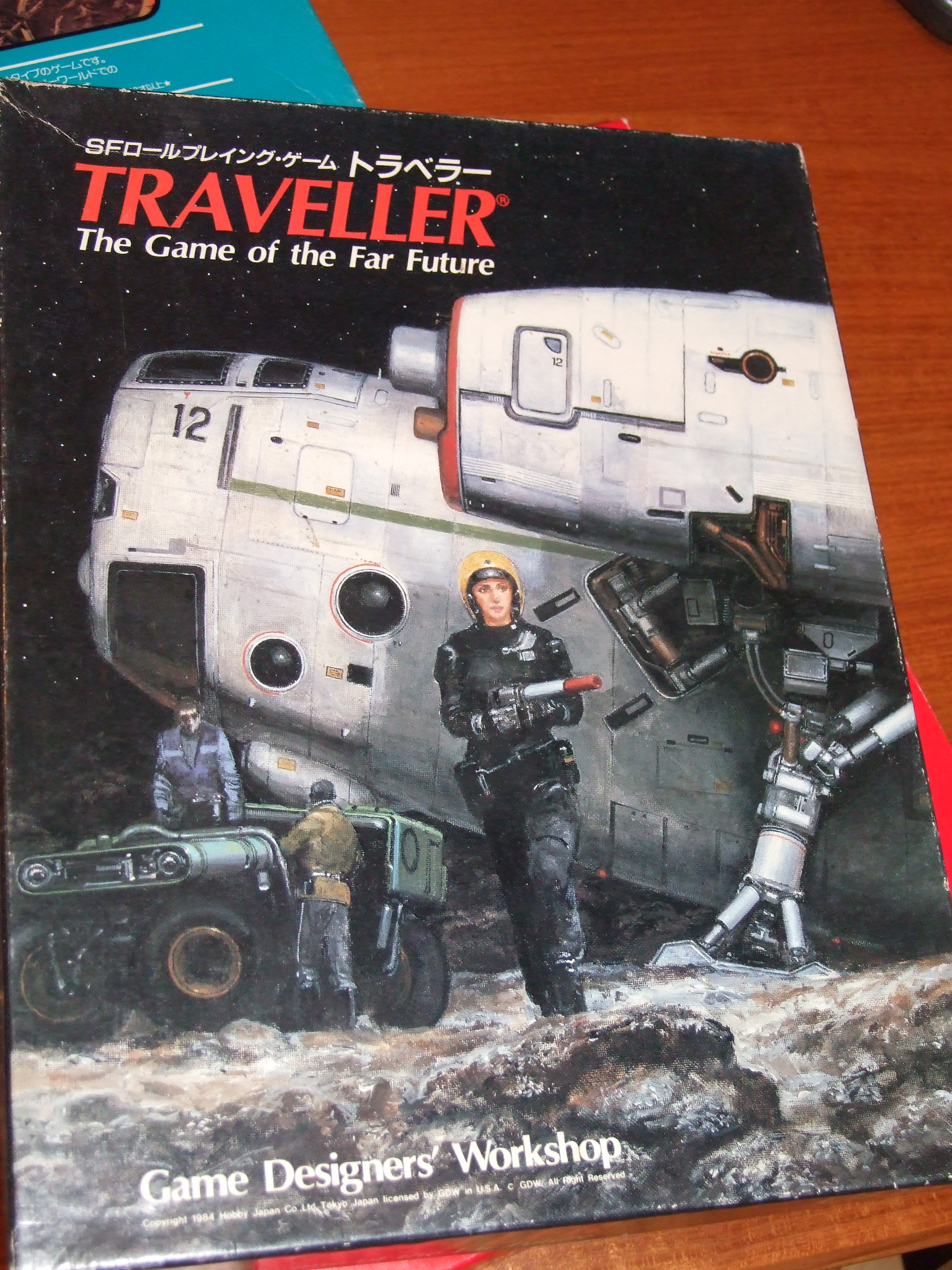
    Mr. Shuto also collected early Traveller, starting with the boxed set:

    Remember this…?

    I’ve played a lot of Traveller and I really don’t like the system, but the game itself is so romantic and such a classic representation of the joys of space opera that I will always remember it fondly. The great thing about these Japanese books is that they retain their western form, so looking on a Traveller rulebook for the first time in years could bring back all those thoughts and images from my early games even though only the title was in English:

    So simple, yet so much within…

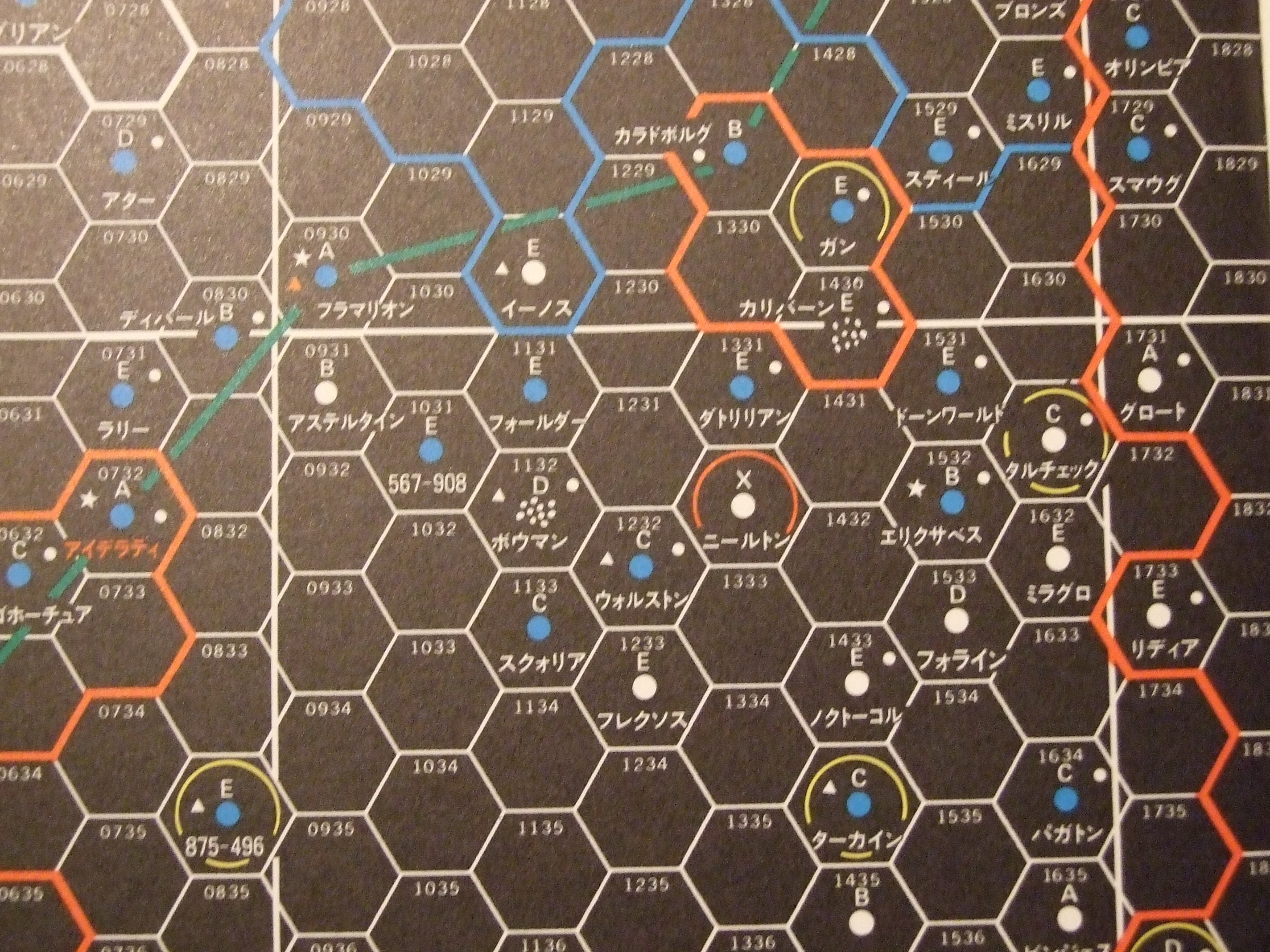
    Exploring this boxed set was quite entertaining. Here, for example, is something I could never have imagined I would ever see when I first began playing – a star system map entirely in Japanese:

    Find your way through this, intrepid scouts!

    The interested reader will note that these games all follow a similar translation process, in which the English language components are often retained and the Japanese translation even subordinated to them. This is the translation style of the main importing company, Hobby Japan, which leaves a lot of the key English words in the translated edition for reference. This pattern has been retained in, for example, the Pathfinder Japanese wiki, which makes it easier for Japanese players to understand what words have been translated how, and also easier for me to read the trickier language. It also means that people who don’t read Japanese can understand what they’re looking at without having to rely on the artwork. This process is particularly important for games like Runequest and Warhammer, because the translation has attempted to incorporate the greater romanticism and historicism of the original works and sometimes includes generating new words in Japanese. They may have deviated from this a bit in early Runequest, and made it a more Japanese-only feel, like the D&D rules cyclopedia, which would make it even denser and more difficult to run an adventure with.

    I have a bit of an interest in finding out whether there is a Japanese grognard movement and if so what its principles are. I’m pretty sure that Mr. 123 is a grognard and I’ve previously proposed interviewing him about his philosophy, because I think the Japanese approach will be more inclusive and less movement-ish than it is in the West. I think also the Japanese have largely rejected 4th Edition D&D, from my impression, and are diverting heavily into Pathfinder, partly because the cost of all those splat books is prohibitive but Pathfinder is free in its basic form. I detect zero interest in 4th Edition and in the 6 – 8 conventions I’ve attended never seen it being run. So I wonder if they’re essentially more amenable to some form of grognarding in any case. There’s also usually a very old school Japanese game being run at any convention I go to. Western games seem to be priced very high compared to Japanese ones (which can be very cheap) so it could also be that Japanese gamers reject new editions of games that they like – I’ve seen no later editions of Shadowrun since I came here either. So I do want to explore Japanese grognarding in more detail.

    Who would have thought that, having come to rural Japan, I am suddenly exposed to the opportunity to play almost any of the key OSR games that I might want to? A fascinating coincidence of location, here in steamy Beppu… and one I may take avantage of when I have a little more time…

  • Livin' the High Life, Otaku-style

    Last weekend my Warhammer role-playing group held a traditional bonenkai party. Bonenkai translates as “forgetting the year party” and is basically an end of year party, with a few formal details (a little tiny speech at the start, then a toast). There is often also a follow-up shinnenkai (“new year party”) to greet the new year. These are important parties, because new year in Japan is as important as christmas in the west, so usually you will have a series of bonenkai with work, hobby mates and friends (my partner has 4 in a row this week).

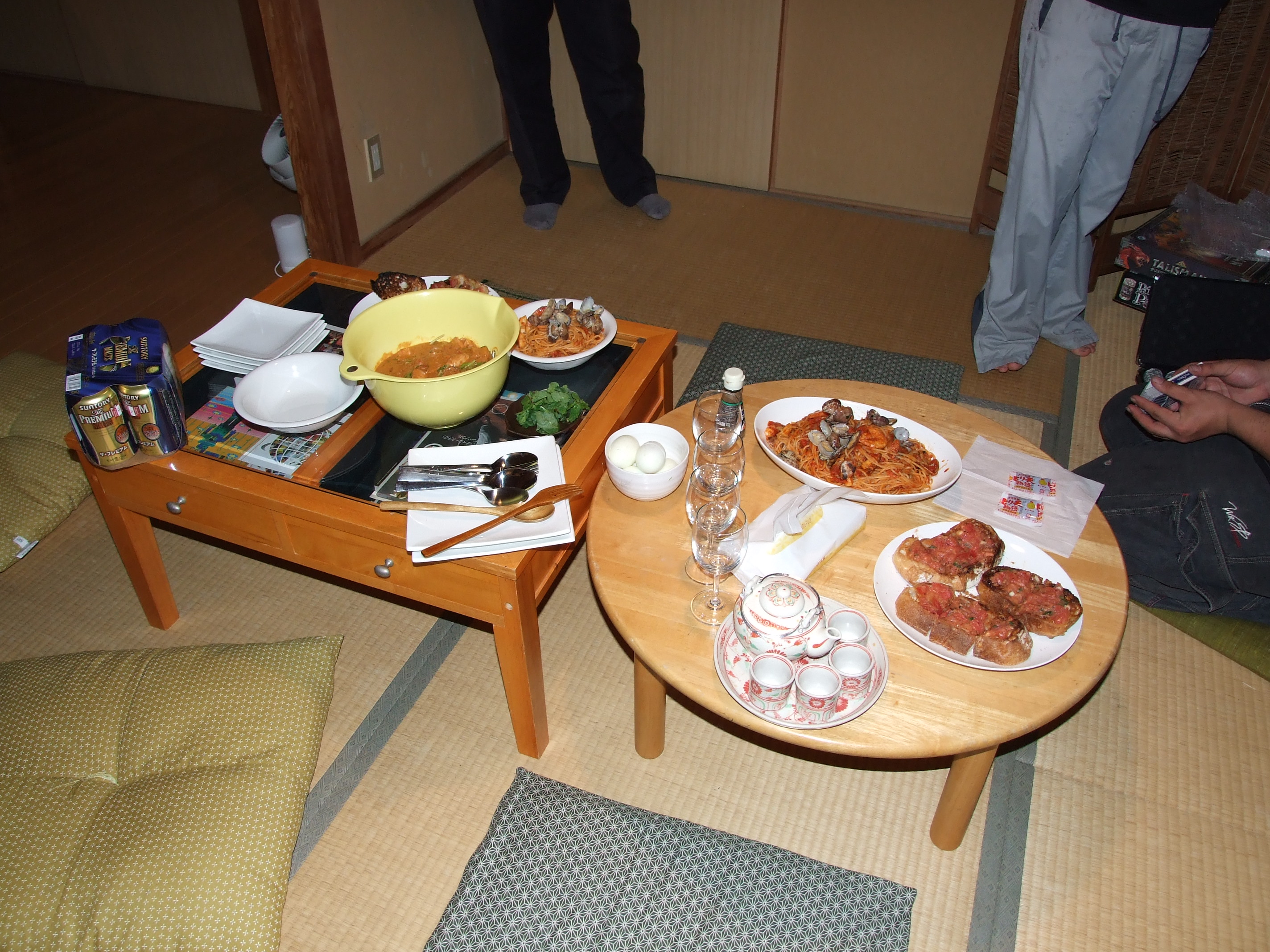
    Our bonenkai was held at the house of one of the players, Mr. Shuto, which is in distant Mie, so it was a sleepover with board games. The date coincided with the same time last year, when I had a farewell/christmas party with my group in the UK, also at a player’s house, also involving good food and board games. The picture above shows the spread we had this year:

    • Chicken tempura
    • Bruschetta
    • Pescatore pasta
    • Tofu satay

    which was all delicious. Mr. Shuto is what, in Australian, we would call a “foody” – someone who really appreciates food. But unlike your average Australian foody he is completely unpretentious about his interests, which is nice. His food was really good. Below we see a close-up of the Red Bream (Tai) that he pan-fried whole in white wine and olive oil.

    Celebratory Yumminess

    This Tai was sooo damn good, that within a few minutes it ended up like this:

    Not so celebratory for the fish…

    Mr. 123 ate both eyes, and you should be able to see the tiny centre of the eyeball somewhere in that picture if you look really closely. Being given the eye is an honor in Japanese dining tradition (god only knows why!) and Mr. 123 was not reticent about indulging!

    After dinner we played poker. This is the first time I have ever played poker, so I was happy to win a few rounds and come third. I’m usually a pretty crap card player, and Texas Hold ‘Em (which we were playing) is fiendish difficult. However, I had the pleasure of winning one hand by calling another player’s bluff – only he and I were left, and he started laying on the bets, but I guessed somehow that he was lying through his teeth, so I matched him all the way, even though I already knew my hand was a guaranteed loser, until he folded and I won. It was like being in a tv drama or something. Except I didn’t win anyone’s girlfriend, car, or job. Or FLGS. Oh well, maybe next time.

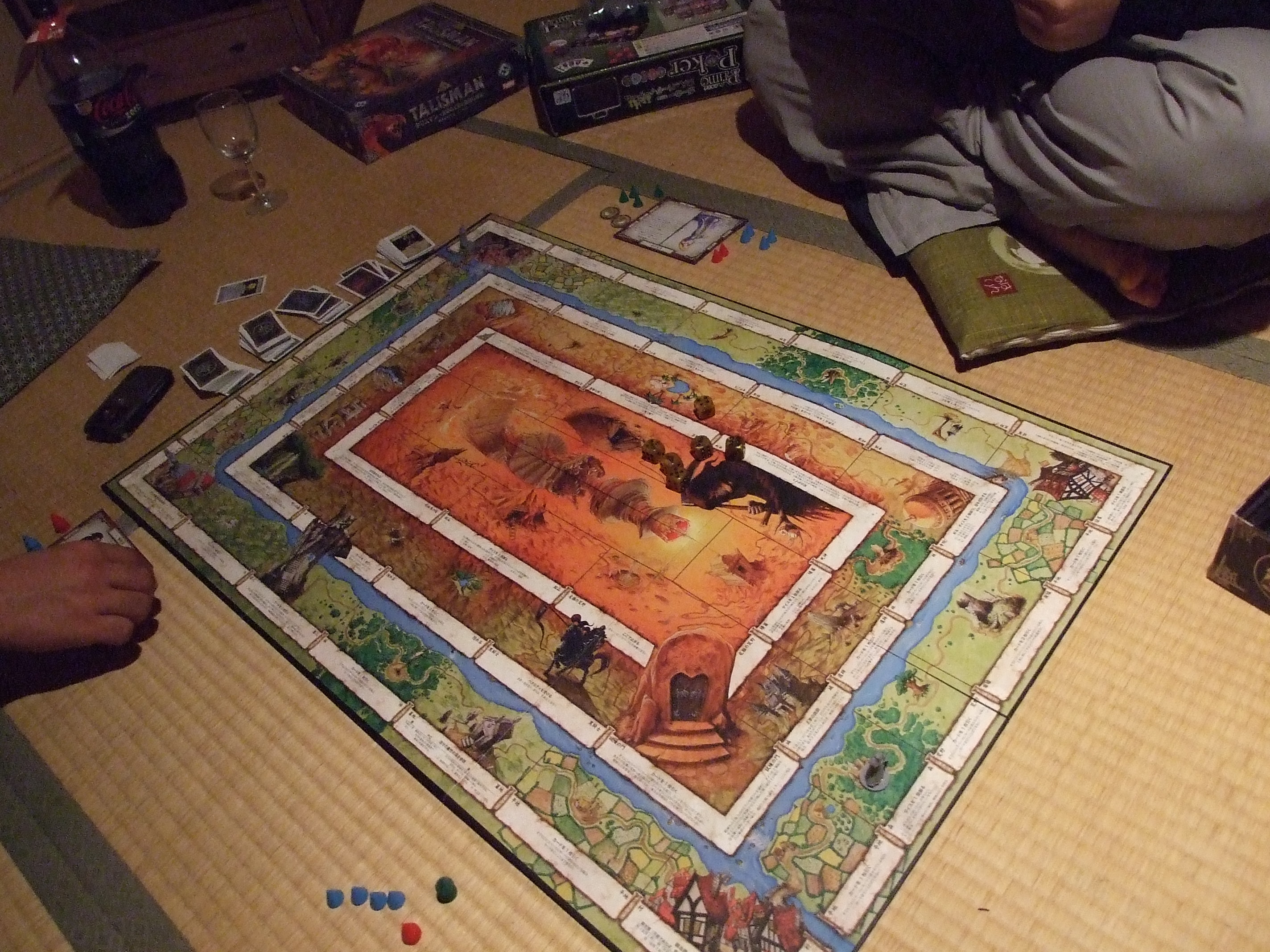
    Finally, at about 1am, we rounded up the poker (it wasn’t going to end by itself). We spent a few minutes admiring Mr. Shuto’s extensive collection of first edition games (see my next post!) and moved on to Talisman 4th Edition (Japanese of course):

    Multi-tiered Sleep Destroyer

    If there’s one recommendation I would like to make to the designers of Talisman, as a man who played it at 2am after too many beers – make it a little easier to get over those damned bridges! It took us 3 hours to finish that game, and I didn’t crawl into bed until 4am, having lost horribly (Mr. Maple destroyed us in this game, and not just through luck). As a sign of how exhausting Talisman is in Japanese at 4am, here’s a picture of my character, suffering under early morning photographic composition skill decay:

    Immune to alignment effects, but not to sleep deprivation

    So at 4am we crashed, and I was astounded to discover that though I was sleeping in a room (on the floor) with 3 other nerds, no-one snored. Must be a Japanese thing. Or maybe it comes from sleeping on hard floors? Anyway, we had green curry and chips for breakfast and were late home because Mr. FLGS took a crash course in espresso making from Mr. Shuto. All round an excellent party. Mr. FLGS was chosen to make the speech at the beginning of the meal, and I thoroughly and whole-heartedly agree with his wish, that we continue playing together next year, and the year after.


  • One space for you, two for me…

    In the last session of Rats in the Ranks, the PCs had to escape from a slowly collapsing dungeon before it crushed them alive. I’m not sure how I would have handled this in previous systems (never done it!) but the Warhammer 3 Progress Tracker gave me an excellent mechanism for doing it, not necessarily specific to the WFRP 3 rules, though the method I used is maybe enhanced by them. This is my description of that skill challenge.

    The race against time in this case was the desperate race to get out of the dungeon. I constructed a 3 space tracker (that is, 3 spaces, and then the destination point, so a total length of 4 steps). I then put a token on the starting point for “the dungeon” and gave the PCs three choices:

    • Break and run separately for the entrance: everyone gets their own progress token, but they can’t help each other
    • Go with the fastest: the person with the best athletics skill determines their progress, but his/her skill checks are penalized for all those with lower skills, and any fatigue results are applied to the fastest PC
    • Go with the slowest: the person with the worst athletics skill determines their progress, but the skill checks are enhanced by all those with higher skills, and any fatigue results are applied to members of the party sequentially starting with the strongest

    They PCs chose option 3, go with the slowest. The slowest was the mage, of course, with a Strength of 2 and no Athletics skill. I assigned an initial difficulty to the check of 1 challenge die (easy) that would increase by 1 misfortune die per round, and then become 2 challenge dice after a few rounds. Everyone with an equal or higher strength to Schultz could add one fortune die to the roll. I used the following outcomes:

    • x successes: advance that many spaces along the progress tracker
    • Fail: the token for the imminent collapse of the dungeon advances one space along the tracker
    • 2 boons: add 1 fortune die to the next roll
    • 2 banes: 1 fatigue

    Schultz was initially successful, getting the party one pace along the tracker. Suzette cast a minor blessing to add one fortune die to the next roll, and Shultz used his once-per-session ability to add two fortune dice to a check, but it was a fail, which brought them back to equal with the dungeon’s inevitable collapse. They then got a bit desperate, with the difficulty now on 2 challenge dice, which is very hard to beat for someone with a strength of 2. So Shultz used his spell First Portent of Amul, and by a very lucky roll was able to neutralize the result of the next challenge die rolled in the skill check. Suzette cast another minor blessing and used her once-a-session bonus, and they rolled again for – a total of 3 successes, and 2 banes. This took their progress tracker to the end of the track, indicating they escaped from the dungeon, but I inflicted a single fatigue on Aruson and said that this was because he had to reach back into the crypt entrance and literally haul Suzette out as the stairs collapsed around her, and she landed on the snowy ground outside, still praying desperately.

    I played a bit fast-and-loose with the rules here (allowing Suzette’s once-per-session ability to affect what was effectively Schultz’s roll) but it helped to add to the sense of desperation and hard scrabble built into the challenge. I find the progress tracker sometimes hard to use effectively but I think at times like this it works really well to give a sense of competition against time or the party’s own mistakes. And, it appears, it can be used to effectively construct save-or-die type situations, with the whole party at risk and the whole party working together to get through the challenge.

  • Last Wednesday was the culmination of the PC’s incursion into the Wizard’s Tomb, a small old tomb just outside Ubersreik, situated in the middle of an orphan’s graveyard and defended by zombie children. The PCs had already explored all the major rooms, and only two remained – a large room on the southern edge of the complex, and a large room reached by a set of stairs to the North. They decided to investigate the southern room first. But first…

    Our First Experience of Career Advancement

    In their previous incursion the PCs got enough experience points for Mr. 123 to advance his Initiate, Suzette, to her next career, Disciple. He spent 1xp for a Dedication Bonus, which enables Suzette to retain her Initiate’s special talent when she becomes a Disciple, as well as to choose a specialization in every skill she trained during her first career. So we have our first character at the next level. Mr. Shuto chose not to advance, because he wants to use the non-career advances available to his apprentice wizard to enhance toughness and get some extra training. Mr. Shop Owner chose not to advance because a) he was indecisive about where to go and b) he wants to spend some accumulated xp on increasing toughness. So we currently have one PC in their second career, meaning they can purchase higher-level spells and more skill training. Will this lead to an invincible party? I’m not sure yet, but stay tuned…

    The Demon Tomb

    The PCs entered the Southern room using the standard method – send the thief in first and wait for the sounds of frenzied slaughter. The Thief found himself in a large room with a raised plinth at the far end on which stood a huge, faintly glowing statue of a demon. This statue loomed over a tomb – the wizard’s grave – and the rest of the room was largely empty except for some decaying boxes near the door, and in one corner.

    The thief hid behind the boxes to survey the room. A group of 3 imps burst from these boxes and attacked him, and combat was joined. Everyone else rushed up to help him, and from the shadow-enshrouded roof there emerged a fury, a much larger, winged demon-like creature, that went straight for the Roadwarden.

    These enemies were supposed to be much stronger than the zombie children, but they went down like hapless rags. The thief slaughtered the imps with two arrow shots, and after one vaguely effective strafing attack, the demon settled in for a good melee stoush, only to be destroyed by the roadwarden and Suzette the Disciple. The whole battle was done in two rounds, with very little damage for the characters. I think I may have mishandled the surprise element of the imps’ attack, but basically the fury is a poorly-named monster, doing very limited damage and not being all that much cop. So the PCs left its steaming body near the door and searched the room. They lifted the lid off the wizard’s grave and found his corpse, along with its magic items:

    • A robe (+1 defense)
    • A gold-plated wand, not magical but designed to be easily enchanted
    • A book, which if read successfully will grant the reader a new spell, probably Dark Magic (but carries a risk of madness)
    • A bottle of superior healing potion

    They fully expected the wizard’s body to come to life and attack them but it didn’t, it just crumbled to dust. Why?

    When they explored the room, the mysterious silver key they had picked up earlier began to glow when held near the crates in the corner, and to emit a soft sound. They searched carefully until they found a key hole and opened a secret door to a final room. This room was reached by a short corridor, and was empty but for a large, shallow pool in the centre of the room.

    Breaking the Wizard’s Enchantment

    The pool glowed with the same vague light as the statue, and in its centre was a small coin held inside an obviously magical circle of some kind. They debated for a while but, eventually, it had to happen – the thief took out the coin. Immediately, the glow that suffused the pool (and lit the room!) snuffed out, as did the glow on the nearby statue in the main room, and the PCs were plunged into complete darkness. Aruson the Thief started scrabbling around in the pitch black for a light for his lantern, but the walls and floor had started to shake and he couldn’t get it to work. In the distance they could hear something falling. In desperation, Shultz the wizard called forth a cantrip of light, and they realized that the walls and floor of the tomb were quaking and making a bad noise.

    They decided to run. As they exited the main room the quaking got worse, and they suddenly found themselves in a race against time, as parts of the tomb began to collapse around them. Staggering on the shifting earth, they helped each other through the gathering dark, Suzette preying to Morr to protect them from the worst of the rubble and Shultz using his celestial magic to predict the safest path through the quaking. In the end, near the entrance, they just had to burst into a run and so they emerged from the crypt into the frigid outside air, Aruson dragging Suzette through just as the entrance collapsed and the entire tomb was swallowed up by the uncaring earth.

    Save or Die

    That’s right folks, that was a save-or-die scenario, played out against the progress tracker. This is another skill check/technique I came up with on the fly, and I’ll explain it separately. I might not have actually killed the entire party (I am not so wrathful) but I put myself on the spot and that’s how it worked out. They really had to scrabble through all their abilities to get out too – Suzette burnt all her available favour points, Schultz used up his magic points, and two characters used their one-time-per-session skill bonus to get through it. It gave a nice sense of panic to the ending!

    Denouement

    The characters returned to town, and paid a local magician a lot of money to identify their magical items. They’re now ready for a few days rest before they look for something else suspicious to get up to. They’ve survived their first ever Warhammer dungeon incursion in typical contrary style, being nearly slaughtered by the easy monsters and destroying the hard ones in the blink of an eye. Continual surprises for the GM, and further ponderings on how to balance monster power for encounters in such an unfamiliar system.

    The Coin: “Wizard’s Last Wish”

    The coin the PCs grabbed from the pool turned out to be the key ingredient in a ritual to bring the wizard back from the dead, perhaps as a lich or other undead. One side was blank, the other side inscribed with the invocation “Do not Die” (shinu na – this comes out better in Japanese I think). Unfortunately, the wizard lacked the power to make his ritual work and so after he died he just crumbled to dust – but all the servants he had prepared for himself remained around forever to guard his crumbling remains.

  • During their recent dungeon-delving, our heroes ran into some scary zombie children, and after a surprisingly challenging battle they had to retreat from the dungeon to recover from wounds, fatigue and stress. One character was carrying such a high load of fatigue and stress that he was essentially in a state of high panic, and any more trouble of any sort was going to lead to insanity. They decided to camp for the night, rest, and try and recover some wounds naturally.

    Now, I’m not a big fan of allowing this sort of thing but I’m also not a big fan of random encounters, so I wanted to fashion a random encounter system that depended on the PC’s wilderness skills, and not on just a die roll. I don’t think random encounters should be something as simple as “occurs on a 1 in a 1d6” but should be avoidable by good sense. I also don’t think people should be able to recover wounds in a wilderness encampment setting unless they have made a solid, defensible camp and it is comfortable and well situated, i.e. unless they can sleep well, not be woken by every scary sound, and also be able to light a fire, eat good food, etc.

    So, on the fly, I made up two new skill checks – actions, essentially – to be conducted in story mode to determine the success of finding and setting up a camp. I had to fashion all of this while my players were smoking, so I didn’t have much time and they’re a bit complex but I think they work. In a full nights rest a PC should recover fatigue, ordinary wounds and stress equal to their toughness (and willpower in the case of stress). They shouldn’t get this much in the wilderness! So here are the two skill checks.

    Locate Camping Spot

    Difficulty: Easy (1 challenge dice)

    Skill: Nature Lore

    Procedure: One character rolls for the group. Add one fortune die for every additional character in the group with either Observation or Nature Lore trained, and for each wood elf in the group. Add two misfortune dice if it is dark, and additional misfortune dice for difficult terrain, haste, etc.

    Effect: Characters are able to find a camping site suitable to use the set camp action. Failure in this action adds one challenge die to the set camp action, while 2 successes adds one fortune die and 3 successes adds one expertise die. Additionally, if the PCs lack food, rolling two boons will provide them with access to a basic food source that they can prepare if their set camp check is successful. Two banes should lead to an increase in the party tension meter of 1.

    Set Camp

    Difficulty: Medium (2 challenge dice)

    Skill:Nature Lore

    Process: One PC rolls for the group, with the same modifiers as above, and including any modifiers from the find camp skill check. Additional modifiers: 1 misfortune die per additional day the camp will be set; 1 misfortune die if the camp is being set after dusk (additional to the darkness modifiers described above). Setting a camp proof against monsters is difficult! The GM should choose a hard and an easy monster for random encounters (in my setting I chose giant spider for hard, and 4 zombie children for easy).

    Effect: The PCs set a camp suitable for resting in, and are not disturbed by monsters. See the lines below for specifics:

    • 3 Fails: PCs are attacked by the hard monster
    • 1 Fail: PCs are attacked by the easy monster
    • 1 success: No encounter, PCs recover 1 wound each
    • 3 successes: No encounter, PCs recover 2 wounds each
    • 2 boons: PCs get warning of the monster attack (if they failed their roll); if they succeeded the check, they recover an additional wound (up to toughness maximum)
    • Sigmar’s comet: PCs get full rest and recover maximum possible wounds (only on a success)
    • 2 banes: Opponents get +1 initiative when they attack
    • Chaos: Opponents get full surprise, a round of free attacks against the PCs

    GM Notes

    While I don’t like random encounters, I also don’t like safe wilderness wandering, and I think how one wanders the wilderness should be dependent very much on how well one knows the wilderness. Nature Lore is a skill that is not often used or rewarded, and I think these two tasks actually make it very important, particularly when travelling long distances. For extended journeys I would not force a check like this every night, but would force a single check for a leg of the journey, and put any encounter at some point in the journey. Note that this can be modified to, for example, a general safe travel skill check, with exactly the same rules, but replacing the find camp check with a research travel check, which depends on folklore or education for its basic roll and modifies the chance of a random encounter during the journey.

    I know some people will view skill checks for setting a camp as “roll playing” but there’s a simple reason I prefer them: I find camp-setting and describing all that survivalist stuff to be hideously boring and I’d rather not have the conversation. I even get the players to describe their camp setting after they’ve rolled it. I also think my judgments of a successful camp-setting process would be flawed in any case, so I wouldn’t necessarily modify a standard random encounter chance “correctly” after a dialogue with the players. What do we, the players, know, anyway, about the best way to set a camp so as not to attract the interest of a nearby giant spider? Of course, if players like this sort of thing they’re welcome to try and stunt their roll in some way (I always reward this!) but I can’t, generally, be bothered with this nuts and bolts stuff. For the same reason, when people are in town I don’t play out every single shopping trip – I generally refuse to haggle, but if my players insist on such tedium I try to do it through skill checks rather than reliving my (generally very disappointing) experiences in Chinese bazaars. Bargaining over a roll of cord was not my most enjoyable experience in China and it isn’t how I prefer to spend my role-playing nights!