• The advent of Infernal materials, lighter and stronger than even the most advanced enlightenment metals, and Infernal magic capable of levitation and propulsion, opened the skies to humans for the first time. From the first experiments in balloons, to the massive and stately airships, and on to more advanced military technology, by the end of the Victorian era the peoples of Europe had developed a wide variety of airborne conveyances. This post provides examples of some of those more suited to adventurers. Most of these were developed after the period of the Compromise and Conceit campaign chronicled in this blog, being technology of the mid- to late-Victorian era.

    The Cupola

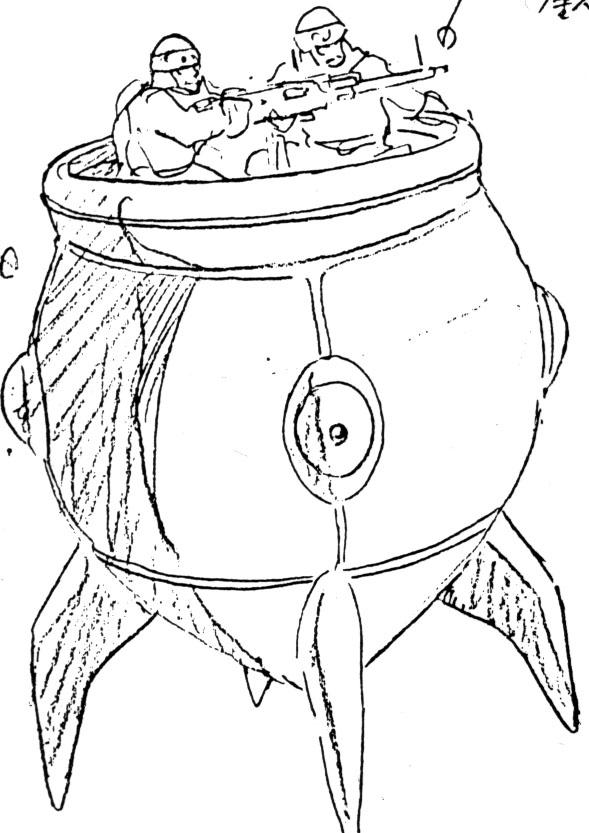
    One could hang a large insect from this…

    The Cupola is a small and effective military observation and guard post developed and used extensively in the Crimean war. They are used heavily by the military as spying, forward-observing and aerial attack bases, and are generally designed to be invulnerable to small arms fire from below.  This flying machine is invested with powerful but simple magics inside its ponderous shell, which can carry up to 3 adult humans and a reasonable amount of equipment, both levitating and propelling them at a pace roughly equal to a horse’s canter. The cupola can operate for periods of up to 12 hours before needing to stop and rest for an equal period of time, during which it recharges. Most Cupolae also need to be returned to a major recharge point once every 360 – 720 hours, or the maximum duration of their operating periods begins to reduce considerably. Details as to how they are recharged and what their internal power source is are carefully guarded, and although most Cupolae are capable of operating even if large portions of their shell has been obliterated, they are designed to rapidly become inert and often to self-destruct if their operator is killed and they are shot down. Rumours abound that the power mechanism is somehow related to that of the Autonomous Sentinel Cannon, one of the more abhorrent developments of the modern infernal industry, so it is understandable that the secret of its power source is jealously guarded from outsiders.

    Cupolae are currently only used in military and a few surveying tasks, and are always magically linked to their pilot, so that stealing them is extremely difficult. The simple magic involved in the Cupola’s flying mechanism prevents it from being scaled up, though occasionally one sees smaller, slightly faster cupolae in mountainous regions.

    The Corvette

    Treading only lightly on the laws of physics

    The Corvette was originally designed as a small hermetically sealed flying vehicle, but has since grown into the most audacious and expensive Victorian project. The corvette is essentially a self-contained flying hull, varying in size from a 5 man reconaissance vessel to a massive troopship. The first vessels were used as transporters and heavy lifters for the initial actions in the Crimean war, and remained quite humble in design and scope. Subsequent developments in materials technology and the growing wealth of the Infernalist nations led to experimentation with the design, and by 1870 these ships had become much larger. They are powered by a combination of levitation magic, flight magic and various conjured creatures, and incorporate all of the various technologies available to the people of the time. The larger ones also incorporate a gas store for lamps, and possibly a steam engine (usually elemental-powered) to maintain atmospheric pressure or to move various objects (such as lifts) inside the ship. Almost nothing in a large Corvette is powered by anything mundane, however, and the vastly complex magic involved in their operation makes Corvettes ridiculously expensive. The English airforce possess only 3 Corvettes of appreciable size, and almost never field them in any but the most desperate situations. Most of the largest trading companies (such as the East India) possess one or two very small Corvettes, and most colonial administrations in the later Victorian era also possessed one or two light corvettes designed exclusively for the purposes of airborne terror. Although corvettes can be licensed for private use their purchase is always at the whim of the Queen, sold on only under extremely restrictive contractual obligations, and all Corvettes have built in self-destruction systems to prevent them being used by the wrong people, or investigated by their private owners.

    Despite its possession of a small fleet of Corvettes of varying size, the mainstay of British Imperial power – such as it is – in the Victorian era remains the surface navy, with corvettes used primarily as support craft and advanced strike vehicles. Some scientists have claimed that a much cheaper and more effective airfleet could be built if infernal power were reserved only for propulsion, and more natural means – similar to the wings of birds – were used to obtain lift, but it is clear to all learned folk of the Victorian era that non-magical flight is purely the province of the birds, and cannot be achieved by men without magical aid.

    Teleconveyancer Glyphs

    One small step for man…

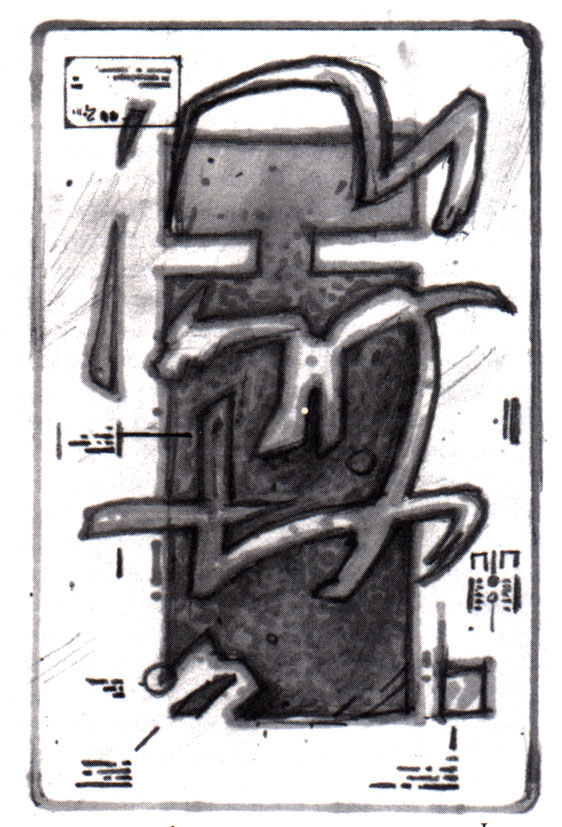
    Probably the most expensive way to travel, Teleconveyancer Glyphs immediately transport anyone who steps on them to a distant location without crossing the intervening space. A simple magical glyph, they can be bought from the appropriate magical college at exorbitant cost. The cost of such Glyphs becomes even greater if their buyer intends for them to be reusable – in such a case they must be embedded in a specially designed plinth (usually referred to as a Ghost Step) which contains the energy for the Glyph’s repeated use. This can be a lump in the ground barely bigger than the glyph itself for a rune which teleports its target across the street, to a plinth taking up the entire floor of a church for a glyph which transports someone to Rome (such a glyph is rumoured to exist in Avignon).

    Teleconveyancer glyphs are sometimes installed in the airships of the rich and famous, as single-use emergency escape devices, and are also rumoured to be used by certain spies and assassins. The infamous assassins of Araby are said to have their own, more esoteric methods of achieving the same effect, and of course it is known that some practitioners of dark arts can turn any pool of shadow into a teleconveyancer glyph of sorts. The military is rumoured to be developing a kind of rope or cord which behaves like a teleconveyancer glyph for anyone crossing it, and which throws its user a fixed distance forward in space. Some magical colleges are rumoured to be playing with movement through time as well, but such rumours are undoubtedly the mad ravings of heretics.

    Nonetheless, the teleconveyancer glyph remains the ultimate escape mechanism, which every evil villain should invest in.

  • Remember those crazy monk powers in AD&D First Edition? Especially the one where the monk could fall his level x 10 in feet without suffering damage, provided he or she was within arms reach of a wall? The Guardian has a story about a mountain climber who did exactly that, down a 1000 foot drop in Scotland.

    And I scoffed, back in the day…

  • NOTE: this post contains spoilers for the WFRP 1st Edition adventure Fear the Worst, so if you’re planning on playing it (which I recommend you badger your GM into doing) you should stop reading here.

    We left our PCs in a state of near death, surrounded by the bodies of 7 vanquished mutants, with only the wizard Shultz still conscious, and himself close to death. They had been ambushed in the cellars of Black Rock Keep, and had to retreat to the stairs and fight a grim and bloody battle for their survival. Now, standing in the smoking and blood-soaked remains, Shultz had to somehow revive his fellows before reinforcements might arrive. He searched his unconscious foes and managed to find a healing potion, which he forced into Suzette; she, upon regaining consciousness, tended to Aruson, but was unable to revive the unconscious Roadwarden NPC. While they waited for her to regain consciousness they set about searching the bodies, finding nothing of interest. However, while searching they heard a small voice saying “Help me! Help me!” Further investigation revealed it was coming from inside the clothing of the pistolier mutant, Franz. They ripped his clothes off and found his mutation carefully hidden under layers of shirts: A tattoo carved on his chest, which appeared to be sentient and able to speak.

    Interrogating Irezumi kun

    The PCs found Irezumi kun (Master Tattoo) quite communicative, and he told them that he was not the soul of the body he occupied, but an additional thing that grew into Franz’s once normal tattoo after he mutated. Is Tzeentch’s blessing not wondrous? He never liked Franz, and would happily tell the PCs everything if they would help him gain control of the body he was carved onto. The PCs were leery of this scheme but when they realized they had no way of bargaining with a mere tattoo they agreed to his offer. Helping him gain control of the body was a gruesome task: he told them that if they chopped off its arms, legs and head, he would be able to regrow new ones that he himself controlled. Initially dubious, the PCs agreed. After some unpleasant butchery, Irezumi kun told them what they needed to know:

    • The mutants had come to the castle some years ago, after they made a deal with someone in the town of Heideldorf
    • The deal was that every year they would be sent a group of adventurers, who they would ambush and kill. They were to return the bodies and all their belongings to the town, and in exchange they would be protected from witch hunters and other rumours by the town elders
    • Occasionally they would be given additional assassination tasks
    • For example, two years ago they were not sent any adventurers, possibly because none came to Heideldorf. But they were told that two chaos mutants, old enemies of their contact in the town, were in the area and they should kill them instead
    • After they killed the mutants they ate the mutated parts of their victims bodies (out of respect for Tzeentch, of course) and became even more mutated. They sent the remainder of the bodies and the items to town
    • Their contact was angry with them for interfering with the bodies and made them promise never to eat another body
    • Irezumi kun was at all the meetings where deals were made, because Franz was the mutants’ negotiator
    • Irezumi kun never saw the people they dealt with, but would recognize their voices if he heard them

    The PCs then got Aruson, who is a master of guile and mischief, to mimic the voice of Heinz Schiller the sausage maker, and a few other key figures in the town. Aruson couldn’t manage Dirk Moser but he did a good job of copying Schiller and the retired witch hunter Manfred, and Irezumi kun was able to confirm that yes, Schiller was one of the people at the meetings where they made deals.

    So, the PCs wrapped Irezumi kun’s torso in a cloak from upstairs, and explored the rest of the cellars. All that remained was the mutants’ cave, where they found a magical prism belonging to the wizard Pedro, along with his notes on the mutations that the mutants underwent after they ate other mutants. From this Shultz was able to do some quick research, and glean that if people were to eat sausages made with mutant meat, there would be some small risk that they would themselves become mutants. That’s bad news… time to go to town and see Schiller nailed to a wall…

    Investigating Town

    First, the PCs sent Aruson into town disguised as a juggler to find Manfred the witch hunter, who they rightly thought was not in on the conspiracy. They brought him to the woods and explained the situation, and he seemed to partially believe them but was unable or unwilling to comprehend the situation properly, so they returned him to town. They then set about finding the person who had sent them the warning of the traps in the cellars. Disguised as clowns by Aruson, they wandered into town and, while Suzette and Shultz distracted the old woman who managed the Boarding House Aruson stole her guestbook. Outside, they looked through the book and tried to match handwriting in the book to the handwriting on the map they had been sent. Fortunately for the group they had a wizard with the Education skill, i.e. someone who could read, and he was able to match the hand-writing to one Jeb Tallnose[1], whose name had written next to it the word “halfling.” They got his room number and went up to investigate…

    Spies for Sigmar, and a small personal aside

    The PCs knocked on the door of the room and were invited in, to find themselves being covered with a crossbow by a small and ferocious-looking halfling. Knowing how effective he was with that thing, they decided not to do anything rash. He was standing next to a giant of a man, over 7′ tall, who was regarding them very suspiciously. They introduced themselves and thanked Jeb for his help, and asked him who he was. He told them that he and his mate Abe were spies for the Church of Sigmar, in Heideldorf on top secret business to investigate an important matter connected to the mutants and the town, and they didn’t want the PCs killed, so thought they’d warn them of the lair so that the PCs could survive and kill the mutants. This solved one of the halfling’s problems, but left him still investigating this secret business. No, of course he couldn’t tell the PCs, but if he needed their help he would ask them.

    The players seemed to believe this story, and at this point I broke one of the key rules for dealing with lies and illusions: I gave them an intuition check to notice he was lying. I wouldn’t usually do this, but a personal skill of mine is that I am very, very good at convincing people of things that aren’t true, and it didn’t seem fair to have the entire adventure’s outcome rest on my players not knowing about this bastard trait. Telling a lie like “this halfling and this dodgy giant are agents of Sigmar” is a doddle for a man who can tell the kinds of lies I have got away with[2]. So it seemed fair that I should give them a saving throw vs. GM-is-a-bastard. Two of them succeeded, and after they left the room they told Suzette of their suspicions. They tried talking to the halfling’s third accomplice in the market area (surrounded by sausage!) but he was untalkative, and a bit suspicious, so they left it be. Nonetheless, the fact remained that whoever these people were, they had helped the PCs against the townsfolk.

    Accomplices and lies

    After this the PCs went to the home of Wilf Shwarzhaus, whose pipe they had found at Black Rock Keep. They got him talking long enough for Irezumi kun to hear his voice, and once they had confirmed he was indeed one of the conspirators they broke into his house, tied him up, beat him, and tortured him a little. He quickly told them all he knew – he thought that Schiller’s conspiracy was simple robbery, and had been charged with the task of selling adventurers’ items through his contacts in Altdorf, while Schiller disposed of the bodies. He had no idea that the bodies were being disposed of via the sausage festival, and was horrified at the idea. They stuffed him in a cupboard, and tried to figure out what to do next…

    The Sausage Factory

    All that remained was to investigate the sausage factory. Under cover of nightfall the PCs headed to the factory, sending Aruson ahead in stealth mode to investigate. Aruson, who never fails stealth rolls, fumbled this most crucial roll, and was noticed on the road to the factory by its owner, Schiller. He then tried to talk to Schiller as if he were a clown, and immediately failed his disguise roll as well. The result: Schiller now knew that his adventurers had returned and wanted to look at his factory. He called over 4 mercenaries and instructed them to take Aruson back to the marketplace and “make sure he didn’t return.” The look in his eyes seemed to suggest “sausagize the elf,” and at this point the players panicked. Suzette emerged from the shadows under the terrifying shroud of a Fearsome Visage spell, and in the mercenaries’ moment of terror Aruson slipped their grip and fled to the nearby river. He managed to hide before they came searching for him and, in a panic, Schiller had his mercenaries return with him to the marketplace. It was now only a matter of time before he returned in force to the factory, and the PCs were in bad shape already, not really in the kind of condition for taking on four mercenaries. They realized they needed to break into the factory and get incriminating evidence quickly, so they dashed there immediately, leaving the Roadwarden on watch while they searched the building. They soon uncovered the secret doors leading to the secret sausage room, and found the remains of two human corpses, preserved from the year before, and a pile of meat waiting to be sausagized for the morning’s final, most spectacular batch. They also found four empty barrels, obviously prepared for 4 new corpses… They took the barrels of remains upstairs, and before Schiller could do anything they ran to the marketplace, where the evening’s partying was in full swing. The roadwarden and Aruson hurled the remains from the barrels onto the dining tables, while Suzette yelled

    Heideldorf Sausage is People!

    One pickled head landed in a champagne cooler amongst a group of 4 young noblewomen, one of its pickled eyes bursting out and flopping onto a hat. Screams erupted! Pandemonium! Amongst this, Shultz stood on a table and began yelling, demanding that a group of villagers come with them to the sausage factory to see the evidence for themselves before Schiller could clear it away.

    Unfortunately, Shultz was still dressed as a clown. The crowd pointed at him and yelled “But you’re a clown!”

    While Shultz struggled to reveal his true magnificence as a wizard, and convince the crowd to come to the factory, the PCs realized Schiller would be rushing there to clean up the evidence. The roadwarden and Aruson dashed back to the factory, only to find two mercenaries standing at the front door. Aruson ran up to them and pointed out the uproar at the marketplace, suggesting they rush to help and implying grave danger for the town. The mercenaries hestitated, then called two more from inside and ran off to help. Thus freed from conflict, Aruson and the roadwarden jammed shut all the entrances to the factory and waited for Shultz and Suzette to arrive, which they eventually did with Dirk Moser, Manfred the witch-hunter, and a large group of angry townsfolk.

    Sanity Checks All Around

    At this point the PCs all drew an insanity card, but for some reason unfathomable to all but the gods of fate, they all succeeded their insanity checks. So hearty is this group of Brash Young Fools that even eating human meat, and the future possibility of becoming ghouls, does not deter them from their course! Still, they were quite exhausted and uninterested in further trouble, so they barricaded themselves inside Wilf’s house and slept until morning…

    … which means they missed the events in the Dancing Dragon, and were woken at dawn by Dirk Moser, telling them that the innkeeper was missing and everyone in a state of panic.

    The Mutant Frenzy

    The characters agreed to help find the inkeeper, and soon discovered his body stuffed behind some barrels in the cellar of his own inn. He had been savaged by some animal, his throat ripped out and scratch marks left on his body by something with hands the size of … a halfling. The barrels he had been stuffed behind had been tampered with, and close inspection revealed some kind of powder residual around the wax seals, which had been broken. Investigating the breakfast foods revealed that they, too, had been tampered with. The PCs emerged to tell the entire assemblage of guests not to eat breakfast, because the food had been drugged, along with most of the tavern’s wine. At this point members of the crowd started pointing out that they had been drinking in the tavern until dawn, and had they drunk the poison?

    The PCs soon discovered that yes, the worried punters had, as they began screaming, hallucinating and attacking each other. The PCs early intervention at breakfast had stopped the entire village from consuming the hallucinatory drug, and the few who had drunk late into the night were soon overpowered, though they still did some damage. While this was happening the PCs noticed the halfling, the giant and a third figure watching the whole affair from their room. They dashed up to the room and charged in, killing the halfling and the Giant immediately in a barrage of lightning, arrows and bullets. All that remained was a fantastically mutated human head, balanced on the windowsill on the remnants of its torso, and looking askance at them. Apparently able to speak telepathically, it offered them a huge amount of money in exchange for letting it go free, and revealed its history.

    The head was once a crime boss in Altdorf, but two years ago he came to Heideldorf and ate the mutant-meat sausage served that year. He and his followers must have got an extra strong batch, because they subsequently all became chaos mutants. As his mutation progressed, the boss realized he was going to lose his former life and become a servant of Tzeentch. He and his followers decided to go to the Chaos Wastes to take on the short and brutal life of chaos mutants; but before they went, they would stop in Heideldorf and poison the town’s sausages with a specially-researched mutation powder, that would turn the entire village into mutants and cause them to destroy each other. This plot was foiled by the PCs, but then they decided to enact their fallback plan – putting a hallucinogenic drug in the party supplies and watching as everyone started killing each other. The simple reason: revenge. The crime boss wanted the entire village to be destroyed, and was willing to use the last of his mutant poison stock to do it. Then he would flee to the chaos wastes and live his life as a mutant.

    He offered the PCs money to let him go. He had lots of money still in Altdorf, and contacts.

    The PCs refused, and the Roadwarden shot the mutant head at point blank range, blowing it away. From outside they heard cries of rage and saw a gang of mutants cut and run – the mutant head had told the PCs the story merely as a diversion while he telepathically called his followers to his aid. The mutant head’s death gave the followers all the excuse they needed to flee and the PCs, exhausted and still badly injured, had no inclination to follow. They went downstairs and returned to the market to oversee the clean-up after the final battle, now over. They had saved the village not once but twice, killed 10 mutants, and nearly died into the bargain. A savage and gruelling adventure had drawn to its close.

    Final Notes

    This adventure could actually have been much more complex than is given here, with a whole additional sessions worth of supporting material to include. For reasons of real-world timelines I shortened it a little by leaving out a lot of stuff. The module is 56 pages of densely-packed, chaotic nasty, and well worth running if you want a realtively freeform and enjoyable but extremely unpleasant story to throw your players’ way. My players nearly failed the adventure thrice – they first thought of running away with the money once they survived the mutants; then they thought of sticking around to watch what happened for another day, in which case they would have seen the entire town mutate and turn on itself. They didn’t do this, but after they caught Schiller they nearly refused to search for the innkeeper, which would have had pretty much the same effect. So, one near TPK and three near failures in the main goal of the adventure – it’s a tough adventure, requiring a party with a good combat ability and excellent investigative powers, as well as a fairly solid commitment to catching evil plots. I think it offers a fairly solid challenge if run at a level to match the party.

    Also, there’s a possibility that the PCs, the townsfolk or both will become ghouls in the future. What a great adventure!

    fn1: This is a change of name from the original module, because in Japan a nose is said to be “tall,” not “long.”

    fn2: These include convincing a friend whose brother lives in Japan that the Romans had extended their empire as far as Japan; convincing a student that in Beppu, Japan you can buy monkey sashimi (there are lots of monkeys here); convincing two students that I changed my hairstyle because in Australia there is a strict rule that every year men must change their hairstyle; and (this is the best!) convincing a friend of mine at a cherry-blossom-viewing party that one of the local hawks had carried off a small child, and we needed to get help. She was actually getting out her phone to call the emergency services before she realized that I was lying, and she only realized because my accomplice started laughing. I managed this particular deception despite having a reputation for this sort of thing.

  • Last night my players got to do some, ah, enhanced interrogation while wearing smug smiles, and I found myself pondering how far we can come from our real-life moralities when we play. The Warhammer world is constructed so that you really have nothing to lose from torture. The only possible question that can arise when confronted with a chaos mutant, greenskin or cultist is will it work, because there’s no chance you’re going to allow them to live – their mere existence is a slight against very real gods, and a genuine threat to the moral order. In fact, the in-game morality is such that last night the PCs were presented with a moral quandary that in the real world is very hard to imagine. They had to consider allowing a chaos mutant to live, because it (and it really was an it) had information they needed, but was unobtainable by any other method.

    Such is the Warhammer world. Having subdued – at great personal risk – 7 quite vicious mutants, and being aware that they were part of a bigger scheme, the PCs needed information. One of the vanquished foes’ mutations was a sentient tattoo on his chest[1], which spoke to the characters and offered to tell them everything it knew if they would help it live. Because it was a mere tattoo on an unconscious body, they couldn’t torture it or interrogate it in any way. Offering to let a mutant live is not normally an option, because the mutant knows that people won’t stand by their word. But in this case the PCs suspected they had a big plot to uncover, so they agreed. And such is the nature of the Warhammer world that the Tattoo informed them that in order to help it they had to cut off the limbs and head of its host body, so it could “grow its own.” This subsequently turned out not to be correct, and after a day the tattoo died, but the PCs thought the tattoo understood its own situation so were willing to oblige. Nonetheless, their dilemma was the exact inverse of that which we sophisticated moderns are used to thinking about.

    Subsequently they caught a ring-leader of the plot they were investigating, and there was not a moments hesitation in laying the boot in. Not for a moment did they consider the obvious problems with torture, viz:

    • It’s wrong
    • It corrupts the person doing it
    • It doesn’t work
    • It radicalizes your enemies

    In warhammer none of this matters anyway. Nothing you do to a real physical representation of ultimate evil can be “wrong.” These people aren’t products of culture or environment, they’re products of dark and corrupting magic whose fate can only be death. It can’t corrupt the person doing it, since destroying and torturing objectively evil creatures elevates you in the eyes of society and your own gods. And the forces of chaos cannot become more radical, so there’s no value to thinking about its social consequences. The only time these risks might apply is when you get the wrong person, but if they’re mutated they are by definition not the wrong person. The only thing wrong with that question is the use of the word “person.” This is a pretty repugnant worldview, but when you play warhammer you’re throwing yourself into it with a passion. So the only relevant question is “does it work?” Which brings me to the point of the post:

    How do you handle torture in your gaming?

    I noticed years ago that players have a tendency, when dealing with the forces of evil, to promise clemency before they get the information, and then to kill their target anyway. Alternatively, they torture the target for information but the target knows they will kill it when they’re done. In either case there is no incentive for the target to provide any information, unless we live in a world where torture is assumed to work even if the final outcome is death; but torture surely never works when the victim knows they will receive no clemency, especially if they have any loyalty to a cause. So in order for the torture to have any chance of working, the NPC has to believe it will survive. So my rules for torture in game are as follows:

    • First of all, a skill check of some kind is essential. There has to be a risk of failure, it has to be challenged against the targets fanaticism and toughness
    • This skill check can be stunted, that is the players can attempt to improve its chances of success through tailored torture. This requires descriptions, which can be a bit icky. Do you allow descriptions?
    • I don’t usually hide the roll, but if my players are the kind of people who can’t resist using information their PCs shouldn’t know, I do
    • The PCs are welcome to break the promise they make at the beginning of the torture process, e.g. to say they are going to let the target live but then kill it. However, if they do this very often they reduce the chance of success in subsequent interrogations of unrelated targets in the future, because a) I need a way to control this kind of behaviour from a believability point of view and b) I figure that the more they do this, the less sincere they’re going to be when they make their initial offer to subsequent targets – lots of nudges and winks and looks exchanged that the target will quickly understand
    • Fumbles and the like lead to misleading or wrong information

    I also in some games (e.g. Warhammer) allow for the possibility of insanity or other dubious consequences of the regular application of torture. Even against “chaos,” it corrupts the user. In my Compromise and Conceit campaign a central character was a torturer, and immune to that kind of thing, and in general the infernal nature of that game meant I didn’t need to apply immediate consequences to these actions; but in any case the players all worked out near the end that their PCs were going to hell in the long run. That’s probably punishment enough…

    Another thing I commonly do when dealing with cults is give their members a built in (and often messy) suicide effect when forced to reveal sensitive information. “It’s in the…” *pop*! I especially like to do this if my players are getting lazy and using the “bag and torture” approach to every problem. It encourages a bit of lateral investigation.

    What I try to avoid at all costs is an environment where torture carries only rewards (getting the information) and no downside (the mutant gets to live, the PCs go slowly mad or turn to chaos themselves, etc.). I think of this as a way of balancing the real world repugnance (and impracticability) of torture with its in-game acceptability (and effectiveness). What’s the point of playing warhammer if you don’t get to fry the odd mutant tentacle? But at the same time I have a game world to balance, and future adventures to plan, and if torturing a target as a shortcut to solving the case means you have to leave a chaos mutant alive, then maybe the PCs will think twice about it. Mutants (and GMs) everywhere rejoice!

    fn1: The original scenario calls for a chest with a second face embedded in it, but I decided to lift the idea of the The Tattoo from Mieville’s Kraken instead. The players spent the day referring to the resulting mutated torso as irezumi san, “Mr. Tattoo” or irezumi kun, which is the diminutive/friendly alternative to “Mr.”

  • Today Crooked Timber has an interesting thread on types of science fiction movie, with lots of commenters bandying about various interpretations of different stories. My favourite is the comparison between Lord of the Rings and Lady Chatterley’s Lover (anxiety about the change in class structure after world war 1). Also, I’m not sure if I’ve seen <i>Gremlins</i> but seeing it as an allegory for re-fighting (and winning) the Vietnam War is a nasty and interesting speculation.

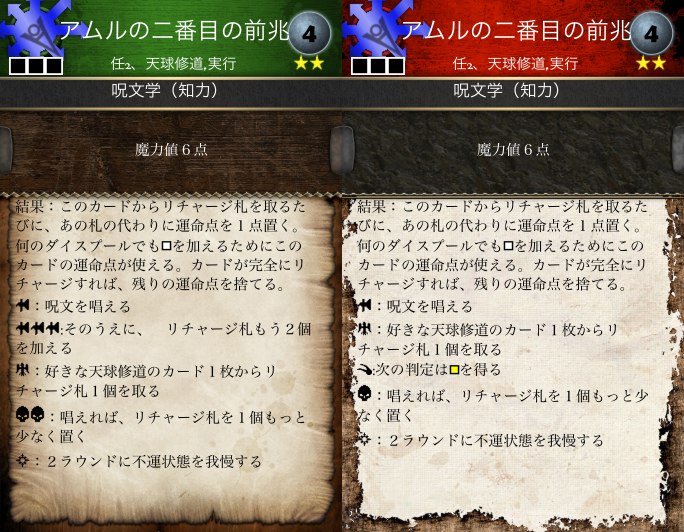
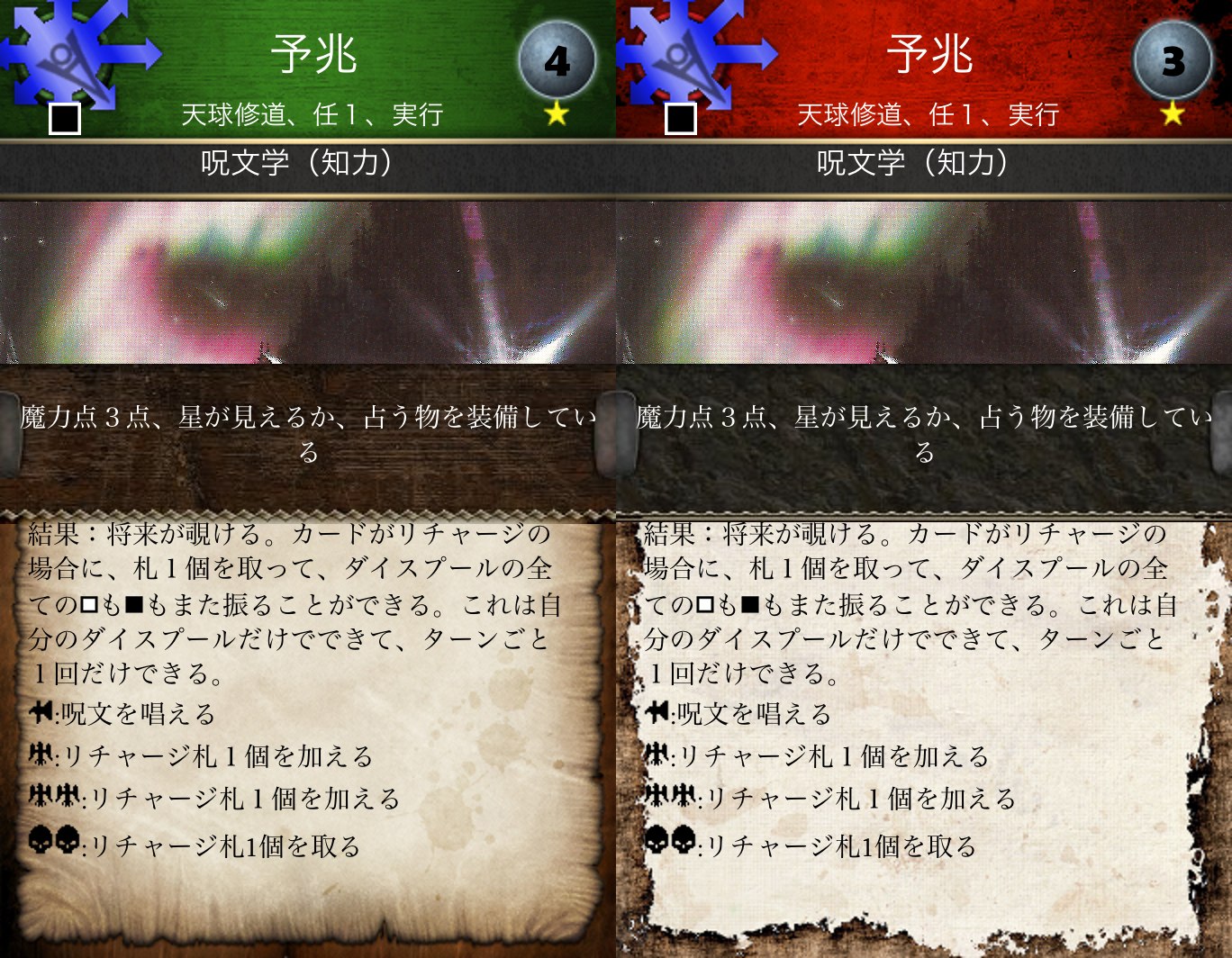
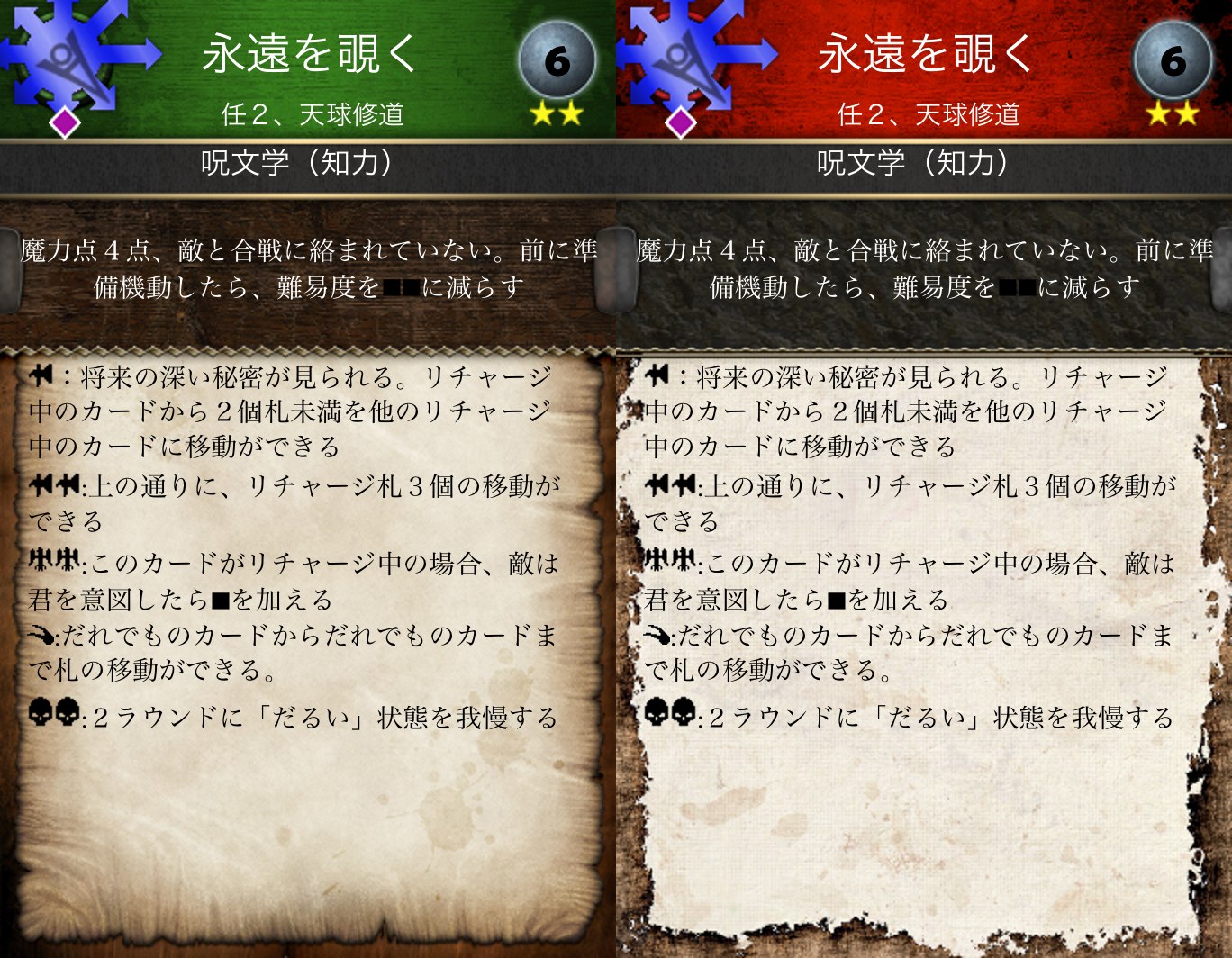
  • はここです:

    魔法使いだったら、将来は不思議じゃない
    チェレンコブエフェクト
    いろな方法で将来に覗ける人間です
    視界が無限、力が永遠
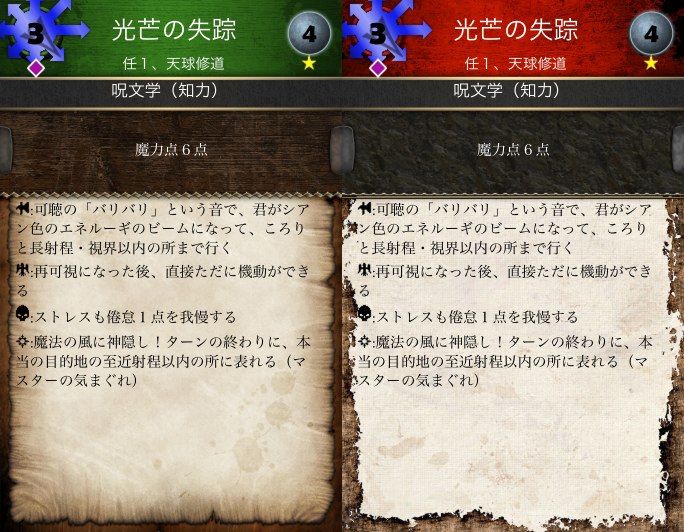
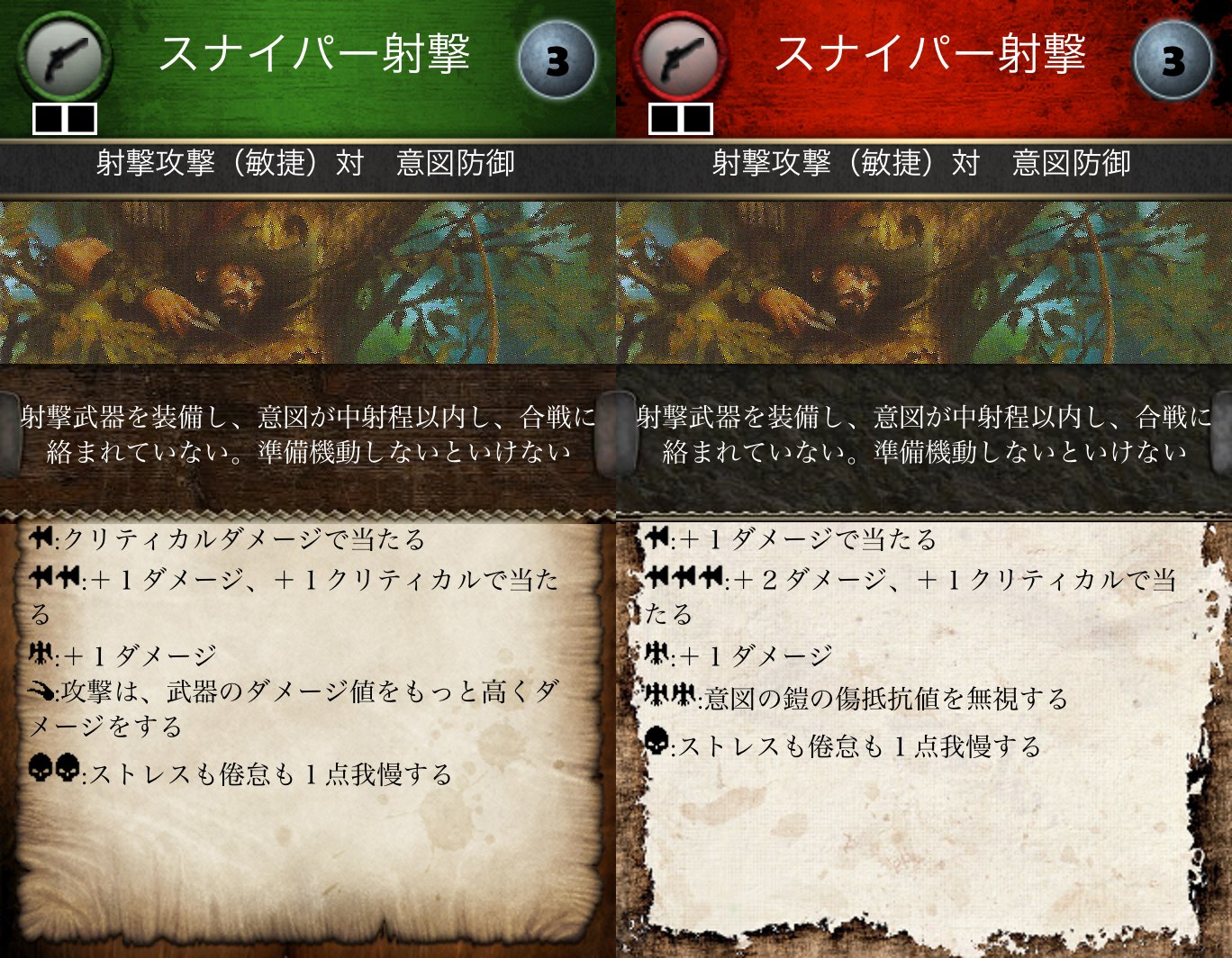
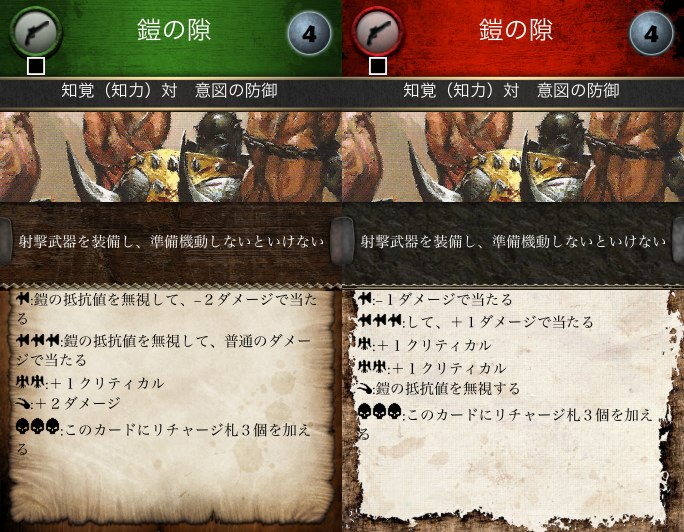
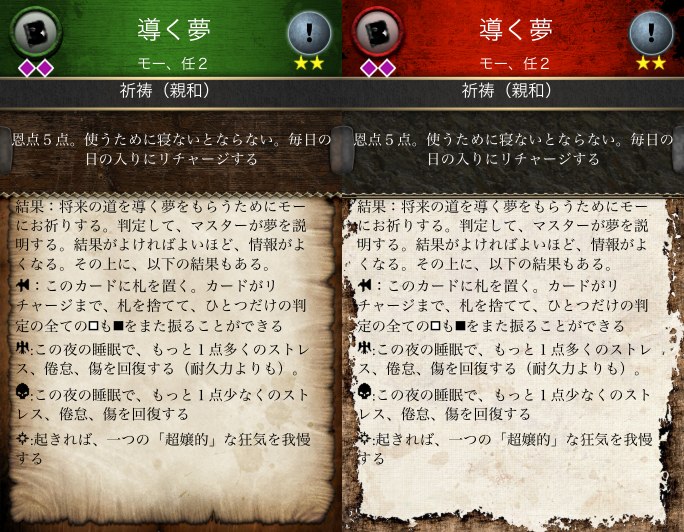
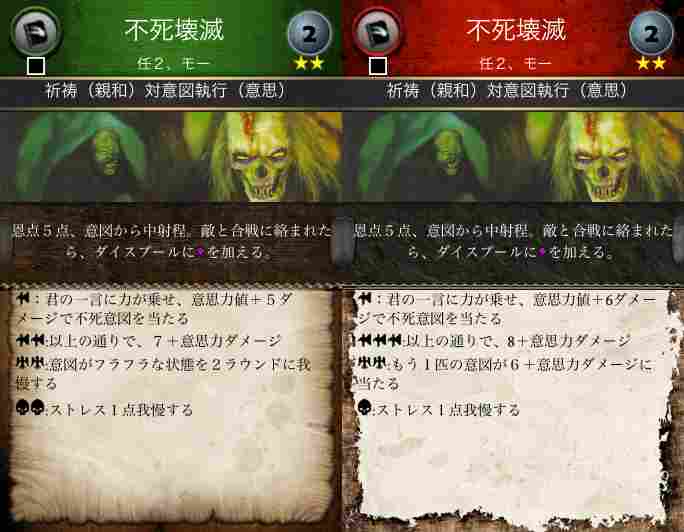
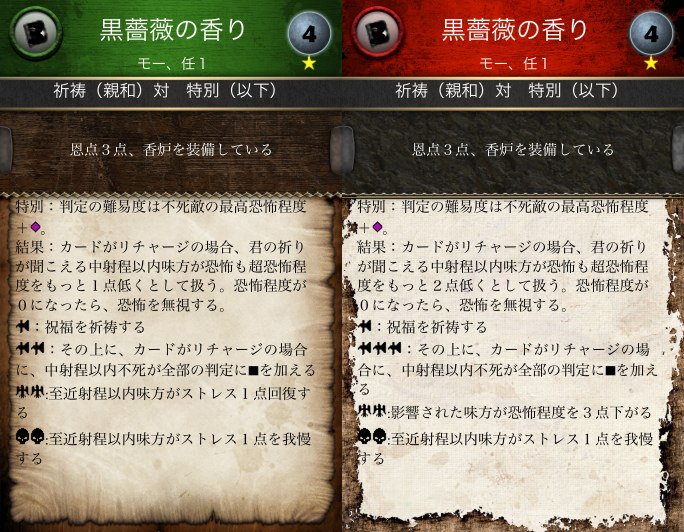
  • 新しい翻訳したカードは以下です。

    秘密が危ない
    どうぞ!お好きなところを貫通してくださいませんか?
    アルソンは悪戯の先生です。。。
    鎧は頭のいいシーフさんを断らない
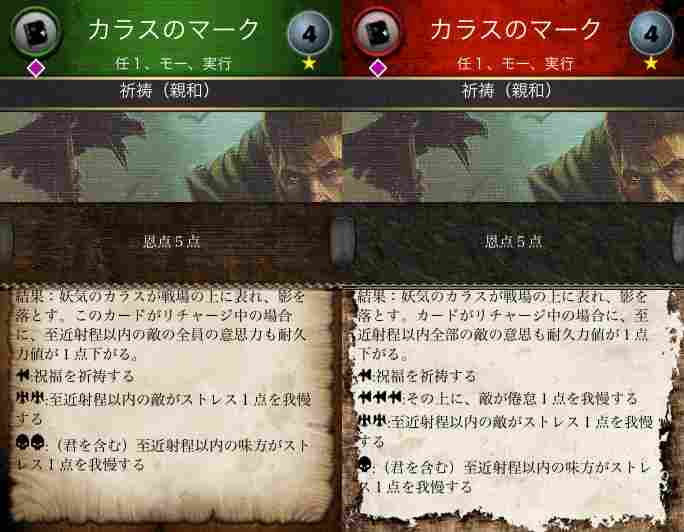
  • カラスの顔が怖い
    シュゼットは普通の夢を見るのが嫌い?
    一緒に不死壊滅を楽しみましょう!
    やっぱり、若子は花が大好きですよね
  • The easiest first pass at simplifying WFRP3 is to make a stripped-down system for a high fantasy campaign, which means less classes, less actions, longer periods between level progression and more flexible magic systems. It also means using some ideas from D&D to simplify the action system and thus the character sheet, which is the main element of the original WFRP3 system that adds complexity. The basic goals are:

    • Ditch Action cards
    • Retain the attribute/challenge/skill/fortune/misfortune dice system
    • Ditch stances
    • Ditch resource management outside of magic
    • Retain Talents
    • Transform the career system into a type of multi-classing

    The system then basically becomes like D&D with a revised dice-rolling and skill system. The basic mechanic is the same, but character classes start with a small number of special abilities and a set of feats that they can use to enhance existing actions. They get more of both as they gain levels.

    Revised Action System

    All character classes start with a few special abilities that are written just like action cards. However, we have removed the stance system so all actions now only have one “face,” and we further revise all actions so that they are described in terms of the same set of outcomes:

    • 1 success: the basic outcome
    • 3 successes: the superior outcome
    • 2 boons: a lucky side effect
    • 2 banes: the downside
    • Sigmar’s comet: the crit
    • Chaos star: the fumble

    These can be written in 6 columns on a character sheet. The player can then spend feats to enhance any basic action, in an upgrade series that follows the path: increase bane line cost (to 3 banes); reduce boon line cost (to 1 boon); reduce extreme success difficulty (to 2 successes); double chaos star difficulty (to 2 chaos stars). These changes can be noted with a cross or a mark on the character sheet for the corresponding column. This makes actions easy to refer to.

    Additional feats will be available which enhance particular lines of these actions (akin to the advanced parry action card, which basically replaces one line of the basic card).

    Spells can be restructured to follow this idea too, though they could also retain their unique properties.

    There are a basic set of 8 actions available to all PCs that are written on the character sheet: basic melee, basic missile, dodge, block, parry, guarded position, assess the situation, perform a stunt. The player then writes their additional character class special abilities on the sheet.

    All other actions are resolved on the fly based on GM decisions. In combat, the perform a stunt action can be used to enhance attacks and defenses, i.e. to generate special action options depending on the situation. As PCs gain levels they gain access to more powerful actions that they can write on their character sheet in the same way as the basic ones above.

    To further make combat favour fighters, we introduce a proficiency system for armours so that only fighters gain easy access to armour better than leather. 

    Stance Dice

    Stance dice are now a GM tool, added in to skill actions to represent the effect of certain decisions, spells and abilities. A party that sets up a careful ambush plan from a solid defensive position gains conservative dice, while a party that decides to just haul arse through the door and start smashing shit gets reckless dice.  The delay symbol on conservative dice only affects initiative order, since resource management has been ditched. The GM could use level as a guideline for the use of these dice – PCs can’t transform more dice than their level, though this could be enhanced with a feat. Alternatively the GM could choose how many dice get transformed depending on the excellence/recklessness of the plan.

    The main methods I see, however, for using these dice are through the bard and barbarian characters, and magic:

    • Bards can use songs to grant the party conservative or reckless dice during combat
    • Barbarian rage obviously provides reckless dice
    • Clerical magic can grant conservative (prayer) or reckless (divine favour) dice

    Also these dice can be a useful tool for GMs to affect the behaviour of NPCs – crazy reckless monsters can use reckless dice, for example.

    Character Classes

    Character classes are the classic set: barbarian, bard, cleric, fighter, mage, ranger, thief. Each class starts out with a few special abilities, key attributes, and key skills they can specialize in. They have a progression path that grants them additional special abilities, some minor and some major. PCs can move between careers just as in warhammer, i.e. they can multi-class over time. A few examples are given below.

    Barbarian

    Key attributes: Toughness, Willpower

    Skills: athletics, weapon skill, ballistic skill, discipline, resilience

    Career Talent: Perhaps equivalent to the dwarven trollslayer’s

    Special abilities:

    • Barbarian Rage: success gives ability to convert dice to reckless; luck adds a free maneuver; critical success is the invigorated condition
    • Fighting stance: Upgrade the block action to improve its effect
    • Toughness: +2 wound threshold

    At higher levels, the Barbarian gets access to the Shrug it Off action, and the devastating strike action.

    Fighter

    Key attributes: Strength and Toughness

    Key Skills: Weapon Skill, Ballistic Skill, Resilience, Leadership, Intimidation

    Career Talent: The Soldier’s talent (recovers fatigue at the end of every round)

    Special Abilities:

    • +2 feats at first level
    • Proficient in all armours
    • Fighting stance: Choose block or parry and upgrade its effect

    At later levels the fighter gets additional attack action cards (disarm, etc.) and can increase the number of people against which he/she can defend in a round.

    Rogue

    Key Attributes: Agility and Intelligence

    Key Skills: Devices (Advanced), Athletics, Stealth, Skullduggery, Guile

    Career Talent: The thief talent, of course

    Special Abilities:

    • Disable trap action
    • Starts with Devices advanced skill acquired for free
    • Backstab: special attack action, conditional on being hidden from target, gives extra attack damage and critical chances

    At later levels, the thief can learn to make traps and improve the backstab action/extend it to sniper actions.

    A note on defense actions

    In order to make this system simpler in combat, I would say that a player can attack once and defend once in a round, unless they forego their attack, in which case they can use all available defensive actions. This makes swarm attacks by weak creatures nastier.

    Classless systems

    Alternatively we could wrap the special abilities into a classless point-buy system, which would make characters more flexible but require judgments about how good each abilities was (for the point buy system).

    Some comments

    I think a simpler alternative to this would be to introduce the fortune dice system into D&D. But this gives us some ideas about how to reduce the complexity of Warhammer, and match it to high fantasy. I’m not yet convinced that the resource management in Warhammer is so fiddly that it needs to be ditched at all, but if so this seems as good a method as any. It actually seems to represent a weakening of the PCs, since it removes a lot of their actions; but by getting rid of resource management it makes the actions they do have access to more readily usable. An option to make the game more diverse is to give all PCs action to an additional action from amongst the existing action cards (suitably modified) at first level, and allow feats to be used to buy more (at some suitable cost). But I don’t know if this would be necessary if we were moving to a game environment (high fantasy) where players are used to only ever having access to two types of actions (spells and basic attack) and the remainder handled freely in skill checks.

    The result would just be simpler game mechanics, I think. But it would depend a lot on the GM’s ability to interpret dice rolls outside of the action card results, so is not a game for novices. But then, I don’t think the existing Warhammer 3 is a game for novices either…

  • From my favourite Japanese magazine, Tokyo Graffiti, comes this delightful but slightly strange web campaign. The magazine have teamed up with the Chiyoda shoe company, and every day they have arranged for a cute girl to stand in front of a camera, express her preferred weather for tomorrow and the reason why, and then kick off one shoe. If the shoe lands upright, the prediction is sunshine; on its side, clouds; and upside down, rain. The girl then hops up to the camera and gives the prediction. The site gives the prediction accuracy to date. It’s going to be running for a year and you can download a google gadget to add to your igoogle so you never miss a smiling weather girl.

    Strange? Definitely. Cute? Certainly. Pointless? You be the judge…