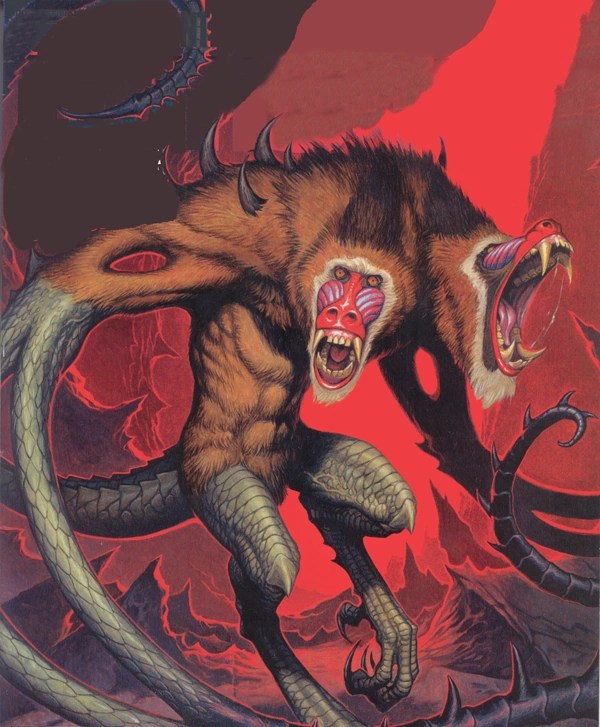
This post contains a huge spoiler for season 5 of Stranger Things, so here is a picture of an actual real life Demogorgon to fill up the screen, for those of you who haven’t seen this season yet.
So, it turns out (as I guessed in the middle of Season 4) that Will Byers is gay, which is a bit of an unfortunate writing decision since he is also, coincidentally, the only one of the original group of dudes who was taken prisoner and possessed by an actual demon from a place that we are now calling the Abyss, dropping small[1] metaphorical hints that being gay is a facet of demonic possession. Which, to be fair, is a very 1987 Indiana view of homosexuality! And, since Will is not a weak-willed person despite what the demon that possessed him says, Will decides to do something insanely brave and come out to his mother and all of his friends and associates in a single public declaration[2].
Will’s coming out speech is long and kind of tedious but also in a way cutely teenage, since he finishes it slightly ambiguously by implying that he might be a misogynist, and has to clarify his coming out statement, but during the speech he reveals that Vecna showed him a terrifying vision of his future, in which he and his friends drift apart because they don’t really accept him, and he needs to move to the big city and becomes kind of detached and alienated from his friends.
This vision is wrong for two reasons. First, it’s wrong because it’s not a vision that Will can afford to be afraid of. This vision is exactly what is going to happen in his future, and in the denouement of this show, assuming Will survives[3], we are going to see him hopping on a big silver bus to the big city, where he will slowly drift apart from his friends. What else could possibly happen to him? He’s not going to get laid in Hawkins, Indiana is he? And the trials, tribulations and joys of being gay are not only going to be completely different to those of his straight friends but he isn’t going to be able to talk about it when he returns. On summer break while they’re taking a break from gaming is he going to tell his mates about his first sauna experience, where he watched five big dudes fuck a skinny man every way they could? Are his friends going to think he’s the go-to guy for showing their kid pics to? The reality of their lives is going to drag them apart, which is a normal part of growing up anyway, and Vecna’s vision is barely even a vision of gayness. It’s just a normal vision of what happens to every ordinary person from every ordinary country town when they hit 20 and have to make life choices.
The second reason it’s wrong is that if Vecna wanted to scare a young, uncertain, closeted gay boy in 1987, he would show him a different vision entirely. He would show Will being rejected by his own mother, estranged from his friends and moving to the big city not because his future is there but because he needs to escape the stigma, discrimination and violence that follows his sexuality in a small country town in Indiana in 1987. It would show Robin forced to move to California after her girlfriend is outed and loses her job at the hospital for the simple fact of being gay, and the two of them losing touch after Will flees the same stultifying atmosphere to live in New York. It would show him avoiding violence and discrimination, finding acceptance, exploring his sexuality and then being diagnosed with HIV. This would further alienate him from his friends and family, leading to the final part of the vision, where Will dies alone, horribly, in a rundown hospice for single gay men, eaten alive by opportunistic infections because he is too poor to afford AZT, which became available in the year of his coming out. Of course there is a more optimistic future for Will in reality, because new drugs will rapidly become available and affordable, and on Will’s timeline he will likely need them around about 1995, by which time they are much more widely in use and might even be enough to save his life.
The real vision Vecna would show Will in 1987, in a country town in Indiana, would be a glimpse into a much more terrifying future than simply drifting apart from his friends. It’s hard to overstate how nasty western society was to gay men in the 1980s, especially rural America and Australia, and the show does generations of gay men a disservice by failing to express this nastiness properly. Same-sex activity was illegal in Indiana until 1977, 10 years before the episode where Will came out, and every adult in the room with him when he came out had grown up with the legal, cultural and political assurance that being gay was an abominable crime, a sin, a disgusting perversion. Homophobia in the USA in 1987 wasn’t just a sentiment, it was a semi-organized violent movement, where men like Steve Harrington and Jonathan Byers cruised the streets with baseball bats looking for ‘fags’ to beat up for fun. It was a movement that was legally defended, even to the extent of inventing a “gay panic” defense for homophobic attackers who were actually unlucky enough to be dragged before the courts for their crimes – they could just say they were propositioned by their victim and in the disgust and panic that followed they beat him up, a kind of religiously-inspired self defense. There is still today no national ban on this defense, and no legal statute in Indiana that prevents its use. Mike could have beaten Will to death in front of his mother, and stood up in a court of law to claim he panicked when Will said he had a crush on him. Would Vecna have shied from putting that in his vision for Will?
Will’s mother Joyce would probably have watched through a wine-soaked haze in 1982 as Ronald Reagan’s spokesperson made jokes about AIDS on national TV (“The President doesn’t have gay plague”), and would have likely used homophobic slurs as a normal part of life. Local radio stations, churches and newspapers would have repeatedly published articles and reports about how degenerate and evil the gay lifestyle was, and probably during the height of fears of the epidemic, which corresponds with the period the show is set, would have talked about how AIDS was a punishment for sin. By 1987 the tide of evil speech had turned somewhat, with Ronald Reagan making his first speech on the disease in June of that year, just a few months after the registration of AZT as a treatment in adults, but it remained a highly contentious issue and homosexuality more generally remained a topic of scorn and violent reaction. In fact, the 1995 Olympics were held in a state where same sex activity was illegal, and to this day Indiana lacks any state-level legal recourse for people fired on the basis of their sexuality.
It’s just inconceivable that Vecna’s vision for Will, a boy struggling with the realization that his sexuality was not normal and that he was carrying the “sin” that this school, his peers, his politicians and his churches had been vociferously railing against for the past five years, would not have shown this future. It’s just not possible that he would restrict this vision to a gentle depiction of what will definitely actually happen naturally to a gay man with straight friends, and not expand it to cover the full horrors waiting in one of Will’s possible futures.
Unless, of course, the writers know nothing about the history of queer struggle. Which is what is actually going on here. They wrote a coming out scene based on the relatively benign environment of modern 2020s urban America, without any particular awareness of or attention to the history of queer struggle and in particular the desperate nature of the struggle during the first decade of HIV. It’s fine not to know these things, but if you are going to do social commentary in your TV shows you should do it right, and this coming out scene was obviously intended to be a significant moment in the show’s arc, happening as it does just in the calm moments before the beginning of the final confrontation. Taking on the mantle of the gay struggle like this, without proper attention to the depth and severity of that historical battle, is a kind of stolen valor, and I’m disappointed in the producers of this show both for the shallowness of this coming out scene, and for misappropriating the queer struggle in this way. Do it right, or don’t do it at all!
We don’t need our TV shows to embrace every form of struggle. This show has been conspicuously careful in its depiction of mid-80s rural mid-western American life, with very few black people in Indiana and no girls in the D&D group, which is very representative of how things were in that place and time. The decision to have two gay people in a squad of 12 or so characters is a decision to over-represent queer characters, to elevate homosexuality to a topic in the show where race and gender relations were largely ignored. If you want to do this, you should take the issue seriously, and not gloss over it with an unrealistic and vaguely cringey depiction of one of the most important parts of a young gay person’s life, which reduces a period of intense, intensely dangerous struggle to a few petty concerns about friends and family.
Do it right, or don’t do it at all!
fn1: By which I mean, you could probably infer that this is a nuclear-bomb sized hint that being gay is bad. I genuinely don’t think the writers meant to give this impression, and also Robin is gay, and she hasn’t been face-fucked by any demons (that we know of – but she went to high school in America, so who’s to say?), but it’s a pretty well-established element of religious conservatism that lesbianism is not viewed as the same kind of evil as male homosexuality, so the distinction still squares with a very, very born-again Christian perspective on homosexuality and sin
fn2: For discussion of what some queer people think of this scene, see this Reddit thread, which makes the point that he came out in front of Murray Bauman (a weird middle-aged conspiracy theorist), Mr. Clarke (a middle-aged high school teacher) and Kali, some chick they just met who is obviously dodgy and is simultaneously trying to talk Eleven into a suicide pact, and who has obviously lied about what was being done to her in the army base. Was Hopper there too? These are dangerous people to reveal your deviant sexuality to in the 1980s! That Reddit thread also makes the point that he outs Robin without her permission, and makes clear to everyone that he had a crush on someone who was in the room with them. It cannot be stressed how dangerous this is to do, even now, but in 1987??! It’s also a really cruel twist on a gay character – who remain quite rare in mainstream TV and cinema – to have him out himself to his friends and colleagues only because he is being threatened with outing by a powerful, evil force. This is the worst, most disempowering and abusive way to do this thing that should be a special, personal and extremely cautious act!
fn3: Mainstream TV and cinema have a very, very bad record of killing off gay and lesbian characters and fat women. They didn’t spare the fat chick in season 1, and I fully expected they’re going to whack Robin before this season ends. Will should be keeping an eye over his shoulder too.

 Compromise and Conceit
Leave a comment